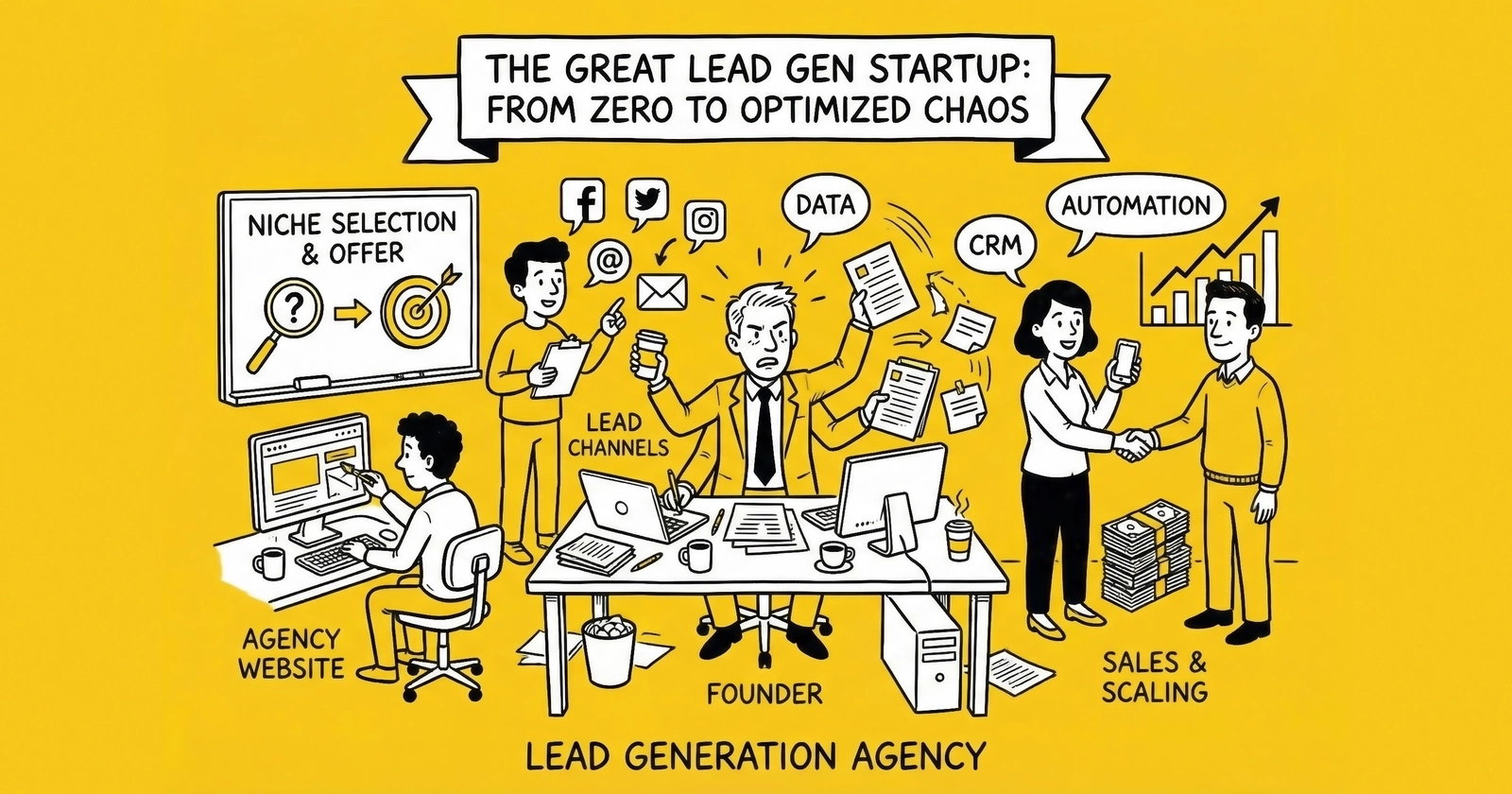
The realistic roadmap from zero to profitable agency – including the capital requirements, timeline, and failure patterns that most guides conveniently omit.
Introduction: What Starting a Lead Gen Agency Actually Requires
You want to start a lead generation agency. The internet tells you it’s a path to six figures in six months with minimal investment. The reality is different.
A lead generation agency is a legitimate business that connects consumer intent with companies ready to pay for that intent through the ping-post system that powers most of the industry. The industry processes billions of dollars annually across insurance, mortgage, solar, legal, and dozens of other verticals. Real operators build real wealth. But they do it over years, not months, with significant capital, and through operational discipline that most newcomers underestimate.
This guide covers what you actually need to launch and grow a lead generation agency in 2026. The numbers are realistic. The timelines are honest. The failure patterns are documented from operators who learned expensive lessons.
If you finish this guide and decide the agency path isn’t for you, that’s a good outcome. Better to know now than after investing $100,000 and two years of your life. If you finish this guide and still want to proceed, you’ll have a blueprint that accounts for how this business actually works.
Agency vs. Solo Operator: Which Path?
Question: Should I Start as a Solo Operator or Build an Agency From Day One?
The distinction matters more than most newcomers realize. Each path has different capital requirements, timelines, and risk profiles.
Solo Operator Model
You generate leads yourself. You run traffic campaigns, build landing pages, manage buyer relationships, and handle operations personally. Your income depends on the margin between your traffic costs and lead sale prices.
The solo path requires $25,000-$75,000 in capital and typically reaches profitability within 6-12 months. Your income ceiling lands between $150,000-$400,000 annually, capped by your personal capacity. The primary risk is straightforward: your income stops when you stop working.
Agency Model
You build a team that generates leads at scale. You hire media buyers, designers, account managers, and eventually leadership. Your income depends on the collective output of your team minus their costs.
The agency path requires $50,000-$250,000+ to launch properly and typically takes 12-24 months to reach profitability. However, the income ceiling scales with your team – $1M+ annually becomes achievable. The primary risk is equally clear: payroll continues whether or not campaigns perform.
The Hybrid Path Most Successful Agencies Follow
Most successful agency founders don’t start with an agency. They start as solo operators, prove the model, then hire incrementally as volume justifies headcount.
The sequence typically unfolds over two years. During months 1-6, you operate solo, learning every aspect of the business firsthand. Months 6-12 bring your first hire – usually a virtual assistant or junior media buyer to handle routine tasks. By months 12-18, you add specialized roles: a dedicated media buyer, account manager, or designer based on your specific bottleneck. Finally, months 18-24 see true team structure emerge, with multiple team members, documented processes, and you stepping back from daily execution.
This path reduces risk. You don’t carry payroll until revenue justifies it. You understand every role before you hire for it. You build systems based on actual operations rather than theoretical assumptions.
Capital Requirements: The Real Numbers
Question: How Much Money Do I Need to Start a Lead Generation Agency?
The answer depends on your starting point and target model. Here are realistic ranges based on operator experience.
Minimum Viable Capital: $50,000-$100,000
This range assumes you’re operating lean, starting as a hybrid solo-to-agency model, and willing to do most work yourself initially.
Breakdown:
| Category | Amount | Purpose |
|---|---|---|
| Traffic Testing | $15,000-$25,000 | 3-4 months of campaign testing at $150-$200/day |
| Technology Stack | $5,000-$10,000 | Platforms, tools, integrations (first year) |
| Legal and Compliance | $5,000-$8,000 | Entity formation, contracts, compliance setup |
| Working Capital Float | $15,000-$30,000 | Covering the gap between spending and collecting |
| Operating Reserve | $10,000-$20,000 | Buffer for unexpected costs and opportunities |
| First Hire Budget | $0-$10,000 | Contractor or part-time support (optional initially) |
At this level, you’re constrained. You can test one or two verticals but not three. You can work with mid-market buyers but not enterprise accounts that demand 60-90 day payment terms. You’ll spend 60+ hours per week on execution.
Recommended Capital: $250,000+
This range allows you to build a proper agency from the outset, test multiple approaches in parallel, weather setbacks, and hire strategically.
Breakdown:
| Category | Amount | Purpose |
|---|---|---|
| Traffic and Campaigns | $75,000-$100,000 | Meaningful testing across channels and verticals |
| Technology Infrastructure | $15,000-$25,000 | Enterprise-grade platforms, custom development |
| Legal and Compliance | $15,000-$20,000 | Comprehensive compliance framework, contract review |
| Working Capital Float | $75,000-$100,000 | Supports enterprise buyer relationships |
| Team (First Year) | $100,000-$150,000 | 2-3 full-time team members |
| Operating Reserve | $50,000+ | 6+ months of runway |
At this level, you can afford to learn. You can test three verticals and focus on the winner. You can hire specialists rather than doing everything yourself poorly. You can survive a bad quarter without existential crisis.
What the Money Actually Goes Toward
Traffic Spend: The largest variable cost. Google Ads CPCs average $4.66 across industries but exceed $15 in competitive verticals like insurance and legal. Facebook runs cheaper at $0.70-$3.00 CPC but conversion rates vary. Plan to spend $5,000-$10,000 per month per vertical during testing phases.
Technology: Lead distribution platforms ($300-$1,000/month), CRM systems ($50-$300/month), consent documentation ($0.15-$0.50 per lead), validation services ($0.05-$0.25 per lead), landing page builders ($100-$300/month), analytics and tracking ($100-$500/month). Technology costs scale with volume but establish minimums regardless of scale.
Compliance: TrustedForm and Jornaya integration, legal review of consent language, litigator scrubbing services, DNC management. Budget $5,000-$10,000 in setup costs plus $0.20-$0.75 per lead in ongoing compliance costs. Understanding TCPA compliance fundamentals before launch is essential.
Float: The silent capital killer. If suppliers require NET 15 payment and buyers pay NET 45, you need to fund 30 days of operations from capital. At $50,000/month in lead purchases, that’s $50,000 in float capital – before you collect a single dollar.
Legal Structure and Entity Formation
Choosing Your Entity Type
For most lead generation agencies, a Limited Liability Company (LLC) provides the optimal balance of liability protection, tax flexibility, and administrative simplicity.
The LLC structure offers four key advantages. It provides personal asset protection from business liabilities while maintaining pass-through taxation that avoids corporate double taxation. It offers flexibility to add partners or investors later and carries a lower administrative burden than corporations.
State Selection Considerations
Your home state is the simplest choice if you’re operating from one location – it avoids foreign qualification fees and registered agent costs. Delaware makes sense if you anticipate investors or complex ownership structures, thanks to its strong business law precedents and privacy protections. Wyoming appeals to operators in high-tax states who can justify the nexus, offering no state income tax, strong privacy, and low annual fees.
Formation costs run $100-$500 for state filing fees plus $200-$1,000 for formation service if you don’t handle it yourself.
Essential Legal Infrastructure
Even for single-member LLCs, your operating agreement should document the management structure, profit distributions, and dissolution procedures.
Buyer contracts define the foundation of your revenue relationships. They must specify lead specifications, delivery methods, pricing, return policies, and payment terms. Have an attorney draft a template you can adapt for each relationship.
If you’re purchasing leads, supplier contracts must include representations about consent capture, data accuracy, and compliance with applicable laws. Any consumer-facing websites require a privacy policy and terms of service that accurately describe data collection, usage, and sharing practices.
Insurance Coverage
Your insurance portfolio needs three components. General liability should provide $1M-$2M coverage for basic business protection. Errors and omissions (E&O) coverage is critical for TCPA exposure – this is where lawsuits land. Cyber liability covers data breach costs, which matter when you’re handling consumer information at scale. Budget $3,000-$10,000 annually depending on coverage limits.
Choosing Your Vertical Focus
Question: Which Industry Should My Lead Generation Agency Focus On?
Vertical selection is one of the most consequential early decisions. Each vertical has different economics, compliance requirements, and competitive dynamics.
High-Volume Verticals
Insurance (Auto, Home, Health, Life)
The insurance vertical represents billions in annual lead transaction value, making it the largest lead generation market. CPLs range from $15-$75 depending on line and state. Competition is intense – MediaAlpha, EverQuote, and QuinStreet dominate the space. Compliance requirements run moderate to heavy depending on the line. This vertical works best for operators with strong traffic optimization expertise.
Solar
Solar lead generation is growing rapidly with policy incentives driving demand. CPLs range widely from $25-$150 depending on geography. Competition remains moderate because geographic fragmentation creates opportunities for regional players. Compliance requirements are light to moderate. Practitioners who understand geographic arbitrage – buying traffic cheaply in high-value installation markets – thrive here.
Home Services (HVAC, Roofing, Plumbing)
Home services represents a large market fragmented across thousands of local operators. CPLs run $20-$75 depending on service type. Competition is moderate, with many local players but fewer national aggregators. Compliance is light. This vertical rewards operators with strong local buyer relationships who can aggregate demand across multiple contractors.
High-Value Verticals
Legal (Personal Injury, Mass Tort)
Legal leads command premium pricing – $200-$500+ for quality cases. Competition is intense at the top tier but fragmented below. Compliance requirements are heavy, with state bar advertising rules adding complexity. Success requires legal industry relationships to access quality buyers.
Mortgage and Refinance
Mortgage CPLs are highly variable with interest rates, ranging from $25-$150 depending on market conditions. Competition is cyclical, intensifying when rates favor refinancing. Compliance is heavy – RESPA, TILA, and state licensing requirements all apply. Practitioners who understand financial services cycles can time their market entry effectively.
Vertical Selection Framework
Evaluate potential verticals across five dimensions. First, consider buyer accessibility – can you reach decision-makers? Insurance carriers have procurement departments with gatekeepers, while local contractors answer their own phones. Second, analyze traffic economics: what are realistic CPCs and conversion rates? Some verticals are structurally unprofitable for new entrants regardless of skill. Third, assess the compliance burden – does the vertical require licenses, specialized legal review, or industry-specific regulations that add time and cost? Fourth, evaluate competitive positioning: is there differentiation opportunity or are you competing purely on price? Finally, be honest about your personal expertise – do you understand the buyer’s business well enough to create leads they’ll actually value?
Start with one vertical. Master it before expanding. Those who try to enter three verticals simultaneously usually fail at all three.
Building Your Service Offering
Question: What Services Should a Lead Generation Agency Offer?
Lead generation agencies typically offer some combination of core services and value-added enhancements.
Core Lead Generation Services
Exclusive leads are sold to a single buyer, commanding higher prices ($50-$150+) but requiring quality buyers willing to pay the premium. Shared leads go to multiple buyers (typically 3-5), generating lower individual prices ($15-$40) but higher total revenue per lead – though this model requires transparent disclosure to all buyers about the sharing arrangement.
Live transfers connect interested consumers directly to sales agents in real-time. This premium service ($75-$200+) demands call center infrastructure but delivers the highest conversion rates for buyers. Appointment setting takes this further, delivering qualified leads with scheduled appointments. It offers the highest value but requires robust outbound calling capability.
Value-Added Services
Beyond core lead delivery, agencies can offer lead nurturing through email and SMS sequences that warm leads before delivery or re-engage aged inventory. Data enhancement appends additional data points – income, property value, credit indicators – to improve lead quality and justify higher prices. Compliance documentation provides consent certificates, call recordings, and audit trails beyond standard requirements, which increasingly matters to enterprise buyers managing regulatory exposure.
Service Packaging by Agency Stage
Your service mix should evolve with your capabilities. In year one, focus on exclusive or shared leads in a single vertical, building operational competence before adding complexity. Year two is the time to add value-added services based on buyer requests and consider live transfers if volume justifies the infrastructure investment. By year three and beyond, you can expand verticals, develop proprietary technology, or move toward platform models that aggregate third-party supply.
Technology Stack Requirements
Essential Platforms
Your lead distribution system forms the operational core – software that routes leads to appropriate buyers based on criteria, manages delivery, and tracks performance. Options include boberdoo, LeadsPedia, LeadExec, and LeadsHook, with budgets running $300-$1,500/month depending on volume and features.
A CRM tracks buyer relationships, manages communications, and documents interactions. HubSpot, Pipedrive, or Salesforce serve different complexity levels, costing $50-$300/month. Your landing page builder lets you create and test lead capture pages without development resources – Unbounce, Leadpages, or Instapage at $100-$300/month.
Consent documentation through TrustedForm ($0.15-$0.50/lead) and/or Jornaya LeadiD provides independent verification that increasingly sophisticated buyers require. For analytics, Google Analytics 4 handles traffic analysis, but server-side tracking improves accuracy. Consider tools like Triple Whale, Hyros, or Wicked Reports for multi-touch attribution, budgeting $100-$500/month.
Validation services protect your quality reputation. Phone verification (Telesign, Twilio Lookup), email verification (ZeroBounce, NeverBounce), and address standardization run $0.05-$0.25/lead but prevent returns that destroy margins.
Technology Stack by Agency Size
At the solo/startup stage ($500-$1,000/month), you need a landing page builder, basic CRM, Google Analytics, consent documentation, and manual or semi-automated lead delivery. This minimal stack lets you prove the model before investing in infrastructure.
A growing agency ($1,500-$3,000/month) upgrades to a full lead distribution platform, integrated CRM, advanced analytics with attribution, multiple validation services, and automated workflows. This stack eliminates manual bottlenecks that limit scale.
Established agencies ($5,000+/month) operate on enterprise distribution platforms or custom development, Salesforce or HubSpot Enterprise, business intelligence dashboards, and custom integrations across all systems. At this level, your technology becomes a competitive advantage rather than just infrastructure.
Hiring Your First Team Members
Question: When Should I Hire, and Who Should I Hire First?
Hire when one of these conditions is true: you’re personally maxed out and turning down profitable opportunities, a specific role is clearly limiting growth, or you can fund the role for 6 months without revenue from that role. Missing any of these signals usually means you’re hiring ahead of need.
Hiring Sequence for Most Agencies
Your first hire should be a virtual assistant or junior operations person ($15-$25/hour) who handles lead data management and cleanup, basic buyer communication, and reporting and administrative tasks. This role frees your time for high-value activities without significant financial commitment.
The second hire – a media buyer or traffic manager ($50,000-$80,000/year) – is the one that enables volume growth. They handle campaign management and optimization, creative testing, and scaling winners. This is typically the inflection point hire that transforms your capacity.
Third comes an account manager ($45,000-$70,000/year) for buyer relationship management, quality issue resolution, and expansion within existing accounts. This hire frees you for new buyer development rather than managing current relationships.
The fourth hire, a designer or creative specialist ($50,000-$75,000/year), handles landing page design and testing, ad creative development, and conversion rate optimization. By this point, your creative production is limiting scale.
Team Structure by Revenue Tier
At $0-$500K annual revenue, you’re the founder doing all roles with zero to one contractors supporting. This is the proving-ground phase where you learn every aspect of the business.
At $500K-$1M annual revenue, you shift to strategy, sales, and oversight while one media buyer handles campaigns and one operations/account management person keeps things running. Contractors fill design and development gaps.
At $1M-$3M annual revenue, you focus on strategy and major accounts while 2-3 media buyers, 1-2 account managers, and an operations manager handle execution. Design and development move in-house or to a dedicated agency relationship.
Above $3M annual revenue, you build an executive team with department heads for media, accounts, and operations, each managing specialized roles within their domains.
Finding Your First Clients
Question: How Do I Get Buyers for My Leads?
Buyer acquisition is the constraint that kills most new agencies. You can optimize campaigns, build beautiful landing pages, and generate leads – but without buyers, you have no revenue.
Direct Outreach Strategy
Build a target list of 100+ potential buyers in your vertical. Research each company before contact. Understand their business model, ideal customer profile, and likely acquisition challenges.
Email Template That Works:
Subject: Lead volume for [City/State] [vertical]
I’m launching a lead generation operation focused on [vertical] leads in [geography]. Before building volume, I’m reaching out to understand what quality and specifications would be valuable to your business.
Would you have 15 minutes to share what you’re looking for in a lead supplier? I’m not selling anything today – I’m gathering input to build something worth buying.
Expect: 10-20% response rate. 5-10 substantive conversations from 50 outreaches.
Industry Event Strategy
Lead generation and performance marketing conferences create concentrated access to buyers. LeadsCon runs in March and September, Affiliate Summit in January and July, InsureTech Connect serves vertical-specific networking, and Digital Summit offers regional events across the country. These conferences compress months of relationship-building into days. Budget $2,000-$5,000 per event including travel.
Network and Marketplace Strategy
Lead aggregators and networks like Leads360 (now Velocify), CAKE, and vertical-specific platforms can provide buyer access while you build direct relationships. They take margin but reduce buyer acquisition cost.
LinkedIn deserves active investment – participation in lead generation groups and direct outreach to buyer-side professionals generates steady pipeline. And never underestimate referrals: every buyer knows other buyers. Satisfied clients are your best source of introductions to their peers.
Landing Your First Three Buyers
Before spending on traffic, secure at least three committed buyers. Three buyers give you volume absorption (somewhere for leads to go), diversification (no single buyer represents 100% of revenue), and market validation (three independent buyers willing to pay confirms your vertical has demand).
Negotiate simple terms initially: price per lead, lead specifications, delivery method, return policy, payment terms. Document everything in writing.
Pricing Your Services
Question: How Should I Price My Leads – Retainer or Performance?
The pricing model you choose shapes your entire business. Each model has different risk profiles, cash flow characteristics, and client relationships.
Performance-Based Pricing (Cost Per Lead)
You charge a fixed price per qualified lead delivered. This model aligns your incentives with client results, scales directly with output (more leads equals more revenue), and is easier to sell to new clients who prefer risk on your side.
The disadvantages are real, though. You absorb all traffic performance risk, your revenue is volatile with campaign performance, and planning becomes harder with variable income.
Typical CPL Ranges by Vertical:
| Vertical | Low | Mid | High |
|---|---|---|---|
| Insurance (Auto) | $15 | $35 | $65 |
| Insurance (Medicare) | $25 | $45 | $85 |
| Solar | $25 | $50 | $150 |
| Home Services | $20 | $40 | $75 |
| Legal (PI) | $100 | $200 | $500+ |
| Mortgage | $25 | $50 | $150 |
Retainer-Based Pricing
Clients pay a monthly fee for your services. You may still charge per lead, but with guaranteed minimum spending. The advantages make financial planning easier: predictable revenue, better cash flow from advance payment, and clients with skin in the game who invest in making the relationship work.
The disadvantages limit adoption. Retainers are harder to sell because clients prefer performance risk on you. Clients also expect service beyond lead delivery when paying monthly fees, and scope creep becomes a constant battle without careful contracts.
Typical retainer ranges run $3,000-$7,500/month for small accounts, $7,500-$25,000/month for mid-market accounts, and $25,000-$100,000+/month for enterprise relationships.
Hybrid Models
Most mature agencies use hybrid structures that balance predictability with performance alignment. Retainer plus CPL combines a monthly management fee with per-lead costs, ensuring base revenue while scaling with output. Tiered CPL models decrease price at volume thresholds, rewarding buyers for commitment while maintaining your margins at lower volumes. Performance bonuses layer on top of base CPL rates, adding bonuses when leads convert to actual sales – aligning your success with your buyer’s success.
Calculating Your Pricing
Start with your costs: traffic acquisition cost per lead, technology costs per lead, validation and compliance costs per lead, labor allocation per lead, and overhead allocation per lead. These components combine to determine your floor – the price below which you lose money.
Add your target margin based on your model. High-volume commodity leads support 20% margins. Qualified leads with value-added services warrant 30-35% margins. Specialized, high-touch programs can command 40%+ margins.
For example, if traffic costs $45 per lead, technology and validation adds $5, and labor and overhead contribute $10, your total cost is $60. At a 30% margin target, divide by 0.70 to get $86 as your target CPL.
Scaling from Startup to Established Agency
The Growth Phases
Phase 1: Validation (Months 1-6)
Your goal is proving unit economics in one vertical, with a milestone of $10,000-$25,000/month in revenue. Focus on campaign optimization and buyer feedback integration. Everything else is secondary to proving the model works.
Phase 2: Foundation (Months 6-12)
Now the goal shifts to building repeatable processes. Target $25,000-$75,000/month in revenue. Focus on documentation, your first hires, and system automation. This phase separates future agencies from perpetual freelancers.
Phase 3: Expansion (Months 12-24)
Your goal becomes scaling volume and potentially adding verticals. Milestone: $75,000-$200,000/month in revenue. Focus on team building, new buyer acquisition, and operational efficiency. The agency is real now – it runs partially without you.
Phase 4: Optimization (Year 2-3)
The goal is improving margins and building defensibility. Target $200,000-$500,000/month in revenue. Focus on technology differentiation, strategic partnerships, and completing your transition from execution to leadership.
Agency Margins by Stage
During the startup phase, expect 10-20% net margins as high costs relative to revenue, learning curve expenses, and inefficient operations consume profit. The growth phase improves to 20-30% net margins – systems are getting better, but investment in team and technology consumes the gains. Mature agencies achieve 25-40% net margins through optimized operations, established buyer relationships, and technology leverage.
Typical Time to Profitability
Realistic timeline for a well-capitalized, competently executed agency looks like this. Months 1-6 operate at a loss while you test, learn, and build. Months 6-12 approach break-even, with unit economics positive but overhead not yet covered. Months 12-18 reach profitability, covering costs and generating owner income. Months 18-24 enter sustainable growth, with profits reinvested in expansion.
Undercapitalized agencies often fail between months 6-12 – right when the model is starting to work – because they run out of runway before reaching profitability.
Common Agency Failure Patterns
Failure Pattern 1: Scaling Before Understanding Unit Economics
You get early success with a campaign and immediately increase budget. But you haven’t analyzed why those leads worked. When the campaign stops performing, you’ve spent the margin you needed to survive testing.
Prevention: Document unit economics at every scale level. Understand which sources, creatives, and audiences drive profitability before scaling.
Failure Pattern 2: Single Buyer Dependency
Your largest buyer represents 50%+ of revenue. When they reduce volume, change terms, or churn entirely, your business enters crisis.
Prevention: No single buyer should exceed 25% of revenue. Diversify deliberately, even when it’s operationally easier to concentrate.
Failure Pattern 3: Compliance Negligence
You treat TCPA compliance as a checkbox rather than an operational discipline. A lawsuit arrives. Settlement demands exceed your total lifetime revenue. The current TCPA litigation environment makes this risk increasingly likely.
Prevention: Compliance-first culture from day one. Document everything. Use certified consent capture. Scrub for litigators. Budget for legal review.
Failure Pattern 4: Undercapitalization
You launch with $30,000 when you needed $100,000. Six months in, unit economics are positive but you’ve exhausted capital. You can’t fund the float required by your own success.
Prevention: Six months of operating expenses plus 20% buffer minimum. Understand float requirements before launching.
Failure Pattern 5: Hiring Too Fast
Revenue is growing. You hire ahead of the growth curve. Revenue plateaus or dips. Payroll continues. Cash disappears.
Prevention: Hire based on trailing revenue, not projected growth. Contractors before employees. Roles that pay for themselves before roles that are “strategic.”
Failure Pattern 6: Chasing Verticals
You start in insurance, hear solar is hot, pivot to solar, discover legal has better margins, move to legal. You never achieve expertise in any vertical.
Prevention: Commit to one vertical for at least 12 months. Master it before considering expansion.
Frequently Asked Questions
1. How much can I realistically earn with a lead generation agency?
First-year earnings for founders typically range from negative (the learning year) to $50,000-$100,000 if well-executed. Year two to three can reach $150,000-$300,000 for successfully scaled agencies. Mature agencies with $2M+ revenue can generate $400,000-$1M+ in owner income. Your speed to lead response time becomes a key differentiator.
2. Do I need experience in lead generation to start an agency?
Direct experience helps significantly but isn’t mandatory. What you need: digital marketing fundamentals, sales ability to acquire buyers, analytical skills to understand data, and willingness to invest 12-18 months learning before expecting significant returns.
3. What’s the biggest mistake new agency owners make?
Undercapitalization and single buyer dependency tie for first. Most agencies that fail do so because they ran out of money before proving the model, or because their largest buyer churned and they had no diversification.
4. How long before my agency becomes profitable?
Realistic timeline: 12-24 months to consistent profitability. Some operators achieve break-even at 6-8 months. Others take 24+ months. Variables include capital availability, vertical selection, and operational competence.
5. Should I start local or national?
Start with geographic focus that matches your buyer relationships. If your buyers are local (home services contractors), start local. If your buyers are national (insurance carriers), geographic targeting matters less than vertical focus.
6. What technology do I absolutely need to start?
Minimum viable stack: landing page builder ($100/month), CRM ($50/month), consent documentation ($0.25-$0.50/lead), Google Analytics (free), and a method to deliver leads to buyers (email if nothing else). Budget $500-$1,000/month at minimum.
7. How do I find lead buyers?
Direct outreach (50+ targeted contacts in your vertical), industry events (LeadsCon, Affiliate Summit), networks and aggregators, LinkedIn, and referrals from existing relationships. Expect 10-20% response rates on cold outreach.
8. What margins should I target?
Gross margins of 25-40% depending on model. Net margins of 15-25% after all costs. Commodity leads at scale operate on thinner margins (15-20%). Specialized leads with value-added services command higher margins (30-40%).
9. Can I run a lead generation agency part-time?
Possible during the validation phase if you have 15-20 hours weekly to dedicate. However, reaching profitability typically requires full-time focus. Most successful agency founders transition from other employment within 6-12 months of starting.
10. What happens if I get sued for TCPA violations?
TCPA class actions average $6.6 million in settlements. Even smaller operations face six-figure exposure. Prevention is the only viable strategy: certified consent capture, litigator scrubbing, proper disclosure language, and E&O insurance that covers marketing claims.
Key Takeaways
-
Start with realistic capital. Minimum $50,000-$100,000 for lean launch; $250,000+ recommended for proper agency build. Undercapitalization kills more agencies than poor execution.
-
Follow the hybrid path. Start as a solo operator, prove unit economics, then hire incrementally. Don’t carry payroll until revenue justifies it.
-
Choose one vertical and master it. Spreading across multiple verticals dilutes focus and expertise. Commit to one for at least 12 months.
-
Secure buyers before generating leads. Three committed buyers minimum before spending on traffic. No buyers means no business.
-
Budget 12-24 months to profitability. Anyone promising faster results is selling dreams. This is a real business that takes time to build.
-
Never exceed 25% revenue from any single buyer. Concentration risk is the silent killer of lead generation agencies.
-
Compliance is non-negotiable. One TCPA lawsuit can exceed your lifetime revenue. Build compliance infrastructure from day one.
-
Document everything. Unit economics, consent, processes, and learnings. Those who survive are the ones who know their numbers.
The lead generation agency model works. Thousands of operators build profitable businesses connecting consumer intent with companies ready to pay for it. But the operators who succeed are the ones who understand the real requirements – capital, time, expertise, and discipline – rather than the fantasy versions promoted by courses and gurus.
Start with realistic expectations. Build on solid foundations. Give yourself the runway to learn. The opportunity is real for those willing to build it properly.
This guide is part of The Lead Economy series on building and scaling lead generation businesses.