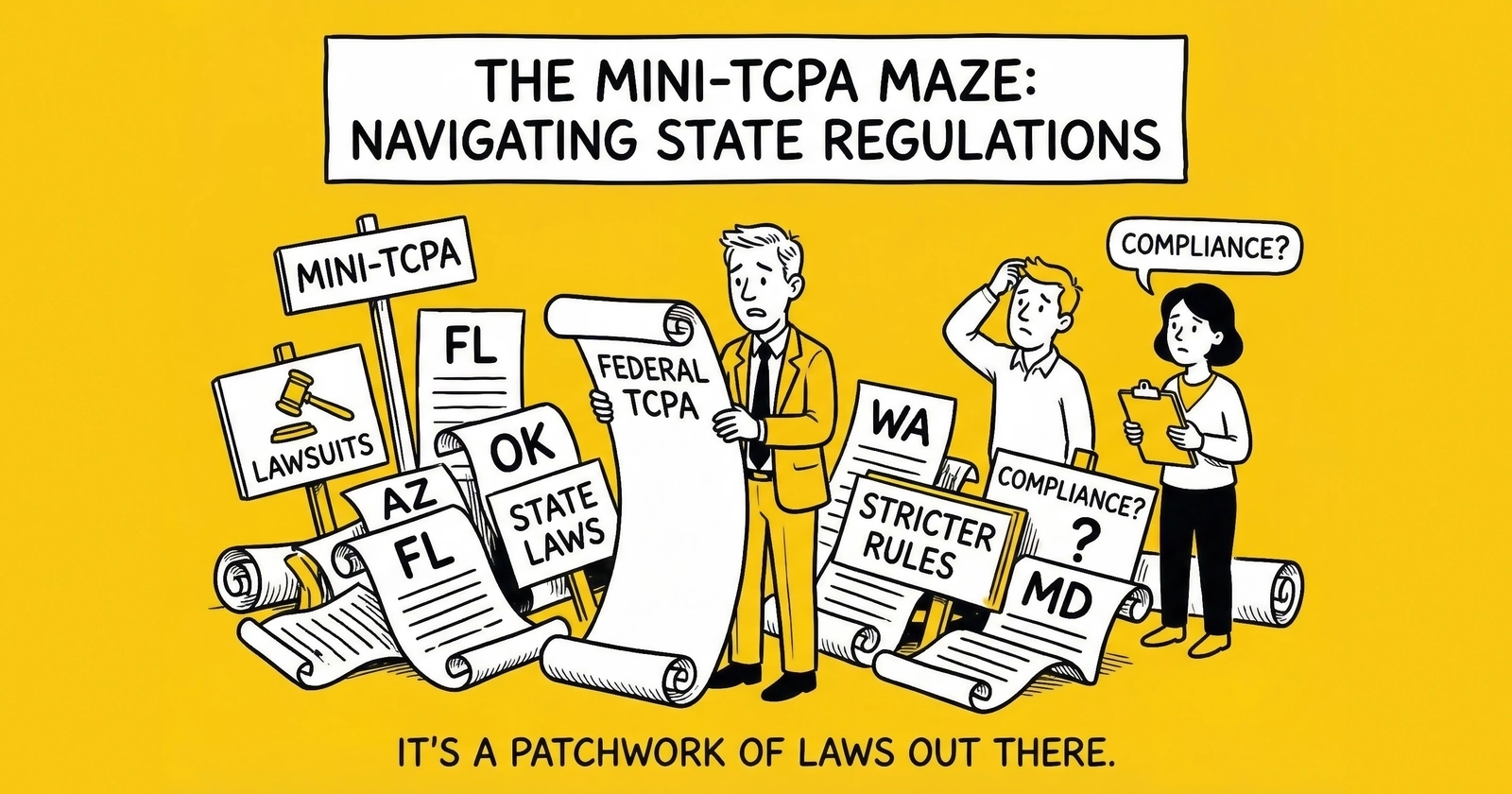
A comprehensive guide to state-level telemarketing laws that exceed federal TCPA requirements, with compliance strategies for lead generators operating across jurisdictions.
Florida generated 330 TCPA-related cases in 2024, representing nearly 12% of all filings nationwide despite comprising only 6.5% of the U.S. population. That disproportionate litigation volume is not an accident. It reflects a fundamental reality that every lead generator must internalize: federal TCPA compliance is the floor, not the ceiling.
The Telephone Consumer Protection Act establishes minimum standards for telemarketing calls and texts. But states have layered their own requirements on top. Often stricter calling hours. Broader autodialer definitions. Enhanced penalties. Private rights of action that create independent liability beyond federal exposure. As of late 2025, at least fifteen states have enacted their own telemarketing statutes, with additional legislation pending in Michigan, Georgia, and other jurisdictions.
For lead generators with national operations, this creates a compliance puzzle with no simple solution. A calling practice that is perfectly compliant under federal law may violate Florida’s Telephone Solicitation Act, Oklahoma’s Telephone Solicitation Act, Maryland’s Stop the Spam Calls Act, or Texas’s newly expanded telemarketing regulations. One non-compliant call to the wrong state can trigger a lawsuit under both federal and state law, effectively doubling your exposure.
The numbers make the stakes clear: average TCPA class action settlements exceed $6.6 million. In September 2025 alone, 224 class actions were filed, a 283% increase over September 2024. The TCPA litigation statistics for 2025 reveal just how aggressive the plaintiff bar has become. With statutory damages of $500 to $1,500 per violation and no cap on aggregate liability, a single calling campaign that crosses state lines without proper compliance can generate eight-figure exposure.
This guide maps the major state mini-TCPA laws, explains how they differ from federal requirements, and provides the compliance strategies that separate operators who thrive from those who face existential litigation.
Why State Laws Matter More Than Ever
The federal TCPA landscape shifted significantly in 2021 when the Supreme Court’s decision in Facebook v. Duguid narrowed the definition of automatic telephone dialing systems. That ruling provided relief for some callers using modern technology that dials from stored lists rather than generating numbers randomly.
But that relief exists only at the federal level.
States Retain Full Authority to Be Stricter
Nothing in the federal TCPA preempts state telemarketing laws. States retain complete authority to regulate telephone solicitations within their borders. This means states can and do:
Use broader ATDS definitions that capture equipment excluded from federal ATDS liability after Duguid. Florida’s Telephone Solicitation Act, for example, may cover systems that dial stored numbers “with one click or touch,” even without random generation.
Impose narrower calling hours than the federal 8 a.m. to 9 p.m. window. Both Florida and Maryland restrict calls to 8 a.m. to 8 p.m., cutting one hour from your evening calling opportunity.
Create state-specific Do Not Call registries that require separate suppression beyond the federal National DNC Registry. Eleven states maintain their own lists.
Establish consent standards that exceed federal requirements. While the FCC’s one-to-one consent rule was vacated in January 2025, states like Florida and Oklahoma effectively require similar specificity through their interpretation of “prior express written consent.”
Authorize enhanced penalties and broader private rights of action. Georgia’s 2024 amendments eliminated damage caps and the “knowing” requirement while adding vicarious liability and permitting class actions.
When a state law is more restrictive than federal law, you must comply with both. The stricter standard controls.
The Litigation Economics
State laws expand plaintiff options in ways that fundamentally affect settlement dynamics. A plaintiff who might struggle to prove federal ATDS liability can assert state-law claims under broader definitions. A single calling campaign that crosses state lines can generate exposure under multiple statutes, each with its own damages framework.
Plaintiff attorneys are sophisticated about these dynamics. When filing in Florida, they add FTSA claims. When filing in Oklahoma, they add OTSA claims. When filing in Texas, they invoke Deceptive Trade Practices Act remedies that include treble damages and attorney’s fees. The result is stacked liability that increases settlement pressure even when federal defenses are strong.
A non-compliant call to a Florida consumer can generate:
- Federal TCPA liability: $500 to $1,500 per violation
- FTSA liability: $500 to $1,500 per violation
- Combined exposure: $1,000 to $3,000 per call
When you multiply that by the thousands of calls in a typical class action, the numbers become existential.
The Operational Compliance Challenge
For operations with national reach, the challenge is fundamentally operational. You cannot simply comply with federal law and assume you are covered. Your systems must:
- Map your calling footprint to identify which states you contact
- Understand the specific requirements of each applicable state law
- Implement technology capable of applying state-specific rules to each call
- Document compliance in ways that satisfy both federal and state requirements
- Monitor ongoing state legislative activity for new requirements
The alternative, hoping you will not get caught, is not a business strategy. It is a countdown to litigation.
Florida Telephone Solicitation Act (FTSA)
Florida is ground zero for state mini-TCPA enforcement. The Florida Telephone Solicitation Act, codified at Florida Statutes sections 501.059 and 501.616, creates one of the most plaintiff-friendly telemarketing liability frameworks in the country.
In March 2025, a single South Florida law firm filed over 100 TCPA lawsuits in one month. All alleged time-of-day violations from text messages sent outside permitted hours. This concentration of litigation reflects Florida’s combination of strict state law, experienced plaintiff counsel, large population, and a court system that has historically been receptive to consumer class actions.
History and Amendments
The FTSA took effect on July 1, 2021, with an explicitly broad autodialer definition that captured equipment excluded from federal ATDS liability after Duguid. The statute created a private right of action with statutory damages mirroring the federal TCPA.
In May 2023, the Florida legislature amended the FTSA in response to industry concerns about excessive litigation. The amendments narrowed the autodialer definition and added procedural requirements for bringing claims. However, the statute remains more restrictive than federal law in several key respects.
FTSA Autodialer Definition
The current FTSA definition of an “automated system for the selection or dialing of telephone numbers” covers equipment that:
- Stores or produces telephone numbers to be called, using a random or sequential number generator, OR
- Dials or texts stored numbers using a human-operated system where a database of stored numbers is called with one click or touch, AND
- Includes technology capable of operating as an autodialer
The critical difference from federal law is the second prong. Equipment that dials stored numbers “with one click or touch” may qualify as an autodialer under FTSA even if it does not generate numbers randomly or sequentially. Many modern CRM-integrated dialers that escape federal ATDS liability could still trigger FTSA liability.
The 2023 amendments added a requirement that the technology be “capable of operating as an autodialer,” which courts have interpreted to require some level of automated functionality beyond simple click-to-dial from a database. This provided modest relief, but the definition remains broader than the post-Duguid federal standard.
FTSA Calling Hours
Federal law prohibits telemarketing calls before 8:00 a.m. or after 9:00 p.m. in the recipient’s local time zone.
The FTSA narrows this window: 8:00 a.m. to 8:00 p.m. local time.
This one-hour difference creates significant operational impact. A call placed at 8:30 p.m. Eastern Time to a Florida consumer is federally compliant but violates the FTSA. For operations making evening calls nationally, Florida requires separate timing rules implemented at the system level.
FTSA Call Frequency Limits
The FTSA limits telephone solicitations to a maximum of three calls per 24-hour period on the same subject matter to the same telephone number. This restriction applies regardless of consent status. Even a consumer who has provided valid consent may not receive more than three calls per day for the same product or service.
For high-velocity sales operations that make multiple contact attempts daily, this creates operational constraints not present under federal law. Your dialing platform must track call frequency at the phone-number level and block excess attempts.
FTSA Penalties and Private Right of Action
The FTSA provides statutory damages of $500 per violation for calls or texts made using an automated system without consent. Willful or knowing violations can result in treble damages of $1,500 per violation, identical to federal TCPA damages.
However, FTSA claims stack with federal TCPA claims. A single non-compliant call to a Florida consumer can generate liability under both statutes, effectively doubling exposure to $1,000 to $3,000 per call.
The private right of action includes class action availability, making Florida a particularly attractive venue for plaintiff counsel.
FTSA Consent Requirements
The FTSA requires prior express written consent for telephone solicitations made using automated systems. Consent must:
- Be in writing (electronic signatures are permitted)
- Clearly authorize the specific seller to make calls
- Not be a condition of purchase
- Be retained by the caller
These requirements substantially mirror federal PEWC standards. The practical difference is that FTSA’s broader autodialer definition means more calls require this level of consent than under federal law alone.
FTSA Do Not Call Provisions
Florida maintains its own Do Not Call list in addition to the National DNC Registry. Telemarketers must suppress against both lists before calling Florida consumers.
The FTSA also requires callers to honor internal Do Not Call requests within 30 days and provides a private right of action for DNC violations independent of autodialer claims.
FTSA Procedural Requirements (Post-2023 Amendments)
The 2023 amendments added procedural requirements for FTSA claims:
Pre-suit notice requirement: Plaintiffs must provide 30-day written notice before filing suit, giving defendants an opportunity to cure.
Notice content: The notice must identify the telephone number allegedly called, the date and time of the call, and the specific violation alleged.
Cure opportunity: Defendants may cure by paying statutory damages and agreeing not to call the plaintiff.
These requirements do not eliminate litigation risk but provide a pre-suit window for resolution. Build processes to receive, track, and respond to FTSA cure notices within the 30-day window.
Oklahoma Telephone Solicitation Act (OTSA)
Oklahoma’s Telephone Solicitation Act, effective November 1, 2022, established one of the newer state mini-TCPA frameworks. The OTSA creates specific consent requirements, call frequency limits, and a private right of action that did not exist under prior Oklahoma law.
OTSA Scope
The OTSA applies to telephone solicitations made to Oklahoma consumers, defined as calls or texts for the purpose of:
- Selling goods or services
- Soliciting donations
- Inducing the recipient to attend a sales presentation
The statute covers both voice calls and text messages, creating unified liability for SMS marketing to Oklahoma consumers.
OTSA Consent Requirements
The OTSA requires prior express written consent for telephone solicitations using prerecorded voices or automated dialing systems. Consent must:
- Be in writing (electronic formats permitted)
- Include a clear and conspicuous disclosure that the consumer authorizes telemarketing calls
- Identify the specific seller authorized to call
- Specify the telephone number to which calls may be made
- Include the consumer’s signature
These requirements closely track federal PEWC standards but apply specifically to Oklahoma consumers regardless of the caller’s location.
OTSA Call Frequency Limits
One distinctive feature of the OTSA is its call frequency limitation. The statute limits telephone solicitations to three calls per 24-hour period to the same telephone number for the same goods or services.
This restriction applies regardless of consent status. Even a consumer who has provided valid consent may not receive more than three calls per day for the same product or service. For high-velocity sales operations that make multiple contact attempts daily, this creates operational constraints not present under federal law.
OTSA Calling Hours and Holiday Restrictions
The OTSA prohibits telephone solicitations before 8:00 a.m. or after 9:00 p.m. in the recipient’s local time zone, matching federal standards. Unlike Florida, Oklahoma does not impose a narrower window.
However, the OTSA prohibits telephone solicitations on state or federal holidays. This holiday restriction adds compliance complexity for year-round operations. Your dialing platform must block calls to Oklahoma numbers on Thanksgiving, Christmas, New Year’s Day, Independence Day, Memorial Day, Labor Day, and other applicable holidays.
OTSA Registration Requirements
Telephone sellers conducting telephone solicitations to Oklahoma consumers must register with the Oklahoma Attorney General. Registration requires:
- Filing a registration statement with business information
- Paying applicable registration fees
- Maintaining current registration status
Failure to register while conducting telephone solicitations to Oklahoma consumers creates independent liability beyond the consent and calling practice requirements. This registration requirement catches many out-of-state operators who are unaware of the obligation.
OTSA Penalties and Private Right of Action
The OTSA creates a private right of action with statutory damages of:
- $500 per violation for calls without proper consent or registration
- $1,500 per violation for willful or knowing violations
These damages parallel federal TCPA damages, creating stacked exposure for non-compliant calls to Oklahoma consumers.
OTSA Do Not Call Provisions
Oklahoma maintains a state Do Not Call registry. Telemarketers must suppress against the Oklahoma registry in addition to the National DNC Registry before calling Oklahoma consumers.
The state registry is maintained by the Oklahoma Attorney General’s office and updated periodically.
Maryland Stop the Spam Calls Act
Maryland’s “Stop the Spam Calls Act,” effective January 1, 2024, represents the newest wave of state mini-TCPA legislation. The act imposes calling hour restrictions and consent requirements that exceed federal standards.
Calling Hours
Maryland restricts telephone solicitations to 8:00 a.m. to 8:00 p.m. local time. This matches Florida’s narrower window, creating the same operational requirement: calls to Maryland consumers must stop one hour earlier than federal law permits.
Autodialer Definition
Maryland retained a broader autodialer definition that predates the Supreme Court’s narrowing in Facebook v. Duguid. Equipment that dials from stored lists without random generation may still qualify as an autodialer under Maryland law even if it does not meet the federal ATDS definition.
This means calls that escape federal ATDS liability may still require prior express consent under Maryland’s framework. Evaluate your dialing technology against both the narrow federal definition and Maryland’s broader standard.
Consent Requirements
Maryland requires prior express consent for telephone solicitations using automated dialing or prerecorded messages. For telemarketing purposes, prior express written consent is required with disclosures substantially similar to federal PEWC standards.
Enforcement
The Maryland Attorney General has enforcement authority over the Stop the Spam Calls Act. The private right of action provisions are still being developed through litigation, but the Attorney General has indicated active interest in enforcement against robocallers and text spammers.
Texas Mini-TCPA Expansion (Effective September 2025)
Texas Senate Bill 140 significantly expanded the state’s telemarketing law effective September 2025. These changes transformed Texas from a moderate-risk jurisdiction into one of the most significant state telemarketing regulatory environments.
Expanded Scope
The definition of “telephone solicitation” now includes text messages, image messages, and other electronic transmissions. Previously, only voice calls were covered. This expansion captures SMS marketing campaigns that may have previously fallen outside Texas telemarketing regulation.
Registration and Bonding Requirements
Businesses engaging in telephone solicitation to or from Texas must register with the Secretary of State and post a $10,000 security bond. This creates a significant administrative burden for out-of-state operations targeting Texas consumers.
DTPA Integration
Violations are now actionable under the Texas Deceptive Trade Practices Act (DTPA), which provides:
- Recovery of actual damages
- Mental anguish damages
- Treble damages for intentional violations
- Attorney’s fees
The DTPA integration is significant because it creates a remedy framework that goes beyond the federal TCPA’s statutory damages model. Trebled actual damages, combined with mental anguish and attorney’s fees, can produce substantial judgments even in individual cases.
Elimination of Pre-Filing Requirements
Unlike the previous Texas law, consumers no longer need to file complaints with state regulators before initiating private suits. This removes a procedural barrier that previously filtered out some claims.
Multiple Recovery Provisions
The amendments explicitly permit multiple actions for repeat violations, enabling serial lawsuits. This provision, combined with elimination of pre-filing requirements, creates a more plaintiff-friendly environment.
Early Litigation: Callier v. Holistic Choice Labs (January 2026)
A January 2026 lawsuit filed in the Western District of Texas (Callier v. Holistic Choice Labs) provides an early test of the new framework. The complaint alleges unsolicited automated marketing texts to a Texas number on the National DNC Registry and adds a Texas Business & Commerce Code § 302.101 registration claim alongside traditional TCPA claims.
The filing frames a $5,000-per-violation theory under Texas law in addition to TCPA damages. This stacking approach – TCPA plus state registration violation – signals how plaintiff attorneys will exploit the expanded Texas framework. If your programs touch Texas consumers, registration status and proof of consent are becoming litigation gating issues, not just operational best practices.
The case highlights a key risk: registration requirements create independent liability. An operator who has valid consent but failed to register may still face $5,000-per-violation exposure under § 302.101. Validate your Texas registration status now.
Calling Window
Texas maintains a 9:00 a.m. to 9:00 p.m. window Monday through Saturday, with a narrower 12:00 p.m. to 9:00 p.m. window on Sundays. This Sunday restriction is unique among major state telemarketing laws and requires day-of-week logic in your dialing systems.
Washington State Telemarketing Regulations
Washington State maintains comprehensive telemarketing regulations under the Washington Automatic Dialing and Announcing Device statutes (RCW 80.36.400) and the Washington Commercial Electronic Mail Act.
Calling Hour Restrictions
Washington prohibits telephone solicitations before 8:00 a.m. or after 9:00 p.m. local time, matching federal standards. However, Washington also prohibits certain automated calls on Sundays and legal holidays, adding compliance considerations not present in federal law.
Registration Requirements
Washington requires registration for certain telephone solicitors. Commercial telephone solicitors must register with the Washington Secretary of State and comply with bonding requirements.
Automated Call Technical Requirements
Washington’s ADAD statute imposes specific requirements on calls using automatic dialing and announcing devices:
- Calls must disconnect within 10 seconds of the recipient hanging up
- Calls must not seize the recipient’s line
- Calls must include accurate caller identification
These technical requirements apply to the dialing technology itself, creating compliance obligations for call center equipment and VoIP systems.
Do Not Call
Washington operates its own telemarketing notification database. While the mechanics differ from a traditional DNC registry, the effect is similar: consumers can register to limit unwanted telemarketing.
Other States with Enhanced Requirements
Beyond the major state mini-TCPAs, numerous other states have telemarketing laws that create additional compliance obligations.
Connecticut
Connecticut imposes some of the most restrictive calling hours in the nation: 9:00 a.m. to 8:00 p.m. This two-hour reduction from federal standards (8 a.m. to 9 p.m.) creates the narrowest standard-hours calling window among major states.
Connecticut also uses a broad autodialer definition that predates Duguid and maintains enhanced consent requirements for certain types of solicitations.
Georgia (2024 Amendments)
Georgia’s SB 73, effective 2024, significantly strengthened the state’s telemarketing framework:
- Eliminated damage caps that previously limited recovery
- Removed the “knowing” requirement, making violations easier to prove
- Added vicarious liability provisions that extend liability up the chain
- Permitted class actions that were previously limited
These amendments transformed Georgia from a moderate-risk jurisdiction into one requiring careful compliance attention.
Virginia Telephone Privacy Protection Act (Effective January 1, 2026)
Virginia significantly updated its telephone solicitation laws effective January 1, 2026, with provisions that create operational requirements beyond federal standards:
SMS-Specific Opt-Out Requirements. The updated law explicitly covers text messages and specifies that opt-out statements can be made by replying “UNSUBSCRIBE” or “STOP.” When a consumer sends either keyword, you must honor the opt-out for at least 10 years – double the federal five-year standard. Your SMS compliance logic must recognize these keywords for Virginia consumers and enforce the extended suppression window.
Calling Hour Restrictions. Virginia restricts telephone solicitations to 8:00 a.m. to 9:00 p.m. in the consumer’s local time, matching the federal standard. However, the law requires callers to identify the telephone solicitor during calls, creating documentation requirements.
Integration with Federal DNC. Virginia’s framework integrates with federal Do Not Call requirements while adding the extended opt-out honor period. A Virginia consumer who opts out in 2026 must remain suppressed until at least 2036.
For lead generators texting Virginia residents, the 10-year suppression window creates a long-tail data management obligation. Build systems that timestamp Virginia opt-outs and maintain suppression records for the full decade.
California
California maintains extensive telemarketing regulations including:
- Two-party consent for call recording under the California Invasion of Privacy Act (CIPA), meaning calls to California consumers must include disclosure and consent for recording
- Caller ID transmission requirements
- State DNC list administered by the California Attorney General
- CIPA liability for certain privacy violations that can stack with TCPA claims
California’s two-party consent recording law creates particular challenges for call centers that record for quality or compliance purposes.
New York
New York General Business Law Article 29-A regulates telephone solicitations with:
- Licensing requirements for certain telemarketers
- Mandatory disclosures including seller identity and purpose of call
- Prohibition on misrepresentation in telemarketing
- State DNC list requirements
- Restrictions during declared states of emergency
State Mini-TCPA Comparison Chart
| Requirement | Federal TCPA | Florida FTSA | Oklahoma OTSA | Maryland | Texas (Sept 2025) | Virginia (Jan 2026) | Connecticut |
|---|---|---|---|---|---|---|---|
| Calling Hours | 8 AM - 9 PM | 8 AM - 8 PM | 8 AM - 9 PM | 8 AM - 8 PM | 9 AM - 9 PM (M-Sat), 12 PM - 9 PM (Sun) | 8 AM - 9 PM | 9 AM - 8 PM |
| ATDS Definition | Random/sequential only | Broader (click-to-dial) | Federal standard | Broader | Federal standard | Federal standard | Broader |
| State DNC List | No | Yes | Yes | No | Yes | No | Yes |
| Call Frequency Limit | None | 3 per 24 hours | 3 per 24 hours | None | None | None | None |
| Registration Required | No | No | Yes (AG) | No | Yes (SOS + bond) | No | No |
| Holiday Restrictions | No | No | Yes | No | No | No | No |
| SMS Opt-Out Period | – | 5 years | 5 years | – | 5 years | 10 years | 5 years |
| Statutory Damages | $500-$1,500 | $500-$1,500 | $500-$1,500 | Up to $1,000 | DTPA (trebled) | Federal applies | Up to $20,000 |
| Private Right of Action | Yes | Yes | Yes | Limited | Yes | Yes | Yes |
This comparison is simplified. Full compliance requires detailed review of each applicable statute.
Compliance Strategies for Multi-State Operations
Operating compliantly across multiple state jurisdictions requires systematic approaches to policy, technology, and monitoring.
Strategy 1: Apply the Most Restrictive Standard Universally
The simplest compliance approach applies the most restrictive requirement across all calls. If any applicable state limits calls to 8 a.m. to 8 p.m., apply that window to all calls nationally.
Advantages:
- Eliminates need for state-by-state routing logic
- Reduces risk of compliance gaps
- Simplifies training and documentation
Disadvantages:
- Reduces available calling hours for non-restricted states
- May impact contact rates and conversion
- Sacrifices productivity for simplicity
For many small and mid-sized operations, this approach is the rational choice. The compliance overhead of tracking state-by-state variations may exceed the revenue impact of conservative calling windows.
Strategy 2: State-Level Routing Rules
More sophisticated operations implement routing logic that applies state-specific rules based on recipient location.
Implementation Requirements:
- Accurate geocoding of phone numbers to states (area codes are not reliable for mobile numbers)
- Real-time lookup of applicable state requirements
- Dialing platform capable of applying state-specific calling windows
- Call frequency tracking at state level for limits like Oklahoma’s three-per-day rule
- Holiday calendars integrated with dialing schedules
Technology Solutions:
Modern lead distribution and dialing platforms increasingly offer state-level compliance features. Evaluate platforms for:
- Native state law compliance modules
- Integration with timezone and geolocation services
- Flexible rule engines for custom state requirements
- Reporting capabilities for state-level compliance monitoring
Strategy 3: Consent Capture Optimization
Because consent requirements vary by state, optimize consent capture to satisfy the most restrictive applicable standards:
Best Practice Consent Elements:
- Written agreement (electronic signature)
- Clear identification of specific seller(s) authorized to call
- Explicit authorization for automated calling and texting
- Identification of phone number(s) to which consent applies
- Clear statement that consent is not a condition of purchase
- Timestamp and IP address documentation
- Third-party verification (TrustedForm, Jornaya)
Consent captured to these standards will satisfy federal PEWC requirements and most state-level consent standards. Our guide on consent documentation for TCPA compliance covers the technical implementation.
Strategy 4: DNC Suppression Integration
National operations must suppress against multiple DNC sources:
Federal:
- National Do Not Call Registry (FTC)
- Internal DNC list (company-specific)
State Registries (11 states):
- Colorado, Connecticut, Florida, Indiana, Louisiana, Massachusetts, Missouri, Oklahoma, Pennsylvania, Tennessee, Texas, Wyoming
Best Practices:
- Subscribe to commercial suppression services that aggregate federal and state lists
- Implement real-time suppression lookup before each call
- Maintain audit trails of suppression decisions
- Update registry data according to state-specific refresh requirements (monthly minimum)
Strategy 5: Registration and Licensing Compliance
Several states require registration or licensing for telephone solicitors. Track requirements for each state in your calling footprint:
| State | Registration Authority | Registration Required For |
|---|---|---|
| Oklahoma | Attorney General | Telephone sellers |
| Texas | Secretary of State | Telephone solicitors + $10K bond |
| New York | Department of State | Telemarketers (certain categories) |
| Washington | Secretary of State | Commercial solicitors + bond |
Maintain a registration calendar with renewal dates and ensure registrations remain current before conducting solicitations in each jurisdiction. Operating without required registration creates independent liability beyond calling practice violations.
Strategy 6: Documentation and Audit
State-level compliance requires documentation sufficient to demonstrate adherence to each applicable law:
Documentation Requirements:
- Consent records with state-specific elements satisfied
- Call detail records showing time, date, and duration
- DNC suppression logs with source registry identification
- Call frequency tracking for states with limits
- Registration certificates and renewal records
- Training records for state-specific requirements
Audit Procedures:
- Monthly review of calling patterns by state
- Quarterly audit of consent documentation samples
- Annual registration verification
- Periodic review of state law changes
Frequently Asked Questions
1. What are state mini-TCPA laws and why do they matter?
State mini-TCPA laws are state-level telemarketing statutes that impose requirements beyond the federal Telephone Consumer Protection Act. These laws matter because they can create liability even when a caller is fully compliant with federal law. States including Florida, Oklahoma, Maryland, Texas, Washington, Connecticut, and Georgia have enacted mini-TCPA statutes with stricter calling hours, broader autodialer definitions, state DNC registries, and private rights of action with statutory damages.
2. Does the federal TCPA preempt state telemarketing laws?
No. The federal TCPA establishes minimum standards but does not preempt stricter state requirements. When state law is more restrictive than federal law, you must comply with both. A call that is federally compliant may still violate state law if that state imposes stricter requirements such as earlier calling hour cutoffs or broader autodialer definitions.
3. What are the calling hour differences between federal TCPA and state laws?
Federal law permits telemarketing calls between 8:00 a.m. and 9:00 p.m. in the recipient’s local time zone. Florida and Maryland restrict calls to 8:00 a.m. to 8:00 p.m. Connecticut uses 9:00 a.m. to 8:00 p.m. Texas requires 9:00 a.m. to 9:00 p.m. Monday through Saturday, with a narrower 12:00 p.m. to 9:00 p.m. window on Sundays.
4. How do state autodialer definitions differ from the federal definition after Facebook v. Duguid?
The Supreme Court’s 2021 Duguid decision narrowed the federal ATDS definition to require random or sequential number generation. Many state laws use broader definitions that capture equipment excluded from federal liability. Florida’s FTSA may cover systems that dial stored numbers “with one click or touch,” even without random generation. Maryland and Connecticut similarly retain pre-Duguid broader definitions.
5. What is Oklahoma’s three-call-per-day limit?
Oklahoma’s Telephone Solicitation Act limits telephone solicitations to three calls per 24-hour period to the same telephone number for the same goods or services. This restriction applies regardless of consent status. High-velocity sales operations must implement call frequency tracking for Oklahoma consumers to avoid violations.
6. Which states require telemarketer registration?
Oklahoma requires registration with the Attorney General. Texas (effective September 2025) requires registration with the Secretary of State plus a $10,000 bond. Washington requires registration for commercial solicitors with bonding. New York requires licensing for certain telemarketer categories. Failure to register while conducting solicitations creates independent liability beyond calling practice violations.
7. How should I handle state Do Not Call lists?
You must suppress against both the federal National Do Not Call Registry and applicable state DNC lists before making telemarketing calls. Eleven states maintain separate registries: Colorado, Connecticut, Florida, Indiana, Louisiana, Massachusetts, Missouri, Oklahoma, Pennsylvania, Tennessee, Texas, and Wyoming. Commercial suppression services can aggregate these sources, but verify coverage for all states in your calling footprint.
8. What happens if I violate both federal TCPA and a state mini-TCPA in the same call?
Violations can stack. A single non-compliant call may trigger liability under both federal TCPA ($500-$1,500 per violation) and state law (often $500-$1,500 additional per violation). Combined exposure can reach $2,000-$3,000 per call. In Texas, DTPA integration allows treble damages plus attorney’s fees. Plaintiff attorneys routinely assert both federal and state claims to maximize settlement leverage.
9. How do I determine which state’s law applies to a call?
Generally, the law of the state where the recipient is located applies to calls received in that state. For mobile numbers, area codes are not reliable indicators of current location. Use geolocation services based on billing address or other consumer-provided location data to determine applicable state law. When location is uncertain, apply the most restrictive applicable standard.
10. How often do state telemarketing laws change?
State laws change regularly. Florida amended the FTSA in May 2023. Texas significantly expanded its law effective September 2025. Georgia strengthened its framework in 2024. Virginia has updates effective January 2026. New states continue proposing mini-TCPA legislation. Build processes that incorporate law changes into operational procedures, and engage legal counsel who monitors state telemarketing legislation.
Key Takeaways
-
Federal TCPA compliance is the floor, not the ceiling. States retain full authority to impose stricter telemarketing requirements, and at least fifteen states have done so. A calling practice that satisfies federal law may still violate Florida’s FTSA, Oklahoma’s OTSA, Maryland’s Stop the Spam Calls Act, Texas’s expanded regulations, or Connecticut’s 9 a.m. start time.
-
Florida and Maryland restrict calling hours to 8 a.m. to 8 p.m.; Connecticut to 9 a.m. to 8 p.m. These narrower windows require separate routing rules. Evening calls federally compliant may violate state law.
-
State autodialer definitions may be broader than federal law after Duguid. The Supreme Court narrowed the federal ATDS definition in 2021, but states like Florida, Maryland, and Connecticut retain broader definitions that capture equipment excluded from federal liability.
-
Oklahoma and Florida limit call frequency to three per 24 hours. This restriction applies regardless of consent and is more restrictive than any federal requirement. High-velocity operations must implement call frequency tracking.
-
Texas’s September 2025 expansion adds registration, bonding, and DTPA remedies. The integration with Deceptive Trade Practices Act allows treble damages and attorney’s fees, creating substantial exposure even in individual cases.
-
Multiple states require telemarketer registration. Oklahoma, Texas, Washington, and New York require registration before conducting telephone solicitations. Failure to register creates independent liability.
-
State and federal claims can stack. A single non-compliant call may generate $500-$1,500 federal liability plus $500-$1,500 state liability, effectively doubling exposure. Texas DTPA integration can treble damages.
-
Florida generated 330 TCPA cases in 2024. The combination of strict state law, active plaintiff’s bar, and large population makes Florida the highest-risk state jurisdiction. California (274 cases) and Texas (170 cases) follow.
-
Suppress against all applicable DNC registries. Beyond the federal National DNC Registry, suppress against the eleven states maintaining separate lists. Commercial suppression services can aggregate sources.
-
Monitor state legislative activity continuously. New mini-TCPA laws continue to emerge. Build review processes that incorporate law changes into operational procedures before they take effect. A TCPA compliance self-assessment can help identify gaps.
Building Multi-State Compliance
The patchwork of state telemarketing laws creates genuine operational complexity. There is no shortcut that makes the problem disappear. But the operators who build systematic compliance programs, with state-by-state requirement mapping, technology-enforced routing rules, documented consent capture, and ongoing monitoring, will avoid the litigation that eliminates competitors who cut corners.
Florida alone generated nearly 12% of national TCPA filings in 2024 despite representing 6.5% of the population. That disparity reflects both aggressive plaintiff activity and the additional liability vectors created by the FTSA. Oklahoma, Maryland, Texas, and other states create similar exposure in their jurisdictions.
The math is straightforward: the cost of multi-state compliance, including technology investments, registration fees, and narrower calling windows, is a fraction of a single class action settlement. Average TCPA settlements exceed $6.6 million. The compliance investment required to avoid that exposure is measured in thousands, not millions.
Every lead you generate, every call you place, every text you send must account for the state where the recipient is located. Those who internalize this reality and build their systems accordingly will thrive. Those who assume federal compliance is sufficient will eventually learn the cost of that assumption in a courtroom.
Choose your path wisely. The state-level exposure is real, the plaintiff bar is organized, and the documentation requirements are unforgiving. Building a comprehensive TCPA compliance program is the foundation for multi-state operations.
This article provides general information about state telemarketing laws. It is not legal advice. State law requirements change through legislation, regulatory action, and court interpretation. Consult qualified legal counsel familiar with the specific states in your calling footprint for current compliance requirements.
Information current as of December 2025. Sources include state statutory text, regulatory guidance, WebRecon LLC litigation data, FCC enforcement records, and industry compliance resources.