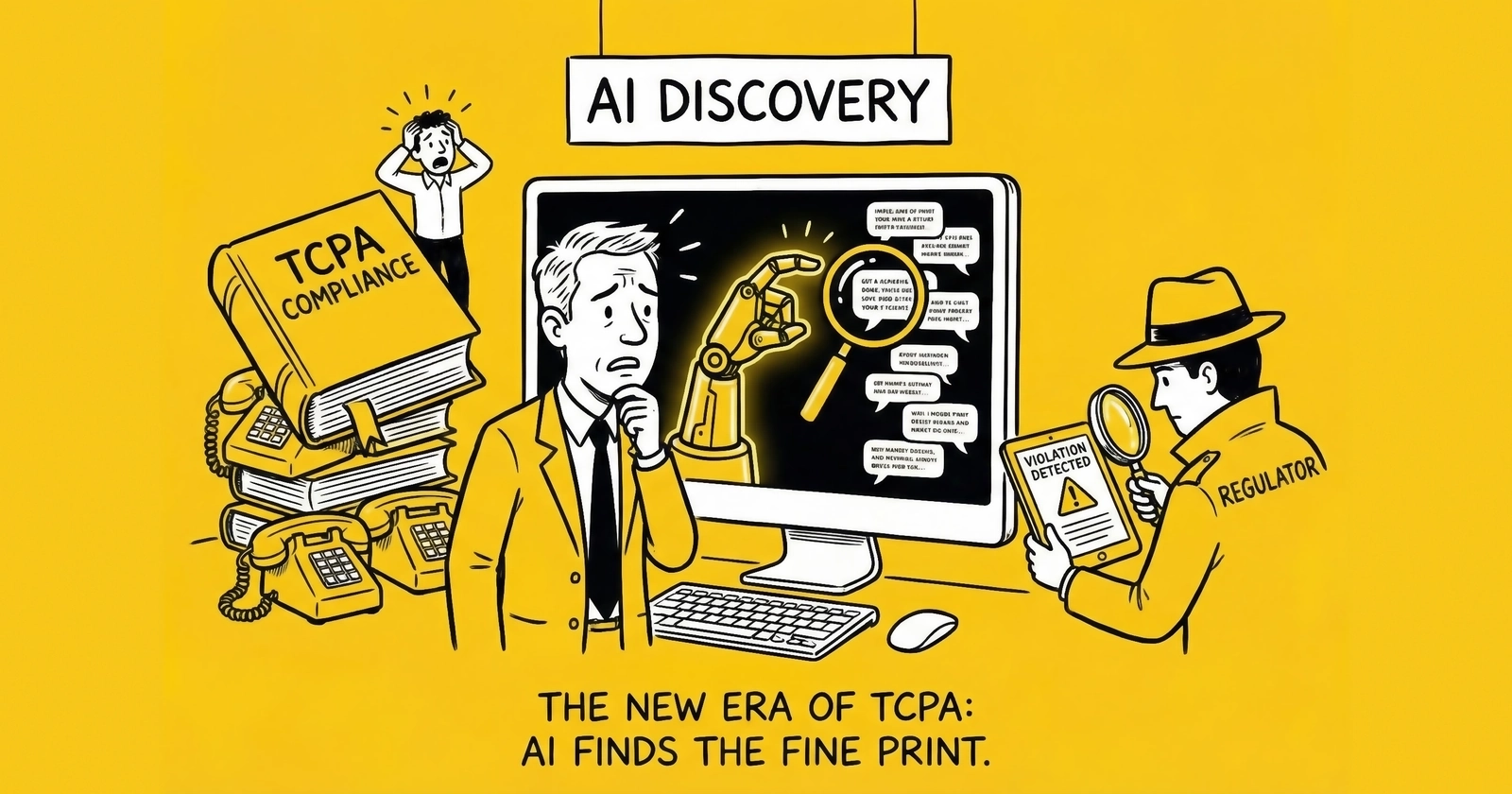
TCPA violations carry $500-$1,500 per incident penalties. Lead buyers searching for compliance guidance need accurate information – and AI systems know it. When ChatGPT fields questions about consent requirements or state regulations, it applies heightened scrutiny to source selection. Companies with authoritative compliance content become default citations. Those without compliance depth become invisible during buyer moments that determine vendor trust.
Lead generation operates in regulated territory. The Telephone Consumer Protection Act imposes consent requirements, calling restrictions, and statutory damages that create real financial exposure. State mini-TCPA laws in Florida, Oklahoma, and Washington add complexity. TCPA class actions regularly produce seven-figure settlements. For comprehensive coverage of these requirements, see our TCPA compliance guide for lead generators.
For lead buyers, compliance isn’t optional – it’s existential. They inherit liability for leads generated through non-compliant methods. A single class action can exceed annual lead spend. This reality makes compliance knowledge a critical buying criterion.
AI systems recognize this dynamic. When users ask compliance questions, AI applies YMYL (Your Money or Your Life) evaluation criteria. These topics affect user finances and legal exposure, requiring AI to favor authoritative, accurate sources over potentially incorrect information. This creates opportunity for companies that build comprehensive compliance content – and disadvantage for those that don’t.
Why Compliance Content Gets AI Priority
The YMYL Classification
Google’s quality guidelines explicitly classify financial and legal content as YMYL – topics where inaccurate information could cause significant harm. AI systems, whether designed by Google or other companies, apply similar scrutiny.
YMYL Characteristics in Lead Generation:
- Financial exposure (TCPA damages, class action risk)
- Legal consequences (regulatory enforcement, lawsuits)
- Business impact (vendor contracts, operational changes)
- Consumer protection implications
When a lead buyer asks “What consent is required for autodialed calls?”, incorrect information could lead to TCPA violations, lawsuits, and significant financial damage. AI systems treat these queries with heightened care, favoring authoritative sources that demonstrate expertise.
The Authority Gap
Most lead generation companies have compliance information buried in legal disclosures or FAQ pages. Comprehensive, structured compliance content is rare. This creates an authority gap that early movers can exploit.
Current State:
- Legal firms dominate TCPA search results
- Lead generation companies rarely create compliance content
- AI systems cite legal sources by default
- Lead industry-specific compliance guidance is scarce
Opportunity:
- Lead generation expertise + compliance depth = unique authority
- Industry-specific compliance guidance fills content gap
- AI citation opportunity with low competition
- Trust building with buyers during research phase
Companies that combine lead generation operational knowledge with regulatory expertise occupy a unique position AI systems recognize as distinctively valuable.
Trust Signal Amplification
Compliance content creates trust signals that extend beyond the specific content:
Direct Trust Signals:
- Demonstrates regulatory knowledge
- Shows operational compliance commitment
- Indicates professional standards
- Proves industry expertise
Indirect Trust Signals:
- Influences perception of all company content
- Builds authority for non-compliance topics
- Creates citation momentum (AI systems cite proven sources)
- Establishes thought leadership positioning
A company known for authoritative TCPA guidance gets more benefit of the doubt for lead quality claims than a competitor without visible compliance expertise. For the strategic framework on building AI-visible authority, see our LLMO guide for lead generation.
TCPA Content That AI Systems Cite
Consent Requirement Guides
The most-cited TCPA content explains consent requirements clearly. AI systems frequently answer questions about what consent is required for different communication types.
Essential Topics:
Prior Express Written Consent (PEWC)
Prior Express Written Consent is required for:
- Autodialed calls to cell phones
- Prerecorded voice messages to cell phones
- Text messages sent via autodialer

PEWC requirements:
1. Written agreement (electronic signatures acceptable)
2. Clear identification of the seller
3. Disclosure that calls may use an autodialer
4. Disclosure that consent is not required for purchase
5. Telephone number provided by consumer
Prior Express Consent
Prior Express Consent is required for:
- Non-telemarketing autodialed calls
- Non-telemarketing prerecorded messages

Prior Express Consent requirements:
1. Consumer provides phone number
2. Reasonable expectation of contact type
3. Can be verbal or written
Established Business Relationship (EBR)
EBR exemption requirements:
- Inquiry or application within 3 months
- Transaction within 18 months
- Consumer has not opted out
- Does NOT exempt autodialed calls to cell phones
State Mini-TCPA Summaries
State-level telemarketing laws create compliance complexity that buyers need help navigating. AI systems frequently cite comprehensive state law summaries.
Florida Telephone Solicitation Act
Florida's mini-TCPA (effective July 1, 2021):

Restrictions:
- No calls before 8am or after 8pm (local time)
- Written consent required for automated calls
- Consent cannot be obtained via autodialer
- 24-hour written notice required to withdraw consent

Penalties:
- $500 per violation (standard)
- $1,500 per violation (after formal demand)
- Private right of action for consumers
- Florida Attorney General enforcement

Key Differences from Federal TCPA:
- Stricter consent requirements
- Narrower EBR exemption
- Additional withdrawal notice requirements
Oklahoma Telephone Solicitation Act
Oklahoma TCPA expansion (effective November 1, 2022):

Key Provisions:
- Express written consent for automated calls
- Consent must include clear seller identification
- 30-day window to honor opt-out requests
- Prohibition on selling consent lists

Penalties:
- $500 per violation
- $1,500 per willful violation
- Private right of action
- Oklahoma Attorney General enforcement
Washington Telephone Solicitation Act
Washington state restrictions:

Do-Not-Call Requirements:
- State-specific do-not-call list
- 10-day window to update calling lists
- Identification requirements for all calls

Robocall Restrictions:
- Written consent for prerecorded messages
- Identification of call sponsor
- Opt-out mechanism required

Penalties:
- Civil penalties up to $2,000 per violation
- Washington Attorney General enforcement
- Consumer complaints trigger investigation
Enforcement Analysis
AI systems cite enforcement examples when users ask about penalties or risks. Comprehensive enforcement analysis provides specific examples.
FCC Enforcement Actions
Notable FCC TCPA Enforcement (2023-2025):

Rising Eagle Capital Group (2024)
- Violation: Spoofed robocalls to cell phones
- Penalty: $225 million proposed forfeiture
- Significance: Largest TCPA fine proposed

Sumco Panama (2024)
- Violation: Illegal robocall campaign
- Penalty: $120 million forfeiture
- Significance: First fine under STIR/SHAKEN framework

The Dentist's Choice (2023)
- Violation: Junk fax violations
- Penalty: $2.6 million settlement
- Significance: Demonstrates TCPA applies to fax marketing
Class Action Settlements
TCPA Class Action Landscape:

Settlement Trends:
- Average TCPA settlement: $7.8 million (2024)
- Class sizes: 100,000 to 10+ million members
- Per-claimant recovery: $50-$500 typical

Notable Settlements:
Capital One (2024): $75 million
- 39 million consumers affected
- Alleged debt collection violations

Dish Network (ongoing)
- $280 million jury verdict
- Appeal pending
- Largest TCPA jury verdict on record
Compliance Checklists
Practical checklists get cited when users ask “How do I comply with TCPA?” or similar action-oriented questions.
Pre-Campaign Compliance Checklist
Before launching any calling/texting campaign:

☐ Consent Verification
  - Written consent obtained before contact?
  - Consent language meets TCPA requirements?
  - Electronic consent properly documented?

☐ Technology Requirements
  - TrustedForm or equivalent certificate capture?
  - Do-not-call list scrubbing implemented?
  - Opt-out mechanism functional?

☐ Timing Compliance
  - Calls scheduled between 8am-9pm local time?
  - Time zone handling configured?
  - Holiday restrictions observed?

☐ Content Requirements
  - Caller identification included?
  - Opt-out instructions provided?
  - No misleading claims or spoofing?

☐ Documentation
  - Consent records retained (4+ years recommended)?
  - Call records maintained?
  - Opt-out requests logged and honored?
Lead Purchase Compliance Checklist
Before purchasing leads:

☐ Vendor Due Diligence
  - TCPA compliance certification obtained?
  - Consent language reviewed and approved?
  - Certificate capture method verified?

☐ Consent Documentation
  - TrustedForm or equivalent certificates provided?
  - Consent timestamp recorded?
  - Consent language captured?

☐ Data Validation
  - Phone numbers verified active?
  - Do-not-call list scrubbing completed?
  - Duplicate/aged leads identified?

☐ Contractual Protections
  - Indemnification clause included?
  - Compliance warranties specified?
  - Audit rights established?
Building Regulatory Authority
Demonstrating Experience
The “Experience” component of E-E-A-T requires evidence of operational involvement with compliance issues.
Operational Experience Signals:
- Case studies of compliance implementation
- Examples of compliance challenges solved
- Metrics from compliance programs
- Real-world consent capture processes
## Our Compliance Implementation Experience

When we transitioned to PEWC-compliant lead generation in 2021:

Challenge: Existing consent language didn't meet PEWC requirements
Solution: Complete consent flow redesign across 47 landing pages
Result: 100% PEWC compliance maintained through 3 regulatory updates

Key Learnings:
1. Consent language must be above the fold
2. Pre-checked boxes invalidate consent
3. One-to-one seller identification required
...
Demonstrating Expertise
Expertise signals come from deep regulatory knowledge and professional credentials.
Expertise Indicators:
- Detailed regulatory citations (47 C.F.R. § 64.1200)
- FCC order references and interpretations
- State law analysis and comparison
- Historical regulatory context
## TCPA Regulatory Framework

The TCPA (47 U.S.C. § 227) established in 1991 restricts
telephone solicitation practices. Key implementing regulations
appear in 47 C.F.R. § 64.1200.

Relevant FCC Orders:
- 2012 TCPA Order: Established PEWC requirement
- 2015 Omnibus Order: Broadened autodialer definition
- 2020 Facebook v. Duguid: Supreme Court narrowed autodialer
- 2023 FCC Report and Order: Updated consent revocation rules
Building Authoritativeness
Authority comes from recognition by other authoritative sources.
Authority-Building Activities:
- Industry publication citations
- Conference speaking engagements
- Association membership and contributions
- Expert commentary in news articles
Content Authority Signals:
- Citations from other industry sources
- Backlinks from legal/compliance sites
- Social sharing by compliance professionals
- Referenced in industry discussions
Establishing Trustworthiness
Trust in compliance content requires accuracy, currency, and transparency.
Trust Signals:
- Clear publication and update dates
- Author credentials displayed
- Source citations for regulations
- Acknowledgment of limitations
## About This Guide

Last Updated: January 2026
Author: [Name], Compliance Director, [Credentials]

This guide provides general compliance information and
should not be construed as legal advice. Consult qualified
legal counsel for specific compliance questions.

Sources:
- Federal Communications Commission (FCC.gov)
- 47 U.S.C. § 227 (TCPA statute)
- 47 C.F.R. § 64.1200 (FCC regulations)
Content Structure for AI Synthesis
Hierarchical Organization
AI systems extract information more effectively from well-organized content. Structure compliance content with clear hierarchies:
H1: TCPA Compliance Guide

  H2: Consent Requirements
    H3: Prior Express Written Consent
    H3: Prior Express Consent
    H3: Established Business Relationship

  H2: State Regulations
    H3: Florida
    H3: Oklahoma
    H3: Washington

  H2: Penalties and Enforcement
    H3: Statutory Damages
    H3: FCC Enforcement
    H3: Private Right of Action

  H2: Compliance Implementation
    H3: Consent Capture
    H3: Record Keeping
    H3: Vendor Management
Each section becomes a discrete unit AI can cite for specific queries.
Definitional Openings
Start each section with clear definitions that AI can extract:
Good:
## Prior Express Written Consent

Prior Express Written Consent (PEWC) is a signed written
agreement that clearly authorizes the seller to deliver
calls or texts using an automatic telephone dialing system
or an artificial or prerecorded voice.
Poor:
## Prior Express Written Consent

Many telemarketers wonder about consent requirements.
The rules have evolved over time, and it's important
to understand what's currently required...
The first version provides a clear definition AI can cite directly. The second buries the definition in narrative.
Table Format for Comparisons
Tables enable efficient information extraction:
## TCPA Consent Requirements by Communication Type

| Communication Type | Consent Level | Documentation |
|-------------------|---------------|---------------|
| Autodialed call to cell phone | PEWC | Signed agreement |
| Prerecorded message to cell phone | PEWC | Signed agreement |
| Text message via autodialer | PEWC | Signed agreement |
| Manual call to cell phone | None required | N/A |
| Autodialed call to landline | Prior Express | Verbal or written |
| Live telemarketing to landline | EBR or consent | Transaction record |
FAQ Integration
FAQ sections match natural query patterns:
## Frequently Asked Questions

### What consent is required to send text messages?

Text messages sent using an autodialer require Prior Express
Written Consent (PEWC). The consent must include a clear
disclosure that automated text messages may be sent and
that consent is not required for purchase.

### How long must I keep consent records?

While the TCPA doesn't specify a retention period, the
statute of limitations for TCPA claims is 4 years. Maintain
consent records for at least 4 years from the date of last
contact to protect against potential claims. For detailed
retention guidance, see [consent documentation and retention](/blog/consent-documentation-retention-tcpa/).
Schema Markup for Regulatory Content
Article Schema for Compliance Content
{
  "@context": "https://schema.org",
  "@type": "Article",
  "@id": "https://www.example.com/tcpa-guide/#article",
  "headline": "TCPA Compliance Guide for Lead Generation",
  "description": "Complete guide to TCPA consent requirements, state regulations, and compliance implementation for lead generation companies",
  "about": [
    {
      "@type": "Thing",
      "name": "Telephone Consumer Protection Act",
      "sameAs": "https://www.fcc.gov/general/telemarketing-and-robocalls"
    },
    {
      "@type": "Thing",
      "name": "TCPA Compliance"
    }
  ],
  "author": {
    "@type": "Person",
    "name": "Compliance Director Name",
    "jobTitle": "Director of Compliance",
    "affiliation": {
      "@type": "Organization",
      "name": "Company Name"
    }
  },
  "publisher": {
    "@type": "Organization",
    "@id": "https://www.example.com/#organization"
  },
  "datePublished": "2026-01-10",
  "dateModified": "2026-01-10"
}
FAQPage Schema
{
  "@context": "https://schema.org",
  "@type": "FAQPage",
  "mainEntity": [
    {
      "@type": "Question",
      "name": "What consent is required for autodialed calls to cell phones?",
      "acceptedAnswer": {
        "@type": "Answer",
        "text": "Autodialed calls to cell phones require Prior Express Written Consent (PEWC). This means a signed written agreement clearly authorizing the calls, including disclosure that an autodialer may be used and that consent is not required for purchase."
      }
    },
    {
      "@type": "Question",
      "name": "What are the penalties for TCPA violations?",
      "acceptedAnswer": {
        "@type": "Answer",
        "text": "TCPA violations carry statutory damages of $500 per violation for negligent violations and up to $1,500 per violation for willful violations. Class actions can aggregate millions in damages when thousands of consumers are affected."
      }
    }
  ]
}
Author Expertise Schema
{
  "@context": "https://schema.org",
  "@type": "Person",
  "@id": "https://www.example.com/authors/compliance-director/#person",
  "name": "Compliance Director Name",
  "jobTitle": "Director of Compliance",
  "description": "15+ years TCPA compliance experience, former state AG investigator",
  "affiliation": {
    "@type": "Organization",
    "@id": "https://www.example.com/#organization"
  },
  "knowsAbout": [
    "TCPA Compliance",
    "Telemarketing Regulations",
    "Lead Generation Compliance",
    "State Mini-TCPA Laws"
  ]
}
Competitive Advantage Through Compliance Content
The Citation Flywheel
Compliance content creates a self-reinforcing citation cycle:
- Initial Citation: AI cites your content for a compliance query
- Authority Building: Citations establish source authority
- Citation Preference: AI systems favor established authorities
- Expanded Citation: Authority extends to related topics
- Competitive Moat: Late entrants face authority gap
Companies that establish compliance authority early create sustainable competitive advantage. Late entrants must overcome established citation patterns.
Sales Process Integration
Compliance content supports the sales process:
Pre-Sales Research:
- Buyers find compliance content during research
- Content establishes expertise before sales contact
- Reduces perceived vendor risk
- Creates warm leads familiar with your authority
Sales Conversations:
- Reference published content during discussions
- Demonstrate expertise through content depth
- Differentiate from less-compliant competitors
- Address compliance objections proactively
Post-Sales Retention:
- Ongoing compliance updates maintain relationship
- Content becomes resource buyers share internally
- Establishes you as trusted compliance partner
- Creates expansion opportunities
Competitor Displacement
Comprehensive compliance content can displace competitors from AI citations:
Analysis Framework:
- Identify competitors currently cited for compliance topics
- Create more comprehensive content on those topics
- Add unique elements (practical examples, proprietary data)
- Update more frequently than competitors
- Monitor citation shifts over time
Competitors without compliance content investment cannot respond quickly. Creating authoritative compliance resources takes months of development and ongoing maintenance.
Key Takeaways
-
AI systems apply YMYL scrutiny to compliance content – accuracy and authority requirements are heightened for regulatory topics.
-
TCPA violations carry $500-$1,500 per incident penalties – buyers need authoritative guidance, creating demand for compliance content.
-
State mini-TCPA laws add complexity – Florida, Oklahoma, and Washington content serves buyers navigating multi-state compliance.
-
Consent guides are most frequently cited – clear explanations of PEWC, Prior Express Consent, and EBR requirements match common queries.
-
Enforcement analysis provides concrete examples – case studies and settlement data make compliance risks tangible.
-
Structure content for AI extraction – hierarchical organization, definitional openings, tables, and FAQ sections enable effective citation.
-
Schema markup establishes authority signals – Article, FAQPage, and Person schema help AI systems evaluate content credibility.
-
Compliance content creates citation flywheel – early authority building compounds into sustainable competitive advantage.
-
Content supports entire sales process – from research discovery through ongoing retention and expansion.
-
Update frequency matters – quarterly reviews and regulatory update integration maintain AI trust and buyer value.
Frequently Asked Questions
Why should lead generation companies create compliance content?
Three strategic reasons converge:
Buyer Need: Lead buyers actively research compliance before purchasing. They face liability for non-compliant leads and need guidance navigating TCPA requirements. Companies providing that guidance establish trust before sales conversations.
AI Visibility: AI systems apply heightened scrutiny to compliance queries, favoring authoritative sources. Lead generation companies with deep compliance content earn citations that competitors without such content cannot access.
Differentiation: Most lead generation companies have minimal compliance content. Comprehensive regulatory coverage differentiates from competitors and signals professional standards.
What compliance topics should we prioritize?
Prioritize topics that match buyer queries and have AI citation potential:
High Priority:
- TCPA consent requirements (PEWC, Prior Express, EBR)
- State mini-TCPA summaries (Florida, Oklahoma, Washington)
- Compliance checklists for lead buyers
- Penalty and enforcement examples
Medium Priority:
- Do-not-call list compliance
- Consent capture best practices
- Vendor compliance evaluation
- Record keeping requirements
Lower Priority (but still valuable):
- TCPA history and evolution
- Detailed FCC order analysis
- Comparative state law analysis
- Industry compliance trends
Start with high-priority topics that serve immediate buyer needs, then expand coverage.
How detailed should compliance content be?
More detailed than you think necessary. AI systems favor comprehensive sources that address subtopics thoroughly. Surface-level overviews don’t establish authority.
Too Thin: “TCPA requires consent for telemarketing calls.”
Appropriate Depth: “TCPA consent requirements vary by communication type and recipient phone type. Autodialed calls and prerecorded messages to cell phones require Prior Express Written Consent (PEWC), which must be in writing, include specific disclosures about autodialer use, and clarify that consent is not required for purchase. The consent must identify the specific seller authorized to call. Prior Express Consent (lower standard) applies to non-telemarketing automated calls…”
Depth signals expertise. Comprehensive coverage addresses the range of queries buyers and AI systems have about each topic.
How often should we update compliance content?
Compliance content requires more frequent updates than most content types:
Quarterly Reviews: Check all compliance content for accuracy against current regulations. Verify examples remain relevant.
Regulatory Triggers: Update immediately when:
- FCC issues new orders or guidance
- States enact or modify mini-TCPA laws
- Significant court decisions affect TCPA interpretation
- Industry enforcement patterns shift
Annual Refresh: Comprehensive review of all compliance content, updating statistics, examples, and citations.
Outdated compliance content loses AI trust and may mislead users – both outcomes damage your authority.
Do we need legal review for compliance content?
Yes, for authoritative content. Compliance content that establishes legal requirements should be reviewed by qualified legal counsel to ensure accuracy.
Review Approaches:
- In-house counsel review for organizations with legal staff
- External legal review for specific high-stakes content
- Legal disclaimer clarifying content is informational, not legal advice
- Regular review cycle aligned with content updates
Legal review adds credibility (“reviewed by counsel”) and protects against accuracy issues that could create liability.
How does compliance content improve traditional SEO?
Compliance content creates SEO value beyond AI visibility:
Backlink Potential: Authoritative compliance content earns backlinks from industry publications, legal blogs, and educational resources.
Topic Authority: Comprehensive compliance coverage builds topical authority that benefits related content rankings.
User Engagement: Buyers researching compliance spend significant time on detailed content, improving engagement metrics.
Conversion Support: Compliance content often appears early in buyer journeys, building familiarity that improves conversion rates for commercial pages.
What credentials strengthen compliance content authority?
Author credentials significantly impact content authority perception:
Strong Credentials:
- Former FCC or state AG staff
- Compliance certifications (CRCM, CCEP)
- Legal background (JD) with telemarketing focus
- 10+ years industry compliance experience
Moderate Credentials:
- Compliance management experience
- Industry compliance training
- Professional association membership
- Conference speaking experience
If lacking credentials:
- Partner with compliance professionals for content
- Cite authoritative sources extensively
- Acknowledge limitations appropriately
- Build credentials through content production over time
How do we measure compliance content ROI?
Compliance content ROI appears in multiple metrics:
Direct Metrics:
- AI citation frequency for compliance queries
- Organic traffic to compliance content
- Time on page and engagement
- Conversions attributed to compliance content paths
Indirect Metrics:
- Lead inquiry quality (buyers mentioning compliance research)
- Sales cycle length (informed buyers decide faster)
- Close rate on compliance-concerned buyers
- Customer retention and expansion
Long-term Metrics:
- Domain authority improvement
- Brand recognition in compliance discussions
- Competitive citation displacement
- Customer compliance incident rates (indicator of buyer selection quality)
Can we repurpose compliance content across formats?
Yes. Core compliance content can extend across formats while maintaining authority:
Format Extensions:
- Webinars expanding on written content
- Downloadable PDF compliance guides
- Email series on compliance topics
- Podcast episodes discussing compliance issues
- Video explanations of complex requirements
- Infographics summarizing key requirements
Each format reaches different audience segments while reinforcing authority across channels. Ensure consistency across formats – conflicting information damages trust.
How do we handle compliance content when regulations change?
Regulatory changes require systematic content updates:
Immediate Actions:
- Identify affected content pages
- Add “Update Pending” notices to affected content
- Prioritize updates by traffic and importance
- Complete updates within 1-2 weeks of significant changes
Communication:
- Publish update announcement content
- Email newsletter to relevant subscribers
- Social media notification of changes
- Update date stamps on all affected content
Ongoing:
- Monitor regulatory sources for upcoming changes
- Build relationships with compliance professionals for early awareness
- Maintain content inventory for rapid update identification
Should compliance content be gated or freely available?
Freely available for maximum AI visibility and trust building:
Why Free Access:
- AI systems cannot access gated content for citation
- Free access enables broader visibility and sharing
- Trust building works better when content is accessible
- Backlink potential increases with free access
What to Gate (if anything):
- Downloadable PDF versions
- Extended templates or tools
- Personalized compliance assessments
- Consultation scheduling
The primary compliance content should be freely crawlable. Additional value-adds can be gated for lead capture without compromising visibility.
How does compliance content fit with overall content strategy?
Compliance content serves as foundational authority within broader content strategy:
Content Hub Structure:
Compliance Hub (pillar)
├── TCPA Requirements (guide)
├── State Regulations (guide)
├── Enforcement Examples (analysis)
├── Compliance Checklists (practical)
└── Compliance FAQs (Q&A)

Connected to:
→ Lead Quality Hub (compliance impacts quality)
→ Technology Hub (compliance tools)
→ Industry Analysis Hub (regulatory trends)
Compliance content supports and strengthens other content areas while serving as a standalone authority pillar.