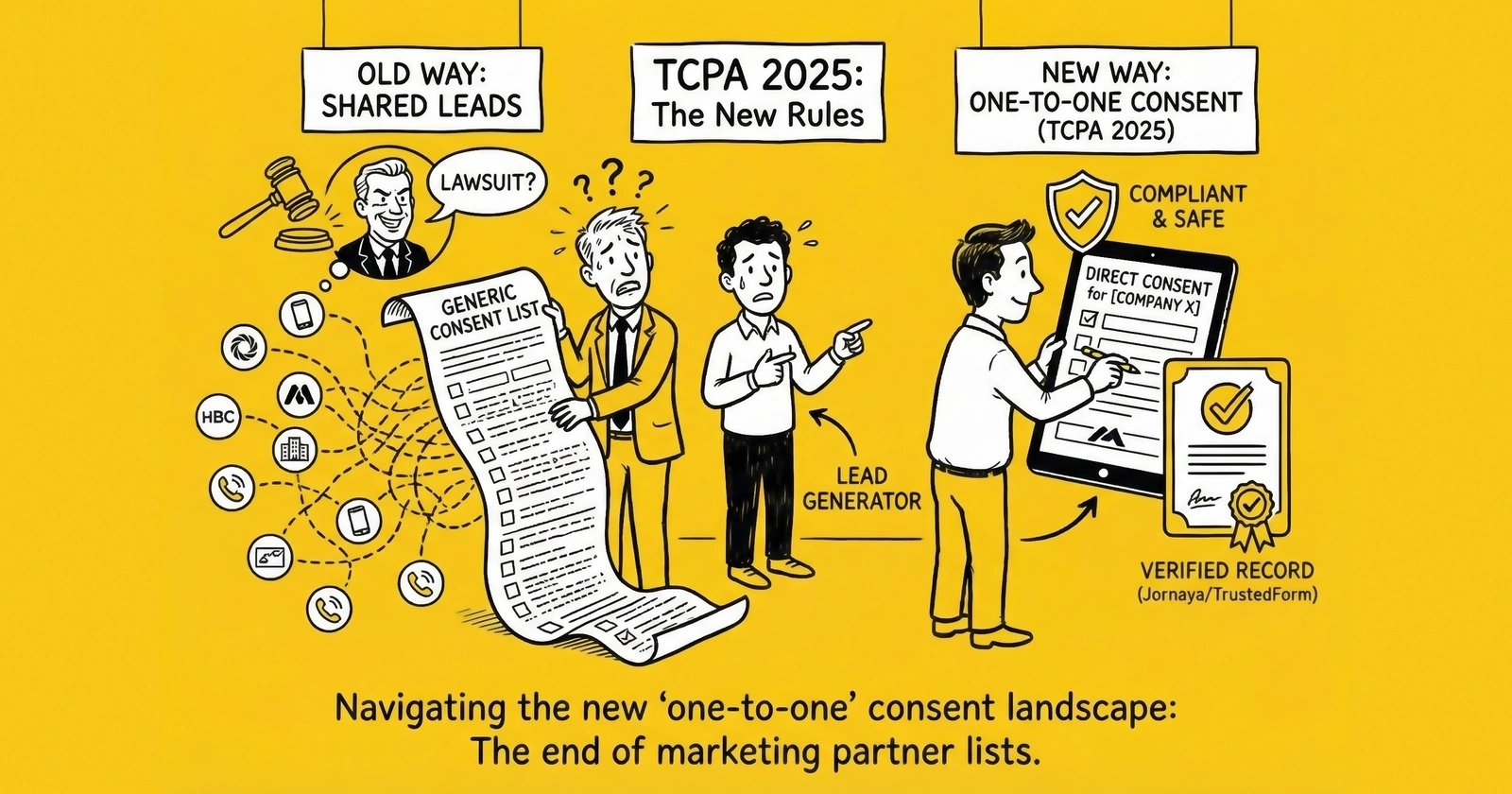
A comprehensive guide to the Telephone Consumer Protection Act for lead generation professionals navigating the most aggressive litigation environment in the statute’s 34-year history.
Introduction: The $6.6 Million Wake-Up Call
The phone rang in March 2025. A process server stood at the door of a mid-sized insurance lead generator in Florida with a class action complaint alleging 47,000 TCPA violations. The potential exposure: $70.5 million. The company’s entire annual revenue was $12 million.
This is not a hypothetical. This is what TCPA litigation looks like today.
In the first quarter of 2025 alone, 507 TCPA class actions were filed – a 112% increase over the same period in 2024. The 2025 litigation statistics reveal the full scope of this surge. The average settlement for TCPA class actions now exceeds $6.6 million. Nearly 80% of all TCPA lawsuits are filed as class actions, compared to just 2-5% for other consumer protection statutes. The plaintiff’s bar has discovered what leading TCPA defense attorney Eric Troutman calls “the biggest cash cow in history.”
For lead generators, the stakes are existential. You capture consumer data. You make calls or send texts. You sell leads to buyers who make calls. Every step of that process intersects with TCPA requirements – and every misstep creates liability that can exceed your company’s total value.
This guide breaks down what the TCPA actually requires, how to build compliant operations, and what happens when you fail. No legal jargon. No theoretical frameworks. Just the operational reality of surviving in this environment.
What Is the TCPA?
The Statutory Foundation
Congress enacted the Telephone Consumer Protection Act in 1991 to address what lawmakers described as “an invasion of consumer privacy” posed by telemarketing practices. The statute, codified at 47 U.S.C. section 227, establishes a regulatory framework governing telephone solicitations, automated dialing systems, prerecorded messages, and unsolicited faxes.
The law grants the Federal Communications Commission authority to prescribe regulations implementing the TCPA, and this implementation authority has been the source of ongoing litigation and regulatory evolution. Understanding the statutory foundation matters because courts increasingly scrutinize whether FCC rules exceed the authority Congress actually granted.
Why Lead Generators Face Heightened Risk
The TCPA was not written with lead generation in mind. It was designed to stop dinner-time telemarketing calls from interrupting family meals. But the statute’s broad language captures lead generation activities precisely:
You capture phone numbers. Every lead form that collects a phone number creates a record that may later be called.
You or your buyers make calls. Whether you operate a call center, transfer live calls, or sell data to buyers who make calls, someone is dialing those numbers.
You use technology. Automated dialers, text message platforms, and prerecorded voice drops all trigger specific TCPA provisions.
Consent flows through your systems. If the consent you capture is defective, everyone downstream inherits your problem.
The lead generation industry sits at the intersection of all four TCPA risk factors. This is not paranoia – it is arithmetic.
Core TCPA Prohibitions
The TCPA prohibits several categories of communications without proper consent or exemption. Understanding these categories determines what you can and cannot do.
1. Calls to Cell Phones Using an ATDS or Prerecorded Voice
The TCPA prohibits calls to wireless numbers using an automatic telephone dialing system (ATDS) or prerecorded/artificial voice without prior express consent. This prohibition applies regardless of whether the call is for telemarketing purposes. Even informational calls to wireless numbers require prior express consent when made using automated technology.
For telemarketing calls – those promoting goods or services – the consent requirement escalates to prior express written consent (PEWC), which includes specific disclosure and documentation requirements discussed below.
2. Telemarketing Calls Using Prerecorded Messages
Telemarketing calls to residential landlines using prerecorded or artificial voice messages require prior express written consent, even when made without automated dialing technology. The consent must be in writing, must not be a condition of purchase, and must clearly identify the caller.
3. Do Not Call Violations
The TCPA prohibits calls to numbers on the National Do Not Call Registry for telemarketing purposes. The registry, maintained by the Federal Trade Commission, contains over 240 million phone numbers that consumers have registered to avoid telemarketing.
Companies must also maintain internal Do Not Call lists of consumers who have requested not to be called. Failing to honor these requests – even if the number is not on the national registry – creates separate liability.
4. Time-of-Day Restrictions
Federal rules prohibit telephone solicitations before 8:00 a.m. or after 9:00 p.m. in the recipient’s local time zone. State rules often impose narrower windows – Florida, for example, restricts calls to 8 a.m. to 8 p.m.
Determining the recipient’s local time zone, particularly for mobile numbers that may not correspond to their area code’s geographic location, creates operational complexity that has generated significant litigation.
The Technology Question
These prohibitions turn on what technology is used. Manual dialing to any number for any purpose is permitted (subject only to DNC restrictions for telemarketing). But the moment you introduce automation – whether dialers, text platforms, or prerecorded messages – specific consent requirements apply.
The Private Right of Action: Why TCPA Lawsuits Proliferate
What makes the TCPA particularly dangerous for businesses is its private right of action with statutory damages. Unlike most consumer protection laws that require actual harm, the TCPA provides:
Statutory damages of $500 per violation. No proof of actual harm required. A single unwanted text message supports a $500 claim.
Treble damages for willful violations. If the court finds the violation was willful or knowing, damages increase to $1,500 per violation.
No cap on aggregate damages. A company that makes 10,000 non-compliant calls faces potential exposure of $5 million to $15 million – before attorney’s fees and litigation costs.
Four-year statute of limitations. Exposure can accumulate over extended periods before a lawsuit materializes.
Favorable class certification standards. Courts have certified classes of millions of call recipients, creating exposure that can reach billions of dollars for large-scale operations.
The Math That Creates Litigation
Consider a lead generator sending 50,000 text messages per month. If 1% of those messages have a consent defect, that is 500 potentially non-compliant messages monthly, or 24,000 over the four-year limitations period.
At minimum statutory damages: $12 million exposure. At treble damages for willful violation: $36 million exposure.
This math explains why TCPA litigation has exploded. The economics favor aggressive plaintiff pursuit even when individual harm is minimal.
The ATDS Definition After Facebook v. Duguid
The definition of “automatic telephone dialing system” was, for decades, among the most litigated aspects of the TCPA. The statute defines an ATDS as equipment with “the capacity to store or produce telephone numbers to be called, using a random or sequential number generator, and to dial such numbers.”
The Supreme Court Narrowing
In 2021, the Supreme Court’s decision in Facebook v. Duguid narrowed this definition significantly. The Court held that equipment must actually use a random or sequential number generator to qualify as an ATDS. This ruling excluded many modern dialing systems that call from pre-loaded lists rather than generating numbers randomly.
What This Means for Lead Generators
The Duguid decision provides some relief, but less than many practitioners assume:
Prerecorded message provisions operate independently. The consent requirements for calls using prerecorded voices apply regardless of whether the dialing system qualifies as an ATDS. For lead generation operations, where automated outbound calling typically involves some form of prerecorded messaging, the consent requirements remain largely unchanged.
State laws may use broader definitions. Florida’s Telephone Solicitation Act and other state mini-TCPAs often define automated dialing more broadly than the post-Duguid federal standard.
The “capacity” question remains unsettled. Some plaintiffs argue that if equipment has the technical capacity to generate numbers randomly – even if that feature was not used for the calls at issue – ATDS liability applies.
Relying on Duguid as a complete defense is a strategic error. The safer approach is to assume consent requirements apply to any automated communications.
What Lead Generators Must Do
Surviving the TCPA litigation environment requires systematic compliance across every aspect of operations. Here is what that looks like.
Capture Valid Prior Express Written Consent
Prior express written consent (PEWC) is the gold standard for TCPA compliance in telemarketing. For lead generators, this means:
An agreement in writing. Electronic signatures satisfying the E-SIGN Act meet this requirement, but the intersection of TCPA and E-SIGN creates compliance complexity discussed below.
The signature of the person called. The agreement must bear the signature of the individual to whom calls will be placed. Courts have accepted various forms of electronic signature, including checkbox clicks, typed names, and digital signatures, provided they satisfy E-SIGN requirements.
Clear authorization for the seller. The agreement must clearly authorize the seller to deliver advertisements or telemarketing messages using an automatic telephone dialing system or artificial/prerecorded voice.
Identification of the telephone number. The agreement must identify the specific telephone number to which the signatory authorizes calls.
Not a condition of purchase. The agreement may not be a condition of purchasing any property, goods, or services. This requirement prevents companies from burying consent in mandatory terms of service.
Clear and conspicuous disclosure. The consent language must be “apparent to a reasonable consumer” – not buried in fine print, accessible only through hyperlinks, or obscured by surrounding content.
Honor Revocation Within Ten Business Days
The FCC’s April 2025 revocation rules require companies to honor consent withdrawal requests within ten business days through any reasonable method. Consumers may revoke consent through “any reasonable manner that clearly expresses a desire not to receive further calls or text messages.”
The FCC identified specific keywords that constitute definitive revocation when received via text message: “stop,” “quit,” “revoke,” “opt out,” “cancel,” “unsubscribe,” and “end.” These terms trigger immediate revocation obligations regardless of other language in the message.
Suppress Against Do Not Call Lists
Before any telemarketing call, verify the number is not on:
- The National Do Not Call Registry (over 240 million numbers)
- State-specific DNC registries (Florida, Colorado, and others maintain separate lists)
- Your internal DNC list (consumers who have previously requested not to be called)
Enforce Time-of-Day Restrictions
No telemarketing calls before 8:00 a.m. or after 9:00 p.m. in the recipient’s local time zone. For state compliance, research specific state windows – several states use 8:00 a.m. to 8:00 p.m.
Verify Consent Before Contact
Before calling or texting any lead – whether you generated it or purchased it – verify that valid consent exists. This means:
- Retrieving and reviewing TrustedForm certificates or Jornaya LeadiDs
- Confirming the consent disclosure identified your company or the buyer who will contact the consumer
- Validating that the consent has not been revoked
Documentation Requirements
Proving consent requires documentation sufficient to withstand litigation. The burden of proof rests with the caller – if you cannot prove consent existed at the time of the call, courts will presume non-compliance.
Essential Documentation for Every Lead
Consent timestamp. The exact date and time consent was provided, in a format that cannot be manipulated.
IP address. The IP address from which the consent was submitted, which helps establish that a real person – not a bot – provided consent.
Consent language displayed. The exact disclosure language shown to the consumer at the time of consent, including any seller identifications.
Consumer action. Evidence of the affirmative action taken by the consumer – checkbox selection, electronic signature, or other consent mechanism.
Phone number provided. The specific phone number for which consent was granted.
Form URL and configuration. The URL of the page where consent was captured and any relevant configuration details.
Session recording or replay. Visual evidence of the consumer’s interaction with the consent form, showing what they saw and how they interacted with it.
Third-Party Verification
Industry best practice requires third-party verification of consent through services like TrustedForm or Jornaya’s TCPA Guardian. These services provide independent documentation that can be presented in litigation as evidence of consent.
A critical distinction: a verification certificate documents what happened – it does not ensure that what happened was compliant. If the underlying disclosure was deficient or the form was misconfigured, the certificate simply documents non-compliance. The certificate must be retrieved, reviewed, and validated against compliance requirements before relying on the documented consent.
Retention Period
There is no statutory minimum retention period for consent documentation, but the four-year statute of limitations for TCPA claims means documentation should be retained for at least four years after the last contact made pursuant to that consent. Industry best practice is five years or longer.
Penalties and Settlement Costs
Statutory Damages
- $500 per violation for TCPA violations
- $1,500 per violation if the court finds the violation was willful or knowing
- No cap on aggregate damages
Real Settlement Data
The largest TCPA settlements have reached nine figures:
| Company | Year | Settlement |
|---|---|---|
| Capital One | 2014 | $75.5 million |
| Caribbean Cruise Line | 2016 | $76 million |
| National Grid | 2024 | $38.5 million |
Average settlements vary widely based on case size and strength, but seven-figure settlements are routine for class actions. Average per-class-member payouts typically range from $50 to $500.
Defense Costs
Even successful defense is expensive. Typical defense costs range from $40,000 to $50,000 for cases resolved early through motion practice, and can reach hundreds of thousands of dollars for cases that proceed through discovery.
The 2024-2026 Litigation Surge
| Metric | Value |
|---|---|
| Total TCPA cases filed (2024) | 2,788 |
| Year-over-year increase (2024 vs. 2023) | 67% |
| Class actions filed Q1 2025 | 507 |
| Q1 2025 vs. Q1 2024 increase | 112% |
| Percentage filed as class actions | ~80% |
| Serial litigators as percentage of plaintiffs | 31-41% |
Common TCPA Mistakes Lead Generators Make
Mistake 1: Assuming Purchased Leads Are Compliant
Buying leads with TrustedForm certificates does not mean the leads are compliant. The certificate documents what happened on the form – it does not guarantee the form itself met TCPA requirements. If the disclosure language was deficient, the seller was not properly identified, or consent was a condition of purchase, the certificate documents your liability.
What to do instead: Retrieve and review every certificate before contact. Verify that your company or your buyer was specifically identified in the disclosure. Audit your lead sources regularly.
Mistake 2: Relying on Multi-Seller Consent
While the FCC’s one-to-one consent rule was vacated in January 2025, sophisticated buyers increasingly demand single-seller consent. Multi-seller disclosures that list dozens of potential callers create litigation vulnerability even if technically compliant.
What to do instead: Implement dynamic consent disclosure that identifies specific buyers at the moment of lead capture. If you must use multi-seller consent, keep the list limited and clearly displayed.
Mistake 3: Ignoring State Mini-TCPAs
Florida’s Telephone Solicitation Act (FTSA), Oklahoma’s Telephone Solicitation Act (OTSA), and Maryland’s Stop the Spam Calls Act all impose requirements beyond federal standards. Calling hour restrictions, consent requirements, and autodialer definitions vary by state.
What to do instead: Map your calling footprint to state-specific requirements. Florida alone generated 330 TCPA cases in 2024 – nearly 12% of all filings despite representing 6.5% of the US population.
Mistake 4: Slow Revocation Processing
The ten-business-day revocation requirement means every opt-out request must propagate across all systems within that window. If a consumer texts “STOP” and receives another message on day eleven, you have a violation.
What to do instead: Build automated opt-out processing that synchronizes across all contact channels. Test your revocation flow regularly.
Mistake 5: Poor Timezone Management
Calling a consumer at 9:15 p.m. their time – even if it is 6:15 p.m. at your call center – violates time-of-day restrictions. Mobile numbers particularly create risk because area codes do not reliably indicate current location.
What to do instead: Use timezone lookup services that determine local time based on current location data, not area code. Build hard stops into your dialing systems. Our guide on telemarketing calling hours by state covers the specific requirements.
Building TCPA Compliance from Day One
Compliance is not a destination. It is infrastructure. Here is how to build it.
Technology Stack Requirements
| Function | Purpose | Solutions |
|---|---|---|
| Consent Verification | Document PEWC for litigation defense | TrustedForm, Jornaya |
| DNC Suppression | Prevent calls to registered numbers | DNCScrub, DNC.com |
| Litigator Suppression | Identify serial TCPA plaintiffs | Litigator Scrub, TCPA Litigator List |
| Reassigned Number Checking | Avoid calls to new number owners | FCC Reassigned Numbers Database, Neustar |
| Call Recording | Document call content | Integrated in dialing platforms |
| Time-Zone Management | Prevent off-hours calls | Integrated in dialing platforms |
Policy Framework
Develop and document written policies covering:
- Consent acquisition standards including disclosure requirements, signature capture, and documentation retention
- Lead acceptance criteria for purchased leads including consent verification requirements
- Calling and texting protocols specifying when, how, and to whom communications may be sent
- Do Not Call procedures for registry suppression, internal DNC management, and opt-out processing
- Time-of-day restrictions including timezone determination and hard stops
- Revocation handling procedures for recognizing and processing opt-outs
- Vendor management requirements for third parties who generate leads or make calls on your behalf
Training Program
Train all personnel who touch leads or make calls. Document the training. Cover:
- TCPA requirements and consequences
- Company-specific policies and procedures
- Role-specific requirements (call center agents need different training than marketing personnel)
- Scenario-based exercises for edge cases
- Documentation requirements and retention
Refresher training should occur at least annually and whenever significant policy or regulatory changes occur.
Audit and Monitoring
Implement ongoing monitoring including:
- Real-time DNC suppression before any call is placed
- Litigator screening against known plaintiff databases
- Consent verification before leads enter calling queues
- Quality assurance reviews examining consent disclosure accuracy, call compliance, and revocation handling
- Regular audits of policy adherence, system effectiveness, and vendor compliance
Frequently Asked Questions
1. What is the TCPA and when was it enacted?
The Telephone Consumer Protection Act was enacted by Congress in 1991 to regulate telemarketing calls, automated dialing systems, and prerecorded messages. It is codified at 47 U.S.C. section 227 and is enforced by both the FCC and through private lawsuits.
2. How much can TCPA damages cost per violation?
TCPA statutory damages are $500 per violation. If the court finds the violation was willful or knowing, damages increase to $1,500 per violation. There is no cap on aggregate damages, meaning high-volume callers can face exposure in the tens or hundreds of millions of dollars.
3. What is an ATDS under the TCPA after the Supreme Court’s Duguid decision?
Following the 2021 Facebook v. Duguid Supreme Court decision, an automatic telephone dialing system (ATDS) is equipment that uses a random or sequential number generator to store or produce phone numbers and dial them. Systems that simply dial from stored lists without random generation may not qualify as ATDS, though this defense does not apply to prerecorded message claims.
4. What consent do I need for telemarketing calls to cell phones?
Telemarketing calls to cell phones using automated technology or prerecorded messages require prior express written consent (PEWC). This must be in writing, signed by the consumer, clearly authorize the specific seller, identify the phone number, not be a condition of purchase, and include clear and conspicuous disclosure.
5. How quickly must I process opt-out requests under the 2026 FCC rules?
The April 2025 FCC rules require companies to honor revocation requests within ten business days through any reasonable method. Keywords including “stop,” “quit,” “revoke,” “opt out,” “cancel,” “unsubscribe,” and “end” trigger immediate revocation obligations.
6. What is the National Do Not Call Registry and how does it affect lead generation?
The National Do Not Call Registry, maintained by the FTC, contains over 240 million phone numbers that consumers have registered to avoid telemarketing calls. Lead generators must suppress against this registry before making any telemarketing call. Violations create $500-$1,500 per-call liability.
7. What hours can I make telemarketing calls under federal law?
Federal law prohibits telemarketing calls before 8:00 a.m. or after 9:00 p.m. in the recipient’s local time zone. Some states impose narrower windows – Florida and Maryland, for example, use 8:00 a.m. to 8:00 p.m.
8. Are purchased leads with TrustedForm certificates automatically TCPA compliant?
No. A TrustedForm certificate documents what happened during the consent capture process, but it does not guarantee compliance. If the consent disclosure was deficient, the seller was not properly identified, or consent was a condition of purchase, the certificate simply documents the problem. You must retrieve and review certificates to verify compliance.
9. What are state mini-TCPAs and which states have them?
Several states have enacted telemarketing laws that impose requirements beyond the federal TCPA. Florida’s Telephone Solicitation Act (FTSA), Oklahoma’s Telephone Solicitation Act (OTSA), and Maryland’s Stop the Spam Calls Act are prominent examples. These laws often have different autodialer definitions, calling hour restrictions, and consent requirements.
10. How long should I retain TCPA consent documentation?
Retain consent documentation for at least four years after the last contact made pursuant to that consent, matching the TCPA statute of limitations. Industry best practice is five years or longer to provide a safety margin for litigation that may be filed near the end of the limitations period.
Key Takeaways
-
TCPA litigation reached historic highs in 2025. 507 class actions in Q1 2025 alone (112% increase over Q1 2024), with 80% of all cases filed as class actions and average settlements exceeding $6.6 million. This is not a regulatory nuisance – it is an existential business risk.
-
Prior express written consent requires six specific elements. Written agreement, consumer signature, clear seller authorization, identified phone number, not a condition of purchase, and clear/conspicuous disclosure. Missing any element creates liability.
-
Document everything, verify before calling. Third-party verification through TrustedForm or Jornaya provides litigation defense, but certificates must be retrieved, reviewed, and validated – not assumed compliant.
-
The April 2025 revocation rules require ten-business-day processing. Any reasonable method of revocation must be honored. Your systems must synchronize opt-outs across all channels within this window.
-
State mini-TCPAs multiply compliance requirements. Florida alone generated 330 TCPA cases in 2024. Map your calling footprint to state-specific requirements – federal compliance is the floor, not the ceiling.
-
Compliance is infrastructure, not a checkbox. Those who survive treat TCPA compliance as core business architecture: technology stack, documented policies, trained personnel, and ongoing monitoring. Those who treat it as a legal afterthought learn the cost in federal courtrooms.
-
Purchased leads with TrustedForm certificates are not automatically compliant. Certificates document what happened, not whether it was lawful. Retrieve and review every certificate to verify your company was identified in the disclosure before making contact.
-
Retain consent documentation for at least five years. The four-year statute of limitations means exposure accumulates over time. Documentation must prove consent existed at the moment of the call, not just that a lead was captured.
-
Screen leads against known litigator databases before contact. Serial plaintiffs constitute 31-41% of TCPA filers. Suppression services identify over 600,000 known plaintiffs who specifically target lead generation operations.
-
Build automated opt-out processing that synchronizes across all channels. The ten-business-day revocation rule means every “STOP” text must propagate to all systems within that window. A message sent on day eleven creates a violation.
Build Compliance Before You Need It
The math is unforgiving. A single non-compliant campaign can generate liability exceeding your company’s total value. The cost of compliance – consent verification, DNC suppression, proper documentation, trained personnel – is a fraction of a single class action settlement.
Every lead you generate, every call you place, every text you send represents both opportunity and risk. Those who approach this reality with discipline, investment, and vigilance build businesses that thrive for decades. Those who treat compliance as an obstacle to be minimized eventually learn the cost of that approach.
Choose your path wisely.
This article provides general information about TCPA compliance. It is not legal advice. TCPA requirements change frequently, and state laws vary significantly. Consult qualified TCPA counsel for guidance on your specific situation.
Statistics current as of Q1 2025. Source: WebRecon TCPA litigation data, FCC regulatory filings.