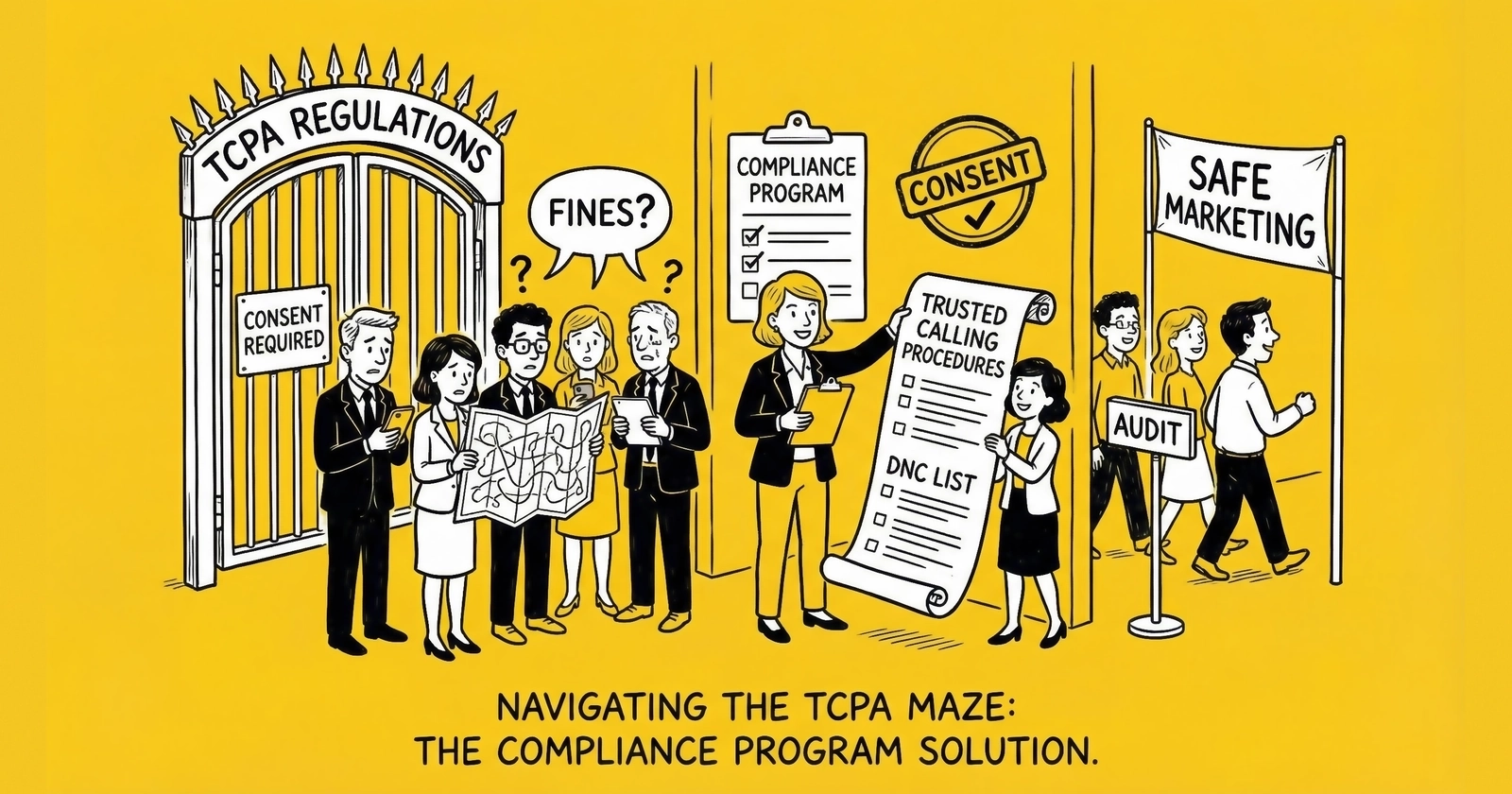
A step-by-step framework for establishing comprehensive TCPA compliance infrastructure, from policy development through technology implementation and ongoing monitoring.
The Foundation You Cannot Skip
The phone rang in March 2025. A process server stood at the door of a mid-sized insurance lead generator in Florida with a class action complaint alleging 47,000 TCPA violations. The potential exposure: $70.5 million. The company’s entire annual revenue was $12 million.
This scenario plays out weekly across the lead generation industry. In Q1 2025 alone, 507 TCPA class actions were filed, representing a 112% increase over the same period in 2024. By September 2025, monthly filings hit 224 class actions, a 283% spike over September 2024. Average settlements now exceed $6.6 million, and nearly 80% of all TCPA lawsuits are filed as class actions. The complete TCPA litigation statistics for 2025 paint an even starker picture.
The companies that survive this environment share one characteristic: they built TCPA compliance as infrastructure before they needed it. Not as a legal checkbox. Not as an afterthought. As core business architecture that touches every lead generated, every call placed, every text sent.
This guide provides the complete blueprint for building that infrastructure from scratch. Whether you are launching a new lead generation operation or retrofitting compliance onto an existing business, these frameworks translate directly into reduced litigation risk and sustainable operations.
Phase 1: Assessment and Foundation (Weeks 1-4)
Before you can build compliant systems, you need to understand exactly what you are building for. The first phase establishes your regulatory baseline and organizational commitment.
Mapping Your Regulatory Exposure
The Telephone Consumer Protection Act is the federal baseline, but your actual compliance requirements depend on multiple factors. Start by documenting your operational footprint.
Channel Inventory. Identify every communication channel you use. Voice calls (manual, preview dial, predictive dial). Text messages (SMS, MMS). Prerecorded voice drops. Each channel carries specific TCPA requirements that differ based on technology type and purpose.
Geographic Footprint. Map every state where you contact consumers. Florida’s Telephone Solicitation Act (FTSA) restricts calling hours to 8:00 a.m. to 8:00 p.m. and caps call frequency at three attempts per 24 hours on the same subject. Oklahoma’s OTSA mirrors these restrictions. Connecticut starts calling hours at 9:00 a.m. Texas imposes Sunday-specific restrictions (noon to 9:00 p.m.). Over fifteen states have enacted mini-TCPA statutes, with additional legislation pending in Michigan, Georgia, and others. Our complete guide to state mini-TCPA laws including FTSA and OTSA covers each jurisdiction’s requirements.
Lead Flow Analysis. Document how leads enter and exit your system. Do you generate leads directly? Purchase from third parties? Both? Do you make calls yourself or sell to buyers who make calls? Each touchpoint in the lead flow creates compliance obligations and potential liability transfer.
Technology Audit. Inventory every technology system involved in lead generation and contact. CRM platforms, dialing systems, text messaging platforms, lead distribution software, consent capture forms, email systems. Each must be evaluated for compliance capability.
Establishing Executive Ownership
TCPA compliance fails when it lives only in the legal department. Effective programs require executive-level ownership with budget authority and organizational influence.
Designate a Compliance Owner. This individual should have direct reporting access to the CEO or COO. For smaller operations, this may be a fractional role. For larger operations, a dedicated Chief Compliance Officer or VP of Compliance. The key attribute is not legal expertise but operational authority to enforce compliance across departments.
Establish Budget. Compliance technology, training, auditing, and legal counsel all require budget. Benchmark your investment against litigation exposure. A single class action settlement averaging $6.6 million justifies substantial compliance investment. Operations generating 10,000+ leads monthly should budget $50,000-$150,000 annually for compliance infrastructure, depending on complexity.
Define Success Metrics. What does compliance success look like? Zero regulatory findings? Zero litigation? Those are outcomes. Leading indicators include consent certificate claim rates, opt-out processing times, DNC suppression accuracy, training completion rates, and audit finding remediation velocity.
Building Your Policy Foundation
Written policies are not bureaucratic overhead. They are evidence of good faith compliance efforts that can affect regulatory and litigation outcomes. Courts and regulators distinguish between companies that made documented efforts to comply versus those operating without formal programs.
Consent Acquisition Policy. Define exactly what constitutes valid consent for your operations. Specify the required disclosure elements, signature capture requirements, documentation standards, and retention periods. Address both leads you generate directly and leads you purchase from third parties.
Required disclosure elements for prior express written consent (PEWC) include: written agreement format, consumer signature, clear authorization identifying the specific seller, the telephone number authorized for contact, language confirming consent is not a condition of purchase, and clear and conspicuous presentation.
Calling and Texting Protocols. Document permitted calling hours by state, frequency limits, technology usage rules, and required disclosures during calls. Address both outbound telemarketing and informational calls, as different consent standards apply.
For telemarketing calls to cell phones using automated technology or prerecorded messages, PEWC is required. For non-telemarketing informational calls using automated technology, prior express consent (PEC) is required but can be demonstrated through conduct such as providing a phone number during a transaction. For manual calls to any number, no consent requirement exists under federal law, though DNC restrictions still apply for telemarketing.
Do Not Call Procedures. Detail your process for suppressing against the National DNC Registry (over 240 million numbers), state-specific registries (eleven states maintain separate lists), and your internal DNC list of consumers who have requested not to be called. Specify suppression frequency, which must occur at least every 31 days under federal requirements, though weekly suppression is industry best practice. Our guide to telemarketing calling hours by state includes state DNC registry requirements.
Revocation Handling. The April 2025 FCC rules require honoring revocation requests within ten business days through any reasonable method. Document how your organization recognizes revocation requests across channels, processes them through your systems, synchronizes opt-out status across all platforms, and confirms processing to the consumer if appropriate.
Standard keywords that trigger immediate revocation obligations include: stop, quit, revoke, opt out, cancel, unsubscribe, and end. However, any communication reasonably conveying intent to stop receiving calls or messages must be honored.
Vendor Management. If you purchase leads or use third-party call centers, document your requirements for vendor qualification, contractual compliance obligations, ongoing monitoring, and incident response when vendor compliance fails.
Phase 2: Technology Implementation (Weeks 4-8)
Policies without technology enforcement are aspirational statements. Technology without policies is a misconfiguration waiting to happen. The second phase implements the technology stack that operationalizes your policies.
Consent Verification Systems
Consent documentation is your primary defense in TCPA litigation. Without independent third-party verification of consent, you cannot prove compliance in court.
TrustedForm. ActiveProspect’s TrustedForm has become the industry standard for consent documentation. The service deploys JavaScript on lead capture forms that documents the consumer’s interaction in real time. For each form submission, TrustedForm generates a unique certificate containing timestamp, IP address, page URL, and a visual recording of the consumer’s session showing exactly what the consumer saw and what actions they took.
Certificates must be claimed (retrieved and stored) by the lead buyer before they expire. Best practice is to claim certificates at the time of lead purchase, before any contact is attempted. TrustedForm offers certificate retention for up to five years, aligning with the four-year TCPA statute of limitations plus margin.
Jornaya (Verisk Marketing Solutions). Jornaya’s LeadiD and TCPA Guardian products provide alternative consent documentation with additional lead intelligence features. Each form submission receives a unique identifier tracking the lead through its lifecycle. The TCPA Guardian service provides consent documentation and compliance reporting that has been used as evidence in legal proceedings.
Implementation Requirements. For leads you generate directly, integrate consent verification JavaScript into all lead capture forms. For leads you purchase, require certificates from vendors as a condition of purchase, and retrieve those certificates before contact. Store certificates in your own systems, not just at the vendor level, with retention matching your documentation policy (minimum four years, recommended five years or longer).
Critical Understanding. A verification certificate documents what happened. It does not guarantee that what happened was compliant. If the disclosure language was deficient, the seller was not properly identified, or consent was a condition of purchase, the certificate simply documents your liability. Retrieve and review certificates before contact.
Do Not Call Suppression
Federal law requires telemarketing calls be suppressed against the National DNC Registry. Your technology stack must automate this suppression before any call is placed.
National Registry Access. Register with the FTC to access the National DNC Registry. The registration process requires identifying all area codes where you intend to make telemarketing calls. Registry data must be refreshed at least every 31 days, though weekly updates are recommended.
State Registry Integration. Eleven states maintain separate DNC registries: Colorado, Connecticut, Indiana, Louisiana, Massachusetts, Missouri, Oklahoma, Pennsylvania, Tennessee, Texas, and Wyoming. Your suppression process must include these state lists for calls to consumers in those states.
Internal DNC List. Maintain your own list of consumers who have requested not to be called, and suppress against this list for all outbound contact. This list should sync with your revocation processing system so opt-outs are automatically added.
Litigator Suppression. Between 31% and 41% of TCPA cases are filed by serial litigators who actively seek non-compliant communications. Industry databases track over 600,000 names and numbers associated with professional plaintiffs, TCPA attorneys, and individuals who have sent demand letters. Major providers include Contact Center Compliance (Litigator Scrub), PossibleNOW (TCPA Litigator Database), and Gryphon.
Implementation Architecture. Suppression must occur in real time, before any dial attempt. Your dialing platform should query suppression lists automatically, block suppressed numbers from entering calling queues, and log every suppression check for audit purposes.
Time Zone Management
Calling before 8:00 a.m. or after 9:00 p.m. in the recipient’s local time zone violates federal TCPA. State laws may impose narrower windows. A single timing violation can trigger per-call liability.
Location Determination. You cannot rely on area codes to determine local time. Mobile number portability means a 212 (New York) area code may belong to someone living in California. For leads captured online, IP address geolocation provides initial location estimates, though VPNs and corporate networks can produce inaccurate results.
Time Zone Database. Your systems must maintain current time zone data including daylight saving time transitions. Time zone boundaries occasionally change, and your database must stay current.
State-Specific Rules Engine. Build logic that applies the most restrictive applicable calling window based on recipient location. Florida and Maryland use 8:00 a.m. to 8:00 p.m. Connecticut starts at 9:00 a.m. Texas has unique Sunday restrictions (noon to 9:00 p.m.). Your system must apply the correct window for each recipient.
Hard Blocks. Implement hard stops that prevent calls outside legal hours for the determined location. This cannot be a soft warning that operators can override. If your system allows overrides, you have a compliance gap.
Safe Window Fallback. When you cannot reliably determine recipient location, the safest calling window is 11:00 a.m. to 7:00 p.m. Eastern Time. This window falls within legal hours across all U.S. time zones, including Hawaii.
Revocation Processing Automation
The April 2025 FCC rules require honoring revocation within ten business days. For operations with multiple systems touching consumer data, this creates significant synchronization challenges.
Keyword Detection. Configure all text messaging systems to automatically recognize standard revocation keywords (stop, quit, revoke, opt out, cancel, unsubscribe, end) and initiate opt-out processing immediately upon receipt.
Cross-System Synchronization. Opt-out status must propagate to every system capable of contacting consumers within the ten-day window. This typically includes CRM platforms, email systems, dialing platforms, text messaging systems, and any third-party lead buyers who received the lead. Build automated synchronization that does not depend on manual data entry.
Confirmation Messages. The FCC permits sending a one-time confirmation message after an opt-out request, but strict conditions apply. The confirmation must be sent within five minutes. It cannot contain marketing content. If the consumer provided consent for multiple message categories, you may request clarification about which categories they wish to discontinue, but if they do not respond, the revocation applies to all categories.
Documentation. Log all revocation requests with timestamp, source, and processing completion time. This documentation becomes critical evidence if you face a claim that revocation was not honored.
Call Recording
Call recording serves multiple compliance functions: verification of script compliance, dispute resolution, training and quality improvement, and litigation defense.
Recording Consent. Many states require consent from one or both call parties before recording. Either announce recording at the start of calls (“This call may be recorded for quality assurance”) or obtain consent through initial disclosures before proceeding.
Retention. Retain recordings for at least the four-year TCPA limitations period plus buffer. Five years matches the Telemarketing Sales Rule retention requirement that took effect in March 2024.
Security. Recordings contain personal information and must be secured appropriately. Implement access controls, encryption, and audit logging for recording systems.
Phase 3: Training and Documentation (Weeks 8-12)
Technology and policy require human implementation. The third phase establishes training programs and documentation practices that demonstrate organizational commitment to compliance.
Training Program Development
Effective TCPA training covers legal requirements, company-specific policies, role-specific procedures, and practical scenario handling.
Legal Framework Overview. All personnel touching leads or making calls should understand the basic TCPA framework: what the statute prohibits, what consent is required for different call types, what penalties apply for violations, and why compliance matters to the organization. Keep this accessible rather than legally dense.
Company Policy Training. Detailed review of your specific policies: consent acquisition standards, calling protocols, DNC procedures, revocation handling, vendor management. Personnel should understand not just what to do but why each requirement exists.
Role-Specific Training. Different roles need different training depth. Call center agents need detailed script compliance and opt-out recognition training. Marketing personnel need consent disclosure and lead source evaluation training. Technology staff need system configuration and monitoring training. Executives need oversight and incident response training.
Scenario Training. Practical exercises applying requirements to realistic situations. What do you do when a consumer says “stop calling me” during a call? How do you handle a lead with missing TrustedForm certificate? What if a consumer claims they never requested contact? Edge cases test whether training has translated to practical capability.
Training Delivery. Initial training should occur before personnel begin working with leads or making calls. Refresher training should occur at least annually and whenever significant policy or regulatory changes occur. New regulatory developments, such as the April 2025 revocation rules, should trigger supplemental training for affected personnel.
Training Documentation. Maintain records of all training provided, including training dates and content, personnel who received training, assessment results if assessments are used, and acknowledgment of policy receipt and understanding. This documentation supports “reasonable practices” arguments in litigation.
Documentation Standards
Documentation serves two purposes: operational consistency and litigation defense. Your documentation practices should address both.
Consent Records. For every lead, maintain records of consent timestamp, IP address, exact consent language displayed, consumer action taken, phone number provided, form URL and configuration, and third-party verification certificate (TrustedForm, Jornaya, or equivalent).
Call Records. For every outbound contact, maintain records of call timestamp, recipient number, outcome (connected, voicemail, no answer, etc.), duration, agent identification, and recording reference.
Suppression Records. Document DNC suppression activities including dates of registry data refresh, suppression queries performed before campaigns, numbers suppressed and reason codes.
Revocation Records. For every opt-out request, document date and time received, channel received through, processing completion date, and systems updated.
Audit Records. Document all compliance audits including scope and methodology, findings identified, remediation plans and deadlines, and verification of remediation completion.
Retention Policy. Define retention periods for each documentation category. Consent records: minimum four years after last contact, recommended five years. Call records: five years. Suppression records: five years. Revocation records: five years. Audit records: permanent.
Phase 4: Monitoring and Continuous Improvement (Ongoing)
Compliance is not a project with an end date. It is an ongoing operational function requiring continuous monitoring, regular auditing, and systematic improvement.
Real-Time Monitoring Systems
Build dashboards and alerts that surface compliance issues before they become litigation.
Consent Certificate Claim Rate. What percentage of leads have claimed certificates before contact? Target: 100% for generated leads, 100% for purchased leads before contact. Any gap represents unverifiable consent.
Opt-Out Processing Time. Average and maximum time from revocation request to full system synchronization. Target: under 24 hours average, never exceeding ten business days.
DNC Suppression Accuracy. Calls blocked by DNC suppression versus calls made to subsequently identified DNC numbers. Any calls to DNC numbers indicate suppression gaps.
Time Zone Violation Attempts. Calls blocked by time zone enforcement versus any calls made outside legal hours. Any after-hours calls indicate configuration problems.
Consumer Complaints. Track and investigate all consumer complaints regardless of whether they involve formal legal action. Complaint patterns often indicate systemic issues before litigation materializes.
Regular Audit Schedule
Internal audits should examine actual practices against documented policies at regular intervals.
Weekly. Review opt-out processing times, consent certificate claim rates, and any blocked call attempts for anomalies.
Monthly. Sample call recordings for script compliance. Sample consent certificates for disclosure accuracy. Review vendor compliance with contract requirements.
Quarterly. Comprehensive policy adherence audit. Technology configuration verification against current regulatory requirements. Training completion and refresher scheduling.
Annually. External audit by qualified compliance consultant. Regulatory update review against current policies. Complete documentation retention verification.
Vendor Oversight
Third-party vendors, particularly lead generators and call centers, represent significant TCPA exposure. Your compliance is only as strong as your weakest vendor.
Vendor Qualification. Before engaging any vendor who generates leads or makes calls on your behalf, conduct due diligence covering their TCPA compliance policies, consent capture mechanisms, litigation history, insurance coverage, and willingness to provide indemnification.
Contractual Requirements. Vendor agreements should include specific TCPA compliance obligations, consent documentation requirements, audit rights, indemnification provisions covering TCPA claims, insurance requirements, and termination rights for compliance failures.
Ongoing Monitoring. Regular audits of vendor consent documentation. Periodic review of vendor calling practices. Monitoring of complaints or litigation involving vendors. Required incident reporting for any TCPA-related issues.
Incident Response Protocol
When compliance issues arise, your response determines whether they become lawsuits.
Immediate Response (Hours 0-4). Stop the violating activity. Do not delete any records. Contact TCPA defense counsel. Notify insurance carrier. Begin documenting discovery.
Assessment (Hours 4-24). Issue written litigation hold to relevant personnel and vendors. Identify scope of potential exposure. Pull consent records for affected communications. Gather call logs and lead source documentation.
Strategic Response (Hours 24-72). Assess strength of consent documentation with counsel. Evaluate indemnification rights against vendors. Determine whether early resolution or defense makes economic sense.
Remediation. Identify root cause. Implement corrective controls. Document remediation for future regulatory or litigation reference.
Budget and ROI Framework
TCPA compliance requires investment. Understanding the economics helps justify budget and prioritize spending.
Compliance Technology Costs
Consent Verification. TrustedForm certificates cost approximately $0.15-$0.50 per lead depending on volume and features. For a lead sold at $30, this represents 0.5% to 1.7% of revenue. Our consent documentation guide covers implementation best practices.
DNC Suppression Services. $5,000-$15,000 annually for federal and state registry access plus litigator suppression, varying by volume.
Dialing Platform Compliance Features. Often included in platform licensing, but may require premium tiers for full time zone management, call recording, and suppression integration.
Comprehensive Stack. $0.25-$0.75 per lead for full technology stack including consent verification, DNC suppression, litigator screening, and time zone management.
Personnel and Training Costs
Compliance Staff. Depending on operation size, $50,000-$150,000+ annually for dedicated compliance personnel or fractional compliance officer.
Training Programs. $5,000-$20,000 annually for training development, delivery, and documentation.
Legal Counsel. $10,000-$50,000+ annually for ongoing compliance guidance from TCPA-specialized attorneys.
ROI Calculation
The math favors compliance investment overwhelmingly.
Average class action settlement: $6.6 million
Average individual settlement: $2,500-$15,000
Defense costs for early resolution: $40,000-$50,000
Defense costs through trial: $300,000-$750,000+
If compliance investment at $0.50 per lead prevents one class action per 13.2 million leads, the investment pays for itself entirely, before accounting for defense costs, management distraction, and reputational harm. The actual prevention rate for comprehensive programs is far higher.
For an operation generating 100,000 leads monthly, annual compliance technology cost of $50,000-$75,000 compares against potential exposure of $5 million to $15 million if just 1% of calls have consent deficiencies over the four-year statute of limitations.
Frequently Asked Questions
What is the first step in building a TCPA compliance program?
Begin with a comprehensive assessment of your regulatory exposure. Map every communication channel you use (voice calls, texts, prerecorded messages), every state where you contact consumers, and every technology system involved in lead generation and contact. Document your lead flow from acquisition through contact. This assessment determines which requirements apply to your specific operations and forms the foundation for policy development. Without understanding exactly what you are building for, you cannot build effectively.
How much does it cost to implement a comprehensive TCPA compliance program?
For small to mid-sized lead generation operations (5,000-50,000 leads monthly), expect to invest $75,000-$150,000 in the first year covering technology implementation, policy development, training programs, and legal counsel. Ongoing annual costs typically run $50,000-$100,000 for technology licensing, auditing, training refreshers, and counsel retainers. Larger operations with complex multi-channel, multi-state footprints may require $200,000+ annually. These investments compare favorably against average class action settlements of $6.6 million and defense costs of $40,000-$50,000 even for early resolution.
What technology systems are essential for TCPA compliance?
Five technology categories are essential. Consent verification systems (TrustedForm or Jornaya) document that valid consent was obtained. DNC suppression services screen against federal, state, and internal Do Not Call lists before any call is placed. Litigator suppression databases identify known serial plaintiffs and TCPA attorneys. Time zone management ensures calls occur only during legal hours in the recipient’s local time zone. Call recording documents what actually occurs during calls for quality assurance and litigation defense. Most operations should budget $0.25-$0.75 per lead for comprehensive technology stack coverage.
How do I ensure third-party lead sources provide compliant leads?
Vendor compliance requires three elements: qualification, contracts, and monitoring. Before engaging any lead vendor, conduct due diligence on their consent capture practices, TCPA compliance policies, and litigation history. Vendor contracts should include specific TCPA compliance representations, requirements for consent documentation and verification certificates, audit rights, indemnification provisions covering TCPA claims, and termination rights for compliance failures. Ongoing monitoring includes regular audits of vendor consent documentation, certificate retrieval and review before contact, and immediate investigation of any vendor-related complaints. Remember that indemnification clauses are only as valuable as the vendor’s ability to pay. Require vendors to carry TCPA-specific insurance.
What are the key elements of valid prior express written consent?
The FCC defines six required elements for prior express written consent (PEWC). The consent must be an agreement in writing (electronic signatures satisfying E-SIGN requirements are acceptable). The agreement must bear the signature of the person to be called. The agreement must clearly authorize the specific seller to deliver telemarketing messages using automated technology or prerecorded voice. The agreement must identify the specific telephone number authorized for contact. Critically, the agreement may not be a condition of purchasing any property, goods, or services. Finally, the consent disclosure must be clear and conspicuous, apparent to a reasonable consumer without being buried in fine print or accessible only through hyperlinks.
How quickly must opt-out requests be processed under current FCC rules?
The April 2025 FCC rules require honoring consent revocation requests within ten business days through any reasonable method. Standard keywords received via text message (stop, quit, revoke, opt out, cancel, unsubscribe, end) trigger immediate revocation obligations. However, any communication that reasonably conveys intent to stop receiving calls or messages must be honored regardless of specific wording. Companies may send a one-time confirmation message within five minutes of the opt-out request, but it cannot contain marketing content. Your systems must synchronize opt-out status across all platforms capable of contacting the consumer within this ten-day window.
What documentation should I retain and for how long?
Retain consent documentation for at least four years after the last contact made pursuant to that consent, matching the TCPA statute of limitations. Industry best practice is five years, aligning with the Telemarketing Sales Rule retention requirement extended in March 2024. Essential documentation includes consent timestamp, IP address, exact disclosure language displayed, consumer action taken, phone number authorized, form URL and configuration, and third-party verification certificates. Call records, suppression records, revocation records, and audit records should all follow the five-year standard. Store documentation in formats that prevent tampering and maintain audit trails of access.
How do I handle TCPA compliance across multiple states with different requirements?
Two strategies exist. The “apply strictest standard” approach uses the most restrictive requirement from any applicable state across all operations, simplifying compliance at the cost of some efficiency. Under this approach, calling hours become 9:00 a.m. to 8:00 p.m. everywhere (Connecticut’s standard), call frequency caps at three per 24 hours (Florida/Oklahoma standard), and consent disclosures identify specific entities rather than generic partner language. Alternatively, larger operations with sophisticated compliance infrastructure can implement state-specific rules engines that apply different requirements based on recipient location. This approach requires accurate location determination, real-time rules application, and careful configuration management.
What insurance coverage do I need for TCPA risk?
Standard business insurance policies often exclude TCPA violations or contain significant coverage gaps. General commercial liability policies typically treat TCPA violations as regulatory penalties rather than covered tort damages. Errors and omissions policies may or may not cover TCPA claims depending on specific policy language. Directors and officers policies often contain “invasion of privacy” exclusions that courts have applied to deny TCPA coverage. Work with a broker who understands telemarketing compliance to secure specialized TCPA insurance that explicitly includes defense costs and statutory damages. Review policy language carefully, as some policies cover defense costs but not damages, or contain sublimits inadequate for class action exposure.
How do I respond if I receive a TCPA demand letter or lawsuit?
Your first 72 hours determine the trajectory of everything that follows. Immediately pause all calling and texting campaigns related to the alleged violation. Do not delete any records. Contact specialized TCPA defense counsel, not your general business attorney. Notify your insurance carrier in writing. Issue a written litigation hold to all relevant personnel and vendors, as failure to preserve evidence can result in severe sanctions. Pull consent records and verification certificates for the named plaintiff or complaining party. Gather call logs and lead source documentation. Work with counsel to assess exposure, evaluate defense strength, and determine whether early settlement or vigorous defense makes economic sense. For demand letters specifically, early settlement often makes sense when consent documentation is weak, while strong TrustedForm certificates may justify firm defense.
What training should employees receive on TCPA compliance?
Training should cover four areas scaled to role-specific needs. Legal framework training provides all personnel with basic TCPA understanding: prohibitions, consent requirements, penalties, and organizational consequences. Company policy training details your specific consent acquisition, calling protocol, DNC, revocation, and vendor management policies. Role-specific training adapts content to job function: call center agents need script compliance and opt-out recognition, marketing personnel need consent disclosure evaluation, technology staff need configuration management, executives need oversight and incident response. Scenario training presents practical edge cases that test whether training translates to capability. Initial training should occur before job duties begin. Refresher training should occur annually and whenever significant regulatory changes occur.
Key Takeaways
Building a TCPA compliance program from scratch requires systematic execution across four phases: assessment, technology implementation, training and documentation, and ongoing monitoring. The companies that survive the current litigation environment, with 507 class actions filed in Q1 2025 alone, treat compliance as core infrastructure rather than legal overhead.
Start with assessment. Map your communication channels, geographic footprint, lead flow, and technology systems before developing policies. Different operations face different requirements.
Establish executive ownership with budget authority. Compliance fails when it lives only in the legal department. Designate an owner with organizational influence and sufficient budget for technology, training, auditing, and counsel.
Build written policies covering every compliance domain. Consent acquisition, calling protocols, DNC procedures, revocation handling, and vendor management all require documented policies that personnel can follow and auditors can verify.
Implement technology that enforces policy. Consent verification, DNC suppression, litigator screening, time zone management, and call recording form the essential compliance technology stack. Budget $0.25-$0.75 per lead for comprehensive coverage.
Train personnel and document everything. Training transforms policies into practice. Documentation provides evidence of compliance efforts that affects regulatory and litigation outcomes. Retain records for five years.
Monitor continuously and audit regularly. Build dashboards that surface compliance issues before they become litigation. Conduct weekly, monthly, quarterly, and annual audits at appropriate scope. External audits provide independent assessment.
Manage vendors as if they were your own operations. Qualify vendors on compliance capabilities, require contractual compliance obligations with indemnification, and monitor ongoing adherence. Your compliance is only as strong as your weakest vendor.
Prepare for incidents before they occur. Document your crisis response protocol. Know your TCPA defense counsel, insurance contacts, and vendor compliance contacts. The first 72 hours after a lawsuit or demand letter determine everything that follows.
The math is unforgiving but clear. Compliance investment of $75,000-$150,000 annually compares against average class action settlements of $6.6 million and statutory exposure that can reach tens of millions for high-volume operations. Those who build compliance infrastructure before they need it build businesses that survive. Those who treat compliance as an obstacle to be minimized learn the cost in federal courtrooms.
Choose your path wisely.
This guide provides a framework for TCPA compliance program development. It is not legal advice. TCPA requirements evolve continuously through FCC rulemaking and court decisions. Consult qualified TCPA counsel for guidance specific to your operations.
Statistics current as of Q4 2025. Sources: WebRecon TCPA litigation data, FCC regulatory filings, industry publications.
Related Resources: