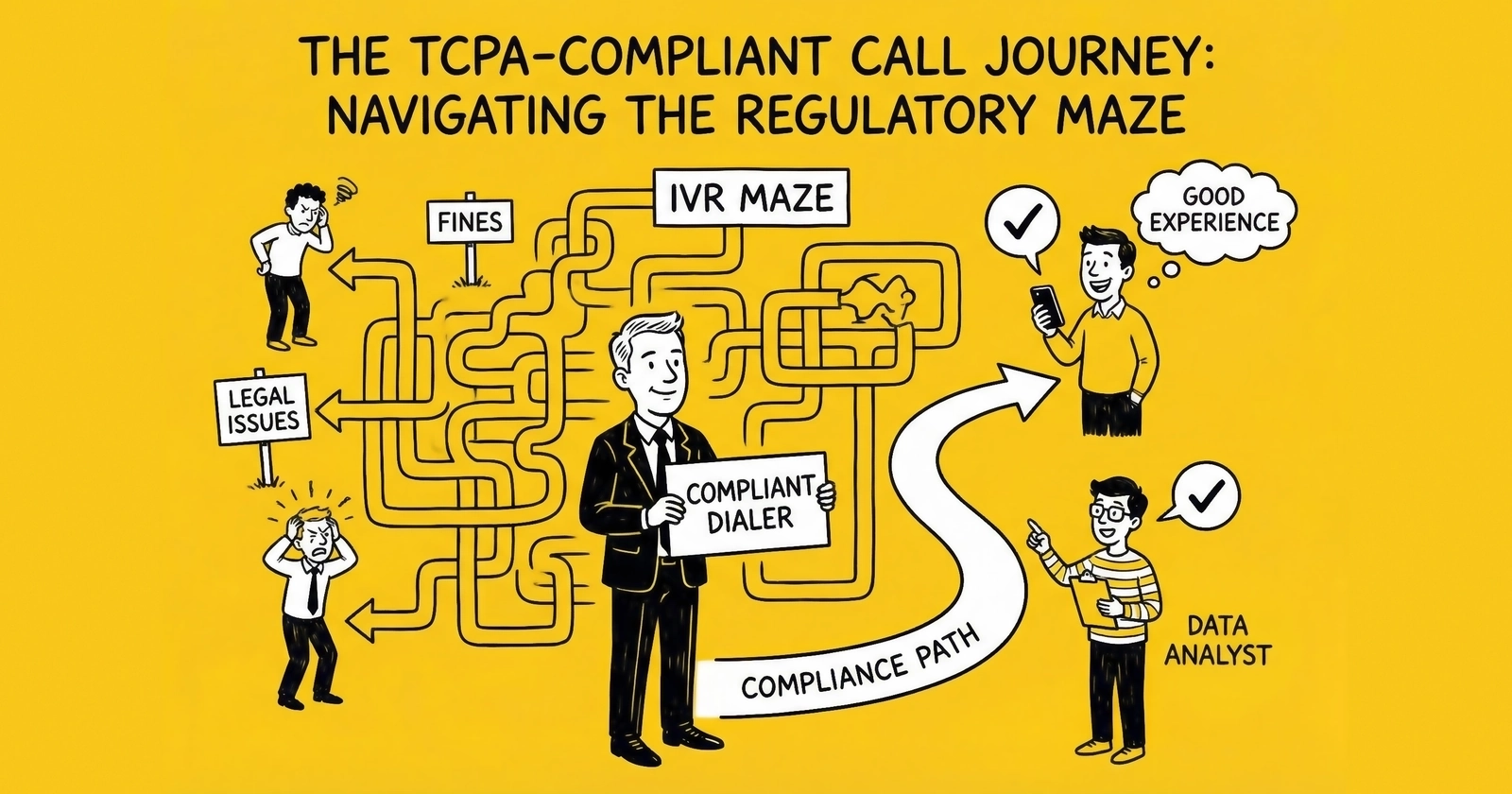
A comprehensive guide for lead generation professionals configuring Interactive Voice Response systems and auto-dialers to maintain regulatory compliance while maximizing operational efficiency.
Why Dialer Configuration Determines Your Survival
The phone rang at 7:47 PM Pacific Time on a Tuesday. The call reached a consumer in Florida. Under federal TCPA rules, a 7:47 PM call is perfectly compliant, falling comfortably within the 8:00 AM to 9:00 PM federal window. Under Florida’s Telephone Solicitation Act, which restricts calls to 8:00 AM to 8:00 PM local time, that same call constituted a violation because it arrived at 10:47 PM Eastern. The consumer happened to be a professional TCPA plaintiff with 23 prior lawsuits. The demand letter arrived 11 days later.
This is not a cautionary tale designed to scare you. This is Tuesday in the lead generation industry. The difference between a revenue-generating call and a lawsuit-generating violation often comes down to a single configuration setting buried three menus deep in your dialer’s admin panel.
Auto-dialers and IVR systems process thousands of calls daily, and each call represents either revenue opportunity or litigation exposure. The difference lies entirely in configuration. A properly configured system enforces compliance automatically, documenting every interaction in a format that will hold up to litigation scrutiny years later. A misconfigured system generates violations at industrial scale, creating exposure that can exceed a company’s annual revenue in a single quarter. There is no middle ground here – your dialing infrastructure either protects you or destroys you.
The numbers make the stakes painfully clear. In 2024, 2,788 TCPA cases were filed, representing a 67% increase over 2023’s already elevated levels. The TCPA litigation statistics for 2025 show the trend continuing. Through September 2025, class actions were running 97% ahead of the prior year’s pace, with 1,807 filed in just the first nine months. Average settlements exceed $6.6 million, and nearly 80% of TCPA lawsuits are filed as class actions. The statutory damages of $500 to $1,500 per violation, with no aggregate cap, mean that a dialer making 10,000 non-compliant calls faces potential exposure of $5 million to $15 million before attorney fees even enter the calculation. This guide provides the technical configuration requirements for TCPA-compliant IVR and auto-dialer operations based on requirements current as of late 2025. However, TCPA requirements evolve continuously through FCC rulemaking and court decisions. Treat this as a foundation requiring ongoing legal review, not a substitute for qualified TCPA counsel.
Understanding the Regulatory Framework for Dialers
Before configuring any dialing system, you must understand what the law actually requires and how different technologies trigger different obligations. The regulatory landscape has shifted dramatically in recent years, and configurations that were compliant five years ago may now generate violations with every call.
The ATDS Definition After Duguid
The Telephone Consumer Protection Act prohibits calls to cell phones using an Automatic Telephone Dialing System (ATDS) or prerecorded/artificial voice without prior express consent. The definition of ATDS has been extensively litigated, with outcomes that have fundamentally changed how the industry operates.
In 2021, the Supreme Court’s decision in Facebook v. Duguid narrowed the ATDS definition significantly. The Court held that equipment must actually use a random or sequential number generator to qualify as an ATDS. This ruling excluded many modern dialing systems that call from pre-loaded lists rather than generating numbers randomly. On its surface, this seemed like a major victory for the telemarketing industry, and many practitioners relaxed their compliance posture accordingly.
However, this narrowing provides far less protection than many practitioners assume, and those who loosened their controls based on Duguid are now discovering the hard way that their exposure never really diminished. The prerecorded message provisions operate independently of ATDS definitions. Calls using prerecorded voices to cell phones still require consent regardless of whether the dialing system qualifies as an ATDS. For lead generation operations where automated outbound calling typically involves some form of prerecorded messaging – IVR prompts, hold music, recorded disclosures, or qualification questions – the consent requirements remain largely unchanged. Your dialer’s ATDS status under Duguid affects one category of federal TCPA exposure but does not eliminate consent requirements for prerecorded messages. The practical implication is straightforward: configure consent verification regardless of ATDS classification.
State Mini-TCPA Autodialer Definitions
The Duguid narrowing applies only at the federal level, and several states have enacted their own telemarketing laws with broader autodialer definitions that capture systems the Supreme Court excluded from federal coverage. These state laws have become the primary battleground for TCPA-style litigation, and many practitioners remain dangerously unaware of their exposure.
Florida’s Telephone Solicitation Act (FTSA) covers equipment that dials stored numbers “with one click or touch.” Understanding state mini-TCPA laws including the FTSA and OTSA is essential for national operations. This seemingly innocuous phrase has enormous implications. Many modern CRM-integrated dialers that escape federal ATDS liability could trigger FTSA liability because click-to-dial functionality from a stored database may qualify as an autodialer under Florida law even without random number generation. If your sales team pulls up a lead record in Salesforce and clicks a button to dial, that may constitute automated dialing under Florida law.
Maryland’s Stop the Spam Calls Act retains a broader autodialer definition that predates Duguid, meaning equipment that dials from stored lists without random generation may still qualify as an autodialer under Maryland law. Oklahoma’s Telephone Solicitation Act (OTSA) uses a definition covering systems that “select or dial” numbers, capturing dialers that would not qualify as ATDS under the federal standard. Each of these states represents significant market population, and excluding them from your calling pool is rarely practical.
The configuration implication is unavoidable: your dialer configuration must accommodate the broadest applicable autodialer definition based on where you place calls. For national operations, assume the Florida and Maryland definitions apply and configure accordingly. The extra documentation and consent verification costs far less than defending a state-level class action.
Consent Requirements for Automated Calling
Prior Express Written Consent (PEWC) is required for telemarketing calls to cell phones using ATDS or prerecorded voice. Understanding what PEWC actually requires – and ensuring your systems verify it before every call – is the foundation of compliant operations.
A valid PEWC requires a written agreement that can be satisfied through electronic signatures complying with E-SIGN. The signature must come from the person who will be called, not someone else in their household or a third party. The agreement must contain clear authorization for the seller to deliver advertisements or telemarketing messages using automated technology or prerecorded voice. It must identify the specific telephone number authorized, because consent for one number does not transfer to another. It must include a statement that consent is not a condition of purchase. And the disclosure must be clear and conspicuous – buried language in fine print or presented in a way designed to minimize attention does not satisfy the requirement.
Your dialer must verify the presence of valid PEWC documentation before initiating any automated call. Our guide on consent documentation for TCPA compliance covers the implementation requirements. This is not optional, aspirational, or a best practice that can be deferred to later phases of your operation’s development. It is the foundation of compliant operations, and every call placed without verified consent is a roll of the dice with five-figure-per-call stakes.
Auto-Dialer Configuration Requirements
Modern dialing platforms offer extensive compliance features, often more than most practitioners realize exist within systems they already own. The challenge is ensuring proper configuration and ongoing monitoring rather than assuming default settings provide adequate protection.
Choosing the Right Dialer Type
Different dialing technologies create different compliance profiles, and understanding these differences should inform both your platform selection and your configuration decisions. Predictive dialers use algorithms to dial multiple numbers simultaneously, connecting answered calls to available agents. This technology increases agent productivity by ensuring someone is always ready to take the next call, but it creates specific compliance risks. Abandonment rate regulations from the FCC limit abandoned calls to 3% over 30 days, and predictive algorithms that optimize too aggressively for agent utilization will blow through this threshold. The timing between call answer and agent connection creates additional exposure, and the sheer volume of calls placed increases the risk of reaching numbers without verified consent.
Progressive dialers take a more measured approach, dialing one number at a time and waiting for disposition before dialing the next. This reduces abandonment risk substantially while still maintaining reasonable agent productivity. Power dialers occupy a middle ground, dialing from a queue as agents become available but typically one call at a time per agent. These offer more control than predictive dialers while maintaining efficiency. Preview dialers sit at the opposite end of the spectrum from predictive systems, presenting lead information to agents before dialing and allowing review and manual initiation. This provides maximum compliance control but the lowest productivity.
For operations with significant TCPA exposure – which includes virtually every lead generation operation of meaningful scale – progressive or power dialers offer better compliance control than predictive dialers. The productivity difference is often smaller than vendors suggest when you factor in the overhead of managing predictive dialer abandonment rates, and the risk reduction is substantial. The extra calls generated by predictive algorithms are worth nothing if they generate litigation that exceeds your revenue.
DNC Suppression Integration
Your dialer must suppress against multiple Do Not Call sources in real-time before any call is placed, and “real-time” means exactly that – not when the list was loaded, but immediately before each dial attempt. The National DNC Registry maintained by the FTC contains over 240 million phone numbers, and suppression against this registry is mandatory for telemarketing calls. Registry data must be refreshed according to FTC requirements, which mandate updates at least every 31 days, though many operations refresh weekly or daily to minimize the window of exposure from new registrations.
State DNC registries add another layer of complexity. Florida, Oklahoma, Texas, and other states maintain separate registries that may contain numbers not on the federal list. Your dialer must suppress against all state registries for states in your calling footprint, which for national operations means maintaining current data from multiple sources. Beyond external registries, your company must maintain and suppress against its own internal DNC list of consumers who have requested not to be called. Under April 2025 FCC rules, revocation requests must be honored within 10 business days, meaning your internal list must be updated and propagated to all dialing systems within that window.
Commercial litigator suppression lists have become increasingly important as professional TCPA plaintiffs have learned to game the system. Services from Contact Center Compliance, PossibleNOW, and Gryphon AI maintain databases of known serial TCPA plaintiffs, and integrating these into your suppression workflow provides an additional layer of protection against the most predatory actors.
The configuration process for DNC suppression requires integrating API endpoints into your dialer’s pre-call workflow, configuring suppression lookup to occur before each call rather than just at list load, setting up automated registry data refresh schedules, implementing logging of all suppression decisions for audit purposes, and configuring fallback behavior if suppression APIs become unavailable. That last point deserves emphasis: if your suppression service goes down, your dialer should block all calls until verification is restored, not proceed without suppression.
Time-of-Day Enforcement
Federal law prohibits telephone solicitations before 8:00 AM or after 9:00 PM in the recipient’s local time zone, but state laws impose stricter windows that your federal-only configuration will not catch. See our telemarketing calling hours by state for complete details. Florida restricts calling to 8:00 AM to 8:00 PM, as does Maryland. Oklahoma matches federal hours but prohibits calls on state and federal holidays.
Your dialer must implement time zone lookup based on recipient phone number, and this lookup must occur at the NPA-NXX level rather than just area code because mobile numbers frequently do not reflect the consumer’s current location. A consumer with a 212 New York area code who moved to California three years ago still carries that number, and calling them at 8:45 PM Eastern when they are actually in Pacific time means reaching them during their dinner hour rather than their late evening. Configure state-specific calling windows rather than just federal defaults, build buffer time into your windows to stop calling 5-10 minutes before cutoff and account for system latency, implement holiday calendars for states with holiday restrictions, and log all calls with timestamps in the recipient’s local time zone so your records accurately reflect when the call was received, not when it was placed.
Most dialer platforms default to federal hours and do not automatically apply stricter state rules. You must manually configure state-specific restrictions for Florida, Maryland, and any other applicable jurisdictions. This is not a platform deficiency – it is a recognition that state laws change frequently and vendors cannot maintain compliance responsibility across all 50 states. The configuration burden falls on you.
Consent Verification Integration
Your dialer must verify consent status before initiating any call, requiring integration with your lead management system and third-party consent verification services. TrustedForm integration involves retrieving and validating consent certificates before leads enter calling queues, configuring certificate age limits of typically 90 days or less for active consent, verifying certificates contain required disclosure elements, and storing certificate URLs with call records for litigation defense. Jornaya integration follows a similar pattern: validate LeadiD tokens before calling, check TCPA Guardian compliance status, and retain evidence tokens with call documentation.
The pre-dial workflow should include consent verification API calls, configured rejection behavior for leads without valid consent documentation, consent expiration rules based on your retention policy, and audit trails linking calls to specific consent certificates. When a lead fails verification, it should route to an exception queue for manual review rather than proceeding automatically.
Frequency, Caller ID, and Abandonment Controls
Oklahoma’s OTSA limits telephone solicitations to three calls per 24-hour period to the same telephone number for the same goods or services. While this is currently a primarily Oklahoma concern, frequency limits may expand to other states. Your configuration must implement per-number call counting with 24-hour rolling windows, track calls by phone number and product/service category since the limit applies per campaign rather than per company, configure automatic blocking when frequency limits are reached, and build Oklahoma-specific frequency rules into your routing logic.
Federal law requires accurate caller ID transmission, and many states prohibit blocking caller ID for telemarketing calls. Your configuration must transmit a valid, dialable callback number, ensure caller ID matches the business or brand making the call, never spoof or misrepresent caller identification, and implement STIR/SHAKEN attestation where required by your carrier. The emergence of STIR/SHAKEN as a spam-fighting framework means carriers increasingly reject or deprioritize calls that lack attestation, creating both compliance and deliverability reasons to ensure proper implementation.
The FCC limits abandoned calls – calls answered but not connected to an agent within two seconds – to 3% of answered calls over a 30-day period. Your configuration must set predictive dialer pacing algorithms to maintain abandonment below 3%, monitor abandonment rates in real-time with alerts when rates approach limits, configure automatic pacing adjustments when rates trend upward, and ensure that if abandonment occurs, a prerecorded message plays within two seconds identifying the caller and providing a callback number.
IVR Configuration for TCPA Compliance
Interactive Voice Response systems serve as the gateway between raw calls and qualified leads. Whether handling inbound calls from consumers responding to your advertising or qualifying outbound calls before connecting to agents, proper IVR configuration ensures compliance while maximizing call quality.
Inbound IVR Requirements
When consumers call your tracking numbers, the IVR handles initial interaction before routing or transfer. The compliance requirements here focus primarily on recording disclosures, consent capture, and opt-out handling.
Recording disclosures are required because you should absolutely be recording calls – they provide essential compliance documentation and dispute resolution evidence. The requirements vary significantly by state. One-party consent states allow recording as long as one party (your company) consents, making disclosure technically optional in many circumstances. However, best practice dictates disclosure regardless of legal requirement. Two-party consent states, including California, Florida, and Washington, require all parties to consent to recording. Your IVR must announce recording at the start of every call reaching or originating from these states.
The simplest approach is configuring your IVR to announce recording at the beginning of every call regardless of state, using language such as “This call may be recorded for quality assurance and compliance purposes.” This covers both one-party and two-party consent requirements universally and eliminates the need for state-level routing logic for this particular disclosure.
If your IVR process includes obtaining TCPA consent for future communications, the consent language must be clear, conspicuous, and properly documented. The required elements for IVR consent include clear identification of who will be calling, statement that calls may use automated technology or prerecorded messages, statement that consent is not required to purchase goods or services, an affirmative consent action through key press or verbal confirmation, and recording of the entire consent exchange. Your IVR must be scripted to include all required disclosure elements, capture and store audio recordings of consent interactions, log the specific phone number from which consent was provided, timestamp all consent captures with date, time, and time zone, and link IVR consent recordings to lead records for retrieval during litigation.
Opt-Out Handling in IVR
Under April 2025 FCC rules, consumers may revoke consent through “any reasonable manner.” Your IVR must recognize and process opt-out requests expressed in natural language. This means configuring IVR to recognize verbal opt-out requests including phrases like “stop calling me” and “take me off your list,” implementing speech recognition or human review for ambiguous requests, adding callers requesting opt-out to internal DNC immediately, confirming opt-out processing within the call when possible, and synchronizing opt-outs across all calling systems within 10 business days.
Outbound IVR Requirements
When your system initiates calls that play IVR prompts to consumers, the TCPA imposes specific requirements for prerecorded messages delivered to cell phones. Prior express written consent is required for telemarketing messages, while prior express consent that may be verbal is required for purely informational messages. Every message must identify the caller clearly at the beginning – not buried in the middle or presented after the marketing pitch. Every message must include a callback number where the caller can be reached.
Your configuration must include caller identification at the start of every prerecorded message, provide a callback number in every message, verify consent status before any prerecorded message is delivered, implement an opt-out mechanism within the message such as “Press 2 to be removed from our list,” and process in-message opt-outs immediately upon receipt.
When your IVR qualifies a caller for transfer to a live agent, the handoff must comply with disclosure requirements even though a person is taking over from the system. Disclose transfer to the caller before connecting, provide warm introduction when transferring to buyer agents so the consumer does not have to repeat information already provided, document transfer disposition for compliance records, and implement hold time limits since callers should not wait more than 30 seconds for agent connection.
State-Specific Configuration Requirements
National operations require state-level routing logic that applies the appropriate rules based on recipient location. The patchwork of state laws means that a single national configuration will inevitably violate some state’s requirements, and state-level customization is not optional.
Florida Configuration Requirements
Florida’s Telephone Solicitation Act creates specific technical requirements that affect virtually every national operation given Florida’s population and lead generation activity. Calling hours of 8:00 AM to 8:00 PM are one hour narrower than federal standards on the evening side. Your configuration must include a separate Florida calling window, time zone lookup at the NPA-NXX level to correctly identify Florida numbers, and buffer time before the 8:00 PM cutoff.
Florida’s broader autodialer definition means click-to-dial may qualify as regulated automated dialing. Treat any automated dialing from stored lists as potentially covered under FTSA, and capture PEWC even for systems that might not qualify as federal ATDS. Florida maintains its own state DNC registry requiring suppression in addition to the national registry.
One favorable Florida provision is the pre-suit notice requirement. FTSA requires a 30-day notice before filing suit, giving you an opportunity to cure violations before litigation commences. Maintain systems to track and respond to FTSA notices promptly, and document compliance efforts in response to notices. This pre-suit period represents your opportunity to settle or remediate before facing full litigation exposure.
Oklahoma Configuration Requirements
Oklahoma presents a different configuration challenge focused primarily on frequency limits and holiday restrictions. Calling hours of 8:00 AM to 9:00 PM match federal standards, but Oklahoma prohibits calls on state and federal holidays. Your configuration must include a holiday calendar for Oklahoma and suppress Oklahoma numbers on all applicable holidays.
The frequency limit of three calls per 24 hours per number per product requires implementation of per-number call counting and building frequency checking into your pre-dial workflow. Additionally, Oklahoma requires registration with the Attorney General before placing calls to Oklahoma consumers. Maintain current registration before placing Oklahoma calls or exclude the state from your calling pool.
Maryland and California Configuration Requirements
Maryland configuration focuses on calling hours and the broader autodialer definition. Calling hours of 8:00 AM to 8:00 PM match Florida’s restriction, requiring a separate Maryland calling window in your configuration. Maryland’s autodialer definition remained broader than the post-Duguid federal definition, meaning you should treat any stored-list dialing as potentially covered and capture PEWC for all automated calling to Maryland consumers.
California presents unique challenges primarily around recording consent. As a two-party consent state, California requires announcement of recording at the start of every call and capture of verbal acknowledgment or key press consent to proceed with recording. California maintains its own state DNC registry requiring suppression. The California Invasion of Privacy Act (CIPA) creates additional liability for certain privacy violations beyond TCPA, adding another dimension to compliance configuration.
Consent Documentation Integration
Your dialer and IVR systems must integrate with consent verification services to create defensible documentation for every call. When litigation comes – and for active operations, it is a matter of when rather than if – your ability to produce comprehensive consent documentation determines whether you settle for nuisance value or face existential exposure.
TrustedForm Integration Architecture
TrustedForm provides independent third-party documentation of consent capture that holds significant weight in litigation. Integration requires attention at multiple points in your lead processing workflow.
Certificate capture begins with deploying TrustedForm JavaScript on all lead capture forms, which generates a certificate documenting the consumer’s consent session. Certificate retrieval must occur via API at the time of lead purchase, before any contact attempt, not deferred until a compliance question arises. Certificate validation should verify the certificate contains required disclosure elements, including proper TCPA language, identification of authorized callers, and the not-required-for-purchase statement. Storage and retention should maintain certificate URLs with call records for a minimum of five years, extending beyond the four-year TCPA statute of limitations to provide a safety margin.
Your pre-call workflow should operate as a gated process. When a lead enters the dialing queue, the system retrieves the TrustedForm certificate via API. Certificate validation checks confirm the certificate exists and is claimed, the certificate age falls within your acceptable window, seller identification matches the calling party, and TCPA disclosure language is present. If validation passes, the lead proceeds to dial. If validation fails, the lead routes to an exception queue for review rather than proceeding without documentation.
Jornaya Integration and Call Recording
Jornaya’s LeadiD and TCPA Guardian provide alternative consent documentation that may be preferred or required by certain lead buyers. LeadiD capture requires deploying the Jornaya SDK on lead capture forms. Token validation via API before calling confirms the lead’s consent status. Compliance status checks against TCPA Guardian verify the lead meets compliance indicators. Evidence retention stores LeadiD tokens with call records for retrieval during disputes or litigation.
Call recordings serve as compliance documentation and dispute resolution evidence, often proving decisive in litigation over consent status or disclosure delivery. Record all calls with appropriate consent disclosures and store recordings with metadata linking to lead records. Implement retention policies aligned with statute of limitations for a minimum of five years, ensure recordings are retrievable by phone number, date, and lead identifier, and secure recordings against tampering with audit trails documenting chain of custody.
The metadata captured with each recording should include call timestamp with time zone, caller phone number, recipient phone number, call duration, disposition code, agent identifier if applicable, lead source, consent certificate reference, and transfer destination if applicable. This metadata allows reconstruction of the complete call context years later when a demand letter arrives asking about a specific contact.
Revocation Processing Configuration
April 2025 FCC rules significantly changed revocation handling requirements, creating a new compliance dimension that many operations have not yet fully implemented. If you’re facing litigation, our guide to TCPA defense strategies covers response protocols. Your systems must be configured to meet these standards, which are considerably more demanding than prior requirements.
The 10-Business-Day Processing Requirement
Companies must honor consent revocation requests within 10 business days of receipt, which sounds straightforward but creates significant operational complexity when revocations can arrive through any channel. Multi-channel recognition requires configuring systems to recognize revocation requests received via phone, text, email, web form, postal mail, or any other reasonable channel. The “any reasonable manner” language from the FCC means you cannot funnel consumers to a specific opt-out mechanism and ignore requests arriving through other channels.
Immediate logging requires logging revocation requests with timestamp upon receipt, creating an audit trail of exactly when the 10-day clock started. Cross-system synchronization requires propagating revocation to all calling and texting systems within 10 days, which for operations with multiple platforms means either real-time synchronization or workflow processes ensuring updates propagate before the deadline. Confirmation capability allows sending a one-time confirmation within five minutes if applicable, but this confirmation cannot contain any marketing content.
Keyword Recognition and Verbal Revocation
Standard opt-out keywords must trigger immediate revocation when received via text message. The recognized keywords include STOP, QUIT, REVOKE, OPT OUT, CANCEL, UNSUBSCRIBE, and END. Your SMS platform must recognize all standard keywords with case-insensitive matching, add the consumer to DNC upon keyword receipt, send a confirmation message within five minutes containing no marketing content, and log the revocation with timestamp for audit purposes.
IVR systems and live agents must recognize verbal revocation requests, which presents greater challenge than keyword-based SMS recognition. Configure speech recognition keywords including “stop calling,” “remove me,” “do not call,” and “take me off your list.” Train agents through scripted procedures to recognize revocation requests and process them immediately. Route unclear requests to compliance review through escalation procedures rather than proceeding with calling. When in doubt, adopt a conservative approach and treat ambiguous requests as revocations – the cost of removing someone who might have stayed on your list is trivial compared to the cost of continuing to call someone who revoked.
Testing and Quality Assurance
Before deploying any dialer or IVR configuration to production, comprehensive testing is essential. The scale of automated dialing means that configuration errors manifest as violations numbering in the thousands before anyone notices something is wrong.
Pre-Deployment Testing
DNC suppression testing must verify that National DNC suppression blocks test numbers on the registry, confirm state registry suppression works for applicable states, test internal DNC list functionality to ensure your own opt-outs are honored, verify litigator list suppression prevents calls to known plaintiffs, and test fallback behavior to confirm all calls are blocked when suppression API becomes unavailable.
Time-of-day testing must verify calls are blocked outside federal hours before 8:00 AM and after 9:00 PM in recipient time, test state-specific restrictions including Florida’s 8:00 PM cutoff and Maryland’s restrictions, confirm time zone lookup accuracy at the NPA-NXX level, and test holiday blocking for Oklahoma on appropriate dates.
Consent verification testing must verify calls are blocked without valid consent documentation, test certificate retrieval and validation workflows, confirm consent expiration rules function correctly for aged certificates, and test exception handling for leads that fail validation.
Recording and documentation testing must verify recording disclosure plays correctly at call start, confirm recordings store with required metadata fields, test retrieval by phone number, date, and lead ID, and verify retention policies prevent premature deletion.
Revocation testing must test SMS keyword recognition for all standard keywords, verify IVR opt-out processing adds consumers to DNC, confirm cross-system synchronization timing meets the 10-day requirement, and test confirmation message delivery and content.
Ongoing Monitoring Requirements
Post-deployment, continuous monitoring ensures sustained compliance as configurations drift and edge cases emerge. Daily monitoring should track abandonment rates to ensure they remain below 3% over the 30-day measurement period, verify DNC suppression performance, analyze call volume by time zone and state to identify patterns suggesting misconfiguration, and monitor exception queue volume for spikes indicating validation problems.
Weekly monitoring should review consent certificate validation rates and investigate declining rates, verify revocation processing timing meets the 10-day standard, analyze complaint volume and patterns for emerging issues, and test recording storage and retrieval functionality.
Monthly monitoring should verify registry update compliance with FTC requirements, check state registration renewals for states requiring telemarketing registration, conduct full compliance audit on a sample of calls, and confirm litigation hold compliance for any matters pending.
Vendor Selection Criteria
Selecting a dialer or IVR platform with robust compliance capabilities is foundational to your operation. The right platform makes compliance achievable; the wrong platform makes it nearly impossible regardless of your team’s intentions.
Essential Compliance Features
The features that separate adequate platforms from inadequate ones fall into clear categories. DNC integration must provide real-time federal and state suppression, not just batch updates – this is critical. Time zone management must operate at the NPA-NXX level with state-specific rule support – also critical. Consent verification API must integrate with TrustedForm and Jornaya – critical. Call recording must capture full recordings with comprehensive metadata – critical. State-specific rules must support Florida, Oklahoma, and Maryland requirements out of the box or through configuration – critical. Revocation processing must include keyword recognition and cross-channel synchronization – critical. Audit logging must provide complete call-level audit trails – critical.
Beyond the critical features, abandonment controls with real-time rate monitoring are high priority, as is caller ID management with STIR/SHAKEN support. Frequency limits with per-number call counting are medium priority but essential for Oklahoma compliance.
Recommended Platforms
For lead generation call centers running outbound campaigns, Convoso offers multi-timezone dialer controls with speed-to-lead optimization designed for the lead generation use case. Five9 provides enterprise-grade cloud contact center capabilities with comprehensive compliance features suitable for larger operations. Talkdesk offers a cloud platform with extensive integrations for operations requiring flexibility in their tech stack.
For pay-per-call operations routing inbound calls to buyers, Ringba has become an industry standard for call routing with IVR builder and real-time bidding capabilities. Retreaver focuses specifically on call tracking and routing with a compliance-first approach. Phonexa provides a comprehensive platform including call routing, IVR, and lead distribution in a single system.
For power dialing applications, PhoneBurner offers SMB-accessible power dialing with CRM integration suitable for smaller teams. Kixie provides Salesforce-native dialing with compliance features for organizations already invested in the Salesforce ecosystem.
When evaluating vendors, probe their compliance capabilities with specific questions. Ask how the platform handles state-specific calling hour restrictions and whether you must configure each state manually. Ask what DNC sources the suppression integrates with and whether real-time lookup is standard. Ask about TrustedForm and Jornaya certificate verification support and whether integration is native or requires custom development. Ask about the process for propagating revocation requests across systems and the typical synchronization timing. Ask how call recordings are stored, for how long, and what retrieval options exist. Ask what audit logging is available for compliance documentation and whether logs are tamper-evident. Ask about STIR/SHAKEN attestation handling and carrier requirements. Ask what reporting is available for abandonment rate monitoring and whether alerts can be configured.
Common Configuration Mistakes
These errors generate the majority of TCPA litigation. Learning from others’ expensive mistakes is considerably cheaper than making your own.
Relying on Federal Hours Only
many practitioners configure their dialers for the federal 8:00 AM to 9:00 PM window without accounting for state variations, resulting in routine violations during the one-hour gap between federal and state restrictions. A call at 8:30 PM to a Florida consumer is a violation under FTSA even though it is perfectly compliant under federal TCPA. Configure state-specific calling windows, apply the most restrictive applicable rule when multiple jurisdictions could apply, and build buffer time before cutoffs to account for system latency and processing time. A call that enters the queue at 7:58 PM might not be placed until 8:02 PM – build your buffers to account for this.
Area Code-Based Time Zone Lookup
Mobile numbers do not reliably correspond to their area code’s geographic location. A consumer with a 212 New York area code may have moved to California years ago and carries that number permanently. Calling based on area code assumes they are in Eastern time when they are actually in Pacific time. Use NPA-NXX level lookup for landlines, which provides more geographic precision. For mobile numbers, use billing address or consumer-provided location data when available. When uncertain about location, apply the most restrictive possible interpretation – call earlier in the day when multiple time zones could apply, and stop calling earlier in the evening.
Batch DNC Suppression Only
Suppressing against DNC lists only when loading calling lists is insufficient because consumers can add numbers to registries at any time. A number that was callable when you loaded your list on Monday may be registered on Tuesday and called on Wednesday, creating a violation despite your suppression process. Implement real-time DNC lookup before each call, not just at list load. Refresh registry data at least weekly to minimize the window of exposure from new registrations. Some operations refresh daily, which further reduces risk at modest additional cost.
Missing Consent Verification
Assuming leads arrive with valid consent without verification creates massive exposure. The seller of a lead may have captured deficient consent, consent that has expired, consent for different sellers than those actually calling, or no consent at all. Lead generation fraud exists, and even legitimate lead sellers occasionally have compliance gaps. Retrieve and validate consent certificates before any contact attempt. Do not dial leads without documented consent, period. When certificate verification fails, route to manual review rather than assuming the verification service is wrong.
Ignoring Revocation Timing
Many operations fail to propagate revocation requests across all systems within the required 10-day window, resulting in continued contact after revocation. When a consumer revokes consent via your website form but continues receiving calls because the revocation did not synchronize to your dialer, each subsequent call is a knowing violation. Implement centralized revocation processing that synchronizes across all calling and texting platforms within the regulatory window. Test synchronization timing regularly to ensure it actually completes within 10 business days rather than assuming it does.
Insufficient Recording Retention
Deleting call recordings before the statute of limitations expires destroys critical evidence that would have supported your compliance defense. The TCPA has a four-year statute of limitations, and recordings deleted at two years cannot be retrieved when the demand letter arrives at three years. Retain recordings for a minimum of five years, providing a safety margin beyond the four-year statute of limitations. Implement litigation holds when compliance issues arise to prevent routine deletion from destroying potentially relevant records.
Frequently Asked Questions
What qualifies as an auto-dialer under the TCPA after the Facebook v. Duguid decision?
Under the 2021 Supreme Court decision in Facebook v. Duguid, equipment qualifies as an Automatic Telephone Dialing System (ATDS) only if it uses a random or sequential number generator to store or produce phone numbers and dial them. Equipment that simply dials from stored lists without random generation does not meet the federal ATDS definition. However, this narrowing applies only to federal TCPA. State laws like Florida’s FTSA use broader definitions where click-to-dial from stored lists may qualify as an autodialer. Additionally, prerecorded message requirements apply regardless of ATDS status. If your calls include any prerecorded content including IVR prompts, disclosures, or hold messages, you still need consent.
What calling hours are compliant under TCPA and state laws?
Federal TCPA prohibits telephone solicitations before 8:00 AM or after 9:00 PM in the recipient’s local time zone. Florida and Maryland restrict calls to 8:00 AM to 8:00 PM, one hour narrower on the evening side. Oklahoma prohibits calls on state and federal holidays. Your dialer must be configured with state-specific rules, not just federal defaults. Use time zone lookup at the NPA-NXX level for landlines, and use billing address or consumer-provided location data for mobile numbers when available. Build five to ten minutes of buffer time before cutoffs to account for system latency.
How do I configure my dialer for DNC compliance?
Your dialer must suppress against multiple DNC sources before any call: the National DNC Registry refreshed at least every 31 days per FTC requirements, state DNC registries for all states in your calling footprint, your internal DNC list of consumers who have requested not to be called, and optionally litigator suppression lists. Configure suppression lookup to occur before each call, not just at list load. Implement logging of all suppression decisions for audit purposes. Configure fallback behavior to block all calls if suppression APIs become unavailable.
What consent documentation do I need before making automated calls?
For telemarketing calls to cell phones using automated technology or prerecorded voices, you need Prior Express Written Consent (PEWC) with specific elements: a written agreement signed by the consumer, clear identification of the seller authorized to call, explicit authorization for automated calling technology, identification of the specific phone number, statement that consent is not a condition of purchase, and clear and conspicuous disclosure. Third-party verification through TrustedForm or Jornaya provides independent documentation. Retrieve and validate consent certificates before any call attempt.
How do I handle opt-out requests under the 2025 FCC rules?
Under April 2025 FCC rules, you must honor consent revocation requests within 10 business days of receipt through any reasonable method. Standard opt-out keywords including STOP, QUIT, CANCEL, UNSUBSCRIBE, END, REVOKE, and OPT OUT must trigger immediate processing when received via text message. Configure your IVR and agent scripts to recognize verbal revocation requests. Implement centralized revocation processing that synchronizes across all calling and texting systems. You may send a one-time confirmation within five minutes, but it cannot contain marketing content.
What IVR disclosures are required for TCPA compliance?
Your IVR must include a recording disclosure at the start of calls such as “This call may be recorded for quality assurance purposes” to satisfy two-party consent state requirements like California and Florida. For outbound calls with prerecorded content, you must identify the caller at the beginning of the message and provide a callback number. If collecting consent during IVR, you must include all PEWC disclosure elements and capture the entire consent exchange as a recording with timestamp and phone number documentation.
How do state mini-TCPA laws affect my dialer configuration?
State laws often impose requirements beyond federal TCPA. Florida’s FTSA uses a broader autodialer definition and restricts calls to 8:00 AM to 8:00 PM. Maryland has similar calling hours and a broader autodialer definition. Oklahoma limits calls to three per 24 hours per number per product and prohibits calls on holidays. You must configure state-specific rules in your dialer. For national operations, apply the most restrictive applicable standard or implement state-level routing logic that applies the correct rules based on recipient location.
What happens if my consent verification API fails during dialing?
If consent verification services like TrustedForm or Jornaya become unavailable during dialing operations, your fallback behavior should block all calls until verification is restored. Proceeding without consent verification creates unacceptable litigation exposure. Configure your dialer to pause queues automatically when verification APIs fail. Monitor API availability continuously and alert operations immediately on outages.
How long must I retain call recordings and consent documentation?
The TCPA has a four-year statute of limitations, meaning claims can be filed for violations dating back four years. Retain call recordings and consent documentation for at least four years after the last contact made pursuant to that consent. Industry best practice is five years or longer to provide a safety margin. The Telemarketing Sales Rule now requires five-year retention for consent records, extended from two years in March 2024. Implement litigation holds when issues arise to suspend routine deletion for potentially relevant records.
What is the abandonment rate limit and how do I stay compliant?
The FCC limits abandoned calls – calls answered by consumers but not connected to an agent within two seconds – to 3% of answered calls over a 30-day measurement period. Configure your predictive dialer pacing algorithms to maintain abandonment below this threshold. Monitor abandonment rates in real-time. If a call is abandoned, you must play a prerecorded message within two seconds identifying the caller and providing a callback number. Progressive or power dialers typically have lower abandonment rates than predictive dialers and may be preferable for operations with significant TCPA exposure.
Key Takeaways
Dialer ATDS status after Duguid does not eliminate consent requirements. The Supreme Court narrowed the federal ATDS definition, but prerecorded message provisions apply regardless of ATDS classification. If your calls include any automated content, consent requirements remain.
State laws are often stricter than federal TCPA. Florida and Maryland restrict calling hours to 8:00 AM to 8:00 PM. Florida’s FTSA uses a broader autodialer definition. Oklahoma limits call frequency to three per 24 hours per number. Configure state-specific rules, not just federal defaults.
Real-time DNC suppression is mandatory. Suppress against federal and state registries, internal DNC lists, and litigator databases before every call. Batch suppression at list load is insufficient.
Consent verification must occur before dialing. Integrate TrustedForm or Jornaya validation into your pre-dial workflow. Do not call leads without documented consent certificates.
April 2025 revocation rules require 10-day processing. Configure systems to recognize revocation requests through any reasonable channel and synchronize across all calling platforms within 10 business days.
Call recording with full documentation is essential for litigation defense. Record all calls with disclosure, store with metadata linking to lead records, and retain for minimum five years.
IVR disclosures must satisfy the most restrictive applicable requirements. Announce recording at call start for two-party consent states. Include caller identification and callback number in all prerecorded messages.
Testing before deployment and ongoing monitoring after are non-negotiable. Comprehensive testing prevents configuration errors from generating violations at scale. Continuous monitoring catches drift before it becomes litigation.
The margin for error is zero. With 2,788 TCPA cases filed in 2024, class actions approaching 80% of filings, and average settlements exceeding $6.6 million, misconfigured dialing systems represent existential business risk.
Building a Compliant Dialing Operation
Those who survive the current TCPA environment are those who treat dialer and IVR configuration as core compliance infrastructure, not a technical afterthought delegated to whoever set up the phones. This requires investment in platforms with robust compliance features, in integration with consent verification services, in state-specific rule configuration, in ongoing monitoring and testing, and in documentation systems that can withstand litigation scrutiny. None of these investments are optional, and none can be deferred to “when we have time.”
The return on that investment is survival. A single class action can exceed a company’s annual revenue. The cost of proper configuration is measured in thousands; the cost of improper configuration is measured in millions. The math is straightforward, even if the implementation is not.
Configure your systems correctly. Document everything. Monitor continuously. Work with qualified TCPA counsel to ensure your specific implementation meets current requirements. The regulatory landscape continues evolving through FCC rulemaking and court decisions, and configurations that are compliant today may require adjustment tomorrow.
The math is unforgiving. Get it right.
This article provides general information about TCPA compliance for IVR and auto-dialer systems. It is not legal advice. TCPA requirements evolve continuously through FCC rulemaking and court decisions. Consult qualified legal counsel familiar with your specific operations for current compliance requirements.
Information current as of December 2025. Statistics from WebRecon litigation tracking, FCC enforcement data, and public court records.
Related Resources: