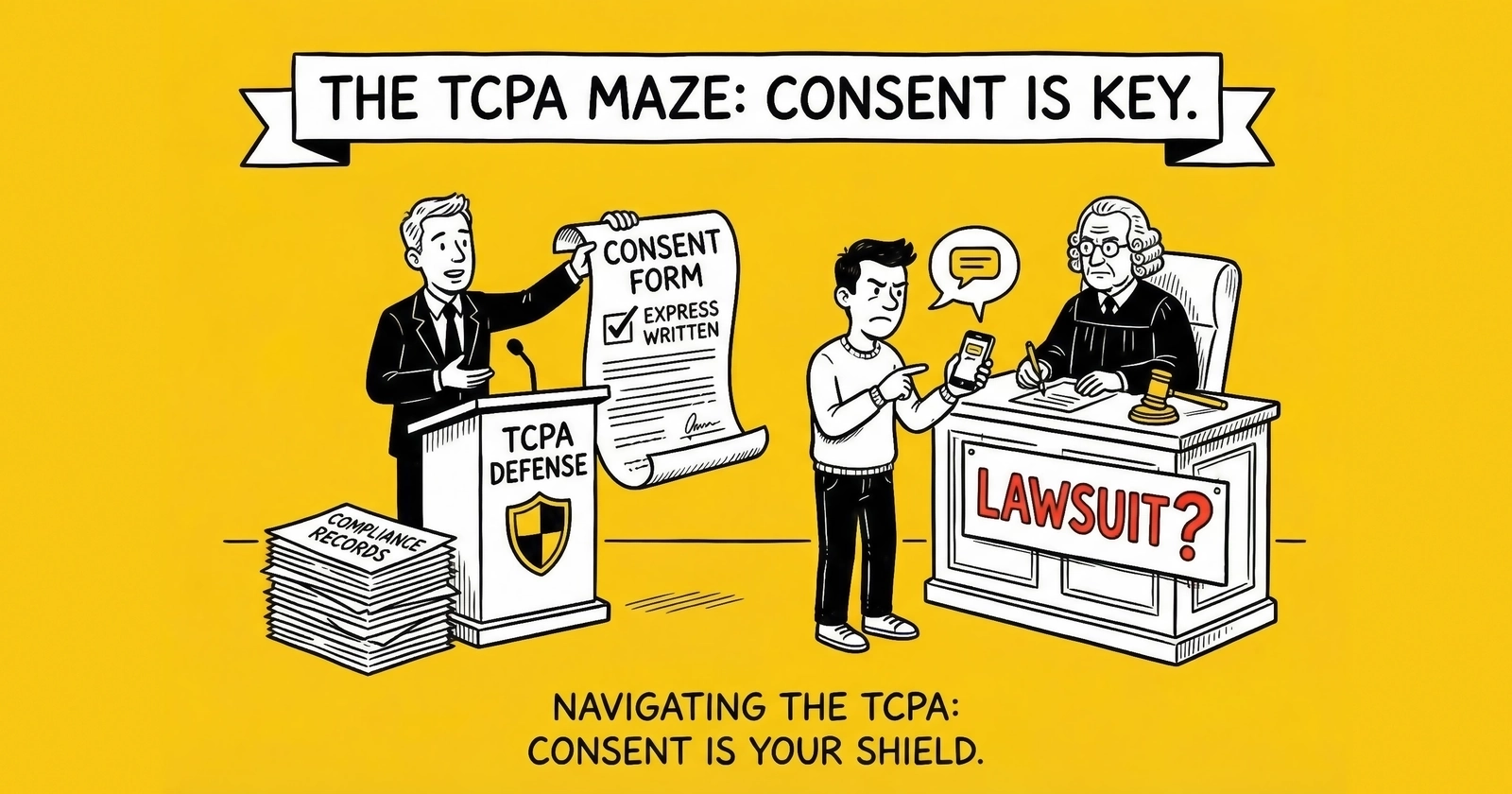
A comprehensive guide for lead generation professionals facing TCPA litigation, with proven defense strategies, early case assessment frameworks, and practical guidance from fifteen years of industry experience.
The Call You Do Not Want to Receive
Your general counsel calls at 4:47 p.m. on a Friday. A process server delivered a class action complaint this morning. The plaintiff alleges 23,000 TCPA violations across eighteen months of calling campaigns. Statutory damages: $11.5 million minimum. If the court finds willful violations, exposure trebles to $34.5 million. Your company’s entire annual revenue is $8 million.
This is the moment that separates prepared operators from those who are about to learn an expensive lesson.
TCPA litigation reached historic highs in 2024-2025. In 2024 alone, 2,788 TCPA cases were filed – a 67% increase over 2023. The first quarter of 2025 saw 507 class actions, a 112% increase over the same period in 2024. By September 2025, filings were running 97% ahead of 2024’s pace, with 224 class actions filed in a single month. Nearly 80% of all TCPA lawsuits are now filed as class actions, compared to just 2-5% for other consumer protection statutes.
The average class action settlement exceeds $6.6 million. Defense costs start at $40,000-$50,000 for early resolution and can exceed $500,000 for cases that proceed through trial. Even winning is expensive.
This article is not about avoiding TCPA lawsuits – that requires a comprehensive compliance program built before the first lead is generated. This article is about what to do when the lawsuit arrives anyway. Because even the most diligent operators can find themselves defending claims, and how you respond in the first 72 hours often determines the trajectory of the entire matter.
Understanding the TCPA Litigation Landscape in 2025
Before discussing defense strategies, you need to understand what you are defending against. The TCPA plaintiff ecosystem has become sophisticated, well-funded, and increasingly aggressive. Knowing who files these suits, where they file, and what they allege shapes every aspect of your defense strategy.
The Plaintiffs Driving This Litigation Wave
Serial litigators represent 31-41% of TCPA plaintiffs. These are professional plaintiffs who have turned TCPA claims into a business model, maintaining multiple phone lines specifically to receive marketing calls. One professional plaintiff, Melody Stoops, testified in court that she maintained 35 cell phones to support her “business” of being a TCPA plaintiff. Kenneth Johansen testified he had been a plaintiff in approximately 60 previous TCPA class actions and generates roughly $60,000 annually from TCPA lawsuits.
Plaintiff law firms have scaled their TCPA practices to meet this demand. Leading TCPA defense attorney Eric Troutman describes the statute as “the biggest cash cow in history” for the plaintiff’s bar. Firms are hiring additional attorneys specifically to increase filing capacity. They know the repeat plaintiffs, the vulnerable consent processes, and the pressure points that force quick settlements. Consumer advocacy organizations and state attorneys general have also become active, though private litigation far exceeds regulatory enforcement in volume.
Geographic concentration matters significantly for defense strategy. In 2024, three states accounted for 58% of all TCPA filings despite representing only 27.6% of the U.S. population. Understanding state mini-TCPA laws like Florida’s FTSA and Oklahoma’s OTSA is critical for defense strategy. Florida led with 330 cases representing 11.8% of the national total, followed by California with 274 cases at 9.8% and Texas with 170 cases at 6.1%. South Florida has emerged as a particular hotbed – in March 2025, a single South Florida firm filed over 100 lawsuits in one month, all alleging time-of-day violations from text messages sent outside permitted hours. If you are being sued in the Southern District of Florida, you are facing experienced plaintiff counsel in a jurisdiction with established TCPA precedent.
Common Claim Categories
Understanding the specific allegations you face determines which defenses are available and how to allocate defense resources. Consent deficiencies form the backbone of most complaints, with claims that the consent disclosure was not sufficiently clear and conspicuous, was buried in fine print, failed to adequately identify the caller, or was obtained as a condition of purchase.
Do Not Call violations target calls to numbers on the National Do Not Call Registry, which now contains over 240 million numbers, or failure to honor internal opt-out requests. Time-of-day violations address calls placed before 8:00 a.m. or after 9:00 p.m. in the recipient’s local time zone, with text message timing becoming a particular litigation focus.
Reassigned number liability targets calls made to numbers that have been reassigned to new owners who did not provide consent. Revocation failures have become increasingly significant under April 2025 FCC rules, which require honoring opt-out requests within ten business days through any reasonable method.
The First 72 Hours: Critical Response Protocol
When a TCPA lawsuit arrives, your response in the first three days sets the trajectory for everything that follows. Panic destroys cases. Methodical, documented response preserves defenses.
Immediate Actions in the First Four Hours
Stop the bleeding first. Pause all calling and texting campaigns related to the alleged violations. This does not mean shutting down your entire operation – it means immediately halting any campaigns that could generate additional violations with the same plaintiff or similarly situated consumers.
Do not delete anything. The moment you have reasonable anticipation of litigation – which a complaint or demand letter creates – you have a legal obligation to preserve relevant evidence. Instruct all personnel to halt any routine document destruction immediately.
Contact TCPA defense counsel immediately. Not your general business attorney. Not your corporate counsel who handles employment matters. A specialist who defends TCPA class actions weekly. The dynamics, economics, and strategies of TCPA litigation are specialized. General commercial litigators lack the pattern recognition that comes from handling hundreds of these cases.
Notify your insurance carrier by reviewing your E&O policy, commercial general liability policy, and any specialized TCPA coverage. Provide written notice of the claim immediately. Insurance notification deadlines are strict, and failure to provide timely notice can forfeit coverage.
Begin documentation immediately. Create a contemporaneous record of how you discovered the issue, who was informed, and what immediate actions were taken. This documentation becomes critical if spoliation or response adequacy becomes contested.
Assessment and Containment Through Hour Twenty-Four
Issue a written litigation hold. This hold must be in writing, distributed to all relevant custodians including third-party vendors who may hold relevant data, and require acknowledgment of receipt. Suspend auto-delete functions on email accounts. Preserve backup tapes. Document your preservation efforts meticulously.
Courts have imposed severe sanctions on defendants who failed to notify downstream vendors of pending litigation and the need to preserve data. Spoliation – the destruction of evidence – can result in adverse jury instructions that assume destroyed evidence would have been harmful to your case.
Identify the scope of potential exposure by determining how many consumers may have been affected, over what time period, using what calling technology and consent processes. This drives settlement valuation and defense investment decisions.
Pull consent records for the named plaintiff. Retrieve all available documentation for the specific individual bringing the claim – TrustedForm certificates, Jornaya LeadiDs, call logs, lead source documentation, form configuration records. If you cannot locate consent documentation for the named plaintiff, that is critical information for your defense strategy. Gather call logs and lead source documentation to identify every campaign that touched the plaintiff’s phone number, when calls were made, what technology was used, and who the ultimate calling party was.
Strategic Planning Through Hour Seventy-Two
Assess the strength of your consent documentation. Can you prove, with independent third-party verification, that the specific consumer agreed to receive calls from the specific caller for the specific purpose alleged? If yes, you have a strong consent defense. If documentation is incomplete or ambiguous, you need to evaluate settlement economics quickly.
Evaluate indemnification rights. If you purchased leads from a third party, review your contract for indemnification provisions. Notify the lead vendor in writing of the claim and your intent to seek indemnification. Even if you ultimately settle the underlying claim, preserve your indemnification rights for recovery against the responsible party.
Determine whether early settlement makes sense. For individual complaints from known serial litigators, nuisance settlement in the $2,500-$15,000 range often makes economic sense compared to $40,000-$50,000 in defense costs. For class actions, the calculus is more complex and requires counsel’s assessment of class certification likelihood and exposure magnitude.
Begin preparing your opposition to class certification. If this is a class action, class certification is the inflection point that transforms a manageable dispute into potential catastrophe. Your counsel should begin identifying arguments against certification from day one.
The Consent Defense: Your Strongest Protection
The strongest TCPA defense is valid consent. If you can prove that the consumer provided prior express written consent (PEWC) for the specific calls at issue, you have a complete defense. Building this defense requires retrievable, authentic, and comprehensive documentation.
What Valid Consent Requires
Under FCC regulations, prior express written consent demands an agreement in writing where electronic signatures satisfying the E-SIGN Act meet this requirement. The agreement must bear the signature of the person called – the individual to whom calls will be placed. It must clearly authorize the specific seller to deliver advertisements or telemarketing messages using automated technology or prerecorded voice and identify the specific phone number to which calls are authorized. Critically, consent may not be a condition of purchasing any property, goods, or services, and the consent language must be apparent to a reasonable consumer through clear and conspicuous disclosure.
Documentation That Wins Cases
Third-party verification certificates from services like TrustedForm and Jornaya provide independent documentation that can be presented in litigation as evidence of consent. Our consent documentation guide covers the technical requirements. These services deploy JavaScript on lead capture forms that documents the consumer’s interaction in real time, including a visual recording of what the consumer saw and what actions they took.
Certificate retrieval and retention matters enormously. Certificates must be claimed – retrieved and stored – at the time of lead acquisition, not reconstructed later. Unclaimed certificates expire. Best practice is to claim certificates immediately upon lead receipt and retain them for at least five years, exceeding the four-year TCPA statute of limitations.
Maintain records of exactly what consent disclosure was displayed on your forms at any given time. If forms are updated, preserve historical versions. The consent language that existed at the moment of lead capture is what matters, not what your form displays today. Services like TrustedForm provide session replay showing exactly what the consumer saw and how they interacted with the form. This visual evidence is powerful in litigation because it demonstrates compliance in a way that database records alone cannot.
The E-SIGN Complication
When consent is obtained electronically, the federal E-SIGN Act creates additional requirements that courts have increasingly recognized. In Bradley v. Dentalplans.com (D. Md. 2024), the court held that because TCPA requires “written” consent with specific disclosures, obtaining that consent electronically triggers E-SIGN’s consumer disclosure and consent requirements.
This means electronic TCPA consent captured without E-SIGN compliance may be unenforceable. For lead generators obtaining consent through web forms, this requires careful structuring of the consent flow to address both TCPA and E-SIGN requirements. Work with counsel to ensure your forms satisfy both frameworks.
The consent defense fails when documentation does not exist or cannot be retrieved, when the consent disclosure was deficient through lack of clarity or being buried in terms of service or conditional on purchase, when the caller was not identified in the disclosure, when the call was outside the scope of consent such as a different topic or seller than disclosed, when consent was revoked before the call was made, or when the phone number was reassigned to a new owner after consent was obtained. When consent defense is unavailable, you must pivot to alternative strategies.
The ATDS Defense After Facebook v. Duguid
The Supreme Court’s 2021 decision in Facebook v. Duguid narrowed the definition of “automatic telephone dialing system” (ATDS) significantly. Equipment must actually use a random or sequential number generator to qualify as an ATDS. Systems that dial from pre-loaded lists without generating numbers randomly may fall outside this definition.
This defense works when your dialing system calls from stored lists rather than generating numbers randomly or sequentially, when you can demonstrate through technical documentation that your equipment lacks random or sequential generation capability, and when the plaintiff’s claims are based on ATDS allegations rather than prerecorded message allegations.
However, this defense has significant limitations that constrain its usefulness. Prerecorded message provisions operate independently – calls using prerecorded voices to cell phones still require consent regardless of whether the dialing system qualifies as an ATDS. For lead generation operations where automated calling typically involves prerecorded messaging, the consent requirements remain largely unchanged.
State laws may use broader definitions than the federal standard. Florida’s Telephone Solicitation Act and other state mini-TCPAs often define automated dialing more broadly than the post-Duguid federal standard. The “capacity” question remains contested, with some plaintiffs arguing that if equipment has the technical capacity to generate numbers randomly – even if that feature was not used for the calls at issue – ATDS liability applies. Courts are split on this interpretation. Discovery burdens add another complication, as proving your equipment lacks random generation capability requires technical documentation and potentially expert testimony, adding defense costs.
To use the Duguid defense effectively, obtain technical specifications from your dialing platform vendor documenting how numbers are dialed. Confirm in writing that your system does not use random or sequential number generation. Preserve system configuration records showing how campaigns were executed. Prepare to explain, in non-technical terms, why your system falls outside the ATDS definition. This defense is most effective when combined with other defenses rather than relied upon exclusively.
Standing Challenges and Procedural Defenses
The Supreme Court’s 2021 decision in TransUnion v. Ramirez established that plaintiffs must demonstrate “concrete harm” to have Article III standing. Defendants have increasingly challenged plaintiff standing based on absence of concrete harm from receiving unwanted calls. The argument holds that receiving an unwanted call or text, without more, does not constitute sufficient injury to support federal court jurisdiction. The plaintiff must demonstrate tangible consequences – lost time, actual interruption, economic harm, or other concrete effects.
Courts are split on this issue. Some courts have dismissed TCPA claims for lack of standing when plaintiffs could not demonstrate injury beyond receipt of the call, while other courts have found that the invasion of privacy from an unwanted call constitutes concrete harm sufficient for standing. The law continues to evolve, and outcomes vary by circuit.
Standing challenges are most viable when the plaintiff received only a few calls or messages, cannot articulate specific harm beyond annoyance, presents no evidence of time spent dealing with the calls, and when calls occurred at reasonable times without causing actual disruption. Standing challenges are least viable when the plaintiff received numerous calls, when calls occurred at inconvenient times, when the plaintiff took action to stop the calls demonstrating actual burden, or when calls involved sensitive topics or false information.
Standing challenges can be filed early via motion to dismiss, potentially resolving cases before significant discovery costs accrue. However, standing motions that fail may antagonize the court and strengthen the plaintiff’s narrative. Consult with counsel on whether standing provides a viable defense in your specific case.
The Established Business Relationship Exception
For calls to residential landlines, an established business relationship (EBR) provides an exception to Do Not Call requirements. A transaction with the consumer within the preceding 18 months or an inquiry from the consumer within the preceding 3 months qualifies.
This defense has critical limitations. It does not apply to calls using prerecorded messages or autodialers to cell phones. It applies only to Do Not Call violations, not to consent requirement violations. The relationship must be with the calling party, not a third party, and the 18-month and 3-month windows are strictly enforced. For most lead generation operations, where cell phone calling and automated technology are standard, the EBR defense provides limited protection.
Consent Standard Distinctions and Their Strategic Implications
Understanding the distinction between consent standards is critical for defense strategy. Different call types require different consent levels, and correctly characterizing the calls at issue can determine which defenses are available.
Prior express written consent is required for telemarketing calls to cell phones using ATDS or prerecorded voice and for telemarketing prerecorded calls to residential landlines. Prior express consent that need not be written is required for non-telemarketing autodialed calls to cell phones and non-telemarketing prerecorded calls to cell phones. No consent is required for manual calls to any number for any purpose, subject only to DNC restrictions for telemarketing, or for calls that fall within specific exemptions such as certain emergency purposes.
If the calls at issue are non-telemarketing in nature – such as informational messages about an existing account – prior express consent rather than prior express written consent may be sufficient. Prior express consent can be implied from conduct, such as providing a phone number during a transaction.
This distinction matters because prior express consent is easier to demonstrate than PEWC, calls that do not meet PEWC requirements may still satisfy PEC requirements, and the telemarketing versus non-telemarketing distinction turns on the purpose of the call, which may be contested. Work with counsel to accurately characterize the calls at issue and determine which consent standard applies.
Serial Litigator Defenses
Given that 31-41% of TCPA cases are filed by serial litigators, defenses specific to professional plaintiffs have developed and can prove effective when properly deployed.
Challenging Class Representation
Named plaintiffs in class actions must be “typical” of the class they seek to represent. Serial litigators who maintain dozens of phone numbers and actively bait companies into violations may not be typical of ordinary consumers who received unwanted calls. In Johansen v. Bluegreen Vacations, the court denied class certification after finding the serial plaintiff had “deceptively” prolonged calls to bolster his damage claims. His conduct was not representative of putative class members who did not share his motivation to generate litigation.
Serial litigators who consent to receive calls and then challenge the validity of that consent may lack standing to sue. If the plaintiff invited the calls, the argument for concrete harm weakens. Some courts have applied equitable doctrines to limit recovery by plaintiffs who deliberately created the conditions for the lawsuit. If discovery reveals that the plaintiff set a “consent trap” – providing consent through a form the plaintiff knew was deficient – equitable defenses may apply.
Plaintiff litigation history is generally discoverable. If the plaintiff has filed numerous prior TCPA cases, this information can support arguments against class certification, undermine credibility on standing and harm, reveal patterns suggesting manufactured claims, and provide leverage in settlement negotiations.
Before responding to any TCPA claim, run the plaintiff’s name and phone number against litigator databases. Services like Contact Center Compliance (Litigator Scrub), PossibleNOW, and WebRecon maintain databases of known serial plaintiffs compiled from court records. If the plaintiff appears in these databases, your defense strategy and settlement calculus change significantly.
Arbitration Enforcement and Class Certification Battles
For companies that included arbitration agreements with class action waivers in their consent flows, enforcing these provisions can dramatically alter litigation dynamics. Individual arbitration eliminates class exposure and often makes plaintiff economics unfavorable. A plaintiff seeking $500-$1,500 in individual TCPA damages faces arbitration costs and attorney fee limitations that discourage pursuit.
Arbitration provisions must be clearly presented in the consent flow, actually agreed to by the consumer through signature or affirmative action, contain class action waiver language, and be enforceable under applicable state law. Courts regularly enforce TCPA arbitration agreements when properly formed, but scrutinize whether the consumer actually agreed to arbitration, whether the arbitration clause was conspicuous, whether state-law unconscionability doctrines render the agreement unenforceable, and whether the class waiver violates public policy.
If you have an enforceable arbitration agreement, file a motion to compel arbitration as early as possible. Prepare to demonstrate that the plaintiff agreed to the arbitration terms. Present documentation of the consent flow showing the arbitration disclosure. Be prepared for the plaintiff to challenge enforceability on procedural or substantive unconscionability grounds. Even if the motion to compel is denied, the litigation has demonstrated that future claims may face arbitration, potentially affecting plaintiff firm interest in pursuing similar cases against you.
The Class Certification Inflection Point
For class actions, class certification is the critical inflection point. Before certification, the case involves one plaintiff with exposure of $500-$1,500 potentially multiplied by number of calls. After certification, exposure can reach millions or billions of dollars.
Under Federal Rule of Civil Procedure 23, plaintiffs must demonstrate numerosity showing the class is so numerous that joinder is impracticable, commonality showing common questions of law or fact exist, typicality showing the named plaintiff’s claims are typical of the class, and adequacy showing the named plaintiff will fairly represent the class. Additionally, the plaintiff must satisfy one of the Rule 23(b) categories, typically 23(b)(3) requiring predominance of common questions and superiority of class treatment.
Defenses against class certification focus on individualized consent inquiries – if consent must be proved consumer-by-consumer, common questions do not predominate because different consumers may have provided consent through different forms, at different times, with different disclosures. Named plaintiff atypicality provides another avenue, as serial litigators, plaintiffs with unique consent circumstances, or plaintiffs whose claims arise from different campaigns than putative class members may not be typical representatives. Manageability concerns arise when the class is so large or varied that managing litigation becomes impractical. Ascertainability requires that the class be defined in a way that allows identification of members – if determining who received calls requires individualized inquiry, ascertainability fails.
Class certification briefing is often the most intensive phase of TCPA litigation. Prepare for this phase from day one by preserving records that demonstrate variations in consent processes across campaigns, documenting changes to forms and disclosures over time, identifying differences among putative class members that defeat commonality or typicality, and developing expert testimony on technical aspects of calling campaigns.
Settlement Strategy and Economics
Most TCPA cases settle. Understanding settlement dynamics helps you achieve the best possible resolution while avoiding traps that invite future litigation.
Individual Case Settlement Economics
For individual complaints and pre-litigation demands, settlement ranges typically fall into predictable bands. Nuisance settlements of $2,500-$15,000 address single-plaintiff claims with limited exposure. Moderate documentation concerns or multiple calls to a single plaintiff typically settle in the $15,000-$50,000 range. Cases with significant exposure, poor documentation, or particularly aggressive plaintiff counsel push into the $50,000 and above range.
Factors affecting individual settlement value include strength of consent documentation, number of calls and texts at issue, whether plaintiff is a known serial litigator, venue and applicable law, and defense costs if litigation proceeds.
Class Action Settlement Complexity
Class action settlements involve multiple elements requiring careful negotiation. The total settlement fund represents the amount available for distribution to class members. Claims processes establish procedures for class members to submit claims. Attorney fees typically consume 25-33% of the fund for plaintiff counsel. Release scope determines what claims are released by the settlement. All class settlements require judicial approval.
Class action settlement values vary enormously based on class size, liability strength, and exposure calculation. Settlements under $1 million are common for smaller classes. Mega-settlements exceeding $50 million involve massive classes with strong liability.
Timing Considerations
Pre-discovery settlement often makes economic sense when consent documentation is weak, exposure is high relative to company value, defense costs would exceed reasonable settlement value, or the case involves a serial litigator who will accept nuisance value.
Post-discovery settlement may be preferable when discovery will reveal strong defenses, you need information about class scope before valuing settlement, or plaintiff’s case may weaken as evidence develops. Post-certification settlement typically involves higher values because certification itself validates the plaintiff’s theories and dramatically increases exposure.
The Nuisance Settlement Trap
Paying nuisance settlements can attract additional litigation. Serial litigators and plaintiff firms track settlement behavior and target companies known to pay quickly. Consider whether the claim has merit, whether payment will encourage future claims, whether defense through motion practice might deter future suits, and the message sent to lead vendors and partners. Quick payment signals vulnerability and may generate more lawsuits than it avoids.
Insurance and Indemnification Realities
Two critical elements of TCPA defense strategy are often misunderstood, leaving companies exposed when litigation arrives.
Standard business insurance policies often do not cover TCPA violations. Our TCPA insurance coverage guide details what protection you actually need. General commercial liability policies typically exclude regulatory penalties. E&O policies may or may not cover TCPA claims depending on specific policy language. D&O policies often contain “invasion of privacy” exclusions that courts have applied to deny TCPA coverage.
Review your current policies with a broker who understands telemarketing compliance. Request a coverage opinion specifically addressing TCPA scenarios. Consider specialized TCPA insurance if your operations involve significant calling volume. Ensure coverage includes defense costs, not just damages.
Your contracts with lead vendors and marketing partners should include robust indemnification provisions. When a TCPA claim arises, immediately review contracts with any vendors involved in the lead flow, notify vendors in writing of the claim and your intent to seek indemnification, document their response, and preserve your indemnification rights even if you settle the underlying claim.
One critical warning deserves emphasis: indemnification clauses are only as valuable as the company providing them. If your lead vendor lacks assets or disappears, that indemnification right is worthless. Due diligence on vendor financial stability matters. Require vendors to carry TCPA-specific insurance and provide certificates of coverage.
Building Defense Infrastructure Before You Need It
The best defense is built before the lawsuit arrives. Practitioners who prepare now face better outcomes when litigation inevitably comes.
Establish relationships with TCPA-specialized legal counsel before you need them. Firms like Troutman Amin, Manatt Phelps, and others who focus on this space can provide guidance that general commercial litigators cannot. When litigation arrives, you do not want to be educating your lawyers about lead generation while simultaneously defending a class action.
Implement automated retention that captures complete consent documentation for every lead, retrieves and stores third-party verification certificates, preserves historical form configurations, maintains call logs and campaign records, and retains records for at least five years.
Screen every calling list against known litigator databases before campaigns launch. Services including Contact Center Compliance, PossibleNOW, and Gryphon maintain databases of over 600,000 names – professional plaintiffs, TCPA attorneys, and individuals who have sent demand letters. The investment is minimal compared to a single avoided lawsuit.
Document crisis response procedures before they are needed. Establish who receives notification of complaints, who has authority to pause campaigns, who contacts counsel and insurance carriers, who issues litigation holds, and where critical documents are stored.
Frequently Asked Questions
What should I do immediately when I receive a TCPA lawsuit?
Stop any calling campaigns related to the alleged violations. Do not delete any records. Contact TCPA-specialized defense counsel immediately – not your general business attorney. Notify your insurance carrier in writing. Issue a written litigation hold to all personnel and vendors. Begin gathering consent documentation for the named plaintiff.
How much does it cost to defend a TCPA lawsuit?
Early resolution within 6 months typically costs $40,000-$50,000 in defense fees. Cases proceeding through discovery cost $100,000-$300,000. Full defense through trial can exceed $500,000. Even successful defense is expensive, which influences settlement economics.
What is the strongest TCPA defense?
Valid consent is the strongest defense. If you can demonstrate through third-party verification from TrustedForm or Jornaya that the consumer provided prior express written consent for the specific calls at issue, you have a complete defense. This requires documentation showing the consumer agreed to receive calls from the specific caller for the specific purpose alleged.
Does the Facebook v. Duguid decision protect my dialing system?
Duguid narrowed the ATDS definition to require random or sequential number generation. Systems that dial from stored lists may fall outside this definition. However, this defense does not apply to prerecorded message claims, which operate independently. Most lead generation calling involves prerecorded messaging, so consent requirements often remain unchanged.
What percentage of TCPA cases settle versus going to trial?
Fewer than 5% of TCPA class actions reach trial. Most settle at various stages: 5-15% at the pre-litigation or demand letter stage, 20-30% before significant discovery, 25-35% after discovery but before class certification, and 15-25% after class certification. Settlement economics heavily favor resolution over full litigation.
How can I identify if a plaintiff is a serial TCPA litigator?
Run the plaintiff’s name and phone number against litigator databases maintained by services like Contact Center Compliance (Litigator Scrub), PossibleNOW, and WebRecon. Also search PACER for prior TCPA filings by the same plaintiff. Serial litigator status affects defense strategy and settlement leverage.
Can I enforce an arbitration agreement to avoid class action?
If your consent flow included an arbitration agreement with class action waiver that was clearly presented and agreed to by the consumer, courts regularly enforce these provisions. File a motion to compel arbitration early and demonstrate the consumer’s agreement. If enforced, individual arbitration eliminates class exposure.
What indemnification rights do I have against lead vendors?
Review your contracts for indemnification provisions covering TCPA compliance. Notify vendors in writing of any claim and your intent to seek indemnification. Preserve these rights even if you settle the underlying claim. However, indemnification is only valuable if the vendor has assets – require vendors to carry TCPA insurance.
How long should I retain consent documentation?
Retain consent documentation for at least five years after the last contact made pursuant to that consent. The TCPA statute of limitations is four years, and retaining records for five years provides margin for litigation filed near the limitations deadline. Store TrustedForm and Jornaya certificates indefinitely.
What are the key differences between state TCPA laws and federal TCPA?
Several states have enacted telemarketing laws exceeding federal requirements. Florida’s FTSA imposes 8 a.m.-8 p.m. calling hours versus 8 a.m.-9 p.m. federal and has a broader autodialer definition in some respects. Oklahoma’s OTSA and Maryland’s Stop the Spam Calls Act also differ from federal standards. Review our telemarketing calling hours by state for specific requirements. Companies with national operations must comply with the most restrictive applicable law.
Key Takeaways
The first 72 hours determine the trajectory. Pause related campaigns immediately. Preserve all records. Contact TCPA-specialized counsel. Notify insurance carriers. Issue litigation holds. Pull consent documentation for named plaintiffs.
Consent is your best defense. Third-party verification through TrustedForm or Jornaya provides documentation that can be presented in litigation. Certificates must be retrieved, stored, and retained for at least five years.
Multiple defense strategies exist. Consent defense, ATDS defense post-Duguid, standing challenges, arbitration enforcement, class certification opposition, and serial litigator defenses can be deployed based on case facts.
Settlement economics favor resolution. Defense costs of $40,000-$50,000 for early resolution often exceed reasonable settlement values for individual claims. Class actions require more complex calculus.
Serial litigators represent 31-41% of plaintiffs. Screen against litigator databases. Discovery into litigation history can support defenses and affect settlement leverage.
Insurance gaps are common. Standard policies often exclude TCPA coverage. Review policies with telemarketing-knowledgeable brokers. Consider specialized TCPA insurance.
Build defense infrastructure before you need it. Relationships with specialized counsel, document retention systems, litigator suppression, and crisis response protocols should exist before the first lawsuit arrives.
Vendor indemnification is only as valuable as the vendor. Require vendors to carry TCPA insurance. Document indemnification claims immediately when issues arise.
Class certification is the critical inflection point. Prepare opposition arguments from day one. Preserve evidence of consent variations that defeat commonality.
The math is unforgiving. With TCPA filings up 67% in 2024 and 112% in Q1 2025, with average settlements exceeding $6.6 million, defense preparation is not optional. It is the cost of operating in this industry.
Conclusion: Defense as Business Infrastructure
TCPA defense is not a legal function separate from operations. It is business infrastructure that determines whether your company survives contact with the litigation environment.
Those who defend successfully share common characteristics. They build documentation systems before they need them. They retain counsel who understand the unique dynamics of TCPA litigation. They screen against known litigators. They preserve records that prove compliance. They respond to lawsuits with methodical, documented precision rather than panic.
Those who fail share different characteristics. They assume compliance without verification. They retain counsel unfamiliar with TCPA nuances. They delete records that would have proved their defense. They wait until lawsuits arrive to think about response protocols.
You cannot prevent all TCPA lawsuits. Even the most compliant operations face claims from serial litigators, from consumers who provided consent and later deny it, from technical failures in complex systems. What you can control is how prepared you are when those claims arrive.
Build the infrastructure now. The lawsuit is coming.
Sources
- WebRecon LLC - TCPA litigation tracking and filing statistics
- Troutman Amin LLP TCPA Research - Defense firm case analysis and litigation trends
- TCPAWorld - Eric Troutman’s TCPA commentary and case law updates
- Facebook v. Duguid, 592 U.S. ___ (2021) - Supreme Court ATDS definition narrowing
- TransUnion v. Ramirez, 594 U.S. ___ (2021) - Supreme Court Article III standing requirements
- 47 CFR 64.1200 - TCPA Regulations - Federal TCPA consent requirements
- FCC TCPA Revocation Rules (2024) - April 2025 10-day revocation rule
- National Do Not Call Registry - Federal DNC registration data
This article provides general information about TCPA defense strategies. It is not legal advice. TCPA litigation is complex and fact-specific. Consult qualified TCPA defense counsel for guidance on your specific situation.
Statistics current as of Q4 2025. Sources: WebRecon LLC litigation monitoring, Troutman Amin LLP TCPA research, FCC regulatory filings, and industry sources.