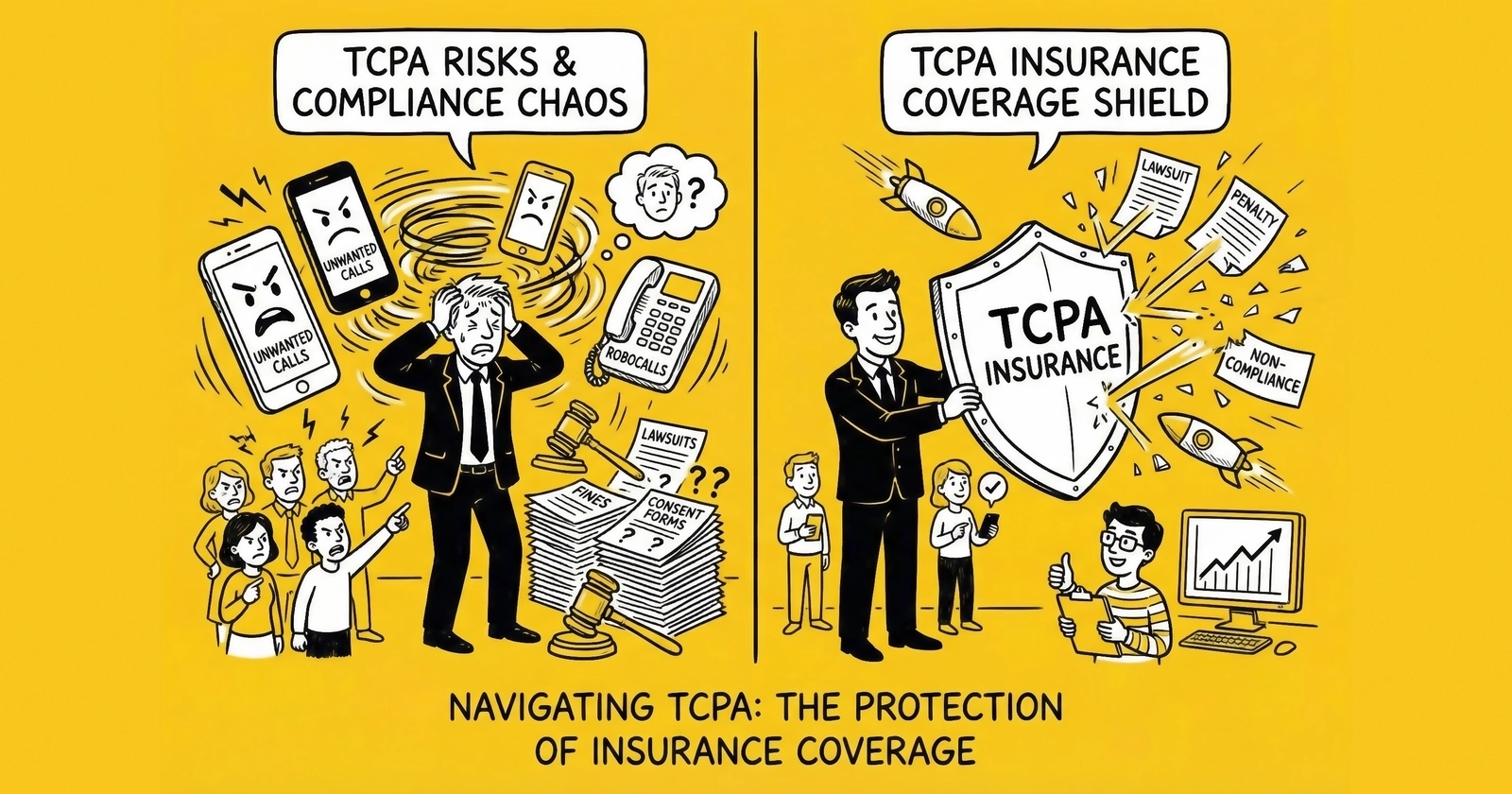
A comprehensive guide to understanding insurance protection against TCPA liability for lead generation professionals, including coverage types, common exclusions, policy selection strategies, and real-world claims scenarios.
Introduction: The Coverage Gap That Can Destroy Your Business
You run a compliant operation. You have TrustedForm certificates for every lead. Your DNC suppression is current. Your revocation handling meets the ten-business-day requirement. Your consent disclosures are clear and conspicuous.
And then a class action complaint arrives alleging 47,000 TCPA violations with potential exposure of $70.5 million.
Your first call is to your attorney. Your second call is to your insurance broker. And that second call is where many practitioners discover a devastating truth: the insurance policy they assumed would protect them offers no coverage for TCPA claims.
In the first quarter of 2025 alone, 507 TCPA class actions were filed – a 112% increase over Q1 2024. Average settlements exceed $6.6 million. Our TCPA litigation statistics analysis provides complete trend data. Nearly 80% of TCPA lawsuits seek class certification. And the standard business insurance policies that most lead generators carry often explicitly exclude or fail to cover these claims.
This is the coverage gap that destroys companies. A single TCPA class action can generate liability exceeding your total annual revenue. Defense costs alone can reach $500,000 before any settlement discussion begins. Without proper insurance protection, even a successfully defended lawsuit can bankrupt an otherwise healthy business.
This guide explains what TCPA insurance actually covers, what it excludes, which policies you need, and how to evaluate whether your current coverage provides meaningful protection. The goal is not to make you an insurance expert – it is to ensure you ask the right questions before the lawsuit arrives.
Understanding the TCPA Liability Landscape
Before evaluating insurance options, you need to understand what you are insuring against. TCPA liability has characteristics that make it fundamentally different from other business risks.
The Mathematics of Statutory Damages
Unlike most torts that require proof of actual harm, the TCPA provides statutory damages of $500 per violation regardless of whether the recipient suffered any concrete injury. If a court finds the violation was willful or knowing, damages treble to $1,500 per violation.
Consider the math for a typical lead generation operation:
A company sends 50,000 marketing text messages monthly. If 2% of those messages have a consent defect – a disclosure issue, an expired consent, a revoked number that was not suppressed – that creates 1,000 potentially non-compliant messages per month.
Over the four-year statute of limitations: 48,000 potential violations.
At minimum statutory damages: $24 million exposure.
At treble damages for willful violation: $72 million exposure.
This math explains why TCPA litigation has become what leading defense attorney Eric Troutman calls “the biggest cash cow in history” for the plaintiff’s bar. The economics favor aggressive pursuit even when individual harm is minimal or nonexistent.
The Class Action Multiplier
Approximately 80% of TCPA lawsuits are filed as class actions – compared to just 2-5% for other consumer protection statutes. Courts have certified classes containing millions of call recipients, creating exposure that can reach billions of dollars for high-volume operations. Plaintiff’s counsel works on contingency, taking 25-33% of any recovery, creating powerful incentives to bring cases that might not be economically viable as individual claims.
Defense Costs Independent of Outcome
Even successful TCPA defense is expensive. Defense costs for cases resolved early typically range from $40,000 to $50,000. Cases that proceed through discovery can reach $200,000 to $500,000. Complex class actions that go to trial can exceed $1 million. A company that did nothing wrong can still face six-figure legal bills simply to prove its innocence.
The 2024-2025 Litigation Surge
The numbers tell a story of exponential growth:
| Metric | Value |
|---|---|
| Total TCPA cases filed (2024) | 2,788 |
| Year-over-year increase (2024 vs. 2023) | 67% |
| Class actions filed Q1 2025 | 507 |
| Q1 2025 vs. Q1 2024 increase | 112% |
| Class actions through September 2025 | 1,807 |
| YTD increase vs. 2024 | 97% |
| Percentage of cases filed as class actions | ~80% |
| Serial litigators as percentage of plaintiffs | 31-41% |
| Largest 2024 settlement (National Grid) | $38.5 million |
This is not a declining risk. TCPA litigation is accelerating, plaintiff’s counsel is scaling up specifically to increase filing capacity, and the economics continue to favor aggressive pursuit of class action claims.
Why Standard Business Insurance Often Fails
The uncomfortable truth that many practitioners discover too late: standard business insurance policies often do not cover TCPA violations. Understanding why this coverage gap exists is essential for closing it.
General Commercial Liability Policies
General commercial liability (CGL) policies are the foundation of most businesses’ insurance programs. They typically cover bodily injury, property damage, and personal and advertising injury arising from business operations.
The problem for TCPA claims lies in multiple policy provisions:
The “Expected or Intended” Exclusion. CGL policies typically exclude coverage for injuries the insured expected or intended to cause. TCPA violations often arise from intentional conduct – you meant to send the text message or make the call, even if you did not intend to violate the law. Many courts have held that this exclusion bars coverage for TCPA claims because the underlying communications were intentional acts.
The “Personal and Advertising Injury” Coverage Question. Some insureds have argued that TCPA violations constitute “invasion of privacy” covered under the personal and advertising injury section of CGL policies. Courts are divided on this issue. Some have found TCPA claims fall within this coverage; others have held that statutory damages do not constitute “damages” under policy language, or that the specific type of privacy invasion at issue (unwanted calls) is not what the policy contemplates.
Statutory Penalty Exclusions. Many CGL policies contain exclusions for fines, penalties, or statutory damages. Since TCPA damages are statutory rather than compensatory, these exclusions can eliminate coverage even when other policy provisions might otherwise apply.
The result: CGL policies provide unreliable protection for TCPA claims. Some insureds secure coverage; others are denied. The outcome often depends on specific policy language, jurisdiction, and the particular facts of the claim.
Errors and Omissions Policies
Errors and omissions (E&O) policies, also called professional liability insurance, cover claims arising from negligent acts, errors, or omissions in providing professional services. For lead generators, this might seem like a logical source of TCPA coverage – after all, TCPA violations often result from operational errors in consent capture or calling practices.
However, E&O policies present their own challenges:
“Professional Services” Definition. E&O policies cover claims arising from the provision of professional services. Whether lead generation constitutes a “professional service” under a particular policy depends on how the policy defines that term. Some policies narrowly define covered services in ways that exclude marketing and lead generation activities.
“Privacy Wrongful Act” Coverage. Some E&O policies include coverage for “privacy wrongful acts.” Whether TCPA violations fall within this coverage depends on specific policy language. Broader definitions may cover TCPA claims; narrower definitions may not.
Exclusions for Advertising Activities. Many E&O policies exclude claims arising from advertising or marketing activities, reasoning that these should be covered under advertising liability policies rather than professional liability coverage. This exclusion can eliminate TCPA coverage even when other policy provisions might otherwise apply.
Regulatory Penalty Exclusions. Like CGL policies, many E&O policies exclude fines, penalties, and statutory damages. This exclusion can be particularly problematic for TCPA claims where the entire exposure consists of statutory damages.
The bottom line: E&O coverage for TCPA claims is inconsistent and policy-dependent. Some policies provide coverage; others explicitly exclude it. You cannot assume protection without careful policy review.
Directors and Officers Policies
D&O policies protect company leadership against claims arising from management decisions. In practice, these policies frequently contain provisions that limit TCPA coverage, including invasion of privacy exclusions, carve-outs for claims covered under other policies, and conduct exclusions triggered by intentional communications. D&O policies may provide some protection for individuals sued personally, but this coverage is often limited and uncertain.
Cyber Liability Policies
Cyber liability policies have become increasingly common as businesses recognize their exposure to data breaches, ransomware, and technology-related claims. Some cyber policies include coverage for privacy violations that might encompass TCPA claims.
However, cyber policies were not designed with TCPA exposure in mind:
“Security Failure” Requirements. Many cyber policies cover privacy claims arising from security failures – data breaches, unauthorized access, or similar incidents. TCPA claims typically do not involve security failures; they involve unwanted communications. This can place TCPA claims outside the policy’s coverage scope.
Sublimits and Aggregate Limits. Even when cyber policies provide some TCPA coverage, they often include sublimits for privacy claims that are far below the aggregate policy limit. A policy with $5 million in aggregate coverage might have only a $500,000 sublimit for privacy claims – inadequate for a serious TCPA class action.
Regulatory Exclusions. Cyber policies frequently exclude claims brought by government regulators. While private TCPA lawsuits might remain covered, FCC enforcement actions and state attorney general investigations may not be.
Cyber policies represent a potential source of partial coverage, but they are not a comprehensive solution to TCPA exposure.
Specialized TCPA Insurance: What Actually Provides Protection
Given the limitations of standard policies, specialized insurance coverage has emerged to address TCPA risk specifically. Understanding these options is essential for any operation with meaningful TCPA exposure.
TCPA-Specific Liability Policies
Several specialty insurers now offer policies designed specifically for TCPA exposure. These policies:
Cover Statutory Damages. Unlike standard policies that may exclude statutory damages, TCPA-specific policies are designed to cover the $500-$1,500 per-violation damages that constitute TCPA exposure.
Cover Class Action Defense. TCPA-specific policies anticipate class action litigation and provide defense cost coverage adequate for extended class action defense.
Address Common Exclusion Issues. Because these policies are designed for TCPA claims, they typically do not contain the exclusions that defeat coverage under standard policies – no unexpected or intended conduct exclusion applied to intentional communications, no statutory penalty exclusion, no advertising activity exclusion.
Provide Coverage for Multiple Claim Types. Better TCPA policies cover the full spectrum of potential claims: private lawsuits, FCC enforcement, state attorney general actions, and state mini-TCPA claims.
The primary limitation is availability and cost. TCPA-specific policies are offered by specialty insurers and may not be available through standard commercial insurance channels. Premiums vary significantly based on the insured’s call volume, compliance practices, prior claims history, and coverage limits.
Telemarketing Insurance Programs
Some insurers offer telemarketing insurance programs that bundle TCPA coverage with other protections relevant to call center and lead generation operations. These programs may include:
TCPA liability coverage as the core protection
State mini-TCPA coverage addressing Florida’s FTSA, Oklahoma’s OTSA, and similar state laws
Do Not Call violation coverage for claims arising from calls to registered numbers
Robocall enforcement coverage for FCC and state enforcement actions
Defense cost coverage with adequate limits for class action defense
Telemarketing programs are typically available through brokers who specialize in marketing and lead generation industries. They require detailed underwriting, including review of the insured’s consent capture practices, compliance technology stack, and claims history.
Media Liability and Advertising Injury Policies
Some media liability and advertising injury policies provide coverage that extends to TCPA claims. These policies are designed for companies that engage in advertising, marketing, and communications activities, making them a natural fit for lead generation operations.
Coverage under these policies may include:
Privacy violations arising from marketing activities
Advertising content claims including claims related to consent disclosures
Electronic communication claims covering text message and email marketing
The key is policy language. Some media liability policies explicitly include TCPA coverage; others are silent on the issue and coverage depends on interpretation; still others explicitly exclude TCPA claims. Review is essential.
Wrap-Up and Difference-in-Conditions Policies
For companies with complex insurance programs, wrap-up or difference-in-conditions (DIC) policies can fill gaps left by primary coverage. These policies provide coverage for claims that fall between or outside primary policy coverage, address coverage exclusions in underlying policies, and offer excess limits. DIC policies are typically expensive and most appropriate for larger operations with significant exposure.
Evaluating Your Current Coverage: The Policy Review Checklist
Before purchasing new coverage, assess what protection your existing policies actually provide. This requires more than a phone call to your broker – it requires detailed policy review.
Questions to Ask About CGL Coverage
-
Does the policy include Personal and Advertising Injury coverage? If so, does the definition of “personal and advertising injury” include invasion of privacy in a manner that could encompass TCPA claims?
-
Does the policy exclude claims arising from advertising, marketing, or communications activities? If so, TCPA claims may be carved out.
-
Does the policy exclude statutory damages, fines, or penalties? If so, the core TCPA exposure may be uninsurable under this policy.
-
Does the policy exclude intentional acts? How is “intentional” defined? Does sending an intentional communication that unintentionally violates the TCPA fall within the exclusion?
-
Has the insurer provided a coverage position on TCPA claims? Ask your broker to obtain the insurer’s position in writing.
Questions to Ask About E&O Coverage
-
Does the policy define “professional services” in a way that includes lead generation activities?
-
Does the policy include coverage for “privacy wrongful acts” or similar provisions?
-
Does the policy exclude advertising or marketing activities?
-
Does the policy exclude regulatory penalties and statutory damages?
-
Are defense costs covered within or in addition to policy limits? For TCPA claims, defense cost coverage can be as important as liability coverage.
Questions to Ask About D&O Coverage
-
Does the policy contain an invasion of privacy exclusion? If so, TCPA claims are likely excluded.
-
Does the policy provide entity coverage or only individual director/officer coverage? Entity coverage may extend to TCPA claims against the company; individual coverage protects only named individuals.
-
Are defense costs advanced or only reimbursed after adjudication? Advancement matters for managing cash flow during litigation.
Questions to Ask About Cyber Coverage
-
Does the policy cover privacy violations arising from marketing activities, or only from security incidents?
-
If TCPA claims are covered, what is the sublimit for privacy claims? Is it adequate for class action exposure?
-
Does the policy cover private lawsuits, regulatory actions, or both?
-
Are defense costs within or in addition to coverage limits?
The Coverage Opinion
For any policy you believe provides TCPA coverage, request a formal coverage opinion from the insurer. This is a written statement from the insurer confirming that the policy provides coverage for specified TCPA scenarios.
A coverage opinion is not a guarantee of coverage – the insurer can still deny coverage based on specific claim facts – but it provides valuable clarity and creates estoppel arguments if coverage is later disputed.
If the insurer refuses to provide a coverage opinion or provides an ambiguous response, treat that as strong evidence that coverage is uncertain.
Purchasing TCPA Insurance: What to Look For
If your current coverage is inadequate – and for most lead generators it probably is – you need to purchase specialized TCPA protection. Here is what to look for.
Coverage Scope
Private Lawsuits. The policy should explicitly cover private TCPA lawsuits, including individual claims and class actions.
Class Action Defense. Class action defense is dramatically more expensive than individual claim defense. Ensure defense cost limits are adequate for class action exposure – typically $500,000 to $1 million or more.
State Mini-TCPA Claims. Florida’s FTSA, Oklahoma’s OTSA, Maryland’s Stop the Spam Calls Act, and other state laws create exposure beyond federal TCPA. Coverage should extend to state-law claims. Our state mini-TCPA guide details each state’s requirements.
FCC Enforcement. FCC investigations and enforcement actions can result in substantial civil penalties. Coverage for regulatory defense and penalties provides important protection.
State AG Actions. State attorneys general have become increasingly active in pursuing telemarketing violations. Coverage should extend to these actions.
Do Not Call Violations. DNC claims represent a significant portion of TCPA litigation. Ensure coverage applies to both national registry violations and internal DNC violations.
Exclusions to Avoid
Intentional Acts Exclusion as Applied to Communications. Any TCPA policy that excludes coverage for “intentional acts” must carve out intentional communications that unintentionally violate the law. Otherwise, the exclusion defeats coverage for most TCPA claims.
Statutory Damages Exclusion. A TCPA policy that excludes statutory damages provides no meaningful protection. This is the core exposure you are insuring against.
Prior Acts Exclusion for Known Issues. Policies typically exclude claims arising from acts the insured knew violated the law before policy inception. This is reasonable. But an overly broad prior acts exclusion that sweeps in all pre-policy conduct may leave you exposed for violations from years past.
Marketing or Advertising Activity Exclusion. A policy that excludes marketing activities while claiming to provide TCPA coverage is contradictory. TCPA claims arise from marketing activities.
Limits and Deductibles
Aggregate Limits. Consider your actual exposure. If you send one million text messages annually, a $1 million policy limit covers fewer than 2,000 violations at minimum damages. For serious operations, limits of $5 million to $10 million or more are appropriate.
Per-Claim vs. Aggregate. Understand how limits work. A policy with $5 million aggregate and $1 million per-claim limits provides less protection than it appears – multiple claims could exhaust coverage before you reach the aggregate limit.
Defense Costs. Are defense costs within limits or in addition to limits? A $5 million policy with defense costs within limits might provide only $4 million in actual liability coverage after legal fees. Defense costs in addition to limits is preferable.
Deductibles and Self-Insured Retentions. Deductibles typically range from $10,000 to $100,000 or more depending on coverage limits and insured risk profile. Higher deductibles reduce premiums but increase out-of-pocket exposure.
Underwriting Requirements
TCPA insurers will want to understand your operations before providing coverage. Expect underwriting questions about:
Call and text message volume. Higher volume creates higher exposure.
Consent capture practices. Do you use TrustedForm, Jornaya, or similar verification? What does your consent disclosure say?
Compliance technology. Do you suppress against DNC registries? Do you screen for litigators? What systems enforce time-of-day restrictions?
Prior claims history. Have you been sued for TCPA violations? Have you received demand letters? How were they resolved?
Lead sources. Do you generate leads yourself or purchase from third parties? What due diligence do you conduct on lead sources?
Vendor management. If you use call centers or other vendors, what compliance requirements do you impose?
Better compliance practices typically result in better coverage terms and lower premiums. Insurers recognize that companies with robust compliance infrastructure present lower risk.
Premium Considerations
TCPA insurance premiums vary significantly based on:
Coverage limits. Higher limits cost more.
Call/text volume. Higher volume creates higher exposure and higher premiums.
Vertical. Some verticals (insurance, financial services) face more aggressive litigation and higher premiums.
Compliance quality. Demonstrable compliance practices reduce premiums.
Claims history. Prior claims increase premiums or may make coverage unavailable.
Deductible selection. Higher deductibles reduce premiums.
As a rough benchmark, expect premiums ranging from $15,000 to $50,000 annually for smaller operations with limited exposure, to $100,000 to $500,000 or more for larger operations with significant call volume and higher limits.
The relevant comparison is not the premium cost in isolation – it is the premium cost relative to self-insured exposure. A $50,000 annual premium that protects against $10 million in potential class action liability represents compelling economics.
Claims Scenarios: How TCPA Insurance Works in Practice
Understanding how TCPA insurance responds to actual claims helps illustrate both its value and its limitations.
Scenario 1: The Individual Demand Letter
A company receives a demand letter from a solo practitioner representing a consumer who claims to have received unwanted text messages. The demand seeks $15,000 to settle the claim.
Without insurance: The company evaluates whether to pay the nuisance settlement or defend the claim. Defense costs likely exceed the settlement demand, so payment is often the economically rational choice – even if the company believes it has valid consent. This dynamic encourages additional demand letters targeting the same company.
With TCPA insurance: The company tenders the claim to its insurer. The insurer evaluates the claim, likely pays the settlement if it falls within nuisance settlement authority, and the company pays only its deductible. The insurer’s involvement also provides professional claims handling and creates documentation useful for future claims.
Scenario 2: The Class Action Filing
A company is served with a class action complaint alleging it sent millions of text messages without proper consent. The complaint seeks class certification and statutory damages exceeding $100 million.
Without insurance: The company faces immediate cash demands for defense costs – typically $50,000 to $100,000 just to respond to the complaint and begin discovery. Survival depends on whether the company has reserves sufficient to fund defense while maintaining operations. Settlement negotiations occur against the backdrop of potential bankruptcy.
With adequate TCPA insurance: The company tenders the claim to its insurer. The insurer assigns experienced TCPA defense counsel (often better counsel than the company could retain on its own). Defense costs are covered, allowing the company to focus on operations rather than fundraising. Settlement negotiations proceed from a position of insurance-backed financial strength rather than desperation.
Scenario 3: The FCC Enforcement Action
The FCC initiates an investigation into a company’s calling practices, requesting production of consent records and compliance documentation. The investigation could result in civil penalties in the millions of dollars.
Without insurance: The company must fund regulatory defense from operating cash. Even if the investigation results in no penalties, the cost of response – document production, legal counsel, regulatory engagement – can reach six figures.
With TCPA insurance covering regulatory actions: Defense costs for responding to the investigation are covered. If the investigation results in penalties, those penalties may be covered depending on policy terms (some policies cover civil penalties; others do not). The company maintains operational focus while the insurer funds the regulatory defense.
Scenario 4: The Claim Against Purchased Leads
A company that purchases leads from third-party generators faces a TCPA class action based on allegedly non-compliant consent capture by its lead source. The company has TrustedForm certificates for all leads, but the underlying consent disclosures were allegedly deficient.
Without insurance: The company defends the class action while simultaneously pursuing indemnification from its lead vendor. If the vendor lacks assets or adequate insurance, the company bears the full exposure. The indemnification claim becomes a separate litigation drain on resources.
With TCPA insurance: The insurer covers defense of the class action. The company can pursue indemnification from its vendor as a separate matter without the pressure of funding its own defense. The insurer may have subrogation rights against the vendor, recovering amounts paid from the responsible party.
Indemnification: The Other Side of TCPA Risk Transfer
Insurance is not the only mechanism for transferring TCPA risk. Contractual indemnification from lead vendors and marketing partners provides an additional layer of protection – when structured properly.
The Indemnification Framework
Standard lead purchase agreements should include indemnification provisions requiring the lead vendor to defend and indemnify the buyer against TCPA claims arising from consent defects in the leads supplied. Key provisions include:
Defense obligation. The vendor must defend the buyer against TCPA claims, not merely reimburse defense costs after the fact.
Indemnification scope. The indemnification should cover all damages, settlements, and legal fees arising from vendor conduct.
Cooperation requirements. The buyer must cooperate with the vendor’s defense, provide timely notice of claims, and allow the vendor to control settlement decisions (subject to reasonable consent rights).
Insurance requirements. The vendor must maintain TCPA insurance adequate to support its indemnification obligations and provide certificates of coverage.
The Enforceability Reality
Indemnification clauses are only as valuable as the company providing them. A 2024 federal court decision in Moore v. Torchlight Technology Group reinforced that indemnification provisions can be enforced, granting summary judgment requiring a lead generator to indemnify its client after the generator failed to obtain proper consent.
But enforcement requires the indemnifying party to have assets or insurance. If your lead vendor is an undercapitalized LLC that folds when litigation arrives, your indemnification right becomes worthless.
Due diligence matters. Before relying on vendor indemnification:
Verify vendor financial stability. Request financial statements or other evidence of ability to satisfy indemnification obligations.
Require insurance. Mandate that vendors carry TCPA-specific insurance with adequate limits and require certificates of insurance as a contract condition.
Verify insurance annually. Insurance policies can lapse. Require updated certificates annually.
Audit compliance practices. Indemnification means nothing if the vendor’s practices create constant claims. Audit consent capture, verify TrustedForm usage, and review disclosure language.
The Coverage Stack
The most protected position combines:
-
Your own TCPA insurance covering claims regardless of source
-
Vendor indemnification with contractual defense and indemnity obligations
-
Vendor insurance requirements ensuring indemnification is backed by coverage
-
Due diligence and monitoring to prevent vendor-sourced claims from arising
When a claim arises, tender to your insurer for immediate defense while pursuing indemnification from the responsible vendor. Your insurer may have subrogation rights to recover from the vendor, aligning interests in vendor recovery.
Building a TCPA Risk Management Program
Insurance is essential, but it is not sufficient. A comprehensive TCPA risk management program integrates insurance with compliance infrastructure and operational controls.
Layer 1: Prevention
The best TCPA claim is the one that never arises. Prevention includes:
Robust consent capture. Clear and conspicuous disclosures, proper seller identification, TrustedForm or Jornaya verification, and documentation retained for five years or longer. See our consent documentation guide for implementation details.
DNC suppression. Real-time suppression against the National DNC Registry, state registries, and internal DNC lists before any call.
Litigator screening. Suppression against known TCPA plaintiff databases containing over 600,000 names.
Revocation handling. Automated processing of opt-out requests within ten business days across all communication channels. Understanding TCPA defense strategies helps when claims arise despite best practices.
Time-of-day enforcement. Hard stops preventing calls outside permitted hours based on recipient time zone.
Vendor management. Contractual compliance requirements, indemnification provisions, insurance mandates, and regular audits of lead sources.
Layer 2: Detection
When issues arise, early detection limits exposure:
Complaint monitoring. Track all consumer complaints, whether informal inquiries or formal legal threats.
Demand letter tracking. Log and analyze demand letters to identify patterns suggesting systemic issues.
PACER alerts. Set up alerts for your company name and related entities to catch lawsuit filings immediately.
Regulatory monitoring. Track FCC enforcement actions and FTC warning letters in your vertical.
Vendor performance tracking. Monitor return rates, complaint rates, and litigation arising from specific lead sources.
Layer 3: Response
When claims arrive, response protocols matter:
Immediate litigation hold. Preserve all relevant evidence the moment litigation is anticipated.
Timely insurance tender. Notify your insurer within policy-required timeframes, typically within days of receiving a claim.
Counsel engagement. Retain experienced TCPA defense counsel immediately – not general business litigators, but attorneys who specialize in TCPA defense. A TCPA compliance self-assessment can help identify vulnerabilities before claims arise.
Vendor notification. Notify lead vendors of claims and preserve indemnification rights.
Root cause analysis. Identify what failed and implement immediate corrective action to prevent recurrence.
Layer 4: Transfer
The transfer layer includes both insurance and contractual mechanisms:
TCPA-specific insurance with adequate limits, appropriate coverage scope, and manageable deductibles.
Vendor indemnification with defense and indemnity obligations backed by vendor insurance requirements.
Arbitration and class waiver provisions in consumer-facing consent language where enforceable.
Layer 5: Retention
Some risk must be retained:
Deductibles and self-insured retentions represent retained risk – ensure cash reserves are adequate.
Uninsurable conduct such as knowing, intentional violations cannot be transferred and must be prevented.
Coverage gaps between policies or above limits represent retained exposure.
Frequently Asked Questions
1. Do standard business insurance policies cover TCPA claims?
Standard business insurance policies – including general commercial liability (CGL), errors and omissions (E&O), and directors and officers (D&O) policies – often do not cover TCPA claims or provide only uncertain, disputed coverage. CGL policies may exclude statutory damages, intentional acts, or advertising activities. E&O policies may exclude marketing activities or define professional services narrowly. D&O policies often contain invasion of privacy exclusions. Before relying on standard coverage for TCPA protection, obtain a formal coverage opinion from your insurer.
2. What is TCPA-specific insurance and who offers it?
TCPA-specific insurance is specialized coverage designed to address the unique characteristics of TCPA exposure, including statutory damages, class action defense costs, and regulatory enforcement. These policies are offered by specialty insurers through brokers who focus on marketing, telemarketing, and lead generation industries. Unlike standard policies, TCPA-specific coverage is designed to respond to TCPA claims without the exclusions that defeat coverage under general business policies.
3. How much TCPA insurance coverage do I need?
Coverage needs depend on your exposure profile. Consider your monthly call and text volume, the number of potential violations over the four-year statute of limitations, and whether those violations would be treated as willful (trebling damages). A company sending one million messages annually faces potential exposure of $24 million to $72 million over four years. Coverage limits should be adequate for a credible class action scenario. Most lead generation operations should consider limits of $5 million to $10 million or more.
4. What is the typical cost of TCPA insurance?
TCPA insurance premiums vary significantly based on coverage limits, call/text volume, vertical risk profile, compliance quality, and claims history. Smaller operations with limited exposure may pay $15,000 to $50,000 annually. Larger operations with significant volume and higher limits may pay $100,000 to $500,000 or more. The relevant comparison is not the premium in isolation but the premium relative to self-insured exposure – a $50,000 premium providing $10 million in protection represents compelling economics.
5. What should I look for when purchasing TCPA insurance?
Key coverage elements include: private lawsuit coverage (including class actions), state mini-TCPA coverage (Florida’s FTSA, Oklahoma’s OTSA, etc.), FCC and state attorney general enforcement coverage, defense costs in addition to (not within) policy limits, adequate aggregate limits for class action exposure, and manageable deductibles. Avoid policies with exclusions for intentional communications, statutory damages, or marketing activities – these exclusions defeat the purpose of TCPA coverage.
6. Does vendor indemnification protect me from TCPA claims?
Vendor indemnification provides an additional layer of protection but is not a substitute for your own insurance. Indemnification clauses require the vendor to defend and indemnify you against TCPA claims arising from their lead generation practices. However, indemnification is only as valuable as the vendor’s ability to pay. If your vendor lacks assets or adequate insurance, your indemnification right may be worthless. Always require vendors to maintain TCPA insurance and provide certificates of coverage.
7. What happens when I tender a TCPA claim to my insurer?
When you tender a claim, the insurer evaluates coverage and assigns defense counsel if coverage applies. For individual claims, the insurer may negotiate settlement within their authority. For class actions, the insurer funds defense costs while the case is litigated or settled. Throughout the process, you typically have duties to cooperate, provide information, and not prejudice the defense. Defense costs are covered (subject to any deductible or retention), and settlement or judgment is covered up to policy limits.
8. Are FCC enforcement actions covered by TCPA insurance?
Coverage for FCC enforcement varies by policy. Some TCPA policies explicitly cover regulatory defense costs and civil penalties; others cover only defense costs; still others exclude regulatory actions entirely. When evaluating policies, specifically ask about FCC enforcement coverage and read the policy language carefully. If regulatory coverage is important, ensure it is clearly included.
9. How do deductibles work for TCPA insurance?
TCPA insurance deductibles typically range from $10,000 to $100,000 or more depending on coverage limits and risk profile. You pay the deductible amount before insurance coverage applies. For individual claims, this means you may pay small settlements out of pocket. For class actions, the deductible applies once and the insurer covers amounts above the deductible up to policy limits. Higher deductibles reduce premiums but increase out-of-pocket exposure.
10. Should I buy TCPA insurance if I have robust compliance practices?
Yes. Even the most compliant operations face TCPA claims. Professional plaintiffs specifically target companies for nuisance settlements. Consent challenges can arise from technical defects in disclosures that were believed to be compliant. Third-party lead sources may have compliance failures unknown to you. And defense costs apply even to meritless claims. Insurance protects the business when despite best efforts, claims arise. Think of it as the final layer in a defense-in-depth strategy.
Key Takeaways
-
Standard business insurance often fails to cover TCPA claims. CGL policies may exclude statutory damages, intentional acts, or advertising activities. E&O and D&O policies have their own limiting provisions. Before relying on existing coverage, obtain a formal coverage opinion.
-
Specialized TCPA insurance provides meaningful protection. TCPA-specific policies are designed to cover statutory damages, class action defense costs, and regulatory enforcement without the exclusions that defeat standard policy coverage.
-
Coverage limits must match actual exposure. With potential exposure of $500 to $1,500 per violation over a four-year statute of limitations, serious operations should consider coverage limits of $5 million to $10 million or more.
-
Defense costs are as important as liability coverage. Class action defense can cost $200,000 to $500,000 or more. Ensure defense costs are covered in addition to policy limits, not within them.
-
Vendor indemnification supplements but does not replace insurance. Contractual indemnification backed by vendor insurance requirements provides an additional recovery source, but your own coverage ensures protection regardless of vendor solvency.
-
Insurance is one layer of a comprehensive risk management program. Prevention through robust compliance, detection through monitoring, response through protocols, and transfer through insurance and indemnification work together to manage TCPA exposure.
-
The cost of coverage is a fraction of potential exposure. Premiums of $50,000 to $100,000 annually protecting against class action exposure of $10 million or more represent sound risk management economics.
-
Require vendors to maintain TCPA insurance and provide certificates annually. Indemnification rights are worthless if the indemnifying party lacks assets or coverage. Verify that contractual protections are backed by actual insurance.
-
Avoid policies with exclusions for intentional communications, statutory damages, or marketing activities. These exclusions defeat the purpose of TCPA coverage. A policy that excludes the core activities that create TCPA exposure provides no meaningful protection.
Closing: The Question Is Not Whether, But How Much
The question is no longer whether lead generation operations need TCPA insurance. The litigation environment has made that answer obvious. In 2024, 2,788 TCPA cases were filed. In Q1 2025 alone, 507 class actions were filed. Average settlements exceed $6.6 million. The math is unforgiving.
The question is how much coverage, from which sources, structured in what ways.
Those who build sustainable businesses are those who approach TCPA insurance not as an expense to minimize but as infrastructure to optimize. They purchase adequate limits. They verify coverage scope. They layer insurance with vendor indemnification. They integrate coverage into comprehensive risk management programs.
Standard business insurance was not designed for TCPA exposure, and it often fails when claims arise. Specialized coverage exists for exactly this purpose. The cost – substantial as it may seem – is a fraction of the exposure it addresses.
Every lead you generate, every call you place, every text you send represents both opportunity and risk. Insurance does not eliminate that risk. But it ensures that when the inevitable claim arrives – and it will – your business survives to operate another day.
The process server will eventually arrive at your door. The question is whether you have prepared for that moment.
This article provides general information about TCPA insurance and risk management. It is not legal or insurance advice. Insurance coverage varies by policy, insurer, and jurisdiction. Consult with qualified insurance professionals and TCPA legal counsel to evaluate your specific coverage needs and options.
Statistics current as of late 2025. Sources include WebRecon TCPA litigation data, FCC regulatory filings, and industry insurance market analysis.