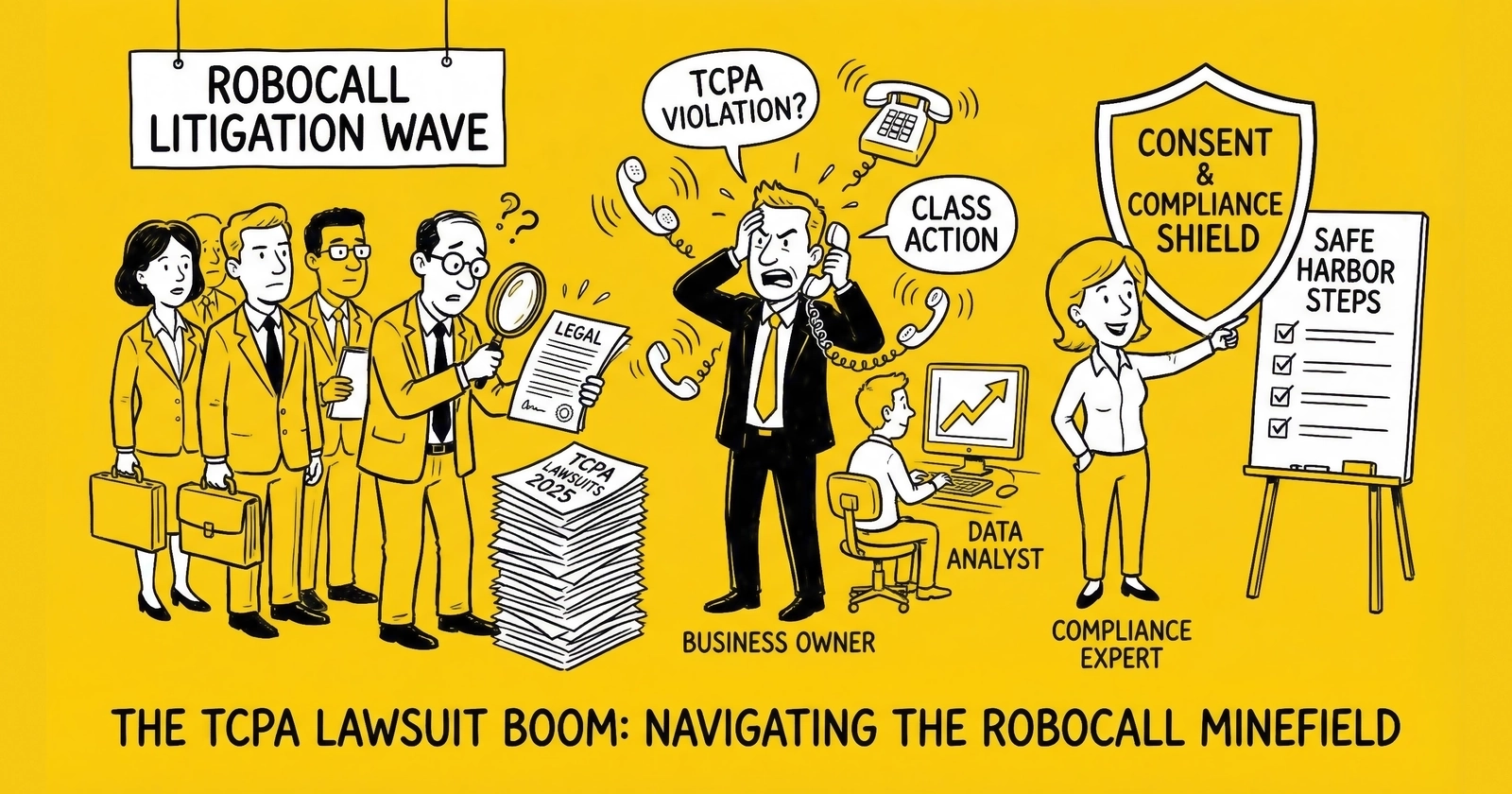
A comprehensive data analysis for lead generation professionals tracking the historic surge in TCPA class actions, settlement values, geographic concentration, and compliance economics.
The Numbers Tell the Story
The Telephone Consumer Protection Act has become what leading TCPA defense attorney Eric Troutman calls “the biggest cash cow in history” for the plaintiff’s bar. The 2025 litigation data proves him right.
In the first quarter of 2025 alone, 507 TCPA class actions were filed. That represents a 112% increase over Q1 2024. Average settlements exceed $6.6 million. Nearly 80% of all TCPA lawsuits are filed as class actions, compared to just 2-5% for other consumer protection statutes like the Fair Debt Collection Practices Act.
For lead generation professionals, these statistics represent existential risk. A single non-compliant calling campaign can generate exposure exceeding a company’s annual revenue. The margin for error has compressed to zero. Building a comprehensive TCPA compliance program is no longer optional.
This analysis provides the complete statistical picture: filing volumes, settlement data, geographic concentration, serial litigator patterns, defense costs, and what these trends mean for your operations. Every number cited here comes from verifiable sources including WebRecon litigation tracking, FCC enforcement data, and public court records.
2024-2025 Filing Volume Analysis
The TCPA litigation surge is not gradual. Filing volumes are accelerating at rates that should concern every operator in the lead generation space.
2024 Annual Statistics
Total TCPA cases filed in 2024: 2,788
This represents a 67% increase over 2023, which was itself a record year with approximately 1,670 filings. The 2024 total more than doubled the 2022 filing volume of approximately 1,300 cases.
| Year | Total TCPA Cases Filed | Year-Over-Year Change |
|---|---|---|
| 2022 | ~1,300 | Baseline |
| 2023 | ~1,670 | +28% |
| 2024 | 2,788 | +67% |
The acceleration continued throughout 2024. Q4 2024 saw higher monthly filing volumes than any previous quarter, with December 2024 recording 287 class action filings – the highest single month on record at that time.
Q1 2025: The Surge Intensifies
Class actions filed in Q1 2025: 507
This represents a 112% increase over Q1 2024. The first quarter alone saw filing volumes that would have represented an entire year’s worth of litigation a decade ago.
Monthly breakdown for Q1 2025:
- January 2025: 158 class actions
- February 2025: 164 class actions
- March 2025: 185 class actions
Each month exceeded the previous, establishing a pattern that continued through the year.
Full-Year 2025 Trajectory
By September 2025, TCPA class actions were running 97% ahead of 2024’s pace. Through the first nine months of 2025:
Class actions filed January-September 2025: 1,807
September 2025 set a new single-month record: 224 class actions filed, representing a 283% increase over September 2024’s 79 filings. This single month exceeded the total annual filings from the early 2010s.
At the current trajectory, 2025 full-year class action filings will approach or exceed 2,400 – nearly doubling 2024’s record total.
Class Action Dominance
Percentage of TCPA lawsuits filed as class actions: ~80%
In some months, this figure exceeds 95%. This rate dramatically exceeds other consumer protection statutes:
| Statute | Percentage Filed as Class Actions |
|---|---|
| TCPA | 80% (up to 95% in peak months) |
| FDCPA (Fair Debt Collection) | 2-5% |
| FCRA (Fair Credit Reporting) | 3-7% |
| TILA (Truth in Lending) | 5-10% |
The disparity reflects the plaintiff bar’s recognition that TCPA’s statutory damages structure – $500 to $1,500 per violation with no aggregate cap – makes class certification extraordinarily valuable. A class of 100,000 consumers receiving one non-compliant call each creates potential exposure of $50 million to $150 million.
Settlement Data and Financial Exposure
Settlement values provide the clearest picture of litigation risk. These figures represent actual financial outcomes, not theoretical exposure calculations.
Average Settlement Value
Average TCPA class action settlement: $6.6 million
This average spans cases from mid-seven figures to rare eight-figure settlements. The median settlement value runs lower – approximately $3.5 million to $4.5 million – but the arithmetic mean is skewed upward by mega-settlements.
Settlement values have increased over time as plaintiff counsel has become more sophisticated in case valuation and as courts have become more familiar with TCPA class action mechanics.
Largest TCPA Settlements on Record
| Company | Settlement Amount | Year | Alleged Violation Type |
|---|---|---|---|
| Caribbean Cruise Line | $76 million | 2016 | Prerecorded telemarketing calls |
| Capital One | $75.5 million | 2014 | Debt collection autodialers |
| DISH Network | $60 million | 2017 | Do Not Call violations |
| Wells Fargo | $50 million | 2023 | Autodialed debt collection calls |
| National Grid | $38.5 million | 2024 | Prerecorded marketing messages |
| Ally Financial | $32 million | 2023 | Autodialed calls without consent |
| DIRECTV | $30 million | 2015 | Telemarketing violations |
| Citibank | $29.5 million | 2024 | Autodialed debt collection |
| Ocwen | $27.5 million | 2022 | Autodialed debt collection calls |
| Conn’s HomePlus | $25 million | 2024 | Prerecorded/autodialed calls |
| Realogy | $20 million | 2024 | Real estate marketing calls |
2024’s largest settlement: National Grid at $38.5 million. This case involved prerecorded marketing messages and demonstrates that even non-financial-services companies face significant exposure.
Per-Class-Member Settlement Values
Most TCPA settlements provide between $50 and $500 per class member who submits a valid claim. The actual per-class-member recovery depends on:
- Number of violations per class member
- Strength of liability arguments
- Settlement fund size versus class size
- Claims rate (typically 3-15% of class submits claims)
| Settlement Range Per Class Member | Typical Case Characteristics |
|---|---|
| $50-$100 | Large class, limited violations per member |
| $100-$250 | Medium class, moderate liability strength |
| $250-$500 | Smaller class or strong liability case |
| $500+ | Small class or exceptional circumstances |
Notable outlier: The AT&T Mobility settlement in 2014 provided approximately $2,812 per class member – a figure widely viewed in the defense community as a significant overpayment that has not been replicated.
Settlement Timing Patterns
Cases settle at different stages with different value implications:
Pre-litigation/demand letter stage: 5-15% of cases resolve here, typically for $2,500 to $25,000. These are often nuisance settlements with serial litigators.
Pre-discovery stage: 20-30% of class actions settle after filing but before significant discovery, typically in the $500,000 to $2 million range.
Post-discovery, pre-certification: 25-35% of cases settle after discovery reveals class scope and liability strength, typically in the $2 million to $8 million range.
Post-class-certification: 15-25% settle after class certification, often at higher values ranging from $5 million to $25 million or more.
Trial or post-trial: Fewer than 5% of TCPA class actions reach trial. Those that do can result in verdicts exceeding settlements – or in defense victories.
Geographic Concentration Analysis
TCPA litigation concentrates in specific jurisdictions. Understanding geographic patterns helps companies assess risk based on operational footprint and target demographics.
Top Filing Jurisdictions (2024)
| State | Cases Filed | % of National Total | Population % of US |
|---|---|---|---|
| Florida | 330 | 11.8% | 6.5% |
| California | 274 | 9.8% | 11.8% |
| Texas | 170 | 6.1% | 9.3% |
| Illinois | 165 | 5.9% | 3.8% |
| New York | 148 | 5.3% | 5.8% |
| Georgia | 112 | 4.0% | 3.2% |
| Pennsylvania | 98 | 3.5% | 3.9% |
| New Jersey | 89 | 3.2% | 2.7% |
| Ohio | 82 | 2.9% | 3.5% |
| Michigan | 71 | 2.5% | 3.0% |
Florida, California, and Texas accounted for 58% of all TCPA filings in 2024 despite representing only 27.6% of the U.S. population.
Why These States Lead in Filings
Florida: Plaintiff-friendly procedural rules, experienced TCPA plaintiff counsel concentrated in South Florida, large retiree population (targets for financial services marketing), and the Florida Telephone Solicitation Act (FTSA) providing additional claims beyond federal TCPA. Our guide to state mini-TCPA laws including Florida’s FTSA covers compliance requirements. In March 2025, a single South Florida law firm filed over 100 TCPA lawsuits in one month – all alleging time-of-day violations from text messages sent outside permitted hours.
California: Large population, established consumer protection bar, and state laws (California Invasion of Privacy Act) that can supplement federal TCPA claims. California courts have historically been receptive to consumer class actions.
Texas: Large population, significant volume of financial services marketing, and procedural rules that do not disadvantage plaintiffs. Texas state courts are often chosen over federal courts by plaintiff counsel.
Illinois: Active plaintiff bar, high-volume debt collection activity, and courts familiar with TCPA class certification standards.
Federal vs. State Court Distribution
Approximately 65-70% of TCPA class actions are filed in federal court, with the remainder in state courts. The choice of forum affects procedural rules, class certification standards, and jury composition. Defendant companies often attempt removal to federal court when cases are filed in state court, though success rates vary by jurisdiction and case characteristics.
Serial Litigator Analysis
A significant portion of TCPA litigation originates from repeat plaintiffs who actively seek non-compliant communications. This is not conspiracy theory – it is documented reality with names, tactics, and court testimony.
Serial Litigator Prevalence
Percentage of TCPA cases filed by repeat plaintiffs: 31-41%
Analysis of 2024 filings found that 31% of cases were filed by individuals who had previously filed TCPA suits. Other analyses, using broader definitions of “repeat plaintiff,” place this figure as high as 41%.
Some individual plaintiffs have filed dozens of TCPA lawsuits over multiple years, generating significant income from settlements.
Documented Serial Litigator Tactics
Professional plaintiffs employ sophisticated techniques to generate litigation opportunities:
Multiple phone lines: Maintaining numerous phone numbers (prepaid, VoIP, multiple carriers) to increase the surface area for receiving non-compliant calls. One professional plaintiff, Melody Stoops, testified in court that she maintained 35 cell phones to support her “business” of being a TCPA plaintiff.
Consent-then-challenge: Providing consent through forms with potential deficiencies, then challenging the validity of that consent in litigation.
Time-zone exploitation: Living in or claiming time zones that make compliant calling hour calculations complex, then alleging violations.
Reassigned number scenarios: Obtaining phone numbers recently assigned to different individuals, then suing when calls intended for the prior number holder arrive.
Prolonging calls: Kenneth Johansen, who testified that he had been a plaintiff in about 60 previous TCPA class actions and makes roughly $60,000 a year from TCPA lawsuits since 2014, was found by the court in his case against Bluegreen Vacations to have “deceptively” prolonged calls to bolster his damage claims. Class certification was denied.
Litigator Suppression Solutions
The industry has responded by developing litigator suppression lists – databases of phone numbers and names associated with serial plaintiffs:
| Provider | Product | Coverage |
|---|---|---|
| Contact Center Compliance | Litigator Scrub | 50,000+ known litigator numbers |
| PossibleNOW | TCPA Litigator Database | Comprehensive plaintiff tracking |
| WebRecon | Litigator Alert | Real-time filing monitoring |
| Gryphon | Gryph platform | Integrated suppression |
Critical limitation: Litigator suppression lists reduce risk by identifying known serial plaintiffs but cannot identify first-time litigators or plaintiffs using new phone numbers. Relying solely on suppression without comprehensive compliance is inadequate.
Defense Cost Economics
Even successful defense of TCPA claims is expensive. These costs affect settlement calculus and must factor into compliance investment decisions.
Defense Cost Benchmarks
Early resolution (within 6 months): $40,000-$50,000
This range applies to cases resolved before significant discovery. Costs include:
- Initial case assessment: $5,000-$10,000
- Answer and initial motions: $10,000-$15,000
- Early settlement negotiations: $5,000-$10,000
- Settlement documentation: $5,000-$10,000
- Insurance and administrative costs: $5,000-$10,000
Defense through discovery: $100,000-$300,000
Discovery in TCPA class actions can be extensive, involving:
- Call records and consent documentation for potentially millions of calls
- Depositions of corporate witnesses on calling practices
- Expert witnesses on technology and compliance
- Electronic discovery from multiple systems
- Interrogatory and document request responses
Full defense through trial: $300,000-$750,000+
Cases that proceed through class certification, summary judgment motions, and trial can generate defense costs in the high six figures to low seven figures.
The Settlement Math
For many defendants, the economics favor settlement even when liability is questionable. Consider a typical scenario:
- A class of 50,000 consumers
- Statutory exposure: $25 million to $75 million
- Defense costs through certification: $150,000
- Defense costs through trial: $400,000
- Plaintiff’s settlement demand: $2 million
Even a defendant confident in their defenses often finds settlement economically rational when comparing $2 million against $400,000+ in defense costs plus trial risk.
Insurance Considerations
Most general liability and commercial umbrella policies exclude TCPA claims or contain significant limitations. Dedicated TCPA insurance products exist but are expensive and may contain sublimits inadequate for class action exposure.
Average TCPA insurance premiums: $15,000 to $50,000+ annually for $1 million to $5 million in coverage, with higher premiums for companies with significant calling operations or prior claims. Our TCPA insurance coverage guide details policy options.
Regulatory Developments Shaping Litigation
The litigation environment is shaped by ongoing regulatory changes that create new liability theories and modify existing ones.
FCC One-to-One Consent Rule (Vacated)
Status as of January 2025: Vacated by the Eleventh Circuit in Insurance Marketing Coalition v. FCC.
The rule would have required consent for each individual seller, eliminating multi-seller consent lists common in lead generation. While vacated, the regulatory attempt signals ongoing FCC interest in lead generation practices and may return in modified form.
The court held that undefined statutory terms must be given their “plain and ordinary meaning,” and the FCC’s one-to-one requirement imposed restrictions beyond common law consent principles. As the court stated: “At bottom, the FCC has decreed a duty that the statute does not require and that the statute does not empower the FCC to impose.”
April 2025 Revocation Rules
Status: In effect as of April 2025.
Key provisions:
- Consumers may revoke consent through any reasonable method
- Companies must honor revocation within 10 business days
- Standard opt-out keywords (STOP, QUIT, CANCEL, UNSUBSCRIBE, END, REVOKE, OPT OUT) trigger immediate revocation obligations
- Confirmation messages may be sent within 5 minutes but cannot contain marketing content
These rules create new liability vectors as companies struggle to implement 10-day revocation processing across fragmented systems.
State Mini-TCPA Proliferation
Several states have enacted telemarketing laws exceeding federal TCPA requirements:
| State | Law | Key Differences from Federal TCPA |
|---|---|---|
| Florida | FTSA (2021) | Broader ATDS definition (narrowed somewhat in 2023), 8 AM-8 PM calling hours |
| Oklahoma | OTSA (2022) | Private right of action, stricter consent requirements, call frequency limits |
| Maryland | Stop the Spam Calls Act (2024) | 8 AM-8 PM calling hours, broader autodialer definition |
| Washington | Various provisions | Enhanced penalties, additional consent requirements |
Companies with national operations must comply with the most restrictive applicable law, creating significant compliance complexity.
McLaughlin Supreme Court Case
The Supreme Court heard oral arguments in January 2025 regarding whether federal district courts are bound by FCC interpretations of the TCPA under the Hobbs Act (McLaughlin Chiropractic Associates v. McKesson Corp.). A ruling limiting deference to FCC guidance could result in more varied and unpredictable outcomes across jurisdictions, increasing litigation risk and uncertainty.
Compliance Investment ROI Analysis
The economics of TCPA compliance investment are unambiguous when measured against litigation exposure.
Cost of Compliance Technology
TrustedForm consent verification: $0.15-$0.50 per lead Comprehensive compliance technology stack: $0.25-$0.75 per lead (includes consent verification, DNC suppression, litigator screening, time-zone management)
Exposure Calculation
For a lead generation operation making 100,000 autodialed calls per month:
If 1% of calls have consent deficiencies:
- Potentially non-compliant calls: 1,000 per month
- Annual exposure at $500/violation: $6 million
- Annual exposure at $1,500/violation (willful): $18 million
If 0.1% of calls have consent deficiencies:
- Potentially non-compliant calls: 100 per month
- Annual exposure at $500/violation: $600,000
- Annual exposure at $1,500/violation: $1.8 million
Even minimal deficiency rates generate material exposure.
Break-Even Analysis
Average class action settlement: $6.6 million
If compliance technology at $0.50 per lead prevents one class action per 13.2 million leads, the investment pays for itself entirely – before accounting for defense costs, management distraction, reputational harm, and business disruption.
For most operations generating significant lead volume, compliance technology ROI is not debatable. It is mathematical certainty.
Operational Implications for Lead Generators
These statistics translate directly to strategic and operational decisions for lead generation businesses.
Risk Mitigation Priority Hierarchy
Based on filing patterns and settlement data, lead generators should prioritize:
- Consent documentation: TrustedForm, Jornaya, or equivalent third-party verification for every lead (see our consent documentation guide)
- Seller identification: Clear, specific identification of calling parties in consent disclosures
- Revocation processing: Systems capable of 10-day (or faster) opt-out processing synchronized across all channels
- Time-zone enforcement: Automated controls preventing calls outside 8 AM-9 PM recipient local time (see our telemarketing calling hours by state guide)
- Litigator suppression: Integration of known litigator databases before calling
- DNC suppression: Federal, state, and internal Do Not Call list integration
Geographic Risk Assessment
Operations concentrated in Florida, California, or Texas face elevated litigation risk based on filing patterns. Consider:
- Insurance coverage adequate for geographic exposure
- Local counsel relationships in high-risk jurisdictions
- Enhanced compliance monitoring for leads from high-risk states
- Documentation practices sufficient for litigation in plaintiff-friendly venues
Technology Stack Requirements
| Function | Purpose | Key Vendors |
|---|---|---|
| Consent Verification | Document PEWC for litigation defense | TrustedForm, Jornaya |
| DNC Suppression | Prevent calls to registered numbers | DNCScrub, DNC.com |
| Litigator Suppression | Identify and avoid serial plaintiffs | Litigator Scrub, TCPA Litigator List |
| Reassigned Number Checking | Avoid calls to new number owners | FCC RND, Neustar |
| Call Recording | Document call content | Integrated in dialing platforms |
| Time-Zone Management | Prevent off-hours calls | Integrated in dialing platforms |
Frequently Asked Questions
What is the current TCPA class action filing rate in 2025?
As of Q3 2025, TCPA class actions are being filed at a rate of approximately 200-225 per month, representing a 97% increase over the 2024 pace. Q1 2025 saw 507 class actions filed – a 112% increase over Q1 2024. By September 2025, 1,807 class actions had been filed year-to-date. At the current trajectory, 2025 full-year filings will approach or exceed 2,400 class actions, nearly doubling 2024’s record 2,788 total cases.
What is the average TCPA settlement amount in 2025?
The average TCPA class action settlement is approximately $6.6 million. However, settlements range widely from under $1 million for smaller classes with weaker liability cases to over $30 million for large classes with strong evidence of non-compliance. The median settlement value is lower – approximately $3.5 million to $4.5 million – but arithmetic averages are skewed by mega-settlements like National Grid’s $38.5 million payout in 2024.
How much does it cost to defend a TCPA lawsuit through trial?
Defense costs for TCPA litigation vary significantly by case stage. Early resolution within 6 months typically costs $40,000-$50,000 in legal fees. Cases proceeding through discovery cost $100,000-$300,000. Full defense through trial can exceed $500,000-$750,000, including expert witness fees, extensive document production, mock jury research, and trial preparation. Even successful defense is expensive, which is why many defendants settle even when they believe they have strong defenses.
What percentage of TCPA cases are filed as class actions?
Approximately 80% of TCPA lawsuits are filed as class actions. In some months, this figure exceeds 95%. This rate dramatically exceeds other consumer protection statutes – the Fair Debt Collection Practices Act sees only 2-5% class action filings, and the Fair Credit Reporting Act sees 3-7%. The TCPA’s statutory damages structure of $500-$1,500 per violation with no aggregate cap makes class certification extraordinarily valuable for plaintiff attorneys.
Where are most TCPA lawsuits filed geographically?
Florida, California, and Texas account for 58% of all TCPA filings despite representing only 27.6% of the U.S. population. Florida alone generated 330 cases in 2024 (11.8% of national total). South Florida has emerged as a particular hotbed for TCPA litigation, with experienced plaintiff counsel and plaintiff-friendly procedural rules. The Florida Telephone Solicitation Act (FTSA) provides additional claims beyond federal TCPA, further attracting litigation to the state.
What percentage of TCPA plaintiffs are serial litigators?
Between 31% and 41% of TCPA cases are filed by individuals who have previously filed TCPA lawsuits. These professional plaintiffs employ sophisticated techniques to generate litigation opportunities, including maintaining multiple phone lines, providing consent through forms with potential deficiencies, and exploiting reassigned number scenarios. Some serial plaintiffs have filed 60+ lawsuits and generate $50,000-$60,000 annually from settlements. Litigator suppression services help identify known plaintiffs, but cannot identify first-time filers.
How long do companies have to honor opt-out requests under 2025 FCC rules?
Under April 2025 FCC rules, companies must honor consent revocation requests within 10 business days of receipt through any reasonable method. Standard opt-out keywords (STOP, QUIT, CANCEL, UNSUBSCRIBE, END, REVOKE, OPT OUT) trigger immediate revocation obligations when received via text message. Companies may send a one-time confirmation message within 5 minutes of the opt-out request, but it cannot contain marketing content. Failure to meet the 10-day timeline creates per-contact liability for subsequent communications.
What are the statutory damages under TCPA per violation?
TCPA provides $500 per violation as the base statutory damage amount. If the court finds the violation was willful or knowing, damages can be trebled to $1,500 per violation. There is no cap on aggregate damages, which is what makes TCPA class actions so dangerous. A company that makes 10,000 non-compliant calls faces potential exposure of $5 million to $15 million. The four-year statute of limitations means exposure can accumulate over extended periods before a lawsuit materializes.
Does the Facebook v. Duguid decision eliminate TCPA liability for most modern dialers?
The 2021 Supreme Court decision in Facebook v. Duguid narrowed the ATDS definition to require random or sequential number generation, excluding many modern dialers that call from stored lists. However, this decision provides less protection than many practitioners assume. The prerecorded message provisions operate independently of ATDS definitions – consent requirements for calls using prerecorded voices still apply regardless of dialing system classification. Most lead generation calling involves some form of prerecorded messaging, maintaining consent requirements. Additionally, state mini-TCPAs like Florida’s FTSA may use broader autodialer definitions.
What is the statute of limitations for TCPA claims?
The TCPA has a four-year statute of limitations. This means exposure can accumulate over extended periods before a lawsuit materializes, and companies can face liability for violations dating back four years from the filing date. Consent documentation should be retained for at least four years after the last contact made pursuant to that consent – industry best practice is five years or longer to provide a safety margin. The Telemarketing Sales Rule now requires five-year retention for consent records, extended from two years in March 2024.
Key Takeaways
-
2,788 TCPA cases filed in 2024 represents a 67% increase over 2023. The acceleration continues in 2025, with Q1 seeing 507 class actions (112% increase) and September 2025 setting a single-month record of 224 filings (283% increase over September 2024).
-
80% of TCPA lawsuits are class actions, compared to 2-5% for other consumer protection statutes. The statutory damages structure of $500-$1,500 per violation with no aggregate cap makes class certification extraordinarily valuable for plaintiffs.
-
Average settlement: $6.6 million. Largest settlements exceed $75 million. Even modest-sized classes generate seven-figure exposure. Defense costs start at $40,000-$50,000 for early resolution and can exceed $500,000 for full defense through trial.
-
Florida, California, and Texas account for 58% of filings despite representing only 27.6% of the U.S. population. South Florida has emerged as the epicenter, with one firm filing over 100 lawsuits in a single month in 2025.
-
31-41% of cases come from serial litigators who actively seek non-compliant communications as a business model. Some plaintiffs have filed 60+ lawsuits and earn $50,000-$60,000 annually from settlements.
-
April 2025 FCC revocation rules require 10-business-day opt-out processing through any reasonable method. Standard keywords (STOP, QUIT, CANCEL) trigger immediate revocation obligations. Systems unable to meet this timeline create per-contact liability.
-
The compliance ROI math is unforgiving. For operations making 100,000 calls monthly, even a 0.1% deficiency rate creates $600,000+ annual exposure. Compliance technology at $0.25-$0.75 per lead provides astronomical ROI when measured against $6.6 million average settlements.
-
Documentation is defense. Without TrustedForm, Jornaya, or equivalent third-party verification, consent claims cannot be proven. Courts presume non-compliance absent documentation. A certificate documents what happened – it does not guarantee compliance with the underlying requirements.
-
State mini-TCPAs multiply requirements. Florida’s FTSA, Oklahoma’s OTSA, and Maryland’s Stop the Spam Calls Act impose stricter calling hours, broader autodialer definitions, and enhanced consent requirements. Federal compliance is the floor, not the ceiling.
-
The trajectory is upward. Filing volumes show no sign of moderation. The plaintiff bar is organized, well-funded, and expanding focus to new violation theories including text message timing and revocation failures. Compliance investment is not optional for survival.
Sources
- WebRecon LLC - TCPA litigation tracking and filing statistics
- Troutman Amin LLP TCPA Research - Defense firm litigation trend analysis
- TCPAWorld - Eric Troutman’s TCPA litigation commentary and data
- 47 CFR 64.1200 - TCPA Regulations - Federal TCPA rules
- Facebook v. Duguid, 592 U.S. ___ (2021) - Supreme Court ATDS definition ruling
- Insurance Marketing Coalition v. FCC (11th Cir. 2025) - One-to-one consent rule vacatur
- FCC TCPA Revocation Rules (2024) - April 2025 effective date rules
- National Do Not Call Registry - FTC consumer registration data
Statistics current as of Q3 2025. TCPA requirements evolve continuously through FCC rulemaking and court decisions. Consult qualified legal counsel for current compliance requirements specific to your operations.
Related Resources: