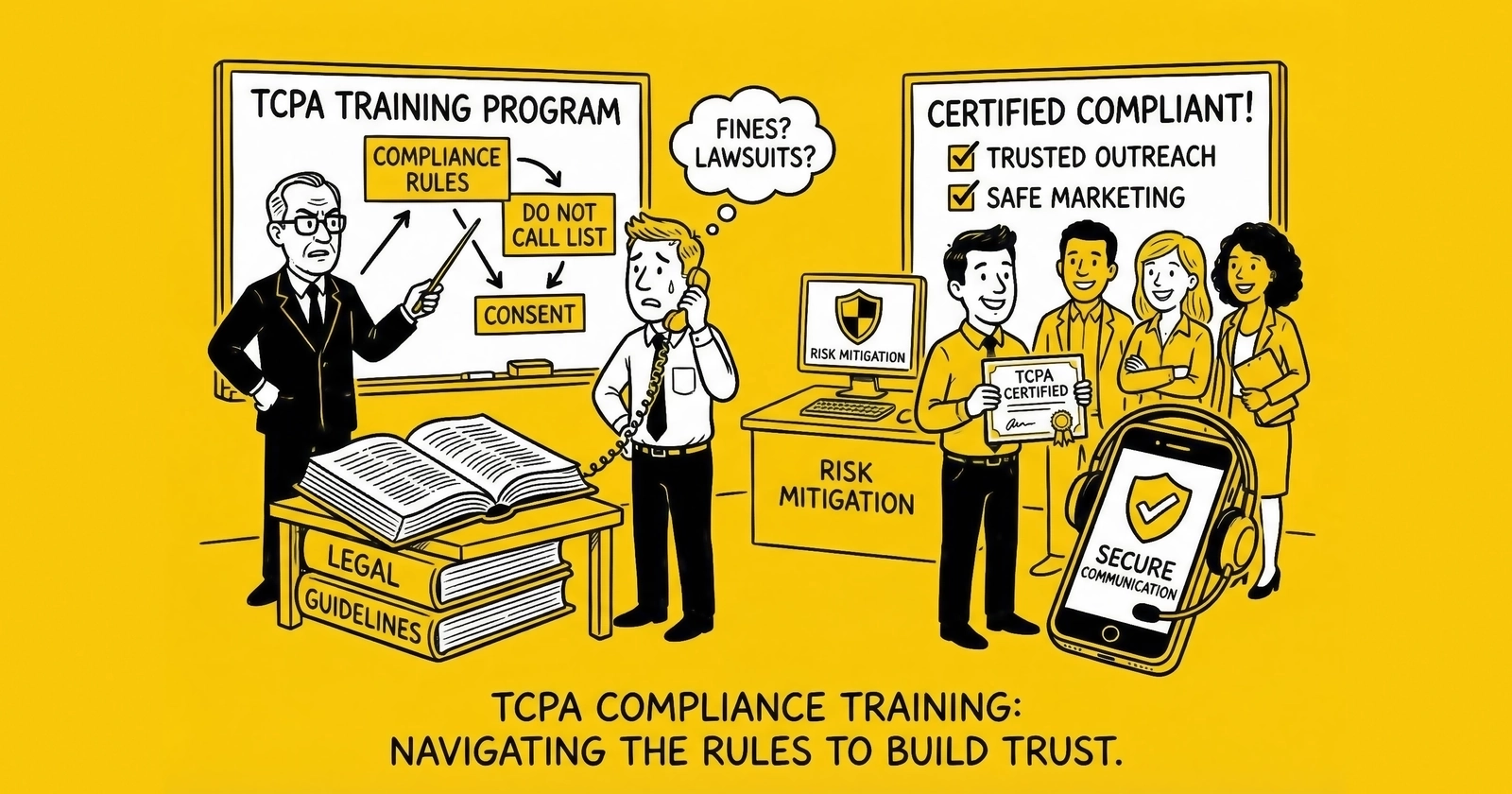
A comprehensive framework for building, implementing, and maintaining TCPA compliance training that protects your organization from the $6.6 million average settlement cost and transforms regulatory requirements into competitive advantage.
Introduction: The Training Gap That Creates Millions in Liability
The process server arrived on a Tuesday morning in March 2025. A mid-sized insurance lead generator in Florida received a class action complaint alleging 47,000 TCPA violations. Potential exposure: $70.5 million. The company’s entire annual revenue was $12 million.
When investigators examined what went wrong, the pattern was familiar. Sales representatives had been calling outside permitted hours without understanding time-zone requirements. Marketing had launched a text campaign using a list without proper consent verification. A new call center agent had ignored opt-out requests because “they weren’t trained on that.”
Three separate failures. Three departments. One common thread: inadequate TCPA training.
The numbers from 2024 and 2025 tell the story. In 2024, 2,788 TCPA cases were filed – a 67% increase over 2023. In Q1 2025 alone, 507 class actions hit the courts – a 112% increase over Q1 2024. By September 2025, year-to-date class action filings were running 97% ahead of the prior year. Nearly 80% of all TCPA lawsuits seek class certification. Average settlements exceed $6.6 million.
Every one of these lawsuits began with someone doing something wrong. And in most cases, that person simply did not know they were violating the law.
This is not a regulatory compliance problem. It is a training problem.
TCPA training programs are not optional. They are infrastructure. Those who build comprehensive training into their organizations do not just avoid lawsuits – they build more effective sales and marketing operations. Understanding what you can and cannot do creates clarity. Clarity creates speed. Speed creates competitive advantage.
This guide provides the complete framework for building TCPA training programs that work: what to teach, who to train, how to document, and how to measure effectiveness. Whether you are building from scratch or auditing an existing program, you will find actionable guidance grounded in the operational reality of lead generation in 2026.
Why TCPA Training Is Non-Negotiable in 2026
The Litigation Environment Has Fundamentally Changed
The TCPA was enacted in 1991 to stop dinner-time telemarketing calls from interrupting family meals. The statute provides $500 per violation for standard infractions and $1,500 per violation for willful violations. There is no cap on aggregate damages. The four-year statute of limitations means exposure accumulates over extended periods before lawsuits materialize.
What has changed is the sophistication of the plaintiff’s bar. TCPA litigation has become what leading defense attorney Eric Troutman calls “the biggest cash cow in history” for plaintiffs’ lawyers. Professional plaintiff operations have emerged, with individuals maintaining dozens of phone numbers specifically to receive non-compliant calls and generate lawsuit income.
Between 31% and 41% of TCPA lawsuits are filed by serial litigators who have turned violations into a business model. The economics work in their favor: a single call to a professional plaintiff can generate $1,500 in statutory damages plus attorney’s fees, with minimal investment of time or resources.
The Regulatory Framework Keeps Evolving
TCPA requirements are not static. The FCC’s April 2025 revocation rules fundamentally changed how companies must handle consent withdrawal. Companies now have ten business days to honor opt-out requests through any reasonable method. Standard keywords – “stop,” “quit,” “revoke,” “opt out,” “cancel,” “unsubscribe,” and “end” – trigger immediate revocation obligations regardless of other language in the message.
State mini-TCPAs add complexity. Florida’s Telephone Solicitation Act (FTSA) imposes 8 a.m. to 8 p.m. calling hour restrictions instead of the federal 8 a.m. to 9 p.m. window. Oklahoma’s Telephone Solicitation Act (OTSA) creates additional consent requirements. Maryland’s Stop the Spam Calls Act maintains a broader autodialer definition than the post-Duguid federal standard.
Personnel who were trained on 2023 rules are operating with outdated information. Training programs must be continuously updated to reflect regulatory changes.
Untrained Personnel Create Organizational Liability
The doctrine of vicarious liability means organizations are responsible for the actions of their employees and agents. When a sales representative violates TCPA requirements, the organization bears the liability – not just the individual.
Courts have held companies liable for violations by:
- Call center agents making outbound calls
- Marketing teams launching text campaigns
- Third-party vendors operating on the company’s behalf
- Independent contractors working within company systems
Training is the primary defense against these exposures. Documented training programs demonstrate good faith compliance efforts and can mitigate damages even when violations occur. Conversely, the absence of training suggests willful disregard – which triggers treble damages at $1,500 per violation instead of $500.
Who Needs TCPA Training
Sales Teams: The Front Line of Exposure
Sales representatives handle the interactions that generate the majority of TCPA lawsuits. They make outbound calls. They send follow-up texts. They process consumer responses. They handle opt-out requests. Every call they make is a potential violation or a potential lawsuit prevention.
Sales team training must cover:
Consent verification before contact. Sales representatives must understand that calling or texting a lead does not automatically mean they have permission. They need to know how to verify that valid prior express written consent exists, what documentation to check, and what to do when consent status is unclear.
Time-of-day restrictions. Federal law prohibits telemarketing calls before 8 a.m. or after 9 p.m. in the recipient’s local time zone. State laws may impose narrower windows. Sales representatives must understand that the relevant time zone is the consumer’s location – not the call center’s location. A 7:00 p.m. call from a California call center reaches a consumer in New York at 10:00 p.m. – a violation.
Do Not Call list compliance. The National Do Not Call Registry contains over 240 million phone numbers. Sales representatives must never call numbers on this registry for telemarketing purposes. They must also honor internal DNC requests – when a consumer says “don’t call me again,” that creates an immediate obligation.
Revocation handling. The April 2025 FCC rules require honoring opt-out requests within ten business days through any reasonable method. Sales representatives must recognize revocation language, know how to document it, and understand the escalation process for immediate suppression.
Proper disclosures. Many states require specific disclosures at the start of telemarketing calls, including caller identity, purpose of the call, and in some cases, the ability to place the consumer on an internal DNC list.
Marketing Teams: Campaign Architecture and Compliance
Marketing teams design the campaigns, build the forms, write the copy, and select the lists that drive sales activity. Their decisions upstream determine compliance downstream. A marketing campaign built without TCPA considerations creates liability before a single call is made.
Marketing team training must cover:
Consent capture requirements. Prior express written consent (PEWC) requires six specific elements: a written agreement, the signature of the person to be called, clear authorization for the specific seller, identification of the telephone number, consent that is not a condition of purchase, and clear and conspicuous disclosure. Marketing teams design the forms that capture this consent – every element must be present.
Consent language drafting. The disclosure language shown to consumers must be “apparent to a reasonable consumer.” It cannot be buried in fine print, hidden behind hyperlinks, or obscured by surrounding content. Marketing teams must understand how to write compliant disclosure language and where to position it on forms.
Third-party verification integration. TrustedForm, Jornaya, and similar services provide independent documentation of consent. Marketing teams must understand how to implement these services, what they document, and how to configure them properly. A TrustedForm certificate that captures non-compliant disclosure language documents the problem – it does not cure it.
E-SIGN Act requirements. When consent is obtained electronically, the federal Electronic Signatures in Global and National Commerce Act creates additional requirements. Marketing teams must understand the consumer disclosure requirements, the consent requirements for electronic records, and the hardware/software disclosure requirements that courts have increasingly recognized.
Campaign timing and targeting. Marketing teams select audience targeting that may include geographic parameters. They must understand that campaigns reaching consumers in different time zones require compliance with both federal and state calling hour restrictions.
State-specific requirements. Campaigns targeting Florida consumers must comply with the FTSA. Campaigns targeting Oklahoma must comply with the OTSA. Marketing teams must understand which state laws apply to their campaigns and what additional requirements those laws impose.
Operations and Technology Teams: System Implementation
Operations and technology teams build and maintain the systems that execute compliance controls. Automated DNC suppression, time-zone enforcement, consent verification, and revocation processing all depend on technical implementation. A compliance policy without technical enforcement is a lawsuit waiting to happen.
Operations and technology team training must cover:
DNC suppression systems. Technical teams must understand how to implement suppression against the National DNC Registry, state registries, and internal DNC lists. They must configure suppression to run in real-time before any call is placed – not in batch processes that allow non-compliant calls through.
Time-zone determination. Area codes do not reliably indicate current location – especially for mobile numbers. Technical teams must implement time-zone lookup services that determine local time based on current location data, not area code assumptions. Systems must enforce hard stops outside permitted calling hours.
Consent verification integration. Technical teams must implement API integrations with TrustedForm, Jornaya, or equivalent services. They must configure certificate retrieval, validation, and retention. They must understand what certificate data to check before leads enter calling queues.
Revocation processing automation. The ten-business-day revocation requirement demands automated systems that recognize opt-out keywords, update suppression lists across all channels, and synchronize revocation status in real-time. Technical teams must build these systems and monitor their operation.
Audit trail and documentation. Technical teams must build systems that capture and retain the documentation needed for litigation defense: call logs, consent records, suppression verification, and system configurations. Retention periods should extend at least five years – beyond the four-year statute of limitations.
Customer Service Representatives: Consumer Interaction Points
Customer service representatives often handle inbound calls where consumers request removal from calling lists, complain about unwanted communications, or make revocation requests. Their handling of these interactions creates compliance obligations.
Customer service team training must cover:
Recognizing revocation requests. A consumer saying “stop calling me” or “take me off your list” is making a revocation request that triggers legal obligations. Customer service representatives must recognize these requests regardless of the specific language used.
Documentation requirements. Every revocation request must be documented immediately with the consumer’s identity, phone number, date, time, and the specific request made. This documentation becomes evidence in any subsequent litigation.
Escalation procedures. Customer service representatives must know how to escalate revocation requests for immediate processing, how to confirm the request has been implemented, and how to handle consumers who call back after revocation claiming they are still receiving calls.
Consumer complaint handling. Complaints about unwanted calls should be documented and escalated. Patterns of complaints may indicate systemic compliance failures that need investigation.
Executives and Managers: Accountability and Oversight
TCPA compliance requires executive-level ownership. When compliance is delegated entirely to legal or operations, it becomes a cost center to be minimized rather than a strategic priority. Executives and managers need training that enables effective oversight.
Executive and management training must cover:
Liability exposure and business impact. Executives must understand the scale of potential liability – settlements exceeding $6.6 million on average, with individual cases reaching $70+ million. They must understand how TCPA violations can threaten business viability.
Compliance program requirements. Executives must understand what a compliant program looks like: written policies, personnel training, technical controls, audit procedures, and documentation requirements. They must be able to evaluate whether their organization’s program meets these standards.
Oversight responsibilities. Executives must understand their personal accountability for compliance failures. Recent enforcement actions have included industry bans and personal liability for executives. The Response Tree LLC action banned both the company and its president from the lead generation industry entirely.
Resource allocation decisions. Compliance requires investment in technology, training, and personnel. Executives must understand the ROI calculation: compliance costs are a fraction of settlement costs. A single avoided class action pays for years of compliance infrastructure.
Core TCPA Training Curriculum
Module 1: TCPA Fundamentals (All Personnel)
This foundational module provides the baseline understanding that every employee needs – regardless of role.
Statutory framework. Cover the basic structure of the TCPA: enacted in 1991, codified at 47 U.S.C. section 227, enforced by the FCC and through private lawsuits. Explain that the statute has been amended and interpreted by courts and regulators over three decades.
Core prohibitions. Explain the four main categories of prohibited conduct:
- Calls to cell phones using an ATDS or prerecorded voice without consent
- Telemarketing calls using prerecorded messages without written consent
- Calls to numbers on the Do Not Call Registry
- Calls outside permitted hours
Penalty structure. Explain statutory damages of $500 per violation, treble damages of $1,500 for willful violations, no cap on aggregate damages, and the four-year statute of limitations. Use concrete examples: “10,000 non-compliant calls creates $5 million to $15 million in potential exposure.”
The litigation landscape. Share current statistics: 2,788 cases filed in 2024, 507 class actions in Q1 2025, 80% of cases filed as class actions, $6.6 million average settlement. Make clear this is not theoretical risk – it is statistical probability.
Company policies. Review the organization’s specific TCPA policies, where to find them, and the consequences of non-compliance.
Module 2: Consent Requirements (Marketing, Sales Leadership)
This module provides detailed training on obtaining and documenting valid consent.
Prior express consent vs. prior express written consent. Explain the distinction between these consent standards and when each applies. Prior express consent may be implied from conduct in some circumstances. Prior express written consent requires a signed written agreement with specific elements.
The six elements of PEWC. Detail each element:
- Written agreement (electronic signatures acceptable under E-SIGN)
- Signature of the person to be called
- Clear authorization for the specific seller
- Identification of the telephone number
- Not a condition of purchase
- Clear and conspicuous disclosure
E-SIGN Act overlay. Explain that electronic consent triggers additional requirements: consumer disclosure about electronic records, consent to receive disclosures electronically, and hardware/software disclosure. Cover how to structure consent flows to address both TCPA and E-SIGN requirements.
Common consent failures. Provide examples of consent language that does not meet requirements:
- Consent buried in terms of service
- Consent as a condition of form submission
- Vague seller identification (“our marketing partners”)
- Disclosures requiring scrolling or clicking to view
Third-party verification. Explain TrustedForm, Jornaya, and equivalent services. Clarify that certificates document what happened – they do not guarantee compliance. Train on how to retrieve, review, and validate certificates.
Multi-seller consent considerations. While the FCC’s one-to-one consent rule was vacated in January 2025, explain why many operations maintain individual seller identification for litigation defense and buyer requirements.
Module 3: Do Not Call Compliance (Sales, Operations)
This module covers the DNC requirements that apply to all telemarketing calls.
National Do Not Call Registry. Explain the registry maintained by the FTC with over 240 million numbers. Cover the requirement to suppress against this registry before any telemarketing call. Explain the safe harbor for calls to numbers not on the registry when checked within 31 days.
Internal Do Not Call lists. Explain the requirement to maintain internal lists of consumers who have requested not to be called and to honor those requests immediately. Internal DNC requests override any consent – a consumer who provided consent can revoke it.
State registries. Cover state-specific DNC registries that impose additional requirements. Florida, Colorado, and other states maintain separate registries that must be suppressed.
Established business relationship exception. Explain the limited exception for calls to consumers with an established business relationship – but clarify that this exception does not apply to automated calls to cell phones.
DNC technology requirements. Explain how DNC suppression should work technically: real-time lookup before any call, integration with dialing platforms, automatic updates from registry data.
Module 4: Calling Hour Restrictions (Sales, Operations)
This module addresses the time-of-day restrictions that generate significant litigation.
Federal requirements. Cover the 8 a.m. to 9 p.m. restriction in the recipient’s local time zone. Emphasize “recipient’s local time zone” – not the caller’s time zone.
State requirements. Detail states with narrower windows: Florida (8 a.m. to 8 p.m.), Maryland (8 a.m. to 8 p.m.), and others. Explain that the most restrictive requirement applies.
Time-zone determination. Explain the challenge of determining recipient time zones, especially for mobile numbers where area codes do not indicate current location. Cover the technology solutions for accurate time-zone determination.
System enforcement. Train on how calling systems should enforce time restrictions: automatic blocks outside permitted windows, time-zone adjustments, and exception handling.
The text message question. Courts have generally held that SMS messages are subject to the same timing restrictions as voice calls. Cover the March 2025 litigation surge involving time-of-day text message violations.
Module 5: Revocation Handling (All Customer-Facing Personnel)
This module covers the critical requirement to honor consent withdrawals.
The April 2025 rules. Explain the new FCC requirements: honor revocation within ten business days through any reasonable method.
Standard opt-out keywords. List the keywords that trigger definitive revocation: “stop,” “quit,” “revoke,” “opt out,” “cancel,” “unsubscribe,” and “end.”
Broader revocation recognition. Explain that any communication reasonably conveying intent to stop receiving calls or messages must be honored. “No more texts” or “take me off your list” require interpretation, but treating ambiguous communications as revocations is the safer approach.
Documentation requirements. Train on how to document revocation requests: consumer identity, phone number, date, time, method of revocation, and the specific request made.
Confirmation messages. Explain that companies may send a one-time confirmation text within five minutes of an opt-out request, but it cannot include marketing content.
Cross-channel synchronization. Cover the requirement to synchronize revocation across all communication channels within the ten-day window. An opt-out via text must also stop phone calls.
Module 6: Call Recording and Documentation (Call Center Personnel)
This module covers documentation practices for compliance defense.
Call recording requirements. Explain state call recording laws – some states require one-party consent, others require two-party consent. Cover how to announce recording at the start of calls when required.
What to document. Train on the documentation elements needed for compliance defense: caller ID, recipient number, date, time, duration, call outcome, and any consent or revocation information.
Retention periods. Cover the five-year retention requirement under the Telemarketing Sales Rule (extended from two years in March 2024). Explain that retention should extend at least beyond the four-year TCPA statute of limitations.
Evidence preservation. Train on the importance of preserving evidence and the legal concept of litigation hold. When litigation is anticipated, normal document destruction must stop.
Module 7: State Mini-TCPA Laws (Marketing, Compliance Personnel)
This module addresses the state laws that impose requirements beyond federal standards.
Florida FTSA. Cover the Florida Telephone Solicitation Act: 8 a.m. to 8 p.m. calling hours, private right of action, enhanced penalties, broader autodialer definition (though narrowed somewhat by May 2023 amendment).
Oklahoma OTSA. Cover the Oklahoma Telephone Solicitation Act: stricter consent requirements, call frequency limits, state DNC registration requirements.
Maryland Stop the Spam Calls Act. Cover the 8 a.m. to 8 p.m. calling hours and the broader autodialer definition retained from pre-Duguid standards.
CMS Medicare requirements. For operations in Medicare-related verticals, cover the CMS one-to-one consent requirements for Medicare Advantage and Part D marketing implemented in 2024.
Geographic compliance mapping. Train on how to map calling campaigns to applicable state requirements and configure systems for state-specific compliance.
Training Program Implementation
Training Delivery Methods
Effective TCPA training uses multiple delivery methods to ensure comprehension and retention.
Initial onboarding training. All new personnel should complete TCPA training before they begin working with leads or making calls. This training should be comprehensive – not a 15-minute overview – and should include assessment to verify comprehension.
Role-specific training. Different roles need different depth. Call center agents need detailed training on call handling procedures. Marketing personnel need detailed training on consent capture. Executives need training on oversight and liability. Develop separate curricula for each audience.
Annual refresher training. TCPA requirements evolve continuously. Annual refresher training ensures personnel remain current on regulatory changes and company policy updates. The April 2025 revocation rules, for example, required immediate supplemental training for affected personnel.
Just-in-time training. When regulatory changes occur or compliance issues are identified, deploy targeted training to affected personnel immediately. Do not wait for the annual cycle.
Scenario-based exercises. Abstract rules are harder to remember than concrete scenarios. Develop exercises that present realistic situations and require personnel to apply compliance rules. “A consumer texts ‘remove me from your list please’ – what do you do?”
Assessment and certification. Training without assessment is incomplete. Develop quizzes and practical exercises that verify comprehension. Require passing scores before personnel can perform TCPA-relevant functions. Maintain certification records.
Training Documentation
Documentation serves two purposes: operational management and litigation defense. Both require rigorous record-keeping.
Training records must capture:
- Training date and content covered
- Personnel who received training
- Trainer identity and qualifications
- Assessment results (scores, pass/fail)
- Acknowledgment of policy receipt and understanding
- Certification expiration dates
Records retention. Maintain training records for at least five years – aligned with the Telemarketing Sales Rule retention requirements and exceeding the TCPA statute of limitations.
Audit trail. Maintain evidence that training was actually delivered – attendance records, learning management system logs, acknowledgment signatures. In litigation, assertions that “we trained everyone” are meaningless without documentation.
Training Program Metrics
Measure training program effectiveness to identify gaps and demonstrate compliance commitment.
Completion rates. Track the percentage of personnel who complete required training on time. Incomplete training is a compliance gap.
Assessment scores. Track average scores and score distributions. Low scores indicate content gaps or comprehension problems.
Remediation rates. Track how many personnel require remediation (additional training after failing initial assessment).
Compliance incident correlation. Track whether personnel involved in compliance incidents had completed required training. Patterns may indicate training gaps.
Knowledge retention. Periodic spot-checks or re-assessments can measure how well personnel retain training content over time.
Regulatory update response time. Measure how quickly supplemental training is deployed following regulatory changes.
Building a Culture of Compliance
Training is necessary but not sufficient. Sustainable TCPA compliance requires a cultural commitment that extends beyond the training program.
Executive Ownership
TCPA compliance must have executive-level ownership and visibility. The CEO or COO should receive regular compliance metrics and be personally accountable for compliance outcomes. When compliance is delegated entirely to legal or operations, it becomes a cost center to be minimized rather than a strategic priority.
Economic Alignment
Compensation and incentive structures must align with compliance outcomes. If sales personnel are rewarded purely on volume while compliance issues create no personal consequence, predictable behavior follows. Include compliance metrics in performance evaluations and bonus calculations.
Quality Over Volume
A lead generated in compliance with all requirements is worth infinitely more than one generated questionably. A single non-compliant lead can generate hundreds of thousands in liability – far exceeding any revenue it might produce. Build this understanding into every conversation about lead volume, cost per lead, and acquisition strategy.
Incident Response Readiness
Despite best efforts, compliance incidents will occur. Have plans in place for responding to demand letters, litigation threats, regulatory inquiries, and discovered compliance failures. Train personnel on escalation procedures. The first 48 hours after receiving a TCPA complaint often determine the trajectory of the entire matter.
Continuous Improvement
Compliance is not a destination; it is a practice. Regulatory requirements evolve. Litigation theories develop. Technology capabilities expand. Training programs must evolve continuously to remain effective. Schedule regular reviews of training content against current requirements.
Training Program Checklist
Use this checklist to audit your existing program or build a new one.
Program Structure
- Comprehensive initial training for all personnel before they perform TCPA-relevant functions
- Role-specific curricula for sales, marketing, operations, customer service, and management
- Annual refresher training for all personnel
- Just-in-time training capability for regulatory updates
- Assessment and certification requirements with passing scores
Content Coverage
- TCPA fundamentals including statute, penalties, and litigation landscape
- Consent requirements including PEWC elements and E-SIGN overlay
- Do Not Call compliance including national and state registries
- Calling hour restrictions including time-zone determination
- Revocation handling including April 2025 FCC rules
- Call recording and documentation requirements
- State mini-TCPA laws for relevant jurisdictions
- Company-specific policies and procedures
Documentation
- Training records capturing date, content, attendees, and results
- Assessment scores and certification status
- Policy acknowledgment signatures
- Retention for at least five years
- Audit trail demonstrating training delivery
Measurement
- Completion rate tracking
- Assessment score analysis
- Remediation rate monitoring
- Compliance incident correlation
- Regulatory update response time measurement
Culture Integration
- Executive-level compliance ownership
- Compensation alignment with compliance outcomes
- Escalation procedures for compliance concerns
- Incident response planning and training
- Continuous improvement processes
Frequently Asked Questions
1. How often should TCPA training be conducted for sales and marketing teams?
Initial training should occur before personnel begin any TCPA-relevant work. Annual refresher training is the minimum standard for all personnel who handle leads, make calls, or design marketing campaigns. However, supplemental training should occur immediately following significant regulatory changes – such as the April 2025 FCC revocation rules – or when compliance incidents indicate knowledge gaps. Organizations in high-litigation environments often conduct quarterly refreshers for front-line personnel.
2. What topics must be included in a comprehensive TCPA training program?
A comprehensive program must cover the TCPA statutory framework and penalties, prior express written consent requirements including the six required elements, E-SIGN Act overlay for electronic consent, Do Not Call list compliance for both national and state registries, calling hour restrictions and time-zone determination, revocation handling under the April 2025 FCC rules, documentation and record retention requirements, and applicable state mini-TCPA laws. Role-specific training should add depth in areas relevant to each function – consent capture for marketing, call handling for sales, system implementation for operations.
3. Who in an organization needs TCPA training?
Everyone who touches lead data or consumer communications needs some level of TCPA training. This includes sales representatives who make outbound calls or send texts, marketing personnel who design campaigns and capture consent, operations and technology teams who build and maintain compliance systems, customer service representatives who handle consumer inquiries and opt-out requests, and executives who oversee compliance programs and allocate resources. Training depth should vary by role, but foundational understanding is required across the organization.
4. How should TCPA training be documented for litigation defense?
Documentation should capture training dates and content covered, the identity of personnel who received training, trainer qualifications, assessment methods and results, acknowledgment of policy receipt and understanding, and certification status with expiration dates. Records should be retained for at least five years – exceeding both the four-year TCPA statute of limitations and the five-year Telemarketing Sales Rule retention requirement. Learning management system logs, attendance records, and signed acknowledgments provide audit trail evidence that training was actually delivered.
5. What is the cost of inadequate TCPA training programs?
The cost is measured in litigation exposure. Average TCPA class action settlements exceed $6.6 million. Recent major settlements include National Grid at $38.5 million, Citibank at $29.5 million, and Realogy at $20 million. Even successful defense costs $40,000 to $50,000 or more. A single compliance failure by an untrained employee can generate liability exceeding total annual revenue. Conversely, documented training programs support “good faith” arguments that can reduce damages and improve litigation outcomes.
6. How do the April 2025 FCC revocation rules affect training requirements?
The April 2025 rules require companies to honor consent revocation requests within ten business days through any reasonable method. Standard keywords – “stop,” “quit,” “revoke,” “opt out,” “cancel,” “unsubscribe,” and “end” – trigger immediate revocation obligations. Training programs must be updated to cover these new requirements, ensure personnel recognize revocation language in all its forms, and understand the escalation procedures for immediate processing. Any personnel who interact with consumers must receive supplemental training on these changes.
7. What role do consent verification services like TrustedForm play in TCPA training?
Training should cover both the value and limitations of consent verification services. TrustedForm and Jornaya provide independent third-party documentation of what happened during consent capture – timestamp, IP address, consent language displayed, and consumer interaction. This documentation is valuable for litigation defense. However, training must clarify that a certificate documents what happened; it does not guarantee compliance. If the underlying consent disclosure was deficient, the certificate documents the problem. Personnel must understand how to retrieve, review, and validate certificates against compliance requirements.
8. How should training address state mini-TCPA laws?
Training should cover the state laws that impose requirements beyond federal standards – particularly for organizations operating in Florida, Oklahoma, Maryland, and other states with mini-TCPAs. Content should include the specific requirements of each applicable state law: calling hour restrictions (Florida and Maryland use 8 a.m. to 8 p.m.), consent requirements, autodialer definitions, and private right of action provisions. Geographic targeting of training may be appropriate – personnel handling Florida leads need FTSA training; those handling Oklahoma leads need OTSA training.
9. What training is required for third-party vendors who make calls on your behalf?
The doctrine of vicarious liability means organizations are responsible for the actions of their agents – including third-party vendors. Vendor contracts should require TCPA compliance and adequate training programs. Due diligence should verify that vendors have documented training, assess their training content, and monitor their compliance performance. Some organizations require vendors to complete the organization’s own training or provide certificates of completion from recognized TCPA training programs. Failure to ensure vendor training creates liability exposure that transfers to the contracting organization.
10. How do you measure the effectiveness of a TCPA training program?
Effectiveness metrics include completion rates (percentage of personnel completing required training on time), assessment scores (average scores and score distributions), remediation rates (personnel requiring additional training after failing initial assessment), compliance incident correlation (whether personnel involved in incidents had completed training), and knowledge retention (periodic spot-checks measuring retention over time). The ultimate metric is compliance incident rate – a declining rate of violations and complaints indicates effective training, while increasing violations despite training indicate content or delivery gaps requiring investigation.
Key Takeaways
-
TCPA training is infrastructure, not overhead. The litigation environment in 2026 – 507 class actions in Q1 alone, 80% of cases filed as class actions, $6.6 million average settlements – makes training a business survival requirement. Untrained personnel create liability that can exceed total company value.
-
Every customer-facing role needs training. Sales representatives who make calls, marketing personnel who capture consent, operations teams who build compliance systems, customer service representatives who handle opt-outs, and executives who oversee programs all need role-appropriate TCPA training.
-
Training must be documented and retained. Training records including dates, content, attendees, and assessment results must be maintained for at least five years. In litigation, documented training demonstrates good faith and supports reduced damages. Undocumented training provides no defense.
-
Content must be current. The April 2025 FCC revocation rules, state mini-TCPA developments, and ongoing litigation trends require continuous training updates. Personnel trained on 2023 rules are operating with dangerously outdated information.
-
Assessment and certification are required. Training without assessment is incomplete. Personnel must demonstrate comprehension through testing before performing TCPA-relevant functions. Passing scores and certification records provide evidence of competence.
-
Training alone is insufficient. Sustainable compliance requires a culture that includes executive ownership, compensation alignment with compliance outcomes, escalation procedures, incident response planning, and continuous improvement processes.
-
The ROI is compelling. Training program costs are a fraction of single settlement costs. A comprehensive program costing $50,000 annually provides protection against liability exposures reaching tens of millions of dollars. The math is unforgiving – but it works in your favor when you invest properly.
Building Compliance Before You Need It
The process server does not call ahead. By the time the complaint arrives, every decision about training, documentation, and compliance infrastructure has already been made. The quality of those decisions determines whether you face a $15,000 nuisance settlement or a $15 million class action.
Those who thrive in this environment are not the ones who never face complaints. They are the ones who can demonstrate, with documented evidence, that they trained their personnel, implemented proper controls, and built compliance into their operations.
Start building now. The investment required is trivial compared to the risk avoided. The time required is measured in weeks, not years. The alternative – hoping your team does not make the mistake that generates the lawsuit – is not a strategy. It is a gamble.
And in TCPA litigation, the house always wins.
This article provides general information about TCPA training programs. It is not legal advice. TCPA requirements change frequently, and state laws vary significantly. Consult qualified TCPA counsel for guidance on your specific situation.
Statistics current as of late 2025. Source: WebRecon TCPA litigation data, FCC regulatory filings, industry enforcement actions.