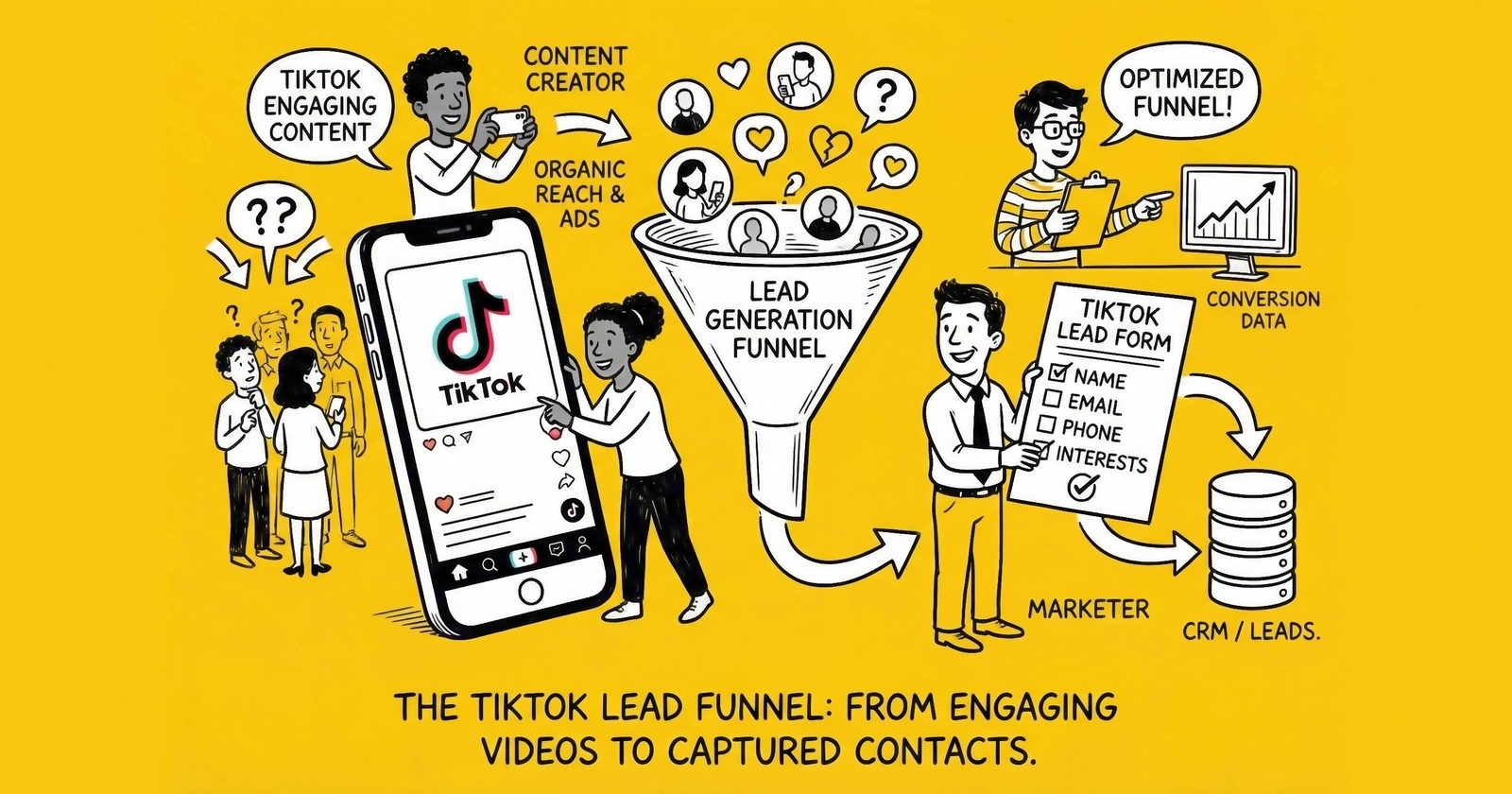
A data-driven guide for lead generation professionals navigating TikTok’s advertising ecosystem – including the hard truths about which verticals work, which fail, and how to build campaigns that actually convert.
Introduction: The Platform Everyone Misunderstands
TikTok is no longer a teenage dancing app. That dismissive characterization cost lead generators two years of competitive advantage. With 1.58 billion monthly active users globally and approximately 135-150 million in the United States alone, the platform has matured into a legitimate advertising channel demanding serious evaluation.
But here is the uncomfortable truth most TikTok evangelists will not tell you: the platform fails for most lead generation campaigns because operators treat it like Facebook with different video dimensions.
TikTok operates on fundamentally different principles. The algorithm rewards entertainment over production value. Users scroll with intent to discover, not intent to buy. The creative requirements invert what works on Google or Meta properties. And the demographic skew means entire verticals – particularly those targeting consumers over 50 – will never perform on this platform regardless of creative quality or budget.
This guide breaks down what actually works for lead generation on TikTok, what verticals see positive ROI, the real CPL benchmarks operators are seeing, and when you should spend your budget elsewhere. No platform evangelism. No hype. Just the numbers and operational reality that determine whether TikTok belongs in your media mix.
TikTok by the Numbers: 2024-2026 Data
Understanding who uses TikTok determines whether your target audience is even reachable. The demographics have shifted significantly since the platform’s earlier years, though it still skews younger than other major advertising platforms.
Global Scale
TikTok reached approximately 1.58-1.59 billion monthly active users globally by early 2025, making it the fifth most popular social platform worldwide. Growth projections suggest the platform will reach 2.35 billion users by 2029. For advertisers, the relevant number is advertising reach: TikTok ads can access approximately 1.6 billion users aged 18 and older.
The platform surpassed Instagram in time spent per user. TikTok users average 78.4 minutes daily on the platform – the highest engagement figure among major social platforms. This translates to 25.5 hours monthly. Compare this to Facebook’s 30-35 minutes daily average, and you understand why advertisers are increasingly interested.
US Market Specifics
The United States represents TikTok’s most valuable advertising market with 135-153 million unique monthly users (estimates vary by measurement methodology). This represents approximately 50% penetration of the US adult population.
The platform is no longer purely Gen Z territory. Among weekly active users, 55% are female, and 50% live in urban areas. Perhaps more surprisingly for lead generators, 45% of TikTok users are parents – a critical insight for home services and family-related verticals. The largest income segment at 39% earns $30,000-$69,900 annually, representing the middle market that many lead generation verticals target. Most significantly, 26% of Americans aged 50-64 now use the platform, up significantly from prior years.
This last statistic matters enormously for lead generators. While the platform skews young, the 50-64 demographic presence has grown enough that some mature-audience campaigns can work – with significant creative adjustments.
Age Distribution Reality
The platform’s age breakdown reveals both opportunity and limitation. Globally, 69.1% of users are aged 18-34, and males aged 25-34 represent the single largest demographic segment at 23.6% of users. In the United States specifically, 76% of Americans aged 18-24 use TikTok, and 82% of Gen Z has a TikTok profile.
For lead generators, one engagement statistic matters most: 54% of users interact with brand content daily. The audience is not just consuming entertainment – they engage with commercial content when it matches the native format. The catch is that word: “native.” Content that looks like advertising underperforms content that looks like organic TikTok videos.
Engagement vs. Other Platforms
TikTok dominates engagement metrics across social platforms. Average engagement rate runs 2.2-2.5% by follower count – the highest among major platforms. Accounts with over 1 million followers achieve 10.53% engagement versus 0.95% on Instagram. This engagement advantage explains why creators flock to TikTok and why brands struggle to replicate the success they see from organic content.
The engagement comes with a caveat: engaged users are not necessarily buying users. TikTok sessions are entertainment-driven. Users are in discovery mode, not shopping mode. This fundamental difference shapes everything about how lead generation must operate on the platform.
TikTok Advertising Costs: Current Benchmarks
Cost efficiency is TikTok’s primary advantage over other platforms. But cheaper impressions do not automatically translate to cheaper leads.
CPM Benchmarks
TikTok’s cost per thousand impressions (CPM) runs significantly lower than Meta platforms. Current data shows TikTok CPM averaging $4.20-7.03 compared to Meta’s $10-12 average. January 2025 data indicates $0.74 cost per link click, substantially lower than Facebook’s typical $1.50-2.50 range.
This CPM advantage makes TikTok attractive for upper-funnel awareness campaigns. For lead generation specifically, the question is whether cheaper impressions translate to profitable lead costs after accounting for lower conversion rates.
CPL by Vertical
Cost per lead on TikTok varies dramatically by vertical, creative quality, and campaign maturity. For context on how these compare across platforms, see our CPL benchmarks by industry. Based on 2024-2026 data from multiple agency sources and operator reports:
| Vertical | Low-End CPL | Median CPL | High-End CPL |
|---|---|---|---|
| Education/Training | $12 | $28 | $55 |
| Solar | $25 | $50 | $95 |
| Home Services | $18 | $38 | $70 |
| Personal Finance | $30 | $55 | $95 |
| Insurance (Auto) | $18 | $35 | $60 |
| Insurance (Other) | $25 | $48 | $80 |
| Legal (Personal Injury) | $45 | $85 | $180 |
| Real Estate | $20 | $45 | $90 |
These ranges reflect Instant Form campaigns using TikTok’s native lead capture. Campaigns driving traffic to external landing pages typically run 40-80% higher CPL due to the friction of leaving the app.
TikTok vs. Facebook vs. Google
Platform selection requires understanding relative economics, and the comparison reveals that TikTok’s position varies significantly by vertical.
TikTok CPL runs 15-30% lower than Facebook for education and home services verticals where younger demographics dominate. TikTok’s CPM advantage translates to lead cost savings when the audience alignment works. However, TikTok CPL runs 20-40% higher than Facebook for insurance and finance verticals where Facebook’s granular targeting and older demographic presence provide advantages. Facebook’s mature pixel optimization also delivers better quality signals.
The Google comparison requires nuance. TikTok CPL is 40-60% lower than Google Search for most verticals, but this comparison is misleading. Google captures explicit intent – someone searching “auto insurance quotes” is ready to buy. TikTok captures attention from users who may not have been thinking about insurance. Lower cost does not mean better economics when downstream conversion rates differ dramatically. TikTok CPL is comparable to Google Display, which is the more appropriate comparison. Both platforms capture interest rather than intent, and both require strong creative to convert casual attention into leads.
Lead Gen Ad Formats: What Actually Works
TikTok offers multiple advertising formats, but for lead generation, only a few deliver consistent results.
In-Feed Ads
In-feed ads appear in users’ For You Page (FYP) as they scroll, resembling organic content. These are the workhouse format for most lead generation campaigns.
The technical specifications matter: video length can run 5-60 seconds, though 9-15 seconds performs best. Aspect ratio must be 9:16 (vertical, full-screen), and file size can reach 500MB. Most critically, sound is required – this is not Facebook where users scroll with sound off. TikTok is an audio-visual platform, and silent ads underperform dramatically.
Average click-through rate (CTR) for in-feed ads ranges from 0.5-1.5% depending on vertical and creative quality. Strong native-style creative can exceed 2% CTR, while polished brand content often falls below 0.5%.
Spark Ads
Spark Ads boost existing organic content from your account or creator partners. This format consistently outperforms standard in-feed ads because the content has already proven engagement in the organic feed.
The performance advantage comes from multiple factors. Spark Ads inherit social proof – likes, comments, and shares – from the organic post, providing immediate credibility. The algorithm has already validated the content as engaging before you spend advertising dollars on it. The format appears more native because it originated as organic content rather than being built for advertising. When using creator content with permission codes, you also bring built-in audience trust that paid placements lack.
For lead generation, Spark Ads typically convert 2-3x better than standard in-feed ads. The trade-off is operational complexity – you need organic content that performs before you can boost it.
Lead Generation Objective
When selecting campaign objectives in TikTok Ads Manager, the Lead Generation objective is purpose-built for capturing contact information within the platform.
This objective differs fundamentally from awareness or traffic campaigns. The algorithm optimizes for users likely to complete forms rather than users likely to click or watch. Lower-funnel targeting is automatically applied based on conversion signals. Conversion tracking focuses on lead events, and audience building uses form engagement signals to find similar users.
This objective typically costs 15-30% more per impression than awareness campaigns but delivers 40-60% lower cost per lead than traffic campaigns with external landing pages. The math usually favors the Lead Generation objective for lead gen campaigns.
Instant Forms vs. External Landing Pages
TikTok’s Instant Forms are native lead capture forms that users complete without leaving the app. This is where most lead generation campaigns should focus.
Instant Forms offer significant advantages for lead generation. Pre-population with TikTok profile data reduces friction – name, email, and phone (where available) auto-fill from the user’s account. Users never leave the environment they’re comfortable in, eliminating redirect friction that kills conversions on external pages. The forms are mobile-optimized by default, leading to faster completion times. Built-in consent capture functionality also simplifies TCPA compliance implementation.
The limitations are real but often secondary to the conversion benefits. Customization options are constrained compared to dedicated landing pages. You cannot implement pixel-based retargeting on form visitors since they never reach your domain. Complex qualification logic is difficult to implement within TikTok’s templates, and form design must work within the platform’s constraints.
For most lead generation campaigns, Instant Forms deliver 40-80% lower CPL than external landing pages. Use landing pages only when you need complex qualification logic, extensive branding, or pixel-based retargeting that requires users on your domain. When external pages are necessary, landing page optimization becomes critical to offset the conversion friction.
What Verticals Work on TikTok (And Which Absolutely Do Not)
Not every lead generation vertical belongs on TikTok. The platform’s demographics and engagement patterns favor certain industries over others. Misaligning your vertical with the platform wastes budget.
Verticals That Work
Education and Career Services
Trade schools, coding bootcamps, certification programs, career counseling, resume services, and online courses perform well on TikTok. The 18-34 demographic is actively seeking career advancement, and educational content performs well organically – making the transition to lead gen natural.
CPL range: $12-55
Educational content that entertains while informing converts well. “How I made $85,000 six months after this certification” as a hook works better than “Enroll in our coding bootcamp today.”
Home Services (Select Categories)
Home improvement, renovation, solar installation, moving services, and pest control can work on TikTok – particularly when targeting homeowners. The 45% of users who are parents often own homes and make household decisions. Before/after content formats thrive on TikTok’s visual-first environment.
CPL range: $18-75
The key is visual demonstration. Transformation content – before/after of a kitchen renovation, a filthy mattress made clean, a termite-damaged wall repaired – captures attention in ways text-based advertising cannot.
Personal Finance (Carefully Regulated)
Debt consolidation, credit repair services, and personal loans can work on TikTok when compliance is carefully managed. Financial content resonates with the $30,000-$70,000 income segment that dominates the platform. Users in this bracket often have credit card debt, student loans, or credit score challenges.
CPL range: $30-95
Compliance requirements are strict. Financial services advertising faces additional verification and content restrictions. Work with compliance counsel before launching.
Insurance (Limited Segments)
Auto insurance for younger demographics, renters insurance, and pet insurance can perform on TikTok. The platform reaches young adults getting their first car insurance or first apartment – moments when insurance becomes relevant.
CPL range: $18-80
TikTok struggles significantly with Medicare, final expense, and other senior-focused insurance products due to demographic mismatch. Do not waste budget testing these on TikTok.
Legal Services (Select Practice Areas)
Workplace injury claims, employment discrimination, consumer protection, and personal injury for younger demographics can work. Younger workers facing workplace issues search for representation, and TikTok’s casual format makes legal advertising feel less intimidating.
CPL range: $45-180
Mass tort lead generation is possible but expensive. The high-CPL economics of legal leads mean TikTok’s lower CPM advantage can translate to viable cost structures.
Verticals That Consistently Fail
Senior-Focused Services
Medicare, final expense insurance, reverse mortgages, assisted living, and any product targeting consumers over 65 will fail on TikTok. Only 26% of users aged 50-64 use the platform, and they are typically not the decision-makers for these products. Worse, the 65+ demographic has minimal presence.
Do not test these verticals on TikTok. The demographic mismatch guarantees failure regardless of creative quality or budget.
B2B Enterprise
Complex B2B sales with 6-10 stakeholder buying groups do not fit TikTok’s consumer-focused environment. The platform lacks professional targeting capabilities, and the entertainment-driven session mentality conflicts with considered business purchasing.
LinkedIn remains the primary channel for B2B lead generation. TikTok has no viable path to B2B enterprise leads.
Luxury Real Estate
High-end real estate targeting affluent buyers over 45 misses TikTok’s core demographic. First-time homebuyer campaigns show better results, but luxury property marketing belongs elsewhere.
Healthcare (Clinical)
Medical procedure leads, clinical trial recruitment, and hospital services face creative restrictions and audience misalignment. The compliance burden is high, targeting is limited by platform policy, and the audience is not seeking healthcare decisions through TikTok.
The Vertical Fit Test
Before investing budget in TikTok lead generation for any vertical, answer these five questions:
- Is your target customer under 45?
- Can you explain your offer in 15 seconds of video?
- Does your product lend itself to visual demonstration?
- Can you create content that entertains while informing?
- Is your CPL target above $15?
If you answer “no” to more than two questions, TikTok is probably not your primary channel. Spend your testing budget elsewhere.
Creative Requirements: Native Content, Not Polished Ads
TikTok creative is where most lead generation campaigns fail. The platform actively punishes content that looks like traditional advertising.
The Native Content Imperative
TikTok users have developed immunity to polished, corporate content. More specifically, the algorithm deprioritizes ads that feel like ads. This creates a fundamental tension for lead generators accustomed to high-production value campaigns.
The content that works on TikTok looks nothing like traditional advertising. User-generated content (UGC) style dominates – shot on phones, not in studios. Talking head videos with personality and authenticity outperform scripted presentations. Behind-the-scenes content that feels real resonates with audiences. Trending sounds and formats adapted to your message capture attention. Text overlays with hooks work even with sound off for users scrolling in public. Quick cuts and movement hold attention in ways static shots cannot.
The content that fails reads like a checklist of traditional advertising best practices. Corporate spokespersons reading from teleprompters feel inauthentic. Stock footage with voiceover screams “advertisement.” Perfectly lit studio productions signal “skip this.” Logos appearing in the first 3 seconds trigger instant scroll. Traditional advertising scripts and structure bore users conditioned to entertainment. Slow-paced brand storytelling loses attention before the message lands.
The difference is stark. A $50,000 professionally produced commercial often underperforms a $500 video shot on an iPhone by a creator who understands the platform.
The First 3 Seconds
TikTok gives you 3 seconds to capture attention. Users scroll past content that does not hook immediately. This is not exaggeration – the platform’s mechanics require immediate engagement.
Effective hook patterns all share one characteristic: they create an immediate reason to stop scrolling. “Stop scrolling if you…” creates a pattern interrupt that works across verticals. Opening with the result or transformation – a before/after reveal – shows the payoff immediately. Provocative questions the viewer needs answered create curiosity that demands resolution. Starting mid-action generates intrigue about context. Text overlays that work with sound off capture users in situations where audio is inappropriate.
The best hooks for lead gen verticals demonstrate these principles in action. For solar, open with an electric bill showing zero balance – the transformation speaks louder than any sales pitch. For education, “I made $85,000 six months after finishing this program” leads with outcome. Home services benefit from before/after split screens of renovation that prove capability visually. Legal hooks like “Your employer owes you money. Here’s why” create immediate personal relevance. Finance content starting with “I eliminated $47,000 in credit card debt without bankruptcy” demonstrates possibility.
The hook is everything. The best offer in the world with a weak hook gets scrolled past. A mediocre offer with a strong hook at least gets watched.
Creator Partnerships
The most effective TikTok lead generation campaigns use creator content rather than brand-produced content. Creators understand native formats and bring built-in audience trust.
Creator partnerships take several forms depending on your needs and budget. Paid creator content for ads gives you ownership of usage rights for ongoing promotion. Spark Ads on creator organic posts let you boost their content with their permission. Whitelisted ads from creator accounts run your ad under their handle, borrowing their credibility. Creator affiliate programs align incentives through performance-based compensation.
Finding the right creators requires multiple approaches. TikTok Creator Marketplace is the in-platform tool for discovery and negotiation. Agencies specializing in UGC production can source and manage creator relationships at scale. Direct outreach to niche creators in your vertical often yields the best fits for specialized campaigns. Converting satisfied customers into creators brings authenticity that paid relationships cannot replicate.
Budget for creator content typically runs $200-$2,000 per video depending on creator reach and exclusivity requirements. A single high-performing creator video can outperform $50,000 of in-house produced content.
Creative Refresh Cadence
TikTok creative fatigues faster than any other major platform. The algorithm’s preference for novelty means content that performs well this week may underperform next week.
Successful TikTok operations plan for new creative concepts every 2-3 weeks, with 5-10 creative variations per concept running simultaneously. Hook testing with the same body content isolates what drives engagement versus what holds attention. When relevant trends emerge, turnaround time under 7 days captures the moment before it passes.
Those who succeed on TikTok build creative production systems. One-off campaigns do not work. You need repeatable processes for generating, testing, and scaling creative at the pace the platform demands.
Targeting Strategy: Less Is More
TikTok’s targeting capabilities have matured significantly but still lag behind Meta’s granularity. More importantly, the platform’s algorithm works differently than Facebook’s – broad targeting often outperforms narrow targeting.
Core Targeting Options
Demographic targeting includes standard options: age (13+, standard brackets), gender, location (country, state, DMA, postal code), and language. These baseline filters define the addressable audience.
Interest targeting categorizes users based on content engagement across 15 major categories and hundreds of subcategories. Interest targeting works best when broad – over-targeting restricts delivery and increases CPL.
Behavioral targeting uses platform activity to identify receptive users: video interactions (likes, comments, shares), creator interactions, hashtag engagement, and purchase intent signals.
Custom and Lookalike Audiences
Customer list upload allows direct targeting of email lists, phone numbers, or TikTok user IDs. Match rates typically range 30-50% – lower than Facebook’s 60-70% match rates due to TikTok’s different data structure.
Website custom audiences require TikTok Pixel installation. Build audiences based on page visitors, event completion (form starts, form completions), time on site, and content viewed.
Lookalike audiences use TikTok’s modeling to find users similar to your seed audience based on engagement and conversion data. Quality depends on seed audience size and specificity. Minimum 1,000 users is required, with 10,000+ preferred for stable modeling.
The Broad Targeting Paradox
The most effective TikTok lead generation campaigns use broad targeting with creative as the filter. The algorithm is sophisticated enough to find converters when given room to optimize.
The recommended approach starts with broad demographic targeting – age, location, and basic interests only. Let the algorithm optimize toward form completions rather than constraining it with assumptions about who will convert. Build engagement and conversion audiences for retargeting as data accumulates. Scale lookalikes from your best converters once you have sufficient seed data. Throughout, avoid audience overlap and fragmentation that force the algorithm to compete against itself.
Over-targeting on TikTok typically increases CPL by 40-60% without improving lead quality. The algorithm knows more about who will convert than your demographic assumptions do.
Lead Quality: The Critical Question
Lower CPL means nothing if leads do not convert downstream. TikTok lead quality requires careful monitoring and adjusted expectations.
Contact Rate Reality
TikTok leads typically show 5-15% lower contact rates than Facebook leads and 25-35% lower than Google leads. This is not necessarily a quality issue – it reflects the platform’s younger demographic being less responsive to phone calls.
The contact rate challenge stems from behavioral patterns specific to TikTok’s audience. Younger users screen calls from unknown numbers as a default behavior. Text and messaging are their preferred communication methods. The entertainment-mode context means lower immediate engagement with commercial follow-up. Users may have engaged impulsively without serious intent, leading to lower recall of what they submitted.
Adjusting contact strategy for TikTok leads improves outcomes significantly. Text-first contact (SMS before phone calls) matches how this demographic actually communicates. Speed to lead remains critical – under 5 minutes is the target. Multi-channel follow-up sequences combining text, email, then call increase touch points without relying on any single channel. Evening contact hours often perform better than business hours for this demographic. Consider messaging apps if your vertical allows.
Form Design Trade-offs
The tension between CPL and quality plays out in form design.
Short forms with 2-3 fields reduce CPL by 20-40% and achieve higher completion rates. However, they capture more unqualified leads, resulting in lower downstream conversion rates and higher contact rate challenges.
Longer forms with 4-5 fields increase CPL by 30-50% and see lower completion rates. The trade-off is better qualified leads that convert at higher downstream rates with better contact and conversion metrics overall.
Intent-qualifying questions bridge the gap by filtering for intent while maintaining reasonable form length. Adding questions like “When are you looking to [take action]?” with options “Immediately,” “Within 30 days,” “3+ months,” and “Just researching” increases CPL but improves downstream conversion.
The right choice depends on your economics. If your buyers pay $50 per lead and your downstream conversion team can handle volume, optimize for CPL. If your leads need to convert at high rates to justify costs, optimize for qualification.
Fraud Considerations
TikTok experiences similar fraud patterns to other platforms: bot form submissions, incentivized form fills, data arbitrage schemes, and click farms targeting CPC campaigns.
Fraud mitigation requires multiple defensive layers. Real-time phone and email validation catches invalid data at point of capture. Duplicate detection across campaigns identifies volume attacks. Behavioral scoring patterns flag submissions that do not match human behavior. Source quality monitoring by creative and audience isolates problematic traffic sources. Disconnected number rate tracking with a target under 15% provides an ongoing quality signal.
Monitor new campaigns closely for the first 48-72 hours. Fraud patterns typically appear within the first 500 leads. If disconnected number rates exceed 20% or invalid email rates exceed 15%, you have a quality problem requiring investigation.
Integration and Lead Delivery
Real-time lead delivery separates profitable TikTok campaigns from failed experiments. Manual CSV exports destroy lead value.
Why Speed Matters Even More on TikTok
Lead value decays approximately 10% per hour of response delay. For TikTok leads specifically, this decay may be faster because users are in entertainment mode with short attention spans, may have submitted forms impulsively, experience rapid context switches as they continue scrolling, and recall of what they submitted fades quickly.
Target lead delivery under 60 seconds from form submission. First contact attempt should occur under 5 minutes – this is the target. Under 15 minutes is acceptable but suboptimal. Over 30 minutes becomes problematic with significant quality degradation. Over 1 hour represents campaign failure in terms of lead economics.
Native CRM Integrations
TikTok offers direct integrations with major CRMs including Salesforce, HubSpot, ActiveCampaign, Klaviyo, and Mailchimp. Setup requires API credentials and field mapping. Integration typically takes 30-60 minutes for standard configurations.
Middleware Solutions
For platforms without native integration, middleware bridges the gap. LeadsBridge is the industry standard for lead distribution, supporting real-time sync with most lead distribution platforms and CRMs. If you’re distributing leads to buyers through ping/post systems or operating a lead brokerage, LeadsBridge provides the flexibility most native integrations lack. Zapier handles simpler workflows. Make (formerly Integromat) serves complex routing scenarios.
Webhook Integration
For custom distribution systems, TikTok offers webhook delivery with JSON payload containing all form fields, sub-second delivery after form submission, custom header authentication, and retry logic on failure.
Webhook integration requires development resources but provides maximum flexibility for complex lead routing scenarios.
TikTok’s Regulatory Uncertainty
Any honest discussion of TikTok for lead generation must address the platform’s ongoing regulatory challenges in the United States.
Current Status (Late 2024-Early 2025)
TikTok faces ongoing political and regulatory scrutiny regarding data privacy, foreign ownership, and national security concerns. The platform’s U.S. ad reach declined by 12.2 million users between early 2024 and early 2025 amid this uncertainty.
Legislative efforts to force divestiture or ban the platform have proceeded through various stages. The situation remains fluid with potential outcomes ranging from continued operation, to forced sale to U.S. ownership, to partial or complete ban.
What This Means for Lead Generators
Do not build TikTok dependency. TikTok should be part of a diversified media mix, not a primary channel. No single platform should represent more than 30-40% of lead volume for sustainable operations.
Maintain contingency plans throughout your TikTok investment. Document what works for potential recreation on other platforms. Build first-party audiences (email lists) that survive platform changes. Develop creative assets that can translate to other short-form video platforms (Instagram Reels, YouTube Shorts). Track performance data externally for historical analysis.
The platform may operate indefinitely. The platform may face significant changes. The platform may become unavailable. Plan accordingly.
TCPA and Compliance Considerations
TikTok lead generation operates under the same regulatory framework as other platforms. The Telephone Consumer Protection Act applies regardless of lead source.
TCPA Requirements for TikTok Leads
TikTok Instant Forms must capture affirmative consent before sharing data, include clear disclosure of who will contact the consumer, document consent timestamp and form version, specify contact methods (call, text, email), and address potential autodialed calls if applicable.
TikTok’s Instant Forms include consent capture functionality, but the default language may not meet TCPA requirements for your specific use case. Work with compliance counsel to customize consent disclosure.
Recommended consent language elements include explicit statement that submitting constitutes consent, list of companies (or “marketing partners”) that may contact the consumer, disclosure of contact methods, statement about automated calling or texting if applicable, and clear opt-out mechanism disclosure.
Platform-Specific Policies
TikTok prohibits certain lead generation activities outright, including cryptocurrency and forex trading offers, quick money or get-rich-quick schemes, political lead generation, adult content or services, and weapons or ammunition.
Other categories require approval before advertising: financial services (lending, insurance, investment), healthcare and pharmaceuticals, alcohol, gambling and gaming, and weight loss products.
Review TikTok’s Advertising Policies before launching campaigns in restricted categories. Policy violations result in ad rejection, account suspension, or permanent bans.
State Privacy Laws
TikTok lead data falls under applicable state privacy regulations: CCPA (California residents), Virginia Consumer Data Protection Act, Colorado Privacy Act, Connecticut Data Privacy Act, Utah Consumer Privacy Act, and Iowa Consumer Data Protection Act.
Ensure your privacy policy addresses data collection through third-party platforms, data sharing with lead buyers, opt-out mechanisms, and data retention periods.
Multi-Platform Strategy: Where TikTok Fits
TikTok should be a component of a diversified media strategy, not a standalone solution.
Recommended Budget Allocation by Vertical
Based on current performance data across verticals, optimal allocation varies significantly by industry.
For Education and Training, allocate 30% to TikTok, 40% to Facebook, and 30% to Google. The younger demographic alignment and visual content opportunities favor TikTok allocation in this vertical.
For Solar, allocate 20% to TikTok, 50% to Facebook, and 30% to Google. Facebook’s homeowner targeting and older demographic presence provides advantages, with TikTok serving as supplementary reach.
For Insurance (Auto and Renters), allocate 15% to TikTok, 50% to Facebook, and 35% to Google. Google captures the highest intent, Facebook provides scale, and TikTok adds incremental volume for younger segments.
For Legal (PI and Employment), allocate 15% to TikTok, 35% to Facebook, and 50% to Google. The high-intent nature of legal searches favors Google, with TikTok and Facebook providing awareness and capture of emerging intent.
For Home Services, allocate 20% to TikTok, 45% to Facebook, and 35% to Google. Visual transformation content works well on TikTok for renovation and improvement services.
The Multi-Platform Funnel
The most effective lead generation operations use platforms according to their strengths. Google Search captures high-intent, bottom-funnel consumers actively searching for quotes. Facebook provides broad awareness, demographic targeting, and retargeting. TikTok reaches younger demographics, enables creative testing, and delivers cost-efficient reach. Google Display provides cost-effective remarketing.
Test allocation assumptions and optimize based on blended CPL and downstream conversion data. What works for one vertical may not work for another.
Getting Started: Minimum Viable TikTok Campaign
For practitioners new to TikTok lead generation, here is the minimum viable approach.
Budget Requirements
Plan for $3,000-$5,000 minimum testing budget per concept. Campaign minimum is $500 total, with ad group minimum at $20/day. Recommended scaling budget runs $500+/day per mature campaign.
Below these thresholds, the algorithm does not gather enough data to optimize effectively. Underfunded campaigns produce unreliable data and waste budget.
Launch Checklist
- Verify vertical fit using the five-question test above
- Install TikTok Pixel on your website for tracking and audience building
- Create business TikTok account and complete verification if required
- Set up Instant Form with TCPA-compliant consent language
- Configure CRM integration for real-time lead delivery
- Produce 5-10 creative variations in native TikTok style
- Set up broad targeting (demographic only, no interest layering initially)
- Select Lead Generation objective
- Set daily budget at $50-100 per ad group minimum
- Monitor for 48-72 hours before making optimization decisions
Week 1-2 Optimization
During the first two weeks, review creative performance and pause underperformers. Check lead quality metrics including phone validation and contact rates. Adjust form fields if quality is problematic. Build engagement audiences from video viewers. Identify top-performing hooks for iteration.
Scaling Decisions
After 50+ leads at stable CPL, scale methodically. Increase budget by 20-30% maximum per adjustment. Create lookalike audiences from converters. Test new creative concepts building on winning hooks. Consider Spark Ads with organic content that performs. Expand geographic targeting if economics support it.
Frequently Asked Questions
What is the minimum budget to test TikTok lead generation?
Plan for $3,000-$5,000 minimum to test a single campaign concept properly. TikTok’s algorithm requires approximately 50 conversions to exit the learning phase and optimize effectively. At a $50 CPL, that requires $2,500 in lead spend plus creative production costs. Underfunded campaigns produce unreliable data and often appear to fail when they simply never had sufficient budget to optimize.
How does TikTok’s lead quality compare to Facebook?
TikTok leads typically show 5-15% lower contact rates than Facebook leads because the platform’s younger demographic is less responsive to phone calls. However, for demographics under 35, TikTok leads often show comparable or better downstream conversion rates when contact strategy is adjusted for text-first outreach. The key is adapting your follow-up approach rather than applying the same process used for other lead sources.
Can I use the same creative on TikTok and Facebook?
No. TikTok creative must be native to the platform. Content that works on Facebook – polished, longer-form, brand-focused – typically fails on TikTok. Budget for platform-specific creative production. A single video produced in TikTok-native style costs $200-500 and will outperform a $5,000 production made for other platforms.
How often should I refresh TikTok creative?
Plan for new creative concepts every 2-3 weeks. TikTok creative fatigues faster than any other major platform due to the algorithm’s preference for novelty. Run 5-10 variations of each concept and rotate based on performance data. Build creative production systems rather than relying on one-off campaigns.
Is TikTok good for B2B lead generation?
Generally, no. TikTok is a consumer platform with limited B2B targeting capabilities. LinkedIn remains the primary channel for B2B lead generation. Exceptions may exist for B2B products targeting young professionals, small business owners, or solopreneurs – software tools and business services for individual decision-makers rather than enterprise buying groups.
What CPL should I expect on TikTok?
CPL varies significantly by vertical: Education ($12-55), Solar ($25-95), Home Services ($18-70), Insurance ($18-80), Legal ($45-180). TikTok CPL is typically 15-30% lower than Facebook for education and home services, 20-40% higher for insurance and finance where Facebook’s targeting and demographic advantages apply.
Should I use Instant Forms or external landing pages?
Instant Forms almost always outperform landing pages for lead generation. External landing pages require users to leave the app, introducing friction that increases CPL by 40-80%. Use landing pages only when you need complex qualification logic, extensive branding, or pixel-based retargeting that requires users on your domain.
How do I handle TCPA compliance on TikTok?
TikTok Instant Forms include consent capture functionality, but default language may not meet TCPA requirements for your specific use case. Customize consent disclosure to explicitly state who will contact the consumer, by what methods, and that submitting the form constitutes consent to such contact. Document consent timestamp and form version for each lead. Work with compliance counsel familiar with TCPA requirements.
What happens if TikTok is banned in the US?
The TikTok ban situation remains unresolved as of December 2025. Multiple 75-90 day extensions have been granted, with 170+ million US users and $15 billion in ad revenue at stake. The January 2025 deadline was deferred, continuing the pattern of regulatory uncertainty.
If a ban occurs, industry analysts project ad spend redistribution with Meta (Facebook/Instagram) capturing approximately 50% of reallocated spend, Google/YouTube capturing 30-40%, and Snap and others capturing 10-20%.
Alternative platforms to evaluate now include YouTube Shorts (native Google integration, similar creative format), Instagram Reels (Meta’s answer to short-form video, strong advertiser infrastructure), RedNote/Xiaohongshu (Chinese lifestyle app gaining US traction), and Lemon8 (ByteDance’s Instagram competitor, also facing regulatory uncertainty).
Risk mitigation strategy requires limiting TikTok to less than 30% of total social ad spend, building parallel campaigns on YouTube Shorts and Instagram Reels, archiving high-performing creative for rapid redeployment, developing first-party data capture (email lists, SMS opt-ins) that survives platform changes, and monitoring regulatory developments weekly through industry news sources.
How do I know if TikTok is right for my vertical?
Apply the five-question vertical fit test: (1) Is your target customer under 45? (2) Can you explain your offer in 15 seconds? (3) Does your product lend itself to visual demonstration? (4) Can you create entertaining content? (5) Is your CPL target above $15? If you answer “no” to more than two questions, test budget is likely better spent on other platforms.
Key Takeaways
-
TikTok reaches 135-150 million US users with 78+ minutes daily engagement, but the platform works only for specific verticals targeting demographics under 45. Senior-focused products (Medicare, final expense, reverse mortgages) will fail regardless of creative quality or budget.
-
Instant Forms reduce CPL by 40-80% compared to external landing pages because users never leave the app. For most lead generation campaigns, in-app lead capture outperforms website funnels despite the customization limitations.
-
Native, UGC-style creative is mandatory. Polished corporate content fails on TikTok regardless of budget. A $500 phone-shot video from a creator who understands the platform will outperform a $50,000 production made for television. Build creative production systems, not one-off campaigns.
-
CPL benchmarks range from $12-55 for education to $45-180 for legal, with TikTok generally cheaper than Facebook for younger demographics and more expensive for older audiences. Platform economics vary by vertical – test with sufficient budget before committing.
-
Lead quality requires contact strategy adjustment. TikTok leads respond better to text-first outreach than phone calls. Expect 5-15% lower contact rates than Facebook and adjust follow-up sequences accordingly. Speed to lead under 5 minutes remains critical.
-
Real-time integration is non-negotiable. Manual CSV exports destroy the value advantage TikTok provides. Configure CRM integration or webhook delivery before launching campaigns.
-
Do not build TikTok dependency. The platform’s regulatory uncertainty means it should be part of a diversified media mix, not a primary channel. Allocate 15-30% of budget to TikTok when demographics and creative capabilities align, maintain contingency plans.
-
TCPA compliance requirements apply equally on TikTok. Customize consent language beyond platform defaults. Monitor lead quality for fraud patterns. Document consent capture for every lead. Work with compliance counsel familiar with telemarketing regulations.
Related Resources
-
Google Ads for Lead Generation: Complete 2026 Strategy Guide - The highest-intent channel for lead generation with current benchmarks and optimization strategies.
-
Facebook Lead Ads vs Landing Pages: Which Converts Better? - Comparing native lead capture versus external landing pages on Meta platforms.
-
Cost Per Click (CPC) Benchmarks by Industry: 2026 Data - Current CPL benchmarks across verticals for planning and performance evaluation.
-
The 60-Day Float Rule: Working Capital Requirements for Lead Businesses - Understanding cash flow requirements before scaling any traffic source.
-
TCPA Compliance 101: What Every Lead Generator Must Know - Comprehensive compliance framework for lead generation operations.
Last updated: December 2025
This guide reflects TikTok’s advertising platform as of late 2024/early 2025. Platform capabilities, policies, and regulatory status change frequently. Verify current requirements before launching campaigns. The regulatory uncertainty surrounding TikTok’s US operations requires ongoing monitoring and contingency planning.