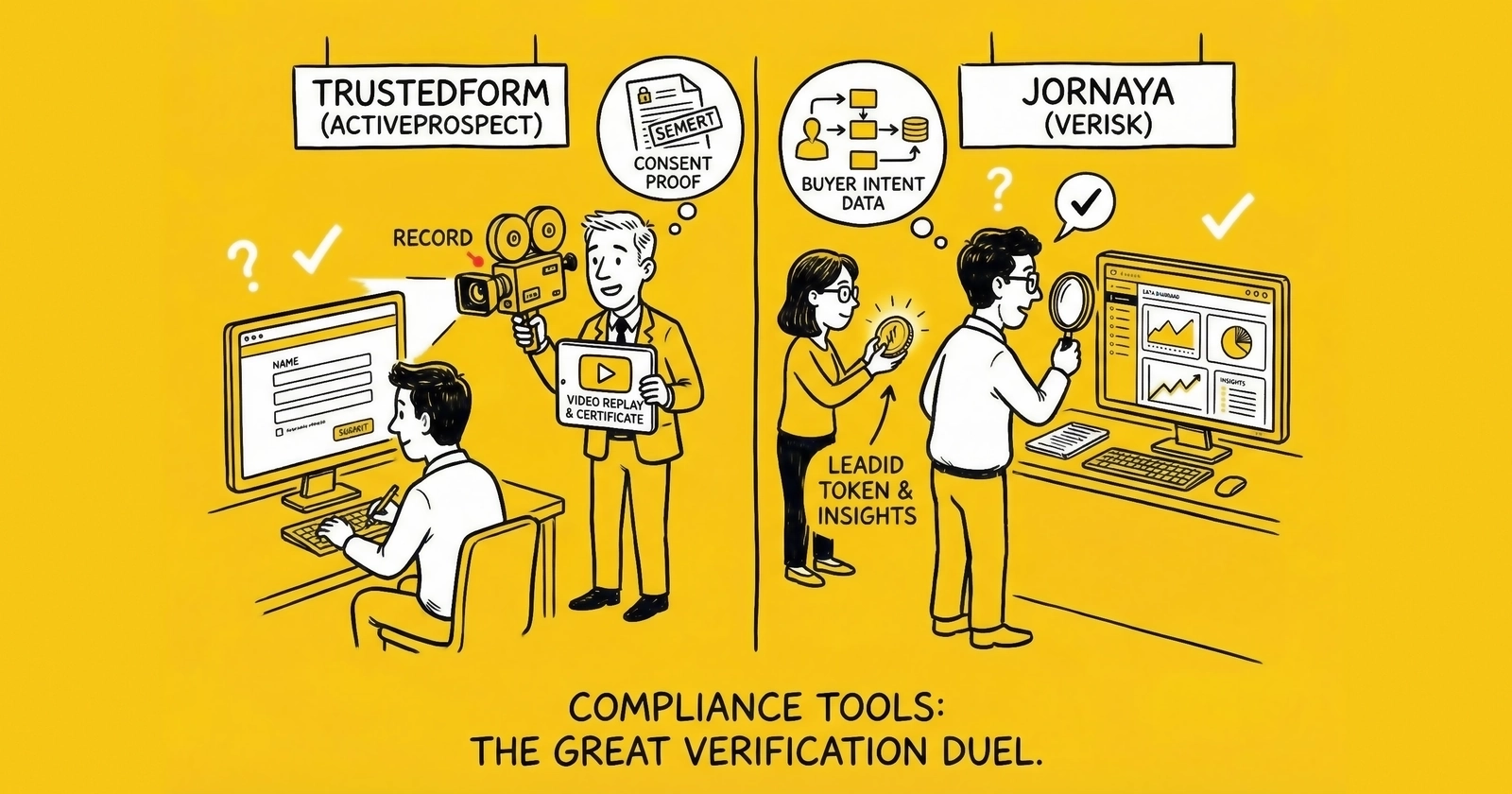
A comprehensive comparison of the two dominant consent verification platforms for lead generation professionals navigating TCPA compliance in an era of escalating class actions and multi-million dollar settlements.
The phone call comes at 2:47 PM on a Thursday. A process server delivers a TCPA class action complaint alleging 47,000 violations. Potential exposure: $70.5 million. The company’s entire annual revenue: $12 million.
Your first call is to your attorney. Your second call is to your consent verification provider.
In the lead generation industry, consent verification platforms are not optional infrastructure. They are litigation survival tools. The two market leaders, TrustedForm (by ActiveProspect) and Jornaya (by Verisk Marketing Solutions), serve similar purposes but differ in approach, capabilities, and optimal use cases.
TCPA class actions continue to escalate. In 2024, 2,788 TCPA cases were filed, representing a 67% increase over the prior year. Average settlements exceed $6.6 million. Statutory damages run $500 to $1,500 per violation with no cap on aggregate damages. The four-year statute of limitations means the lead you generated yesterday can become a lawsuit in 2029.
Your consent verification strategy determines whether you defend successfully or settle expensively. This guide compares TrustedForm and Jornaya across every dimension that matters: features, pricing, implementation, litigation defensibility, and optimal use cases.
What Is Consent Verification?
Consent verification is the process of documenting that a consumer provided valid consent to receive marketing communications. Under the Telephone Consumer Protection Act (TCPA), the burden of proving consent rests entirely on the caller. When litigation arrives, you must demonstrate that the specific consumer provided prior express written consent (PEWC) for the specific calls or texts at issue.
Without third-party verification, your defense relies on internal records that opposing counsel will challenge as self-serving, manipulable, or incomplete. Third-party consent verification creates an independent, time-stamped, tamper-resistant record of the consent transaction that survives litigation scrutiny.
The Consent Documentation Problem
Lead generators face a fundamental documentation challenge. A consumer completes a form on your website. Your database records that the consent checkbox was checked at 3:47 PM on March 15. Three years later, that consumer claims they never consented to telemarketing calls and sues under the TCPA.
Your internal records show the checkbox was clicked. But opposing counsel challenges: How do you know the record was not fabricated after the fact? Can you prove the database was not modified? Where is the audit trail showing who had access to that record? Can you demonstrate what disclosure language was actually displayed to this specific consumer on this specific date?
Internal records create a “he said, she said” dynamic that favors plaintiffs. TCPA plaintiffs’ attorneys exploit this vulnerability systematically.
Why Third-Party Verification Matters
Courts and opposing counsel treat your internal records differently than third-party verification. Third-party platforms like TrustedForm and Jornaya provide independent documentation with several critical advantages:
-
Tamper-resistant certificates. Neither you nor the lead buyer can modify the certificate after generation. The documentation reflects what actually happened, not what you claim happened.
-
Visual evidence. Session replays (TrustedForm) and behavioral documentation (Jornaya) show exactly what the consumer saw and did, not just that a form was submitted.
-
Industry acceptance. Courts have accepted evidence from both platforms. Defense attorneys routinely use TrustedForm certificates and Jornaya reports in litigation.
-
Retention infrastructure. Both platforms offer long-term storage aligned with the four-year TCPA statute of limitations, removing the burden of maintaining your own archival systems.
-
Independent verification. Third-party platforms have no stake in the outcome of individual disputes. Their independence enhances credibility in litigation.
What Verification Does Not Guarantee
A certificate documents what happened. It does not guarantee what happened was compliant.
If your underlying consent disclosure was deficient, hidden in fine print, or failed to identify the specific seller, the certificate simply documents your non-compliance. If the consumer did not actually take an affirmative action, the certificate captures that failure.
Lead buyers who assume a TrustedForm certificate or Jornaya LeadiD means the lead is “safe” misunderstand the system. Lead validation addresses data quality, while consent verification addresses legal compliance. The certificate is evidence for review, not a compliance stamp of approval. You must verify that the documented consent meets legal requirements before relying on it.
The 2024 QuoteWizard case emphasized this point. The court was “not at all impressed” with a Jornaya LeadiD that was “not entirely genuine.” Certificates must be authentic, must correspond to the actual lead in question, and must document compliant consent language.
TrustedForm Overview
TrustedForm, developed by ActiveProspect, has become the industry standard for consent documentation in lead generation. The platform generates unique certificates for each form submission, capturing comprehensive evidence of the consent transaction.
ActiveProspect reports that TrustedForm certifies over 2.5 billion leads annually across more than 40,000 websites. The platform processes over 6,000 requests per second at peak capacity and identifies over 200,000 bots weekly. These scale statistics reflect TrustedForm’s dominant market position in consent certification.
How TrustedForm Works
TrustedForm operates through a JavaScript snippet installed on lead capture forms. When a consumer interacts with the form, the script monitors and records the session. Upon form submission, TrustedForm generates a unique certificate URL.
The process follows this sequence:
- Publisher installs TrustedForm JavaScript on lead capture pages
- Consumer lands on page; script begins monitoring session
- Consumer completes form and submits
- TrustedForm generates unique certificate URL
- Certificate URL passes with lead data to buyer
- Buyer claims certificate using API key
- Claimed certificate retained for configured period (up to 5 years)
The certificate exists independently of both publisher and buyer systems. Neither party can alter it after generation. This independence provides litigation value that internal records cannot match.
Certificate Features and Contents
A TrustedForm certificate contains extensive documentation of the consent transaction:
-
Timestamp and session data. Exact date and time of submission (to the second), session duration, and time zone.
-
Consumer environment. IP address, browser type, device information, operating system, and screen resolution.
-
Page documentation. URL where consent was captured, page source, and DOM state at submission.
-
Visual session replay. A playable recreation showing cursor movements, form field completion, scrolling behavior, and the consent disclosure displayed. This is TrustedForm’s signature feature. The session replay shows exactly what the consumer saw, not a static screenshot, but a video-like recreation of the entire form interaction.
-
Consent language capture. The specific disclosure text visible at the moment of submission.
-
Form field data. The phone number, email, and other data entered by the consumer.
-
Certificate metadata. Certificate age, claim status, fingerprint data, and behavioral signals.
TrustedForm Product Line
TrustedForm offers several products serving different functions:
-
TrustedForm Certify. The core product that generates consent certificates. Implementation requires adding the JavaScript snippet to your forms. Certificate generation is free; retention beyond 90 days requires upgrade to Retain. This is the foundation that most publishers implement first.
-
TrustedForm Retain. Extended certificate storage for up to 5 years. Given the 4-year TCPA statute of limitations, 5-year retention provides appropriate protection. Pricing is per-certificate. Without Retain, certificates expire after 90 days, potentially leaving you without evidence when litigation arrives years later.
-
TrustedForm Verify. Programmatic consent verification for lead buyers. Rather than manually reviewing certificates, Verify can automatically confirm whether specific consent language was present, whether clear-and-conspicuous standards were met (including font size and contrast), and whether one-to-one consent for a specific brand was obtained. This automates what would otherwise require manual certificate review for every purchased lead.
-
TrustedForm Insights. Provides 22 proprietary data points per lead for behavioral analytics and fraud detection. Identifies bot activity, form manipulation, and suspicious patterns. Insights helps distinguish legitimate consumer behavior from automated fraud.
-
TrustedForm Bot Detection. Identifies non-human form submissions before they become leads in your system. ActiveProspect reports identifying over 200,000 bots weekly across the TrustedForm network.
TrustedForm Pricing
TrustedForm pricing is volume-based and varies by product:
-
Certify (certificate generation): Free for basic certificate creation. Certificates are deleted after 90 days unless retained.
-
Retain (extended storage): Starting at approximately $0.15 per certificate, scaling based on volume. Higher volumes command lower per-certificate costs. ActiveProspect offers contracted pricing with minimum annual commitments (typically $24,000+ annually) for additional discounts.
-
Verify (automated validation): Per-verification pricing starting at approximately $0.15 per verification. Contact ActiveProspect for volume-based quotes.
-
Insights and Bot Detection: Add-on pricing layered on top of core products. Enterprise-level access available via API or through LeadConduit.
For a typical lead generator selling leads at $30-50 each, TrustedForm costs represent 0.5% to 2% of lead revenue. This cost is negligible compared to the litigation exposure it mitigates. A single TCPA violation carries $500-$1,500 in statutory damages; TrustedForm certification costs $0.15-$0.50.
TrustedForm Strengths
-
Visual session replay. The ability to show exactly what a consumer saw and did is TrustedForm’s primary differentiator. When a plaintiff claims they “never saw” the consent disclosure, the replay shows their cursor hovering above clearly visible consent language before clicking submit. Defense attorneys consistently cite session replay as decisive evidence in litigation defense.
-
Industry standard status. TrustedForm has achieved near-universal adoption among sophisticated lead buyers. Many buyers require TrustedForm certificates as a condition of purchase. Using TrustedForm signals compliance commitment to buyers and partners.
-
Native integration with LeadConduit. ActiveProspect’s lead routing platform (LeadConduit) integrates natively with TrustedForm, creating a seamless workflow for operations using both products. This integration enables real-time certificate verification within lead flows without additional API development.
-
Comprehensive documentation. Certificates capture everything needed for litigation defense: timestamp, IP, page state, session replay, consent language, and consumer data. The certificate provides a complete evidence package rather than fragmented data points.
-
Court acceptance. TrustedForm certificates have been successfully used as evidence in TCPA litigation defense. Defense attorneys report that session replay evidence can be compelling in settlement negotiations and at trial.
-
Scale and reliability. Processing over 6,000 requests per second, TrustedForm has demonstrated the scale necessary for high-volume operations. Uptime and reliability matter when certificate generation failure creates compliance gaps.
Jornaya Overview
Jornaya, now part of Verisk Marketing Solutions, takes a different approach to consent verification. Rather than focusing exclusively on consent documentation, Jornaya provides lead lifecycle tracking, consumer journey analytics, and compliance tools within a broader intelligence platform.
Jornaya’s technology tracks consumer behavior across over 40,000 websites in its publisher network. This cross-publisher visibility creates capabilities that pure consent documentation platforms cannot match: understanding how consumers shop, how many forms they complete, and how they move through the lead generation ecosystem.
LeadiD and TCPA Guardian
Jornaya’s product ecosystem includes two primary components for consent verification:
LeadiD is a unique identifier assigned to each lead transaction when a consumer interacts with a form. The LeadiD tracks the lead through its lifecycle, enabling verification of authenticity and consent status. Implementation requires installing Jornaya JavaScript on lead capture pages and transmitting the LeadiD token with lead data.
Unlike a certificate URL that provides documentation of a single event, LeadiD connects to Jornaya’s broader intelligence about the consumer’s journey across the ecosystem.
TCPA Guardian is Jornaya’s consent documentation and compliance reporting service. Guardian provides real-time consent validation, compliance reporting, and evidence packages for litigation support. When a compliance inquiry arises, Jornaya can provide a compliance report showing session playback, disclosure language displayed, and user interactions.
How Jornaya Works
Jornaya operates through JavaScript deployment similar to TrustedForm, but captures different data and serves different primary purposes:
- Publisher installs Jornaya JavaScript on lead capture pages
- Consumer lands on page; script begins tracking session
- Consumer completes form and submits
- Jornaya generates unique LeadiD token
- LeadiD transmits with lead data to buyer
- Buyer queries Jornaya API to verify consent status
- Jornaya provides compliance report and session data
The key difference: Jornaya’s primary focus extends beyond consent documentation to include consumer behavior intelligence across its publisher network.
Cross-Publisher Intelligence
Jornaya’s unique capability is cross-publisher visibility. Because Jornaya tracks consumer behavior across multiple sites implementing their technology, they can provide insights into a lead’s shopping journey:
-
Shopping intensity. How many forms has this consumer completed across how many sites? A consumer who has submitted 15 forms across 8 sites in 72 hours is demonstrating different intent than a consumer making a single inquiry.
-
Recency patterns. When did this consumer last submit inquiries? How recently did their shopping behavior begin? Recency signals can indicate urgency and conversion likelihood.
-
Velocity indicators. Is this consumer in active shopping mode or casually browsing? Shopping velocity correlates with conversion rates.
-
Duplicate detection. Has this exact consumer already been purchased by this buyer from another source? Cross-publisher visibility enables de-duplication across your lead sources.
-
Fraud patterns. Some fraud patterns are invisible from a single publisher’s perspective but become apparent when viewed across the network. Jornaya’s cross-publisher visibility enables fraud detection that single-site analysis cannot achieve.
This intelligence helps identify “over-shopped” leads (consumers who have submitted dozens of forms across multiple sites) that typically convert poorly. These consumers may be tire-kickers, may already have purchased from a competitor, or may simply be generating inquiries without genuine intent.
Jornaya Product Line
-
LeadiD. Unique consumer journey tracking identifier. Each form submission receives a LeadiD that connects to Jornaya’s broader consumer intelligence. Per-lookup pricing.
-
LeadiD Verify. Consent verification confirming TCPA-compliant consent was presented. Enables buyers to verify consent status before purchasing or contacting leads. Per-verification pricing.
-
TCPA Guardian. Comprehensive consent management and risk mitigation. Provides real-time consent validation, compliance reporting, and evidence packages. Subscription pricing based on volume.
-
Journey Analytics. Consumer behavior insights for optimization. Enables lead scoring based on shopping behavior, timing optimization, and conversion prediction. Subscription pricing.
Jornaya Pricing
Jornaya operates on enterprise pricing models. Specific rates depend on volume, product mix, and contract terms. Contact Verisk Marketing Solutions for current pricing.
General pricing guidance:
LeadiD lookups: Per-lookup pricing, volume-tiered. Pricing is competitive with TrustedForm for comparable consent verification functions.
TCPA Guardian: Subscription pricing based on monthly volume and feature requirements.
Journey Analytics: Enterprise subscription pricing for behavioral intelligence features.
Jornaya pricing is typically competitive with TrustedForm for comparable consent verification functions, with additional cost for behavioral intelligence features that TrustedForm does not provide.
Jornaya Strengths
Cross-publisher behavioral intelligence. No competitor matches Jornaya’s visibility into consumer shopping behavior across the lead generation ecosystem. This intelligence helps identify lead quality signals invisible from a single-publisher perspective.
Consent verification with context. TCPA Guardian provides consent documentation plus behavioral context about the consumer’s journey. Understanding that a consumer has been actively shopping for insurance across 12 sites adds context that pure consent documentation lacks.
Network effects. Jornaya’s value increases with network size. More publishers using Jornaya means more comprehensive consumer journey data. The network currently spans 40,000+ websites.
Court acceptance. Evidence from Jornaya has been used in legal proceedings. Courts have accepted TCPA Guardian reports as evidence of consent.
Enterprise focus. Jornaya’s products are designed for large-scale operations needing both compliance and optimization intelligence. The product suite addresses multiple operational needs beyond consent verification.
Fraud detection through network visibility. Some fraud patterns only become visible when viewed across multiple publishers. Jornaya’s network-wide perspective enables fraud detection unavailable from single-publisher analysis.
Head-to-Head Comparison
The following table compares TrustedForm and Jornaya across key dimensions:
| Feature | TrustedForm | Jornaya |
|---|---|---|
| Primary Function | Consent documentation | Lead intelligence + consent |
| Visual Session Replay | Yes (full video-like playback) | No (behavioral data, session information) |
| Certificate/Token Storage | Up to 5 years (Retain) | Varies by product |
| Cross-Publisher Insights | No | Yes (network-wide visibility) |
| Bot Detection | Yes (add-on) | Yes (included in LeadiD) |
| Real-Time API | Yes | Yes |
| Consent Language Capture | Yes (visual + text) | Yes (metadata) |
| One-to-One Consent Verification | Yes (Verify product) | Yes (Guardian product) |
| Litigation Support | Strong (session replay) | Moderate (compliance reports) |
| Pricing Model | Per-certificate | Per-lookup / Subscription |
| Typical Cost | $0.15-$0.50/lead | Contact for enterprise pricing |
| Industry Adoption | Near-universal | Strong in specific verticals |
| Native Platform Integration | LeadConduit (ActiveProspect) | Various via API |
| Implementation Complexity | Low (JavaScript snippet) | Low (JavaScript snippet) |
| Network Size | 40,000+ websites | 40,000+ websites |
Feature Comparison: Consent Documentation
TrustedForm advantage: Visual session replay provides compelling evidence of exactly what consumers saw. This is decisive in litigation where plaintiffs claim they never saw consent language. The replay shows cursor movement, scrolling, and the disclosure’s visual prominence. When a plaintiff’s attorney argues the disclosure was “buried” or “inconspicuous,” TrustedForm’s replay demonstrates exactly how prominent it was.
Jornaya approach: TCPA Guardian captures consent metadata and session information without full visual replay. The compliance report documents that consent was presented, captures session data, and provides evidence of the consent event. However, the evidence is metadata-based rather than visual.
Verdict: TrustedForm’s session replay is superior for pure consent documentation. If litigation defensibility is your primary concern, TrustedForm provides stronger evidence. The ability to show exactly what a consumer saw and did is compelling in both settlement negotiations and at trial.
Feature Comparison: Lead Intelligence
Jornaya advantage: Cross-publisher behavioral intelligence is unavailable from TrustedForm. Understanding this data helps with lead quality scoring and optimization. Knowing that a consumer has submitted 15 forms across 8 sites in the past 72 hours provides conversion optimization value that pure consent documentation cannot match. This intelligence enables:
- Lead scoring based on shopping behavior
- Duplicate detection across lead sources
- Fraud pattern identification
- Conversion timing optimization
- Over-shopped lead identification
TrustedForm approach: TrustedForm focuses on consent documentation. Insights and Bot Detection add fraud detection and behavioral analytics, but these are based on single-session data rather than cross-publisher intelligence. TrustedForm cannot tell you how this consumer has been shopping across other sites.
Verdict: Jornaya provides substantially more lead intelligence. If you need to understand consumer shopping behavior beyond your own forms, Jornaya is the only choice.
Feature Comparison: Implementation
Both platforms require similar implementation effort:
JavaScript installation: Both require adding a JavaScript snippet to lead capture pages. Typical implementation time: 1-2 hours for basic setup.
Form modification: Both require adding a hidden field to capture the certificate URL (TrustedForm) or LeadiD token (Jornaya). Standard form platforms support this readily.
API integration: Claiming TrustedForm certificates or querying Jornaya data requires API integration. Typical implementation time: 4-8 hours.
Distribution platform integration: Both platforms integrate with major lead distribution systems (boberdoo, LeadsPedia, LeadExec, LeadHoop, Lead Prosper). Most platforms offer native or documented integrations. TrustedForm has native integration with ActiveProspect’s LeadConduit.
Verdict: Implementation complexity is equivalent. Neither platform presents significant implementation barriers. Most operations can implement either or both within a day.
Feature Comparison: Pricing
TrustedForm: Transparent per-certificate pricing. Certify is free; Retain costs approximately $0.15-$0.50 per certificate depending on volume. Easy to calculate ROI based on lead volume. Contracted pricing with annual commitments offers additional discounts.
Jornaya: Enterprise pricing requiring direct engagement. Per-lookup and subscription models. Less transparent but negotiable based on volume and relationship.
Verdict: TrustedForm offers simpler, more transparent pricing. Jornaya may offer competitive pricing for high-volume enterprise operations but requires negotiation and direct engagement with sales.
Which Platform Should You Choose?
The optimal choice depends on your operational needs, primary concerns, and budget constraints. Here is a decision framework:
Choose TrustedForm If:
Litigation defense is your primary concern. TrustedForm’s session replay provides the strongest evidence for TCPA defense. If you anticipate litigation or operate in high-risk verticals (insurance, mortgage, solar, legal), TrustedForm’s visual documentation is invaluable.
Your buyers require TrustedForm. Many sophisticated lead buyers specifically require TrustedForm certificates as a purchase condition. If your buyer agreements mandate TrustedForm, the decision is made.
You need transparent, predictable pricing. TrustedForm’s per-certificate model makes cost calculation straightforward. You know exactly what you will pay based on lead volume.
You use ActiveProspect’s LeadConduit. Native integration between TrustedForm and LeadConduit creates operational efficiency for operations using both products.
You want the industry standard. TrustedForm has achieved near-universal adoption among quality-focused lead operations. Using TrustedForm signals compliance commitment to buyers and partners.
You prioritize visual evidence. If your compliance strategy emphasizes having indisputable visual proof of consent capture, TrustedForm’s session replay is unmatched.
Choose Jornaya If:
Consumer journey intelligence matters for your operation. If you need to understand how leads are shopping across the ecosystem, Jornaya’s cross-publisher visibility is unique. This intelligence helps with lead scoring, fraud detection, and conversion optimization.
You operate at enterprise scale with complex needs. Jornaya’s product suite addresses multiple operational needs beyond consent verification. Large operations may benefit from consolidated vendor relationships.
Your vertical has strong Jornaya adoption. In some verticals and among some buyer groups, Jornaya is the preferred or required verification standard. Match your verification to buyer requirements.
You need behavioral fraud detection. Jornaya’s network-wide visibility enables fraud pattern detection that single-publisher solutions cannot match.
You want to optimize conversion through behavioral insights. Understanding consumer shopping behavior can inform contact timing, lead prioritization, and conversion strategies.
Choose Both If:
Maximum litigation protection is required. Using both platforms provides belt-and-suspenders documentation. TrustedForm’s session replay plus Jornaya’s behavioral intelligence creates comprehensive evidence.
Your buyers have mixed requirements. Some buyers require TrustedForm; others require Jornaya. Running both satisfies all buyer requirements without limiting your distribution options.
You operate in high-litigation verticals. Insurance, mortgage, solar, and legal leads face the highest TCPA litigation risk. Double documentation may be appropriate given the stakes.
Cost is secondary to risk mitigation. Combined cost of both platforms typically runs $0.30-$0.75 per lead. For leads selling at $50+, this represents 0.6%-1.5% of revenue, negligible compared to litigation exposure.
Using Both Platforms Simultaneously
Many sophisticated lead operations implement both TrustedForm and Jornaya on the same forms. The platforms do not interfere with each other, and the combined documentation provides maximum protection.
Implementation Considerations
JavaScript placement. Both scripts can load on the same page without conflict. Place both snippets in your page header or footer. Test to ensure both scripts load and function correctly.
Hidden fields. Add separate hidden fields to capture the TrustedForm certificate URL and Jornaya LeadiD token. Both values transmit with lead data.
Data storage. Your lead records should store both certificate URL and LeadiD. Associate both with the lead permanently for future retrieval.
Cost calculation. Budget for both platforms. At combined costs of $0.30-$0.75 per lead, the investment remains minimal relative to lead value.
When Dual Implementation Makes Sense
High-value leads. For leads selling at $100+ (mortgage, solar, legal), dual verification costs represent less than 1% of revenue.
High-litigation verticals. Insurance and financial services face disproportionate TCPA litigation. Maximum documentation is appropriate.
Mixed buyer requirements. If your buyer base includes both TrustedForm-required and Jornaya-required buyers, dual implementation serves all.
Enterprise operations. Large operations with legal counsel advising maximum protection often implement both platforms.
Implementation Best Practices
Regardless of which platform you choose, these implementation practices ensure maximum value:
For Publishers (Lead Generators)
Claim certificates immediately. TrustedForm certificates expire if not claimed within 90 days. Configure your systems to claim certificates automatically at lead generation, not later. Do not wait until you sell the lead to claim the certificate.
Retain for 5+ years. The TCPA has a 4-year statute of limitations. Retain documentation for at least 5 years to cover the full exposure window plus margin. TrustedForm Retain offers 5-year storage. Budget for retention from the start.
Verify before selling. Review a sample of your certificates regularly. Confirm that consent language is actually visible, clear, and conspicuous. A certificate documenting hidden consent is evidence of non-compliance, not defense.
Store with lead record. Certificate URLs and LeadiDs should be permanently associated with lead records and retrievable by phone number for future disputes.
Monitor certificate quality. Track the percentage of leads generating valid certificates. Certificate generation failures indicate implementation problems requiring attention. A 6% certificate generation failure rate means 6% of your leads lack documentation.
Validate implementation across devices. Test certificate generation on mobile devices, tablets, and various browsers. Implementation issues often manifest differently across platforms.
For Lead Buyers
Claim at purchase. Retrieve and claim TrustedForm certificates at the moment of lead purchase, before any contact is attempted. Do not wait until a dispute arises to claim certificates.
Verify before calling. The presence of a certificate does not guarantee compliant consent. Review the certificate to confirm correct seller name, visible disclosure, affirmative action, and matching phone number.
Reject leads without valid certificates. Leads lacking consent verification should be returned or rejected. The potential liability exceeds any lead value. A $50 lead without consent documentation creates $500-$1,500 per-call exposure.
Build verification into routing. Configure your distribution platform to automatically verify consent before accepting leads. TrustedForm Verify and Jornaya TCPA Guardian enable automated validation.
Document verification decisions. When you verify a certificate and proceed to call, document that verification. When you reject a lead for certificate deficiency, document the reason. This documentation supports good-faith defense arguments.
Technical Best Practices
Test implementation thoroughly. Submit test leads through your forms and verify that certificates generate correctly. Check that certificate URLs and LeadiDs transmit with lead data.
Monitor for failures. Implement alerting when certificate generation fails or certificates fail to transmit with leads. Silent failures create compliance gaps that may not become apparent until litigation arrives.
Maintain script versions. Both platforms update their JavaScript periodically. Monitor for updates and implement promptly to access latest features and maintain compatibility.
Document your implementation. Maintain records of when you implemented verification, which script versions you use, and how certificates are stored. This documentation supports compliance defense.
What Certificates Do Not Guarantee
Consent verification platforms document what happened. They do not guarantee compliance. Understanding these limitations is essential:
Certificates Do Not Make Bad Consent Good
If your disclosure language is deficient, the certificate documents deficient language. Common deficiencies include:
Vague seller identification. “Our marketing partners” without naming specific sellers fails one-to-one consent standards that sophisticated buyers still require despite the FCC rule’s vacatur and repeal. A certificate showing this language documents non-compliance.
Hidden or inconspicuous disclosure. If consent language appears in tiny font at page bottom, the certificate captures that poor placement. The 2024 Dahdah v. Rocket Mortgage case specifically cited “tiny gray font” as problematic.
Pre-checked boxes. If your form pre-checks the consent box (violating PEWC requirements for affirmative consent), the certificate documents this failure.
Conditional consent. If your form requires consent to proceed (violating “not a condition of purchase” requirement), the certificate shows this.
Certificates Do Not Cover Subsequent Failures
Consent verification captures the consent transaction. It does not protect against:
Calling after revocation. If a consumer revokes consent and you continue calling, the original certificate provides no defense. The FCC requires honoring revocation requests within 10 business days.
Calling wrong numbers. Consent is phone-number-specific. If you call a different number than the one documented in the certificate, the consent does not apply.
Scope violations. If consent was for insurance marketing and you call about debt consolidation, the certificate for insurance consent provides no protection.
Timing violations. Certificates document consent, not calling hour compliance. Calling at 11 PM creates liability regardless of valid consent.
Certificates Are Evidence, Not Immunity
A certificate is one piece of evidence in litigation. It does not guarantee case dismissal. Plaintiffs and their attorneys may challenge:
Certificate authenticity. Is this certificate actually from the lead at issue? Does the data match?
Consent validity. Does the documented consent meet all FCC requirements?
Consent scope. Did consent cover the specific calls made by this specific caller?
Certificate accuracy. Does the certificate accurately represent what happened?
Strong certificates make these challenges difficult to sustain. But certificates are part of a comprehensive compliance program, not a substitute for one.
The Economics of Consent Verification
Understanding the economic case for consent verification helps justify the investment and prioritize implementation.
Cost of Verification
TrustedForm costs approximately $0.15-$0.50 per certificate depending on volume and features. Jornaya pricing is competitive for comparable functions. Combined implementation of both platforms runs $0.30-$0.75 per lead.
For 10,000 monthly leads at $0.35 per lead average, consent verification costs $3,500 monthly.
Cost of Non-Verification
TCPA statutory damages run $500-$1,500 per violation. A single lead that becomes a lawsuit creates exposure exceeding years of verification costs.
Average TCPA class action settlements exceed $6.6 million. A class of 10,000 consumers at $500 per violation represents $5 million in exposure.
The economics are unambiguous: verification costs pennies to avoid dollars of exposure.
ROI Calculation
For a lead sold at $30:
- TrustedForm cost: $0.35 (1.2% of revenue)
- TCPA exposure per call: $500-$1,500 (1,667%-5,000% of revenue)
- Break-even: Verification pays for itself if it prevents liability on 0.02% of leads
The math is not close. Consent verification is among the highest-ROI investments in lead generation operations.
Frequently Asked Questions
1. What is the difference between TrustedForm and Jornaya?
TrustedForm focuses on consent documentation with visual session replay, capturing exactly what consumers saw when providing consent. Jornaya focuses on lead lifecycle intelligence with cross-publisher behavioral insights, including consent verification as one component. TrustedForm’s strength is litigation-ready visual evidence. Jornaya’s strength is understanding consumer shopping behavior across the ecosystem. Many operations use both for comprehensive coverage.
2. How much does TrustedForm cost?
TrustedForm Certify (certificate generation) is free. TrustedForm Retain (extended storage) costs approximately $0.15 to $0.50 per certificate depending on volume and contract terms. TrustedForm Verify (automated validation) uses per-verification pricing starting at approximately $0.15. For most lead operations, TrustedForm costs represent 0.5% to 2% of lead revenue.
3. How much does Jornaya cost?
Jornaya uses enterprise pricing requiring direct engagement. Pricing models include per-lookup for LeadiD and subscription for TCPA Guardian and Journey Analytics. Contact Verisk Marketing Solutions for current pricing based on your volume and requirements.
4. Which platform provides better litigation protection?
TrustedForm’s visual session replay provides stronger litigation evidence. The ability to show exactly what a consumer saw and did is compelling evidence when plaintiffs claim they never saw consent language. Jornaya’s compliance reports provide consent documentation but without visual replay capability. For pure litigation defense, TrustedForm is generally considered superior.
5. Can I use both TrustedForm and Jornaya on the same forms?
Yes. Both platforms use JavaScript snippets that can run simultaneously without conflict. Many sophisticated operations implement both to satisfy varied buyer requirements and maximize documentation coverage. Combined cost typically runs $0.30-$0.75 per lead.
6. What does TrustedForm’s session replay actually show?
The session replay is a playable video-like recreation of the consumer’s interaction with your form. It shows cursor movements, form field completion, scrolling behavior, disclosure language visibility, and the submit action. When a plaintiff claims they never saw the consent disclosure, the replay can show their cursor hovering directly above clearly visible consent language before clicking submit.
7. What is Jornaya’s LeadiD used for?
LeadiD is a unique identifier assigned to each lead transaction. It tracks the lead through its lifecycle and enables buyers to verify authenticity, check consent status, and access consumer journey intelligence. LeadiD also supports cross-publisher duplicate detection, identifying when the same consumer has submitted forms across multiple sites.
8. How long should I retain consent certificates?
The TCPA has a 4-year statute of limitations. Retain consent documentation for at least 5 years after the last contact made under that consent. Industry best practice extends to 6 years to account for tolling provisions and class action timing. TrustedForm Retain offers 5-year storage. Jornaya retention varies by product.
9. Do courts accept TrustedForm and Jornaya evidence?
Yes. Both platforms have provided evidence accepted in court proceedings. TrustedForm certificates with session replay have been used successfully in TCPA defense. Jornaya TCPA Guardian reports have been used as consent evidence. However, the 2024 QuoteWizard case emphasized that certificates must be genuine and correspond to the actual lead at issue.
10. What if my certificate shows non-compliant consent language?
The certificate documents what happened, not what should have happened. If your consent language was deficient, the certificate documents your non-compliance. You cannot rely on that certificate as valid consent. Fix your disclosure language immediately and generate new compliant certificates for future leads. The certificate documenting non-compliance may actually be used against you in litigation.
Key Takeaways
-
TrustedForm excels at litigation defense with visual session replay showing exactly what consumers saw. At $0.15-$0.50 per certificate, it represents negligible cost compared to the $500-$1,500 per-violation statutory damages it helps defend against.
-
Jornaya excels at lead intelligence with cross-publisher behavioral insights unavailable from any competitor. TCPA Guardian provides consent verification within a broader intelligence ecosystem enabling lead scoring, fraud detection, and conversion optimization.
-
Choose TrustedForm if litigation defense is primary, buyers require it, or you need the industry standard with transparent pricing.
-
Choose Jornaya if consumer journey intelligence matters, you need cross-publisher behavioral insights, or enterprise-scale intelligence capabilities are required.
-
Use both platforms if you need maximum litigation protection, serve buyers with mixed requirements, or operate in high-litigation verticals where belt-and-suspenders documentation is appropriate.
-
Certificates document consent but do not guarantee compliance. Deficient disclosure language, hidden consent, or pre-checked boxes documented in a certificate provide evidence of non-compliance, not defense.
-
Claim and retain certificates immediately. TrustedForm certificates expire if not claimed within 90 days. Configure automatic claiming at lead generation and retain for 5+ years.
-
Verify before calling. The presence of a certificate does not mean consent is valid. Review certificates to confirm correct seller identification, visible disclosure, affirmative action, and matching phone number before making contact.
-
The economics are unambiguous. Verification costs $0.15-$0.50 per lead. TCPA exposure runs $500-$1,500 per violation. Verification pays for itself if it prevents liability on 0.02% of leads.
-
Implementation is straightforward. Both platforms require JavaScript installation and hidden field addition. Most operations implement in 2-8 hours. See our TrustedForm implementation guide for step-by-step instructions. The minimal implementation effort compared to litigation exposure makes verification essential infrastructure.
This article reflects platform capabilities and industry practices as of late 2025. TrustedForm is a product of ActiveProspect. Jornaya is a product of Verisk Marketing Solutions. Pricing, features, and capabilities evolve. Contact vendors directly for current information. This article does not constitute legal advice. Consult qualified TCPA counsel for compliance requirements specific to your operations.
Related Resources
- TrustedForm: activeprospect.com/trustedform
- Jornaya (Verisk Marketing Solutions): marketing.verisk.com/leadid-create/
- FCC TCPA Rules: 47 CFR 64.1200
- TCPAWorld (Eric Troutman): tcpaworld.com