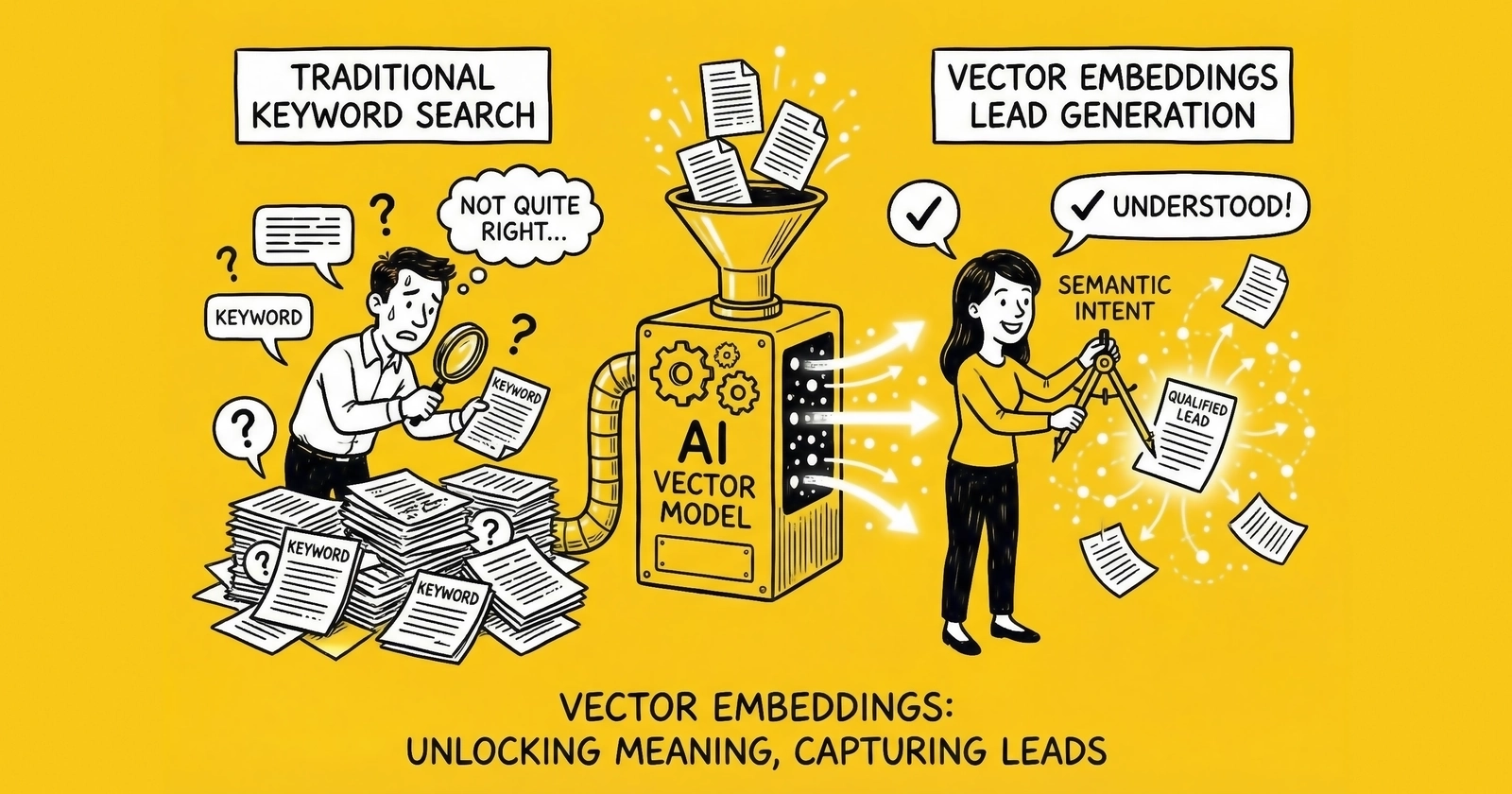
The word “TCPA” exists as a coordinate in 4,096-dimensional space. So does your compliance guide, your competitor’s guide, and every query a lead buyer types into ChatGPT. The mathematical distance between these points determines who gets cited. Understanding vector embeddings isn’t academic – it’s the technical foundation of AI visibility.
When you ask an AI system about lead generation compliance, something remarkable happens before you receive a response. Your question gets transformed into an array of thousands of floating-point numbers – coordinates in a high-dimensional mathematical space where meaning has geometry. These coordinates are vector embeddings, and they represent the semantic essence of what you’ve asked.
Your content exists in this same space. Every TCPA guide, lead scoring methodology, and industry analysis occupies its own position in this mathematical universe. The proximity between your content’s position and the user’s query position determines whether you get cited, referenced, or remain entirely invisible.
This isn’t metaphor – it’s the literal mechanism by which modern AI systems understand and retrieve information. Lead generation companies that understand embeddings can structure content that naturally occupies the right semantic neighborhoods. Those that don’t leave their visibility to chance.
From Words to Coordinates: The Conceptual Foundation
The Spatial Representation of Meaning
Imagine a map, but instead of two dimensions (latitude and longitude), this map has thousands of dimensions. Each dimension captures some aspect of meaning – grammatical properties, emotional valence, associations with other concepts, contextual patterns learned from vast text datasets.
When text enters an AI system, it gets transformed into coordinates on this map. The word “compliance” becomes an array of 4,096 numbers (in systems like Llama 3). These numbers position “compliance” relative to every other concept the model knows about.
| Embedding Model | Dimensions | Use Case |
|---|---|---|
| BERT | 768 | Smaller applications, fast inference |
| GPT-3 | 12,288 | Large-scale language understanding |
| Llama 3 8B | 4,096 | Balanced performance and efficiency |
| DeepSeek-R1 | 7,168 | High-fidelity semantic representation |
| text-embedding-3-large | 3,072 | OpenAI’s production embedding model |
The magic happens in how these coordinates relate to each other. Words with similar meanings end up positioned close together. “TCPA” clusters near “compliance,” “consent,” “telephone,” and “regulation.” “Lead generation” clusters near “marketing,” “sales,” “conversion,” and “qualified.”
This spatial relationship isn’t programmed – it emerges from training on enormous text datasets. The model learns from billions of examples how words appear in context and what they mean relative to each other.
The Distributional Hypothesis
The power behind embeddings rests on a linguistic principle: words appearing in similar contexts tend to bear similar meanings. If “compliance” and “regulation” appear in nearly identical sentence structures across millions of documents, the model learns they’re related. Their embeddings converge toward similar positions in the vector space.
This principle dates back decades in linguistic research, but modern AI applies it at unprecedented scale. Consider how you’d understand an unfamiliar term if you encountered it repeatedly in specific contexts. You’d build intuitions about its meaning from surrounding words. Embedding models do this, but from billions of contextual examples.
The result is a geometric organization of human knowledge. Mathematical operations on embeddings produce meaningful results:
embedding("queen") - embedding("woman") + embedding("man") ≈ embedding("king")
embedding("TCPA") - embedding("federal") + embedding("state") ≈ embedding("mini-TCPA")
These relationships aren’t programmed – they emerge naturally from the geometry of learned semantic space.
How AI Systems Use Embeddings
The Retrieval Process
When a lead buyer asks ChatGPT “What are the TCPA consent requirements for mortgage leads?”, here’s what happens:
-
Query embedding: The question gets converted to a vector – thousands of numbers representing its semantic position.
-
Similarity search: The system searches for content whose embeddings are closest to the query embedding.
-
Retrieval: The closest matches get retrieved as potential sources for the response.
-
Generation: The AI uses retrieved content as context to generate its answer, potentially citing the sources.
The critical insight: this process operates on semantic similarity, not keyword matching. Content about “mortgage lead consent compliance” can match a query about “TCPA requirements for home loan prospects” because their embeddings occupy similar positions – even without shared keywords.
Retrieval-Augmented Generation (RAG)
RAG systems make this process explicit. They embed documents and store them in vector databases optimized for similarity search. When users ask questions, the system:
- Embeds the query using the same embedding model
- Searches the vector database for similar embeddings
- Retrieves the most similar documents
- Provides them as context for the language model
- Generates responses grounded in actual retrieved content
This architecture powers many AI applications – from enterprise knowledge systems to consumer-facing AI assistants. The embedding quality of your content directly determines whether it gets retrieved.
Similarity Metrics
Several metrics measure embedding similarity:
Cosine Similarity
The most common metric. Measures the angle between two vectors, ignoring magnitude. Values range from -1 (opposite) to 1 (identical).
cosine_similarity(A, B) = (A · B) / (|A| × |B|)Two documents about TCPA compliance might have cosine similarity of 0.85, while TCPA content compared to unrelated content might score 0.15.
Euclidean Distance
Measures straight-line distance between points in embedding space. Smaller values indicate more similarity.
Dot Product
Simple multiplication of corresponding dimensions, summed. Captures both similarity and magnitude.
For most AI applications, cosine similarity dominates because it focuses on semantic direction rather than content length.
Content Structure and Embedding Quality
How Structure Affects Embeddings
Content structure directly impacts embedding quality. When AI systems process your content, they break it into chunks, embed each chunk, and store those embeddings. Poor structure creates poor embeddings.
Clear Hierarchies Improve Embeddings
Well-organized content with logical heading structures creates coherent embeddings. Each section focuses on a specific subtopic, producing embeddings that cluster appropriately with relevant queries.
H1: TCPA Compliance Guide
  H2: Consent Requirements
    H3: Express Written Consent
    H3: Prior Express Consent
  H2: State Regulations
    H3: Florida Mini-TCPA
    H3: Oklahoma Restrictions
This structure creates distinct embeddings for each section – one cluster for consent requirements, another for state regulations. Users asking about Florida regulations get matched with that specific section.
Scattered Content Creates Fragmented Embeddings
Disorganized content mixing multiple topics creates embeddings that don’t cluster coherently with any specific query.
TCPA requires consent, but Florida has its own rules.
Lead scoring matters for quality. You should also consider
state regulations. Marketing automation helps with compliance.
This paragraph touches TCPA, state regulations, lead scoring, and marketing automation. Its embedding sits somewhere in the middle of these concepts, matching none particularly well.
Terminology Consistency
Embedding models learn that different terms can mean similar things, but inconsistent terminology still fragments your content’s semantic profile.
| Inconsistent | Consistent |
|---|---|
| ”leads,” “prospects,” “contacts,” “inquiries” used interchangeably | ”leads” for qualified contacts, “prospects” for unqualified, clear definitions |
| ”ping/post,” “real-time bidding,” “distribution” mixed randomly | ”ping/post distribution” used consistently with explanation |
| ”compliance,” “regulations,” “rules,” “requirements” scattered | ”compliance requirements” as the primary term throughout |
Consistency helps your content form cohesive semantic clusters. When you consistently use “ping/post distribution,” your content builds strong embedding associations with that specific concept.
Semantic Completeness
Comprehensive topic coverage creates stronger embedding profiles. An article that covers all aspects of TCPA compliance – consent types, record-keeping, state variations, enforcement, remediation – creates embeddings that match a wider range of related queries.
Shallow content covering only surface aspects produces weak embeddings that may miss important query variations. A one-paragraph TCPA overview won’t match queries about specific consent requirements because it doesn’t create detailed embeddings for those subtopics.
Topic Clusters and Embedding Strategy
The Hub-and-Spoke Model
Topic clusters – pillar pages supported by related content – create embedding networks that reinforce each other. This structure mirrors how embedding spaces organize related concepts.
Pillar Page: Comprehensive TCPA Compliance Guide
Supporting Content:
- Express Written Consent Requirements
- State Mini-TCPA Regulations
- TCPA Enforcement and Penalties
- Consent Record-Keeping Best Practices
- TCPA Technology Solutions
Each piece of supporting content creates embeddings in related but distinct semantic neighborhoods. Together, they establish your content’s authority across the entire TCPA topic cluster.
When users ask broad questions (“What is TCPA?”), the pillar page matches. When they ask specific questions (“What are Florida’s telephone solicitation rules?”), the supporting content matches. The cluster covers the entire semantic territory.
Internal Linking and Embedding Relationships
Internal links between cluster content don’t directly affect embeddings, but they influence how AI systems crawl and understand content relationships. A well-linked cluster signals topical coherence that may influence retrieval decisions.
More importantly, consistent terminology and cross-references between cluster content reinforce semantic relationships during AI processing. When your pillar page mentions “express written consent” and links to a detailed article using the same terminology, the semantic connection strengthens.
Cross-Cluster Connections
Real topics don’t exist in isolation. Lead generation connects compliance, technology, operations, and business strategy. Strategic content connections between clusters create broader semantic networks.
TCPA Compliance Cluster → connects to → Lead Quality Cluster
(consent requirements)    (how consent affects lead quality)

Lead Quality Cluster → connects to → Technology Cluster
(scoring frameworks)     (automation platforms)

Technology Cluster → connects to → Operations Cluster
(distribution systems)   (workflow optimization)
These connections mirror how concepts relate in embedding space. Content that acknowledges and addresses these connections creates richer embeddings that match more query variations.
Practical Implications for Lead Generation Content
Content That Embeds Well
Based on how embeddings work, certain content characteristics produce better AI visibility:
Definitional Clarity
Open sections with clear definitions. When explaining lead scoring, start with what lead scoring is. This creates strong embedding anchors that match definitional queries.
Lead scoring assigns numerical values to prospects based on
their likelihood to convert. This framework helps lead buyers
prioritize high-value leads and optimize acquisition costs.
This opening embeds strongly with queries like “What is lead scoring?” or “How does lead scoring work?”
Exhaustive Subtopic Coverage
Cover all aspects of your topic. For lead distribution, address:
- How ping/post works technically
- Pricing models (exclusive, shared, aged)
- Platform options and selection criteria
- Integration requirements
- Quality assurance mechanisms
- Compliance considerations
Each aspect creates embeddings matching specific query variations. Incomplete coverage leaves semantic gaps where competitor content might match instead.
Concrete Examples
Abstract concepts embed weakly. Concrete examples create specific embeddings:
Abstract: Lead distribution involves multiple pricing models.

Concrete: Exclusive leads typically cost $40-150 for mortgage
verticals, while shared leads (sold to 3-5 buyers) range from
$15-40. Aged leads older than 30 days drop to $5-15.
The concrete version embeds with queries about lead pricing, cost benchmarks, and specific vertical economics.
Data and Specificity
Numbers and specific facts create distinctive embeddings:
Generic: TCPA violations can result in significant penalties.

Specific: TCPA violations carry statutory damages of $500 per
incident for negligent violations and $1,500 per incident for
willful violations. Class actions can aggregate millions in damages.
Specific content matches queries seeking concrete information – the queries most likely to cite authoritative sources.
Content Structures That Embed Poorly
Wall-of-Text Paragraphs
Long paragraphs mixing multiple concepts create confused embeddings that match nothing specifically:
Lead generation involves many aspects including compliance
with TCPA and state regulations while also considering lead
quality and scoring methodologies as well as distribution
technology platforms and pricing models that vary across
verticals and geographic regions with different requirements.
This embeds weakly for TCPA, quality, distribution, and pricing queries because it addresses everything superficially.
Ambiguous Terminology
Using terms without clear context produces ambiguous embeddings:
The system processes leads through the platform.Which system? What kind of processing? Which platform? Vague language creates vague embeddings.
Outdated Information
AI systems increasingly factor freshness into retrieval. Content referencing 2019 regulations when 2025 updates exist may be deprioritized despite topical relevance.
Embedding Optimization for Different AI Platforms
Platform Variation
Different AI platforms use different embedding models and retrieval systems. What works optimally for ChatGPT may perform differently with Claude or Perplexity.
| Platform | Embedding Approach | Optimization Focus |
|---|---|---|
| ChatGPT | Proprietary embeddings + search | Comprehensive coverage, freshness |
| Claude | Training-based knowledge + search | Authoritative depth, clear structure |
| Perplexity | Real-time retrieval emphasis | Current information, citations |
| Gemini | Google’s embedding ecosystem | E-E-A-T signals, structured data |
The safest strategy: create content that embeds well universally by focusing on fundamentals – clear structure, comprehensive coverage, specific information, consistent terminology.
Training vs. Retrieval
AI systems get information two ways:
- Training data: Information embedded in the model’s base knowledge from pre-training
- Retrieval: Real-time retrieval of current information during queries
For lead generation companies, both matter:
- Getting into training datasets provides persistent visibility – the model “knows” your content without retrieval
- Optimizing for retrieval enables citation for current queries
Training datasets update periodically (months to years). Retrieval happens in real-time. Content strategy should address both:
- Evergreen authoritative content for training inclusion
- Current, updated content for retrieval optimization
Technical Considerations for Content Teams
Chunking Strategy
AI systems break content into chunks before embedding. How content chunks affects retrieval:
Natural Chunk Boundaries
Structure content with clear section breaks that serve as natural chunking points:
## Express Written Consent

[Complete section on express written consent - 300-500 words]

## Prior Express Consent

[Complete section on prior express consent - 300-500 words]
Each section becomes a coherent chunk with focused embeddings.
Avoid Mid-Concept Breaks
Long paragraphs that split across chunks create fragmented embeddings:
...consent requirements under TCPA include both express written
consent for certain message types and prior express consent for
[CHUNK BREAK]
others. The distinction matters because express written consent
requires specific disclosures while prior express consent...
The split creates two incomplete chunks that embed poorly for either concept.
Heading Optimization
Headings often receive special processing in embedding systems. Optimize them for semantic clarity:
Semantic Headings
## TCPA Express Written Consent Requirements
## State Mini-TCPA Regulations: Florida, Oklahoma, Washington
## Lead Scoring Frameworks for B2B Finance Verticals
These headings embed specifically with targeted queries.
Vague Headings
## Overview
## Requirements
## More Information
These headings provide no semantic signal and produce generic embeddings.
Metadata and Structured Data
While metadata doesn’t directly create text embeddings, it influences how AI systems process and prioritize content:
- Schema markup helps AI systems understand content type and relationships
- Clear titles influence how content gets categorized and retrieved
- Publication dates affect freshness-weighted retrieval
Measuring Embedding Effectiveness
Proxy Metrics
Direct measurement of embedding quality requires technical infrastructure most marketing teams don’t have. Proxy metrics provide practical alternatives:
Query Coverage
List questions your content should answer. Test whether AI systems cite your content for those queries. Low citation rates may indicate embedding misalignment.
Competitor Comparison
For the same queries, which sources do AI systems cite? If competitors consistently appear and you don’t, investigate structural and content differences.
Topic Authority Signals
AI citation tools (LLMO Metrics, Peec AI) track brand visibility across AI platforms. Declining visibility may indicate embedding degradation as language evolves or competitors improve.
Content Refresh Cycles
Language evolves. Terminology shifts. Regulations update. Content that embedded well in 2024 may embed poorly in 2026 as:
- Industry terminology changes (“leads” vs. “prospects” vs. “buyer intent signals”)
- Regulations update (new state mini-TCPA laws)
- Market dynamics shift (new verticals, pricing models)
Regular content audits help maintain embedding relevance. Annual reviews minimum; quarterly for high-value content.
Vector Databases and Enterprise Applications
The Infrastructure Layer
For organizations building internal AI applications, vector databases store and search embeddings at scale. Understanding their role helps content teams communicate with technical teams:
| Vector Database | Strengths | Use Case |
|---|---|---|
| Pinecone | Managed service, easy scaling | Quick deployment, SaaS applications |
| Weaviate | Open source, flexible | Custom implementations |
| Milvus | High performance, distributed | Large-scale enterprise |
| Chroma | Lightweight, developer-friendly | Prototyping, smaller applications |
| pgvector | PostgreSQL extension | Teams with existing PostgreSQL |
How Vector Databases Work
- Content gets embedded using an embedding model
- Embeddings (vectors) get stored in the database
- Specialized indexing (HNSW, IVF) enables fast similarity search
- Queries get embedded using the same model
- Database returns most similar stored embeddings
This infrastructure powers internal knowledge bases, customer support AI, and proprietary RAG applications. Content that embeds well in external AI systems also performs well in internal applications using similar architectures.
Building Internal AI Applications
Lead generation companies increasingly build internal AI systems for:
- Compliance checking: RAG systems that retrieve relevant regulations
- Lead quality analysis: Semantic search across lead data
- Knowledge bases: Internal documentation with AI-powered search
Understanding embeddings helps specify requirements:
- Which embedding model matches your content types?
- What chunk sizes optimize for your typical queries?
- How should content be structured for internal retrieval?
Key Takeaways
-
Vector embeddings are the foundation of AI understanding – they convert text into mathematical coordinates where meaning has geometry and similar concepts cluster together.
-
Proximity determines citation – when user queries and your content occupy nearby positions in embedding space, you’re more likely to be retrieved and cited.
-
Content structure directly affects embedding quality – clear hierarchies, consistent terminology, and comprehensive coverage create coherent embeddings that match relevant queries.
-
Semantic completeness matters more than keyword density – covering all aspects of a topic creates embeddings that match a wider range of query variations.
-
Topic clusters create embedding networks – pillar pages supported by related content establish authority across entire semantic territories.
-
Concrete specificity embeds better than abstract generality – specific numbers, examples, and facts create distinctive embeddings that match queries seeking authoritative information.
-
Different platforms use different embedding systems – universal best practices (clear structure, comprehensive coverage, specific information) provide cross-platform optimization.
-
Training and retrieval require different strategies – evergreen content for training inclusion, current content for retrieval optimization.
-
Content chunking affects retrieval – natural section breaks, clear headings, and focused paragraphs create coherent chunks that embed well.
-
Language evolution requires content maintenance – as terminology and regulations change, content embeddings may become misaligned with current queries, requiring regular updates.
Frequently Asked Questions
How do vector embeddings actually work in simple terms?
Vector embeddings convert text into lists of numbers – thousands of numbers that together represent the meaning of that text. Think of these numbers as coordinates on an extremely complex map. On a regular map, you need two numbers (latitude and longitude) to locate any point. In embedding space, you need thousands of numbers to locate any piece of meaning.
The remarkable part is how this map organizes itself. Through training on billions of text examples, the model learns to position related concepts near each other. “TCPA” ends up close to “compliance,” “consent,” and “telephone” because they appear together frequently in training data. “Lead generation” ends up close to “marketing,” “sales,” and “conversion” for the same reason.
When you ask an AI system a question, your question becomes coordinates on this map. The system then looks for content whose coordinates are nearby – that’s semantic similarity. Content near your question’s coordinates is semantically related and likely to answer your query.
Why should lead generation companies care about embeddings?
Embeddings determine whether AI systems can find and cite your content. When a potential lead buyer asks ChatGPT “What are the TCPA requirements for real estate leads?”, the system doesn’t search for those exact words. It converts the question to embedding coordinates and finds content with similar coordinates.
If your TCPA compliance guide has embeddings that cluster with that query, you get cited. If your competitor’s guide clusters closer, they get cited. Understanding embeddings helps you create content that naturally occupies the right semantic neighborhoods for your target queries.
With AI-referred traffic growing 527% and 10% of some companies’ signups coming from ChatGPT, the business stakes are significant. For frameworks on measuring AI search performance, see our guide on AI search ROI measurement and LLMO metrics. Embedding-aware content strategy isn’t optional for companies that want AI visibility.
Can I see my content’s embeddings?
Not directly from major AI platforms – they don’t expose their proprietary embedding systems. However, you can experiment with publicly available embedding models to understand the concept:
OpenAI’s embedding API lets you generate embeddings for any text. You can compare embeddings for different content pieces to see how similar they are. Free tools like Hugging Face’s embedding models enable similar experiments.
These won’t match exactly what ChatGPT or Claude use internally, but they demonstrate the principles. If your content about TCPA compliance embeds near queries about TCPA compliance in a public model, it likely embeds similarly in proprietary systems.
How does embedding optimization differ from traditional SEO?
Traditional SEO optimizes for search engine ranking algorithms – backlinks, page authority, keyword relevance, technical factors. Embedding optimization focuses on semantic positioning – ensuring your content occupies the right conceptual neighborhoods for relevant queries.
Key differences:
Keywords vs. Concepts: SEO emphasizes specific keyword inclusion. Embedding optimization emphasizes comprehensive concept coverage. You don’t need exact keyword matches if you thoroughly address the underlying concepts.
Links vs. Structure: SEO values backlinks as authority signals. Embedding quality depends more on content structure, terminology consistency, and semantic completeness.
Rankings vs. Retrieval: SEO aims for high search result positions. Embedding optimization aims for high similarity scores when queries get compared against your content.
The approaches overlap significantly – well-structured, comprehensive content performs well for both. But the mechanisms differ, and pure SEO optimization may miss embedding-specific opportunities.
What makes content embed well for lead generation topics?
Content that embeds well shares several characteristics:
Definitional Clarity: Open sections with clear definitions that anchor the semantic content. “Express written consent is a documented authorization from the consumer that meets specific disclosure requirements under TCPA.”
Exhaustive Coverage: Address all aspects of your topic. Shallow coverage creates weak embeddings that miss specific queries.
Concrete Specificity: Use specific numbers, examples, and facts. “$500 per negligent violation, $1,500 per willful violation” embeds more distinctively than “significant penalties.”
Consistent Terminology: Use terms consistently throughout. Don’t alternate between “leads,” “prospects,” and “contacts” without clear distinction.
Logical Structure: Clear heading hierarchies with focused sections create coherent chunks that embed specifically.
How do topic clusters relate to embeddings?
Topic clusters create semantic networks in embedding space. A pillar page on “TCPA Compliance” creates embeddings in that general neighborhood. Supporting articles on specific subtopics – consent requirements, state regulations, enforcement – create related embeddings that cover adjacent semantic territory.
Together, the cluster establishes your content across the entire TCPA topic area. Broad queries match the pillar page. Specific queries match supporting content. The cluster covers semantic territory that a single article couldn’t.
This mirrors how embedding spaces naturally organize. Concepts cluster into related neighborhoods. Your content strategy should mirror this natural organization, creating comprehensive coverage across related concept clusters.
Does my existing content need restructuring for embeddings?
Not necessarily wholesale restructuring, but targeted improvements often help:
Quick Wins:
- Add clear definitions at section beginnings
- Break long paragraphs into focused chunks
- Use specific numbers and examples instead of vague generalities
- Ensure headings clearly describe section content
Deeper Improvements:
- Organize content into logical topic clusters
- Standardize terminology across content
- Add comprehensive coverage of subtopics
- Update outdated information that may create misaligned embeddings
Audit your highest-priority content against embedding best practices. Prioritize improvements based on business value and optimization potential.
How often should I update content for embedding relevance?
Content embedding relevance degrades as:
- Industry terminology evolves
- Regulations change
- Market dynamics shift
- Competitor content improves
Minimum: Annual audits of all significant content, checking for outdated information, terminology shifts, and coverage gaps.
Recommended: Quarterly reviews of high-value content in dynamic areas (compliance, technology).
Continuous: Monitor AI citation patterns. If citations decline for content that previously performed well, investigate potential embedding degradation.
What’s the relationship between embeddings and AI training data?
AI systems get information two ways:
Training Data: Information embedded in the model’s parameters from pre-training on vast text datasets. This is the model’s “base knowledge” – it doesn’t require retrieval during queries.
Retrieval: Real-time retrieval of current information using embedding similarity. This augments base knowledge with current, specific information.
Getting into training datasets provides persistent visibility – the model “knows” about your content without looking it up. This happens when AI companies include your content in their training data, typically from web crawling.
Retrieval optimization helps even if you’re not in training data. When users ask questions, retrieval systems find and surface relevant current content.
Both matter for comprehensive AI visibility. Authoritative evergreen content may enter training data. Current, frequently updated content performs well in retrieval.
Can I optimize differently for ChatGPT vs. Claude vs. Perplexity?
Each platform uses proprietary embedding and retrieval systems, but the underlying principles are similar enough that universal best practices work across platforms:
- Clear content structure
- Comprehensive topic coverage
- Specific, concrete information
- Consistent terminology
- Regular freshness updates
Platform-specific considerations:
ChatGPT: Heavy retrieval emphasis for current information. Freshness matters.
Claude: Larger context windows handle longer content. Depth may be valued more than breadth.
Perplexity: Real-time retrieval focus. Citation-friendly format helps.
Creating fundamentally excellent content – well-structured, comprehensive, specific, current – provides the best cross-platform optimization.
How do embeddings relate to the other AI optimization strategies?
Embeddings are the foundational layer that other strategies build upon:
LLMO/GEO: These strategies optimize content for AI citation. For comprehensive implementation guidance, see our LLMO guide to AI citation optimization. Embeddings are the mechanism – LLMO/GEO tactics work because they create better embeddings that match relevant queries.
Schema Markup: Structured data helps AI systems understand content relationships, potentially influencing how content gets embedded and retrieved.
llms.txt: Crawler optimization ensures AI systems can access and process your content to create embeddings. For implementation details, see our llms.txt AI crawler optimization guide.
E-E-A-T: Trust signals may influence retrieval ranking among content with similar embeddings.
Understanding embeddings reveals why these strategies work. They all ultimately affect the semantic positioning of your content in AI systems’ embedding spaces. For deeper exploration of how AI systems use context, see our guide on context engineering for lead generation AI applications.
What tools help with embedding optimization?
Direct Tools:
- OpenAI Embeddings API for experimentation
- Hugging Face embedding models for comparison
- Vector databases (Pinecone, Weaviate) for similarity testing
Indirect Measurement:
- LLMO Metrics, Peec AI for AI citation tracking
- Semrush AI SEO Toolkit for visibility monitoring
- Manual testing with AI platforms for query coverage
Content Analysis:
- Clearscope, Surfer for semantic completeness
- Content structure auditing tools
- Internal linking analysis for cluster coverage
Most lead generation companies don’t need direct embedding tools. Focus on content quality fundamentals and measure results through citation tracking and visibility monitoring.