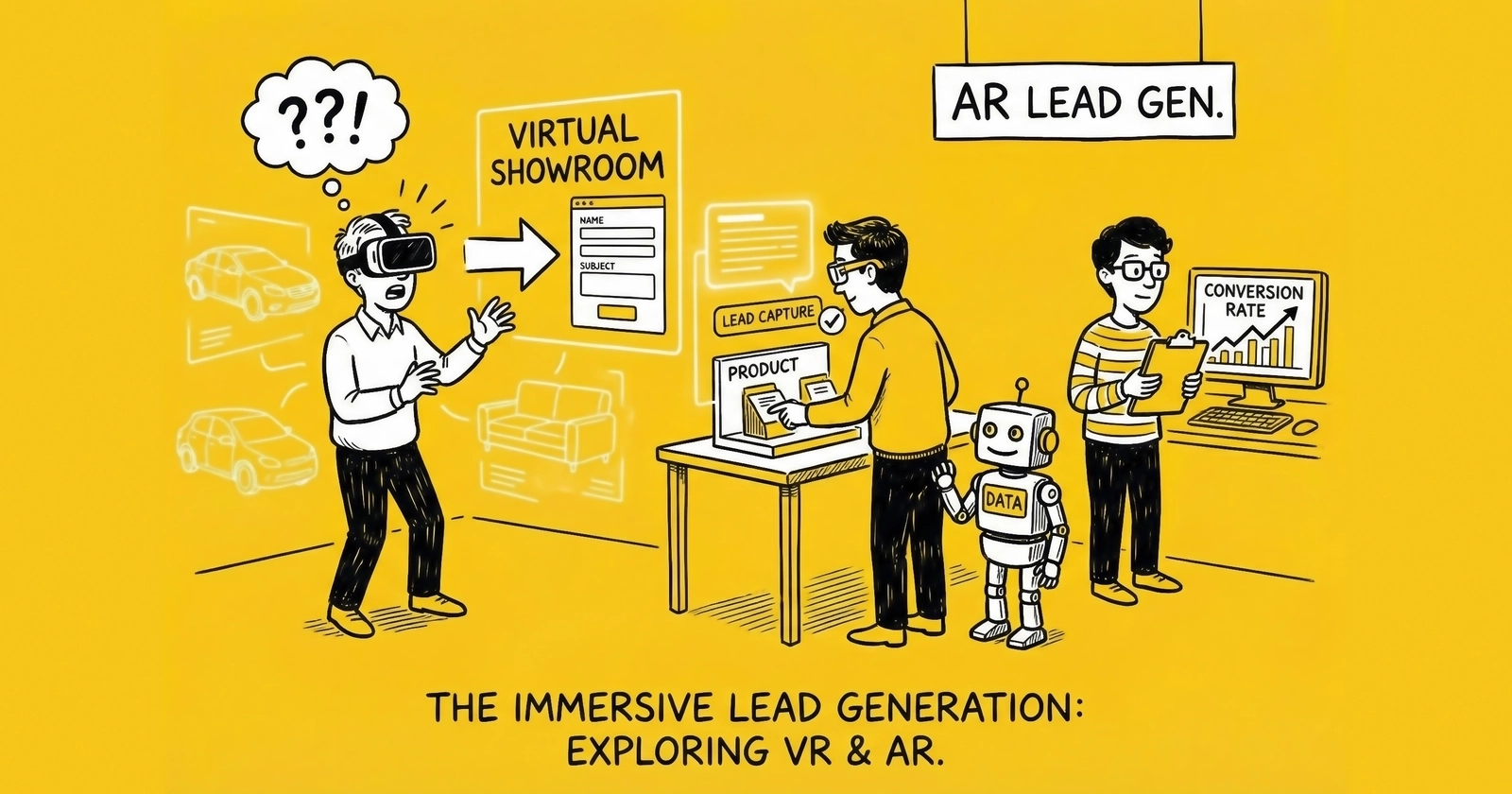
The combined AR/VR market reached $40 billion in 2024 and is projected to exceed $500 billion by 2030. Immersive technology is transforming how businesses capture leads across real estate, automotive, retail, and professional services. Here’s what works, what’s still experimental, and how to implement VR/AR experiences that generate qualified leads.
The real estate agent shows a property in Shanghai to a buyer sitting in Seattle. The automotive dealer lets a prospect configure and sit inside a car that hasn’t arrived at the showroom. The furniture retailer places a couch in a customer’s living room before any purchase decision.
These are not future scenarios. They are current operational realities reshaping lead generation across multiple industries.
Virtual reality creates fully immersive digital environments that transport users to simulated spaces. Augmented reality overlays digital content onto the physical world through smartphone cameras or specialized glasses. Both technologies share a common marketing outcome: they transform passive browsing into active engagement, and active engagement generates qualified leads.
The numbers tell the story. The AR market alone reached $94.82 billion in 2025, growing at 40.10% annually toward a projected $511.75 billion by 2030. The combined AR/VR sector hit $40.38 billion in 2024. Meta shipped 70% of XR headsets in Q3 2025, while Apple’s Vision Pro expanded the spatial computing category. More importantly for lead generation operators: 63% of home buyers report being more likely to purchase a property with a virtual tour, and booking conversion rates increase 12% when listings include 3D digital twins.
But the technology hype obscures practical reality. Most lead generation operations don’t need custom VR development. They need to understand where immersive experiences deliver ROI – and where they remain expensive experiments without clear conversion impact.
This guide examines VR/AR applications that generate leads today, the verticals where immersive technology delivers measurable results, implementation approaches at different budget levels, and the practical limitations every operator should understand before investing.
The Lead Generation Case for Immersive Technology
Traditional lead generation relies on static content: landing pages, form fills, email sequences. The consumer reads about a product or service, views images, perhaps watches a video – then submits contact information if interest persists.
Immersive technology compresses the buyer journey by simulating direct experience. Instead of reading about a vacation property, the prospect walks through it. Instead of viewing a car from six angles, the prospect sits in the driver’s seat. Instead of imagining how furniture fits a room, the prospect places virtual items in their actual living space.
This compression creates several lead generation advantages that compound across the buyer journey.
Time-on-site correlates with conversion probability, and immersive experiences dramatically extend engagement duration. Virtual property tours average 5-10 minutes of engagement compared to 20-45 seconds for photo galleries. Automotive configurators hold attention for 7-12 minutes. AR try-on experiences generate 3-5 minutes of active product interaction. Extended engagement signals genuine interest – and consumers who invest significant time with a product are more likely to submit contact information and more likely to convert.
Immersive experiences also enable powerful self-qualification that improves lead quality for everyone. A buyer who walks through a virtual property discovers the bedrooms are smaller than expected. A car shopper realizes the back seat won’t accommodate their family. This self-qualification reduces unqualified form submissions and improves outcomes for buyers – fewer returns, higher conversion rates, more efficient sales processes. The leads that do submit are leads that fit.
Beyond qualification, immersive technology creates emotional connection that static content cannot match. Purchase decisions, particularly for high-consideration products, involve emotional processing. Static images engage cognitive evaluation. Immersive experiences trigger emotional response. A prospect who has virtually “lived in” a space develops attachment that text and photos cannot create. This emotional investment increases conversion probability and reduces comparison shopping.
In saturated markets, experience differentiation matters as much as product differentiation. When every competitor offers similar product specifications at similar prices, the buying experience itself becomes a competitive factor. Immersive technology signals sophistication, investment, and customer-centricity – attributes that influence brand preference and willingness to engage.
Finally, VR/AR experiences generate behavioral data unavailable from static content. Heatmaps show which product features receive attention. Dwell time indicates areas of interest or concern. Navigation patterns reveal decision-making processes. This data enhances lead scoring and informs sales conversations, transforming a lead record from basic contact information into a behavioral profile that helps sales teams close deals.
Real Estate: The Bellwether Vertical
Real estate leads the immersive technology adoption curve. The industry’s unique characteristics – high-value transactions, geographic constraints, visual-centric decisions – create ideal conditions for VR/AR implementation. What works in real estate today often predicts what will work elsewhere tomorrow.
Matterport pioneered 3D property capture, and the technology has become standard for premium listings. A 3D camera captures spaces in minutes, generating virtual tours that prospects navigate independently. The tour replicates physical presence: users move through rooms, examine details, understand spatial relationships that photos cannot convey.
The lead generation impact is measurable and significant. Properties with virtual tours receive 87% more views than those without. Buyers are 63% more likely to schedule in-person viewings after virtual tours. Vacation rental conversions increase 12% with digital twin integration. These aren’t marginal improvements – they represent fundamental shifts in buyer behavior that reward operators who implement the technology correctly.
Virtual tours serve distinct lead generation functions at each buyer journey stage. At the awareness stage, virtual tours appear in search results, social media, and listing aggregators, attracting attention from buyers who might scroll past static listings. During consideration, serious buyers use virtual tours to narrow options before scheduling viewings – a buyer might virtually visit 20 properties and schedule 3-4 in-person tours, with the virtual tour qualifying them before they ever contact an agent. At the decision stage, relocation buyers often cannot visit before commitment. Virtual tours enable purchase decisions from across the country – or across the world. These leads arrive pre-qualified by extensive virtual exploration.
Augmented reality addresses a different challenge: helping buyers visualize potential. Empty spaces are difficult to evaluate – the average person cannot mentally place furniture, estimate room function, or imagine renovation outcomes. AR applications overlay furniture, décor, and renovation possibilities onto real environments. For new construction and renovation projects, AR shows finished spaces before construction completes. Buyers view wall colors, flooring options, and fixture placements in the actual space. This visualization reduces decision friction and accelerates commitment.
Real estate VR/AR operates across multiple implementation tiers that match different budgets and property types. Basic implementations using smartphone-based 360-degree photo tours with standard cameras and free hosting platforms cost under $500 per property and deliver incremental improvement over static photos. Standard implementations using Matterport or equivalent 3D capture with interactive digital twins cost $200-500 per capture plus platform fees and deliver significant engagement and conversion improvements. Premium implementations using custom VR environments with guided tours, neighborhood exploration, and interactive elements cost $2,000-10,000+ per property but are justified for luxury properties where marketing budget supports differentiation.
The technology matters less than the lead capture mechanism. Virtual tour platforms must integrate with CRM systems, track engagement metrics, and trigger appropriate follow-up sequences. Entry capture requiring email or phone before tour access gates the experience. Engagement tracking monitors rooms visited, time spent, and features examined. Intent signals flag behaviors indicating serious interest – return visits, long sessions, specific feature attention. Automated follow-up triggers personalized outreach based on tour engagement.
The virtual tour is not the product. The lead is the product. Tour quality matters only insofar as it generates and qualifies leads. For more on what makes a lead valuable, see our foundational guide. For more on what makes a lead valuable, see our foundational guide.
Automotive: Virtual Showrooms and AR Configuration
The automotive industry faces a structural challenge: inventory constraints, complex configurations, and declining showroom traffic create friction between consumer interest and purchase decision. VR/AR addresses each constraint while generating high-quality leads that justify the technology investment.
Mercedes-Benz, BMW, Audi, and Porsche have deployed virtual showroom experiences ranging from web-based 3D configurators to full VR environments. These experiences serve prospects who cannot visit physical dealerships due to distance or scheduling, want to explore models not in local inventory, prefer self-directed exploration before sales contact, or seek detailed configuration before commitment.
Virtual showrooms generate leads through configuration saves, scheduled test drives, and quote requests. The configurator becomes a qualification mechanism – a prospect who spends 45 minutes specifying a vehicle has demonstrated serious purchase intent that no form fill can match. They’ve essentially told you exactly what they want to buy.
AR brings vehicles into customer environments through a different mechanism. Apps project life-size 3D models into driveways, garages, and parking spaces. Prospects verify fit, visualize colors against their home, and experience scale before dealership visits. More advanced AR applications enable interior exploration showing dashboard configurations, seating options, and cargo capacity through smartphone cameras. Feature demonstrations visualize parking sensors, heads-up displays, and safety systems in operation. Color matching shows vehicle colors in various lighting conditions. Accessory visualization previews wheel options, roof racks, and exterior modifications. Each interaction deepens engagement and moves the prospect closer to purchase.
Automotive VR/AR generates high-intent leads because the engagement requires substantial time investment. A prospect who spends 30 minutes configuring a vehicle in VR or AR has qualified themselves through behavior – they’re worth contacting, and sales teams know it. Effective lead capture mechanisms include configuration saves requiring contact information to retrieve later, price quotes generating personalized pricing with lead submission, test drive scheduling transitioning VR exploration to physical test drive booking, and inventory matching connecting virtual configuration to available inventory near the prospect.
The data generated by VR/AR interactions enhances lead qualification in ways traditional forms cannot. Sales teams know which features the prospect explored, which options they considered and rejected, and how much time they invested. This intelligence transforms initial sales conversations from cold outreach to informed consultations.
Dealers implementing VR/AR technology face decisions about deployment location and scope. In-showroom VR using headset-based experiences at dealerships showcases unavailable inventory and enhances the physical visit – the lead has already arrived, so VR becomes a closing tool rather than lead generation tool. Web-based configurators accessible through standard browsers reach prospects anywhere, generating leads from consumers who never enter the physical showroom and extending reach beyond geographic constraints. Mobile AR apps using smartphone-based visualization travel with the prospect – they can project vehicles at home, at work, anywhere – and capture leads through app downloads and engagement tracking. Social AR filters on Instagram and Snapchat create shareable brand moments where lead generation is indirect, building awareness and preference that converts through other channels.
Retail and E-Commerce: AR Try-On and Visualization
Product visualization addresses e-commerce’s fundamental challenge: customers cannot touch, try, or experience products before purchase. AR bridges this gap, and the lead generation implications extend well beyond direct sales.
Eyewear, cosmetics, and apparel brands have deployed AR try-on experiences that overlay products onto customer images or live video. Warby Parker pioneered virtual eyeglass try-on; Sephora launched virtual makeup application; Nike enabled AR shoe fitting. Each solved the same problem: showing customers how products look on them rather than on models.
Try-on experiences generate leads through multiple mechanisms. Account creation requirements for try-on features capture contact information. Wishlist saves for products tried virtually enable remarketing to engaged prospects. Social sharing of virtual try-on images extends brand reach to networks. Abandoned session capture converts prospects who try products without purchasing into retargeting audiences.
The lead generation value extends beyond immediate conversion. Virtual try-on creates rich behavioral data – which products attracted attention, which were rejected, what patterns emerge across the customer base. This intelligence informs product development, inventory decisions, and marketing strategy. A prospect who tries on five pairs of glasses and abandons the session tells you something valuable about your product mix or pricing.
IKEA’s Place app pioneered furniture AR, enabling customers to project true-to-scale furniture into their homes. The capability has expanded across categories: home improvement applications visualize paint colors, flooring, and fixtures before purchase; appliance apps place refrigerators, washers, and ranges in actual kitchens; outdoor visualization projects patio furniture, grills, and landscaping elements; B2B equipment tools let industrial buyers visualize machinery in production facilities.
For high-consideration purchases, AR visualization reduces friction and accelerates decision-making. A customer uncertain about sofa dimensions can verify fit. A business evaluating equipment placement can confirm spatial requirements. These answers – which previously required showroom visits, measuring tape, and imagination – now arrive through smartphone cameras in seconds.
Retail AR experiences capture leads through app downloads requiring installation and capturing device information while enabling push notifications, account registration gating premium features behind account creation, save and share functionality requiring login while exposing brands to networks, purchase intent signals when adding visualized products to cart, and consultation requests triggered by complex products connecting prospects to advisors.
The behavioral data from AR interactions enhances lead scoring significantly. A prospect who visualizes the same product in multiple rooms over several sessions demonstrates serious consideration worth prioritizing. A prospect who tries many products quickly without saving indicates browsing behavior that deserves different treatment. These distinctions inform follow-up priority and approach.
Professional Services and B2B Applications
VR/AR applications extend beyond product-centric industries. Professional services and B2B companies are deploying immersive technology for lead generation, though implementation patterns differ from consumer applications in important ways.
Manufacturing companies, data centers, medical facilities, and educational institutions use VR tours to showcase capabilities to prospects who cannot visit in person. A pharmaceutical company evaluates contract manufacturing partners through virtual facility walkthroughs. A prospective patient explores a surgical center before scheduling procedures. A student tours a university campus from another continent. Each scenario generates leads through different mechanisms: gated access requiring form submission before tour access, engagement tracking indicating prospect interest areas, meeting scheduling transitioning tour completion to sales consultation, and document requests for technical specifications and proposals post-tour.
B2B companies selling complex equipment or software use AR to demonstrate capabilities rather than just explain features. A medical device company uses AR to demonstrate surgical instrument capabilities in the context of actual procedures. A software vendor overlays interface elements onto prospect workflows to show integration possibilities. These demonstrations generate leads by qualifying interest through engagement, capturing technical contacts beyond initial contacts, creating shareable content for buying committees, and advancing sales stages by compressing evaluation timelines.
The shift to virtual and hybrid events has expanded VR application for B2B lead generation significantly. Virtual trade show booths, product demonstrations, and networking spaces capture leads that would otherwise require physical presence. Virtual event lead generation includes booth visits with badge scans capturing attendee information, session attendance through webinar registrations generating leads, one-on-one meetings in virtual meeting rooms facilitating qualification, and content downloads of gated materials capturing additional contacts.
The B2B context changes the ROI calculation. A $500,000 manufacturing equipment sale easily justifies sophisticated virtual demonstration development. A $500 software subscription does not. Match VR/AR investment to transaction value and sales cycle complexity.
Implementation: From Concept to Lead Generation
VR/AR implementation requires decisions about technology, content, integration, and measurement. The wrong choices waste investment without generating proportional lead value. The right choices compound over time.
Implementation options span a capability and cost spectrum. Web-based 3D experiences using WebGL require no app installation or specialized hardware – prospects access experiences through standard browsers on phones, tablets, or computers. Development costs range from $5,000 for template-based solutions to $50,000+ for custom development. The lead generation advantage is zero friction to access and maximum reach.
Mobile AR represents a moderate barrier. App-based AR experiences leverage smartphone cameras for product visualization and try-on. Development costs range from $20,000 for basic implementations to $200,000+ for sophisticated experiences. The lead generation advantage is that app installation provides a persistent marketing channel with rich behavioral data collection.
VR headset experiences represent the highest barrier. Dedicated VR headsets like Meta Quest and Apple Vision Pro enable fully immersive experiences. Development costs start around $50,000 and can exceed $500,000 for comprehensive environments. The lead generation challenge is that limited installed base restricts reach – these experiences are primarily useful for in-person showroom and event contexts.
360-degree photo and video offers a quick start option. Basic immersive content using 360-degree cameras provides entry-level experience at minimal cost. Equipment costs under $500; hosting through platforms like YouTube or specialized services is inexpensive. The lead generation advantage is fast deployment that works on existing platforms.
Technology selection determines nothing without compelling content. Immersive experiences must serve clear lead generation objectives. Define the journey – what path leads prospects from entry to lead submission? Each experience requires intentional design toward conversion. Create value exchange – what does the prospect gain from engagement? Education, entertainment, utility, and convenience justify time investment. Maintain quality standards – immersive experiences amplify quality perception, both positive and negative. Low-resolution textures, slow loading, and navigation confusion all damage brand perception. Quality standards should match or exceed primary marketing materials. Enable self-service – most immersive experiences should function without human guidance. Intuitive navigation, clear information hierarchy, and obvious conversion paths prevent abandonment. Plan for iteration – first implementations rarely optimize. Build measurement capability and content update processes from the start.
Isolated VR/AR experiences fail to generate lead generation value. Integration requirements are non-negotiable. Lead capture forms must be native within experiences or seamlessly handed off to landing pages – friction kills conversion, so form fields should be minimal and autofill-enabled. CRM synchronization must flow lead data to sales systems in real-time – delayed synchronization means delayed follow-up and lost conversion opportunity. Behavioral data capture must record what the prospect explored, how long they engaged, and what they skipped – this data should attach to lead records for sales intelligence. Marketing automation triggers should fire appropriate follow-up sequences – a prospect who completes a virtual tour receives different nurturing than one who abandoned early. Attribution tracking must integrate VR/AR touchpoints with attribution systems – without clear ROI measurement, budget justification becomes impossible.
VR/AR lead generation requires specific metrics beyond standard digital marketing KPIs. Engagement metrics include session duration (average time in experience), completion rate (percentage who reach designated endpoints), feature interaction (which elements receive attention), and return visits (repeated engagement indicates consideration). Conversion metrics include form submission rate (leads generated per session), lead quality score (qualification indicators), sales conversion (leads to customers), and lifetime value (customer value by acquisition source). Experience metrics include error rates (technical problems affecting experience), load times (performance affecting engagement), device distribution (which platforms generate leads), and abandon points (where prospects exit).
Measurement enables optimization. Without data, VR/AR investments become faith-based expenditures. With data, operators identify what works, improve what doesn’t, and justify continued investment.
Practical Limitations and Honest Assessment
Every technology has limitations. Ignoring VR/AR constraints leads to wasted investment and missed expectations. Operators should understand these realities before commitment.
Hardware barriers restrict VR reach significantly. VR headsets reach limited audiences – Meta commands 70% of XR headset shipments, but installed base remains small relative to smartphone penetration. Apple Vision Pro’s $3,499 price point restricts adoption to early adopters and enterprise deployments. The implication: headset-based VR experiences limit reach. Web-based and mobile AR experiences reach broader audiences because they function on existing devices.
Quality immersive content is expensive to produce. 3D modeling, environment design, interaction programming, and optimization require specialized skills. Unlike video production where good results are achievable at various budgets, immersive experiences have quality thresholds below which outcomes damage rather than enhance brand perception. Budget realities matter: basic 360-degree tours run $500-2,000 per space; Matterport-style 3D capture costs $200-500 per space plus platform fees; custom VR environments range from $50,000-500,000+ depending on scope; AR applications cost $20,000-200,000+ for development; ongoing maintenance runs 15-25% of initial development annually.
Technology friction reduces conversion at every step. VR headset experiences require hardware acquisition and setup. AR apps require downloads and camera permissions. Even web-based 3D experiences load slower than static pages. Each friction point loses prospects. Conversion rate analysis must account for experience entry rate (how many prospects begin the experience), completion rate (how many finish intended journey), form submission rate (how many convert to leads), and lead qualification rate (how many leads are quality). A spectacular VR experience with 5% entry rate may generate fewer leads than a basic landing page with 95% entry rate. The math matters more than the technology.
VR/AR experiences depend on device capabilities including cameras, sensors, and processing power, network connectivity for cloud-rendered experiences, browser and OS compatibility for web-based experiences, and platform policies for app-based experiences. These dependencies create risk. Apple’s privacy changes affected AR advertising. Browser security updates break WebGL implementations. Platform store policies gate distribution. Technical dependencies require ongoing monitoring and adaptation.
Comfort with immersive technology varies by age, technical sophistication, and context. Younger demographics show higher adoption; older demographics show resistance. B2C applications must account for audience technology comfort. B2B applications face additional constraints – enterprise IT policies may restrict AR app installation. Audience analysis should precede technology selection. Building sophisticated VR experiences for audiences uncomfortable with the technology wastes investment.
Despite vendor claims, VR/AR ROI remains difficult to prove for many implementations. Attribution challenges, long sales cycles, and multiple touchpoints obscure causal relationships. The 63% increase in purchase likelihood with virtual tours sounds compelling – but proving that your specific implementation generates proportional returns requires rigorous measurement. Operators should approach VR/AR with experimental mindsets. Start small, measure rigorously, scale what works. Avoid large upfront commitments based on industry averages that may not apply to your specific context.
Implementation Roadmap: Phased Approach
Rushing to sophisticated VR/AR deployment wastes resources and risks failure. A phased approach reduces risk while building capability and organizational learning.
Phase 1: Assessment and Quick Wins (Months 1-3)
Begin with an honest audit of current state. What immersive content exists – 360 photos, 3D models, video tours? What platforms already support VR/AR, including social AR filters and Google 3D? What do competitors offer, establishing the market baseline? What does your audience expect, determined through survey, research, and analysis?
Deploy low-risk implementations to generate early learnings. 360-degree photography for key products and spaces provides immediate improvement. Platform-native AR on Instagram and Snapchat builds awareness without custom development. Free and low-cost 3D tour platforms enable experimentation. Existing AR apps for your product category may already exist.
Establish measurement before scaling. Implement tracking for immersive content. Connect to CRM for lead attribution. Define success metrics before scaling to ensure you know what good looks like.
Phase 2: Validated Expansion (Months 3-9)
Assess Phase 1 results honestly. Which implementations generated leads? What engagement patterns emerged? Where did prospects abandon? What ROI did investments generate?
Invest in proven approaches based on data, not hope. Scale implementations that demonstrated ROI. Improve user experience based on data. Expand content library for performing formats. Develop integration with sales processes.
Experiment strategically while managing risk. Test one higher-investment implementation. Pilot with limited audience before broad deployment. Measure rigorously against established baselines.
Phase 3: Strategic Integration (Months 9-18)
Build mature capabilities justified by proven results. Develop proprietary platforms if scale justifies the investment. Integrate VR/AR data into lead scoring models. Train sales teams on immersive-assisted selling. Establish content production workflows.
Optimize continuously based on data. A/B test experience variations. Iterate based on conversion data. Expand to new product categories and use cases. Retire underperforming implementations without sentiment.
Prepare for evolution as the landscape shifts. Monitor emerging hardware including lighter glasses and better displays. Track platform developments in the Apple Vision Pro ecosystem. Assess AI integration opportunities for generative 3D content. Build flexibility for technology shifts.
The Future: Spatial Computing and Agentic Commerce
Current VR/AR implementations are transitional. The industry is evolving toward spatial computing – persistent digital layers over physical reality – and agentic commerce – AI systems that shop and transact autonomously. Understanding these trajectories helps operators invest wisely today.
Meta’s pivot to “spatial computing” and Apple’s Vision Pro launch signal platform convergence. The distinction between VR (fully immersive) and AR (overlay on reality) is collapsing into unified spatial computing platforms that transition fluidly between modes.
For lead generation, spatial computing implies fundamental changes. Persistent brand presence means digital brand elements – product information, promotional content, interactive experiences – will overlay physical retail environments, public spaces, and home contexts. Contextual targeting becomes possible when location, time, activity, and visual context enable precise targeting. A prospect looking at a competitor’s car sees your comparison overlay. A homeowner examining a renovation project sees your service offer. Frictionless conversion means form submission becomes obsolete when systems know identity and preferences. Lead capture evolves from “collect contact information” to “capture intent signal and fulfill automatically.”
AI agents acting as autonomous buyers – agentic commerce – reshape lead generation fundamentally. McKinsey projects agentic commerce reaching $3-5 trillion globally by 2030.
When AI agents evaluate products and services on behalf of humans, the dynamics change completely. Visual and experiential content matters differently because agents process structured data rather than experiencing VR/AR content emotionally – but they may use visual analysis to verify claims and assess quality. Machine-readable formats become mandatory because product specifications, pricing, availability, and policies must be structured for agent consumption, and 3D models need associated metadata. Trust signals shift because agents verify through data analysis, not emotional connection – reviews, certifications, and verifiable claims matter more than brand affinity. Human and agent paths diverge because some purchases route through human decision-making where VR/AR influences emotion, while others route through agent evaluation where structured data determines selection. Operators must serve both paths.
Operators investing in VR/AR today should position for the spatial computing and agentic commerce future. Structure your data by ensuring 3D models, product specifications, and experience content are machine-readable with proper metadata and schema markup. Build API accessibility because agent-mediated commerce queries APIs, not websites – expose product and service data through structured interfaces. Maintain dual paths because human-centric immersive experiences and machine-centric data structures will coexist, and investment should serve both. Monitor platform development as Apple, Meta, Google, and others define spatial computing standards – early alignment with winning platforms creates advantage. Develop hybrid capabilities because the future involves AI-assisted human decisions and human-supervised AI decisions – build for fluid transitions between modes.
Frequently Asked Questions
How does VR/AR actually generate leads rather than just providing cool experiences?
VR/AR generates leads through deliberate conversion architecture. Every immersive experience should include clear paths to lead capture – email gates before tour access, account creation for saved configurations, quote request forms, consultation scheduling, and similar mechanisms. The experience itself qualifies leads through engagement duration and behavior patterns. A prospect who spends 15 minutes exploring a virtual property has demonstrated genuine interest worth following up on. Without intentional lead capture integration, VR/AR becomes an expensive brand exercise rather than a lead generation tool.
What ROI can I realistically expect from VR/AR lead generation investments?
ROI varies dramatically by implementation quality, audience fit, and integration effectiveness. Real estate operators report 63% higher likelihood of scheduling viewings with virtual tours and 12% booking conversion increases. However, these industry averages may not apply to your specific situation. Start with low-investment implementations ($500-5,000), measure rigorously, and scale only what demonstrates clear lead generation impact. Expect 6-12 months before meaningful ROI data emerges.
Do I need specialized hardware or can I use web-based solutions?
Web-based 3D experiences and smartphone AR reach dramatically larger audiences than headset-based VR. Meta Quest reaches millions of users, but smartphone AR reaches billions. For most lead generation applications, browser-based 3D configurators and mobile AR experiences provide superior reach at lower cost. Reserve headset VR for premium contexts (luxury real estate, high-end automotive showrooms) where the audience and margin justify limited reach.
Which industries see the best lead generation results from VR/AR?
Real estate leads adoption with clear ROI – virtual property tours generate measurably more leads than static listings. Automotive follows with configurators and visualization tools that qualify high-intent buyers. Retail AR (try-on, room visualization) reduces returns while capturing purchase-intent data. B2B applications (virtual facility tours, equipment demonstrations) work for high-value transactions where travel constraints limit prospect access. Industries selling visual, spatial, or experiential products benefit most; commoditized products with price-driven decisions benefit least.
How much does it cost to implement VR/AR for lead generation?
Costs span wide ranges. Basic 360-degree photography costs under $500 per space. Matterport-style 3D capture runs $200-500 per space plus platform fees. Mobile AR app development ranges from $20,000-200,000+. Custom VR environments start around $50,000 and can exceed $500,000 for comprehensive implementations. Plan for 15-25% annual maintenance costs. Most practitioners should start with low-investment options and scale based on demonstrated results rather than making large upfront commitments.
How do I integrate VR/AR experiences with my existing CRM and marketing automation?
Integration requires deliberate architecture. VR/AR platforms must connect to your CRM through APIs or webhook integrations. Lead capture forms within experiences should populate standard lead records. Behavioral data – session duration, features explored, engagement patterns – should attach to lead records for sales intelligence. Marketing automation platforms should trigger appropriate sequences based on VR/AR engagement. Work with platform vendors and developers to map data flows before implementation, not after.
What are the biggest mistakes companies make with VR/AR lead generation?
The most common mistakes include building experiences without clear conversion paths (no lead capture mechanism), overinvesting in technology before validating audience interest, ignoring mobile and web options in favor of headset VR (limiting reach), failing to integrate with existing marketing and sales systems, deploying low-quality experiences that damage brand perception, and expecting immediate ROI from inherently long-term investments. Start small, measure everything, and scale what works.
How will AI and agentic commerce change VR/AR in lead generation?
AI agents evaluating products on behalf of consumers will process structured data rather than experiencing immersive content emotionally. This creates divergent paths: human buyers influenced by VR/AR experiences, and AI agents influenced by machine-readable specifications. Forward-thinking operators should ensure 3D models include rich metadata, product data is API-accessible, and trust signals are verifiable rather than purely experiential. The winners will serve both human and AI decision-making processes effectively.
Is VR/AR effective for B2B lead generation or just B2C?
B2B applications work well for high-value transactions where travel constraints limit evaluation. Virtual facility tours, equipment demonstrations, and remote training create genuine value for B2B prospects. Virtual trade show booths capture leads when physical attendance is impractical. The key is matching VR/AR investment to transaction value – a $500,000 manufacturing equipment sale justifies sophisticated virtual demonstration; a $500 software subscription does not.
How do I measure the effectiveness of VR/AR lead generation?
Track engagement metrics (session duration, completion rates, feature interaction, return visits), conversion metrics (form submission rates, lead quality scores, sales conversion rates), and experience metrics (error rates, load times, abandon points). Compare VR/AR-sourced leads against other channels on quality and conversion. Establish baseline metrics before implementation and measure change over time. Without rigorous measurement, you cannot optimize – and VR/AR investments require ongoing optimization to deliver sustainable ROI.
Key Takeaways
-
The combined AR/VR market reached $40 billion in 2024, with AR alone projected to exceed $500 billion by 2030. Immersive technology has moved from experimental to operational across real estate, automotive, and retail verticals.
-
Virtual property tours increase buyer likelihood to schedule viewings by 63% and booking conversions by 12%. Real estate leads VR/AR adoption because high-value, visual, spatial products align perfectly with immersive technology strengths.
-
Lead generation through VR/AR requires intentional conversion architecture – gated access, engagement tracking, CRM integration, and clear paths to lead capture. Without these elements, immersive experiences become brand investments without measurable lead value.
-
Web-based 3D experiences and smartphone AR reach dramatically larger audiences than headset VR. Most practitioners should prioritize reach over immersion depth, especially in early implementations.
-
Start with low-investment implementations ($500-5,000), measure rigorously, and scale only what demonstrates clear lead generation impact. Large upfront VR/AR investments based on industry averages frequently disappoint.
-
VR/AR behavioral data – session duration, features explored, engagement patterns – enhances lead qualification. Sales teams with immersive engagement intelligence convert more effectively than those working blind.
-
Technical limitations matter: hardware barriers restrict headset VR reach; content production costs require quality thresholds; user experience friction reduces conversion; technical dependencies create ongoing maintenance requirements.
-
The future involves spatial computing (persistent digital layers over reality) and agentic commerce (AI agents shopping autonomously). Forward-thinking operators should ensure immersive content is machine-readable with structured metadata.
-
Integration with CRM and marketing automation is non-negotiable. Isolated VR/AR experiences that do not connect to lead management systems waste investment regardless of engagement quality.
-
Measurement enables optimization. Track engagement metrics, conversion metrics, and experience metrics. Without data, VR/AR investments become faith-based expenditures. With data, operators identify what works and scale accordingly.
Statistics and projections current as of December 2025. VR/AR technology, platform capabilities, and market adoption continue to evolve rapidly.