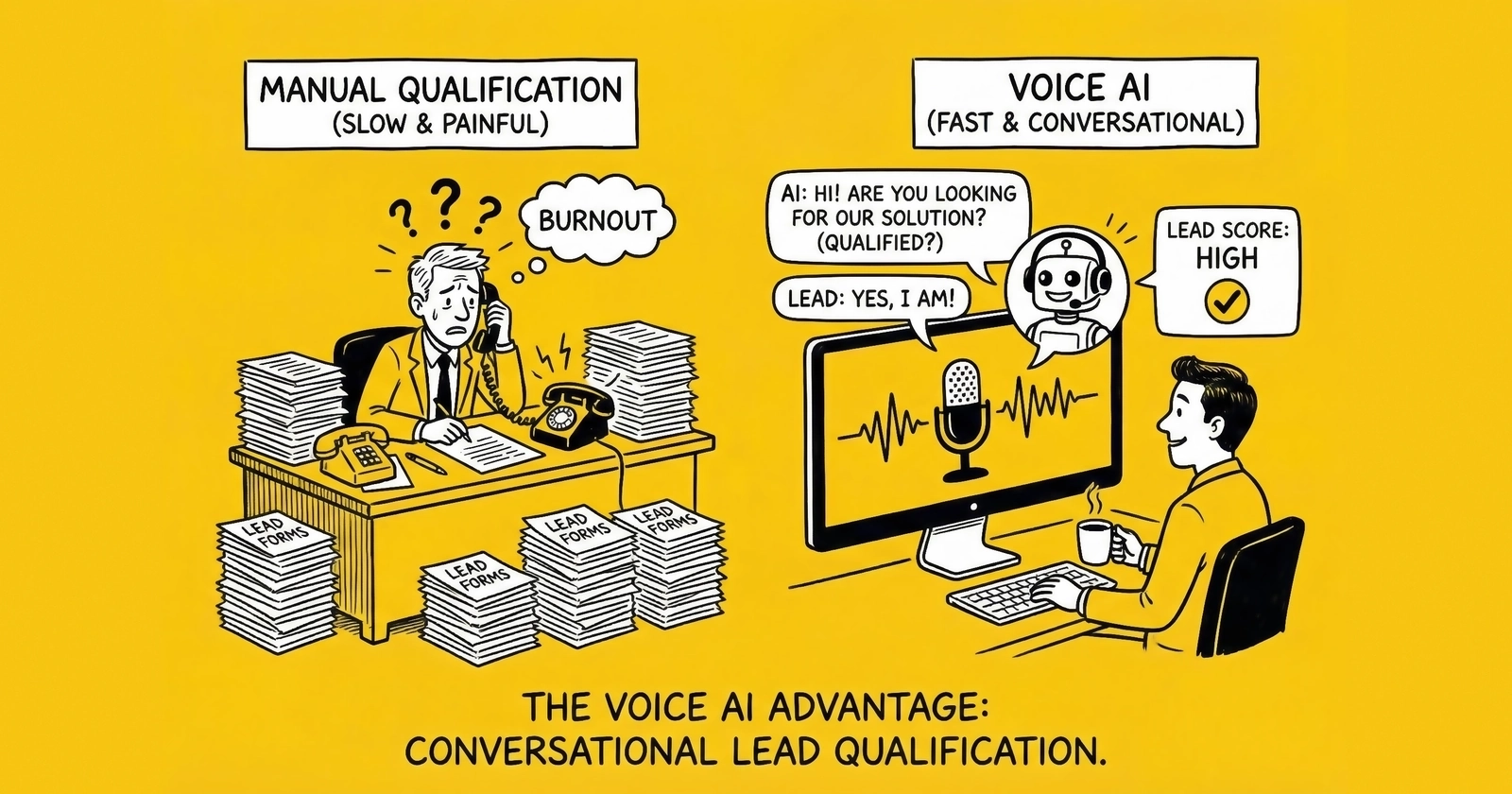
Voice AI is transforming lead qualification from a human bottleneck into a 24/7 competitive advantage. Companies implementing conversational AI for qualification report 40-60% reductions in cost per qualified lead and 3x improvements in speed-to-contact. Here is how the technology works, what it actually delivers, and how to implement it without destroying lead quality.
The phone rings. A potential customer with genuine intent to buy insurance, solar panels, or home services has just submitted a form. The clock starts ticking.
Industry data is unforgiving: leads contacted within five minutes convert at 8x the rate of those contacted in 30 minutes. After one hour, contact rates drop by 10x. After 24 hours, that lead is effectively worthless for most high-intent verticals.
Yet the average response time for web leads across industries ranges from 42 hours to never. Sales teams are overwhelmed, prioritization is inconsistent, and high-intent prospects go cold while representatives chase unqualified contacts.
Voice AI changes this equation fundamentally. Not the frustrating IVR systems of decades past, but conversational agents capable of natural dialogue, intelligent qualification, and real-time routing. The technology has matured faster than most practitioners realize, and the economics now favor adoption for any operation processing more than a few hundred leads monthly.
This guide covers the current state of voice AI for lead qualification, realistic performance benchmarks you can expect, implementation approaches based on operational scale, and the strategic considerations that separate successful deployments from expensive failures.
The Qualification Bottleneck: Why Voice AI Matters Now
Lead qualification exists at the intersection of two conflicting forces: the need for speed and the need for accuracy.
Speed is non-negotiable. The first responder wins 78% of deals. Every minute of delay reduces conversion probability. But human qualification has hard limits: representatives handle 15-25 calls daily, operate during business hours, and require breaks, training, and supervision.
Accuracy is equally critical. Connecting buyers with unqualified leads destroys trust and wastes resources. A $50 lead that never had genuine intent costs more than the $50. It consumes buyer capacity, generates returns, and damages the buyer relationship that took months to build.
Traditional operations forced a tradeoff: hire more people to improve speed (destroying unit economics) or accept slower response times to maintain quality (destroying conversion rates). Voice AI breaks this tradeoff by handling the high-volume, time-sensitive qualification that humans cannot scale.
The Economics Have Shifted
Voice AI economics crossed a decisive threshold in 2024-2026. What previously required enterprise-scale investment now works for mid-market operations.
The cost equation has transformed. Per-minute costs for AI voice conversations have dropped from $0.15-0.25 to $0.05-0.12 as competition intensified among providers like Bland AI, Vapi, Air AI, and Retell. A five-minute qualification call that cost $1.25 two years ago now costs $0.25-0.60.
For context, consider a lead generation operation processing 1,000 leads monthly:
Traditional human qualification:
- 2 qualification representatives at $45,000/year salary = $90,000 annually
- Benefits, management, turnover costs: +30% = $117,000 total
- Capacity: ~40 leads per rep per day = 80 leads daily, ~1,600 monthly
- Effective cost per qualified lead: $73.12
Voice AI qualification:
- Platform costs: $500-2,000/month depending on volume
- Average 4-minute qualification call at $0.08/minute = $0.32 per attempt
- 1.5 attempts per lead average = $0.48 per lead
- 1,000 leads monthly: $480-1,480 call costs + platform fees
- Effective cost per qualified lead: $0.98-2.48
The math is not subtle. Even adding human oversight for escalations and complex cases, AI-first qualification delivers 10-50x cost efficiency at scale.
Capability Has Caught Up
The technology transformation of 2024-2026 moved voice AI from “impressive demo” to “production-ready tool.” Several advances converged:
Natural language understanding now handles the messy reality of human speech: interruptions, non-sequiturs, accent variations, background noise. Modern systems do not require callers to speak in complete sentences or wait for prompts.
Latency dropped below perceptibility. Early voice AI had 1-2 second delays between statement and response, creating an uncanny valley effect that frustrated callers. Current systems respond in 200-400 milliseconds, indistinguishable from human conversation speed.
Persona consistency improved dramatically. Systems maintain coherent personalities, remember context from earlier in the conversation, and adapt tone appropriately. A caller who expresses frustration receives empathy; a caller who wants efficiency gets directness.
Multi-turn reasoning enables genuine qualification. The AI does not just collect data fields. It probes inconsistencies, asks follow-up questions, and makes judgment calls about intent level based on behavioral signals.
How Voice AI Qualification Works
Voice AI qualification replaces or augments the initial human contact that determines whether a lead is worth sales attention. The technology handles inbound calls, outbound qualification, and live transfer pre-screening.
The Qualification Conversation Flow
A typical voice AI qualification follows this pattern:
Greeting and context setting: The AI introduces itself, references how the caller arrived (the form they submitted, the ad they clicked), and establishes the purpose of the conversation. Transparency matters: the best implementations acknowledge AI involvement rather than attempting to pass as human.
Information verification: The AI confirms or collects basic data: contact information, location, relevant demographics. This verification serves dual purposes: ensuring data accuracy and beginning the behavioral qualification.
Intent probing: Beyond demographic qualification, the AI assesses genuine intent. Is this someone actively shopping or passively browsing? What is the timeline for decision? Who else is involved in the decision? These questions reveal where the lead sits in the buying journey.
Objection handling: Genuine prospects raise concerns. The AI addresses common objections, provides relevant information, and gauges response. A lead who dismisses every answer signals different intent than one who engages thoughtfully with concerns.
Routing decision: Based on qualification criteria, the AI determines next steps: immediate transfer to a live agent, scheduling a callback, nurture sequence enrollment, or disqualification with explanation.
Technical Architecture
Voice AI qualification systems integrate three primary components:
Speech-to-text (STT) converts caller audio to text in real-time. Modern STT handles diverse accents, background noise, and natural speech patterns with 95%+ accuracy. Leading providers include Deepgram, AssemblyAI, and OpenAI Whisper.
Large language model (LLM) processing interprets the transcribed speech, determines appropriate responses, and manages conversation flow. The LLM maintains context, applies qualification logic, and generates natural responses. Systems use either general-purpose models (GPT-4, Claude) with careful prompting or fine-tuned models optimized for specific verticals.
Text-to-speech (TTS) converts AI responses back to natural-sounding audio. Modern TTS has moved far beyond robotic voices. ElevenLabs, PlayHT, and similar providers deliver voices that are essentially indistinguishable from human speech, with appropriate emotion, pacing, and emphasis.
The integration layer orchestrates these components: managing conversation state, applying business rules, integrating with CRM and distribution systems, and handling edge cases like call drops or transfers.
Inbound vs. Outbound Applications
Voice AI serves different functions depending on call direction:
Inbound qualification intercepts calls from prospects who have already expressed interest. When someone calls after submitting a lead form or clicking an ad, the AI handles initial screening before human involvement. This is the highest-ROI application: these callers have demonstrated intent and expect immediate response.
Outbound qualification reaches out to web leads who submitted forms but did not call. The AI contacts them within minutes of submission, verifies intent, and either transfers to a live agent or schedules callback. Speed advantage is the primary value: AI can call within seconds of form submission.
Pre-transfer screening sits between lead capture and live transfer. Before connecting a prospect to a sales agent, AI conducts rapid qualification to ensure the lead meets buyer criteria. This protects buyer capacity from unqualified contacts.
Real Performance Benchmarks: What Voice AI Actually Delivers
The marketing claims around voice AI qualification are aggressive. Vendors promise 90% automation rates, perfect qualification accuracy, and customers who cannot tell they are speaking to AI. Reality is more nuanced but still compelling.
Contact Rate Improvements
Voice AI consistently outperforms human teams on contact rates because of speed and persistence advantages:
Speed-to-contact: AI calls within 30-60 seconds of form submission. Human teams, even with aggressive SLAs, typically respond in 5-30 minutes. This speed advantage alone improves contact rates by 25-40% based on documented implementations.
Persistence at scale: AI makes multiple contact attempts at optimal times without the fatigue that degrades human performance. A typical deployment attempts 5-8 contacts across different times and days. Human teams rarely sustain this discipline consistently.
After-hours coverage: 35-45% of lead form submissions occur outside business hours. Without AI, these leads wait until morning, losing the intent urgency that drove initial submission. AI qualifies immediately, 24/7.
Documented contact rate improvements range from 30-65% depending on baseline performance and implementation quality. Operations with already-strong contact discipline see smaller gains; those with delayed response times see dramatic improvement.
Qualification Accuracy
Qualification accuracy depends heavily on implementation sophistication and the complexity of qualification criteria.
Simple demographic qualification (income level, geographic location, basic eligibility) achieves 92-97% accuracy compared to human qualification. These are essentially data validation tasks where AI has no inherent disadvantage.
Intent-based qualification (distinguishing tire-kickers from serious buyers) shows more variance: 75-90% accuracy depending on training data quality and prompt engineering. AI struggles with subtleties that experienced human qualifiers catch through tone, hesitation patterns, and micro-expressions.
Complex consultative qualification (assessing fit for high-consideration purchases, navigating nuanced situations) remains challenging. Current systems achieve 60-80% accuracy on complex qualification, making human oversight essential for high-stakes decisions.
The practical implication: use AI for initial screening and simple qualification, with human escalation paths for ambiguous or high-value situations.
Cost Per Qualified Lead Impact
Cost reductions from voice AI qualification are substantial and documented:
Direct labor cost reduction: 60-85% reduction in qualification labor costs for operations that previously relied entirely on human teams. The reduction comes from handling routine qualification automatically while humans focus on exceptions and closings.
Increased throughput: Same team size handles 3-5x more leads through AI-assisted qualification. The human representative who previously made 25 calls daily now reviews 75-100 AI-qualified leads and handles 15-20 complex conversations.
Reduced waste: Better qualification accuracy means fewer unqualified leads passed to sales. When 30% of passed leads are actually unqualified, every improvement in qualification accuracy directly reduces wasted sales capacity.
Overall cost-per-qualified-lead reductions of 40-65% are common in well-implemented deployments. The gains compound: lower direct costs, higher throughput, and reduced waste.
Customer Experience Considerations
Customer acceptance of AI qualification depends significantly on implementation quality and transparency.
Satisfaction scores for AI interactions average 3.8-4.2 out of 5.0 in surveyed deployments, compared to 4.0-4.4 for human interactions. The gap narrows when AI implementations are well-designed: low latency, natural voices, context-aware responses.
Caller preference data shows 55-65% of callers prefer immediate AI interaction over waiting for a human callback. Speed trumps human preference when the alternative is delay.
Transfer acceptance: When AI-qualified callers are transferred to humans, conversion rates are 15-25% higher than cold transfers. The AI has set context, addressed initial objections, and confirmed interest before the human conversation begins.
The reputational risk of poor AI experiences is real. Frustrating interactions create lasting negative impressions. This argues for thoughtful implementation with graceful fallbacks rather than aggressive automation that sacrifices experience for efficiency.
Voice AI Platforms and Technology Stack
The voice AI market has consolidated around several platform approaches, each with distinct strengths and tradeoffs.
Dedicated Voice AI Platforms
Purpose-built platforms for voice AI conversations offer the most polished experience:
Bland AI focuses on low-latency, natural conversations with strong enterprise features. Per-minute pricing ranges from $0.07-0.15 depending on volume. Strengths include conversation quality and integration flexibility. Best suited for operations prioritizing natural experience.
Vapi provides developer-focused infrastructure with extensive customization options. Pricing starts lower ($0.05-0.10 per minute) but requires more technical implementation. Strengths include API flexibility and multi-provider support (swap underlying LLMs and voice providers). Best for operations with development resources.
Air AI targets sales-specific use cases with pre-built flows for common scenarios. Pricing is outcome-based in some configurations. Strengths include faster time-to-value and sales-optimized conversation design. Best for operations wanting turnkey solutions.
Retell AI emphasizes developer experience with strong documentation and modular architecture. Pricing competitive with Vapi at $0.06-0.12 per minute. Strengths include ease of integration and clear pricing. Best for technical teams building custom solutions.
Contact Center Platforms with AI
Established contact center platforms have added AI capabilities:
Five9, NICE, Genesys, and Talkdesk all offer AI-assisted qualification within their broader contact center suites. The advantage is unified infrastructure: AI and human agents operate within the same system, with seamless handoffs.
The disadvantage is cost and complexity. These enterprise platforms carry significant base costs ($100-500+ per agent monthly) that make sense for large operations but are excessive for mid-market lead generators.
Build vs. Buy Considerations
Technical teams can assemble voice AI from component parts:
Speech-to-text: Deepgram ($0.0043/minute), AssemblyAI ($0.0045/minute), or Whisper API ($0.006/minute)
LLM processing: GPT-4 ($0.03/1K tokens), Claude ($0.015/1K tokens), or fine-tuned open-source models
Text-to-speech: ElevenLabs ($0.18/1K characters), PlayHT ($0.12/1K characters)
Telephony: Twilio ($0.013/minute + per-call fees)
Building from components offers maximum flexibility and potentially lower costs at very high volume. But the integration complexity is substantial. Latency management, conversation state, error handling, and telephony edge cases consume significant development time.
For most lead generation operations, dedicated voice AI platforms offer better ROI. The per-minute premium over raw components is offset by reduced development costs and faster deployment.
Integration Requirements
Voice AI qualification requires integration with existing lead management infrastructure:
CRM integration enables the AI to access lead data, update records, and log qualification outcomes. Most platforms offer native integrations with Salesforce, HubSpot, and similar systems. Custom CRM integration requires API development.
Lead distribution integration connects qualification outcomes to routing logic. When AI qualifies a lead, the disposition should trigger appropriate routing: transfer to specific buyer, enrollment in sequence, or disqualification with reason code.
Telephony integration enables call control: initiating outbound calls, receiving inbound, managing transfers. Click-to-call functionality from your existing lead forms requires coordination between web events and telephony systems.
Analytics integration feeds qualification data into your reporting infrastructure. Understanding which traffic sources produce AI-qualified leads at what rates enables optimization at the campaign level.
Implementation Approaches by Operation Size
Voice AI implementation complexity scales with operational scope. The right approach depends on lead volume, technical resources, and strategic priority.
Small Operations: 100-500 Leads Monthly
Operations at this scale benefit from turnkey solutions that minimize setup complexity:
Recommended approach: Single-purpose voice AI platform with pre-built qualification flows. Air AI, Synthflow, or similar providers offer templates for common verticals (insurance, home services, solar) that deploy in hours rather than weeks.
Implementation timeline: 1-2 weeks from decision to production, including integration with lead forms and basic CRM connection.
Expected investment: $200-500/month platform costs plus $0.25-0.50 per qualified lead in variable costs. Total investment of $400-1,000 monthly for 500 leads.
Primary value: Speed-to-contact improvement and after-hours coverage. At this scale, the goal is not replacing human qualifiers but ensuring no lead waits more than minutes for response.
Watch for: Overcomplicating qualification logic. Simple implementations outperform sophisticated ones at low volume because there is insufficient data to optimize complex flows.
Mid-Market Operations: 500-5,000 Leads Monthly
Operations at this scale can justify more sophisticated implementations:
Recommended approach: Dedicated voice AI platform with custom conversation flows, integrated with lead distribution system. Bland AI, Vapi, or Retell provide the flexibility needed for custom qualification while managing underlying complexity.
Implementation timeline: 4-8 weeks including conversation design, integration development, testing, and progressive rollout.
Expected investment: $500-2,000/month platform costs plus $0.10-0.25 per qualified lead. Total investment of $1,500-5,000 monthly for 3,000 leads.
Primary value: Cost reduction through automation plus quality improvement through consistent qualification. At this scale, AI handles 70-85% of qualification volume, with human oversight for escalations.
Watch for: Insufficient conversation design investment. The difference between 70% and 90% automation rate often comes from spending 20 additional hours on edge case handling and objection management.
Enterprise Operations: 5,000+ Leads Monthly
High-volume operations can justify enterprise-grade implementations:
Recommended approach: Either enterprise voice AI platform (potentially custom-built) integrated with contact center infrastructure, or component-based build for maximum flexibility. The choice depends on whether the operation has development resources.
Implementation timeline: 8-16 weeks for full deployment including custom model training, multi-vertical support, advanced analytics, and compliance infrastructure.
Expected investment: $5,000-25,000/month depending on volume and complexity. Per-lead costs drop to $0.05-0.15 at scale.
Primary value: Competitive differentiation through speed and consistency. At enterprise scale, voice AI becomes strategic infrastructure that enables business models impossible with human-only qualification.
Watch for: Over-engineering initial deployment. Even enterprise operations benefit from launching simple, then iterating. A sophisticated system that takes six months to deploy loses to a simple system deployed in six weeks and improved continuously.
Conversation Design: The Make-or-Break Factor
Technology selection matters less than conversation design. A well-designed conversation on mediocre technology outperforms a poorly designed conversation on the best platform.
Principles of Effective AI Qualification Conversations
Start with context, not interrogation. The AI should reference what brought the caller here: “I see you requested information about auto insurance quotes. Let me ask a few quick questions to connect you with the right specialist.”
Explain the value exchange. Callers answer questions when they understand why: “To find the best rates for your situation, I need to know a bit about your driving history.”
Use conditional branching, not linear scripts. Real conversations do not follow predetermined paths. The AI should adapt based on responses, probing deeper on relevant topics and skipping irrelevant ones.
Handle objections as information, not obstacles. When a caller says “I’m just looking” or “I already have coverage,” these are data points about intent and timeline, not barriers to overcome through persistence.
Know when to transfer. Complex situations, emotional callers, and high-value opportunities benefit from human handling. Design clear escalation triggers: specific phrases, sentiment signals, or qualification outcomes that route to humans.
Common Conversation Design Failures
Over-scripting. Rigid scripts create robotic experiences even with natural-sounding voices. Allow flexibility in how the AI achieves objectives rather than specifying exact phrasings.
Insufficient error handling. When callers say something unexpected, the AI should acknowledge and redirect gracefully, not repeat the previous question or ignore the input entirely.
Ignoring sentiment. An AI that plows through qualification questions while a caller expresses frustration destroys both experience and qualification accuracy. Build sentiment detection and response adaptation.
Premature transfer decisions. Making qualification decisions too early loses leads who would qualify with more context. Make qualification decisions at the right moment, after gathering sufficient information but before caller patience exhausts.
Inadequate disqualification. Telling a caller “you don’t qualify” creates negative experiences. Explain what would be needed to qualify, offer alternatives when possible, and end conversations positively even when declining.
Testing and Iteration
Conversation design is never complete. Continuous improvement is essential:
Monitor conversation transcripts. Review a sample of conversations regularly: what questions cause confusion, where do callers drop off, what objections lack adequate responses?
Track qualification accuracy. Compare AI qualification decisions to eventual outcomes. When AI marks a lead qualified but buyers reject it, or AI disqualifies leads that would have converted, adjust criteria and conversation flow.
A/B test conversation variants. Different openings, question sequences, and objection responses affect qualification rates and caller experience. Test systematically rather than guessing.
Update for market changes. Caller expectations, product offerings, and competitive landscape evolve. Conversation design must evolve with them. Schedule quarterly reviews at minimum.
Compliance and Regulatory Considerations
Voice AI qualification operates within the same regulatory framework as human calling. Automation does not create compliance exemptions, and in some ways creates additional requirements.
TCPA Compliance Requirements
The Telephone Consumer Protection Act (TCPA) applies fully to AI-initiated calls. Key requirements:
Prior express written consent is required for AI calls to cell phones using autodialer technology. Though the FCC’s one-to-one consent rule was vacated in January 2025, many sophisticated buyers still require consent specific to each caller. Leads must consent to receive calls from your specific operation.
Called party identification. AI callers should clearly identify who is calling and provide opt-out mechanisms. “This is [Company Name] calling about the insurance quote you requested” meets basic identification requirements.
Calling time restrictions. TCPA prohibits calling before 8 AM or after 9 PM in the called party’s time zone. State laws may impose tighter restrictions.
DNC list compliance. AI must scrub against federal and state Do Not Call registries. The internal DNC process that works for human calling must apply equally to AI calling.
AI-Specific Considerations
Disclosure of AI. Some jurisdictions require disclosure when callers are speaking to AI systems. California’s Bot Disclosure Law requires disclosure when AI is used in sales conversations. Best practice is transparent acknowledgment: “I’m an AI assistant helping connect you with our specialists.”
Recording consent. If AI conversations are recorded (essential for quality assurance and compliance), appropriate consent must be obtained. Two-party consent states require explicit acknowledgment; one-party states require at least notification.
Data handling. AI platforms process sensitive personal information: phone numbers, addresses, financial details. Ensure vendors meet security requirements and have appropriate data processing agreements.
Consent Documentation
Voice AI must integrate with consent verification infrastructure:
Certificate capture. Capture consent certificates (TrustedForm, Jornaya) at form submission and associate with subsequent AI contact. This proves consent existed before AI calling.
Call recording retention. Record AI qualification calls and retain them according to your compliance requirements. These recordings provide evidence of proper calling practices and consent acknowledgment.
Disposition tracking. Log AI qualification outcomes with the detail required for compliance auditing: what was said, what consent was verified, why routing decisions were made.
Vertical-Specific Applications
Voice AI qualification adapts to vertical-specific requirements. The conversation design, qualification criteria, and compliance considerations vary by industry.
Insurance Lead Qualification
Insurance leads require specific qualification elements:
Coverage type verification. Auto, home, health, life, and Medicare each have distinct qualification flows. AI must identify the correct vertical early and apply appropriate questions.
Geographic qualification. Insurance licensing varies by state. AI must verify location and route to appropriately licensed agents. For national operations, this routing logic becomes complex.
Regulatory compliance. Insurance conversations must avoid making promises or representations about coverage. AI should qualify and route, not advise or sell.
Example flow elements:
- Verify current coverage status and expiration timeline
- Confirm vehicle/property/health details relevant to quoting
- Assess urgency and decision-making authority
- Route to licensed agent for state of residence
Solar Lead Qualification
Solar qualification centers on property and financial eligibility:
Property qualification. Homeownership, roof condition, shading, and utility provider determine solar viability. AI can gather initial data; some systems integrate with satellite imagery APIs for preliminary assessments.
Financial qualification. Credit requirements, utility bills, and financing preferences affect which programs apply. AI gathers information without making credit decisions.
Geographic arbitrage. Incentive programs vary dramatically by utility territory. AI must route to installers serving specific geographies with appropriate program knowledge.
Example flow elements:
- Confirm homeownership and decision-making authority
- Gather utility provider and approximate bill information
- Verify roof age and known issues
- Assess timeline and financing preferences
- Route based on utility territory and installer coverage
Legal Lead Qualification
Legal leads require particular care given the sensitivity of legal matters:
Case type identification. Personal injury, mass tort, family law, and other practice areas have distinct qualification criteria. Initial case type determination drives subsequent questioning.
Statute of limitations. Time-sensitive matters require urgency assessment. AI must identify situations where immediate attorney contact is essential.
Conflict checking. Some matters require conflict verification before detailed discussion. AI can gather preliminary information while flagging potential conflicts for attorney review.
Ethical constraints. AI must not provide legal advice. Qualification conversations should gather facts and route to attorneys, not assess claim viability or value.
Example flow elements:
- Identify case type and jurisdiction
- Gather incident date and basic circumstances
- Assess injury severity and treatment status
- Verify no attorney relationship exists
- Transfer to intake specialist for detailed evaluation
Mortgage and Real Estate Lead Qualification
Mortgage qualification involves financial sensitivity:
Purchase vs. refinance. These are distinct flows with different qualification criteria and urgency patterns.
Financial qualification. Income, credit, and property value determine loan eligibility. AI gathers information for preliminary assessment without making underwriting decisions.
Licensing requirements. RESPA and state licensing requirements govern mortgage conversations. AI must route to appropriately licensed loan officers.
Timeline assessment. Buyers with immediate need require different handling than those planning for future purchases.
Measuring Voice AI Qualification Success
Effective measurement determines whether voice AI is delivering expected value and identifies optimization opportunities.
Primary Performance Metrics
Contact rate. What percentage of leads are successfully contacted? Compare AI contact rates to baseline human performance, segmented by time of day and lead source.
Qualification accuracy. What percentage of AI-qualified leads are accepted by buyers or convert to outcomes? Track both false positives (unqualified leads marked qualified) and false negatives (qualified leads rejected or abandoned).
Conversion rate through funnel. Track leads from initial contact through qualification, transfer, and eventual conversion. Identify where in the flow AI performance diverges from human baselines.
Time to qualification. How quickly are leads qualified after submission? Measure total elapsed time, not just call duration.
Caller satisfaction. Post-call surveys or sentiment analysis of call recordings provide experience metrics. Track satisfaction trends over time and by conversation variant.
Operational Efficiency Metrics
Automation rate. What percentage of qualification conversations complete without human intervention? Higher automation reduces cost but may sacrifice quality; find the optimal balance.
Transfer rate and acceptance. When AI transfers to humans, what percentage of transfers are accepted? Low acceptance may indicate poor transfer timing or inadequate pre-qualification.
Cost per qualified lead. Total voice AI costs (platform fees, per-minute charges, human oversight) divided by qualified leads produced. Compare to baseline human qualification costs.
Throughput per human hour. How many leads does each human hour support? With AI handling routine qualification, humans should support 3-5x more leads than in purely human models.
Quality Assurance Metrics
Conversation completion rate. What percentage of started conversations reach qualification decision? High abandonment may indicate conversation design problems.
Error rate. How often does AI misinterpret caller statements or provide incorrect information? Track and categorize errors for targeted improvement.
Escalation rate. What percentage of conversations require human escalation? Some escalation is appropriate; excessive escalation suggests inadequate AI capability.
Compliance adherence. Audit calls for disclosure compliance, calling time compliance, and consent verification. AI should match or exceed human compliance rates.
The Future of Voice AI in Lead Qualification
Voice AI is evolving rapidly. Understanding the trajectory helps operators prepare for changes ahead.
Near-Term Developments (2025-2026)
Multimodal integration. Voice AI will increasingly integrate with visual elements: screen sharing, document review, and real-time form completion. A caller discussing insurance can view policy options on their phone while the AI explains differences.
Deeper CRM integration. AI will access and update CRM records in real-time, personalizing conversations based on previous interactions and updating lead status without manual intervention.
Emotional intelligence improvements. Better sentiment detection and response adaptation will make AI conversations feel more natural, with appropriate empathy when callers express frustration or concern.
Reduced latency. As edge computing and model optimization advance, response latency will drop further. Sub-100ms responses will become standard, eliminating the remaining perception gap with human conversation.
Medium-Term Evolution (2026-2028)
Agentic qualification. AI will handle increasingly complex qualification scenarios, including multi-turn consultative conversations that previously required human judgment. The line between “qualification” and “sales” will blur.
Cross-channel orchestration. Voice AI will coordinate with email, SMS, and chat AI to provide consistent experiences across channels. A lead who starts on chat can continue by phone without repeating information.
Predictive optimization. AI will predict optimal contact timing, conversation approach, and routing based on lead characteristics, improving contact rates and conversion through personalization.
Strategic Implications
Competitive differentiation shifts. As voice AI becomes ubiquitous, advantage shifts from having AI to implementing it exceptionally. Conversation design, integration quality, and continuous optimization become differentiators.
Labor model transformation. Human roles shift from call handling to exception management, conversation design, and quality assurance. Operations need fewer but more skilled people.
Scale economics change. With qualification costs dropping toward zero marginal cost, operations that previously could not afford robust qualification can implement it. This increases competition for qualified leads.
Frequently Asked Questions
What is voice AI for lead qualification and how does it differ from traditional IVR?
Voice AI for lead qualification uses artificial intelligence to conduct natural conversations with leads, qualifying them through dialogue rather than button presses. Unlike traditional IVR systems that follow rigid menu trees, voice AI understands natural language, responds contextually, and adapts the conversation based on caller responses. Modern voice AI achieves 95%+ speech recognition accuracy, responds in under 400 milliseconds, and can handle complex multi-turn conversations that feel natural rather than robotic.
How much does voice AI lead qualification cost compared to human qualification?
Voice AI costs $0.05-0.15 per minute of conversation, with a typical five-minute qualification call costing $0.25-0.75. Platform fees add $200-2,000 monthly depending on volume and features. For comparison, human qualification costs include salary, benefits, management overhead, and facility costs, typically working out to $15-30 per hour or $1.25-2.50 per five-minute call. At scale, voice AI reduces qualification costs by 60-85% while improving speed and consistency.
What qualification accuracy can I expect from voice AI compared to human agents?
For simple demographic and eligibility qualification, voice AI achieves 92-97% accuracy compared to human baselines. For intent-based qualification that requires interpreting subtle signals, accuracy ranges from 75-90% depending on conversation design quality. Complex consultative qualification remains challenging for AI, with accuracy of 60-80%. Best practice uses AI for initial screening with human escalation for ambiguous or high-value situations.
How quickly can leads be contacted using voice AI versus human teams?
Voice AI can initiate outbound qualification calls within 30-60 seconds of form submission, 24 hours a day, 7 days a week. Human teams, even with aggressive SLAs, typically achieve 5-30 minute response times during business hours, with no coverage outside business hours. Since 35-45% of lead submissions occur outside business hours, and contact rates drop 10x after one hour, the speed advantage of AI translates directly to improved contact and conversion rates.
Does voice AI work for inbound calls or only outbound?
Voice AI works effectively for both inbound and outbound qualification. For inbound calls, AI intercepts calls from prospects who have already expressed interest, handling initial screening before routing to human agents. For outbound, AI proactively contacts web leads within minutes of form submission. Pre-transfer screening is a third application: AI qualifies leads immediately before connecting them with live sales agents, ensuring human time is spent on qualified prospects.
How do callers react to speaking with AI rather than humans?
Research shows 55-65% of callers prefer immediate AI interaction over waiting for human callback when given the choice. Satisfaction scores for well-implemented AI interactions average 3.8-4.2 out of 5.0, compared to 4.0-4.4 for human interactions. The gap narrows with high-quality implementations featuring low latency, natural voices, and context-aware responses. Transparency about AI involvement tends to improve rather than hurt acceptance when the AI performs well.
What compliance considerations apply to voice AI calling?
Voice AI calling operates under the same TCPA, state telemarketing laws, and Do Not Call registry requirements as human calling. Key requirements include prior express written consent for calls to cell phones, proper caller identification and opt-out mechanisms, compliance with calling time restrictions, and DNC list scrubbing. Additionally, some jurisdictions like California require disclosure when callers are speaking to AI systems. Recording consent must be obtained for conversations that are recorded.
How long does it take to implement voice AI qualification?
Implementation timelines vary by complexity. Small operations using turnkey platforms can deploy in 1-2 weeks. Mid-market implementations with custom conversation design and CRM integration typically require 4-8 weeks. Enterprise deployments with multi-vertical support, custom model training, and advanced analytics may take 8-16 weeks. Regardless of scale, plan for 2-4 weeks of testing and optimization before full production reliance.
Can voice AI handle objections and complex conversations?
Modern voice AI handles common objections effectively when properly designed. The AI can address concerns about timing, existing coverage, pricing, and trust through programmed responses that match what human agents would say. Multi-turn conversations with follow-up questions, clarification requests, and adaptive flow are standard capabilities. However, highly complex or emotionally charged situations still benefit from human handling. Design clear escalation triggers to route these conversations appropriately.
How do I measure whether voice AI is delivering value?
Track primary metrics including contact rate, qualification accuracy, conversion rate through funnel, and cost per qualified lead. Compare against baseline human performance. Monitor operational metrics like automation rate, transfer acceptance rate, and throughput per human hour. Quality assurance metrics include conversation completion rate, error rate, and compliance adherence. Most implementations show positive ROI within 30-60 days through reduced qualification costs and improved contact rates.
Key Takeaways
-
Voice AI economics crossed a decisive threshold in 2024-2026, with per-minute costs dropping to $0.05-0.12 and enabling 60-85% reduction in qualification costs compared to human-only models.
-
Speed advantage alone justifies implementation. Voice AI contacts leads within 60 seconds of form submission, versus 5-30 minutes for human teams. Since contact rates drop 10x after one hour, immediate response directly improves conversion.
-
Qualification accuracy ranges from 92-97% for simple eligibility checks to 75-90% for intent-based qualification. Complex consultative qualification remains human territory, arguing for hybrid models with AI handling routine volume and humans managing exceptions.
-
Conversation design determines success more than technology selection. Invest in context setting, conditional branching, objection handling, and graceful escalation paths. A well-designed conversation on mediocre technology outperforms a poorly designed conversation on the best platform.
-
Implementation complexity scales with operation size. Small operations should use turnkey platforms for rapid deployment. Mid-market operations benefit from custom conversation flows. Enterprise operations can justify sophisticated multi-vertical implementations.
-
Compliance requirements apply fully to AI calling. TCPA consent requirements, calling time restrictions, DNC compliance, and disclosure requirements do not change because AI makes the call. Some jurisdictions impose additional disclosure requirements for AI interactions.
-
Measure what matters: contact rate, qualification accuracy, cost per qualified lead, and caller satisfaction. Compare to human baselines and track trends over time. Most implementations show positive ROI within 30-60 days.
-
The competitive window is open. As voice AI becomes ubiquitous, advantage shifts from having it to implementing it exceptionally. Early movers build experience and optimization advantages that compound over time.
Statistics and technology assessments current as of December 2025. Voice AI capabilities and market pricing continue to evolve rapidly.