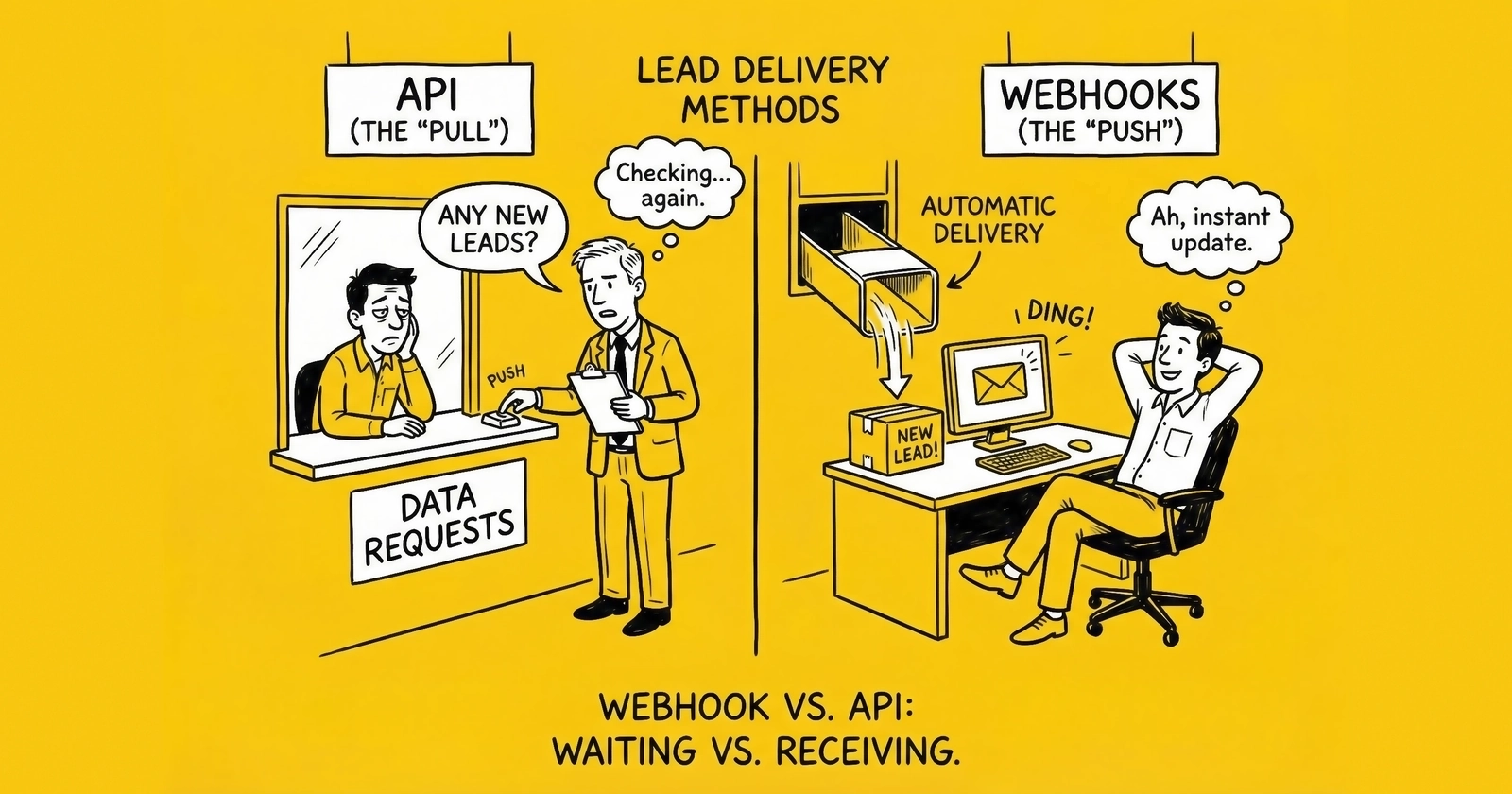
Understanding the two dominant technologies for real-time lead transfer and when to use each one for maximum revenue and reliability.
A lead has 391% higher conversion probability when contacted within one minute versus thirty minutes. That statistic should terrify anyone still receiving leads via email notification or daily spreadsheet drops. In the lead generation industry, delivery method determines whether your leads arrive in milliseconds or minutes, whether your buyers can act immediately or chase cold prospects, and whether your operation scales smoothly or collapses under technical debt.
Two technologies dominate professional lead delivery: APIs and webhooks. Both enable real-time data transfer. Both use HTTP protocols. Both require technical integration. But they solve fundamentally different problems and serve different operational needs. Choosing wrong does not just create technical headaches. It costs money on every transaction.
This guide breaks down what APIs and webhooks actually do, how they differ mechanically, when to use each approach, and how to implement both for reliable lead distribution at scale. Whether you generate leads, buy leads, or broker between both, understanding these delivery methods separates professional operations from amateur ones.
What Is an API?
API stands for Application Programming Interface. In lead generation, an API is a structured way for one system to request information or actions from another system using HTTP protocols. The key word is “request.” With APIs, the requester initiates the conversation.
When a lead buyer wants to retrieve new leads from a generator’s system, they send an API request to an endpoint the generator has published. The generator’s server receives the request, processes it, and returns the requested data. The transaction follows a pull model: the buyer pulls leads when they want them.
Consider how this works practically. A lead buyer’s CRM might call a generator’s API every 60 seconds with a request that effectively says: “Give me any new leads matching my criteria since my last request.” The generator’s API responds with either new lead records or an empty result indicating no new leads are available. The buyer’s system processes whatever comes back and makes another request 60 seconds later.
This polling pattern works, but it has inherent limitations. If leads arrive between polling intervals, they wait. If the buyer polls too frequently, they waste resources on empty requests. If the generator’s API goes down briefly, the buyer misses that polling window entirely.
REST APIs for Lead Data
Most lead generation APIs follow REST (Representational State Transfer) principles. REST APIs use standard HTTP methods to perform operations:
- GET retrieves data without modifying anything
- POST submits new data for creation
- PUT updates existing records
- DELETE removes records
A REST API for lead retrieval might expose an endpoint like /api/v1/leads that accepts GET requests with parameters for date ranges, lead types, and status filters. The response returns leads in JSON format, a lightweight data structure that most programming languages can parse easily.
Authentication typically uses API keys or OAuth tokens included in request headers. Rate limiting prevents abuse by capping how many requests a client can make per minute or hour. Pagination handles large result sets by returning data in chunks with metadata indicating whether more results exist.
SOAP APIs (Legacy Systems)
Some older lead distribution systems use SOAP (Simple Object Access Protocol) APIs instead of REST. SOAP wraps requests and responses in XML envelopes and defines strict message formats through WSDL (Web Services Description Language) documents.
SOAP APIs remain common in enterprise environments, particularly in insurance and mortgage where legacy carrier systems predate REST adoption. If you integrate with major insurance carriers or mortgage lenders, expect to encounter SOAP endpoints requiring XML formatting and specific namespace declarations.
SOAP is more verbose and complex than REST but offers built-in error handling and formal contracts that some enterprises prefer. Modern lead platforms typically support both REST and SOAP to accommodate buyer requirements across different technology generations.
The Pull Model
APIs operate on a pull model: the data consumer initiates requests when they want data. This architecture works well for:
- On-demand queries: Buyers who want leads only when they have capacity to work them
- Batch retrieval: Operations that process leads in scheduled batches rather than real-time
- Selective filtering: Buyers with complex criteria who want to evaluate leads before accepting
- Historical data: Accessing past leads, reports, or analytics
The pull model gives buyers control over timing and volume. They fetch leads when ready, request only what matches their criteria, and can pause requests during system maintenance or capacity constraints.
But the pull model creates latency. Every polling interval adds delay between lead creation and lead receipt. Even with aggressive 30-second polling, leads can wait up to 30 seconds before the buyer knows they exist. In verticals where speed-to-contact drives conversion, that delay costs sales.
What Is a Webhook?
A webhook inverts the API model. Instead of the buyer requesting data, the generator pushes data to the buyer the moment it becomes available. No polling, no waiting, no wasted requests. The lead arrives at the buyer’s system within milliseconds of creation.
Webhooks use HTTP POST requests, just like API calls, but the direction reverses. The generator’s system initiates the connection, sending lead data to an endpoint URL the buyer has configured. The buyer’s system receives the incoming request, processes the data, and returns a response indicating success or failure.
This push model eliminates polling overhead and latency. When a consumer submits a lead form, the distribution platform can deliver that lead to the winning buyer before the confirmation page finishes loading. The buyer’s agent can be dialing within seconds rather than waiting for the next polling cycle.
Event-Driven Architecture
Webhooks enable event-driven architectures where actions trigger immediately upon events occurring. In lead distribution, the “event” is lead creation or lead sale. The “action” is immediate delivery to the buyer.
Beyond initial lead delivery, webhooks can push other events:
- Status updates: When a lead’s disposition changes (contacted, converted, returned)
- Return notifications: When a buyer rejects a lead and requests a refund
- Cap alerts: When a buyer approaches or reaches their daily volume limit
- Quality feedback: When downstream conversion data becomes available
Each event triggers a webhook call to the relevant party’s endpoint, enabling real-time synchronization across systems without constant polling.
The Push Model
The push model means data arrives immediately upon availability. Benefits include:
- Zero latency: Leads arrive in milliseconds, not seconds or minutes
- Resource efficiency: No wasted polling requests when no new leads exist
- Immediate action: Buyers can trigger automated workflows instantly
- Bi-directional communication: Both parties can push updates to each other
The push model suits high-volume, time-sensitive lead distribution where speed-to-contact directly impacts conversion rates. Insurance quotes, mortgage applications, and home service requests all benefit from sub-second delivery.
However, the push model requires the buyer to maintain an always-available endpoint. If the buyer’s system goes down, webhooks fail. If the buyer’s firewall blocks incoming connections, webhooks never arrive. The buyer becomes responsible for uptime and accessibility in ways the pull model avoids.
Key Differences Between Webhooks and APIs
Understanding the mechanical differences between webhooks and APIs helps you choose the right approach for each integration scenario.
Direction of Data Flow
The most fundamental difference is who initiates the connection:
| Aspect | API (Pull) | Webhook (Push) |
|---|---|---|
| Initiator | Data consumer (buyer) | Data producer (generator) |
| Direction | Consumer requests data | Producer sends data |
| Timing | On-demand or scheduled | Event-triggered, immediate |
| Connection | Consumer connects to producer | Producer connects to consumer |
This directional difference cascades into everything else: security requirements, failure handling, scaling considerations, and operational responsibilities.
Latency and Real-Time Capabilities
APIs with polling introduce inherent latency equal to the polling interval. Even aggressive 10-second polling means leads can wait up to 10 seconds before the buyer knows they exist. Adding network latency, processing time, and queue delays, practical latency often exceeds 30 seconds.
Webhooks deliver data within milliseconds of event occurrence. The HTTP POST transmits as soon as the lead is created, with total latency typically under one second for well-configured integrations. This difference matters enormously when lead value decays 10% per hour and the first five minutes determine whether a lead converts.
Latency comparison by delivery method:
| Method | Typical Latency | Impact on Conversion |
|---|---|---|
| Webhook (real-time push) | Sub-500 milliseconds | Maximum conversion potential |
| API with 10-second polling | 5-15 seconds average | Minimal degradation |
| API with 60-second polling | 30-90 seconds average | Measurable conversion loss |
| API with 5-minute polling | 2.5-7.5 minutes average | Significant conversion loss |
| Email notification | 30 seconds to 5 minutes | Substantial conversion loss |
| Batch file transfer | Hours to daily | Major conversion loss |
For high-intent leads in competitive verticals, the latency difference between webhooks and even aggressive API polling can mean the difference between winning and losing the sale.
Server Infrastructure Requirements
APIs require the producer (generator) to maintain robust server infrastructure. The generator’s API must handle all incoming requests, scale to meet buyer demand, and remain available for buyers to query. If the generator’s API goes down, buyers cannot retrieve leads regardless of their own system health.
Webhooks shift infrastructure responsibility partially to the consumer (buyer). The buyer must expose an endpoint that the generator can reach, keep that endpoint available, and handle incoming requests reliably. If the buyer’s webhook endpoint goes down, the generator’s delivery attempts fail.
This difference affects scaling strategies:
API scaling (generator responsibility):
- Load balancers to distribute incoming requests
- Auto-scaling server clusters to handle volume spikes
- Caching layers to reduce database load
- Rate limiting to prevent abuse
Webhook scaling (buyer responsibility):
- Publicly accessible endpoint
- SSL/TLS certificate for HTTPS
- Firewall rules allowing incoming connections
- Queue systems to buffer bursts of incoming webhooks
Error Handling Approaches
API errors are relatively straightforward because the requester controls the conversation. If an API request fails, the buyer’s system knows immediately and can implement retry logic, fall back to cached data, or alert operators. The buyer retains control throughout.
Webhook errors require more sophisticated handling because the generator initiates the connection. When a webhook delivery fails, the generator must decide: retry immediately, queue for later retry, alert the buyer, or give up. The buyer may not know their endpoint is failing until leads stop arriving.
Professional webhook implementations include:
- Automatic retry logic: Multiple attempts with exponential backoff for transient failures
- Dead letter queues: Storage for webhooks that fail all retry attempts
- Delivery status endpoints: APIs the buyer can query to check webhook delivery status
- Health check notifications: Alerts when webhook delivery failure rates spike
How APIs Work in Lead Distribution
APIs in lead distribution typically serve three primary functions: lead retrieval, lead submission, and status synchronization.
Lead Retrieval APIs
Lead buyers use retrieval APIs to pull leads from generators or aggregators. A typical workflow:
- Buyer’s system authenticates with API credentials
- Buyer sends GET request with filters (date range, lead type, geography)
- Generator’s API validates request and queries database
- Generator returns matching leads in JSON or XML format
- Buyer’s system parses response and imports leads into CRM
- Buyer sends acknowledgment or updates lead status via API
Retrieval APIs work well for buyers who:
- Process leads in batches (hourly, daily, or on-demand)
- Have complex filtering requirements evaluated before acceptance
- Want to control when and how many leads they receive
- Lack infrastructure to receive incoming webhook connections
Lead Submission APIs
Lead generators use submission APIs to post leads to buyers or distribution platforms. The ping/post protocol central to lead distribution relies on APIs for both phases:
Ping phase (bid request): The generator’s system sends an API request containing non-identifying lead attributes (ZIP code, lead type, credit tier) to potential buyers. Each buyer’s system evaluates the data and returns a bid price or rejection. No personally identifiable information transmits until a buyer commits to purchase.
Post phase (full delivery): The generator sends a second API request containing complete lead data to the winning bidder. The buyer’s system validates the data and returns acceptance or rejection. If rejected, the generator may cascade to subsequent bidders.
This API-based auction happens in under one second for optimized systems. Each ping and post is a discrete API call with request and response. The generator’s platform orchestrates the conversation, but each buyer’s API must respond quickly enough to participate in the auction.
Status and Disposition APIs
After lead delivery, buyers often provide conversion data back to generators. This feedback loop helps generators optimize for quality rather than just volume. Status APIs enable:
- Disposition updates: Buyer marks leads as contacted, converted, invalid, or returned
- Conversion attribution: Buyer reports which leads became customers
- Return requests: Buyer initiates returns for leads not meeting quality standards
- Performance queries: Generator retrieves conversion rates by source or campaign
Bi-directional API integration creates transparency that benefits both parties. Generators learn which leads convert, enabling better traffic optimization. Buyers document their returns with standardized codes, streamlining refund processing.
How Webhooks Work in Lead Distribution
Webhooks in lead distribution deliver leads and events in real-time without polling. Understanding webhook mechanics helps you implement reliable integrations.
Real-Time Lead Delivery
When configured for webhook delivery, the distribution platform sends an HTTP POST request to the buyer’s endpoint immediately upon lead sale. The request body contains complete lead data in JSON or XML format. The buyer’s endpoint must:
- Receive the incoming HTTP POST request
- Authenticate the request (verify it came from the expected sender)
- Parse the lead data from the request body
- Store or process the lead (import to CRM, queue for calling, etc.)
- Return an HTTP response indicating success (200 OK) or failure
The entire exchange completes in milliseconds for well-implemented endpoints. The buyer’s system knows about the lead before the consumer has finished reading the thank-you page.
Delivery Confirmation and Acknowledgment
Webhook delivery confirmation relies on HTTP response codes. The generator interprets responses to determine next steps:
| Response Code | Meaning | Generator Action |
|---|---|---|
| 200 OK | Lead accepted successfully | Mark delivered, move to next lead |
| 201 Created | Lead created in buyer system | Mark delivered, move to next lead |
| 400 Bad Request | Invalid data in request | Log error, do not retry with same data |
| 401 Unauthorized | Authentication failed | Alert buyer, do not retry until fixed |
| 404 Not Found | Endpoint URL incorrect | Alert buyer, do not retry until fixed |
| 500 Server Error | Buyer system error | Queue for retry with exponential backoff |
| 503 Service Unavailable | Buyer system overloaded | Queue for retry with exponential backoff |
| Timeout | No response received | Queue for retry |
A robust webhook system distinguishes between errors requiring immediate attention (authentication failures, endpoint not found) and transient errors worth retrying (server errors, timeouts). Retrying permanent failures wastes resources; failing to retry transient errors loses deliverable leads.
Webhook Security
Webhooks create inbound connections to the buyer’s infrastructure, raising security considerations:
Signature verification: The generator includes a cryptographic signature in request headers, computed using a shared secret. The buyer’s endpoint recomputes the signature and compares. Mismatches indicate tampering or misconfiguration.
IP whitelisting: Buyers can restrict webhook endpoints to accept requests only from known generator IP addresses. This prevents attackers from reaching the endpoint even if they obtain the shared secret.
HTTPS enforcement: All webhook traffic should use HTTPS to encrypt data in transit. Lead data contains personally identifiable information; transmitting over unencrypted HTTP violates privacy best practices and potentially regulations.
Timestamp validation: Including timestamps in webhook payloads and rejecting requests with stale timestamps prevents replay attacks where attackers capture and re-send valid webhooks.
Idempotency: Network issues can cause duplicate webhook deliveries. Buyers should track processed webhook IDs and ignore duplicates rather than creating duplicate leads.
When to Use APIs vs Webhooks
Neither APIs nor webhooks are universally superior. The right choice depends on your operational model, technical capabilities, and specific use case.
Choose APIs When:
You need on-demand data retrieval. If buyers want leads only when they have capacity, API polling lets them control timing. A call center at capacity stops polling until agents become available.
The buyer lacks webhook infrastructure. Exposing a publicly accessible endpoint requires firewall configuration, SSL certificates, and always-on servers. Smaller buyers may lack this infrastructure. API polling works from behind firewalls without exposing any inbound ports.
You query historical data. Webhooks deliver events as they happen but cannot replay historical data. APIs enable queries for past leads, reports, and analytics that webhooks cannot provide.
Complex filtering happens before acceptance. If buyers evaluate leads against complex criteria before deciding to accept, API retrieval with filter parameters lets them request only matching leads. Webhooks would deliver all leads, requiring the buyer to filter and potentially return many.
Batch processing suits the workflow. Operations that process leads in scheduled batches (hourly uploads to legacy systems, overnight imports) work naturally with API retrieval on schedule.
Choose Webhooks When:
Real-time delivery is critical. When speed-to-contact determines conversion and lead value decays by the minute, webhook delivery’s sub-second latency beats any polling interval.
Volume is high and variable. Polling wastes resources when no new leads exist. At 100,000 leads daily, polling every 10 seconds generates 8,640 requests daily. With webhooks, the generator sends exactly 100,000 requests (one per lead) with no wasted polls.
You want event-driven automation. Webhooks trigger immediate downstream actions: new lead arrives, workflow launches, agent notified, call initiated. Polling adds delay between event and action.
Buyers have modern infrastructure. Buyers with cloud hosting, containerized applications, and DevOps capabilities can easily expose and scale webhook endpoints.
Bi-directional synchronization is needed. Both parties can send webhooks to each other, enabling real-time status updates without either side polling.
Hybrid Approaches
Most sophisticated lead operations use both APIs and webhooks depending on the scenario:
- Webhooks for real-time lead delivery to maximize speed-to-contact
- APIs for historical queries and reporting
- Webhooks for status updates as leads progress through the buyer’s pipeline
- APIs for bulk operations like batch returns or mass status updates
- Webhooks for alerts when caps are reached or system issues arise
- APIs for configuration changes to buyer filters or pricing
The technologies complement rather than compete. A buyer might receive leads via webhook in real-time, then use APIs to pull performance reports daily and submit return requests in batches.
Implementing Webhook Lead Delivery
Implementing webhook delivery requires attention to reliability, security, and operational monitoring. Done well, webhooks provide the fastest and most efficient lead delivery. Done poorly, they create silent failures that lose leads without anyone noticing.
Endpoint Setup and Configuration
The buyer creates an endpoint URL where they will receive leads. Requirements:
Publicly accessible URL: The generator’s servers must reach this URL over the internet. Internal network addresses or localhost URLs will not work.
HTTPS with valid certificate: Use SSL/TLS encryption. Self-signed certificates may cause delivery failures. Use certificates from trusted authorities (Let’s Encrypt provides free certificates).
Appropriate path structure: Use clear, descriptive paths like /webhooks/leads or /api/incoming/leads. Avoid generic paths that might conflict with other services.
Authentication mechanism: Configure how the endpoint validates incoming requests. Common approaches:
- Static API key in a custom header
- HMAC signature verification using a shared secret
- Basic authentication (username/password in Authorization header)
The generator’s platform typically provides a configuration interface where buyers enter their webhook URL and authentication credentials. Some platforms offer test functionality to verify the endpoint works before going live.
Response Handling Best Practices
Your endpoint must respond quickly and appropriately. Best practices:
Respond in under 3 seconds. Generators typically timeout webhook requests if no response arrives within a few seconds. Process the lead asynchronously if your workflow takes longer; return 200 OK immediately and handle the lead via a background queue.
Return appropriate HTTP codes. 200 OK means you received and accepted the lead. 400-level codes indicate problems you want the generator to address (bad data, authentication failure). 500-level codes indicate temporary issues the generator should retry.
Do not process in the request handler. Accept the lead, queue it for processing, return success. Doing CRM imports, validation calls, or complex logic in the request handler risks timeouts and blocks the generator’s system.
Log everything. Log incoming requests with timestamps, headers, and bodies. Logs enable debugging when leads appear to go missing or data seems incorrect.
Error Handling and Retry Mechanisms
Webhook delivery will fail sometimes. Networks have issues, servers restart, deployments introduce bugs. Robust error handling prevents these transient problems from losing leads.
Generator retry logic:
Generators should implement exponential backoff for failed deliveries:
- First retry: 2 seconds after failure
- Second retry: 4 seconds after first retry
- Third retry: 8 seconds after second retry
- Fourth retry: 16 seconds after third retry
- Fifth retry: 32 seconds after fourth retry
After exhausting retries (typically 5-10 attempts over several minutes), the generator should queue the lead for manual review or alternative delivery.
Buyer idempotency handling:
Buyers should handle duplicate webhooks gracefully. Network issues can cause the generator to retry a successfully delivered webhook. Track the lead ID or webhook event ID and skip processing if already received.
Circuit breaker patterns:
If a buyer’s endpoint fails repeatedly, generators should stop attempting delivery to that endpoint temporarily. After a cooling period, attempt a single probe. If it succeeds, resume normal delivery. This protects both parties from cascading failures.
Testing Webhook Integrations
Before going live with webhook delivery, test thoroughly:
Endpoint accessibility: Verify the generator can reach your endpoint from outside your network. Tools like ngrok can expose local endpoints for testing.
Authentication: Confirm the authentication mechanism works correctly. Send test webhooks with valid and invalid credentials to verify both acceptance and rejection.
Data parsing: Verify your endpoint correctly parses the lead data format (JSON, XML) the generator will send. Edge cases like special characters, long field values, and optional fields should all work.
Error handling: Intentionally return error codes and verify the generator’s retry behavior matches expectations.
Load testing: If you expect high volume, verify your endpoint handles concurrent requests without failures or excessive latency.
Monitoring: Confirm your alerting and monitoring systems detect webhook failures so you know when problems arise.
Implementing API Lead Delivery
API-based lead retrieval is simpler than webhooks in some respects but requires different implementation considerations.
Authentication Methods
Most lead APIs use one of three authentication methods:
API Keys: Simple string tokens included in request headers or query parameters. Easy to implement but offer limited security. If the key is compromised, it must be rotated, breaking all integrations using it.
OAuth 2.0: Token-based authentication where you exchange credentials for temporary access tokens. More secure than API keys because tokens expire and can be scoped to specific permissions. More complex to implement, requiring token management and refresh logic.
Basic Authentication: Username and password encoded in the Authorization header. Simple but transmits credentials with every request. Acceptable only over HTTPS.
Store credentials securely. Never embed API keys in client-side code or public repositories. Use environment variables or secrets management systems.
Rate Limiting and Throttling
APIs implement rate limits to prevent abuse and ensure fair access. Common limits:
- Requests per minute: 60-1,000 depending on plan level
- Requests per hour: 1,000-10,000 depending on plan level
- Concurrent connections: 5-50 simultaneous requests
Rate limit information typically appears in response headers:
X-RateLimit-Limit: Maximum requests allowed in periodX-RateLimit-Remaining: Requests remaining in current periodX-RateLimit-Reset: Timestamp when the limit resets
When you hit rate limits, the API returns 429 Too Many Requests. Respect this response by waiting until the reset time before retrying. Implementing automatic backoff prevents your integration from repeatedly hitting limits.
Pagination for Large Datasets
APIs return lead data in pages to avoid overwhelming responses. Common pagination patterns:
Offset-based: Request specifies offset and limit. /leads?offset=100&limit=50 returns leads 101-150. Simple but can miss or duplicate leads if new leads arrive during pagination.
Cursor-based: Response includes a cursor token pointing to the next page. Each request includes the previous response’s cursor. More reliable for data that changes during pagination.
Keyset-based: Request specifies the last ID received. /leads?after_id=12345&limit=50 returns leads created after ID 12345. Efficient and handles concurrent changes well.
When retrieving leads via API, continue fetching pages until you receive an empty or partial page, indicating you have reached the end of available data.
Polling Best Practices
If using APIs with polling for pseudo-real-time delivery:
Use webhooks for new lead notification, APIs for retrieval. Some systems send a lightweight webhook indicating new leads are available, then the buyer calls the API to retrieve them. This combines webhook immediacy with API flexibility.
Implement smart polling intervals. Poll more frequently during high-volume hours, less frequently overnight. Adjust intervals based on actual lead flow rather than fixed schedules.
Track your last successful retrieval. Query only leads created since your last poll rather than retrieving all leads each time. Reduces data transfer and processing load.
Handle partial failures gracefully. If you retrieve 50 leads but fail to process lead 23, ensure you can re-retrieve lead 23 without losing or duplicating the other 49.
Ping/Post Systems: Where APIs and Webhooks Converge
The ping/post protocol that dominates high-volume lead distribution uses both API and webhook patterns in a coordinated dance. Understanding this architecture illustrates how the technologies work together.
The Ping Phase
When a consumer submits a lead form, the distribution platform initiates the ping phase by sending API requests (or webhooks, depending on buyer preference) to all qualified buyers simultaneously. These pings contain non-identifying lead attributes: ZIP code, state, lead type, credit tier, and similar attributes sufficient for pricing but insufficient for consumer identification.
Each buyer’s system evaluates the ping against their targeting rules and returns a response:
- Bid price if they want the lead at that price
- Rejection code if the lead does not match their criteria
- Timeout if they fail to respond within the window (typically 100 milliseconds)
The platform collects all bids and identifies the winner.
The Post Phase
The platform then sends a post request (typically via webhook for speed) containing complete lead data to the winning buyer. This post includes everything: name, phone, email, address, and all qualification data. Only the winning buyer receives this data; losing bidders never see the consumer’s personal information.
The buyer’s system validates the complete data and returns acceptance or rejection. If rejected, the platform may cascade to the next-highest bidder.
Why Speed Matters
The entire ping/post sequence happens while the consumer waits for a confirmation page. Target timing:
- Ping transmission: under 50 milliseconds
- Buyer bid response: under 100 milliseconds
- Winner selection and post transmission: under 50 milliseconds
- Post acceptance: under 500 milliseconds
- Total transaction: under 1 second
This speed requires webhooks (or webhook-like push delivery) for the post phase. API polling cannot achieve sub-second delivery.
The platforms that dominate high-volume lead distribution invest heavily in infrastructure to maintain these latencies at scale. Buyers who cannot respond to pings within the timeout window miss auctions. Generators whose platforms add latency lose buyer participation.
Common Integration Challenges
Both API and webhook integrations face common challenges that require planning and robust error handling.
Handling Downtime
Systems fail. Servers restart. Networks glitch. Professional integrations plan for downtime on both sides.
Generator downtime (API delivery): When the generator’s API is unavailable, buyers cannot retrieve leads. Implement:
- Health check endpoints to detect outages quickly
- Cached responses for non-time-sensitive queries
- Clear error messages indicating the problem
- Status page or alerts notifying buyers of issues
Buyer downtime (Webhook delivery): When the buyer’s webhook endpoint is unavailable, deliveries fail. Implement:
- Retry queues that hold failed deliveries
- Exponential backoff to avoid hammering struggling systems
- Alternative delivery options (email fallback, portal access)
- Alerting when delivery failure rates spike
Data Format Mismatches
Field names, data types, and value formats vary across systems. Your “first_name” might be their “FirstName” or “fname”. Your date format might be ISO 8601 while theirs expects MM/DD/YYYY.
Build flexible field mapping that transforms data between formats. Document expected formats clearly. Validate incoming data against expected schemas and provide clear error messages for format violations.
Common mapping challenges:
- Phone number formats (10 digits, dashes, parentheses, country codes)
- Date formats (ISO 8601, MM/DD/YYYY, DD/MM/YYYY)
- State codes (two-letter abbreviations versus full names)
- Boolean values (true/false, 1/0, Yes/No, Y/N)
- Currency formats (decimal points, thousand separators, currency symbols)
Security Vulnerabilities
Lead data contains personally identifiable information (PII). Security failures create regulatory exposure, reputational damage, and legal liability. TCPA compliance requires careful attention to data handling.
Encrypt all transmissions: Use HTTPS for all API and webhook traffic. Never transmit lead data over unencrypted HTTP.
Validate authentication on every request: Do not assume requests are legitimate. Verify API keys, signatures, or tokens on every incoming request.
Sanitize input data: Incoming lead data could contain malicious content. Sanitize before storing or processing to prevent SQL injection, XSS, or other attacks.
Audit access: Log who accesses what data and when. Audit logs support compliance requirements and incident investigation.
Minimize data retention: Do not store lead data longer than necessary. Implement data retention policies that automatically purge old records.
Frequently Asked Questions
What is the difference between a webhook and an API for lead delivery?
The primary difference is direction: APIs use a pull model where the buyer requests data, while webhooks use a push model where the generator sends data automatically. APIs require the buyer to initiate requests, introducing latency equal to the polling interval. Webhooks deliver leads immediately upon availability, achieving sub-second latency. APIs give buyers control over timing; webhooks give generators control over timing. Most high-volume lead operations use webhooks for real-time delivery and APIs for historical queries and reporting.
Which method is faster for receiving leads?
Webhooks are significantly faster. Webhook delivery transmits leads within milliseconds of creation, with typical end-to-end latency under 500 milliseconds. API polling adds latency equal to at least half the polling interval on average. Even aggressive 10-second polling means leads wait 5 seconds on average before the buyer knows they exist. For speed-critical applications where response time affects conversion, webhooks are the clear choice. Industry data shows leads contacted within one minute convert at 391% higher rates than those contacted after 30 minutes.
Can I use both webhooks and APIs together?
Yes, and most sophisticated operations do. A common pattern uses webhooks for real-time lead delivery (maximizing speed) while using APIs for historical queries, reporting, bulk operations, and configuration management. Webhooks can also push status updates bidirectionally between generator and buyer, while APIs handle on-demand data retrieval. The technologies complement each other; using both provides flexibility that neither offers alone.
What happens if my webhook endpoint goes down?
Professional generators implement retry logic for failed webhook deliveries. Typical patterns include exponential backoff (waiting 2 seconds, then 4, then 8, etc.) across 5-10 retry attempts. Failed webhooks after all retries typically queue for manual review or alternative delivery methods. Buyers should monitor their webhook endpoint availability and have alerting in place when failures spike. During planned maintenance, buyers should coordinate with generators to pause delivery or use alternative methods temporarily.
How do I secure my webhook endpoint?
Implement multiple security layers. Use HTTPS to encrypt all traffic. Require signature verification where the generator includes a cryptographic signature computed with a shared secret, and your endpoint validates the signature before processing. Consider IP whitelisting to restrict requests to known generator IP addresses. Include timestamp validation to reject stale requests (older than a few minutes) to prevent replay attacks. Implement idempotency handling to safely ignore duplicate webhook deliveries.
What is the ping/post protocol?
Ping/post is a two-phase auction protocol used in high-volume lead distribution. The ping phase broadcasts non-identifying lead attributes (ZIP code, lead type, credit tier) to potential buyers who return bids. No personal information transmits during pings. The post phase delivers complete lead data to the winning bidder only. This separation enables competitive bidding while protecting consumer privacy until payment is committed. The entire sequence completes in under one second for optimized systems.
How long should I wait before retrying a failed webhook?
Implement exponential backoff starting with short delays. A common pattern: first retry after 2 seconds, second retry 4 seconds later, third 8 seconds later, fourth 16 seconds later, fifth 32 seconds later. This progression gives transient issues time to resolve while limiting retry volume. Cap maximum delay at around 60 seconds. Cap total retries at 5-10 attempts. After exhausting retries, queue for manual review or alternative delivery rather than continuing indefinitely.
What response time should my webhook endpoint achieve?
Your webhook endpoint should respond within 1-3 seconds. Generators typically timeout requests after 5-10 seconds, treating timeouts as failures triggering retries. To achieve fast response times, accept the incoming data, queue it for asynchronous processing, and return an HTTP 200 immediately. Do not perform CRM imports, validation API calls, or complex business logic synchronously in the request handler. Process the lead from the queue after returning the response.
How do I monitor webhook delivery health?
Implement monitoring at multiple levels. Track incoming webhook volume over time to detect unexpected drops. Monitor response latency to catch performance degradation. Alert on HTTP error rates (4xx and 5xx responses). Log all incoming requests with timestamps, headers, and bodies for debugging. Ask generators if they provide delivery status endpoints or dashboards showing webhook success rates. Set up synthetic monitoring that sends test webhooks periodically to verify your endpoint remains accessible.
Should I use REST or SOAP APIs?
Use REST for new integrations. REST APIs are simpler, more flexible, and easier to implement than SOAP. They use JSON (lightweight, human-readable) rather than XML (verbose, complex). Most modern lead platforms default to REST. However, SOAP remains common in enterprise environments, particularly insurance carriers and mortgage lenders whose systems predate REST adoption. If you integrate with specific legacy systems requiring SOAP, you have no choice but to support it. When building new systems, offer REST as the primary option with SOAP only for backward compatibility where required.
Key Takeaways
-
APIs use a pull model where buyers request data; webhooks use a push model where generators send data automatically. The directional difference determines latency, infrastructure requirements, and operational responsibilities.
-
Webhooks deliver leads in milliseconds; API polling adds latency equal to the polling interval. For high-intent leads where speed-to-contact determines conversion, this latency difference translates directly to revenue.
-
Webhooks require buyers to maintain publicly accessible, always-available endpoints. APIs shift infrastructure burden to generators. Choose based on your technical capabilities and operational model.
-
The ping/post protocol combines both technologies: API-style requests for bid solicitation, webhook-style pushes for lead delivery. Understanding this architecture is essential for participating in high-volume lead marketplaces.
-
Implement robust error handling for both methods. APIs need rate limit handling and pagination logic. Webhooks need signature verification, retry logic, and idempotency handling.
-
Most sophisticated operations use both APIs and webhooks for different purposes. Webhooks for real-time delivery; APIs for queries, reports, and bulk operations. The technologies complement each other.
-
Security is non-negotiable for either method. HTTPS encryption, authentication verification, and input validation protect lead data and your operation from compromise.
-
Monitor integration health proactively. Silent failures lose leads without anyone noticing. Alerting on error rates, latency, and volume anomalies catches problems before they cost significant revenue.
Technical specifications and integration patterns current as of December 2025. API and webhook implementations vary by platform; consult specific vendor documentation for integration requirements.