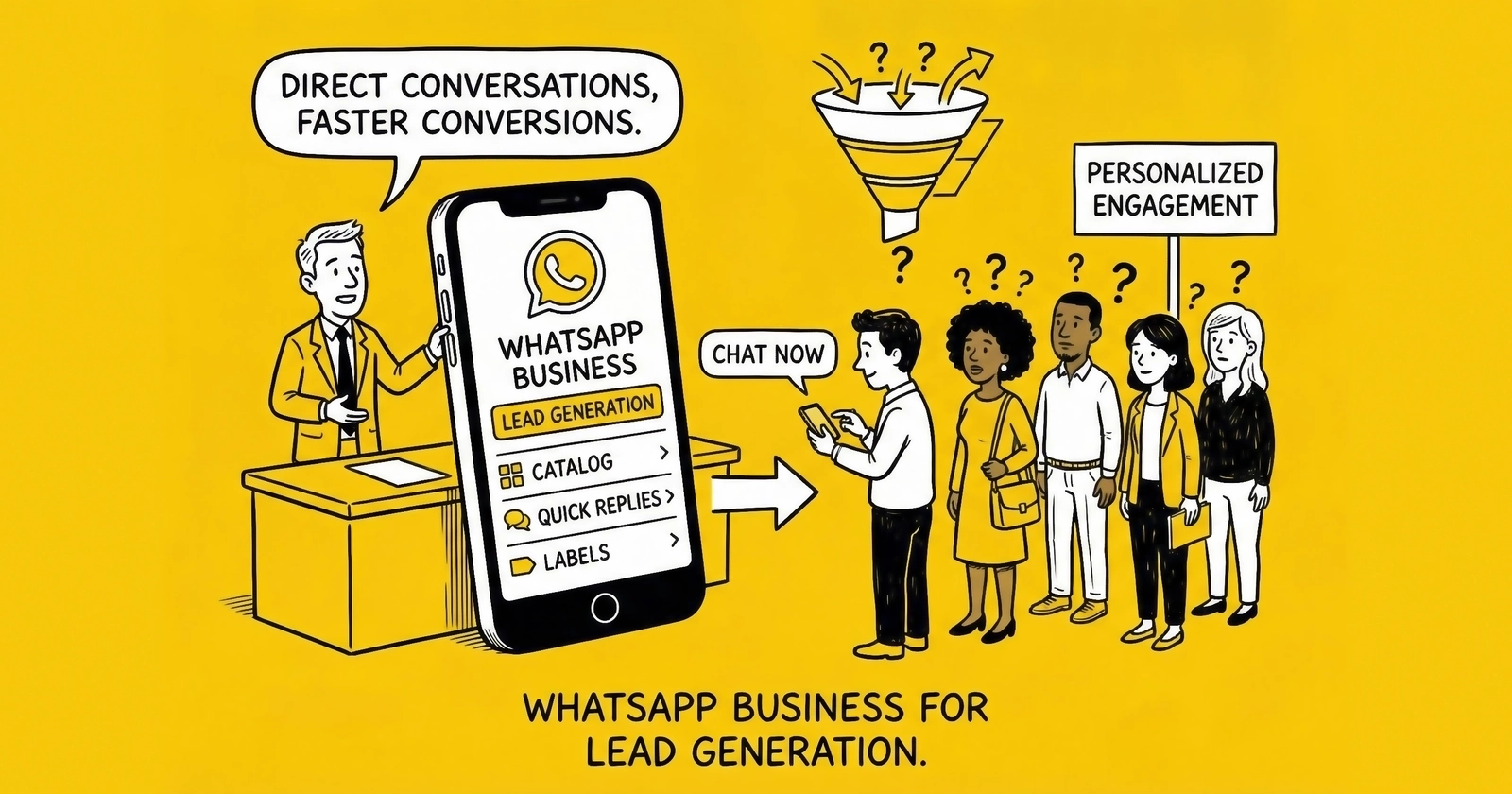
How to leverage the world’s largest messaging platform for lead generation, with 98% open rates and conversion capabilities that far exceed traditional channels.
Introduction: The WhatsApp Opportunity
WhatsApp is the world’s largest messaging platform with 3.1 billion global users. In many markets outside the United States, WhatsApp is not just popular – it is the default communication channel, more trusted than email and more accessible than phone calls.
The numbers reveal an extraordinary lead generation opportunity. WhatsApp delivers 98% open rates compared to email’s 15-25%, with 60% click-through rates on messages. Businesses using chatbot qualification achieve 28% lead conversion rates, while follow-up messaging reduces cart abandonment by 25%. Overall, WhatsApp campaigns generate 30-40% higher conversion rates than email campaigns.
For lead generation operators, WhatsApp represents a channel where consumer attention is available at scale. Messages actually get read. Responses happen in real-time. Conversations flow naturally toward qualification and conversion.
WhatsApp Business – the platform’s commerce and business communication layer – now serves over 50 million businesses worldwide. Meta has aggressively expanded WhatsApp’s commercial capabilities, adding Click-to-WhatsApp ads, WhatsApp Flows for interactive experiences, AI chatbot integration, and payment functionality.
This guide covers how to implement WhatsApp as a lead generation channel: the technical infrastructure, advertising integration, chatbot qualification, and conversion optimization strategies that transform messaging engagement into qualified leads.
Understanding WhatsApp Business Infrastructure
WhatsApp Business App vs. API
WhatsApp offers two business solutions with fundamentally different capabilities, and understanding the distinction is critical for lead generation planning.
WhatsApp Business App (Free)
The free Business App is designed for small businesses with limited messaging volume. It provides single user access with manual message responses and basic automated greetings and away messages. You can create a product catalog, but the app is limited to one device with no CRM integration capabilities. For operations handling more than a few dozen conversations daily, these limitations become prohibitive.
WhatsApp Business API
The API represents the enterprise solution for scaled operations. It enables unlimited team members, programmatic messaging via API, and full chatbot integration. The API connects to CRM and marketing automation platforms, supports multi-agent inbox management, and provides comprehensive analytics and reporting. Broadcast messaging capabilities allow reaching opted-in audiences at scale. For lead generation at any meaningful volume, the WhatsApp Business API is required.
Business Solution Providers (BSPs)
WhatsApp Business API access requires working with an authorized Business Solution Provider. Each provider offers different strengths suited to particular use cases.
| Provider | Strengths | Best For |
|---|---|---|
| Twilio | Developer-focused, flexible | Custom implementations |
| MessageBird | Global reach, omnichannel | International operations |
| Zendesk | Support integration | Customer service focus |
| HubSpot | Marketing automation | Inbound lead generation |
| Salesforce | CRM integration | Enterprise sales |
| Intercom | Conversational marketing | Product-led growth |
Pricing Models
WhatsApp API pricing operates on a conversation-based model rather than per-message charges. Marketing conversations initiated by the business cost $0.025-0.05 per conversation in the US market. Utility conversations for transactional updates run $0.015-0.03, while service conversations responding to customer inquiries cost $0.01-0.02. Authentication messages fall in the $0.01-0.02 range.
Each conversation represents a 24-hour window. Marketing conversations (promotional messages) cost more than service conversations (responding to inquiries), creating an incentive to respond quickly and keep conversations within a single window.
Verification and Trust
WhatsApp offers verification tiers that significantly affect business credibility and user trust. Official Business Accounts receive a green checkmark badge, verified business name, enhanced trust signals, and priority support. These accounts consistently see higher engagement rates and better deliverability.
Verification requires a registered business entity with consistent branding across platforms, an active website, proper business documentation, and Meta Business Manager setup. The verification process takes one to four weeks, so plan accordingly when launching WhatsApp lead generation campaigns.
Click-to-WhatsApp Advertising
How Click-to-WhatsApp Ads Work
Click-to-WhatsApp ads appear on Facebook and Instagram, directing users to initiate WhatsApp conversations rather than visiting landing pages. The user sees an ad, clicks the CTA (typically “Message Us” or “Get Quote”), and WhatsApp opens with a pre-filled message. When the user sends that message, the conversation begins, and the business responds via WhatsApp – either through human agents or chatbots.
The strategic advantage is clear. Traditional advertising follows the path: ad → landing page → form submission → email or call follow-up. Click-to-WhatsApp compresses this to: ad → immediate conversation → real-time qualification. This shortened funnel eliminates landing page abandonment and the delays that kill lead value.
Setting Up Click-to-WhatsApp Campaigns
Campaign setup requires a Meta Business Manager account, WhatsApp Business API access, a linked WhatsApp Business number, and a connected Facebook Page. The configuration process involves selecting “Engagement” or “Messages” as your objective, choosing WhatsApp as the destination, creating an approved message template, defining your audience targeting, developing ad creative, and setting the pre-filled message users will send.
The pre-filled message deserves careful attention. A message like “Hi! I saw your ad about [product/service]. I’m interested in learning more.” reduces friction for conversation initiation, provides context for response agents or bots, enables conversation categorization, and can include tracking parameters for attribution.
Performance Benchmarks
Click-to-WhatsApp campaigns typically outperform traditional lead ads across every meaningful metric.
| Metric | Traditional Lead Ads | Click-to-WhatsApp |
|---|---|---|
| CTR | 0.5-1.5% | 1.5-3.0% |
| Cost per conversation | N/A | $0.50-2.00 |
| Response rate | 20-40% (to follow-up) | 80-95% (immediate) |
| Qualification rate | 10-20% | 25-40% |
| Time to engagement | Hours-days | Seconds-minutes |
Campaign optimization focuses on several key areas. Creative that shows a WhatsApp interface mockup sets proper user expectations. Using “Send Message” as the CTA outperforms generic alternatives. Targeting should focus on mobile users since 99%+ of WhatsApp usage occurs on mobile devices. Schedule ads for hours when your team can respond promptly, and connect campaigns to chatbots for immediate engagement around the clock.
WhatsApp Chatbot Lead Qualification
Why Chatbots Excel on WhatsApp
WhatsApp’s conversational interface provides the ideal environment for chatbot-driven qualification. Chatbots feel native in a messaging context where users already expect text-based interaction. They provide immediate engagement without wait times for human response and operate 24/7 to capture leads regardless of time zone. Structured qualification flows guide conversations toward gathering the data you need, while seamless handoff capabilities transfer high-value conversations to humans at the right moment.
The performance data supports aggressive chatbot adoption. Chatbots increase lead generation by 500%+ on WhatsApp while achieving 28% lead conversion rates. Lead qualification time drops by 61% with automated workflows, and 55% of businesses using chatbots report increases in high-quality lead volume.
Building Qualification Flows
Effective chatbot flows gather qualification data through natural conversation rather than interrogation. An opening message might say: “Hi [Name]! Thanks for reaching out about [product/service]. I’m here to help you find the right solution. To get started, could you tell me a bit about what you’re looking for?” followed by options like Personal use, Business use, or Just exploring.
Structure subsequent questions to capture intent level (browsing versus ready to buy), budget range, timeline, decision-making authority, and specific needs or requirements. Progressive disclosure improves completion rates – ask simple questions first, moving to complex questions only after engagement is established. A typical flow might progress from “What type of [product/service]?” to “What’s your timeline?” to “What’s your budget range?” to “What’s the best way to reach you?”
Configure handoff triggers carefully. Transfer to human agents when a high-value opportunity is identified, when questions exceed bot capability, when the customer explicitly requests human assistance, or when qualification criteria indicate a ready-to-close lead.
AI-Powered Conversations
Modern WhatsApp chatbots leverage AI for natural, dynamic conversations. These systems provide natural language understanding with intent recognition, context retention across messages, sentiment analysis, dynamic response generation, and multi-language support.
Several platforms excel at AI-powered WhatsApp chatbots. Landbot offers a visual flow builder with native WhatsApp integration. ManyChat emphasizes marketing automation capabilities. Freshworks provides strong CRM integration. Dialogflow delivers advanced AI and NLP capabilities via API integration. Intercom supports product-led growth strategies with native WhatsApp support.
Success requires training bots on actual customer conversations, providing reliable fallback to human agents, testing extensively before deployment, monitoring and improving continuously, and maintaining consistent conversation personality that reflects your brand voice.
WhatsApp Flows for Lead Capture
What Are WhatsApp Flows?
WhatsApp Flows are interactive, app-like experiences within WhatsApp conversations. Instead of back-and-forth text messages, Flows present structured forms, selections, and data capture interfaces. They support multi-screen interactive experiences with form fields including text, date, dropdown, and checkbox inputs. Image and media integration, conditional logic, data validation, and CRM integration round out the capabilities.
Lead Capture Flow Design
Consider an insurance quote flow as an example. Screen 1 asks for coverage type with options for Auto, Home, Life, or Health Insurance. Screen 2 captures basic information: full name, date of birth, and ZIP code. Screen 3 presents coverage details that dynamically adapt based on the Screen 1 selection. Screen 4 asks about contact preferences including best time to call, phone number, and optional email. Screen 5 provides confirmation with a summary of information, submit button, and privacy policy link.
Flow design best practices emphasize brevity – keep flows to 3-5 screens maximum. Design mobile-first for thumb-friendly interaction and include progress indicators showing completion status. Allow users to save progress and resume later. Provide immediate confirmation upon submission and set clear expectations for follow-up timing and method.
Integration with Lead Management
WhatsApp Flows connect directly to lead management systems at multiple integration points. CRM integration creates lead records automatically. Marketing automation connections trigger nurture sequences. Lead distribution systems route inquiries to appropriate agents. Validation services verify phone and email in real-time. Consent documentation records TCPA and GDPR consent with proper timestamps.
A typical webhook workflow processes Flow completion by sending data to a webhook endpoint, creating a lead record in the CRM, applying lead scoring based on qualification responses, executing routing rules to determine assignment, triggering agent notifications, and sending confirmation messages via WhatsApp – all within seconds of submission.
Conversion Optimization Strategies
Reducing Cart Abandonment
WhatsApp messaging recovers abandoned carts and incomplete lead submissions more effectively than email. An abandoned cart flow might trigger one hour after abandonment with: “Hi [Name]! We noticed you were checking out [product]. Did you have any questions I can help with?” A 24-hour message follows: “Still thinking about [product]? Here’s a quick summary of what’s in your cart: [details]. Let me know if you need help!” The 48-hour message creates urgency: “Last chance! Your [product] is still waiting. Complete your purchase now and get [incentive].”
This approach delivers 25% reduction in cart abandonment and 30-40% higher recovery rates than email-based recovery sequences.
Lead Nurturing Sequences
WhatsApp enables high-engagement nurture sequences that maintain contact without overwhelming prospects. A qualification follow-up sequence might send a thank you with value proposition summary on Day 1, relevant content or a resource on Day 3, a case study or testimonial on Day 5, and a direct offer or consultation invitation on Day 7.
Monitor engagement triggers throughout the sequence: message opens, link clicks, response messages, and sentiment indicators. Adjust sequence timing and content based on these signals – accelerating for engaged prospects and spacing out for those showing less interest.
Re-engagement Campaigns
Dormant leads can be reactivated through WhatsApp with the right approach. A re-engagement template might read: “Hi [Name]! It’s been a while since we connected about [product/service]. A lot has changed – [new feature/offer]. Would you like a quick update?” followed by options for “Yes, tell me more,” “Not right now,” and “Please remove me.”
Best practices require respecting opt-out preferences immediately, providing clear value propositions, limiting frequency to maximum 1-2 re-engagement attempts, and segmenting based on previous engagement levels.
Compliance and Best Practices
WhatsApp Business Policy
WhatsApp enforces strict policies that directly affect lead generation operations. Prohibited content includes unsolicited promotional messages, political content, adult content, illegal products or services, and misleading claims.
Message templates must be pre-approved by WhatsApp and include variable placeholders for personalization, clear opt-out mechanisms, and accurate sender identification. Regarding opt-in requirements, users must initiate conversations or provide explicit opt-in through another channel. Purchased lists are prohibited. Clear consent is required for promotional messages, and easy opt-out processes must be readily available.
TCPA and Privacy Considerations
WhatsApp messaging triggers compliance requirements similar to SMS. For TCPA compliance, written consent is required for marketing messages, opt-out requests must be honored promptly, consent must be documented with timestamp and language shown, and suppression lists must be maintained.
GDPR and broader privacy regulations require lawful basis for processing, data minimization, purpose limitation, right to erasure support, and careful attention to cross-border transfer considerations. Document each WhatsApp opt-in with timestamp, consent language displayed, IP address for web-based opt-ins, platform or source, and unique identifier.
Quality and Deliverability
WhatsApp monitors business account quality based on message response rates, user blocking rates, spam reports, and template rejection rates. Quality ratings directly impact capabilities: Green rating provides full messaging capability, Yellow indicates a warning requiring practice improvements, and Red results in restricted messaging.
Maintain quality by responding quickly to messages, sending relevant content that users expect, honoring opt-outs immediately, and avoiding aggressive messaging frequency. A degraded quality rating can take weeks to recover, significantly impacting lead generation capacity.
Industry Applications
Insurance Lead Generation
WhatsApp excels for insurance quote requests where complex qualification benefits from conversational interaction. The typical flow begins with a Click-to-WhatsApp ad offering “Get Your Free Quote,” followed by chatbot qualification covering coverage type, ZIP code, and basic information. A WhatsApp Flow captures detailed quote form data, enabling real-time quote calculation before agent handoff for closing.
Results demonstrate 45% higher completion rates than web forms, 3x faster speed-to-contact, and 25% higher close rates.
Home Services
Local service providers benefit from WhatsApp’s immediate engagement capabilities. Flows start with local ads featuring “Message for Estimate,” proceed through chatbot qualification of service type, urgency, and location, enable photo upload for assessment, integrate with calendars for scheduling, and provide confirmation and reminders.
This approach converts 60% of inquiries to appointments, enables same-day scheduling, and reduces no-show rates through WhatsApp reminders.
Real Estate
Property inquiries convert effectively through WhatsApp’s conversational approach. Listing ads with “Schedule Viewing” CTAs lead to property interest qualification, budget and timeline assessment, scheduling via WhatsApp, and pre-visit information delivery. The result is higher-intent showings, better qualified buyers, and faster transaction timelines.
Frequently Asked Questions
How does WhatsApp compare to SMS for lead generation?
WhatsApp offers significant advantages over SMS: 98% open rates versus SMS’s 90%+, richer media support (images, documents, interactive elements), two-way conversation capability, no character limits, lower per-message costs at scale, and global reach without international SMS fees. However, SMS has advantages in markets where WhatsApp penetration is lower (parts of the US) and for transactional messages where simplicity matters. For lead generation specifically, WhatsApp’s interactive capabilities, chatbot integration, and WhatsApp Flows provide qualification and conversion tools that SMS cannot match.
What does WhatsApp Business API cost?
WhatsApp Business API pricing is conversation-based rather than message-based. Marketing conversations (business-initiated promotional messages) cost $0.025-0.05 per 24-hour conversation window. Utility conversations (transactional updates) cost $0.015-0.03. Service conversations (responding to customer inquiries) cost $0.01-0.02. Additionally, you will pay your Business Solution Provider (Twilio, MessageBird, etc.) platform fees ranging from $0-500/month depending on volume and features. For lead generation operations, expect total costs of $0.50-2.00 per qualified lead conversation including advertising and messaging costs.
Can I send promotional messages to anyone on WhatsApp?
No. WhatsApp requires opt-in consent before sending promotional messages. Users must either initiate conversation with your business or provide explicit consent through another channel (website form, in-person signup, etc.). You cannot message users from purchased lists or scraped contacts. Even with opt-in, messages must use pre-approved templates and provide clear opt-out mechanisms. Violating these policies results in account restrictions or permanent bans. WhatsApp actively monitors for spam and policy violations.
How do I integrate WhatsApp with my CRM?
Integration approaches depend on your CRM and WhatsApp access method. Major CRMs (Salesforce, HubSpot, Zoho) offer native WhatsApp integrations or marketplace apps. For custom integrations, use your BSP’s API to sync conversations, create leads, and trigger automations. Key integration points include: lead creation when conversations start, contact record updates from qualification data, activity logging for all messages, and trigger workflows based on WhatsApp events. Most integrations require WhatsApp Business API access (not just the Business App).
What is the best way to get WhatsApp opt-ins?
Effective opt-in strategies include: Click-to-WhatsApp ads that initiate conversation (built-in opt-in), website chat widgets with WhatsApp option, QR codes on physical materials linking to WhatsApp, checkbox on lead forms offering WhatsApp follow-up, in-store signage promoting WhatsApp contact, and email campaigns inviting WhatsApp subscription. For each method, clearly communicate what users are opting into (message types, frequency) and document consent. The most effective approach combines Click-to-WhatsApp advertising (conversation initiation counts as opt-in) with website integration for organic traffic.
How quickly should I respond to WhatsApp inquiries?
Speed-to-response dramatically impacts conversion: WhatsApp users expect near-instant responses given the platform’s real-time nature. Best practice is response within 5 minutes during business hours, with chatbot handling providing immediate engagement 24/7. WhatsApp’s conversation pricing (24-hour windows) also incentivizes quick response – if you wait too long and the window closes, re-initiating requires a new paid conversation. For lead generation, immediate chatbot engagement followed by human handoff within 1-2 hours optimizes both cost and conversion.
Key Takeaways
-
WhatsApp reaches 3.1 billion users with 98% open rates, dramatically outperforming email’s 15-25% and providing unmatched attention for lead generation messaging.
-
Click-to-WhatsApp ads eliminate landing page friction, moving users directly from ad to conversation with 1.5-3.0% CTR and 25-40% qualification rates versus 10-20% for traditional forms.
-
Chatbot-driven qualification achieves 28% conversion rates on WhatsApp, with 500%+ increase in lead generation compared to traditional methods and 61% reduction in qualification time.
-
WhatsApp Flows enable interactive lead capture with multi-screen forms, conditional logic, and direct CRM integration – far exceeding simple text-based qualification.
-
Messaging requires proper opt-in consent, with WhatsApp enforcing strict policies against unsolicited promotional messages and monitoring account quality signals.
-
Cost structure is conversation-based at $0.025-0.05 per marketing conversation, making WhatsApp cost-effective at scale compared to SMS or phone-based lead generation.
-
Integration with lead management systems enables real-time lead creation, scoring, and distribution based on WhatsApp conversation data and chatbot qualification results.
-
Industry applications span insurance, home services, real estate, and B2B, with each vertical benefiting from WhatsApp’s immediate engagement and rich media capabilities.
Platform capabilities and pricing based on WhatsApp Business and Meta announcements through December 2025. Features and costs evolve – verify current specifications with WhatsApp Business documentation.