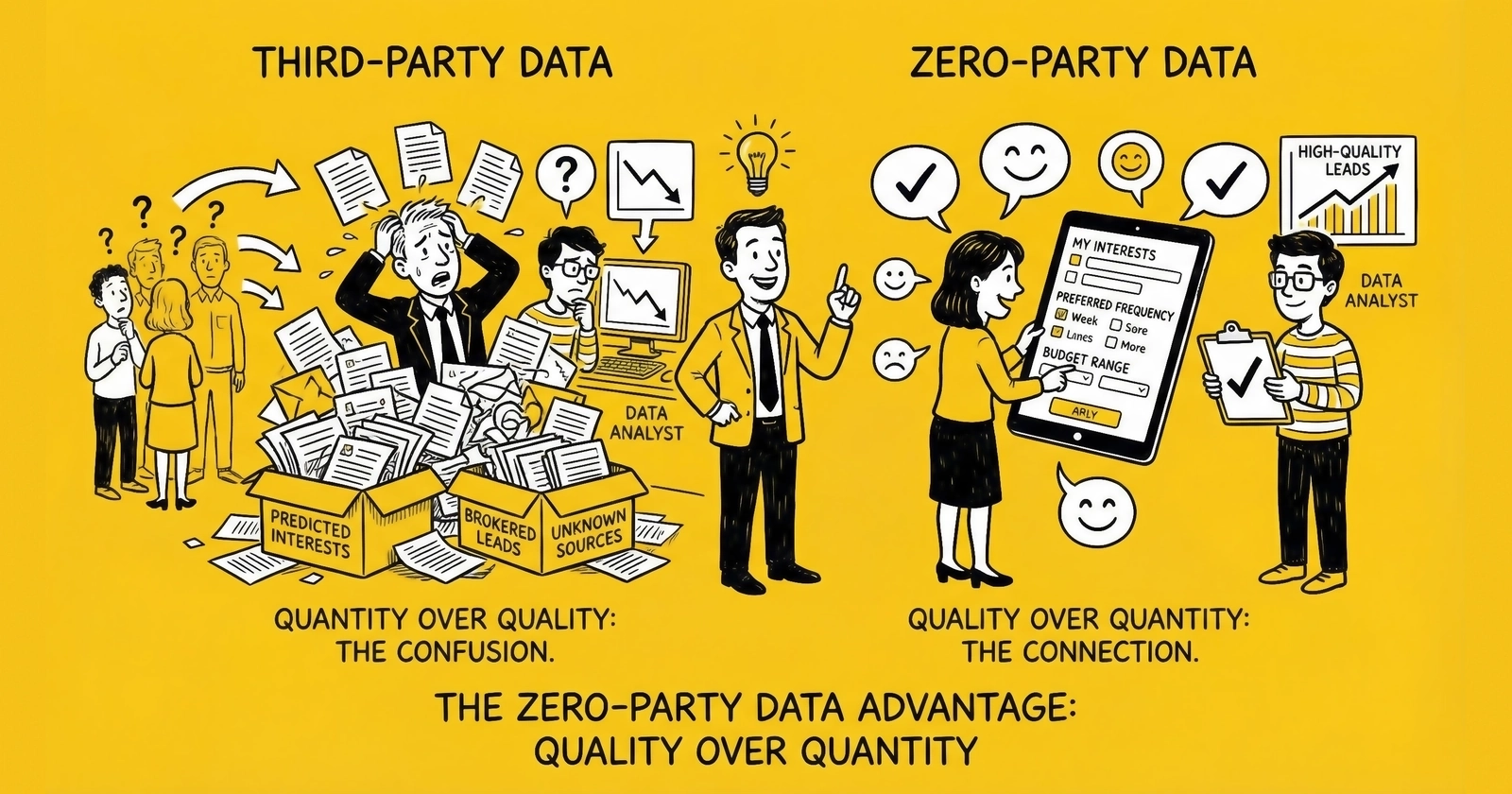
In an industry where third-party cookies are dying and privacy regulations multiply annually, the operators who thrive will be those who master what consumers willingly tell them. Zero-party data represents the highest-quality signal available in lead generation – and most practitioners are leaving it on the table.
What Is Zero-Party Data and Why Does It Matter Now?
Zero-party data is information that consumers proactively and intentionally share with your organization. Unlike behavioral data you observe or infer, zero-party data comes directly from explicit consumer disclosure. When a prospect tells you their purchase timeline, budget range, specific requirements, and the motivation behind their search, they are providing zero-party data. The concept was coined by Forrester Research in 2018, but it has become operationally critical since 2023 as privacy infrastructure has fundamentally shifted.
The shift happened faster than most practitioners anticipated. Safari and Firefox implemented aggressive tracking prevention years ago, but the real tipping point came when approximately 30% of browser traffic started blocking third-party cookies entirely. The signals that fueled lead generation for two decades – cookie-based retargeting, cross-site behavioral tracking, third-party audience segments – are degrading rapidly. Every quarter, these traditional methods become less effective, less accurate, and less predictable.
Zero-party data solves this problem by inverting the data collection model entirely. Instead of watching what consumers do and inferring intent from their digital footprints, you ask them directly. And here’s the crucial insight: they tell you because they receive value in return. This exchange creates a fundamentally different relationship with data. For lead generators, this shift creates both challenge and opportunity. The challenge is real: traditional behavioral targeting becomes less effective every quarter as privacy tools improve and regulations tighten. But the opportunity is equally real. Practitioners who build zero-party data collection into their lead generation flows capture higher-quality leads that convert better, experience fewer returns, and command premium pricing from buyers who understand the value of explicit intent.
Understanding the Distinction Between Zero-Party and First-Party Data
The terminology can be confusing because both zero-party and first-party data come directly from consumers. However, they differ fundamentally in how they’re collected and what they reveal about consumer intent. Understanding this distinction is essential for building a data strategy that actually works.
First-party data encompasses everything you collect through direct consumer interactions on your properties. This includes the behavioral signals that marketing teams have relied on for years: pages viewed, time on site, click patterns, form abandonment points, session frequency, device and browser information, geographic location from IP address, and return visit patterns. You observe this data passively. The consumer doesn’t explicitly provide it – you extract it from their behavior. First-party data is valuable because you collected it directly without intermediaries, and match rates reach approximately 90% when used for targeting. But here’s the limitation: first-party data tells you what consumers did, not necessarily what they want or why they want it. You can infer from browsing behavior, but inference carries uncertainty.
Zero-party data operates on a completely different principle. This is information consumers explicitly share in exchange for value, understanding it will be used to personalize their experience. When a consumer tells you they’re planning to refinance within 60 days because their ARM is resetting, that’s zero-party data. When you infer refinance intent from their browsing pattern on rate comparison pages, that’s first-party data. The difference is intent and explicitness. Zero-party data includes purchase timeline declarations, budget range disclosures, specific preferences and requirements, household composition, motivation for seeking information, prior experiences with competitors, and their role in the decision-making process.
The quality advantage of zero-party data stems from three interconnected factors. First, explicit intent beats inferred intent every time. A consumer who states they’re ready to purchase within 30 days has declared readiness. A consumer who exhibits purchase-like browsing behavior might be ready – or might be a curious researcher, a competitor doing market analysis, or a journalist writing an article. Second, self-qualification through disclosure matters enormously. When consumers provide detailed preference information, they’re investing effort in the interaction. This investment correlates strongly with genuine interest. A consumer who completes a 6-question quiz about their insurance needs has demonstrated more commitment than one who submits a 2-field contact form. Third, the personalization value exchange creates accountability on both sides. Consumers who provide zero-party data expect – and receive – personalized responses. They provided real information; they expect real value in return.
Research from Forrester indicates that companies excelling at zero-party data collection see 15-25% higher conversion rates compared to those relying solely on behavioral inference. In lead generation terms, this translates directly to improved sell-through rates, lower return rates, and premium pricing justification that buyers understand and accept.
Consumer Sentiment and the Zero-Party Advantage
Consumer attitudes toward data collection have shifted dramatically over the past five years, creating a strategic opportunity for operators who understand the dynamics at play. The numbers tell a compelling story that should reshape how you think about data collection strategy.
Privacy concerns have become nearly universal. Eighty-six percent of consumers express concern about data privacy, and 92% of Americans worry about their online privacy specifically. Perhaps most critically for lead generators, 75% of consumers report they will not purchase from companies they perceive as privacy violators. This is not a niche concern anymore – it’s mainstream consumer sentiment that affects every interaction you have.
But here’s where the opportunity emerges: zero-party collection changes the dynamic entirely. Fifty-eight percent of consumers report being more comfortable with brands collecting zero-party data than with passive tracking approaches. Thirty-seven percent actually prefer personalized services when the personalization is based on data they explicitly shared rather than data that was observed or inferred. Consumers increasingly expect value exchange for data disclosure – they understand the transaction and will participate willingly when the terms are fair.
These statistics explain a phenomenon that puzzles many practitioners: quiz completion rates and preference center engagement have increased even as form abandonment rates have risen. The apparent contradiction resolves when you understand the psychology. Consumers resist passive data extraction, but they accept – even appreciate – transparent data exchange when the value proposition is clear. They’re not opposed to sharing information. They’re opposed to having information taken without their knowledge or consent.
The implication for lead generation is profound. Practitioners who shift from “capture as much data as possible through tracking” to “offer clear value in exchange for declared preferences” align with consumer expectations rather than fighting against them. This alignment doesn’t just feel better – it produces better business outcomes through higher completion rates, richer data, and leads that perform better for buyers.
Strategic Advantages That Compound Over Time
Beyond lead quality, zero-party data collection creates strategic advantages that compound over time and become increasingly difficult for competitors to replicate. These advantages span compliance, technology resilience, proprietary intelligence, and market positioning.
Consider compliance first, because it matters more than ever in an environment where TCPA settlements average $6.6 million. Zero-party data collection inherently satisfies consent requirements. When a consumer voluntarily provides information in exchange for stated value, the consent is unambiguous. There’s no question about whether the consumer understood what data was being collected or how it would be used – they actively provided it through deliberate action. This creates defensible compliance documentation. If a consumer claims they didn’t consent to share their purchase timeline, you can demonstrate they typed it into a form that explicitly explained the purpose. In the current litigation environment, this compliance clarity provides substantial risk reduction.
Future-proofing against cookie deprecation represents another critical advantage. Google’s timeline for third-party cookie deprecation has shifted repeatedly – from 2022 to 2023 to 2024 to its current uncertain state. But the direction is unmistakable. Safari and Firefox have already blocked third-party cookies entirely. Approximately 40% of browser traffic now operates in a cookie-limited or cookie-free environment. Zero-party data doesn’t depend on cookie infrastructure at all. A consumer who tells you their insurance renewal is in 90 days provides a signal that survives any browser update, any privacy regulation, or any platform policy change. That signal is yours to use regardless of what happens in the broader technology landscape.
The proprietary intelligence advantage deserves particular attention because it compounds over time. Every quiz response, preference declaration, and intent signal you collect becomes proprietary intelligence that competitors cannot replicate. Over time, you develop pattern recognition that informs every aspect of your operation. You understand which preference combinations predict high-value conversions. You identify which timeline declarations correlate with actual purchase behavior versus aspirational statements. You learn which questions elicit accurate responses and which questions prompt wishful thinking. This intelligence creates compounding advantage. Your lead quality improves not just because you collect better data, but because you understand what the data means better than competitors who lack your pattern library.
Finally, zero-party data enables premium positioning with buyers. Lead buyers increasingly differentiate between leads based on data richness, and they should. A lead with name, phone, and email commands one price. A lead with those basics plus declared purchase timeline, budget range, specific requirements, and competitive context commands significantly higher prices – often 40-80% premiums. For mortgage leads, the difference might be $35 for a basic inquiry versus $65 for a lead with stated timeline, home value, current rate, and refinance motivation. Zero-party data enables premium pricing because it enables buyer confidence and better conversion outcomes.
Building Your Zero-Party Data Collection Engine
Zero-party data collection requires giving consumers compelling reasons to share. The methods that work best create genuine value exchange, where consumers feel they’re getting something worthwhile in return for the information they provide. This isn’t about tricking people into disclosure – it’s about designing experiences where sharing information is obviously beneficial.
Interactive Quizzes and Assessments
Interactive quizzes and assessments represent the highest-engagement method for zero-party data collection. Consumers willingly answer 5-15 questions when the experience is well-designed and the value proposition is clear. The psychology is straightforward: quizzes gamify data collection, making disclosure feel like participation rather than extraction. They provide immediate value through personalized results. They segment consumers naturally based on responses. And they create psychological investment in outcomes that carries forward into the sales process.
The most effective quiz structures for lead generation fall into three categories. Needs assessment quizzes help consumers understand their own requirements while generating rich data. A quiz asking “What type of life insurance is right for you?” walks consumers through coverage needs, family situation, budget constraints, and health factors. The consumer receives genuine guidance; you receive detailed qualification data. Savings or comparison calculators quantify potential benefit while collecting current situation details. A calculator asking “How much could you save on auto insurance?” collects current coverage details, driving history, vehicle information, and household composition while delivering a personalized estimate that motivates action. Readiness assessments qualify purchase intent directly. A quiz asking “Are you ready to go solar?” evaluates roof condition, ownership status, energy usage, and financial situation – generating leads that come pre-qualified on the factors that matter most to buyers.
Quiz design principles make the difference between 40% completion rates and 70% completion rates. Lead with value – the first question should demonstrate that you’re trying to help, not interrogate. Include progress indicators so consumers can see how far they’ve progressed and how many questions remain. Use conversational framing, because “Help us understand your situation” outperforms “Complete this form” every time. Build logical flow where questions build on previous answers, creating narrative coherence. And offer optional depth – allow consumers to skip questions they don’t want to answer while incentivizing completeness for those willing to share more. Well-designed quizzes achieve completion rates of 40-70%, compared to 10-30% for traditional multi-field forms. The difference comes from perceived value exchange: consumers understand why they’re answering and what they’ll receive.
Progressive Disclosure Forms
Progressive disclosure forms offer another powerful approach to zero-party data collection. Traditional lead forms present all requirements upfront, and a 12-field form looks like work before you start. Abandonment rates reflect that perception. Progressive disclosure reveals form complexity gradually, collecting basic information first and requesting additional details based on responses. You show 2-3 fields initially, then reveal additional fields based on responses. The process feels manageable even when substantial information is collected.
Consider how this works for home services leads. The first step collects the basic service need and contact information. The second step, triggered by the consumer’s service selection, reveals relevant qualification questions – for HVAC repair, you might ask if this is an emergency and what type of system they have. The third step, for non-emergency situations, offers optional depth questions with clear value messaging – when they need service and a description of the issue that helps match them with the right specialist. Progressive forms typically achieve 25-40% higher completion rates than equivalent static forms. More importantly, they collect 2-3x more data points per completed lead because consumers commit incrementally rather than facing upfront cognitive load.
Preference Centers and Interactive Experiences
Preference centers and interactive content experiences round out the collection toolkit. Preference centers allow consumers to explicitly state communication preferences, interest areas, and personal information in exchange for better-matched experiences. They work especially well for post-capture enhancement, nurture sequence personalization, and converting leads to registered users. Interactive content beyond quizzes – product configurators, comparison tools, scenario builders – creates engagement opportunities that naturally collect zero-party data while delivering genuine utility.
A solar calculator that adjusts recommendations based on roof orientation, shade patterns, and usage priorities collects detailed preference data while delivering value. Interactive content generates 2x the conversions of passive content according to Demand Gen Report research, and the engagement creates data collection opportunities that static content cannot match.
Survey Strategies That Convert Engagement Into Intelligence
Surveys remain the most direct method for collecting zero-party data, but survey design for lead generation differs fundamentally from academic research or customer satisfaction measurement. The goal isn’t comprehensive data collection – it’s collecting the specific information that improves lead quality and buyer outcomes.
Pre-Qualification Surveys
Pre-qualification surveys determine whether a consumer fits your buyer criteria before collecting contact information. Not every consumer who lands on your page is a viable lead, and pre-qualification surveys filter out consumers who won’t convert – reducing return rates and improving buyer satisfaction. Effective pre-qualification asks 2-4 questions that directly predict lead value, covering qualifying criteria like homeowner versus renter or business size, timeline indicators that reveal urgency level and decision stage, authority markers that distinguish decision makers from researchers, and financial qualification signals like budget range or credit profile. Display results that match qualification level. Qualified consumers see full lead capture; unqualified consumers receive appropriate alternatives like educational content, waitlist signup, or referral to appropriate resources.
Intent Clarification Surveys
Intent clarification surveys solve the disambiguation problem that plagues generic lead categories. “Insurance lead” could mean a consumer shopping for auto, home, life, health, commercial, or specialty coverage. Without clarification, leads route to wrong buyers, creating returns and wasted effort on all sides. Present clear options early in the flow to capture intent precisely. For complex verticals, use branching logic where “Home insurance” branches to homeowners versus renters, new purchase versus shopping existing coverage, bundling interest, and claim history. Each branch collects increasingly specific information that enables precise routing.
Value Enhancement Surveys
Value enhancement surveys collect information that increases lead value beyond baseline qualification. The specific data points that enhance value vary by vertical but follow predictable patterns. For mortgage leads, current lender and rate enable competitive offers, loan purpose distinguishes purchase from refinance from HELOC, property value and equity estimates size the opportunity, and employment stability and income range affect qualification. For auto insurance, current carrier and premium enable savings messaging, driving record and claim history predict pricing, vehicle details and daily usage affect coverage needs, and multi-policy bundling interest signals expansion opportunity. For solar leads, monthly electricity cost sizes system recommendations, roof age and condition affects installation complexity, ownership status and timeline confirms qualification, and utility provider enables accurate incentive calculations. Each data point justifies higher lead pricing because it enables better buyer outcomes. A solar lead with utility bill information is worth materially more than one without – because it enables accurate savings estimates on the first call.
Optimizing Survey Length
Survey length requires balancing data depth against completion rates, and the research provides clear guidance. One to four questions achieve 85-95% completion rates. Five to eight questions achieve 65-80% completion. Nine to twelve questions achieve 45-65% completion. Beyond thirteen questions, completion typically drops below 40% with significant abandonment. The optimization strategies that work best include separating core requirements from optional depth questions, using conditional branching to skip irrelevant questions, enabling save-and-continue for longer surveys, and providing progressive value unlock messaging that motivates completion.
Converting Data Into Measurable Value
Zero-party data only justifies collection effort if it creates measurable value in your operation. The conversion from declared preferences to lead quality improvements happens across four domains: scoring, routing, follow-up, and buyer intelligence.
Real-Time Lead Scoring Enhancement
Real-time lead scoring enhancement demonstrates the clearest advantage of zero-party data. Traditional lead scoring assigns points for page views, time on site, and engagement signals. These proxies correlate with interest but don’t capture intent specificity. A consumer who spends 10 minutes comparing rates might be ready to buy – or might be an industry analyst researching market conditions. Zero-party data eliminates this ambiguity. When consumers declare purchase timeline, budget range, and decision stage, scoring models can weight explicit intent directly. A consumer who states “ready to purchase within 30 days” with budget matching your product range scores higher than one exhibiting similar browsing behavior without declarations.
Building scoring rules that incorporate zero-party declarations follows a straightforward pattern. Timeline declaration contributes the most signal: 0-30 days adds 30 points, 31-90 days adds 20 points, 90+ days adds 10 points. Budget match adds another layer: aligned with product adds 25 points, slightly misaligned adds 10 points, fully misaligned adds nothing. Decision stage provides the final component: ready to decide adds 25 points, comparing options adds 15 points, researching adds 5 points. Combined with behavioral signals, this produces lead scores that predict conversion 20-35% more accurately than behavior-only models.
Dynamic Buyer Routing
Dynamic buyer routing transforms how leads flow through your distribution system. Generic leads route to generic pools. A home improvement lead might fit 20 different contractors, and without preference data, routing defaults to round-robin or bid-based distribution – neither optimized for conversion. When consumers declare project type, timeline, and budget, routing can match leads with buyers best positioned to convert. Emergency HVAC repair routes to contractors with same-day availability. High-budget kitchen remodels route to full-service design-build firms. Budget-conscious projects route to contractors specializing in affordable solutions.
Buyers receiving preference-matched leads experience 25-40% higher contact rates because consumers engaged with the qualification process. They see 15-30% higher conversion rates because of better fit between consumer needs and buyer capabilities. And they experience 30-50% lower return rates because qualification reduces mismatched leads. These buyer benefits justify premium pricing for zero-party-enriched leads.
Personalized Follow-Up Sequences
Personalized follow-up sequences represent another critical value creation opportunity. Standard nurture sequences treat all leads identically, creating obvious mismatches. The consumer who declared “just researching, 6+ months out” receives the same urgency messaging as the consumer who stated “ready to decide this week.” This mismatch creates opt-outs and damages brand perception. Preference-informed nurture segments sequences by declared characteristics.
Timeline segmentation routes urgent leads to immediate contact sequences while long-timeline leads receive educational drip campaigns. Concern-based segmentation delivers value-focused content to price-sensitive leads and trust-building content to those expressing quality concerns. Communication preference segmentation ensures leads preferring phone contact get call attempts while those preferring text or email receive appropriate outreach. Preference-segmented nurture sequences achieve 25-45% higher engagement rates and 15-30% higher conversion rates compared to generic sequences.
Buyer Intelligence Delivery
Buyer intelligence delivery completes the value chain. When buyers receive leads, they typically get contact information and basic qualifying data. They don’t know what motivated the consumer to inquire, what competitors they’re considering, or what concerns might create objections. Zero-party intelligence transfer changes this dynamic entirely. You deliver buyer-ready intelligence with each lead: “Consumer is refinancing because ARM resets in 90 days – urgency is rate lock before increase.” Or: “Has received quotes from 2 competitors, primary concern is coverage gaps in current policy.” Or: “Researching solar because of recent rate increase – environmental concerns secondary to cost savings.”
Buyers armed with consumer context convert at measurably higher rates. They can lead with relevant talking points, address known concerns proactively, and position against specific competitors. This intelligence justifies premium lead pricing because it directly improves buyer outcomes.
Implementation: From Concept to Operation
Moving from concept to operation requires systematic implementation across technology, process, and measurement. The good news is that most lead generation operations already have the foundational infrastructure – the challenge is configuring it properly and building the processes that make zero-party data actionable.
Technology Requirements
Technology requirements span form infrastructure, data management, and integration layers. Form infrastructure needs include multi-step form capability with conditional logic, quiz and assessment builders like Typeform, LeadQuizzes, or Outgrow (or custom development for operations at scale), progressive disclosure form frameworks, and mobile-optimized responsive design that works flawlessly on small screens. Data management requirements include CRM integration for zero-party data storage, custom fields for preference and intent data, segmentation capabilities based on declared attributes, and data hygiene and standardization processes that keep information usable. The integration layer connects everything through API connections for real-time lead enrichment, webhook triggers for preference-based routing, dynamic content insertion for personalized follow-up, and analytics integration for conversion tracking.
Process Development
Process development follows a structured approach. Form flow design starts with mapping the consumer journey from ad click to lead submission, then identifying natural points for zero-party data requests. From there, you design value propositions for each data request, build branching logic for conditional questions, and create fallback paths for consumers who decline optional questions. Buyer integration requires defining which zero-party data points increase lead value for buyers, developing data delivery specifications matching buyer system requirements, training buyers on leveraging zero-party intelligence, and establishing pricing tiers based on data richness. Quality assurance covers testing all form branches and conditional logic, verifying data capture accuracy across devices, confirming integration delivery of all data points, and validating scoring model behavior with test leads.
Measurement Framework
The measurement framework tracks collection metrics, quality metrics, and value metrics. Collection metrics include question response rates by position and type, quiz and survey completion rates, optional question opt-in percentages, and data completeness scores. Quality metrics include contact rates by data richness level, conversion rates by zero-party data availability, return rates by qualification level, and buyer satisfaction by lead data quality. Value metrics include revenue per lead by data richness tier, pricing premium achieved for enriched leads, buyer retention by lead quality experience, and lifetime value correlation with zero-party data.
Track outcomes by data richness level consistently. Apply cohort analysis techniques to measure quality over time. Compare conversion rates, return rates, and revenue for leads with full zero-party data versus those with minimal data. Calculate the incremental value per lead attributable to data richness. Compare this value against collection costs. For most lead generation operations, zero-party data collection pays for itself through reduced returns and higher buyer pricing within 60-90 days.
Avoiding the Mistakes That Undermine Collection
Zero-party data collection can backfire when implemented poorly. These mistakes undermine both data quality and consumer experience, turning what should be an advantage into a liability. Understanding what goes wrong helps you design systems that work.
Asking without giving represents the most common failure mode. Operators request extensive information without clear value exchange, and consumers recognize extraction-focused forms immediately. When 15 questions precede any value delivery, completion rates collapse and those who do complete provide lower-quality responses out of frustration. The fix is straightforward: lead with value. Show consumers what they’ll receive before or concurrent with data requests. “Answer these 5 questions and we’ll match you with the 3 best options for your situation” creates reciprocity that encourages disclosure. The consumer understands the transaction and participates willingly.
Making everything mandatory creates similar problems. Consumers who might happily share budget range when optional will abandon forms that require it. Mandatory requirements on sensitive information create friction disproportionate to the data value. The solution is to require only information essential for basic lead value and make enhancement questions optional with clear messaging: “These optional questions help us match you with the best options.” Most consumers will provide optional information when they understand the benefit, but forcing the issue drives abandonment.
Collecting without using is perhaps the most damaging mistake because it erodes consumer trust over time. If collected preferences don’t influence experience, consumers notice. When someone states they prefer email contact and receives phone calls, trust erodes. When declared timeline isn’t reflected in follow-up timing, the data collection becomes extraction theater. Before collecting any data point, define how it will be used operationally. If you can’t specify the application, don’t collect it. Better to collect less data that drives action than more data that sits unused.
Ignoring mobile experience affects over 60% of your traffic. Complex quiz interfaces with tiny buttons, horizontal scrolling requirements, or desktop-scaled layouts generate abandonment rates 2-3x higher than mobile-optimized versions. Design mobile-first. Test on actual devices, not just browser emulators. Ensure touch targets are adequate, progress is visible, and the experience works on small screens.
Overweighting data in scoring creates its own problems. Some consumers provide aspirational rather than accurate responses. Someone might state they’re ready to buy in 30 days when they’re really 6 months out. Overweighting declared intent can misroute leads to high-urgency tracks when patience would convert better. Calibrate zero-party data against actual outcomes. Track which declarations predict actual behavior. Weight scoring models based on demonstrated predictive power, not assumed importance.
Frequently Asked Questions
What is the difference between zero-party data and first-party data?
Zero-party data is information consumers explicitly and intentionally share – their preferences, intentions, and personal context provided directly. First-party data is information you observe from consumer behavior – pages viewed, click patterns, time on site. Both are valuable and privacy-compliant, but zero-party data captures explicit intent while first-party data captures inferred intent. For lead generation, zero-party data enables qualification and routing that behavioral observation cannot match because consumers directly state what they want and when they want it.
How much zero-party data can I collect before consumers abandon forms?
The threshold depends on value exchange and design quality. Well-designed quizzes with clear value propositions maintain 65-80% completion rates through 5-8 questions. Beyond 8-10 questions, completion rates typically drop below 50%. The key variable is perceived value: consumers will answer more questions when they understand how responses benefit them. Progressive disclosure and conversational design extend the threshold versus static multi-field forms.
Do quizzes really outperform traditional lead forms?
Yes, but the advantage depends on implementation. Interactive quizzes achieve 40-70% completion rates compared to 10-30% for equivalent traditional forms. More importantly, quiz-generated leads convert 15-25% higher because the engagement process pre-qualifies intent. The caveats: poorly designed quizzes can underperform simple forms, and quiz infrastructure requires more development investment than basic form builders.
How do I convince consumers to share preference data?
Create clear value exchange. Consumers share preferences when they understand how doing so benefits them: more relevant recommendations, faster service, better matches, personalized pricing. Frame data requests as service improvement rather than information extraction. “Help us match you with the right specialist” performs better than “Please complete all required fields.” Transparency about data use also matters – consumers share more when they trust how information will be used.
What zero-party data points matter most for lead quality?
The highest-value data points vary by vertical but generally include purchase timeline as an urgency indicator, budget range for qualification, decision stage for sales-readiness, specific requirements for routing precision, and competitive context for objection handling. Across verticals, timeline declaration proves most valuable for predicting conversion. A consumer who states “ready to purchase within 30 days” converts at 3-4x the rate of one stating “just researching.”
How do I integrate zero-party data with existing lead distribution systems?
Most lead distribution platforms accept custom fields. Define the zero-party data points you’ll collect, create corresponding fields in your distribution system, and map form responses to those fields. For real-time routing, build logic that evaluates zero-party data against buyer criteria. The technical integration is typically straightforward; the challenge is defining which data points matter and how they should influence routing decisions.
Can zero-party data replace behavioral tracking entirely?
No – they serve complementary functions. Zero-party data captures explicit intent at specific moments. Behavioral data captures engagement patterns across time. Together, they provide complete signal. A consumer might declare long-term research intent while exhibiting high-urgency behavioral signals – the combination suggests their stated timeline may be conservative. Effective lead scoring weights both signals, using declared intent as primary and behavioral data as confirmation or contradiction.
What privacy considerations apply to zero-party data?
Zero-party data carries lower privacy risk than observed data because consumers explicitly provide it. However, standard data protection practices still apply: secure storage, access controls, retention policies, and honoring deletion requests. Consent documentation should reflect that consumers voluntarily provided information. The primary compliance advantage of zero-party data is consent clarity – there’s no question about whether consumers understood what they were sharing because they actively chose to share it.
How do I prevent consumers from providing false zero-party data?
Some inaccuracy is inevitable, but design choices minimize it. First, align incentives: consumers who believe accurate information leads to better outcomes provide more accurate responses. Second, validate where possible: stated income can be cross-referenced against property data, claimed vehicle age against VIN lookups. See our guide on lead validation techniques for more verification methods. Third, calibrate over time: track which declarations predict actual behavior and weight scoring accordingly. False declarations that don’t predict conversion should carry less weight in routing and scoring decisions.
Key Takeaways
Zero-party data is information consumers intentionally share – preferences, intentions, and context provided explicitly in exchange for value. This differs fundamentally from first-party data (observed behavior) and third-party data (purchased from external sources). The distinction matters because explicit disclosure carries intent clarity that inferred data cannot match.
The privacy landscape makes zero-party data strategically essential. With 30-40% of browser traffic blocking third-party cookies and privacy regulations tightening annually, declared consumer preferences become the most reliable signal available. Practitioners who build this capability now will own the quality advantage as the industry continues its privacy evolution.
Interactive quizzes achieve 40-70% completion rates compared to 10-30% for traditional forms, while generating leads that convert 15-25% higher. The engagement process pre-qualifies intent in ways that static forms cannot replicate.
Every data request requires a value exchange. Consumers share preferences when they understand the benefit. “Help us match you better” outperforms “complete all required fields” because it frames the transaction honestly.
Zero-party data enables premium lead pricing. Leads with declared timeline, budget, and specific requirements command 40-80% price premiums because they enable better buyer outcomes. Buyers pay more because they get more.
Collect only data you will use. Before adding any question, define how responses will influence routing, scoring, or follow-up. Unused data collection erodes consumer trust without delivering value.
Calibrate zero-party data against outcomes continuously. Track which declarations predict actual conversion behavior. Weight scoring models based on demonstrated predictive power, not assumed importance.
Mobile-first design is non-negotiable. With 60% of traffic on mobile devices, quiz experiences must work flawlessly on small screens or abandonment rates will double.
Zero-party data complements rather than replaces behavioral tracking. Use declared intent as primary signal and behavioral data as confirmation. Together they provide signal quality neither achieves alone.
Those who build zero-party data infrastructure now will own the quality advantage as cookie deprecation continues and privacy regulations expand. This is infrastructure investment, not tactical optimization – and the returns compound over time.
This article is part of The Lead Economy series on lead generation best practices. For comprehensive coverage of lead quality, compliance, and data strategy, see the complete guide.