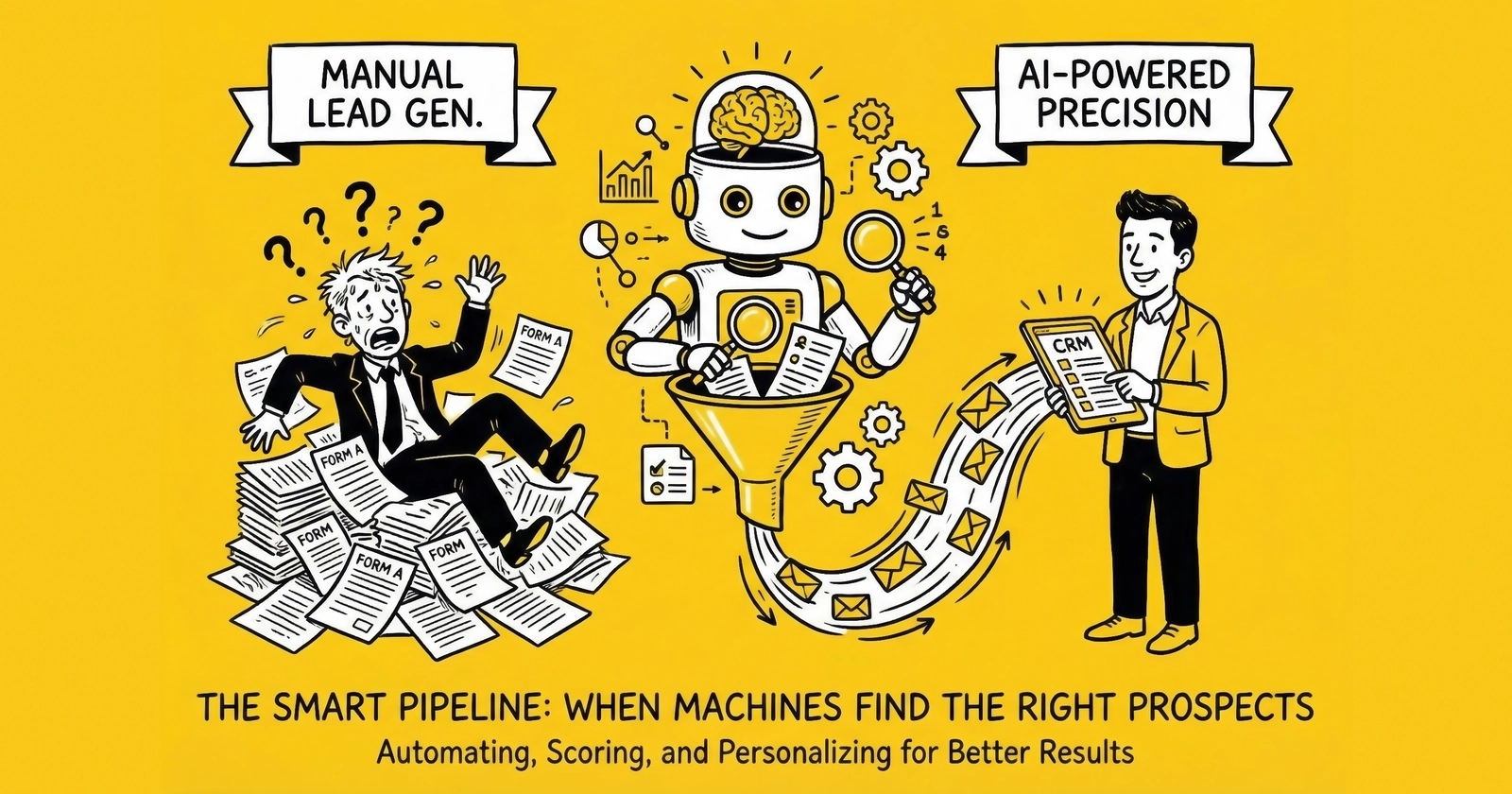
The lead generation industry is undergoing its most significant technological transformation since the shift from print advertising to digital capture. Machine learning and artificial intelligence have moved from experimental curiosity to operational necessity in less than five years. Understanding what AI actually does in lead generation – beyond the marketing hype – determines whether you capture value from this shift or get disrupted by operators who do.
Eighty-four percent of B2B companies now use AI-powered solutions for lead generation, according to 2026 industry research. Sixty-four percent of marketers now employ AI and automation tools in their strategies, with 46% of B2B leads now generated via automated workflows. This is not early adopter territory. This is baseline capability. The differentiation has moved from whether you use AI to how effectively you deploy it across lead scoring, qualification, content generation, conversation intelligence, and predictive analytics.
The numbers are compelling. Companies using AI-powered lead generation report 50% increases in output, 47% higher conversion rates, and cost reductions reaching 60%. Yet the gap between AI leaders and laggards continues widening. Practitioners who treat AI as a checkbox feature gain incremental efficiency. Those who integrate AI into their core workflows achieve compounding advantages that reshape competitive dynamics.
This guide examines how machine learning is actually transforming lead generation operations – not the theoretical possibilities, but the practical applications generating measurable results today. We cover the six primary AI applications in lead generation, the vendor landscape worth evaluating, implementation realities that determine success, and the emerging capabilities that will define the next phase of evolution.
The AI Adoption Reality in Lead Generation
Before exploring specific applications, understanding the current adoption landscape provides necessary context for strategic planning.
AI adoption in lead generation has crossed the threshold from competitive advantage to table stakes. When 84% of B2B companies report using AI for lead generation, the question shifts from “should we adopt?” to “are we implementing effectively?” High-performing sales teams show even higher adoption, with 69% using AI tools to augment their capabilities.
Gartner projects that generative AI will handle 30% of outbound marketing tasks by 2027, including SEO optimization, content creation, customer data analysis, segmentation, lead scoring, and hyper-personalization. The companies building these capabilities now will have operational infrastructure in place when the transformation accelerates.
Yet adoption statistics obscure significant variation in implementation depth. Most companies use basic chatbots or simple lead scoring rules and call it “AI-powered lead generation.” A smaller subset has integrated machine learning into core operational workflows – predictive scoring, real-time routing optimization, automated qualification, and conversation intelligence. This latter group captures disproportionate value.
The investment follows the adoption. The global lead generation software market is projected to grow from $5.11 billion in 2024 to $12.37 billion by 2033 – a compound annual growth rate of 10.32%. More conservative estimates suggest growth from $7.8 billion to $11.7 billion by 2031. Either projection indicates substantial capital flowing into AI-powered lead generation infrastructure.
AI for Lead Scoring: Predicting Conversion Before Contact
Traditional lead scoring assigned point values based on assumed importance. A California lead gets +10 points. A mobile phone number adds +5 points. Prior insurance coverage adds +15 points. These rules-based systems work when relationships between characteristics and conversion remain stable and obvious. They fail when market conditions shift or important patterns emerge from non-obvious variable combinations.
Machine learning transforms lead scoring by analyzing thousands of historical leads with known outcomes to identify patterns that predict conversion – patterns that human analysts would never detect in multidimensional data.
How Predictive Lead Scoring Works
The process begins with training data assembly. Collect historical leads with complete disposition information: contacted or not contacted, converted or did not convert, sale value, time to close. The richness of this outcome data determines model quality more than any algorithm choice.
Feature engineering transforms raw lead data into model-ready inputs. Submitted data fields, validation results, behavioral signals (time on form, pages viewed before submission, device type), source characteristics, and timing factors all become potential predictive signals.
The model training phase uses machine learning algorithms – typically gradient boosting methods like XGBoost or LightGBM for tabular data – to identify patterns across thousands of leads. The model might discover that leads submitted between 10 AM and 2 PM from mobile devices in specific ZIP codes convert at 2x average rate. Or that leads who spent more than three minutes on a pricing page before submitting convert at higher rates than those who submitted immediately. These patterns exist in the data but remain invisible to human analysis.
Scoring deployment applies the trained model to new leads in real-time, generating conversion probability scores before routing or pricing decisions occur.
The Impact of Predictive Scoring
The performance improvements from predictive lead scoring are well-documented:
Companies using AI-powered lead scoring see 25% average conversion increases. Some businesses report up to 45% conversion rate improvements. Sales cycles shorten by 28% when teams focus on leads identified as high quality. Among businesses using AI qualification, 75% report significant improvement in outcomes.
Yet only 44% of companies use lead scoring systems at all. The majority treat all leads the same – a structural inefficiency creating opportunity for operators willing to invest in predictive infrastructure.
Intent Data Enhancement
Intent data platforms add another layer of predictive signal by tracking buying behavior before form submission. Content consumption patterns, product research behavior, competitor visits, and technology installations reveal purchase intent that forms alone cannot capture.
The impact is measurable: 93% of B2B marketers using intent data report increased conversion rates. Sixty-five percent say intent signals improve pipeline forecasting accuracy. Ninety-five percent link intent data to positive sales outcomes.
Intent-enriched leads command premiums because they demonstrably perform better. For lead generators, integrating intent signals into scoring models enables premium positioning and performance-based pricing that raw demographic data cannot support.
Implementing Predictive Lead Scoring
Building effective predictive scoring requires several components working together:
Data infrastructure. You need clean, consistent outcome data connecting lead characteristics to conversion events. Many organizations discover their CRM data is too fragmented, inconsistent, or incomplete to train effective models. Data quality work often consumes more project time than model development.
Model development. While off-the-shelf scoring solutions exist, custom models trained on your specific data typically outperform generic approaches. The patterns that predict conversion vary by vertical, geography, and business model.
Deployment infrastructure. Scoring must happen at lead intake speed – typically under 100 milliseconds – to inform routing decisions. This requires API-first architecture and real-time processing capability.
Feedback loops. Models degrade as market conditions change. Continuous retraining on recent outcome data maintains prediction accuracy. Establish processes to feed conversion outcomes back to model training pipelines.
The vendors offering predictive lead scoring capabilities range from specialized point solutions (Madkudu, Infer, 6sense) to features embedded in marketing automation platforms (HubSpot, Marketo, Salesforce Einstein). Evaluate based on your data infrastructure, integration requirements, and whether you need custom model development or can work within platform constraints.
AI for Lead Qualification: Automating the First Conversation
The initial qualification conversation determines whether a lead deserves human sales attention. Traditionally, this required either expensive human labor or accepting that qualification would happen later in the sales process, wasting time on leads that should have been filtered earlier.
AI-powered qualification automates these conversations through conversational AI platforms that can conduct natural dialogue, assess lead quality, gather additional information, and route qualified leads to appropriate human resources.
Conversational AI Platforms
The conversational AI landscape has matured significantly beyond simple chatbots following decision trees. Modern platforms use large language models to conduct genuinely conversational interactions, adapting responses based on context and handling unexpected inputs gracefully.
Qualified leads the B2B web chat category, combining intent signals with conversational AI to identify high-value prospects in real-time. The platform detects when target accounts visit specific pages and triggers personalized engagement based on account intelligence.
Drift (now part of Salesloft) pioneered “conversational marketing,” using chatbots for initial engagement then routing qualified conversations to human representatives. Their playbook-based approach enables sophisticated routing logic without custom development.
Conversica focuses on automated follow-up, using AI to maintain persistent email and SMS communication that keeps leads engaged until they are ready for human conversation. Their revenue digital assistants handle routine nurture that would otherwise consume sales bandwidth.
Intercom bridges customer support and sales qualification, providing unified inbox management with AI-powered bot capabilities that can qualify inbound inquiries before routing to appropriate teams.
Voice AI for Phone Qualification
Voice AI has advanced to enable automated phone conversations that qualify leads before human contact. These systems conduct brief conversations to confirm interest, verify information, and assess buying readiness.
The economics are compelling: adding $1-3 per lead in AI pre-qualification cost generates significant quality improvement for premium positioning. Industry data shows “sales-ready” leads command 2-3x pricing versus raw leads. The qualification cost is a small fraction of the pricing premium it enables.
Implementation requires careful attention to disclosure requirements and consumer expectations. Transparency about AI involvement maintains trust. The goal is not to deceive consumers but to provide faster, more convenient initial qualification than waiting for human callback.
Chatbot Qualification Frameworks
Effective qualification chatbots follow structured conversational frameworks while maintaining natural dialogue flow:
Intent confirmation. Verify the lead’s purpose and confirm they are in the right place. “I see you’re interested in comparing auto insurance rates. Is that right?”
Qualification questions. Gather information that determines routing and priority. For insurance: current coverage status, policy renewal timing, coverage types needed. For mortgage: property type, purchase timeline, estimated credit range.
Information enrichment. Collect data points that enhance lead value and enable personalization. Each additional verified data point increases lead utility for buyers.
Routing logic. Based on qualification responses, direct leads to appropriate human resources or automated nurture sequences. High-intent leads get immediate callback scheduling. Lower-intent leads enter nurture flows.
Handoff preparation. When transitioning to human conversation, provide context that enables seamless continuation. The consumer should not repeat information already captured.
The best implementations feel like helpful conversation rather than form filling. Consumers tolerate chatbot interaction when it feels efficient and leads to faster resolution than alternative channels.
AI for Content Generation: Scaling Without Sacrificing Quality
Generative AI has transformed content production economics. What previously required hours of human writing now happens in minutes. The question is no longer whether AI can generate content but how to deploy AI content generation without commoditizing your output or losing the authentic voice that builds trust.
Landing Page Copy Optimization
AI-powered landing page optimization operates at two levels: generating copy variations and testing which variations perform.
For copy generation, tools like Jasper, Copy.ai, and Claude can produce landing page headlines, body copy, CTAs, and form labels at scale. A/B testing that previously required waiting for creative teams now happens in hours. The key is providing sufficient context about your audience, value proposition, and conversion goals to generate relevant variations rather than generic marketing speak.
For optimization, platforms like Unbounce’s Smart Traffic and VWO use machine learning to automatically route visitors to page variations most likely to convert based on visitor characteristics. Rather than waiting for A/B tests to reach statistical significance, these systems continuously optimize allocation based on real-time performance.
The combination enables rapid iteration: generate multiple page variants, deploy them simultaneously, let machine learning optimize traffic allocation, analyze results, generate new variants informed by learnings, repeat. This compressed cycle generates landing page improvements that would take months to achieve through traditional testing.
Email Sequence Automation
AI writing assistants accelerate email sequence creation while maintaining personalization at scale. The applications span the email lifecycle:
Sequence planning. AI can analyze conversion data to recommend optimal email frequency, timing, and sequence length. What cadence generates best response rates? Which message themes resonate with which segments?
Copy generation. Given context about the recipient, previous interactions, and campaign goals, AI generates personalized email copy that maintains consistent voice across thousands of messages.
Subject line optimization. Generating and testing subject line variations is particularly well-suited to AI – creating hundreds of variations for testing requires minimal context, and open rate data provides clear feedback for optimization.
Dynamic personalization. Beyond simple merge fields (first name, company), AI enables deeper personalization based on industry, role, previous engagement, and stated interests. A CFO receives different messaging than a marketing director, automatically.
Response handling. AI can classify email replies, identify the appropriate next action, and either route to human representatives or continue automated conversation as appropriate.
The Content Saturation Problem
The same technology that enables your content generation enables competitors’ content generation. When everyone can produce unlimited “thought leadership,” the concept loses meaning. AI-generated content saturation is already degrading channel effectiveness.
Strategic responses to content saturation:
Depth over breadth. Generic AI content competes poorly with genuinely expert analysis. Use AI for efficiency on commodity content; invest human expertise in differentiated material.
Authentic voice. AI produces competent content that sounds like… AI-produced content. Distinctive voice, personal perspective, and authentic experience remain difficult to replicate. Founder-led and expert-led content outperforms corporate communications.
Data advantage. AI content based on unique data (proprietary research, customer insights, operational benchmarks) generates more value than AI summarizing publicly available information. Your competitive advantage increasingly resides in data access rather than writing capability.
Multi-format expansion. Text content faces the heaviest saturation. Video, audio, interactive tools, and original research face less AI competition (for now) and can differentiate content strategy.
The reality check: AI content generation is table stakes. Avoiding it puts you at competitive disadvantage. But treating it as magic differentiation ignores that everyone has the same capability. Use AI for efficiency; differentiate through strategy, data, and authentic expertise.
AI SDR Tools: The Autonomous Prospecting Revolution
Beyond qualification and content, AI is now replacing entire SDR functions. The AI SDR market has exploded, with autonomous prospecting systems capable of handling 60-80% of traditional BDR workload.
Market Scale and Economics
The AI SDR market reached $4.12 billion in 2025 and is projected to grow to $15.01 billion by 2030 – a 29.5% compound annual growth rate. This growth reflects fundamental economics: human SDRs spend two-thirds of their time on non-selling activities, and AI can automate most of that time.
Cost comparison:
- Average human SDR fully loaded cost: $85,000-$150,000 annually
- AI SDR platform cost: $15,000-$50,000 annually for equivalent output
- Net savings: $70,000-$132,000 per SDR role automated
The human SDR challenge compounds the opportunity. Average SDR tenure is just 14 months, with 52% leaving within their first year. Constant recruiting, training, and ramp time create hidden costs that AI eliminates.
Leading AI SDR Platforms
| Platform | Key Capabilities | Best For |
|---|---|---|
| 11x.ai | Alice (outbound), Julian (inbound), Jordan (phone) | Full-stack enterprise replacement |
| Artisan Ava | 10-minute onboarding, 80% automation | Fast deployment, mid-market |
| AiSDR | 50+ pre-built SDR playbooks | Playbook-driven organizations |
| Salesforce Agentforce | Native Salesforce integration | Existing Salesforce environments |
| Persana AI Nia | 90% automation, 1B+ contact database | Data-first prospecting |
| Reply.io Jason AI | Multi-channel orchestration | Multi-channel campaigns |
Core Capabilities
Modern AI SDRs deliver functionality that approaches human performance:
24/7 autonomous prospecting across time zones without scheduling constraints. An AI SDR working European accounts at 3 AM local time does not require shift differentials or burnout management.
Personalized outreach drawing from 75+ data providers to craft relevant messaging based on company news, job changes, technology stack, and behavioral signals.
Real-time intent signal detection identifies prospects demonstrating buying behavior and prioritizes accordingly, something human SDRs rarely accomplish systematically.
Multi-channel orchestration across email, LinkedIn, SMS, and voice with coordinated sequencing and automatic channel optimization based on response patterns.
Automated objection handling maintains engagement through standard objections without human intervention, escalating complex conversations appropriately.
CRM auto-updates eliminate the data entry that consumes SDR time and degrades data quality when humans forget or shortcut the process.
Implementation Reality
AI SDRs are not plug-and-play replacements. Successful implementations require:
Clear ICP definition. AI performs better with explicit ideal customer profiles than human intuition-based targeting. Force the rigor that AI requires.
Messaging framework. AI personalizes within a framework. That framework must exist and reflect actual value propositions, not generic marketing language.
Human escalation protocols. Define when AI hands off to humans. Complex buying processes, enterprise deals, and relationship-based sales still benefit from human involvement.
Performance monitoring. AI SDRs need oversight. Response rates, meeting conversion, pipeline quality – measure what matters and adjust.
The emerging model is hybrid: AI handles 60-80% of prospecting volume while humans focus on high-value conversations, complex accounts, and relationship development. Organizations eliminating human SDRs entirely often discover the need for “go-to-market engineers” who optimize and manage AI systems.
AI for Conversation Intelligence: Understanding What Actually Happens in Sales Calls
The best salespeople do something that resists automation: they read people. They notice when a prospect’s enthusiasm fades. They sense confusion before it is articulated. They adjust their approach mid-conversation based on signals no spreadsheet captures.
Conversation intelligence platforms now capture and analyze these dynamics, providing visibility into what actually happens in sales conversations and enabling coaching at scale that was previously impossible.
Real-Time Speech Analysis
Real-time conversation intelligence analyzes multiple signal streams simultaneously as sales calls happen:
Speaking rate changes. When cognitive load increases, speech typically slows as processing capacity is consumed. Sudden decreases in a prospect’s speaking rate may indicate they are struggling to process information.
Response latency. The gap between question and answer expands under cognitive load. Systems track this latency in real-time, flagging when responses start taking longer than baseline.
Filler word frequency. “Um,” “uh,” and similar fillers increase when cognitive processing is strained. Elevated filler rates signal that the listener is working to keep up.
Vocal energy. Engagement correlates with vocal energy. Declining energy levels often precede complete disengagement.
Sentiment indicators. Beyond simple positive/negative classification, modern systems detect stress markers, genuine versus performed enthusiasm, and urgency indicators that predict actual behavior more accurately than stated words.
Platforms Leading Conversation Intelligence
Cogito (now part of Verint) pioneered real-time coaching for contact centers. Their system provides agents with discrete visual cues when customer sentiment shifts, when pace does not match the customer, when energy flags, or when empathy is needed. Results from enterprise deployments show 16% NPS increases from real-time coaching interventions.
Salesken extends these capabilities specifically for sales conversations, adding objection handling suggestions, competitive intelligence surfacing when competitors are mentioned, next-question recommendations, and closing cue detection when buying signals indicate readiness.
Gong and Chorus (now part of ZoomInfo) focus on post-call analysis and conversation intelligence at scale. They analyze recorded calls to identify patterns that distinguish successful conversations from unsuccessful ones, enabling systematic coaching based on demonstrated best practices.
Real-Time Coaching Applications
Detection without action provides no value. Conversation intelligence systems deliver real-time coaching prompts that help salespeople adjust before conversations deteriorate:
“Pause and check understanding” when load indicators spike
“Simplify – use an analogy” when technical density exceeds processing capacity
“Slow your pace” when the salesperson’s speaking rate outpaces the prospect’s processing
“Ask what questions they have” when engagement indicators decline
“Great buying signal – propose next step” when engagement indicators peak
“Match their energy” when the salesperson’s enthusiasm exceeds the prospect’s
These prompts arrive discreetly – through visual cues on screen or earpiece guidance – allowing adjustment without disrupting conversational flow.
Implications for Lead Generation
Conversation intelligence creates strategic opportunities for lead operators because the same leads, routed to buyers with AI-enhanced conversion capabilities, convert at materially higher rates.
Lead enrichment for coaching. Leads enriched with information that aids AI coaching – personality indicators, conversation context, engagement patterns – may convert at higher rates because the coaching is better calibrated. This enrichment represents potential premium positioning.
Performance feedback loops. Conversation intelligence captures detailed conversion data that lead generators have never accessed: objection frequency by source, close timing by lead characteristics, customer satisfaction by lead origin. This feedback, properly structured, enables continuous improvement in lead generation quality.
Technology partnerships. Lead generators who integrate with conversation intelligence platforms can demonstrate lead quality through conversion analytics unavailable to non-integrated operators.
AI for Prediction: Forecasting Outcomes Before They Happen
Beyond scoring individual leads, machine learning enables prediction at pipeline and portfolio levels. These capabilities transform sales management from reactive to proactive.
Win Probability Modeling
Traditional forecasting relies on CRM stage-based probability (discovery = 10%, proposal = 50%, negotiation = 75%). This approach ignores everything meaningful about the actual opportunity: conversation quality, engagement patterns, stakeholder dynamics, competitive positioning.
AI-powered win probability models analyze conversation patterns, engagement signals, and historical outcome data to predict deal outcomes more accurately than stage-based approaches. Deals where engagement signals are strong, objections are handled effectively, and buying signals accumulate receive higher probability scores than deals stuck in cycles of education without commitment.
The practical benefit: sales managers can identify at-risk deals before they formally stall and intervene while recovery remains possible.
Pipeline Health Assessment
Aggregate conversation analysis identifies pipeline segments at risk before individual opportunities are lost. When sentiment patterns across a cohort of deals shift negative, intervention can occur at the segment level.
For lead generators, pipeline health data from buyers provides quality signal that individual lead disposition cannot. If leads from a specific source tend to stall in mid-funnel rather than converting or disqualifying cleanly, that pattern reveals quality issues beyond what validation metrics capture. Applying regression analysis to lead quality data can identify the specific variables driving these conversion patterns.
Lead-to-Revenue Modeling
The most sophisticated implementations connect lead generation directly to revenue prediction. Given lead source characteristics, predicted lead quality, and buyer conversion capability, what revenue will a lead cohort generate?
This modeling enables:
Budget optimization. Allocate acquisition spend toward sources that generate revenue, not just leads.
Pricing precision. Price leads based on predicted revenue value rather than category averages.
Performance guarantees. Offer performance-based pricing backed by predictive confidence intervals.
Partner selection. Identify buyers whose conversion capability maximizes the value of your leads.
The data requirements are substantial: closed-loop attribution connecting lead source to revenue outcome, sufficient volume for statistical significance, and consistent tracking across the lead-to-revenue journey. Few organizations have this infrastructure in place. Those that do gain significant competitive advantage.
The Vendor Landscape: Evaluating AI Lead Generation Tools
The AI lead generation vendor landscape spans multiple categories, from specialized point solutions to capabilities embedded in major platforms. Strategic evaluation requires understanding where AI adds value in your specific workflow and whether you need specialized capability or platform-integrated features.
Lead Scoring and Qualification Platforms
| Platform | Primary Focus | Key Strengths | Considerations |
|---|---|---|---|
| 6sense | Account identification and intent | Best-in-class intent data, account-based focus | Enterprise pricing, B2B focus |
| Madkudu | Predictive lead scoring | Strong Salesforce integration, model transparency | Smaller company, B2B focus |
| Clearbit | Data enrichment | Real-time enrichment, broad data coverage | Acquired by HubSpot, integration focus |
| ZoomInfo | Contact and company data | Comprehensive database, intent signals | Premium pricing, data freshness varies |
Conversational AI Platforms
| Platform | Primary Focus | Key Strengths | Considerations |
|---|---|---|---|
| Qualified | B2B web chat | Intent-based engagement, ABM integration | Premium positioning, enterprise focus |
| Drift/Salesloft | Conversational marketing | Playbook flexibility, ecosystem | Part of larger platform, complexity |
| Conversica | Email/SMS follow-up | Persistent nurture, revenue focus | Narrow use case, integration needs |
| Intercom | Support and sales chat | Unified platform, product-led focus | Broader than lead gen, SMB origins |
Conversation Intelligence
| Platform | Primary Focus | Key Strengths | Considerations |
|---|---|---|---|
| Gong | Revenue intelligence | Strong analytics, coaching tools | Premium pricing, call recording focus |
| Chorus/ZoomInfo | Conversation analytics | ZoomInfo integration, data access | Part of larger platform |
| Cogito/Verint | Real-time coaching | Live intervention, enterprise scale | Contact center origins |
| Salesken | Sales coaching | Real-time prompts, sales focus | Newer entrant, feature depth varies |
Content Generation Tools
| Tool | Primary Focus | Key Strengths | Considerations |
|---|---|---|---|
| Jasper | Marketing copy | Brand voice training, templates | Quality varies, requires oversight |
| Copy.ai | Short-form copy | Quick generation, simple interface | Limited customization, generic risk |
| Claude/ChatGPT | General purpose | Flexibility, depth of reasoning | Requires prompt engineering, no marketing focus |
| Writer | Enterprise content | Brand governance, compliance | Enterprise focus, higher complexity |
Platform Selection Principles
Start with workflow, not features. Which specific workflow steps would benefit from AI augmentation? Map your process before evaluating vendors.
Integration matters more than features. A tool with fewer features that integrates cleanly with your existing stack often outperforms a feature-rich solution requiring manual workarounds.
Evaluate on your data. Demo performance using vendor sample data rarely predicts performance on your actual leads. Request pilots using your data before committing.
Consider build versus buy. For organizations with data science capability, custom models on your specific data often outperform vendor solutions built on generic training sets.
Plan for evolution. The AI landscape evolves rapidly. Avoid deep lock-in to specific vendors. Prefer solutions with data portability and standard integrations.
Implementation Realities: What Determines Success
The gap between AI promise and operational reality often comes down to implementation quality. Organizations achieving significant results share common characteristics that organizations achieving minimal results lack.
Data Quality Requirements
Every AI application depends on data quality. Predictive scoring requires accurate outcome data. Conversation intelligence requires clear audio and consistent recording. Content generation requires training context. Without quality input data, no algorithm produces quality output.
Common data quality gaps that undermine AI effectiveness:
Inconsistent field values. “Interested,” “Interest,” “int,” and blank all mean the same thing to humans but confuse models.
Missing outcome data. If you cannot track which leads converted, you cannot train scoring models.
Data silos. Marketing automation, CRM, and lead distribution systems contain partial views that must be unified for effective analysis.
Stale information. Models trained on data from 18 months ago may not predict current market behavior accurately.
Before investing in AI applications, audit your data infrastructure. Organizations often find that 60-70% of their AI budget should go toward data quality improvement rather than model development.
Process Integration Requirements
AI that operates in isolation from existing workflows generates minimal value. Effective implementation requires deep process integration:
Workflow redesign. AI capabilities often require rethinking existing processes rather than automating current steps. If your lead routing takes 30 minutes, AI scoring that happens in real-time but feeds into manual processes still produces 30-minute routing.
Human-AI handoff. Define clear criteria for when AI handles tasks independently versus when human oversight is required. Unclear handoff points create friction and missed opportunities.
Feedback mechanisms. AI systems improve through feedback. Without systematic processes to capture what worked and what failed, models cannot learn and improve.
Training and adoption. Sales teams receiving AI coaching prompts must be trained on interpretation and action. Technology deployed without user adoption generates no value.
Organizational Requirements
AI implementation is as much organizational change as technology deployment:
Executive sponsorship. AI initiatives without leadership support face resistance and resource constraints that undermine success.
Clear ownership. Who is accountable for AI performance? Shared ownership often means no ownership.
Patience with learning curves. AI systems improve over time as they accumulate data and feedback. Expecting immediate perfection leads to premature abandonment of initiatives that would have succeeded with patience.
Willingness to experiment. AI applications often require iteration to find effective configurations. Organizations uncomfortable with experimentation struggle to realize AI value.
Cost-Benefit Reality Check
AI generates value by improving outcomes, reducing costs, or both. Before implementation, model expected benefits against realistic costs:
Implementation costs. Software licensing, integration development, data preparation, training, and ongoing maintenance. These costs are often underestimated.
Opportunity costs. Time and attention devoted to AI implementation is not available for other initiatives. Is AI the highest-value use of implementation capacity?
Expected benefits. What specific metrics will improve, by how much? Base expectations on similar implementations, not vendor marketing claims.
Measurement capability. Can you actually measure the expected benefits? If you cannot attribute improvements to AI implementation, you cannot validate the investment.
Conservative benefit estimates with comprehensive cost accounting provide more useful guidance than optimistic projections that ignore implementation realities.
Emerging Capabilities: What Comes Next
The AI capabilities described above represent current state of practice. Several emerging capabilities will reshape lead generation over the next three to five years.
Agentic Commerce Integration
AI agents are beginning to act as autonomous buyers, conducting research and making purchasing decisions on behalf of humans. McKinsey projects agentic commerce could reach $3-5 trillion globally by 2030, with the U.S. B2C market alone representing up to $1 trillion.
For lead generation, this means the “lead” may increasingly arrive not as a form submission from a human but as an API query from an AI agent acting on a human’s behalf. This shift toward machine-to-machine lead transactions fundamentally changes capture mechanisms. The agent does not read your persuasive copy. It evaluates your structured data, API responses, and machine-readable reputation signals.
Preparation requires:
API-first architecture. Expose lead and pricing data through documented APIs that AI agents can query programmatically.
Structured data markup. Schema.org markup across all content enables machine interpretation of your offerings.
Algorithmic trust signals. Reputation data, verification credentials, and consistency of information become selection criteria for AI agent decision-making.
Generative Engine Optimization
As discovery shifts from search engines to AI assistants, a new discipline emerges: Generative Engine Optimization (GEO) – optimizing content for AI citation rather than search ranking.
When consumers ask AI assistants for recommendations, the AI cites sources in its training data and retrieval corpus. Getting cited requires different optimization than getting ranked:
Content structure for extraction. Clear headers, summary sections, and organized information that AI can parse and cite.
Citable facts. Specific statistics, dated information, and verifiable claims are more likely to be cited than general statements.
Authority signals. AI systems weight perceived authority heavily. Brand mentions across authoritative sites, industry citations, and verified credentials improve citation probability.
GEO does not replace SEO. It adds a parallel optimization requirement. Content needs to rank in traditional search and be cited by AI systems and be queryable by AI agents.
Real-Time Personalization at Scale
Generative AI enables personalization beyond simple merge fields. Research-driven outreach that references specific prospect challenges, recent company news, and industry context becomes possible at scale.
The irony: as AI-generated personalization becomes universal, its effectiveness may decline. When every prospect receives AI-researched, AI-personalized outreach, the differentiating factor disappears.
This creates strategic opportunity: authentically human interaction becomes more valuable precisely because it becomes scarcer. Organizations that deploy AI for efficiency while preserving genuine human engagement for high-value interactions will outperform those that automate everything.
Privacy-Preserving AI
As privacy regulation tightens and consumers resist surveillance-based targeting, AI applications must operate within stricter data constraints. Emerging capabilities include:
Federated learning. Training models on distributed data without centralizing sensitive information.
Differential privacy. Adding mathematical guarantees that individual records cannot be identified from model outputs.
Data clean rooms. Enabling collaborative analysis between parties without exposing raw data.
These capabilities enable AI-powered personalization while respecting privacy requirements – solving the paradox of consumers who want personalized experiences without feeling surveilled.
Frequently Asked Questions
What percentage of companies use AI for lead generation?
Eighty-four percent of B2B companies now use AI-powered solutions for lead generation, according to 2026 industry research. Among high-performing sales teams, 69% report using AI tools to augment their capabilities. AI adoption has crossed from competitive advantage to baseline capability for serious operators.
What ROI can I expect from AI lead scoring?
Companies using AI-powered lead scoring typically see 25% average conversion increases, with some reporting up to 45% improvement. Sales cycles shorten by 28% when teams focus on high-quality leads identified by predictive models. The specific ROI depends on your current scoring sophistication, data quality, and sales process effectiveness.
Which AI lead generation tools are best for small businesses?
Small businesses should prioritize integrated solutions over specialized point products. HubSpot’s AI features, Pipedrive’s AI capabilities, and Freshsales’s Freddy AI provide lead scoring and automation within CRM platforms already designed for smaller organizations. Avoid enterprise-focused tools that require significant implementation investment.
How does AI lead qualification work?
AI lead qualification uses conversational AI – chatbots and voice AI – to conduct initial conversations that assess lead quality, gather additional information, and determine appropriate routing. Modern systems use large language models for natural dialogue that adapts based on responses, moving beyond rigid decision trees to genuine conversation.
Can AI replace human salespeople for lead follow-up?
AI augments rather than replaces human sales capability. AI handles initial qualification, routine follow-up, and data gathering, allowing humans to focus on high-value consultative conversations. Gartner projects AI will handle 30% of marketing tasks by 2027, but complex sales still require human judgment, relationship building, and creative problem-solving.
What data do I need for AI lead scoring to work?
Effective AI lead scoring requires historical leads with known outcomes: which leads converted, which did not, and ideally the sale value and time to close. You need sufficient volume for statistical significance (typically hundreds to thousands of leads with outcomes) and consistent data quality across the training period.
How accurate are AI predictions for lead conversion?
Accuracy varies based on data quality, model sophistication, and market stability. Well-implemented predictive scoring models typically achieve 20-40% improvement over rules-based approaches in separating high-conversion from low-conversion leads. No model achieves perfect prediction – the goal is relative improvement over current methods.
How does conversation intelligence differ from call recording?
Call recording captures audio. Conversation intelligence analyzes that audio to extract insights: sentiment patterns, talk ratios, objection handling, coaching opportunities, and outcome predictions. The value comes from automated analysis at scale, not just having recordings available for manual review.
What are the privacy implications of AI in lead generation?
AI applications must operate within privacy regulations (GDPR, CCPA, state privacy laws) and respect consumer expectations. Key considerations include transparency about AI involvement, consent for data processing, data minimization, and avoiding discriminatory outcomes. Emerging privacy-preserving AI techniques enable personalization while respecting regulatory requirements.
How long does it take to implement AI lead scoring?
Implementation timelines vary from weeks (for platform-integrated features using existing data) to months (for custom models requiring data infrastructure development). The primary driver is data readiness. Organizations with clean, complete outcome data implement faster than those requiring significant data preparation.
Key Takeaways
AI adoption is table stakes, not differentiation. With 84% of B2B companies using AI for lead generation, the competitive advantage has shifted from whether you adopt to how effectively you implement. Treating AI as a checkbox feature yields minimal benefit; deep workflow integration creates compounding advantages.
Predictive lead scoring outperforms rules-based approaches. Machine learning models identify patterns in multidimensional data that human analysts cannot detect. Companies using AI-powered scoring see 25%+ conversion increases and 28% shorter sales cycles. The gap between AI-powered and traditional operations continues widening.
Conversation intelligence scales coaching that was previously impossible. Real-time analysis of speech patterns, sentiment, and engagement enables coaching prompts during conversations – not just post-call review. Enterprise deployments show 16% NPS improvements from real-time intervention.
Content generation is democratized; differentiation requires strategy. AI content generation is available to everyone, creating saturation that degrades channel effectiveness. Competitive advantage resides in unique data, authentic voice, and strategic deployment rather than raw content volume.
Data quality determines AI effectiveness. Every AI application depends on quality input data. Organizations achieving significant results invest heavily in data infrastructure – often 60-70% of AI budget goes toward data quality improvement rather than model development.
Agentic commerce requires new infrastructure. AI agents acting as autonomous buyers will increasingly bypass traditional lead capture mechanisms. Preparation requires API-first architecture, structured data markup, and algorithmic trust signals that machines can evaluate.
The human premium is emerging. As AI handles more interactions, authentic human connection becomes more valuable. Organizations that deploy AI for efficiency while preserving human engagement for high-value interactions will outperform those that automate everything.
Sources
-
IBM: Machine Learning - Technical reference defining machine learning concepts, algorithm types, and enterprise AI implementation patterns underlying predictive lead scoring and conversation intelligence systems.
-
scikit-learn: Ensemble Methods - Technical documentation for the ensemble machine learning methods (Random Forest, Gradient Boosting) commonly used in lead scoring model development.
-
XGBoost Documentation - Technical reference for XGBoost, the gradient boosting framework widely used in production lead scoring implementations due to its accuracy and computational efficiency.
-
Model Context Protocol - Anthropic’s open standard for AI integration, relevant for understanding how agentic AI systems connect to enterprise data sources for lead generation automation.
-
Google Developers: Structured Data - Technical documentation for structured data implementation, supporting the API-first architecture required for AI-powered lead generation systems.
The transformation of lead generation through AI and machine learning is accelerating. The operators building these capabilities now – predictive scoring, conversation intelligence, content optimization, and agentic commerce readiness – will capture disproportionate value as the industry evolves. Those waiting to see how it unfolds will find themselves competing against operators whose AI advantages compound over time. The window for building competitive AI infrastructure is measured in years, not decades. Your move.