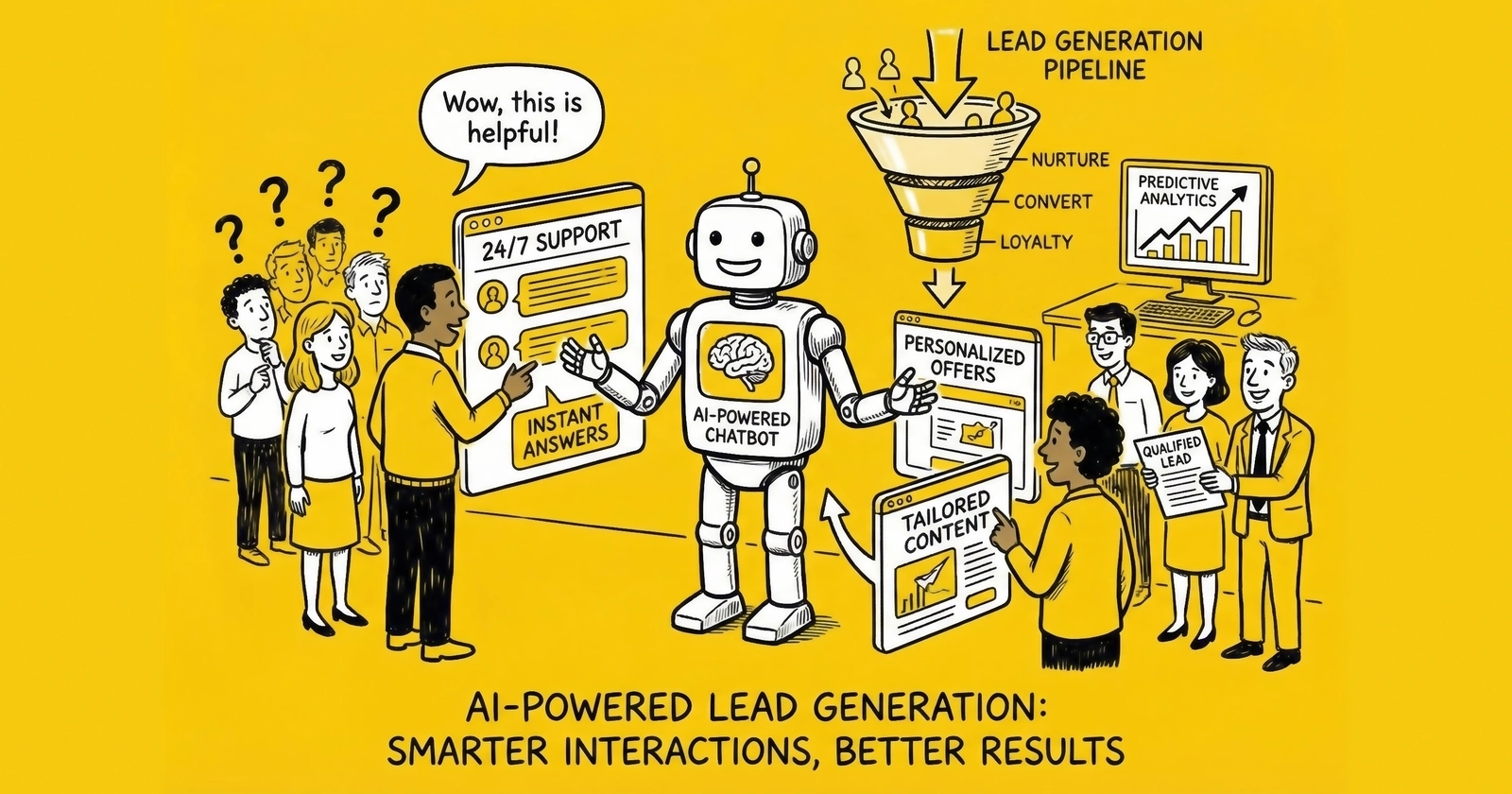
How AI chatbots, predictive engagement, and the next best experience framework transform lead generation – from 3x conversion rates to $80B in cost savings.
The conversational AI market grew from $13.6 billion in 2024 to a projected $151.6 billion by 2033 – a 29.16% CAGR that reflects businesses recognizing AI’s significant potential for customer interactions. For lead generation operators, this isn’t abstract technology forecasting. It’s operational reality: businesses using AI chatbots achieve 3x better conversion into sales than those relying on website forms. As 88% of users now interact with chatbots and 62% prefer them over waiting for human agents, AI-powered customer interactions have moved from competitive advantage to operational necessity.
Traditional customer interaction models are reactive: customers contact businesses, businesses respond. AI-powered interaction inverts this model through predictive engagement – anticipating customer needs before they’re expressed.
The “Next Best Experience” Paradigm
McKinsey’s “next best experience” framework represents the most sophisticated application of AI to customer interaction. Rather than asking “What should we tell customers?”, it asks “What does this customer need most in this moment?”
The approach combines:
- Propensity models: Predicting customer behaviors (upgrade likelihood, churn risk, response probability)
- Channel models: Determining optimal communication channel (email, SMS, in-app, voice)
- Value models: Calculating lifetime value and near-term revenue opportunity
- Decision orchestration: Blending statistical outputs with operational logic
The results from early adopters are substantial:
- 15-20% improvement in customer satisfaction
- 5-8% increase in revenue
- 20-30% reduction in cost to serve
For lead generation, this means moving beyond “did we capture this lead?” to “what does this lead need to become a customer?”
From Broadcast to Conversation
Traditional lead generation broadcasts messages: email blasts, display ads, mass SMS campaigns. AI-powered interaction creates conversation:
Broadcast Model:
- Send offer to all leads
- Wait for response
- Follow up with non-responders
- Repeat
Conversational Model:
- Analyze individual lead behavior and context
- Determine optimal engagement moment
- Personalize message content and channel
- Adapt based on response (or non-response)
- Continue conversation toward conversion
This shift from broadcast to conversation changes the fundamental economics of lead engagement.
Chatbots and Conversational AI for Lead Generation
Chatbots represent the most visible application of AI to customer interaction, and their impact on lead generation is substantial.
Performance Metrics
Current chatbot performance data:
| Metric | Value | Source |
|---|---|---|
| Conversion rate vs. forms | 3x higher | Industry research |
| Maximum industry conversion rates | 70% | Vertical-specific data |
| Sales increase from chatbots | 67% | Business leader reports |
| Sales initiated by bot interaction | 26% | Transaction analysis |
| First-time buyer conversions | 64% | Rep AI data |
The 3x conversion improvement over forms deserves emphasis: a landing page converting at 3% with forms might convert at 9% with properly implemented conversational AI.
Why Chatbots Outperform Forms
Several factors drive chatbot’s superior conversion:
Engagement timing. Forms require visitors to commit to an interaction. Chatbots engage visitors at moments of interest – when they’re browsing specific content, showing exit intent, or returning to the site.
Progressive disclosure. Forms present all fields simultaneously, creating friction. Chatbots gather information conversationally, reducing perceived effort.
Immediate qualification. Forms collect data for later qualification. Chatbots qualify in real-time, routing high-intent leads immediately while nurturing lower-intent visitors. For deeper exploration of conversational lead qualification with ChatGPT, see our implementation guide.
24/7 availability. Forms don’t answer questions. Chatbots respond to visitor inquiries instantly, regardless of business hours – critical given that 62% of customers prefer chatbots over waiting for human agents.
Personalization. Forms are static. Chatbots adapt questions based on responses, showing visitors only relevant options.
B2B Lead Generation Advantage
Interestingly, B2B companies use chatbots more than B2C: 58% versus 42%. This counterintuitive finding reflects B2B’s complex buying processes – longer sales cycles, multiple stakeholders, higher information requirements – where conversational interaction provides more value than simple form capture.
B2B chatbot applications include:
- Initial lead qualification (budget, authority, need, timeline)
- Product configuration and pricing guidance
- Meeting scheduling with sales teams
- Document and resource delivery
- Technical question answering
- Account-based engagement personalization
Implementation Considerations
Effective lead generation chatbots require:
Clear objectives. Is the goal lead capture, qualification, appointment setting, or information delivery? Different objectives require different conversation flows.
Integration with CRM. Chatbot conversations must flow into existing lead management systems. Isolated chatbot data creates operational fragmentation.
Human escalation paths. When should the bot hand off to humans? Clear escalation triggers (complex questions, high-value signals, frustration indicators) prevent chatbot failures.
Continuous optimization. Chatbot conversations generate data for improvement. Regular analysis of conversation flows, abandonment points, and conversion patterns enables optimization.
Compliance integration. In lead generation, chatbots must capture consent, document interactions, and maintain TCPA-compliant records. Conversational AI needs the same compliance rigor as form capture.
Predictive Lead Scoring and Engagement
Beyond conversational interfaces, AI transforms how operators identify, prioritize, and engage leads.
AI-Powered Lead Scoring
Traditional lead scoring assigns points based on demographic and behavioral attributes: job title (+10), company size (+15), downloaded whitepaper (+5). AI-powered scoring learns which combinations actually predict conversion.
Traditional scoring limitations:
- Weights based on assumptions, not outcomes
- Static rules that don’t adapt
- Equal treatment of correlated factors
- Limited ability to capture interaction effects
AI scoring advantages:
- Weights learned from conversion data
- Continuous model updates as patterns change
- Automatic feature interaction detection
- Probability outputs (not just point totals)
Platforms with predictive analytics and automated lead scoring report up to 451% more leads from automation. This isn’t from generating more leads – it’s from more effectively identifying and engaging leads that actually convert. For implementation details, see our guide on AI lead scoring with machine learning prioritization.
Predictive Engagement Timing
When you contact a lead matters as much as how. AI models can predict optimal engagement windows:
Factors influencing engagement timing:
- Historical response patterns (when does this lead typically engage?)
- Channel preferences (email in morning, SMS in evening?)
- Competitive context (is the lead actively shopping?)
- Life events (recent triggers suggesting purchase readiness?)
- Capacity alignment (when do our sales resources have bandwidth?)
A global payments processor using predictive timing reduced merchant attrition by 20% by identifying at-risk accounts and intervening before the merchant recognized the issue themselves.
Churn Prevention and Retention
For lead buyers purchasing ongoing lead streams, AI-powered interaction extends to customer retention:
Predictive churn indicators:
- Declining lead volume purchases
- Reduced login frequency
- Support ticket patterns
- Billing dispute history
- Competitive research behavior
AI models combining these signals can identify at-risk relationships before visible churn behavior emerges, enabling proactive intervention. A major airline using this approach achieved 210% improvement in targeting at-risk customers and 59% reduction in churn intention among high-value customers.
Personalization at Scale
Personalization represents AI’s greatest promise – and greatest challenge – for customer interaction.
The Personalization Gap
BCG research reveals a disconnect: personalization was the most common experimental GenAI use case in 2023, but CMOs have since learned it’s “among the harder use cases to deploy quickly at scale.”
The challenge: GenAI can generate personalized content, but it takes predictive AI to determine what action to take with each customer, what content is appropriate, in what sequence, and through which channel.
Personalization requires:
- Real-time customer data access
- Predictive models for next-best-action
- Content generation capabilities
- Channel orchestration
- Continuous testing and learning infrastructure
Organizations achieving personalization at scale have typically completed multi-year change journeys, achieving quick wins initially, then investing in AI, technology, and operating model changes.
Lead Generation Personalization Opportunities
For lead generation operators, personalization manifests across the funnel:
Capture stage:
- Form fields adapted to traffic source
- Conversation flows tailored to browsing behavior
- Content recommendations based on inferred interest
- Channel selection based on user preference signals
Qualification stage:
- Questions sequenced based on responses
- Pricing/offer presentation personalized to signals
- Sales routing based on lead characteristics
- Follow-up timing optimized per lead
Nurturing stage:
- Email content personalized to engagement history
- Content recommendations based on consumption patterns
- Re-engagement triggers based on predictive models
- Offer timing aligned to buying cycle signals
Conversion stage:
- Sales talk tracks informed by lead intelligence
- Competitive positioning based on lead research behavior
- Closing offers personalized to decision criteria
- Terms structured to individual requirements
The Personalization Index
BCG’s Personalization Index identifies that only 15% of companies qualify as personalization leaders. These leaders share common characteristics:
- Multi-year investment in personalization capabilities
- Cross-functional agile teams running constant experiments
- Machine learning models fed with continuous data streams
- Operating models designed for personalization, not campaigns
- Executive commitment to personalization as growth driver
For lead generation operators, the implication is clear: personalization capability represents significant competitive advantage, but achieving it requires sustained investment beyond chatbot implementation.
AI for Lead Response Time Optimization
Lead response time directly impacts conversion. AI transforms response time from operational challenge to strategic advantage.
The Response Time Imperative
Research consistently shows response time’s impact:
- Leads contacted within 5 minutes are 21x more likely to qualify
- Response rates decline 400% after the first hour
- 78% of customers buy from the company that responds first
Our detailed analysis of speed to lead response workflow optimization explores these dynamics and implementation strategies.
Yet most companies fail to respond quickly: average B2B response time exceeds 42 hours, with 23% of companies never responding at all.
AI-Powered Instant Response
AI enables instant engagement regardless of human agent availability:
Chatbot instant engagement: Conversational AI engages leads immediately upon capture, beginning qualification and relationship building while human agents are unavailable.
Automated SMS/email response: Triggered messages acknowledge lead submission and provide immediate value (confirmation, relevant resources, next steps).
Intelligent routing: AI scores incoming leads and routes high-value leads to available agents immediately while queueing lower-priority leads appropriately.
Agent augmentation: When human agents do engage, AI provides context: lead history, recommended talking points, predicted objections, suggested offers.
Lead Response Time Economics
Consider the economics of AI-enhanced response time:
Without AI:
- Lead captured at 3 AM
- Sales team engages at 9 AM (6-hour delay)
- Competitor has already responded
- Conversion probability: significantly reduced
With AI:
- Lead captured at 3 AM
- Chatbot engages immediately, qualifies lead
- SMS confirmation sent with relevant offer
- Sales team has qualified, warm lead at 9 AM
- Conversion probability: maintained
Gartner forecasts that conversational AI will reduce contact center agent labor costs by $80 billion by 2026. For lead generation, this cost reduction enables faster, more consistent response without proportional labor increases.
Generative AI for Customer Communication
Generative AI transforms content creation for customer communication, enabling personalization at previously impossible scale.
Current GenAI Applications
BCG research shows CMOs deploying GenAI primarily for:
- Content creation (50%+ adoption)
- Draft copy and images for social media
- Ad copywriting
- Social listening and sentiment analysis
A large direct-to-consumer pharmaceutical company achieved 60% efficiency improvement in content creation and doubled social media advertising ROI by reinvesting freed resources into personalized content creation.
GenAI for Lead Communication
Lead generation applications include:
Email personalization: GenAI creates message variations personalized to lead characteristics, behavior, and engagement history. What previously required writers creating dozens of templates now enables true 1:1 personalization.
Landing page optimization: Dynamic content generation adapts landing page messaging to traffic source, visitor behavior, and conversion stage.
Nurture sequence creation: GenAI generates nurture content streams tailored to different lead segments, buying stages, and interest areas.
Sales enablement: Personalized sales collateral generated for specific accounts, incorporating account-specific research and messaging.
GenAI Limitations and Guardrails
CMOs have learned GenAI’s limitations: over 70% are concerned about impact on creativity and brand voice. GenAI content can be bland or unimaginative – adequate for efficiency but insufficient for differentiation.
Effective GenAI deployment requires:
- Human review of generated content
- Brand voice training and guardrails
- Copyright and compliance verification
- Quality control processes
- Continuous feedback loops for improvement
Organizations embedding GenAI successfully maintain human oversight while using automation for scale. The goal isn’t replacing human creativity but amplifying it.
ROI of AI-Powered Customer Interactions
AI investment delivers measurable returns, but outcomes vary significantly based on implementation quality.
Average AI ROI
The average ROI on AI investment is $3.50 return for every $1 invested. However, this average masks significant variance:
| Performance Tier | AI ROI |
|---|---|
| Average performers | 3.5x |
| Strong performers | 5-6x |
| Top performers | Up to 8x |
Top performers achieve dramatically higher returns by integrating AI across operations rather than deploying isolated point solutions.
Lead Generation-Specific ROI Drivers
For lead generation, AI ROI materializes through:
Conversion improvement: 3x conversion rates from chatbots vs. forms translates directly to lead volume or reduced traffic acquisition costs.
Qualification efficiency: Automated qualification reduces sales time on unqualified leads. Sales focus on conversations likely to convert.
Response time value: Faster response preserves more lead value. The first 5 minutes represent the highest-probability conversion window.
Personalization premium: Personalized engagement converts at higher rates than generic communication. Each percentage point of conversion improvement flows to margin.
Labor efficiency: AI handling routine interactions frees human agents for complex, high-value conversations.
Scale enablement: AI removes linear relationship between lead volume and labor requirements. Growth doesn’t require proportional headcount increases.
Implementation Cost Considerations
AI ROI calculations must include:
Direct costs:
- Platform licensing/usage fees
- Integration development
- Training data preparation
- Ongoing optimization resources
Indirect costs:
- Change management and training
- Process redesign
- Data infrastructure upgrades
- Compliance and governance
Time to value:
- Initial implementation: 3-6 months typical
- Optimization period: 6-12 months
- Full value realization: 12-24 months
Over half of successful AI implementations invest more in change management and training than technology itself. The lesson: technology alone doesn’t deliver ROI – organizational integration does.
Implementation Roadmap for Lead Generation Operators
Practical implementation follows predictable patterns:
Phase 1: Foundation (Months 1-3)
Data integration:
- Consolidate lead data into unified repository
- Establish data quality controls
- Implement tracking for AI model inputs
Initial use case selection:
- Identify highest-impact, lowest-complexity opportunity
- Typically: chatbot for initial lead engagement
- Define success metrics clearly
Technology selection:
- Evaluate conversational AI platforms
- Assess integration requirements
- Plan compliance infrastructure
Phase 2: Pilot (Months 4-6)
Limited deployment:
- Deploy chatbot on subset of traffic
- Establish A/B testing framework
- Monitor performance against baseline
Iteration:
- Analyze conversation flows
- Identify abandonment points
- Refine scripts and logic
Integration:
- Connect chatbot to CRM
- Establish human escalation workflows
- Document compliance processes
Phase 3: Scale (Months 7-12)
Expanded deployment:
- Roll out to full traffic
- Add additional channels (SMS, email automation)
- Implement predictive lead scoring
Advanced capabilities:
- Personalization based on behavior data
- Predictive timing optimization
- GenAI content generation
Organizational integration:
- Train sales teams on AI-qualified leads
- Establish feedback loops for model improvement
- Integrate AI insights into reporting
Phase 4: Optimization (Ongoing)
Continuous improvement:
- Regular model retraining
- Conversation flow optimization
- A/B testing of new approaches
Capability expansion:
- Additional AI applications (churn prediction, retention)
- Deeper personalization
- Agentic AI for autonomous optimization
Common Implementation Mistakes
Avoid frequent errors in AI customer interaction deployment:
1. Technology-First Implementation
Starting with technology selection rather than use case definition produces solutions seeking problems. Begin with specific operational challenges (slow response time, poor qualification, low conversion) and select technology to address them.
2. Ignoring Change Management
As McKinsey’s internal GenAI deployment demonstrated, over 50% of successful implementation effort focuses on change management, enablement, and training – not technology. AI that sales teams don’t trust or use delivers no value.
3. Insufficient Data Foundation
AI models require data. Organizations with fragmented, inconsistent, or incomplete lead data cannot train effective models. Data foundation work must precede AI deployment.
4. Expecting Immediate Results
AI implementation follows a J-curve: initial investment period precedes returns. Organizations expecting immediate ROI often abandon implementation before value materializes.
5. Neglecting Compliance
AI-powered customer interactions must maintain TCPA compliance, consent documentation, and regulatory adherence. Building compliance into AI systems from inception prevents costly remediation.
The Future: Agentic AI for Lead Generation
Emerging agentic AI capabilities point toward autonomous customer interaction systems. For background on how agentic AI is transforming enterprise operations, see our detailed analysis.
Current state: AI recommends actions; humans execute Near-term future: AI executes routine actions; humans oversee Longer-term future: AI autonomously optimizes interactions within defined guardrails
Agentic AI systems will:
- Autonomously refine message content based on response patterns
- Predict optimal engagement timing without human scheduling
- Test communication variations without manual A/B testing
- Adjust offers based on real-time competitive intelligence
- Coordinate multi-channel engagement sequences autonomously
For lead generation operators, agentic AI promises further automation of engagement while maintaining human oversight for strategic decisions, compliance verification, and exception handling.
Conclusion
AI-powered customer interactions have moved from experimental to essential. The 3x conversion improvement from chatbots, the $3.50+ ROI on AI investment, and the competitive reality that 58% of B2B companies already use conversational AI establish clear stakes: operators without AI-powered interaction capabilities face growing competitive disadvantage.
The path forward requires systematic implementation: foundation building, pilot deployment, scaled rollout, and continuous optimization. Technology matters, but organizational integration matters more. The companies achieving 8x AI returns aren’t necessarily using different technology – they’re integrating AI more deeply into operations and maintaining commitment through the inevitable implementation challenges.
For lead generation specifically, AI transforms every stage: capture through conversational engagement, qualification through predictive scoring, nurturing through personalized communication, and conversion through optimized timing and messaging. The operators who master AI-powered interaction will capture disproportionate share of an industry projected to reach $21 billion by 2033.
Key Takeaways
-
AI chatbots convert leads at 3x the rate of traditional website forms, with some industries achieving 70% conversion rates through conversational engagement.
-
The “next best experience” approach uses AI to determine optimal customer interactions, increasing revenue by 5-8% while reducing service costs by 20-30%.
-
58% of B2B companies use chatbots (higher than B2C at 42%), primarily for their effectiveness in lead qualification and initial engagement.
-
Conversational AI will reduce contact center labor costs by $80 billion by 2026, fundamentally changing lead follow-up economics and enabling 24/7 engagement.
-
The average ROI on AI investment is $3.50 for every $1 invested, with top performers achieving 8x returns – making AI adoption a financial necessity, not just an operational upgrade.
-
88% of users have interacted with chatbots and 62% prefer them over waiting for human agents, reflecting fundamental shifts in customer expectations.
-
Predictive engagement inverts the traditional customer interaction model – anticipating needs before they’re expressed rather than reacting to inbound requests.
-
The hybrid human-AI model outperforms pure automation: AI handles qualification and routing while human agents focus on high-value conversion conversations.
-
Real-time lead routing powered by AI can achieve sub-5-minute response times, critical given that lead contact rates decline by 10x after the first 5 minutes.
-
CMO AI adoption reached an inflection point in 2024-2025, with 70% of marketing leaders planning significant AI investments in customer interaction systems.
The Evolution from Reactive to Predictive Customer Interaction
Frequently Asked Questions
How do AI chatbots maintain TCPA compliance for lead generation?
AI chatbots must capture and document consent with the same rigor as traditional forms. This includes: presenting consent language before collecting contact information, recording timestamp and consent version, integrating with TrustedForm or similar certification services, maintaining conversation transcripts as consent documentation, and implementing clear opt-out mechanisms. The conversational format requires careful design to ensure consent capture occurs at appropriate moments without disrupting user experience.
What’s the typical implementation timeline for lead generation chatbots?
Initial deployment typically requires 3-6 months: 1-2 months for platform selection and integration planning, 1-2 months for conversation flow development and testing, and 1-2 months for pilot deployment and optimization. Full value realization – with refined conversations, integrated CRM workflows, and optimized performance – typically requires 12-18 months of continuous improvement.
How do we measure chatbot ROI for lead generation?
Primary metrics include: conversion rate (chatbot vs. form), lead qualification accuracy (chatbot-qualified leads vs. sales-qualified outcomes), response time improvement, cost per qualified lead, and sales team efficiency (time saved on qualification). Secondary metrics include user satisfaction, escalation rates, and conversation completion rates. Calculate ROI as (incremental revenue from improved conversion + cost savings from automation - chatbot costs) / chatbot costs.
Should we build or buy AI customer interaction capabilities?
For most lead generation operators, buying established platforms makes more sense than building custom solutions. The conversational AI market is mature, with platforms offering lead generation-specific features, CRM integrations, and compliance capabilities. Building makes sense only when: existing platforms don’t support unique requirements, competitive differentiation depends on proprietary AI capabilities, or scale justifies custom development investment. Most operators achieve better ROI faster through platform adoption with customization.
How do we prevent chatbots from providing incorrect information?
Implement multiple safeguards: define conversation scope clearly (what the bot can and cannot discuss), use knowledge bases with verified information, implement confidence thresholds (escalating uncertain responses to humans), establish regular review of conversation transcripts, create feedback mechanisms for error identification, and maintain human oversight for complex or high-stakes interactions. The goal isn’t perfection but systematic error reduction with appropriate escalation for edge cases.
What’s the difference between rule-based and AI-powered chatbots for lead generation?
Rule-based chatbots follow predefined decision trees – if user says X, respond with Y. They’re predictable, compliant, and easy to audit but can’t handle unexpected queries. AI-powered chatbots (using NLP/NLU) understand intent and generate contextual responses, handling a wider range of conversations but requiring more oversight for compliance. For lead generation, hybrid approaches often work best: AI handles initial engagement and qualification, while rule-based logic ensures required questions are asked and consent language is presented correctly. The choice depends on conversation complexity and compliance requirements.