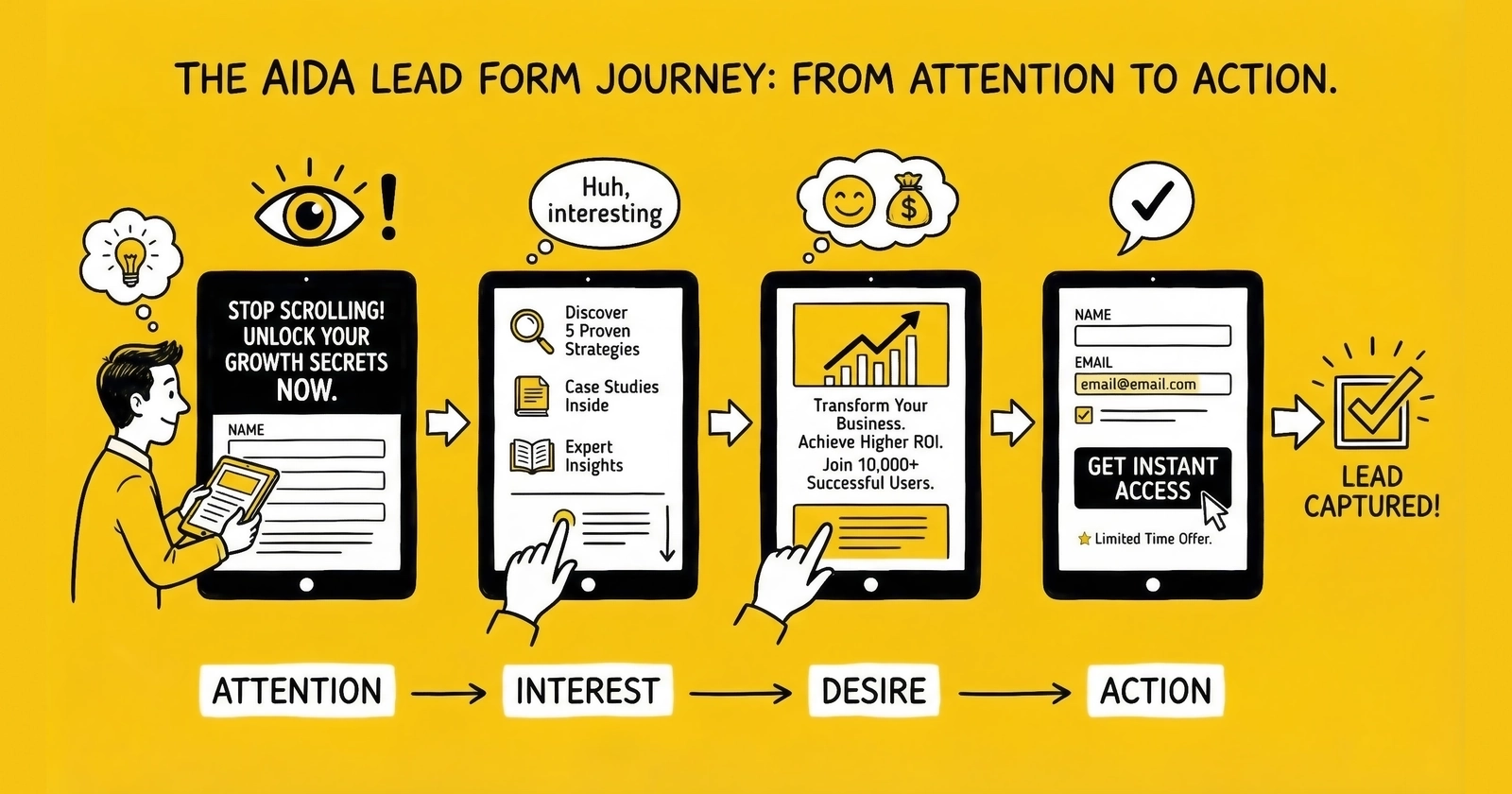
Apply the AIDA framework (Attention, Interest, Desire, Action) to lead generation forms, landing pages, and conversion optimization for higher form completion rates.
In 1898, advertising executive Elias St. Elmo Lewis articulated a framework for persuasion that would outlive every marketing channel invented since. Newspapers, radio, television, direct mail, websites, social media, mobile apps – all have risen since Lewis wrote his framework, and all still rely on the same psychological progression he identified: Attention, Interest, Desire, Action.
AIDA isn’t a tactical playbook that expires with algorithm changes. It’s a description of how humans decide. Before someone fills out a lead form, they must first notice it exists. Before they consider submitting their information, they must believe the offering might be relevant. Before they take the action of submitting, they must want what you’re offering more than they fear giving up their data.
That progression – notice, consider, want, act – is universal. It applies whether you’re selling insurance leads in 2026 or newspaper subscriptions in 1898. The tactics change; the psychology doesn’t.
For lead generation operators, understanding AIDA means understanding why some landing pages convert at 20% while others struggle to reach 2%. The difference rarely lies in the form itself. It lies in how well the entire page experience moves prospects through the psychological stages that precede form completion.
The AIDA Framework Explained
AIDA breaks the customer journey into four sequential stages:
- Attention: The prospect becomes aware of your message. In a world of infinite content competing for limited attention, this stage requires pattern interruption – something that stops the scroll, breaks the scan, or stands out from everything else the prospect has seen today.
- Interest: The prospect decides to invest time in understanding what you’re offering. Attention is fleeting; interest requires sustaining engagement long enough to communicate value. This stage is about relevance – showing prospects that what you’re offering applies to their specific situation.
- Desire: The prospect shifts from intellectual interest to emotional want. They don’t just understand your offering; they want it. This stage is about transformation – showing prospects the specific outcomes they’ll achieve, the problems they’ll solve, the future state they’ll inhabit.
- Action: The prospect takes the step you’re asking for. In lead generation, this means completing a form. This stage is about friction removal – eliminating every obstacle between wanting and doing.
Each stage depends on the previous stage completing successfully. You can’t generate interest in someone who hasn’t noticed you. You can’t create desire in someone who isn’t interested. You can’t get action from someone who doesn’t want what you’re offering.
The framework appears simple, but execution is difficult because each stage requires different psychological appeals. What captures attention (disruption) is different from what maintains interest (relevance) is different from what creates desire (transformation) is different from what drives action (ease).
Stage 1: Capturing Attention on Lead Forms
The attention economy has never been more competitive. Siege Media’s 2025 analysis found that over 58% of Google searches now end without any click – users either get their answer from the search results page or give up before selecting a result. In this environment, capturing attention requires immediate value delivery.
The Headline Problem
Lead form pages typically appear after some initial engagement – a click from a search result, an ad, or an email. The prospect has already taken one action. But attention isn’t binary; it exists on a spectrum. A prospect who clicked an ad might give your page 2-3 seconds before deciding whether to continue or bounce.
Your headline must accomplish three things in those seconds:
- Confirm relevance. The prospect clicked expecting something specific. Your headline must immediately signal that they’re in the right place. Message match between ad and landing page is essential – if your ad promised “solar installation quotes in 24 hours,” your headline should reinforce that promise, not introduce a different concept.
- Communicate value. What will the prospect get by continuing? Not what you offer – what they get. “Request a Quote” describes your process; “Compare Solar Options from 3+ Installers” describes their benefit.
- Create curiosity or urgency. Give them a reason to continue reading rather than bouncing. Questions, unexpected claims, or time constraints can all create the cognitive hook that earns continued attention.
Attention-Grabbing Headline Patterns
Effective lead form headlines often follow recognizable patterns:
- Quantified benefit: “Save $2,400 Per Year on Energy Bills” immediately communicates specific value.
- Problem acknowledgment: “Tired of Waiting Weeks for Insurance Quotes?” shows you understand their frustration.
- Unexpected comparison: “Why 72% of Homeowners Overpay for Solar Installation” creates curiosity about whether they’re in that majority.
- Time specificity: “Get 3 Quotes in Under 24 Hours” promises speed that differentiates from slower alternatives.
- Audience targeting: “For Texas Homeowners Looking to Reduce Energy Costs” immediately signals relevance to qualified prospects.
The worst headlines are generic descriptors: “Contact Us,” “Get Started,” “Request Information.” These describe your process but communicate zero value and create zero urgency.
Visual Attention on Form Pages
Headlines aren’t the only attention element. Visual design determines where eyes land:
- Contrast and whitespace draw attention to key elements. Your headline and form should have clear visual priority, not compete with navigation, sidebars, or decorative elements.
- Hero images can capture attention but must reinforce rather than distract from the message. A smiling stock photo communicates nothing; an image of the actual product or outcome being offered reinforces desire.
- Above-the-fold visibility matters for forms. If prospects must scroll to reach the form, many won’t. Place forms where they’re immediately visible on typical screen sizes.
Stage 2: Maintaining Interest Through Relevance
Capturing attention gets prospects to your page. Maintaining interest keeps them there long enough to consider submitting. This stage is about demonstrating that your offering applies to their specific situation – not just anyone, but them specifically.
The Personalization Imperative
Generic content kills interest. “We help businesses grow” could apply to any company and therefore appeals to no one specifically. Effective Interest-stage copy shows prospects you understand their particular circumstances.
- Industry specificity: “Mortgage brokers spend an average of 12 hours per week on manual lead management” speaks directly to a defined audience and demonstrates understanding of their reality.
- Problem validation: Describing the problem in detail before introducing your solution shows prospects you understand what they’re dealing with. The more accurately you describe their situation – informed by thorough buyer persona development – the more credible your solution becomes.
- Objection preemption: If you know prospects commonly hesitate for specific reasons (price, complexity, time commitment), addressing those concerns proactively shows you understand their decision-making process.
Content Elements That Sustain Interest
After the headline, what keeps prospects reading?
- Subheadlines and supporting copy should expand on the headline promise with additional detail. If your headline promises “3 Quotes in 24 Hours,” your subheadline might explain how: “Submit your requirements once, receive competitive offers from verified installers.”
- Benefit bullets quickly communicate multiple value points for scanning readers. Focus on outcomes, not features: “Reduce quote-to-bind time by 60%” rather than “Integrated CRM functionality.”
- Social proof indicators (client logos, review scores, customer counts) build credibility without requiring extensive reading. “Join 2,500+ insurance agencies” signals popularity that encourages continued consideration.
- Interactive elements can deepen engagement. Quote calculators, assessment tools, or configurators give prospects a reason to invest time rather than just passively consume information.
Interest vs. Bounce: The Decision Point
Within 10-15 seconds, prospects make a stay-or-leave decision. The Interest stage is about winning that decision through demonstrated relevance.
Common Interest-stage failures:
- Too much information. Overwhelming prospects with details they don’t need yet causes bounce. Save comprehensive specifications for after they’ve expressed interest by submitting the form.
- Self-focused copy. “We are the leading provider of…” puts your company at the center. Prospect-focused copy puts their outcomes at the center.
- Unclear next steps. If prospects can’t immediately understand what you’re asking them to do and what they’ll receive in return, confusion causes abandonment.
Stage 3: Building Desire Through Transformation
Interest means prospects understand what you’re offering and see potential relevance. Desire means they want it. The difference is emotional commitment – shifting from “this could help” to “I must have this.”
The Interest-Desire Gap
According to CrazyEgg’s analysis of the AIDA framework, the distinction between Interest and Desire is one of the most commonly misunderstood aspects of the model. Both stages involve positive engagement, but they differ in psychological intensity:
- Interest stage psychology: “This pitch seems interesting enough to stay and hear them out. This product COULD be a possible solution to my problems.”
- Desire stage psychology: “This could actually help me improve my life. The way they describe its benefits makes me think I MUST buy it to solve my problems!”
The transition from “could” to “must” requires demonstrating specific transformation – not theoretical benefits, but concrete outcomes that prospects can envision experiencing.
Transformation Demonstration Tactics
- Before-and-after visualization. Help prospects imagine their life after using your product or service. “Before: spending 12 hours per week chasing leads. After: leads automatically routed to available agents within 60 seconds.”
- Quantified outcomes. Abstract benefits like “save time” become compelling when quantified: “Reduce lead response time from 3 hours to 5 minutes.” Specificity signals credibility – tracking the right KPIs gives you these concrete numbers to cite.
- Case studies and testimonials. PowerReviews research found that 95% of shoppers read online reviews before buying. On lead form pages, testimonials from similar customers – ideally with specific outcomes – build trust that enables desire. “After switching to [product], our conversion rate increased 40% within 90 days” is more compelling than generic praise.
- Risk reversal. Guarantees, free trials, and “no obligation” language reduce the perceived risk of taking action, which allows desire to overcome hesitation.
Social Proof Architecture
Social proof on lead form pages should be strategically positioned to reinforce desire:
- Quantity signals. “12,000+ customers” indicates popularity and implies that many others found the offering valuable.
- Authority signals. Client logos from recognized brands suggest capability and trustworthiness.
- Similarity signals. Testimonials from customers similar to the prospect (“As a small insurance agency owner…”) demonstrate relevance to their specific situation.
- Specificity signals. Testimonials with specific outcomes (“increased lead conversion 40%”) are more credible than vague endorsements (“great product!”).
The most effective lead form pages layer multiple social proof types, creating cumulative credibility that supports the desire-to-action transition.
Stage 4: Driving Action Through Friction Removal
Prospects who reach the Action stage want to submit. They’ve been captured (Attention), engaged (Interest), and convinced (Desire). Your job now is not to persuade further – it’s to remove every obstacle between wanting and doing.
The Form Itself
Form design is where many lead generation operations fail despite doing everything else correctly. Common friction points:
- Too many fields. Every additional field reduces completion rates. Ask only for information you genuinely need at this stage. If you need detailed qualification data, collect it in follow-up communications, not the initial form.
- Unclear labels. “Preferred Contact Method” is clearer than “Communication Preference.” Use language prospects use, not internal terminology.
- Hidden requirements. Surprising prospects with validation errors after they’ve attempted to submit creates frustration. If fields are required, mark them clearly. If formats are expected (phone number structure, email validation), indicate upfront.
- Mobile unfriendliness. Forms designed for desktop often fail on mobile – small tap targets, awkward keyboards, excessive scrolling. Test forms on actual mobile devices, not just responsive design simulators.
- Privacy ambiguity. Prospects hesitate to share information if they’re uncertain how it will be used. Brief, clear privacy statements (“We’ll never share your information without permission”) reduce submission anxiety.
CTA Design
The submit button is the final conversion point. HubSpot research found that emails with a single call-to-action increased clicks by 371% compared to multiple options. The same principle applies to form pages – one clear action, prominently displayed.
- Button copy matters. “Submit” is generic and vaguely threatening. “Get My Free Quote,” “Start My Trial,” or “Send Me the Guide” are specific and benefit-oriented.
- Visual prominence is essential. The submit button should be the most visually prominent element in its vicinity – contrasting color, adequate size, clear positioning.
- Placement affects completion. The submit button should be visible without scrolling on the form. If the form is long, consider fixed-position submit buttons or multi-step forms that maintain button visibility.
Urgency and Scarcity (When Appropriate)
Urgency and scarcity can accelerate action, but they must be genuine. Fake countdown timers or manufactured scarcity damage trust when prospects see through them.
Legitimate urgency examples:
- “Prices increase January 1” (if true)
- “Only 3 spots remaining in this cohort” (if limited capacity is real)
- “This rate is locked for 24 hours” (if time-limited pricing is actual policy)
Illegitimate urgency to avoid:
- Countdown timers that reset on page refresh
- “Limited availability” claims that are always present
- Pressure tactics that feel manipulative
The best urgency comes from communicating the cost of delay: “Every day without [solution] costs the average [customer type] $X in [outcome].” This creates urgency based on the prospect’s own losses, not artificial deadlines.
Applying AIDA Across Lead Generation Assets
While form pages are the conversion point, AIDA applies to every asset in the lead generation funnel.
Landing Pages
The full AIDA sequence plays out on landing pages:
- Above the fold: Attention elements (headline, hero image, value proposition)
- First scroll: Interest elements (problem validation, benefit bullets, initial social proof)
- Middle sections: Desire elements (case studies, testimonials, transformation demonstration)
- Near form: Action elements (CTA, form, friction-reducing assurances)
Long-form landing pages can take prospects through all four stages. Short-form pages may compress stages, relying on preceding assets (ads, emails) to have completed earlier stages before the prospect arrives.
Ad Copy
Ads must accomplish Attention in 1-2 seconds. Headlines carry almost all the weight:
- Search ads: Match user intent directly. Someone searching “compare solar installers” should see ad copy that promises comparison, not generic solar benefits.
- Social ads: Pattern interruption is essential in scroll-heavy feeds. Questions, contrarian claims, or striking images stop the scroll.
- Display ads: Visual impact matters more than copy length. Simple, bold creative with clear value propositions outperforms cluttered designs.
Email Sequences
Email nurture sequences can move prospects through AIDA stages across multiple messages:
- Email 1 (Attention): Subject line must earn the open. Body confirms relevance and sets expectations for the sequence.
- Emails 2-3 (Interest): Provide value through educational content that demonstrates understanding of the prospect’s situation.
- Emails 4-5 (Desire): Share case studies, testimonials, and specific outcome examples that create want.
- Email 6+ (Action): Make specific offers with clear CTAs. Urgency and scarcity elements may be appropriate if genuine.
The timeline varies by sales cycle. Complex B2B purchases may require weeks of nurture; simple consumer forms may need only one or two emails.
Form Page Copy
The copy surrounding forms should complete whatever AIDA stages haven’t been completed by preceding assets:
- Form headline: Typically Action-oriented, confirming what the prospect is about to receive
- Supporting copy: Brief Desire reinforcement (what they’ll get, why it matters)
- Form labels: Clear, friction-reducing language
- Submit button: Action-oriented, benefit-focused
- Post-form confirmation: Immediate Action validation and next-step expectation setting
Common AIDA Mistakes in Lead Generation
Mistake 1: Skipping Stages
Jumping directly to Action (“Fill out this form!”) without establishing Interest or Desire results in low conversion rates. Prospects who haven’t been moved through the psychological progression aren’t ready to take action.
The fix: Audit landing pages for complete AIDA coverage. If Interest or Desire stages are weak or missing, strengthen them before testing form changes.
Mistake 2: Feature-First Copywriting
“Our platform offers real-time lead routing, CRM integration, and automated follow-up” describes features. Prospects care about outcomes: “Never miss another lead – automated routing ensures instant response even when your team is busy.”
The fix: Translate every feature into the outcome it enables for the customer. Features are what you built; outcomes are why prospects should care.
Mistake 3: Overwhelming Instead of Guiding
Providing too much information kills conversions. Prospects don’t need comprehensive product documentation before filling out a form – they need enough information to want a conversation.
The fix: Apply the “minimum effective information” principle. Provide just enough to move prospects to the next stage, saving details for after they’ve expressed interest.
Mistake 4: Generic Social Proof
“Our customers love us!” communicates nothing. Specific, relevant testimonials from similar customers with quantified outcomes build real credibility.
The fix: Collect outcome-focused testimonials from customers similar to your target audience. Include names, companies (when permitted), and specific results achieved.
Mistake 5: Friction at the Action Stage
After doing everything right through Attention, Interest, and Desire, many lead generation operations lose prospects to form friction – too many fields, confusing labels, mobile-unfriendly design.
The fix: Audit forms for friction. Remove unnecessary fields, simplify labels, test on mobile devices, and monitor abandonment data to identify specific friction points.
AIDA Limitations and Complements
The AIDA framework has endured for 126 years because it captures fundamental psychology. But it has limitations that lead generation operators should understand:
Limitation 1: Linear Assumption
AIDA assumes prospects move sequentially through stages. In reality, some prospects arrive already in the Desire stage (referrals, repeat visitors). Others jump backward when new objections arise.
Complement: Design pages that allow stage-skipping. Most Aware prospects (per the Schwartz framework) should be able to jump directly to forms without wading through Interest-building content they don’t need.
Limitation 2: First-Purchase Focus
AIDA ends at Action – it doesn’t address what happens after conversion. In lead generation, the form submission is often just the beginning of a longer sales process.
Complement: Extend AIDA thinking to post-form experience. Confirmation pages, follow-up sequences, and sales handoffs should continue the psychological progression toward the final conversion (purchase, signup, appointment). A comprehensive customer experience strategy addresses this entire journey.
Limitation 3: Single-Channel Design
AIDA was developed for single-touchpoint advertising. Modern lead generation involves multiple channels and touchpoints.
Complement: Map AIDA stages to multi-touch journeys. A prospect might experience Attention on social, Interest through blog content, Desire in an email sequence, and Action on a dedicated landing page. Each touchpoint should advance the overall progression.
Key Takeaways
-
AIDA (Attention, Interest, Desire, Action) was developed by advertising pioneer Elias St. Elmo Lewis in 1898 and remains the most widely used copywriting framework because it mirrors the natural psychology of decision-making.
-
The framework solves lead form abandonment by structuring the entire page experience – from headline to submit button – around moving prospects through a logical emotional progression that ends in form completion.
-
Over 58% of Google searches now end without a click (Siege Media, 2025), meaning your headline or opening line must deliver immediate value to stop the scroll and earn attention in an increasingly distracted digital environment.
-
Single-CTA focus increases clicks by 371% according to HubSpot research – eliminating competing options and distractions on form pages dramatically improves conversion rates.
-
95% of shoppers read online reviews before buying (PowerReviews, 2023), making social proof in the Desire stage non-negotiable for lead forms that require trust before submission.
-
The Interest stage isn’t about you – it’s about them. Personalization and problem acknowledgment keep prospects engaged long enough to reach the form; generic benefit lists cause immediate bounce.
-
Desire differs from Interest in psychological commitment level: Interest says “this could help me”; Desire says “I must have this.” The transition requires demonstrating specific outcomes, not just features.
-
Form friction kills conversions at the Action stage. Every unnecessary field, every confusing label, every hidden requirement loses prospects who were ready to submit.
-
AIDA applies to landing pages, email sequences, ad copy, and form design – but the execution differs for each format while the underlying psychological progression remains constant.
-
The framework has limitations: it assumes linear progression (real buyers jump stages), ignores post-conversion experience, and doesn’t address retention. Use AIDA as foundation, not complete strategy.
Frequently Asked Questions
What is the AIDA copywriting framework?
AIDA stands for Attention, Interest, Desire, and Action – a sequential framework for persuasive communication developed by Elias St. Elmo Lewis in 1898. The model describes how customers move from initial awareness through purchase decision: first they notice your message (Attention), then they engage with it (Interest), then they want what you’re offering (Desire), then they take action (Action). Despite being 126 years old, AIDA remains the most widely used copywriting framework because it mirrors natural human decision-making psychology.
How does AIDA apply to lead generation forms?
AIDA applies to the entire landing page experience that surrounds a form. The headline captures Attention, supporting copy and benefits maintain Interest, testimonials and outcome demonstrations build Desire, and the form itself enables Action. Each stage must complete successfully before the next can work – prospects won’t fill out forms (Action) if they haven’t first been convinced they want what you’re offering (Desire).
What’s the difference between Interest and Desire in AIDA?
Interest means prospects see potential relevance: “This could help me.” Desire means emotional commitment: “I must have this.” Interest is intellectual consideration; Desire is want. The transition requires demonstrating specific transformation and outcomes, not just describing features. Prospects with Interest are still evaluating; prospects with Desire are ready to act if friction is low enough.
How long should landing page copy be?
Length depends on awareness level and offer complexity. Most Aware prospects (already convinced) need short pages focused on action. Unaware or Problem Aware prospects need longer pages that complete multiple AIDA stages. Complex offers (high-price, long commitment) typically require more copy than simple offers. Test different lengths, but ensure every length still includes all necessary AIDA elements.
How many form fields is too many?
Every unnecessary field reduces completion rates. Ask only for information you genuinely need at the initial conversion point. If you need detailed qualification data, collect it in follow-up communications rather than the initial form. The optimal number depends on offer value – free content might justify only email address; high-value consultations might warrant more fields. A/B test field counts to find your specific optimum.
Should I use urgency on lead forms?
Genuine urgency can accelerate action – limited availability, time-sensitive pricing, capacity constraints. But fake urgency damages trust. If your countdown timer resets on page refresh, prospects will notice. Use urgency based on real constraints or communicate the cost of delay rather than manufacturing artificial deadlines.
How do testimonials fit into AIDA?
Testimonials primarily serve the Desire stage – they demonstrate that others achieved the outcomes prospects want, building credibility that transforms interest into want. The most effective testimonials come from customers similar to the target audience and include specific, quantified outcomes rather than generic praise.
Can AIDA apply to email marketing?
Yes. Email sequences can move prospects through AIDA stages across multiple messages: subject lines and first emails capture Attention, educational content builds Interest, case studies and social proof create Desire, and conversion-focused emails with clear CTAs drive Action. The timeline varies by sales cycle complexity.
What’s the relationship between AIDA and awareness stages?
AIDA describes the psychological progression within a conversion; awareness stages (Schwartz’s Unaware through Most Aware) describe the prospect’s knowledge state before encountering your content. The frameworks complement each other: awareness level determines which AIDA stages your content must accomplish. Most Aware prospects need minimal Attention and Interest work; Unaware prospects need extensive work before Desire is even possible.
What are alternatives to AIDA?
Several frameworks address similar goals. PAS (Problem, Agitation, Solution) works well for problem-focused messaging. ACCA (Attention, Comprehension, Conviction, Action) emphasizes understanding before action. REAN (Reach, Engage, Activate, Nurture) incorporates post-conversion retention. Each has advantages for specific contexts, but AIDA remains the most broadly applicable starting point.
How do I know which AIDA stage is failing?
Analytics reveal stage failures. High bounce rates suggest Attention problems – headlines aren’t compelling. High time-on-page but low scroll depth suggests Interest problems – content isn’t engaging enough to continue. High scroll depth but low form starts suggests Desire problems – not enough conviction to begin submission. High form starts but low completions suggests Action problems – form friction is killing conversions. Diagnose based on where prospects drop off.
Does AIDA work for B2B lead generation?
AIDA works for any human decision-making, including B2B. The difference is timeline and complexity: B2B purchases typically involve longer consideration periods, multiple stakeholders, and higher stakes. Each AIDA stage may require more content and more touchpoints. But the fundamental progression – notice, consider, want, act – remains constant whether you’re generating consumer insurance leads or enterprise software trials.
Sources
- Lewis, Elias St. Elmo. “Catch-Line and Argument.” The Book-Keeper, 1903.