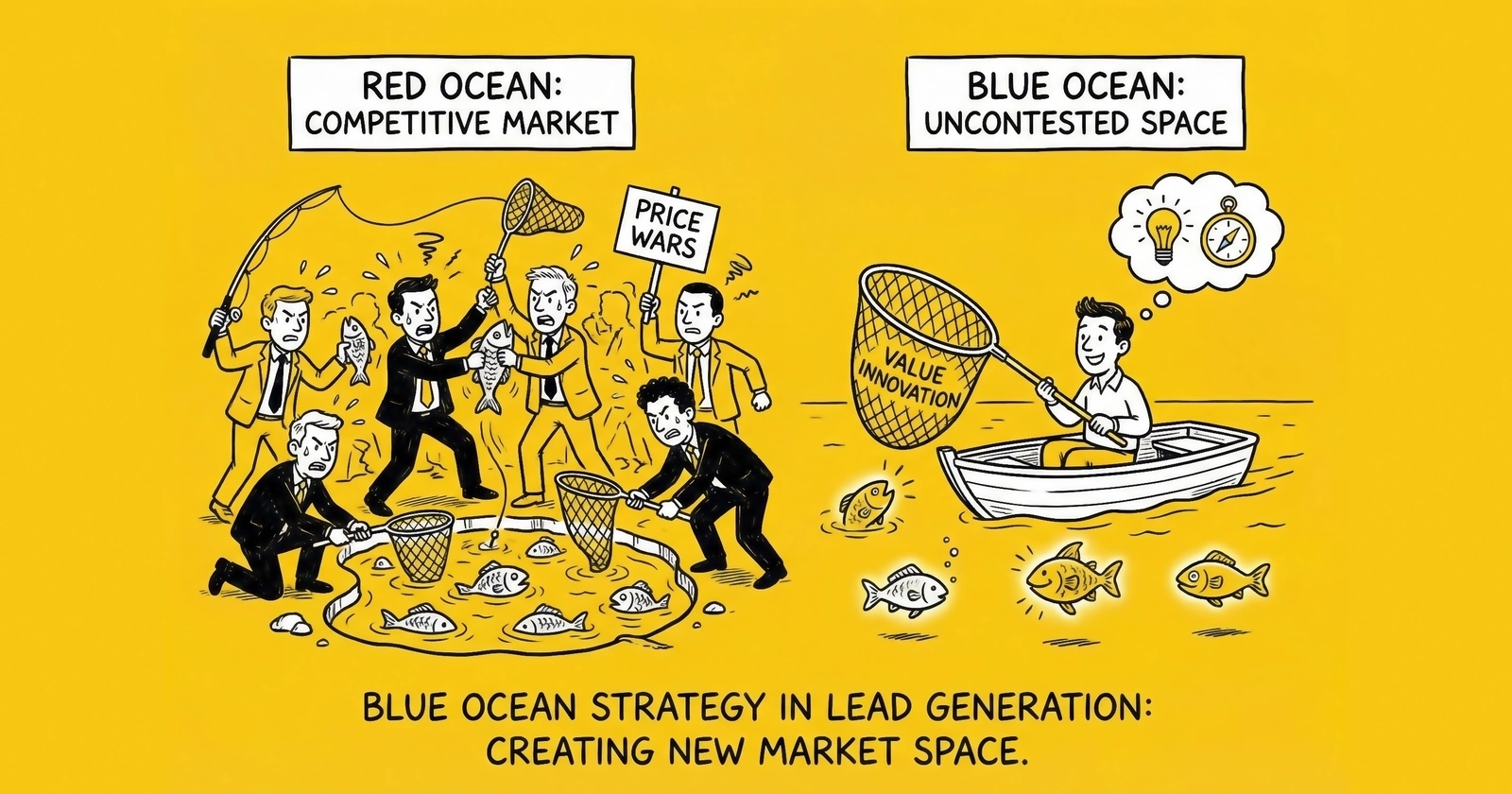
Apply Blue Ocean Strategy to lead generation – escape red ocean competition through value innovation, the Four Actions Framework, and creating new market space.
The lead generation industry operates in a classic red ocean: fierce competition, commoditized products, and shrinking margins as operators fight for the same publishers and buyers. Blue Ocean Strategy, developed by W. Chan Kim and Renée Mauborgne and introduced in their 2004 Harvard Business Review article, offers an alternative – creating uncontested market space where competition becomes irrelevant. For lead generation operators watching margins compress as the market grows to over $5 billion, understanding how to escape red ocean competition isn’t just strategic theory. It’s survival.
The business universe consists of two types of market space: red oceans and blue oceans.
Red oceans represent all existing industries – the known market space. In red oceans, industry boundaries are defined, competitive rules are understood, and companies fight for greater shares of existing demand. As competition intensifies, products commoditize, margins shrink, and the water turns bloody – hence the red ocean metaphor.
Blue oceans represent industries not yet in existence – unknown market space untainted by competition. In blue oceans, demand is created rather than fought over. There’s opportunity for rapid, profitable growth because the rules haven’t been set and competitors haven’t arrived.
Kim and Mauborgne’s research across 150 strategic moves spanning 100 years revealed something surprising: 86% of business launches were line extensions competing in red oceans, accounting for 62% of revenues but only 39% of profits. The 14% aimed at creating new markets delivered 38% of revenues and 61% of profits.
The lesson: escaping red ocean competition isn’t just strategically elegant – it’s dramatically more profitable.
Lead Generation’s Red Ocean Reality
The lead generation industry exhibits nearly every characteristic of a red ocean market:
Intense Rivalry
With the top 15 providers controlling only 48% of global spend, lead generation remains highly fragmented. Hundreds of operators compete for the same buyers and publishers, with no single company able to set industry standards or pricing.
Product Commoditization
A lead meeting specific demographic and coverage criteria is functionally interchangeable regardless of who generated it. Understanding the different business models in lead generation reveals why this commoditization drives price-based competition that erodes margins industry-wide. When your product looks identical to competitors’ products, the only remaining competitive dimension is price.
Low Switching Costs
Buyers add and remove lead sources in days. Publishers shift volume to operators offering marginally better rates. This liquidity means no relationship is truly secure, forcing continuous competition on terms that favor neither operators nor publishers.
Zero-Sum Competition
Traditional lead generation strategy involves fighting competitors for existing demand – the same buyers, the same publishers, the same traffic sources. When one operator wins a buyer relationship, another loses. When one offers higher publisher payouts, margins compress for everyone.
Declining Unit Economics
Rising traffic acquisition costs, increasing compliance requirements, and intensifying competition squeeze margins from multiple directions simultaneously. Operators running faster just to stay in place is the defining experience of red ocean competition.
The Blue Ocean Alternative: Value Innovation
Blue Ocean Strategy’s core concept is value innovation – the simultaneous pursuit of differentiation AND low cost. This breaks the traditional trade-off where companies must choose between creating greater value at higher cost or reasonable value at lower cost.
Value innovation happens when a company’s actions favorably affect both its cost structure and its value proposition to buyers. Cost savings come from eliminating and reducing factors the industry competes on. Buyer value increases by raising and creating elements the industry has never offered.
This isn’t about finding a sweet spot in the existing trade-off – it’s about breaking the trade-off entirely by reconstructing industry boundaries.
The Cirque du Soleil Example
Cirque du Soleil illustrates value innovation perfectly. When Cirque launched, the circus industry was in decline: rising costs (star performers, animal care), shrinking audiences (competition from TV, video games), and negative publicity (animal rights concerns).
Instead of competing for the declining circus audience, Cirque reconstructed industry boundaries:
Eliminated: Animal shows (expensive, controversial), star performers (costly), aisle concessions (annoyed parents), multiple show arenas (confusing, expensive)
Reduced: Fun and humor (less slapstick), thrill and danger (fewer traditional acts)
Raised: Unique venue (glamorous tent), artistic music and dance (sophisticated experience)
Created: Theme and storyline (like theater), refined viewing environment (comfortable seating), multiple productions (like Broadway)
The result: Cirque offers the fun of circus AND the sophistication of theater at prices several times higher than traditional circuses, while achieving lower costs by eliminating expensive traditional elements. Cirque created a new market space – entertainment for adults and corporate clients who’d abandoned circuses decades ago.
The Four Actions Framework for Lead Generation
The Four Actions Framework systematically reconstructs industry boundaries by asking four questions:
1. Eliminate: What should be eliminated that the industry takes for granted?
In lead generation, candidates for elimination include:
Geographic ubiquity. Most operators try to serve all markets, spreading resources thin. Eliminating non-core geographies concentrates expertise and publisher relationships where they matter most.
All-vertical coverage. Serving every vertical prevents deep specialization. Eliminating peripheral verticals enables the expertise that commands premium pricing.
Commodity lead types. Some lead categories (shared leads in saturated verticals) may be worth eliminating entirely if they can’t be differentiated.
Manual processing. Elements that require human intervention but don’t add buyer value – like manual lead routing, manual quality checks, manual compliance verification – may be candidates for elimination through automation.
Intermediary complexity. Some operators maintain multiple technology platforms, multiple publisher networks, and multiple integration methods that add cost without proportional value.
2. Reduce: What should be reduced well below industry standards?
Reduction targets factors that are over-engineered relative to their value contribution:
Speed to arbitrage. The industry obsesses over millisecond response times in ping-post auctions. For many buyers, lead quality matters far more than whether they received the lead in 50ms or 500ms. Reducing speed obsession may free resources for quality improvement.
Volume orientation. The traditional focus on lead volume often conflicts with quality. Reducing volume emphasis while increasing quality focus may better serve buyer needs.
Publisher diversity. Maintaining relationships with hundreds of publishers spreads attention thin. Reducing to a smaller portfolio of high-performing, compliant publishers may improve results.
Integration complexity. Supporting every possible integration method increases costs. Reducing to standardized integrations may lower operational burden while serving most buyers adequately.
3. Raise: What should be raised well above industry standards?
Raising selected factors differentiates the offering meaningfully:
Compliance documentation. While competitors provide minimal consent records, raising compliance to include TrustedForm certificates, call recordings, multi-layer consent verification, and litigation-ready documentation creates differentiation buyers increasingly value.
Contact rate transparency. Most operators hide poor contact rates. Raising transparency around contact performance builds trust and attracts quality-focused buyers.
Publisher visibility. Providing buyers insight into traffic sources (without revealing proprietary details) raises the value proposition above competitors who operate as black boxes.
Conversion support. Going beyond lead delivery to include conversion optimization guidance, buyer training, and performance analytics raises the relationship beyond commodity transactions.
Regulatory expertise. Providing compliance guidance, regulatory updates, and risk assessment raises the value proposition for buyers facing TCPA, FTC, and state-level enforcement exposure.
4. Create: What should be created that the industry has never offered?
Creation involves introducing entirely new factors:
Compliance insurance. No lead generation operator currently offers compliance guarantees or insurance products that protect buyers from litigation costs associated with purchased leads. Creating this would open new market space.
Outcome-based pricing. Instead of cost-per-lead, creating pricing tied to actual outcomes (applications submitted, policies bound, contracts signed) aligns operator and buyer incentives in unprecedented ways.
Non-customer conversion. Creating solutions for businesses that could benefit from leads but don’t purchase them – often because traditional lead generation doesn’t fit their sales process, compliance requirements, or technical capabilities.
Vertical ecosystems. Creating integrated solutions that combine leads with CRM, compliance tools, dialer technology, and sales enablement in vertical-specific packages that current fragmented offerings don’t provide.
AI-powered matching. Creating intelligent lead-to-buyer matching that considers factors beyond price and basic demographics – sales team availability, conversion history, regulatory jurisdiction, buyer capacity utilization.
The Strategy Canvas for Lead Generation
The Strategy Canvas visually maps the competitive factors an industry invests in and what buyers receive across competing offerings. It reveals where the industry currently competes and where blue ocean opportunities exist.
Traditional Lead Generation Strategy Canvas
The current industry typically competes on:
- Price (CPL)
- Volume capacity
- Speed (response time)
- Vertical coverage
- Geographic reach
- Integration options
- Basic lead attributes (demographics, coverage types)
Most operators cluster around similar positions on these factors, creating a “strategic convergence” where differentiation is minimal and price becomes the primary competitive lever.
Blue Ocean Strategy Canvas
A blue ocean move would show a dramatically different profile:
Lower on: Price competition, volume focus, speed obsession, geographic spread, vertical breadth
Higher on: Compliance documentation, conversion transparency, buyer support, regulatory expertise, outcome accountability
New factors: Compliance guarantees, outcome-based pricing, vertical ecosystems, AI matching, non-customer solutions
The visual contrast between current industry positioning and blue ocean positioning reveals the strategic shift required.
Identifying Non-Customers in Lead Generation
Blue Ocean Strategy emphasizes that demand creation often comes from serving non-customers – people or businesses that don’t currently participate in the market.
In lead generation, non-customers fall into three tiers:
Tier 1: Soon-to-be Non-Customers
These are businesses currently purchasing leads minimally, on the edge of leaving the market. They might include:
- Buyers frustrated with lead quality who are considering in-house generation
- Small businesses finding traditional lead generation too expensive when calculating true ROI
- Companies with compliance concerns that outweigh lead generation benefits
Understanding why these customers are nearly leaving reveals opportunities to retain them with modified offerings.
Tier 2: Refusing Non-Customers
These businesses have consciously evaluated and rejected lead generation:
- Companies whose sales processes don’t fit the lead model (complex B2B, relationship-based sales)
- Businesses in regulated industries where traditional lead generation creates unacceptable compliance risk
- Organizations that view purchased leads as low quality by definition
Converting refusing non-customers requires fundamental reconstruction of the offering, not incremental improvement.
Tier 3: Unexplored Non-Customers
These are businesses that have never considered lead generation:
- Companies unaware that lead generation exists for their industry
- Organizations with sales capacity but no prospecting infrastructure
- Businesses that could benefit from leads but lack technical capability to receive and process them
Unexplored non-customers represent the largest potential market expansion but require the most significant value innovation to reach.
Blue Ocean Opportunities in Lead Generation
Applying the framework reveals several potential blue ocean opportunities:
Compliance-as-a-Service Platform
The insight: Compliance risk is the fastest-growing concern in lead generation, yet most operators treat compliance as a cost center rather than a value driver.
The blue ocean move: Create a platform where compliance isn’t an add-on but the core value proposition. Comprehensive consent documentation, litigation-ready records, compliance monitoring, regulatory updates, and risk assessment become the primary offering, with leads as the delivery mechanism.
Non-customers served: Businesses currently avoiding lead generation due to compliance concerns. Legal teams who block lead purchasing due to liability exposure. Regulated industries (healthcare, financial services) with stringent consent requirements.
Outcome-Based Lead Partnership
The insight: The cost-per-lead model creates misaligned incentives. Operators benefit from volume regardless of quality. Buyers pay for leads that don’t convert.
The blue ocean move: Create partnerships where compensation ties to outcomes – applications, sales, revenue. The operator shares the buyer’s success rather than transferring risk entirely to the buyer.
Non-customers served: Businesses unwilling to accept lead generation’s inherent risk. Companies that tried lead generation, experienced poor ROI, and abandoned the channel. Budget-constrained organizations that can’t afford lead experiments that might fail.
Vertical Integration Ecosystem
The insight: Lead buyers must assemble multiple vendors: lead sources, CRM, dialer, compliance tools, training. This fragmentation creates friction and prevents optimization.
The blue ocean move: Create vertically-integrated ecosystems that combine leads, technology, compliance, and sales enablement into unified solutions for specific industries. Instead of selling leads, sell sales capability.
Non-customers served: Small businesses lacking resources to assemble vendor ecosystems. New market entrants who need turnkey sales infrastructure. Businesses with technical limitations preventing traditional lead integration.
AI-Powered Customer Intelligence
The insight: Traditional leads represent consumer interest captured at a specific moment. But interest signals exist before form fills, and consumer needs evolve after initial contact.
The blue ocean move: Create an intelligence platform that provides ongoing customer insight rather than one-time lead data. Intent signals before purchase consideration, behavior patterns during decision-making, and opportunity indicators after initial contact.
Non-customers served: Companies finding traditional leads arrive too late in the buying cycle. Businesses needing ongoing relationship intelligence, not just initial contact data. Organizations whose sales processes extend beyond initial lead contact.
Barriers to Blue Ocean Imitation
Blue ocean creators typically enjoy protection from imitation for 10-15 years. Several barriers prevent competitors from quickly copying successful blue ocean moves:
Economic Barriers
First movers in blue oceans attract customers rapidly, achieving scale economies that put imitators at immediate cost disadvantage. A compliance platform serving thousands of buyers has data, expertise, and infrastructure that new entrants can’t quickly replicate.
Organizational Barriers
Blue ocean strategy often requires system-wide changes that existing operators find difficult to implement. An operator built around volume-based pricing can’t easily shift to outcome-based partnerships – it requires different metrics, different compensation, different culture.
Cognitive Barriers
Blue ocean creators build brand recognition and customer loyalty that expensive marketing struggles to overcome. When a company defines a new category, it owns that category in buyers’ minds regardless of later entrants.
Network Effects
Certain blue ocean moves create network effects where value increases as participation grows. A compliance platform becomes more valuable as more buyers and publishers use it, creating data that improves risk assessment for everyone.
Implementing Blue Ocean Strategy
Moving from red ocean competition to blue ocean creation requires systematic execution:
Step 1: Assess Current Position
Map your current strategic position against competitors using a Strategy Canvas. Identify where strategic convergence creates commodity competition.
Step 2: Identify Non-Customers
Analyze who doesn’t currently purchase leads and why. Understanding refusing and unexplored non-customers reveals the largest opportunities.
Step 3: Apply Four Actions Framework
Systematically identify factors to eliminate, reduce, raise, and create. Focus on factors that simultaneously lower cost and increase buyer value.
Step 4: Test Blue Ocean Hypotheses
Before full commitment, test whether proposed blue ocean moves attract non-customers, whether value innovation creates sustainable differentiation, and whether economic viability supports the strategy.
Step 5: Build Organizational Alignment
Blue ocean strategy requires organizational transformation. Leadership must communicate the strategic logic, build capabilities for the new approach, and create metrics that reinforce blue ocean objectives.
Step 6: Execute and Defend
Launch the blue ocean move and invest in building barriers to imitation. Scale rapidly to capture economic benefits before competitors recognize the opportunity.
Common Pitfalls in Blue Ocean Attempts
Not every attempt at blue ocean creation succeeds. Common pitfalls include:
Technology-Driven Rather Than Value-Driven Innovation
Kim and Mauborgne’s research found that blue oceans were seldom about technology innovation per se. The underlying technology often already existed – value innovation came from applying technology to what buyers valued, not from technical novelty.
Operators who pursue technology for technology’s sake often miss the mark. AI, blockchain, or other emerging technologies only create blue oceans when they solve problems buyers actually have.
Incremental Rather Than Reconstructive Moves
Blue ocean strategy requires reconstructing industry boundaries, not incrementally improving within existing boundaries. Adding features to existing offerings, marginally improving quality, or slightly lowering prices keeps you in the red ocean.
True blue ocean moves feel uncomfortable because they reject industry conventions. If the strategy doesn’t make competitors (and your own team) say “that’s not how our industry works,” it probably isn’t a blue ocean move.
Ignoring Execution Challenges
Blue ocean strategy must build execution into strategy from the beginning. A brilliant strategic concept that can’t be implemented practically delivers no value. The Four Actions Framework helps ensure proposed moves are operationally feasible.
Premature Commitment
Testing blue ocean hypotheses before full commitment prevents expensive failures. Some promising blue ocean concepts don’t survive contact with market reality. Small-scale tests reveal feasibility before major resource allocation.
The Time Horizon Challenge
Blue ocean strategy operates on longer time horizons than red ocean competition. Building new market space, attracting non-customers, and establishing barriers to imitation takes years, not quarters.
Operators under pressure for immediate results may find blue ocean strategy incompatible with short-term expectations. The most successful blue ocean creators are those with patience for strategic development and tolerance for the uncertainty inherent in creating new markets.
However, once established, blue oceans deliver returns that red ocean competition cannot match. The 10-15 year protection from credible competition that Kim and Mauborgne document justifies the investment in blue ocean creation.
Conclusion
Lead generation’s red ocean reality – commoditization, price competition, compressed margins – will only intensify as the market grows toward $21 billion by 2033. More operators fighting for the same buyers and publishers means bloodier water for everyone.
Blue Ocean Strategy offers an alternative: creating uncontested market space where competition becomes irrelevant. By systematically applying the Four Actions Framework, identifying non-customers, and pursuing value innovation that simultaneously differentiates and reduces cost, lead generation operators can escape red ocean competition.
The path isn’t easy. Blue ocean creation requires rejecting industry conventions, tolerating strategic uncertainty, and building capabilities for fundamentally different business models. But for operators willing to make the strategic shift, the rewards – protection from competition, premium pricing, rapid growth – justify the transformation.
In the words of Kim and Mauborgne: “The only way to beat the competition is to stop trying to beat the competition.”
Key Takeaways
-
Blue Ocean Strategy rejects the trade-off between differentiation and low cost, pursuing both simultaneously through value innovation – a concept that enables profitable growth in even the most competitive industries.
-
The Four Actions Framework (Eliminate, Reduce, Raise, Create) provides a systematic method for reconstructing industry boundaries in lead generation and breaking free from commodity competition.
-
Lead generation exhibits classic red ocean characteristics – commoditization, price competition, and publisher fragmentation – making it an ideal candidate for blue ocean creation.
-
Successful blue ocean moves serve non-customers: businesses that could use leads but don’t because traditional offerings don’t fit their needs, compliance requirements, or technical capabilities.
-
Blue ocean protection lasts 10-15 years through economic barriers (scale from early adoption), cognitive barriers (brand recognition), and organizational complexity that deters imitation.
-
Compliance-as-a-service represents a major blue ocean opportunity – transforming compliance from cost center to core value proposition for buyers facing increasing regulatory risk.
-
Outcome-based pricing breaks industry conventions by aligning operator and buyer incentives around results rather than transferring all risk to lead buyers through cost-per-lead models.
-
Vertical integration ecosystems create new market space by combining leads with CRM, compliance tools, and sales enablement into unified solutions that fragmented offerings can’t match.
-
The Strategy Canvas reveals strategic convergence among lead generation operators – most cluster around similar positions, making price the only remaining competitive lever.
-
True blue ocean moves feel uncomfortable because they reject industry conventions. If the strategy doesn’t make competitors say “that’s not how our industry works,” it probably isn’t a blue ocean move.
Understanding Red and Blue Oceans
Frequently Asked Questions
How does Blue Ocean Strategy differ from differentiation?
Traditional differentiation pursues higher value at higher cost – creating a better product that commands premium pricing. Blue Ocean Strategy pursues differentiation AND low cost simultaneously through value innovation. By eliminating and reducing factors the industry takes for granted while raising and creating factors that deliver new value, blue ocean strategists break the value-cost trade-off rather than accepting it.
Can small lead generation operators create blue oceans?
Research shows that blue oceans are created by new entrants and incumbents alike – size doesn’t determine capability. In fact, small operators may have advantages: less organizational inertia, more willingness to challenge industry conventions, and greater strategic flexibility. The key is systematic application of blue ocean frameworks, not scale.
How long does blue ocean protection typically last?
Kim and Mauborgne’s research found that blue ocean creators typically enjoy 10-15 years of protection from credible imitation. Economic barriers (scale from early adoption), cognitive barriers (brand recognition and customer loyalty), and organizational barriers (difficulty transforming existing operations) combine to protect blue ocean positions.
What’s the biggest risk in pursuing Blue Ocean Strategy?
The biggest risk is pursuing technology-driven rather than value-driven innovation. Many operators assume new technology creates blue oceans automatically. However, research shows blue oceans were seldom about technology pioneering per se – they came from applying technology (often existing technology) to create value in ways the industry hadn’t considered.
How do I know if my strategy is truly blue ocean?
True blue ocean strategy reconstructs industry boundaries rather than competing within them. If your strategy can be described using existing competitive dimensions (better quality, lower price, faster delivery), it’s likely red ocean competition. Blue ocean strategy creates new competitive dimensions that make existing competition irrelevant.
What role do non-customers play in Blue Ocean Strategy for lead generation?
Non-customers represent the largest opportunity for market expansion. In lead generation, they fall into three tiers: soon-to-be non-customers (businesses about to abandon lead purchasing due to quality or compliance concerns), refusing non-customers (companies that evaluated and rejected traditional lead generation), and unexplored non-customers (organizations that never considered lead purchasing as an option). Each tier reveals different blue ocean opportunities. Soon-to-be non-customers might be retained through compliance-focused offerings. Refusing non-customers might be converted through outcome-based pricing that eliminates their primary objection. Unexplored non-customers might be reached through vertical ecosystems that remove technical barriers to lead integration.
Sources
- Kim, W. Chan, and Renée Mauborgne. “Blue Ocean Strategy.” Harvard Business Review, October 2004.
- Kim, W. Chan, and Renée Mauborgne. Blue Ocean Strategy: How to Create Uncontested Market Space and Make the Competition Irrelevant. Harvard Business School Press, 2005.
- Kim, W. Chan, and Renée Mauborgne. Blue Ocean Shift: Beyond Competing. Hachette Books, 2017.
- Blue Ocean Strategy Official
- The Strategy Institute - Blue Ocean Strategy
- Business Research Insights - Lead Generation Market