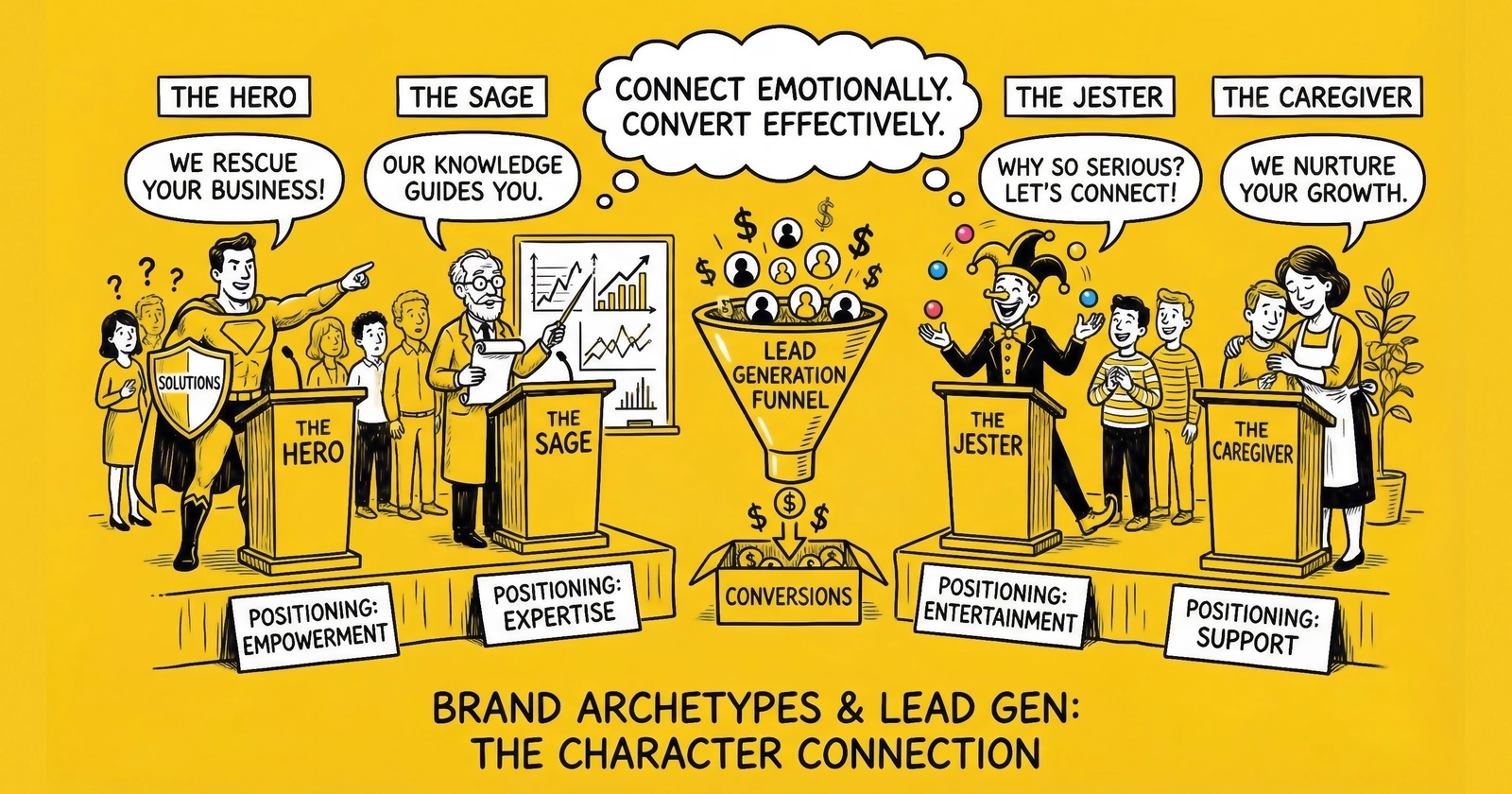
How Carl Jung’s 12 brand archetypes can differentiate lead generation businesses in commoditized markets through emotional positioning and psychological connection with buyers.
Lead generation operates in one of business’s most commoditized markets. When every competitor offers “high-quality leads at competitive prices,” differentiation becomes nearly impossible through rational arguments alone. The solution lies not in better features but in psychological positioning – and Harvard research reveals why: 95% of purchasing decisions occur in the subconscious mind, driven by emotional patterns rather than logical evaluation.
Carl Jung’s archetypal psychology, adapted for marketing by Margaret Mark and Carol Pearson in “The Hero and the Outlaw,” provides a framework for building emotional differentiation that transcends commodity competition. The 12 brand archetypes represent universal patterns of human motivation that resonate across cultures and contexts. Applied to lead generation, these archetypes offer a pathway from price-driven competition to value-driven relationships.
This analysis examines how each of the 12 brand archetypes applies to lead generation positioning, providing specific implementation guidance for operators seeking differentiation in crowded markets.
Why Archetypes Matter in Lead Generation
The lead generation industry suffers from acute differentiation failure. Visit ten lead vendor websites and you’ll encounter nearly identical claims: quality leads, fast delivery, compliance-focused, competitive pricing. This sameness forces buyers to evaluate primarily on price, creating a race to the bottom that compresses margins industry-wide.
Archetypal positioning offers an alternative. Rather than competing on rational features that competitors can copy, archetypes create emotional associations that are difficult to replicate. A lead generation company positioned as a Hero archetype – courageous, protective, dedicated to buyer success – creates fundamentally different buyer expectations than one positioned as a Sage archetype – knowledgeable, analytical, wisdom-driven.
The Psychology of Buyer Decision-Making
Understanding why archetypes work requires examining how B2B buyers actually make decisions. Despite the rational veneer of business purchasing, emotional factors dominate:
-
Risk aversion drives vendor selection. Buyers choose vendors that feel safe, trustworthy, and aligned with their self-image. Archetypal positioning addresses these subconscious concerns directly.
-
Pattern recognition enables rapid evaluation. Buyers process hundreds of vendor signals daily. Clear archetypal positioning provides a mental shortcut that aids recognition and recall.
-
Consistency builds trust. Archetypes provide a coherent framework for all brand communications, creating the consistency that builds credibility over time.
-
Differentiation justifies premium pricing. When emotional positioning resonates, buyers evaluate value rather than just price, enabling margin preservation.
The Lead Generation Archetype Landscape
Not all archetypes suit lead generation equally. The industry’s characteristics – B2B transactions, compliance requirements, performance measurement, relationship intensity – favor certain archetypal positions over others. The most applicable archetypes for lead generation include the Hero, Caregiver, Sage, Ruler, and Explorer, though creative operators have found success with less obvious positions.
The 12 Archetypes Applied to Lead Generation
The Innocent: Optimism and Simplicity
Core Traits: Pure, optimistic, simple, moral, nostalgic Brand Examples: Coca-Cola, Dove
Lead Generation Application: The Innocent archetype promises simplicity in a complex industry. For lead generation, this translates to positioning that emphasizes straightforward pricing, transparent processes, and honest relationships. “No hidden fees. No complicated contracts. Just leads that work.”
Target Buyers: First-time lead buyers overwhelmed by industry complexity. Small business owners seeking simplicity over sophistication. Buyers who’ve been burned by overly complex arrangements.
Implementation Guidance:
- Use clear, jargon-free language in all communications
- Offer simple pricing structures without volume tiers or conditional terms
- Provide transparent reporting that doesn’t require expertise to understand
- Emphasize trustworthiness and honest dealing
- Visual identity should be clean, bright, and uncluttered
Messaging Example: “Lead generation shouldn’t be complicated. We deliver quality leads at fair prices with no hidden terms. That’s it.”
Risk: May be perceived as unsophisticated by enterprise buyers seeking advanced capabilities. Works best for operators targeting small business or first-time buyers.
The Everyman: Belonging and Accessibility
Core Traits: Down to earth, supportive, faithful, relatable Brand Examples: IKEA, Home Depot, eBay
Lead Generation Application: The Everyman archetype positions as the reliable, accessible choice for regular businesses. This archetype works for lead vendors serving main-street businesses rather than enterprise clients – the insurance agent, the local contractor, the small mortgage broker.
Target Buyers: Small and medium businesses that don’t see themselves as sophisticated marketers. Buyers who want a vendor that “gets” their everyday challenges. Price-conscious operators who value relationship over flash.
Implementation Guidance:
- Use conversational, accessible language
- Feature testimonials from relatable businesses (not just impressive logos)
- Price competitively without premium positioning
- Provide responsive, personal customer service
- Avoid corporate formality in communications
Messaging Example: “We work with thousands of businesses just like yours. No fancy algorithms or enterprise features – just reliable leads from people who understand your business.”
Risk: Difficult to command premium pricing. May struggle to attract enterprise clients or differentiate from true commodity providers.
The Hero: Courage and Protection
Core Traits: Courageous, bold, inspirational, determined, protective Brand Examples: Nike, FedEx, BMW
Lead Generation Application: The Hero archetype positions the lead vendor as a champion for buyer success – fighting fraud, protecting against compliance risk, delivering results against the odds. This is one of the most naturally applicable archetypes for lead generation, where buyers face genuine threats (bad leads, compliance exposure, wasted spend) and need a capable ally.
Target Buyers: Buyers who’ve experienced problems with other vendors. Compliance-conscious organizations. Performance-driven buyers who track measurable KPIs. Buyers in high-risk verticals.
Implementation Guidance:
- Lead with protection messaging (compliance, fraud prevention, quality assurance)
- Showcase specific victories (problems solved, risks avoided)
- Use bold, confident language without arrogance
- Provide strong guarantees and warranties
- Position competitors implicitly as threats the Hero protects against
Messaging Example: “Your business faces real threats: fraudulent leads, compliance exposure, wasted budget. We stand between your business and those threats with industry-leading validation, certified consent documentation, and a quality guarantee that puts your success first.”
Risk: Must deliver on heroic promises. A single significant failure undermines the entire positioning.
The Outlaw: Disruption and Liberation
Core Traits: Rebellious, liberating, rule-breaking, bold Brand Examples: Harley-Davidson, Diesel, Virgin
Lead Generation Application: The Outlaw archetype positions against industry conventions – challenging the standard practices that buyers may resent. This works for vendors offering genuinely different approaches: unusual pricing models, radical transparency, rejection of industry norms.
Target Buyers: Buyers frustrated with traditional vendor relationships. Operators seeking something genuinely different. Price-sensitive buyers attracted to disruption.
Implementation Guidance:
- Explicitly challenge industry conventions (“We don’t do long-term contracts because they benefit vendors, not buyers”)
- Use edgy, direct language that stands out from corporate messaging
- Offer genuinely different terms or approaches
- Build community among “outsiders” who reject conventional practices
- Accept that some buyers will be repelled
Messaging Example: “The lead industry is broken. Long contracts, hidden fees, quality disputes that never get resolved. We built something different: month-to-month terms, transparent pricing, and a returns policy that actually works. Join the operators who’ve stopped accepting the status quo.”
Risk: Polarizing position that will alienate some buyers. Requires genuinely different practices to avoid appearing inauthentic.
The Explorer: Discovery and Independence
Core Traits: Adventurous, ambitious, independent, pioneering Brand Examples: Jeep, Red Bull, Patagonia
Lead Generation Application: The Explorer archetype positions around discovery and new frontiers – new markets, innovative approaches, emerging opportunities. This works for vendors specializing in emerging verticals, new lead types, or pioneering methodologies.
Target Buyers: Growth-oriented businesses seeking new opportunities. Early adopters open to innovative approaches. Buyers expanding into new markets or verticals.
Implementation Guidance:
- Emphasize new opportunities and emerging markets
- Position as pioneers in innovation (new channels, new technology, new approaches)
- Use language of discovery and adventure
- Showcase success in new or unusual applications
- Attract buyers who see themselves as pioneers
Messaging Example: “While others fight over saturated markets, we’re opening new frontiers. Our emerging-market lead programs connect you with opportunities your competitors haven’t discovered yet.”
Risk: May seem risky or unproven to conservative buyers. Requires genuine innovation to maintain credibility.
The Creator: Innovation and Quality
Core Traits: Creative, imaginative, inventive, perfectionist Brand Examples: Apple, Lego, Adobe
Lead Generation Application: The Creator archetype positions around building something better – superior technology, innovative processes, craft-level quality. This works for technically-oriented lead vendors who genuinely build differentiated systems, from optimized landing pages to advanced lead scoring.
Target Buyers: Technically sophisticated buyers who appreciate engineering quality. Buyers seeking best-in-class performance. Organizations that value innovation in vendor selection.
Implementation Guidance:
- Showcase proprietary technology and methodology
- Emphasize craft and quality in all operations
- Use precise, detailed language that demonstrates expertise
- Invest in product quality over marketing volume
- Attract buyers who recognize and value technical excellence
Messaging Example: “We’ve spent years building lead validation technology that others can’t match. Every lead passes through 47 quality checks before it reaches you. This isn’t just lead generation – it’s precision engineering.”
Risk: May seem overengineered or expensive to price-sensitive buyers. Requires genuine technical differentiation to maintain credibility.
The Ruler: Control and Excellence
Core Traits: Leader, responsible, organized, authoritative, successful Brand Examples: Microsoft, Mercedes-Benz, Rolex
Lead Generation Application: The Ruler archetype positions as the industry standard – the choice for organizations that demand the best and accept nothing less. This premium positioning works for vendors serving enterprise clients with significant budgets and high expectations.
Target Buyers: Enterprise organizations with rigorous vendor standards. Large buyers who view vendor selection as a status signal. Buyers who prioritize reliability and security over price.
Implementation Guidance:
- Position as the industry leader and standard-setter
- Emphasize stability, reliability, and institutional quality
- Use formal, authoritative language
- Showcase enterprise client logos and institutional credibility
- Price at premium levels consistent with leadership positioning
Messaging Example: “The industry’s leading organizations trust us with their lead generation. Enterprise-grade security. Fortune 500 reliability. The standard by which others are measured.”
Risk: Inaccessible to smaller buyers. Requires institutional credibility to maintain positioning. Difficult to achieve without existing market position.
The Magician: Transformation and Results
Core Traits: Visionary, charismatic, change-driving, inspiring Brand Examples: Disney, Apple (in certain contexts), Tesla
Lead Generation Application: The Magician archetype positions around transformation – converting leads into customers, turning marketing spend into revenue, creating growth from opportunity. This works for vendors who can demonstrate dramatic results and position lead generation as transformation rather than transaction.
Target Buyers: Growth-focused businesses seeking significant change. Buyers attracted to vision and possibility. Organizations investing in marketing transformation.
Implementation Guidance:
- Emphasize transformation and results over process
- Use aspirational language about what’s possible
- Showcase dramatic before/after outcomes
- Create sense of possibility and potential
- Position lead generation as gateway to business transformation
Messaging Example: “Last year, our clients generated $2.4 billion in revenue from our leads. We don’t just deliver contacts – we transform your growth trajectory. Let’s talk about what’s possible for your business.”
Risk: Change-driving promises must be substantiated. Buyer skepticism about “magical” claims requires strong proof points.
The Lover: Connection and Experience
Core Traits: Passionate, intimate, warm, appreciative, committed Brand Examples: Victoria’s Secret, Godiva, Hallmark
Lead Generation Application: The Lover archetype positions around deep relationships and partnership – not transactional lead delivery but committed engagement with buyer success. This works for high-touch vendors who emphasize relationship over volume.
Target Buyers: Buyers who value personal relationships with vendors. Organizations seeking long-term partnerships with strong customer experience. Buyers in verticals where relationship quality matters.
Implementation Guidance:
- Emphasize partnership and commitment language
- Invest heavily in relationship management
- Provide personalized, attentive service
- Communicate warmth and appreciation
- Build long-term relationships rather than maximizing short-term transactions
Messaging Example: “We’re not interested in one-time transactions. We build partnerships. Your dedicated account team knows your business, anticipates your needs, and is invested in your success. This is lead generation as relationship.”
Risk: Difficult to scale. May seem inappropriate for transactional B2B context. Requires genuine relationship investment.
The Caregiver: Protection and Support
Core Traits: Caring, nurturing, compassionate, supportive, protective Brand Examples: Johnson & Johnson, Campbell’s, Volvo
Lead Generation Application: The Caregiver archetype positions around protecting buyers from harm – compliance risk, quality problems, wasted spend. This works naturally for lead generation, where buyers face genuine risks and need supportive partners.
Target Buyers: Risk-averse buyers concerned about compliance. Organizations that have experienced problems with other vendors. Buyers in regulated industries where protection matters.
Implementation Guidance:
- Lead with protection and support messaging
- Emphasize compliance, safety, and risk mitigation
- Provide responsive support that demonstrates care
- Anticipate buyer needs and proactively address concerns
- Use warm, supportive language
Messaging Example: “We know the risks you face: compliance exposure, quality disputes, wasted budget. We’ve built our entire operation around protecting you. From certified consent documentation to proactive quality monitoring, we’re here to make sure nothing goes wrong.”
Risk: May seem paternalistic to sophisticated buyers. Must deliver on protective promises.
The Jester: Enjoyment and Engagement
Core Traits: Fun-loving, playful, optimistic, entertaining Brand Examples: M&Ms, Old Spice, Dollar Shave Club
Lead Generation Application: The Jester archetype is challenging in B2B contexts but can work for vendors who want to stand out through personality and entertainment. This positions lead generation as enjoyable rather than stressful – a refreshing contrast to industry norms.
Target Buyers: Buyers who appreciate personality in business relationships. Small business owners who value enjoyment. Organizations seeking differentiation through culture fit.
Implementation Guidance:
- Use humor and personality in communications
- Make interactions enjoyable rather than purely transactional
- Create memorable experiences through unexpected approaches
- Don’t take yourself too seriously
- Accept that some buyers will prefer serious positioning
Messaging Example: “Lead generation doesn’t have to be painful. We’ve somehow made it almost enjoyable. (Don’t tell anyone, but we actually like this stuff.)”
Risk: May seem unprofessional to enterprise buyers. Humor is subjective and can backfire. Difficult to execute well consistently.
The Sage: Knowledge and Wisdom
Core Traits: Knowledgeable, wise, analytical, expert, truth-seeking Brand Examples: Google, BBC, Harvard
Lead Generation Application: The Sage archetype positions around expertise and knowledge – the vendor that understands the industry deeply and shares that understanding with buyers. This works for vendors who can genuinely offer industry insight and guidance.
Target Buyers: Buyers who value expertise and want to learn from vendors. Sophisticated buyers seeking strategic guidance. Organizations that use vendor knowledge as competitive advantage.
Implementation Guidance:
- Produce thought leadership content demonstrating expertise
- Provide strategic guidance alongside tactical execution
- Use data and analysis to support recommendations
- Position as trusted advisor rather than vendor
- Invest in research and insight development
Messaging Example: “We’ve analyzed 12 million leads across 47 verticals. We don’t just deliver leads – we help you understand what’s working, why, and how to improve. Our quarterly insights reports have become essential reading for our clients’ strategic planning.”
Risk: Must have genuine expertise to maintain credibility. Knowledge positioning requires ongoing investment in insight development.
Implementing Archetypal Positioning
Selecting an archetype is only the beginning. Effective implementation requires systematic alignment across all brand touchpoints.
Step 1: Authentic Selection
Choose an archetype that aligns with genuine organizational characteristics. Attempting to project an archetype that contradicts actual culture and operations creates dissonance that buyers eventually detect. A transactional, high-volume operation cannot credibly position as the Lover archetype emphasizing deep relationships.
Evaluate current brand associations through buyer research, including detailed buyer personas. What do existing customers believe about your organization? Build on genuine strengths rather than aspiring to characteristics that don’t exist.
Step 2: Comprehensive Alignment
Once selected, align all brand expressions with the chosen archetype:
-
Visual Identity: Colors, imagery, and design should reflect archetypal characteristics. The Hero archetype calls for bold, dynamic imagery; the Sage archetype suggests clean, informative design; the Caregiver archetype evokes warmth and safety.
-
Verbal Identity: Language, tone, and messaging should consistently express the archetype. Develop a voice guide that ensures all communications reflect the chosen position.
-
Customer Experience: Operations should deliver on archetypal promises. The Caregiver positioning requires genuinely supportive customer service; the Creator positioning requires demonstrable technical excellence.
-
Content Strategy: Thought leadership and marketing content should reinforce archetypal positioning. The Sage archetype demands educational content; the Explorer archetype calls for pioneering perspectives.
Step 3: Consistent Expression
Archetypal positioning builds through repetition and consistency. Buyers need multiple exposures to form clear associations. Inconsistency – formal language on the website, casual language in emails – undermines the clarity that makes archetypes effective.
Develop brand guidelines that ensure consistency across all touchpoints and team members. Train customer-facing staff to embody the archetypal position in interactions.
Step 4: Competitive Differentiation
Evaluate competitive positioning to ensure differentiation. If major competitors already occupy a particular archetypal space, consider adjacent or contrasting positions. A market with multiple Hero-positioned competitors might be ripe for a Sage or Caregiver alternative.
Map the competitive landscape by archetype to identify open positions. The most effective differentiation comes from claiming space that competitors haven’t occupied.
Archetypes in Practice: Industry Examples
Examining how successful lead generation companies have applied archetypal positioning illustrates practical implementation.
The Compliance-First Vendor: Caregiver + Hero Hybrid
Several successful compliance-focused lead vendors combine Caregiver and Hero archetypes – protecting buyers from regulatory harm while positioning as champions against industry bad actors. This hybrid works because the archetypes share protective motivation.
Messaging emphasizes both care (“We’re here to protect your business”) and courage (“We fight lead fraud so you don’t have to”). Visual identity combines warmth with strength.
The Technology Innovator: Creator + Sage Hybrid
Technology-forward lead vendors often combine Creator and Sage archetypes – building innovative systems while positioning as industry experts. This hybrid appeals to technically sophisticated buyers who value both innovation and expertise.
Messaging balances technical detail (“Our proprietary scoring algorithm processes 127 signals in real-time”) with strategic insight (“Based on our analysis of 8 million leads, here’s what’s actually driving conversion…”).
The Main Street Partner: Everyman + Caregiver Hybrid
Vendors serving small business often combine Everyman and Caregiver archetypes – being accessible and relatable while providing protective support. This hybrid resonates with small business owners who want a vendor that understands their challenges.
Messaging emphasizes understanding (“We work with thousands of businesses just like yours”) while providing reassurance (“You’re protected by our quality guarantee”).
Measuring Archetypal Effectiveness
Effective archetypal positioning produces measurable outcomes:
-
Brand Recognition: Buyers should be able to describe your brand personality consistently. Survey buyers to assess whether intended archetypal associations have formed.
-
Consideration Set Position: Strong archetypal positioning should improve consideration set inclusion. Track whether brand awareness translates to vendor consideration.
-
Premium Pricing Acceptance: Effective emotional differentiation should enable premium pricing. Monitor price sensitivity and willingness to pay relative to competitors.
-
Buyer Loyalty: Archetypal connection should improve retention. Track customer lifetime value and churn rates as positioning matures.
-
Referral Rates: Strong brand positioning should generate word-of-mouth. Monitor referral rates and the language buyers use when recommending.
Key Takeaways
-
Harvard research confirms that 95% of purchasing decisions occur in the subconscious mind, making emotional positioning through brand archetypes more influential than rational feature comparisons in lead generation vendor selection.
-
The 12 Jungian archetypes provide a universal framework for emotional differentiation that transcends the commoditized competition on features and price that characterizes most lead generation markets.
-
The Hero, Caregiver, and Sage archetypes naturally align with lead generation dynamics, where buyers face real risks (compliance, fraud, wasted spend) and need protection, support, or expertise from vendor partners.
-
Archetypal positioning requires systematic alignment across all brand touchpoints – visual identity, verbal identity, customer experience, and content strategy must consistently express the chosen archetype.
-
Hybrid archetypal positions combine complementary archetypes for nuanced positioning. Caregiver + Hero (protective champion), Creator + Sage (innovative expert), and Everyman + Caregiver (accessible supporter) represent common effective combinations.
-
Authentic archetype selection builds on genuine organizational characteristics. Attempting to project an archetype that contradicts actual culture creates dissonance that buyers detect, undermining trust rather than building it.
-
Competitive differentiation requires archetypal mapping. Understanding which positions competitors occupy reveals open territory for differentiation, as claiming unoccupied archetypal space creates clearer market distinction.
-
The Innocent archetype promises simplicity in a complex industry, resonating with first-time buyers and small businesses overwhelmed by lead generation complexity – but may sacrifice sophistication perception.
-
The Outlaw archetype positions against industry conventions, attracting buyers frustrated with traditional vendor relationships, but requires genuinely different practices to avoid appearing inauthentic.
-
Measuring archetypal effectiveness requires tracking emotional outcomes: brand recognition consistency, consideration set position, premium pricing acceptance, buyer loyalty, and referral rates indicate whether positioning has achieved intended psychological connection.
Frequently Asked Questions
How do I determine which archetype fits my lead generation business?
Start by examining your organization’s genuine characteristics rather than aspirational identity. Survey existing customers about how they perceive your brand. What words do they use? What do they value most about the relationship? Analyze your operational strengths – are you genuinely innovative (Creator), genuinely protective (Caregiver), genuinely expert (Sage)? The most effective archetypal positioning amplifies authentic characteristics rather than projecting false ones. Consider also your target buyer profile: small businesses may respond to Everyman accessibility, while enterprise buyers may expect Ruler authority. The intersection of genuine strengths and buyer preferences identifies your optimal archetypal position.
Can a lead generation company use multiple archetypes?
Hybrid positioning combining two complementary archetypes is common and effective. The key is compatibility – archetypes must share underlying motivations. Caregiver and Hero both emphasize protection, making them natural partners. Creator and Sage both value excellence and expertise. However, attempting to project conflicting archetypes creates confusion: Outlaw (rebellion) and Ruler (authority) contradict each other. Limit positioning to two archetypes maximum, with one primary and one supporting. More than two dilutes clarity and makes consistent expression difficult.
How long does archetypal positioning take to establish?
Effective archetypal positioning typically requires 12-18 months of consistent expression to form clear buyer associations. The timeline depends on marketing intensity (more touchpoints accelerate association formation), consistency (inconsistent expression delays recognition), distinctiveness (unique positions form faster than common ones), and market size (smaller markets with fewer buyers allow faster penetration). During this establishment period, resist the temptation to change direction based on short-term feedback. Archetypal positioning builds cumulatively; changing approaches resets the clock.
How do brand archetypes work alongside functional value propositions?
Archetypes and functional value propositions serve different roles in buyer decision-making. Functional propositions address rational evaluation: features, pricing, performance metrics. Archetypal positioning addresses emotional evaluation: trust, relationship, identity alignment. Both are necessary. A Sage archetype doesn’t replace the need for competitive features – it makes competitive features more compelling by creating emotional connection. Think of archetypes as the personality that delivers functional benefits. Strong positioning integrates both: “We deliver industry-leading conversion rates (functional) through deep expertise earned over 15 years of lead generation innovation (Sage archetype).”
What happens when archetypal positioning conflicts with reality?
When projected archetype contradicts actual experience, trust collapses faster than if no archetype had been claimed. A vendor positioning as Caregiver (protective, supportive) but delivering poor customer service creates cognitive dissonance that damages relationships. Buyers feel deceived, and deception destroys trust more completely than simple disappointment. This is why authentic archetype selection matters so much – the archetype must reflect genuine organizational characteristics. If your operations can’t deliver on archetypal promises, either change operations or choose different positioning. The gap between promise and delivery is fatal to brand equity.
How do archetypes affect pricing strategy?
Effective archetypal positioning supports premium pricing by creating perceived value beyond functional features. The Ruler archetype (prestige, excellence) naturally commands premium pricing – buyers expect to pay more for the industry standard. The Sage archetype (expertise, wisdom) justifies premium through demonstrated knowledge value. The Caregiver archetype (protection, support) supports premium through risk reduction value. Conversely, the Everyman archetype (accessibility, relatability) typically aligns with competitive rather than premium pricing. Consider pricing implications when selecting archetype – the position you choose affects the pricing strategy you can execute.
How should archetypal positioning adapt as the company grows?
Archetypal positioning can evolve as companies mature, but evolution should be gradual and purposeful. Early-stage companies might lead with Creator or Outlaw archetypes that emphasize innovation and industry disruption. As they establish market position, Sage or Hero elements may strengthen their positioning. The core archetype typically remains constant, with supporting elements evolving. Major archetypal shifts – completely changing brand personality – require careful management and significant investment to re-establish buyer associations. Most successful companies maintain archetypal consistency while evolving how they express the archetype through marketing and operations.
How do I train teams to express archetypal positioning consistently?
Consistent archetypal expression requires systematic team enablement. Start with archetype education: ensure all customer-facing staff understand the chosen archetype, its characteristics, and why it was selected. Develop communication guides that translate archetype into specific language patterns, response templates, and interaction styles. Create scenario training that shows how archetypal positioning applies in common situations – sales conversations, support interactions, marketing content development. Establish review processes that catch inconsistent expression before it reaches customers. Regular reinforcement through team meetings, examples of good expression, and gentle correction of deviations maintains consistency. The goal is making archetypal expression intuitive rather than forced – staff should naturally communicate in ways that reinforce positioning.
How do brand archetypes interact with market segment targeting?
Different market segments may respond differently to archetypal positioning. Enterprise buyers may expect Ruler or Sage positioning that signals market leadership and expertise. Small business buyers may respond better to Everyman or Caregiver positioning that signals accessibility and support. This creates tension when serving multiple segments. Resolution approaches include: selecting an archetype with broad appeal across segments (Sage often works across segments), adapting expression while maintaining core archetype (same underlying position, different communication style), or choosing a primary segment and accepting reduced resonance with others. Avoid trying to project different archetypes to different segments – the inconsistency undermines both positions.
How does archetypal positioning affect pricing strategy?
Strong archetypal differentiation typically enables premium pricing by shifting buyer evaluation from commodity comparison to value assessment. When buyers perceive emotional alignment and trust, price sensitivity decreases. The Hero archetype justifies premium pricing through protection value. The Sage archetype justifies it through expertise value. The Ruler archetype demands premium pricing for consistency with leadership positioning. The Everyman archetype, by contrast, suggests competitive rather than premium pricing as accessibility is core to the position. Match pricing strategy to archetypal position for coherent brand expression.
How do I measure whether archetypal positioning is working?
Measure archetypal effectiveness through multiple indicators. Brand perception surveys assess whether buyers describe your brand using characteristics consistent with your intended archetype – if you position as Sage but buyers describe you as “affordable” rather than “expert,” positioning isn’t landing. Consideration set tracking monitors whether brand awareness translates to vendor consideration. Pricing power indicates emotional differentiation: strong archetypal connection reduces price sensitivity. Retention and referral rates reflect relationship strength that archetypal positioning should build. Competitive win rates reveal whether differentiation creates advantage in head-to-head comparisons. Track these metrics over time as archetypal positioning matures – effects compound as consistent expression builds recognition.
How do brand archetypes relate to brand personality and brand voice?
Brand personality and brand voice are expressions of the underlying archetype. The archetype is the fundamental identity pattern – Hero, Sage, Caregiver. Brand personality translates that archetype into human characteristics – bold and confident (Hero), thoughtful and articulate (Sage), warm and supportive (Caregiver). Brand voice translates personality into communication style – active and assertive language (Hero), educational and precise language (Sage), empathetic and reassuring language (Caregiver). Think of archetype as foundation, personality as character traits, and voice as how the character speaks. Coherent brand development starts with archetype selection, develops personality characteristics, then defines voice guidelines that express both consistently.
What mistakes do lead generation companies make with archetypal positioning?
The most common mistakes include selecting aspirational rather than authentic archetypes (creating dissonance when operations don’t match positioning), inconsistent expression across touchpoints (formal website but casual emails), attempting too many archetypes (diluting clarity), copying competitor positioning (sacrificing differentiation), and changing archetypes too frequently (preventing association formation). Additionally, many companies select archetypes based on what leadership finds appealing rather than what resonates with target buyers – buyer research should inform selection rather than internal preference.
How do I maintain archetypal positioning as my company grows?
Growth challenges archetypal consistency as new team members, expanded operations, and diversified offerings create variation risk. Maintain positioning through documented brand guidelines that explicitly connect archetype to expression standards, training programs that help new team members embody the archetypal position, regular brand audits that identify consistency gaps, and leadership commitment to archetypal integrity even when growth creates pressure for change. Some archetypal evolution is natural – a company positioned as Explorer may mature toward Creator as pioneering becomes building – but such shifts should be deliberate rather than accidental.
Does archetypal positioning work in highly rational B2B contexts?
Research consistently demonstrates that emotional factors influence B2B decisions despite rational appearances. B2B buyers are humans making decisions that affect their careers, teams, and organizations. They seek vendors that feel trustworthy, aligned with their values, and safe to recommend. Archetypal positioning provides this emotional resonance. The key in B2B contexts is balancing emotional positioning with rational proof points – the Sage archetype works well because it provides both emotional positioning (wisdom, expertise) and rational evidence (data, analysis). B2B doesn’t mean emotionless; it means emotions operate alongside rational evaluation.
How do I research competitor archetypal positioning?
Map competitors by analyzing their communications across multiple channels: website messaging, advertising, content marketing, social media presence, customer communications. What words do they use consistently? What imagery dominates? What promises do they make? Categorize each competitor by apparent archetype. Look for gaps – archetypal positions that no competitor has claimed clearly. Also survey buyers about competitor perceptions: how do they describe competing brands? Their language often reveals archetypal associations more clearly than competitor self-presentation. This research identifies both competitive positioning and differentiation opportunities.
Sources
- Margaret Mark and Carol Pearson. “The Hero and the Outlaw: Building Extraordinary Brands Through the Power of Archetypes.” McGraw-Hill.
- Visme. “12 Brand Archetypes by Carl Jung (& How to Use Them).” https://visme.co/blog/brand-archetypes/
- Gerald Zaltman, Harvard Business School. Research on subconscious purchasing decisions.
- IconicFox. “Brand Archetypes: The Definitive Guide.” https://iconicfox.com.au/brand-archetypes/
- March Branding. “Brand Archetypes Overview.” https://marchbranding.com/design-insight/brand-archetypes
- DesignRush. “Brand Archetypes & Examples.” https://designrush.com/agency/logo-branding/trends/brand-archetypes
- JD Meier. “Ultimate Guide to Brand Archetypes.” https://jdmeier.com/brand-archetypes/