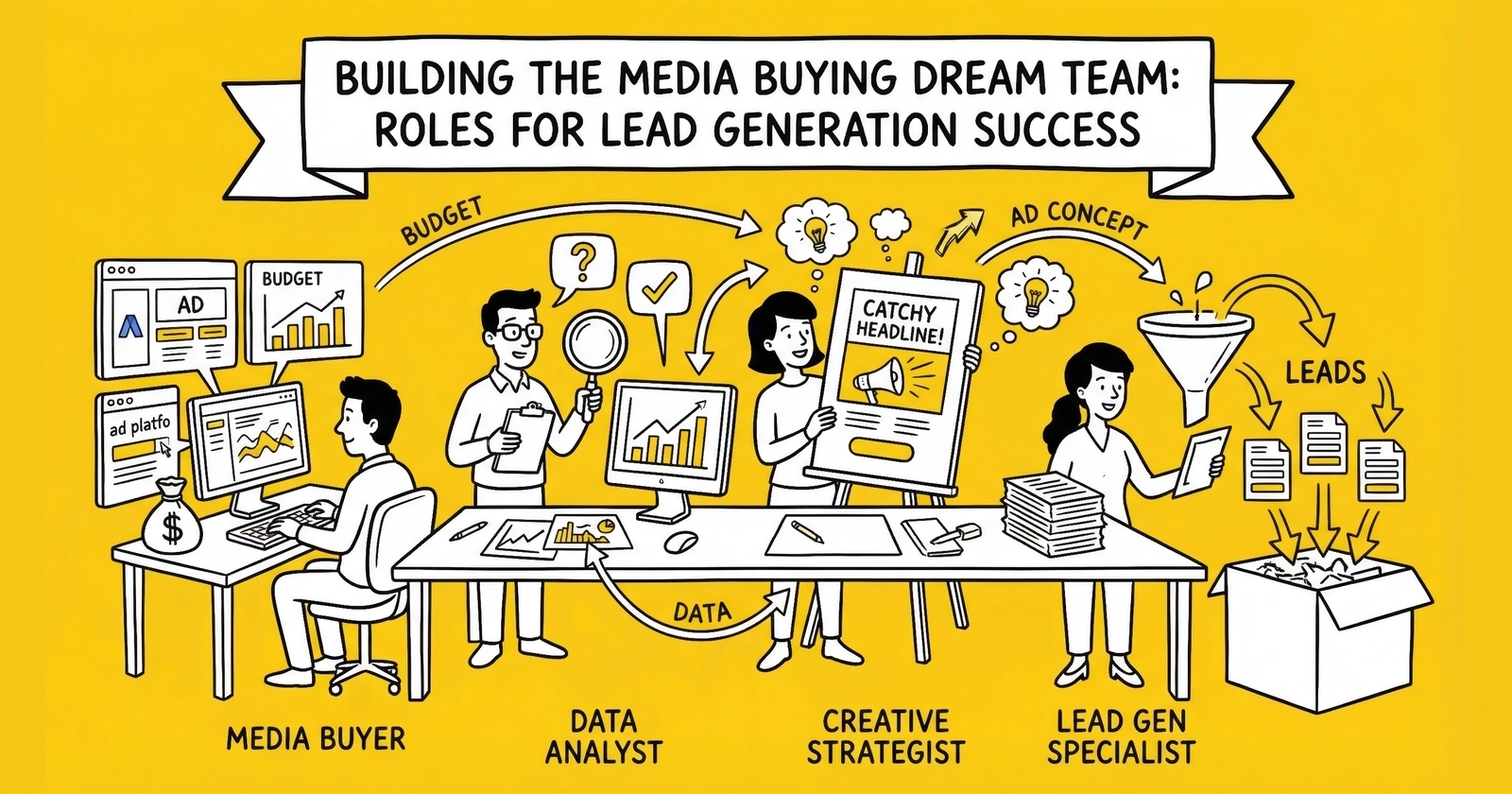
The practical guide to hiring, structuring, and managing media buyers who generate leads profitably at scale – from your first hire to a fully staffed department.
Introduction: When to Hire vs. Outsource Media Buying
You are running campaigns yourself. You have proven the model works. You are spending $500-$1,000 per day profitably, but cannot scale further without sacrificing sleep, personal life, or campaign quality. The question is no longer whether to bring on media buying help, but how.
The decision between building an in-house team and outsourcing to an agency is not binary. Most successful lead generation operations use a hybrid approach that evolves as they scale. The right answer depends on your spend level, vertical complexity, and organizational capabilities.
Media buying talent is the single largest leverage point in a lead generation business. A skilled buyer can turn $10,000 monthly spend into $50,000 in lead revenue. An unskilled buyer burns through that same $10,000 with nothing to show. The difference between these outcomes is not luck – it is systematic hiring, training, and management.
This guide covers when you need a media buying team, what roles to hire and in what order, how to compensate for performance, and how to structure your team as you scale from $10,000 to $1 million or more in monthly ad spend. For budget allocation frameworks, see our data-driven budget allocation guide.
Signs You Need a Media Buying Team
You Are Personally Maxed Out
The clearest signal is when growth stops not because campaigns lack potential, but because you lack hours. You are spending 40+ hours per week on campaign management while also handling sales, operations, and strategy. Something has to give.
Specific warning signs:
- Optimization frequency drops. You used to check and adjust campaigns daily. Now it is every few days or weekly.
- Testing has stopped. You have creative ideas queued but no time to implement them.
- New channels remain unexplored. You know you should be testing TikTok or programmatic, but cannot find the bandwidth.
- Profitable campaigns plateau. Good campaigns stay at current spend instead of scaling because scaling requires attention you do not have.
You Are Leaving Money on the Table
Calculate the opportunity cost. If you are spending $20,000 monthly and achieving 3x ROAS (return on ad spend), you are generating $60,000 in lead revenue. A 20% improvement from having a dedicated buyer would add $12,000 monthly – $144,000 annually. That more than covers a media buyer salary with margin to spare.
The math typically works when:
- Monthly spend exceeds $30,000 across all channels
- ROAS is positive but not optimized
- You can identify at least two or three channels or campaigns not receiving adequate attention
- Your time has alternative uses worth more than a buyer’s salary
Scale Requires Specialization
At lower spend levels, one person can manage Facebook, Google, and perhaps a third channel adequately. As spend increases, platform complexity demands specialization.
Facebook and Meta require understanding of Advantage+ campaign structures, creative fatigue cycles and testing velocity, iOS 14.5 signal loss workarounds, and audience building strategies. Google requires different expertise: search keyword bidding and match type strategy, Performance Max campaign optimization, display and YouTube creative requirements, and conversion tracking models.
One person rarely excels at both. The lead generation operators who scale past $100,000 monthly spend typically have specialists for each major platform.
Quality Suffers From Attention Deficits
When you manage campaigns while also doing everything else in the business, the first casualty is thoughtful analysis. You react to surface-level metrics instead of investigating root causes. You miss the gradual decay in creative performance that compounds into major losses over weeks.
Signs quality is suffering: you are surprised by performance swings because you were not watching closely, returns or quality complaints increase without you understanding why, and your campaigns look the same as they did six months ago.
Core Roles and Responsibilities
Media Buyer
The media buyer is your frontline operator. This role manages daily campaign performance, executes optimizations, and scales profitable campaigns while shutting down losers quickly.
Core responsibilities:
- Daily budget management and bid adjustments
- Creative rotation and testing execution
- Audience targeting refinement
- Performance monitoring against CPL and ROAS targets
- Troubleshooting underperforming campaigns
- Implementing tracking and attribution correctly
- Reporting on spend, leads, and efficiency metrics
Skills required:
- Hands-on platform expertise (Facebook Ads Manager, Google Ads)
- Data analysis – ability to read dashboards, identify trends, and draw conclusions
- Understanding of lead generation metrics (CPL, conversion rate, ROAS, return rates)
- Comfort with rapid testing and iteration
- Technical ability to implement pixels, events, and conversion tracking
What separates good from great:
Average media buyers react to what happened yesterday. Great media buyers anticipate what will happen next week. They notice creative fatigue before CTR collapses. They spot traffic quality shifts before return rates spike. They understand the lag between spend and outcome in lead generation’s delayed-feedback environment.
Salary ranges (2024-2025):
| Experience Level | Base Salary | With Performance Bonus |
|---|---|---|
| Junior (0-2 years) | $50,000-$65,000 | $60,000-$80,000 |
| Mid-level (2-5 years) | $65,000-$90,000 | $80,000-$120,000 |
| Senior (5+ years) | $90,000-$130,000 | $110,000-$180,000 |
Creative Director / Designer
In lead generation, creative is the variable that matters most. Audiences saturate. Platforms change algorithms. But a winning creative can carry a campaign for months. The creative role develops the ads, landing pages, and visual assets that drive performance.
Core responsibilities:
- Ad creative development (static, video, carousel)
- Landing page design and optimization
- Creative testing roadmap and hypothesis development
- Brand consistency across campaigns and channels
- Rapid iteration based on performance data
- Collaboration with media buyers on what to test next
Skills required:
- Proficiency in design tools (Figma, Adobe Creative Suite, Canva for rapid iteration)
- Video editing capabilities (CapCut, Premiere, After Effects)
- Understanding of direct response design principles
- Ability to produce high volume without sacrificing quality
- Data literacy – understanding which creative metrics matter
What separates good from great:
Average designers make things look professional. Great lead generation designers understand that professional often means boring. They know that ugly ads sometimes outperform polished ones because authenticity drives clicks. They balance brand consistency with the visual disruption required to stop a scroll.
Salary ranges:
| Experience Level | Base Salary |
|---|---|
| Junior Designer | $45,000-$60,000 |
| Mid-level Designer | $60,000-$80,000 |
| Creative Director | $85,000-$130,000 |
Analytics / Data Analyst
Lead generation involves complex attribution and delayed feedback loops. The data analyst role connects ad spend to lead quality to buyer outcomes – the full chain from click to revenue.
Core responsibilities:
- Build and maintain reporting dashboards
- Track attribution across channels and campaigns
- Analyze lead quality by source, creative, and audience
- Connect ad platform data to CRM and lead distribution outcomes
- Identify patterns in returns, conversions, and lifetime value
- Provide actionable insights to media buyers and leadership
Skills required:
- SQL and database querying
- Dashboard tools (Looker, Tableau, Google Data Studio)
- Understanding of ad platform APIs and data exports
- Statistical literacy – significance testing, correlation vs. causation
- Knowledge of lead generation economics and metrics
What separates good from great:
Average analysts produce reports. Great analysts produce decisions. They do not wait for questions – they surface the insights that should be driving strategy. They translate data into language media buyers understand: “Campaign X should scale” or “Traffic source Y has a return rate problem.”
Salary ranges:
| Experience Level | Base Salary |
|---|---|
| Junior Analyst | $55,000-$70,000 |
| Mid-level Analyst | $70,000-$95,000 |
| Senior/Lead Analyst | $95,000-$140,000 |
Account Manager
If your media buying team supports multiple internal campaigns or external clients, account management becomes necessary to translate business needs into campaign requirements and results into client satisfaction.
Core responsibilities:
- Serve as primary contact for internal stakeholders or external clients
- Translate business goals into campaign briefs and KPIs
- Communicate performance and explain results
- Manage expectations around timelines and deliverables
- Coordinate between media buyers, creative, and analytics
- Identify upsell and expansion opportunities
Salary ranges:
| Experience Level | Base Salary |
|---|---|
| Junior Account Manager | $45,000-$60,000 |
| Mid-level Account Manager | $60,000-$85,000 |
| Senior Account Manager | $85,000-$120,000 |
Hiring Your First Media Buyer
Where to Find Candidates
- Job boards and platforms: LinkedIn Jobs (filter by performance marketing, paid media, growth marketing), Indeed and ZipRecruiter for broader reach, WeWorkRemotely for remote-first positions, Angel List / Wellfound for startup-oriented candidates.
- Specialized communities: Facebook groups focused on media buying (Foxwell Founders, Ad Buyers Community), performance marketing Slack communities, LeadsCon and Affiliate Summit attendee networks, Twitter/X performance marketing circles.
- Agencies as talent pools: Media buying agencies train hundreds of junior buyers who eventually seek client-side roles. Agency alumni know how to move fast, manage multiple accounts, and handle pressure. The trade-off: they may need to unlearn some agency behaviors like prioritizing billable hours over outcomes.
- Competitors and adjacent companies: Your competitors train people who understand your vertical. Reach out to media buyers at companies in your space who might want a new challenge. This requires delicacy – do not poach aggressively from key partners – but the talent pool is real.
What to Look For in Interviews
- Platform proficiency: Have candidates walk through a live campaign or a sanitized case study. Ask them to explain their optimization process. What do they check first? How do they decide when to pause versus when to give a campaign more time? Generic answers reveal generic knowledge.
- Analytical thinking: Give them a scenario: “CPL jumped 40% week-over-week. Walk me through your diagnostic process.” Strong candidates have a mental checklist. They consider creative fatigue, audience saturation, competitive pressure, landing page issues, and tracking problems – in a logical sequence.
- Lead generation understanding: Not all media buyers understand lead generation economics. Ask about return rates, lead quality indicators, and the relationship between CPL and actual profitability. Candidates from e-commerce may need time to adapt to delayed feedback and non-purchase conversions.
- Comfort with autonomy: Lead generation media buyers work in ambiguous environments. The best performers do not wait for instructions. They see a problem, develop a hypothesis, test it, and report results. Probe for examples of initiative.
Red Flags to Watch For
- Only worked on large budgets: Someone who managed $10 million annually at a massive agency may not thrive managing $50,000 monthly. Small-budget optimization requires different skills.
- Cannot explain losses: Every media buyer has failed campaigns. The question is whether they learned from them. Beware candidates who blame the product, the audience, or the platform without self-reflection.
- Platform knowledge only surface-deep: Ask about edge cases. What happens when conversion tracking breaks? How do you recover from a learning phase reset? Superficial knowledge reveals itself quickly.
- No curiosity about your vertical: Strong candidates ask questions about your business. Candidates who show no interest probably will not develop it.
The First 90 Days
- Week 1-2: Orientation. Access to all platforms, tools, and documentation. Review of existing campaigns and historical performance. Introduction to key stakeholders and communication norms. Understanding of lead quality metrics and buyer feedback.
- Week 3-4: Observation with guided participation. Shadow existing campaigns and optimization decisions. Make recommendations (reviewed before implementation). Begin managing a subset of spend with oversight. Daily check-ins to address questions and calibrate judgment.
- Month 2: Managed ownership. Take ownership of specific campaigns or channels. Weekly performance reviews with feedback. Begin testing new creative or audience hypotheses. Still requires approval for major budget changes.
- Month 3: Full ownership with accountability. Clear KPI targets (CPL, ROAS, lead volume). Autonomy within defined guardrails. Monthly performance reviews. Escalation protocols for major decisions.
Compensation Structures
Base Salary Benchmarks
Media buyer compensation varies by geography, vertical complexity, and spend under management.
By geography (2024-2025):
| Location | Junior | Mid-level | Senior |
|---|---|---|---|
| Major metro (NYC, SF, LA) | $65,000-$85,000 | $85,000-$120,000 | $120,000-$160,000 |
| Secondary markets | $50,000-$65,000 | $65,000-$90,000 | $90,000-$130,000 |
| Remote (national) | $55,000-$75,000 | $75,000-$100,000 | $100,000-$140,000 |
By spend under management:
| Monthly Spend | Typical Salary Range |
|---|---|
| Under $50K | $50,000-$70,000 |
| $50K-$200K | $70,000-$100,000 |
| $200K-$500K | $90,000-$130,000 |
| $500K+ | $120,000-$180,000 |
Performance Bonus Structures
The most effective compensation for media buyers includes performance incentives. Properly structured, these bonuses align employee interests with company outcomes.
- Percentage of margin: Pay a percentage of the margin generated above target. Example: 5% of incremental margin when ROAS exceeds 3.0x. This ties directly to business outcomes but requires transparent margin calculation.
- CPL improvement bonus: Bonus for reducing CPL below baseline while maintaining volume. Example: $500 bonus for each $1 reduction in average CPL. Simple to calculate but may incentivize gaming by reducing quality to hit CPL targets.
- Tiered performance bonus: Hit target = base bonus. Exceed target = multiplier. Example structure: 100-110% of target CPL = $1,000 monthly; 110-125% = $2,000 monthly; 125%+ = $3,500 monthly.
Sample balanced bonus structure:
| Component | Weight | Metric | Payout Trigger |
|---|---|---|---|
| Efficiency | 40% | CPL vs. target | Beat target by 10%+ |
| Volume | 30% | Leads delivered | Meet or exceed monthly goal |
| Quality | 30% | Return rate | Under 15% return rate |
Must meet two of three criteria for 50% payout, all three for 100%.
Structuring Bonuses Effectively
Effective bonus structures share common characteristics:
- Clear metrics: Everyone understands exactly what is being measured.
- Realistic targets: Targets should stretch but remain achievable with strong performance.
- Timely payout: Monthly or quarterly bonuses work better than annual for reinforcement.
- Multi-factor balance: Avoid single-metric bonuses that invite gaming.
- Guardrails: Include claw-backs for lead quality issues discovered after bonus payment.
Training and Onboarding
Building Internal Training Programs
Relying on external training alone leaves gaps. Your vertical, your buyers, and your systems create unique requirements that generic courses cannot address.
- Platform fundamentals (Week 1): Account structure and campaign organization. Pixel and event setup verification. Conversion tracking and attribution models. Interface navigation and efficiency shortcuts.
- Lead generation economics (Week 1-2): Understanding CPL in context (not just the number, but what it means). Return rates and quality indicators. Buyer economics and what makes a lead valuable. The relationship between traffic quality and downstream performance.
- Your specific systems (Week 2): Lead distribution platform orientation. CRM and reporting tools. Consent documentation and compliance requirements. Communication and escalation protocols.
- Creative and testing frameworks (Week 3-4): Creative testing methodology. Statistical significance and when to make decisions. Documentation requirements. Feedback loops with design team.
- Ongoing development: Weekly team knowledge sharing. Platform update reviews (algorithms change constantly). Case study analysis of wins and losses. External training for advanced skills.
Documentation That Accelerates Onboarding
Create these documents before your first media buying hire:
- Campaign playbooks: Standard operating procedures for each campaign type, optimization checklists by platform, troubleshooting decision trees, naming conventions
- KPI definitions: What each metric means and how it is calculated, target ranges and danger thresholds, how metrics connect to business outcomes
- Escalation protocols: When to pause versus optimize, approval thresholds for budget changes, who to contact for different issue types
- Historical context: What has worked before (with data), what has failed and why, vertical-specific insights, seasonal patterns
External Training Resources
- Platform certifications: Meta Blueprint certification, Google Ads certifications (Search, Display, Video), LinkedIn Marketing certifications, TikTok Ads Academy.
- Courses and communities: CXL Institute performance marketing courses, Foxwell Digital training programs, AdWorld conference recordings, vertical-specific training.
- Budget: Allocate $1,000-$3,000 per buyer annually for external training. The ROI on keeping skills current is substantial.
Agency vs. In-House: Pros and Cons
When Agency Partnership Makes Sense
- Early stage (under $30,000 monthly spend): You lack volume to justify a full-time salary. An agency can provide fractional expertise while you build scale.
- Channel testing: You want to explore TikTok or programmatic but lack internal expertise. Agencies can test new channels without permanent hiring commitments.
- Specialized expertise: Some channels (connected TV, audio advertising, affiliate networks) require deep specialization that makes sense to outsource.
- Capacity overflow: Your internal team is at capacity but growth opportunity exceeds headcount. Agencies provide elastic capacity.
Agency Disadvantages
- Misaligned incentives: Agencies typically charge percentage of spend or fixed retainers. Neither model perfectly aligns with your profitability goals. Percentage-of-spend incentivizes spending more, not spending better.
- Divided attention: Your campaigns compete with the agency’s other clients for attention. During busy periods, you may not be the priority.
- Knowledge exodus: When the agency relationship ends, the institutional knowledge walks out with them. Internal teams build lasting organizational capability.
Agency Costs
| Model | Typical Range | Best For |
|---|---|---|
| Percentage of spend | 10-20% of ad spend | Lower spend accounts |
| Flat retainer | $3,000-$15,000/month | Predictable scope |
| Hybrid | 5-10% + base retainer | Scaling accounts |
| Performance-based | % of margin or CPL bonus | Aligned incentives |
A $100,000 monthly spend account paying 15% agency fee costs $15,000 monthly – $180,000 annually. That covers a senior media buyer salary with budget remaining for tools and training.
In-House Advantages
- Alignment: Your media buyer wins when you win. No conflicting client priorities. Full attention on your campaigns.
- Speed: No waiting for agency response. Ideas can be implemented immediately. Testing velocity increases.
- Institutional knowledge: Every lesson learned stays in the organization. Performance compounds over time.
- Cost efficiency at scale: Above $100,000 monthly spend, in-house typically becomes more cost-effective than agency fees.
The Hybrid Approach
Most mature lead generation operations use both: core channels in-house for alignment and institutional knowledge, specialized channels outsourced for expertise access and overflow capacity.
Team Structure by Spend Level
Under $50,000 Monthly Spend
- Structure: Solo operator or founder + one generalist.
- Roles: Founder handles strategy and major decisions. One junior/mid-level media buyer manages execution. Creative through contractors or templates. Analytics through platform native reporting.
- Investment: $60,000-$90,000 annually in team cost.
$50,000-$200,000 Monthly Spend
- Structure: Small dedicated team.
- Roles: Lead media buyer with platform specialization. Second media buyer or creative specialist. Part-time or shared analytics support. Founder still involved in strategy and oversight.
- Investment: $150,000-$250,000 annually in team cost.
$200,000-$500,000 Monthly Spend
- Structure: Functional team with specialization.
- Roles: Media Buying Manager or Lead. Platform-specialized buyers (Facebook, Google). Dedicated creative designer or team. Full-time analytics. Account management if serving multiple stakeholders.
- Investment: $350,000-$550,000 annually in team cost.
$500,000+ Monthly Spend
- Structure: Full department with leadership.
- Roles: Director or VP of Performance Marketing. Media buying team with channel specialization. Creative team with testing capacity. Analytics and data engineering. Account management layer.
- Investment: $800,000-$1,500,000+ annually in team cost.
Managing Media Buying Performance
Key Metrics for Media Buyer Evaluation
- Primary metrics: CPL (Cost Per Lead) – the efficiency metric. Lead Volume – total leads delivered. ROAS – revenue generated per dollar spent. Return Rate – percentage of leads returned by buyers.
- Secondary metrics: Testing Velocity – number of creative and audience tests per month. Optimization Actions – documented changes made to improve performance. Response Time – how quickly they identify and address performance changes. Accuracy – quality of estimates and forecasts.
Review Cadence
- Daily standup (15 minutes): Yesterday’s performance versus target. Any anomalies or issues. Today’s focus areas. Blockers requiring help.
- Weekly performance review (30-60 minutes): Week-over-week trend analysis. Creative and audience test results. Upcoming tests and hypotheses. Resource needs and priorities.
- Monthly business review (60-90 minutes): Month versus target performance. Attribution and quality analysis. Strategic recommendations. Goal-setting for next month.
Constructive Performance Conversations
- For controllable factors: If performance issues stem from lack of testing, slow optimization, or preventable mistakes: Document specific examples with data. Ask for the buyer’s perspective on causes. Agree on specific improvement actions. Set clear timeline for reassessment. Follow up consistently.
- For uncontrollable factors: If performance issues stem from platform changes, competitive pressure, or vertical headwinds: Acknowledge the external factors. Evaluate whether the buyer responded appropriately. Assess what could have been done differently. Adjust expectations if market conditions warrant.
- Termination criteria: Performance misses persist for 2-3 months despite coaching. The buyer cannot articulate why campaigns are underperforming. Quality of work consistently fails standards. Cultural fit issues surface.
Frequently Asked Questions
1. How much should I spend on ads before hiring my first media buyer?
At least $20,000-$30,000 monthly with proven unit economics. Below this level, a $60,000 salary represents 25-30% of total ad spend. Wait until you have validated unit economics and have campaigns worth scaling.
2. Should my first media buyer be a specialist or a generalist?
Hire a generalist with primary expertise in your largest channel (Facebook or Google) but capability across platforms. Specialists make sense when you exceed $100,000 monthly spend and can afford dedicated buyers per channel.
3. What is a realistic timeline to ramp a new media buyer?
Plan for 90 days to full productivity. Week 1-2 is orientation. Week 3-4 is guided work with oversight. Month 2 is managed ownership with approval requirements. Month 3 is full ownership with accountability. Some buyers ramp faster; others need longer.
4. How do I evaluate media buyers without deep platform expertise myself?
Ask candidates to walk through their process – strong buyers can explain their methodology clearly to non-experts. Use case study exercises where they analyze data and recommend actions. Check references – ask previous employers about specific performance and work quality.
5. What is the biggest mistake companies make when building media buying teams?
Hiring too fast and firing too slow. Companies add headcount based on projected growth that does not materialize, then carry underperformers too long hoping performance improves. Hire based on current needs with demonstrated demand. Address underperformance within 60-90 days.
6. How should I structure compensation to motivate performance without encouraging gaming?
Use multi-factor bonus structures that balance efficiency, volume, and quality. No single metric should determine bonus payout. Include guardrails and claw-backs for quality issues discovered after bonus payment. Transparency about how bonuses are calculated prevents gaming.
7. When should I promote a media buyer to a management role?
Promotion criteria should include: consistent top-tier performance, demonstrated ability to mentor others, strategic thinking beyond tactical execution, and desire for management responsibility. Not every great buyer wants to manage. Do not force the transition.
8. How do I prevent knowledge loss when a media buyer leaves?
Require campaign playbooks, testing logs, and regular knowledge transfer sessions. Cross-train team members on critical campaigns. Maintain institutional knowledge in systems, not just people. Two-week notice periods are minimum; negotiate for longer with senior buyers.
9. What tools and technology should I provide my media buying team?
At minimum: ad platform access, analytics dashboards, creative collaboration tools, project management software, and communication platforms. Budget $200-$500 monthly per buyer for tools. Do not cheap out on technology – the productivity gains from proper tools exceed their costs quickly.
10. Should I hire remote or require in-office for media buyers?
Media buying works effectively remote. The work is digital, asynchronous collaboration is possible, and talent pools are larger when location-agnostic. However, in-office or hybrid structures facilitate faster onboarding, easier collaboration, and stronger culture. Consider hybrid: 2-3 office days weekly for team members in reasonable proximity, fully remote for exceptional talent elsewhere.
Key Takeaways
-
Hire when the math works. A media buyer should generate more value than they cost. At $30,000+ monthly spend with proven unit economics, the investment typically pays off.
-
Build the team in sequence. First hire is a generalist media buyer. Then creative or second buyer based on your bottleneck. Analytics and account management come with scale.
-
Compensation must include performance. Base salary alone does not align incentives. Structure bonuses around efficiency, volume, and quality – not just one metric.
-
Invest in onboarding and training. The first 90 days determine long-term success. Rushing produces mediocre results. Create documentation before the first hire arrives.
-
Agency and in-house are not mutually exclusive. Use agencies for specialized channels or capacity overflow. Build in-house for core platforms and institutional knowledge.
-
Structure evolves with spend. A $50,000 monthly operation looks different than a $500,000 operation. Plan your structure for current reality, not aspirational scale.
-
Performance management is ongoing. Daily standups, weekly reviews, monthly business reviews. Problems addressed early stay small. Problems ignored become terminations.
-
Document everything. Campaign playbooks, testing logs, optimization rationale. Knowledge in systems survives turnover. Knowledge in heads leaves with the person.
Sources
- PayScale Media Buyer Salary Data - Salary benchmarks for media buyer positions by experience level and geography
- Google Skillshop Certifications - Official Google Ads certification programs referenced for training requirements
- Meta Blueprint Certification - Meta’s official advertising certification program for Facebook/Instagram media buyers
- IAB Internet Advertising Revenue Report - Industry data on digital advertising spend and growth trends
- Statista Global Advertising Spending - Market data on advertising industry investment levels
Building a media buying team is among the highest-leverage investments in a lead generation business. Done well, it enables scale that no solo operator can achieve. Done poorly, it burns capital and creates operational chaos. The difference is in the details: hiring the right people, structuring compensation correctly, investing in onboarding, and managing performance consistently.
Those who build strong media buying capabilities compound their advantages over time. Each lesson learned, each system documented, each relationship developed creates durable value that competitors cannot easily replicate. Start with one great hire. Build systematically from there.
This guide is part of The Lead Economy series on building and scaling lead generation businesses.