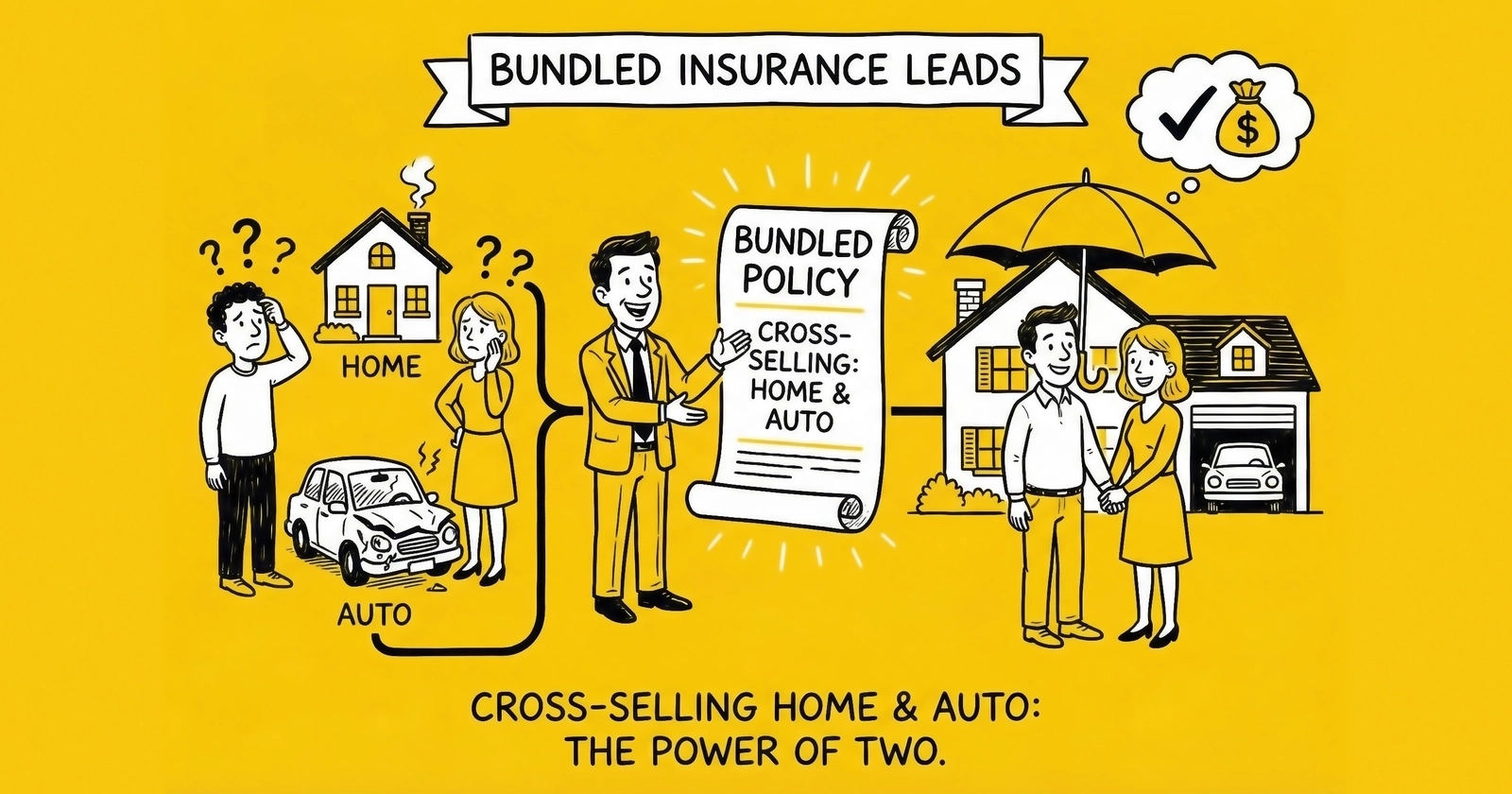
Master the economics of bundled insurance lead generation with real CPL benchmarks, cross-sell conversion rates, and strategic guidance for capturing “Robinson” households. Includes 2025 pricing, carrier demand dynamics, and actionable frameworks for both lead generators and buyers.
A consumer requests an auto insurance quote at 2:14 PM. By 2:15 PM, they have also completed a home insurance form. Same session. Same consumer. Two leads.
This is the bundled insurance opportunity. It represents one of the highest-value segments in lead generation because it captures what carriers desperately want: multi-policy households with significantly higher lifetime value and dramatically lower churn rates.
Insurance carriers call these “Robinson” households, named after the industry shorthand for families holding both auto and home policies with the same carrier. These households represent the ideal acquisition target because they convert better, retain longer, and generate substantially more revenue per customer than single-policy holders.
The math is straightforward. A consumer with auto-only coverage might leave after two years when they find a better rate. A consumer with bundled home and auto coverage faces switching costs that make them three to five times more likely to stay. They would need to find competitive rates on both policies simultaneously, coordinate two separate switching processes, and risk gaps in coverage during the transition. Most simply renew.
This article provides the complete framework for generating, routing, and monetizing bundled insurance leads. You will understand the economics that make bundled leads command premium pricing, the operational strategies for capturing cross-sell opportunities, the technology requirements for effective bundle routing, and the carrier behaviors that drive market demand. For complete coverage of the auto insurance vertical, see our auto insurance lead generation guide.
Why Bundled Leads Command Premium Pricing
The premium pricing for bundled insurance leads reflects genuine economic value, not arbitrary market positioning. Understanding why carriers pay more for bundle-qualified leads helps you optimize your generation and routing strategies.
The Lifetime Value Differential
A single-policy auto insurance customer generates approximately $1,500-$2,500 in lifetime value, assuming average premiums around $1,400 annually and 3-4 year retention. A bundled household with both auto and home policies generates $4,500-$7,500 in lifetime value due to higher combined premiums and significantly longer retention.
The retention differential is the key driver. Industry data consistently shows bundled policyholders retain at 85-90% annually compared to 75-80% for single-policy holders. Over a five-year period, this 10-15 percentage point difference compounds dramatically.
Consider the math: Start with 100 customers. At 80% annual retention (single-policy), you have 33 customers remaining after year five. At 90% annual retention (bundled), you have 59 customers remaining. The bundled cohort generates nearly twice the long-term value from the same initial acquisition.
The Bundle Discount Economics
Carriers offer bundle discounts ranging from 10-25% on combined policies. These discounts seem expensive until you understand what they buy.
A 15% bundle discount on combined premiums of $2,800 annually costs the carrier $420 per year in forgone revenue. But the retention improvement alone more than compensates. If bundling increases average customer lifetime from 3.5 years to 5.5 years, the carrier gains two additional years of premium at $2,380 (post-discount). That is $4,760 in additional lifetime revenue against $420 in annual discount cost.
Beyond retention, bundle discounts also reduce acquisition costs per policy. Instead of paying separately to acquire an auto customer and a home customer, the carrier acquires both through a single transaction. If auto and home leads each cost $50-$100, the carrier saves $50-$100 in secondary acquisition costs while simultaneously improving retention.
The Cross-Sell Conversion Rate Reality
Not every auto insurance lead converts to a home insurance opportunity, and not every home lead converts to auto. Understanding realistic cross-sell rates helps you project bundle capture accurately.
From auto insurance leads, expect 25-35% to indicate homeowner status (renters cannot bundle home insurance, though they can bundle renters insurance at lower values). Of those homeowners, 40-60% will express interest in home insurance quotes during the same session if prompted effectively. This yields an effective bundle capture rate of 10-21% from auto insurance leads.
From home insurance leads, the cross-sell opportunity is typically stronger. Home insurance shoppers are almost always also auto insurance customers (you need a car to own a home in most markets). Bundle capture rates from home insurance leads typically range from 30-45% when cross-sell prompts are integrated into the quote process.
These rates assume effective form design and timing. Passive approaches that wait until after the primary quote to suggest cross-selling capture 40-60% fewer bundle opportunities than integrated approaches.
CPL Benchmarks: What Bundled Insurance Leads Cost
Lead pricing for bundled opportunities reflects the premium value these leads deliver. The following benchmarks represent 2025 pricing across established intermediaries.
Bundled Lead Pricing
| Lead Type | Shared CPL | Exclusive CPL | Notes |
|---|---|---|---|
| Auto + Home Bundle (Pre-Qualified) | $35-$65 | $80-$150 | Consumer expressed interest in both |
| Auto Lead (Homeowner Verified) | $25-$50 | $60-$100 | Homeowner status confirmed, bundle opportunity |
| Home Lead (Auto Cross-Sell Intent) | $30-$55 | $70-$120 | Consumer also seeking auto quotes |
| Sequential Bundle (Same Consumer, Both Forms) | $50-$90 | $120-$200+ | Both forms completed in single session |
Price Premium Analysis
Bundled leads command a 25-40% premium over comparable single-vertical leads. The premium reflects several factors.
First, bundled leads represent pre-qualified cross-sell opportunities. The consumer has already expressed interest in multiple products, eliminating the conversion friction of cold cross-selling after initial policy sale.
Second, bundled leads have higher close rates. When consumers actively seek multiple quotes, they convert at 15-25% compared to 8-12% for single-product leads. Higher conversion rates justify higher acquisition costs.
Third, bundled leads concentrate valuable demographic signals. Homeowners seeking both auto and home quotes typically represent stable, creditworthy households, the exact profile carriers prioritize.
Fourth, bundled leads reduce carrier operational complexity. Instead of managing two separate lead workflows for the same consumer, carriers process a single integrated opportunity.
Carrier-Specific Demand Patterns
Major carriers allocate specific budgets for bundle-qualified leads, often at premium rates exceeding their single-product bid levels.
Progressive, as the industry’s largest lead buyer with $3.5 billion in 2024 advertising spend, actively bids higher for bundle-qualified leads. Their direct-to-consumer model benefits significantly from cross-sell opportunities because each additional policy reduces their customer acquisition cost per policy.
State Farm and Allstate, operating through agent networks, also prioritize bundle leads because agent compensation structures reward multi-policy households. Agents earn higher commissions on bundled sales and benefit from improved retention metrics.
Smaller regional carriers and independent agent networks often compete aggressively for bundle leads because they lack the advertising scale to generate equivalent volume organically. Bundle leads represent concentrated high-value opportunities that justify premium pricing.
The Robinson Household: Understanding Your Target
The insurance industry uses “Robinson” as shorthand for the ideal household profile: multiple policies, stable demographics, and high retention probability. Understanding what defines a Robinson household helps you optimize lead generation for bundle capture.
Demographic Profile
Robinson households typically share common characteristics.
Homeownership is the defining attribute. You cannot bundle homeowners insurance without a home. This immediately filters the market to approximately 65% of U.S. households (the homeownership rate), eliminating renters from the primary bundle opportunity.
Multiple vehicles are common. Robinson households often have two or more vehicles, creating larger auto insurance premiums and more policies to retain. Multi-vehicle households also demonstrate the transportation stability that correlates with longer retention.
Established credit profiles support competitive pricing. Bundle discounts amplify value for consumers who already qualify for preferred rates. Carriers pursuing Robinson households typically want credit scores above 680 for optimal lifetime value.
Geographic stability indicates lower churn risk. Consumers who have owned homes for multiple years, rather than recent purchasers, demonstrate the stability carriers value. However, new home purchases represent a concentrated bundle opportunity because consumers must establish new home insurance and often reassess their auto coverage simultaneously.
Life stage matters. Families with children, particularly school-age children, exhibit the highest bundle retention rates. Moving children between school districts creates a barrier to relocation, which in turn creates insurance retention.
Behavioral Signals
Beyond demographics, certain behaviors indicate Robinson household potential.
Active shopping across multiple insurance products in a compressed timeframe (same day or same week) suggests bundle intent. These consumers are often consolidating coverage, possibly due to a life event like home purchase, marriage, or policy cancellation.
Comparison shopping behavior indicates price sensitivity that bundle discounts can address. Consumers requesting quotes from multiple carriers are actively seeking the best value, making bundle discount messaging particularly effective.
Policy expiration alignment creates natural bundle windows. When auto and home policies expire within 30-60 days of each other, consumers face consolidated decision points that favor bundled switching.
Lead Generation Strategy: Capturing Bundle Opportunities
Generating bundled insurance leads requires intentional form design, traffic strategy, and cross-sell mechanics. The following frameworks maximize bundle capture rate from your existing traffic.
Form Design for Bundle Capture
The timing and presentation of cross-sell prompts significantly impact bundle capture rates.
Integrated approach (highest conversion): Include homeownership questions in the auto insurance form flow, positioned after vehicle information but before contact details. When the consumer indicates homeownership, immediately present a bundle opportunity: “Would you also like home insurance quotes? Bundling typically saves 15-25%.”
This integrated approach captures 40-60% more bundle opportunities than sequential approaches because it leverages the consumer’s active engagement state. They are already completing a form and invested in the process. Adding home insurance feels like an expansion of their existing request, not a new task.
Sequential approach (moderate conversion): Complete the primary form first, then present a dedicated cross-sell offer on the thank-you page. “You are receiving auto insurance quotes. Save more by bundling home insurance. Click here to add home quotes.”
Sequential approaches capture fewer opportunities but may produce higher-quality bundle leads because each form completion represents a separate affirmative action. Some buyers prefer sequential leads because intent is independently verified for each product.
Exit-intent approach (recovery): Trigger bundle prompts when consumers show exit behavior on single-product forms. “Before you go: homeowners who bundle typically save $400+ annually. Add home insurance quotes?”
Exit-intent captures leads that would otherwise leave with single-product value only. While conversion rates are lower than integrated or sequential approaches, the incremental value from otherwise-lost visitors makes this worthwhile.
Question Sequencing Optimization
The order of questions impacts both completion rates and bundle capture.
Start with low-friction questions (zip code, vehicle year) to build commitment before introducing more sensitive fields. Consumers who have invested effort in early fields are more likely to complete additional questions.
Position the homeownership question strategically. Asking too early feels presumptuous; asking too late misses the opportunity to present bundle offers before contact information capture.
Effective sequence for auto forms with bundle capture:
- Zip code
- Vehicle year, make, model
- “Do you own or rent your home?”
- If own: “Would you like home insurance quotes too? Bundle and save.”
- Driver information (age, driving history)
- Contact information
This sequence confirms homeownership before asking for personal details, allowing the bundle offer to appear while engagement is high but before the most sensitive fields.
Landing Page Strategy
Create dedicated landing pages for bundle-seeking traffic alongside your single-product pages.
Bundle-focused pages target keywords like “bundle home and auto insurance,” “multi-policy discount,” and “home auto insurance quotes.” These pages lead with bundle value propositions and present integrated forms requesting both product types from the start.
Bundle-focused page conversion rates typically run 5-10% lower than single-product pages because the form is longer. However, the value per conversion is 2-3x higher because you capture both products. The math favors bundle-focused pages when you have traffic seeking bundle quotes.
Single-product pages with bundle upsell target standard auto or home insurance keywords and add bundle opportunities through integrated or sequential prompts. These pages maintain high conversion rates for single-product leads while capturing bundle opportunities from interested consumers.
The optimal portfolio includes both page types, with traffic routed based on search intent signals. Consumers searching “bundle” or “multi-policy” go to bundle pages; consumers searching single products go to product pages with bundle upsells.
Traffic Source Considerations
Different traffic sources produce different bundle capture rates.
Search traffic from keywords indicating bundle intent (bundle, multi-policy, combined) converts to bundle leads at 45-65%. These consumers are actively seeking bundled quotes and simply need a form to complete.
Search traffic from single-product keywords (auto insurance quotes, car insurance rates) converts to bundle leads at 15-25% when homeowners are prompted effectively. The bundle is an upsell rather than the primary intent.
Social media traffic typically produces lower bundle capture rates (8-15%) because intent is less defined. However, life event targeting (recently married, new homeowner) can improve bundle capture by reaching consumers during natural bundle decision windows.
Remarketing traffic to consumers who previously completed single-product forms but did not convert offers strong bundle opportunity. “Come back for quotes, and this time add your home for additional savings.” Remarketing bundle offers convert at 25-40% for previously engaged consumers.
Cross-Selling Mechanics: Converting Single Leads to Bundles
Not all bundle value comes from initial capture. Sophisticated operations extract additional bundle revenue from single-product leads through systematic cross-selling.
Timing Windows for Cross-Sell
Cross-sell timing significantly impacts success rates.
Immediate (same session): Highest success rates occur when cross-sell opportunities are presented while the consumer is actively engaged. Same-session cross-sell converts at 30-45% for interested consumers.
Near-term (1-7 days): Follow-up cross-sell campaigns within the first week capture consumers who considered bundling but did not complete the second form. Email and SMS sequences offering bundle savings convert at 10-20% of opened messages.
Trigger-based (policy events): Cross-sell campaigns timed to policy events like renewal dates, rate increases, or life changes capture consumers during natural decision windows. Renewal-triggered cross-sell converts at 15-25%.
Seasonal (home buying season): Auto insurance customers who purchase homes during spring/summer real estate season represent natural bundle opportunities. Monitoring for home purchase signals (address changes, new mortgage data) enables targeted cross-sell at high-intent moments.
Cross-Sell Messaging Frameworks
Effective cross-sell messaging emphasizes specific bundle benefits.
Savings-focused: “Bundle and save $[specific amount] on combined coverage.” Quantified savings outperform percentage claims because consumers can immediately understand the value. Calculate representative savings based on typical premiums and bundle discounts.
Convenience-focused: “One carrier, one bill, one agent for all your coverage.” Convenience messaging resonates with consumers who value simplicity over maximum savings.
Protection-focused: “Complete protection for your home and vehicles from a single trusted carrier.” Protection messaging works well for risk-averse consumers who prioritize coverage quality over price.
Social proof-focused: “Join [X] families who save [Y] by bundling home and auto with [carrier].” Social proof adds credibility to savings claims and reduces perceived risk of switching.
Lead Routing for Cross-Sell Opportunities
When you identify cross-sell opportunities from existing single-product leads, routing strategy matters.
Same buyer routing: Route the cross-sell lead to the same buyer who received the original lead. This maintains relationship continuity and allows the buyer to present integrated offers to the consumer. Same-buyer routing typically requires contractual commitments and may involve reduced CPL on the secondary lead.
Competitive routing: Route the cross-sell lead through standard distribution, allowing multiple buyers to compete. Competitive routing maximizes immediate revenue but may create confusion for consumers receiving calls from multiple carriers.
Bundle-specific buyer routing: Route bundle opportunities to buyers who specifically bid on bundle-qualified leads at premium rates. These buyers often have specialized sales processes for bundle conversion and justify higher CPLs through improved close rates.
The optimal approach depends on your buyer relationships and their cross-sell capabilities. Sophisticated buyers prefer same-buyer routing because it improves their conversion rates. Price-focused buyers may accept competitive routing for lower secondary lead costs.
Distribution Strategies: Monetizing Bundle Leads
Bundle leads require distribution strategies that capture their premium value while managing operational complexity.
Exclusive vs. Shared Distribution
The exclusive/shared trade-off is particularly pronounced for bundle leads.
Exclusive bundle leads ($80-$200+) sell to a single buyer who receives the full cross-sell opportunity. Exclusive distribution enables comprehensive bundle presentations without competitive interference. Buyers pay premium pricing for the exclusive opportunity to convert both products.
Exclusive distribution works best when buyers have integrated sales processes that can present and close both products in a single conversation. Carriers with combined call centers and agents licensed for both products maximize exclusive bundle value.
Shared bundle leads ($35-$90) sell to multiple buyers, each receiving the bundle opportunity. Competition may fragment the consumer experience as multiple carriers pursue the same opportunity.
However, shared distribution can work for bundles when buyers specialize in different products. Selling the auto component to auto-focused buyers while simultaneously selling the home component to home-focused buyers captures maximum value from each vertical while accepting the cross-sell fragmentation.
Vertical-Specific Routing
Some operations route bundle leads across separate vertical distribution systems rather than treating them as unified bundle opportunities.
Unified bundle routing treats the lead as a single entity sold to buyers seeking bundle-qualified opportunities. This approach maximizes per-lead revenue from bundle-specific buyers but limits the buyer pool to those equipped for integrated bundle sales.
Split vertical routing routes the auto component through auto distribution and the home component through home distribution. This approach maximizes each vertical’s competitive dynamics but sacrifices the bundle premium.
The optimal strategy depends on your buyer network. If you have strong bundle-specific buyers willing to pay premium rates, unified routing captures maximum value. If your buyer network is vertically siloed, split routing may yield higher total revenue despite losing the bundle premium.
Ping-Post Dynamics for Bundle Leads
Ping-post systems require adaptation for bundle leads.
When pinging bundle leads, include bundle qualification signals in the ping data: homeowner status, multi-product interest, and bundle-specific fields. Buyers configured for bundle leads can bid accordingly, while single-product buyers can bid on individual components.
Some ping-post systems support multi-vertical pings that simultaneously offer leads to buyers across both auto and home verticals. This approach captures competitive dynamics from both markets while allowing bundle-specific buyers to bid on the combined opportunity.
Return policies for bundle leads require clear terms. If a buyer purchases a bundle lead and successfully closes one product but not the other, can they return the unclosed component? Contractual clarity prevents disputes and sets appropriate expectations.
Technology Requirements: Building Bundle Capture Infrastructure
Effective bundle lead generation requires technology infrastructure that supports cross-product workflows, consolidated consumer records, and bundle-specific routing.
Form Technology
Your form technology must support conditional logic for bundle capture.
Conditional field display shows home insurance questions only when consumers indicate homeownership. This prevents renters from seeing irrelevant bundle prompts while ensuring homeowners receive appropriate offers.
Progressive disclosure extends forms when consumers express bundle interest without requiring separate form submissions. A consumer who indicates bundle interest should complete both products in a single flow, not two separate sessions.
Session persistence ensures consumers who start bundle forms but do not complete them can resume where they stopped. Bundle forms are longer than single-product forms, increasing abandonment risk. Persistence reduces friction for returning consumers.
Consumer Record Management
Bundle operations require unified consumer records that connect activity across products.
Deduplication logic must identify when the same consumer submits both auto and home requests, whether in the same session or across multiple sessions. Consolidated records enable bundle-specific routing and prevent duplicate charges to buyers.
Cross-reference tracking links consumer records across vertical databases. A consumer who submitted an auto lead last month and a home lead this week represents a historical bundle opportunity that may justify different routing than a net-new consumer.
Consent management for bundle leads must address both products. If consent specifies “auto insurance offers,” extending that consent to home insurance outreach may create compliance risk. Bundle forms should capture consent for all intended products explicitly.
Routing Technology
Bundle-specific routing requires logic that evaluates combined opportunity value rather than individual vertical value.
Bundle-specific bidding allows buyers to set bid levels for bundle-qualified leads that differ from their single-product bids. A buyer who bids $50 for auto leads and $70 for home leads might bid $150 for bundle-qualified leads, recognizing the combined opportunity value exceeds the sum of individual bids.
Multi-vertical evaluation enables routing decisions that consider value across both products simultaneously. When bundle-specific buyers are not available or not bidding competitively, the system should evaluate split routing against bundle routing and select the highest-value path.
Cascade logic for bundle leads should attempt bundle-specific buyers first, then fall back to split vertical routing if bundle bids are insufficient. This maximizes bundle revenue capture while ensuring leads monetize even when bundle buyers are unavailable.
Seasonal Patterns and Market Timing
Bundle lead generation exhibits distinct seasonal patterns driven by real estate cycles, policy renewal timing, and carrier budget dynamics.
Real Estate Seasonality
Home purchases concentrate in spring and summer, with transaction volume typically peaking between March and August. New home purchases create natural bundle opportunities because consumers must establish new homeowners insurance and often reassess auto coverage simultaneously.
During peak home-buying season, home insurance lead volume increases 30-50% compared to off-season months. Bundle capture rates from home insurance leads also increase because new homeowners are actively configuring their complete insurance portfolio.
Auto insurance lead volume remains relatively stable year-round, but bundle capture rates from auto leads increase during home-buying season as more auto insurance shoppers are also active home buyers.
Policy Renewal Cycles
Auto insurance policies typically renew every six months or annually, with many policies concentrated around calendar year-end (December/January) and mid-year (June/July). Home insurance policies typically renew annually, often aligned with mortgage escrow cycles.
When auto and home renewals coincide, consumers face consolidated decision points that favor bundled switching. Marketing campaigns timed to these alignment windows capture consumers actively evaluating their complete insurance portfolio.
Historical data on policy renewal patterns can inform lead generation timing. If your traffic sources show higher bundle capture rates in January and July, allocating additional budget to those months maximizes bundle revenue.
Carrier Budget Dynamics
Carrier advertising budgets directly influence bundle lead pricing and demand.
In 2024, major carriers dramatically increased advertising spend as underwriting profitability returned after two difficult years. Progressive’s ad spend nearly tripled from $1.22 billion to $3.5 billion. This spending surge increased demand for all lead types, including bundle-qualified opportunities.
When carriers invest aggressively in acquisition, bundle lead pricing tends to increase because carriers recognize the superior lifetime value of multi-policy households. Conversely, when carriers restrict advertising during underwriting challenges, bundle lead pricing may compress as buyer demand decreases.
Monitoring carrier combined ratios (the ratio of losses plus expenses to premiums) provides early warning of advertising budget shifts. Combined ratios below 100% indicate profitability and potential advertising expansion. Combined ratios above 100% signal losses that eventually force advertising pullbacks.
Compliance Considerations for Bundle Leads
Bundle lead generation creates specific compliance considerations beyond standard single-vertical requirements.
Consent Documentation
Bundle leads require consent that clearly covers both products. TCPA consent specifying “auto insurance offers” may not extend to home insurance outreach without explicit expansion.
Best practice: Use consent language that specifies all intended products. “By submitting this form, you consent to receive calls, texts, and emails about auto insurance and home insurance offers from [specified parties].”
Separate consent checkboxes for each product provide the clearest documentation but may reduce completion rates. Integrated consent covering multiple products is more common in practice but requires careful language review.
Licensing and Appointment Verification
Agents selling both auto and home insurance must be licensed for both product lines in the consumer’s state. Bundle leads routed to agents lacking appropriate licensing create compliance risk and failed sales opportunities.
Lead distribution systems should verify agent licensing for both product lines before routing bundle leads. If an agent is licensed for auto but not home in a particular state, the bundle lead should route elsewhere or the home component should route separately.
Carrier appointments also vary by product line. An agent appointed with Carrier A for auto may not be appointed for home. Bundle leads intended for specific carriers require verification of dual appointment.
State-Specific Considerations
Some states impose additional requirements on insurance marketing that affect bundle lead generation.
State insurance departments regulate advertising claims including bundle discount representations. Claiming “save 25% by bundling” may require substantiation showing that savings level is typical and achievable.
Some states require specific disclosures when marketing multiple insurance products in a single communication. Review state-specific requirements before deploying bundle marketing campaigns.
Rate comparison claims (“save $X by switching and bundling”) face particular scrutiny in states with strict advertising regulations. Ensure any savings claims are supported by actual rate data and clearly disclosed as estimates.
Measuring Bundle Lead Performance
Effective bundle operations require metrics that capture the unique dynamics of multi-product leads.
Bundle-Specific Metrics
Bundle capture rate: The percentage of single-product leads that convert to bundle opportunities. Calculate separately for auto-to-bundle and home-to-bundle conversions. Benchmark: 15-25% from auto leads, 30-45% from home leads.
Bundle close rate: The percentage of bundle leads that close both products, not just one. A bundle lead that closes auto but not home delivers only partial value. Track full-bundle close rates separately from partial-bundle outcomes.
Bundle premium realization: The percentage of theoretical bundle premium captured in actual pricing. If bundle leads theoretically warrant 40% premiums but you capture only 25% premiums in practice, you are leaving value on the table.
Cross-sell conversion rate: For operations that cross-sell from existing single-product leads, track what percentage of cross-sell attempts convert to additional lead opportunities.
ROI Calculation for Bundle Leads
Bundle lead ROI requires accounting for the value of both products.
Total bundle value = (Auto CPL x auto conversion rate) + (Home CPL x home conversion rate) + Bundle premium
If auto leads sell at $45 with 55% conversion and home leads sell at $60 with 45% conversion, a bundle lead that captures both opportunities has theoretical value of $24.75 (auto) + $27.00 (home) = $51.75 before bundle premium. Adding a 25% bundle premium yields approximately $65 total value.
Compare this value to your bundle lead acquisition cost to calculate true ROI. If bundle leads cost $15 to generate (incremental cost above single-product leads), the $65 value yields 4.3x ROI.
Source-Level Analysis
Not all traffic sources produce bundle leads equally. Track bundle capture rates by source to identify where bundle-interested consumers concentrate.
Search traffic from bundle-specific keywords typically produces the highest bundle capture rates. Optimize budget allocation toward these sources when bundle revenue exceeds single-product revenue on a risk-adjusted basis.
Social media traffic from life event audiences (recently married, new homeowners) often produces above-average bundle capture rates despite lower overall conversion rates. The bundle opportunity may justify the lower base conversion.
Advanced Strategies: Maximizing Bundle Revenue
Beyond basic bundle capture, sophisticated operations employ advanced strategies to maximize bundle lead revenue.
Predictive Bundle Scoring
Machine learning models can predict bundle propensity from single-product lead data, enabling proactive bundle routing even before explicit bundle interest is expressed.
Model inputs include homeownership indicators, vehicle count, demographic signals, geographic factors (homeownership rates by zip code), and behavioral signals (time on site, pages viewed, form completion patterns).
Leads scoring above threshold for bundle propensity can be routed to bundle-specialized buyers even if the consumer only completed a single-product form. The buyer then pursues the cross-sell opportunity directly.
Predictive bundle scoring requires sufficient historical data to train accurate models. Operations with 10,000+ bundle conversions can develop reliable propensity models; smaller operations may need to rely on rule-based proxies.
Real-Time Bundle Offer Optimization
Dynamic testing can optimize bundle offer presentation in real time.
Test bundle discount claims ($400 savings vs. 20% discount vs. “hundreds saved”) to identify which framing drives highest bundle capture rates.
Test bundle prompt timing (early in form vs. mid-form vs. confirmation page) to identify optimal conversion points for your specific traffic sources.
Test bundle prompt design (inline text vs. modal popup vs. dedicated section) to identify which presentation maximizes capture without harming single-product conversion rates.
Real-time optimization requires traffic volume sufficient to reach statistical significance quickly. Prioritize high-traffic pages for testing while applying learnings across lower-traffic properties.
Lifecycle Bundle Marketing
Consumers who submit single-product leads today may become bundle opportunities tomorrow. Lifecycle marketing captures these delayed bundle conversions.
Maintain contact with single-product leads who did not convert to immediate sales. When life events occur (home purchase, policy renewal, rate increase), trigger bundle-focused outreach.
Integrate with data partners who provide life event signals. Third-party data indicating recent home purchases, marriages, or relocations can trigger bundle outreach to previously acquired auto insurance leads.
Lifecycle bundle marketing requires careful consent management. Ensure initial consent covers ongoing marketing contact for the extended period you intend to maintain the relationship.
Frequently Asked Questions
What is a bundled insurance lead?
A bundled insurance lead is a consumer who has expressed interest in multiple insurance products, typically home and auto insurance, within a single shopping session. These leads capture the consumer’s intent to establish coverage across multiple product lines, creating a higher-value opportunity for carriers and agents who can sell both policies. Bundled leads command premium pricing (25-40% above single-product leads) because they offer higher lifetime value, better retention rates, and lower per-policy acquisition costs.
How much more are bundled insurance leads worth compared to single-product leads?
Bundled insurance leads typically command 25-40% premium pricing over comparable single-product leads. Exclusive bundled leads range from $80-$200+ depending on qualification depth, while shared bundled leads range from $35-$90. The premium reflects the higher lifetime value of multi-policy households (3-5 year longer retention), improved close rates (15-25% vs. 8-12% for single products), and reduced carrier acquisition costs per policy.
What is a Robinson household in insurance lead generation?
A Robinson household is insurance industry shorthand for the ideal acquisition target: a family holding multiple policies (typically auto and home) with the same carrier. These households represent premium value because they exhibit higher retention rates (85-90% annually vs. 75-80% for single-policy), generate more lifetime revenue, and respond favorably to bundle discounts. Lead generators target Robinson household characteristics including homeownership, multiple vehicles, established credit profiles, and geographic stability.
What is the best form design for capturing bundled insurance leads?
Integrated form design produces the highest bundle capture rates (40-60% better than sequential approaches). Position homeownership questions after vehicle information but before contact details. When consumers indicate homeownership, immediately present a bundle opportunity: “Would you also like home insurance quotes? Bundling typically saves 15-25%.” This leverages the consumer’s active engagement state to expand their request rather than requiring a separate decision later.
How do bundle discounts affect lead generation economics?
Bundle discounts of 10-25% create win-win economics. Consumers receive meaningful savings, which improves conversion rates and reduces shopping friction. Carriers sacrifice some per-policy premium but gain substantially through improved retention (an additional 2+ years of customer lifetime) and reduced acquisition costs (one lead acquisition instead of two). Lead generators benefit because bundle-motivated consumers complete longer forms more readily and justify premium CPL pricing.
What conversion rates should I expect from bundled insurance leads?
Bundle leads convert to sales at 15-25% for both products combined, compared to 8-12% for single-product leads. However, partial conversion (closing one product but not both) is common. Track full-bundle close rates separately from partial outcomes. Auto-to-home cross-sell conversion typically runs 35-45% when prompted effectively; home-to-auto cross-sell conversion typically runs 45-55%. These rates assume integrated bundle presentation and trained sales processes.
How should I route bundled leads through my distribution system?
Optimal bundle routing depends on your buyer network. If you have buyers specifically bidding on bundle-qualified leads at premium rates, unified bundle routing captures maximum value. If your buyers are vertically siloed, split routing may yield higher total revenue despite losing the bundle premium. Ping-post systems should include bundle qualification signals in ping data so buyers can bid appropriately. Consider same-buyer routing for cross-sell opportunities to maintain relationship continuity.
What compliance considerations apply to bundled insurance leads?
Bundle leads require consent covering both products explicitly. TCPA consent specifying only “auto insurance offers” may not extend to home insurance outreach. Use consent language specifying all intended products. Verify that agents receiving bundle leads are licensed for both product lines in the consumer’s state. Check carrier appointments for both products. Review state-specific advertising regulations for bundle discount claims and multi-product marketing disclosures.
When is the best time to generate bundled insurance leads?
Bundle lead opportunity peaks during spring and summer home-buying season (March-August) when more auto insurance shoppers are simultaneously purchasing homes. Policy renewal periods (January and July for many consumers) create natural bundle evaluation windows. Carrier advertising budget increases, like the 2024 surge in Progressive and Allstate spending, increase bundle lead demand and pricing. Monitor carrier combined ratios for early warning of budget shifts.
How do I measure ROI on bundled insurance lead generation?
Calculate bundle lead value as: (Auto CPL x auto conversion rate) + (Home CPL x home conversion rate) + bundle premium. Compare to your bundle lead acquisition cost (typically $10-$20 incremental cost above single-product generation). Track bundle-specific metrics including bundle capture rate (15-25% from auto, 30-45% from home), full-bundle close rate (both products sold), bundle premium realization (percentage of theoretical premium captured), and source-level bundle performance. Analyze by traffic source to optimize budget allocation.
Key Takeaways
-
Bundled insurance leads command 25-40% premium pricing because multi-policy households deliver 3-5x higher lifetime value through improved retention (85-90% annual vs. 75-80% single-policy) and combined premium revenue.
-
Integrated form design captures 40-60% more bundle opportunities than sequential approaches. Position homeownership questions strategically and present bundle offers while consumer engagement is high.
-
Bundle capture rates vary by traffic source. Bundle-intent search traffic converts at 45-65%; single-product search traffic with homeowner prompts converts at 15-25%; social media life event audiences convert at 15-25%.
-
Real estate seasonality drives bundle opportunity. Peak home-buying season (March-August) increases home insurance volume 30-50% and improves bundle capture rates from both auto and home starting leads.
-
Consent documentation must explicitly cover both products. Single-product consent may not extend to cross-product outreach. Verify agent licensing and carrier appointments for both product lines before routing bundle leads.
-
Predictive bundle scoring enables proactive bundle routing even before explicit bundle interest is expressed, using homeownership indicators, demographic signals, and behavioral patterns to identify high-propensity opportunities.
-
Same-buyer routing for cross-sell opportunities maintains relationship continuity and improves conversion rates, though it requires contractual commitments and may involve reduced CPL on secondary leads.
Sources
- Insurance Information Institute - Auto Insurance Facts - Industry retention rates and multi-policy household statistics
- NAIC Insurance Industry Snapshot - National Association of Insurance Commissioners data on policy retention and carrier market share
- U.S. Census Bureau - Homeownership Rates - Current U.S. homeownership rate statistics (approximately 65%)
- MediaAlpha - Insurance lead marketplace referenced for bundled lead distribution dynamics
- EverQuote - Insurance lead platform data on bundle pricing and conversion benchmarks
Statistics, pricing benchmarks, and conversion rates current as of 2025. Market conditions, carrier advertising behavior, and regulatory requirements change. Verify current data before making significant purchasing or operational decisions.