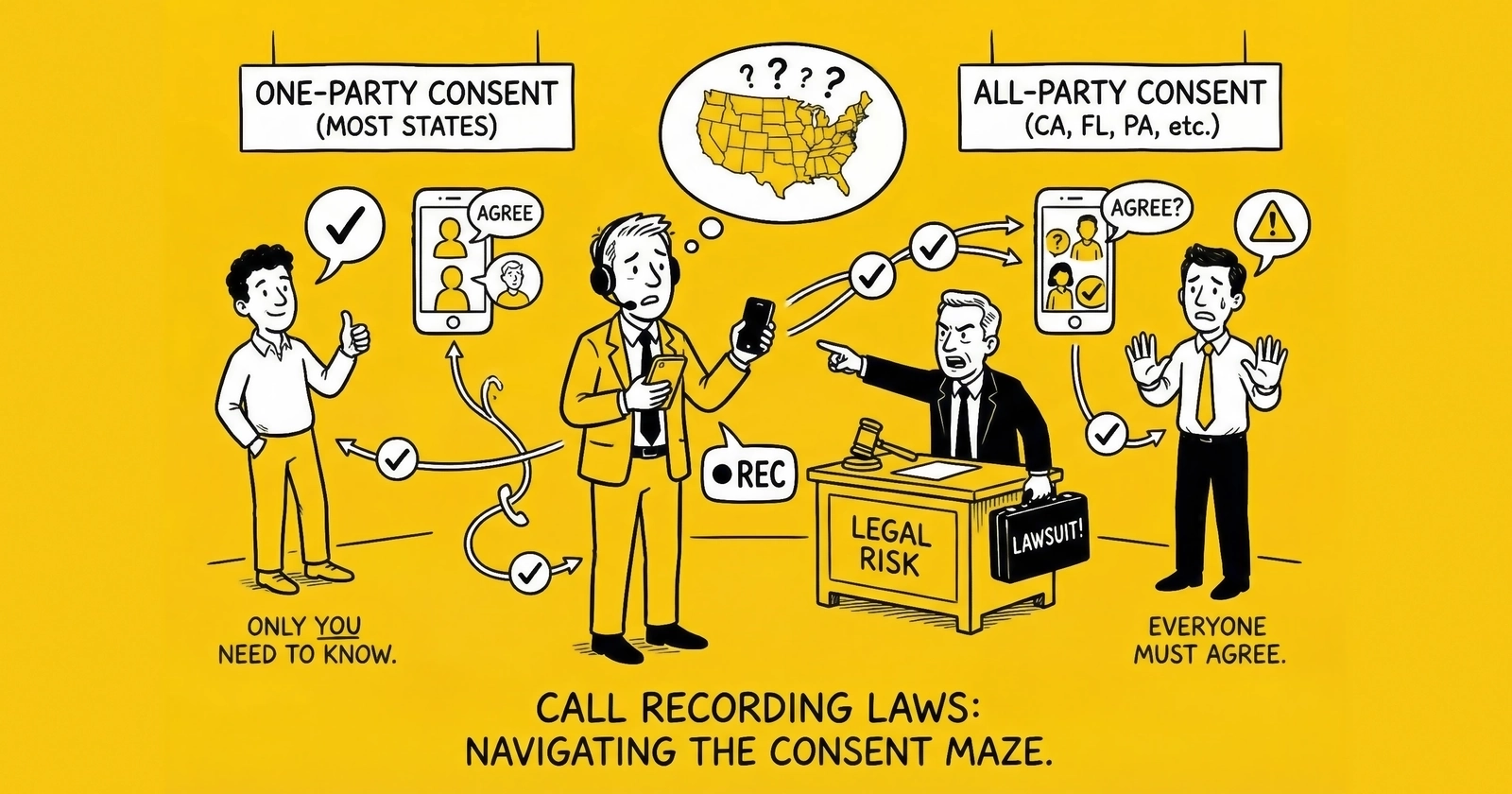
A comprehensive guide to call recording consent requirements across all 50 states, with practical compliance strategies for lead generation and sales operations.
Introduction: Why Call Recording Consent Matters
You recorded a sales call with a prospect in California without disclosing the recording. The call converted. The customer later complained. Now you are facing potential felony charges and civil liability that could exceed $5,000 per violation.
This is not a hypothetical scenario. It is a predictable outcome when operations fail to understand the patchwork of call recording consent laws across the United States.
For lead generation and sales operations, call recording serves essential business functions: quality assurance, compliance documentation, training, dispute resolution, and liability protection. But the act of recording a telephone conversation without proper consent violates federal and state wiretapping laws – with penalties that include criminal prosecution, civil damages, and professional sanctions. These requirements layer on top of TCPA compliance obligations that govern how and when you can contact consumers.
The complexity arises from a fundamental split in state law. Thirty-eight states and the federal government follow “one-party consent” rules – meaning you can record a call if at least one participant (including yourself) consents. But twelve states require “all-party consent” (commonly called “two-party consent”) – meaning every participant must agree before recording can legally occur.
When calls cross state lines, determining which law applies becomes more complex. When a one-party state caller contacts a two-party state resident, which rule governs? The answer varies by jurisdiction, creating compliance challenges that demand careful planning.
This guide provides state-by-state requirements, practical compliance strategies, and answers to the questions that matter most for operations that record telephone conversations.
Understanding One-Party vs Two-Party Consent
Before examining state-specific requirements, understanding the fundamental legal framework is essential.
One-Party Consent
In one-party consent jurisdictions, a conversation can be legally recorded if at least one participant consents to the recording. This means you can record your own conversations without notifying the other party.
The federal Wiretap Act (18 U.S.C. section 2511) follows this standard, making it legal under federal law to record a telephone conversation when you are a party to that conversation or when one party has given prior consent.
The practical implication is straightforward: in a one-party consent state, a sales representative can record calls with prospects without disclosure, provided no participant is located in a two-party consent state.
Two-Party (All-Party) Consent
In two-party consent jurisdictions, all parties to a conversation must consent before recording can occur. The term “two-party” is somewhat misleading – if a conference call has six participants, all six must consent.
This means you must obtain explicit consent from everyone on the call before pressing record when any participant is in a two-party consent state.
Why the Distinction Matters for Lead Generation
Lead generation operations make high volumes of calls across state lines. A call center in Texas (one-party consent) calling prospects throughout the country will regularly connect with consumers in California, Florida, Washington, and other two-party consent states.
Without proper consent procedures, each improperly recorded call represents a separate violation – potentially criminal in nature – with civil damages that accumulate quickly at scale.
Federal Law: The Baseline Standard
The federal Wiretap Act (18 U.S.C. section 2510-2522) establishes the federal standard for call recording consent. Understanding this baseline helps frame state-level requirements.
Federal Requirements
The federal standard permits recording when at least one party to the communication consents. This covers recording your own telephone conversations, recording when another participant has consented to the recording, and recording when you have obtained prior consent from at least one party.
Federal Penalties
Federal wiretapping violations carry significant penalties. On the criminal side, willful interception can result in up to five years imprisonment. Civil remedies include actual damages, punitive damages, reasonable attorney fees, and statutory damages of the greater of $100 per day of violation or $10,000.
State Preemption
Here is the critical point that creates compliance complexity: federal law does not preempt stricter state laws. When state law requires all-party consent and federal law permits one-party consent, the stricter state standard applies to calls involving that state’s residents.
You must satisfy both federal requirements and the requirements of every state with which your calls connect. This layered framework demands that operations default to the strictest applicable standard.
State-by-State Recording Consent Requirements
The following section provides a comprehensive breakdown of call recording consent requirements for all 50 states plus the District of Columbia. States are organized alphabetically with their consent standard, governing statute, key provisions, and penalty information.
Two-Party (All-Party) Consent States
These twelve jurisdictions require consent from all parties before recording a conversation.
California
Consent Requirement: All-party consent
Governing Statute: California Penal Code Section 632
California’s law applies to “confidential communications” – those made in circumstances reasonably indicating the parties intended the communication to be private. The statute covers both telephone conversations and in-person communications, and recording without consent constitutes a criminal offense.
Criminal penalties include imprisonment up to one year for misdemeanor violations or two to four years for felony convictions, with fines reaching $2,500 for misdemeanors or $10,000 for felonies. Civil damages can reach $5,000 per violation or three times actual damages, whichever is greater, plus attorney fees.
California’s law is among the most frequently litigated in the nation. Courts have interpreted the “confidential communication” element broadly – a call made to a business number during business hours may still be considered confidential.
Connecticut
Consent Requirement: All-party consent (with exceptions)
Governing Statute: Connecticut General Statutes Section 52-570d
Connecticut prohibits recording telephone communications without consent of all parties but provides a civil rather than criminal liability framework. Law enforcement with proper court orders receives an exception.
Penalties include actual damages, punitive damages, and attorney fees, though no statutory minimum exists.
Connecticut is sometimes classified as “mixed” because the criminal wiretapping statute (Section 53a-189) has been interpreted to permit one-party consent for in-person recordings, while Section 52-570d requires all-party consent for telephone recordings specifically.
Delaware
Consent Requirement: All-party consent
Governing Statute: Delaware Code Title 11, Section 2402
Delaware prohibits interception of wire, oral, or electronic communications without consent of all parties, applying to both recording and real-time interception.
Violations constitute a Class D felony with imprisonment up to five years. Civil remedies include actual damages, punitive damages, attorney fees, and statutory damages not less than liquidated damages of $100 per day of violation or $1,000, whichever is greater.
Florida
Consent Requirement: All-party consent
Governing Statute: Florida Statutes Section 934.03
Florida requires consent of all parties to intercept or record wire, oral, or electronic communications. The statute defines “interception” to include recording, though consent may be either express or implied.
Criminal penalties classify violations as third-degree felonies with imprisonment up to five years and fines up to $5,000. Civil remedies include actual damages with a $1,000 minimum, punitive damages, attorney fees, and litigation costs.
Florida is a major lead generation state. The combination of strict all-party consent requirements and the Florida Telephone Solicitation Act (FTSA) makes Florida calls particularly compliance-sensitive. Understanding state mini-TCPA laws like FTSA and OTSA is essential for operations targeting these markets.
Illinois
Consent Requirement: All-party consent
Governing Statute: 720 ILCS 5/14-2
Illinois requires consent of all parties to record any private conversation, applying to electronic, mechanical, or other recording devices. Recording in violation constitutes a Class 4 felony.
Penalties include imprisonment from one to three years and fines up to $25,000. Civil actions permit recovery of actual damages, punitive damages, and attorney fees.
Illinois’s eavesdropping law was previously struck down as unconstitutional in 2014, then reenacted with modifications in 2015. The current law focuses on “private” conversations with a reasonable expectation of privacy.
Maryland
Consent Requirement: All-party consent
Governing Statute: Maryland Courts and Judicial Proceedings Code Section 10-402
Maryland prohibits interception without consent of all parties, requiring that consent be express rather than implied. The statute applies to wire, oral, and electronic communications.
Criminal violations constitute felonies with imprisonment up to five years and fines up to $10,000. Civil remedies include actual damages, punitive damages, attorney fees, and statutory damages of the greater of $100 per day or $1,000.
Maryland also has the “Stop the Spam Calls Act” with 8 a.m. to 8 p.m. calling hour restrictions, making compliance with both recording consent and calling time requirements essential for operations in this state.
Massachusetts
Consent Requirement: All-party consent
Governing Statute: Massachusetts General Laws Chapter 272, Section 99
Massachusetts has among the strictest recording consent laws in the nation. The statute prohibits “secret” recording of any oral or wire communication with no exception for recording one’s own conversations without other party knowledge.
Criminal penalties include felony charges with imprisonment up to five years and fines up to $10,000. Civil remedies encompass actual damages or statutory damages of $100 per day or $1,000 (whichever is greater), plus punitive damages and attorney fees.
Massachusetts courts have interpreted this law strictly. Even recording for personal documentation without intent to disseminate may violate the statute.
Montana
Consent Requirement: All-party consent
Governing Statute: Montana Code Annotated Section 45-8-213
Montana requires consent of all parties to record private communications made with the reasonable expectation that the communication is not being overheard or recorded.
First offense violations constitute misdemeanors with imprisonment up to one year and fines up to $500. Civil remedies are available under state tort law.
Nevada
Consent Requirement: All-party consent
Governing Statute: Nevada Revised Statutes Section 200.620
Nevada’s all-party consent requirement applies only to telephone conversations. In-person recordings follow one-party consent under a separate statute (Section 200.650), requiring express consent of all parties only for telephone communications.
Violations constitute Category D felonies with imprisonment from one to four years and fines up to $5,000. Civil remedies include actual damages, punitive damages, and attorney fees.
Nevada’s split treatment – all-party for telephone, one-party for in-person – requires careful attention to communication medium.
New Hampshire
Consent Requirement: All-party consent
Governing Statute: New Hampshire Revised Statutes Section 570-A:2
New Hampshire prohibits interception of wire or oral communications without consent of all parties, applying to any device capable of recording.
Violations constitute Class B felonies with imprisonment up to seven years. Civil remedies include actual damages, punitive damages, and attorney fees.
Pennsylvania
Consent Requirement: All-party consent
Governing Statute: 18 Pennsylvania Consolidated Statutes Section 5704
Pennsylvania prohibits interception without consent of all parties for wire, electronic, and oral communications, providing for both criminal and civil penalties.
Criminal violations constitute third-degree felonies with imprisonment up to seven years. Civil remedies include actual damages with a minimum of $100 per day or $1,000, punitive damages, and attorney fees.
Pennsylvania is a major state for insurance and financial services lead generation. All-party consent requirements add compliance complexity for operations targeting this market.
Washington
Consent Requirement: All-party consent
Governing Statute: Revised Code of Washington Section 9.73.030
Washington requires consent of all parties to record private telephone conversations. Consent may be given verbally at the beginning of the call, applying to communications with a reasonable expectation of privacy.
Criminal violations constitute gross misdemeanors with imprisonment up to 364 days and fines up to $5,000. Civil penalties can reach $10,000, plus actual damages and attorney fees.
Washington State also has specific ADAD (Automatic Dialing and Announcing Device) regulations affecting lead generation operations.
One-Party Consent States
The remaining thirty-eight states and the District of Columbia follow one-party consent rules. In these jurisdictions, you may record a conversation to which you are a party without obtaining consent from other participants.
Alabama
Consent Requirement: One-party consent
Governing Statute: Alabama Code Section 13A-11-31
Alabama permits recording when one party consents for wire, oral, or electronic communications. Violations constitute Class C felonies with civil remedies also available.
Alaska
Consent Requirement: One-party consent
Governing Statute: Alaska Statutes Section 42.20.310
Alaska permits recording with consent of at least one party for private communications. Unlawful recording constitutes a Class A misdemeanor with civil damages available.
Arizona
Consent Requirement: One-party consent
Governing Statute: Arizona Revised Statutes Section 13-3005
Arizona permits recording when one party to the communication consents for wire and electronic communications. Unlawful interception constitutes a Class 5 felony with civil remedies available under state tort law.
Arkansas
Consent Requirement: One-party consent
Governing Statute: Arkansas Code Section 5-60-120
Arkansas permits recording with consent of one party for wire, oral, and electronic communications. Violations constitute Class D felonies with civil liability for actual damages.
Colorado
Consent Requirement: One-party consent
Governing Statute: Colorado Revised Statutes Section 18-9-303
Colorado requires one-party consent for recording. Recording without consent constitutes a Class 6 felony with civil remedies available.
District of Columbia
Consent Requirement: One-party consent
Governing Statute: District of Columbia Code Section 23-542
The District of Columbia permits recording with consent of at least one party, following the federal standard. Violations constitute felonies with imprisonment up to five years and civil damages available.
Georgia
Consent Requirement: One-party consent
Governing Statute: Georgia Code Section 16-11-66
Georgia’s one-party consent rule permits recording for oral, wire, and electronic communications. Violations constitute felonies with imprisonment from one to five years and civil liability for damages.
Hawaii
Consent Requirement: One-party consent
Governing Statute: Hawaii Revised Statutes Section 803-42
Hawaii permits recording with one-party consent for wire and oral communications. Violations constitute Class C felonies with civil damages including $1,000 minimum statutory damages.
Idaho
Consent Requirement: One-party consent
Governing Statute: Idaho Code Section 18-6702
Idaho follows the one-party consent standard for wire, electronic, or oral communications. Violations constitute felonies with imprisonment up to five years and civil remedies available.
Indiana
Consent Requirement: One-party consent
Governing Statute: Indiana Code Section 35-33.5-5-5
Indiana permits recording with consent of one party for intercepted communications. Violations constitute Level 5 felonies with civil liability for damages.
Iowa
Consent Requirement: One-party consent
Governing Statute: Iowa Code Section 808B.2
Iowa’s one-party consent standard permits recording for wire, oral, and electronic communications. Violations constitute Class D felonies with civil remedies available under statute.
Kansas
Consent Requirement: One-party consent
Governing Statute: Kansas Statutes Section 21-6101
Kansas permits recording with consent of at least one party for wire and oral communications. Violations constitute Severity level 8 felonies with civil damages available.
Kentucky
Consent Requirement: One-party consent
Governing Statute: Kentucky Revised Statutes Section 526.010
Kentucky follows the one-party consent standard for wire and oral communications. Violations constitute Class D felonies with civil liability available.
Louisiana
Consent Requirement: One-party consent
Governing Statute: Louisiana Revised Statutes Section 15:1303
Louisiana permits recording with one-party consent for wire, electronic, and oral communications. Violations carry imprisonment up to five years and fines up to $10,000, with civil remedies available.
Louisiana has specific holiday and emergency state calling restrictions that affect lead generation operations beyond recording consent.
Maine
Consent Requirement: One-party consent
Governing Statute: Maine Revised Statutes Title 15, Section 709
Maine’s one-party consent standard permits recording for wire, oral, and electronic communications. Violations constitute Class C crimes with civil damages available.
Michigan
Consent Requirement: One-party consent
Governing Statute: Michigan Compiled Laws Section 750.539c
Michigan permits recording with consent of at least one party for private conversations. Violations constitute felonies with imprisonment up to two years and civil liability for damages.
Minnesota
Consent Requirement: One-party consent
Governing Statute: Minnesota Statutes Section 626A.02
Minnesota follows the one-party consent standard for wire, electronic, and oral communications. Violations constitute felonies with civil damages and attorney fees available.
Mississippi
Consent Requirement: One-party consent
Governing Statute: Mississippi Code Section 41-29-531
Mississippi permits recording with one-party consent under a limited statutory framework. Penalties apply under general criminal law with civil remedies available.
Missouri
Consent Requirement: One-party consent
Governing Statute: Missouri Revised Statutes Section 542.402
Missouri’s one-party consent standard permits recording for wire communications. Violations constitute Class D felonies with civil damages available.
Nebraska
Consent Requirement: One-party consent
Governing Statute: Nebraska Revised Statutes Section 86-290
Nebraska permits recording with consent of one party for wire and electronic communications. Violations constitute Class IV felonies with civil remedies available under statute.
New Jersey
Consent Requirement: One-party consent
Governing Statute: New Jersey Statutes Section 2A:156A-4
New Jersey follows the one-party consent standard for wire, electronic, and oral communications. Violations constitute crimes of the third degree with civil remedies including actual damages, punitive damages, and attorney fees.
New Mexico
Consent Requirement: One-party consent
Governing Statute: New Mexico Statutes Section 30-12-1
New Mexico permits recording with consent of at least one party for wire and oral communications. Violations range from petty misdemeanor to fourth-degree felony with civil damages available.
New York
Consent Requirement: One-party consent
Governing Statute: New York Penal Law Section 250.00
New York’s one-party consent rule permits recording for telephonic and oral communications. Violations constitute Class E felonies with civil damages available.
New York has specific telemarketing licensing requirements that affect lead generation operations beyond recording consent.
North Carolina
Consent Requirement: One-party consent
Governing Statute: North Carolina General Statutes Section 15A-287
North Carolina permits recording with consent of one party for wire, oral, and electronic communications. Violations constitute Class H felonies with civil remedies available under statute.
North Dakota
Consent Requirement: One-party consent
Governing Statute: North Dakota Century Code Section 12.1-15-02
North Dakota follows the one-party consent standard for wire and oral communications. Violations constitute Class C felonies with civil damages available.
Ohio
Consent Requirement: One-party consent
Governing Statute: Ohio Revised Code Section 2933.52
Ohio permits recording with consent of at least one party for wire, oral, and electronic communications. Violations constitute fourth-degree felonies with civil damages and attorney fees available.
Oklahoma
Consent Requirement: One-party consent
Governing Statute: Oklahoma Statutes Title 13, Section 176.4
Oklahoma’s one-party consent standard permits recording for wire and electronic communications. Violations constitute felonies with civil remedies available.
Oklahoma’s Telephone Solicitation Act (OTSA) includes separate compliance requirements including the three-call-per-24-hour limit and registration requirements.
Oregon
Consent Requirement: One-party consent
Governing Statute: Oregon Revised Statutes Section 165.540
Oregon permits recording with consent of one party, though certain telephonic conversations involving electronic communications may require all-party consent under specific conditions.
Violations constitute Class A misdemeanors with civil damages including $200 minimum statutory damages.
Oregon’s law includes complexity around electronic communications. The general rule is one-party consent, but specific provisions may require additional consent for certain telephonic recordings. Consult Oregon counsel for specific applications.
Rhode Island
Consent Requirement: One-party consent
Governing Statute: Rhode Island General Laws Section 11-35-21
Rhode Island follows the one-party consent standard for wire and oral communications. Violations constitute felonies with imprisonment up to five years and civil damages available.
South Carolina
Consent Requirement: One-party consent
Governing Statute: South Carolina Code Section 17-30-30
South Carolina permits recording with consent of at least one party for wire, oral, and electronic communications. Violations constitute misdemeanors with imprisonment up to one year and civil remedies available under statute.
South Dakota
Consent Requirement: One-party consent
Governing Statute: South Dakota Codified Laws Section 23A-35A-20
South Dakota’s one-party consent standard permits recording for wire communications. Violations constitute Class 1 misdemeanors with civil damages available.
Tennessee
Consent Requirement: One-party consent
Governing Statute: Tennessee Code Section 39-13-601
Tennessee permits recording with consent of one party for wire, oral, and electronic communications. Violations constitute Class D felonies with civil remedies for actual damages.
Texas
Consent Requirement: One-party consent
Governing Statute: Texas Penal Code Section 16.02
Texas follows the one-party consent standard for wire, oral, and electronic communications. Violations range from state jail felony to second-degree felony with civil damages including $10,000 minimum statutory damages and punitive damages.
Texas is a major lead generation state. While one-party consent applies to recording, the state has separate calling time restrictions (9 AM - 9 PM Monday-Saturday; 12 PM - 9 PM Sunday) and telemarketer registration requirements.
Utah
Consent Requirement: One-party consent
Governing Statute: Utah Code Section 77-23a-4
Utah permits recording with consent of at least one party for wire, oral, and electronic communications. Violations constitute third-degree felonies with civil damages available.
Vermont
Consent Requirement: One-party consent
Governing Statute: Vermont Statutes Title 13, Section 1408
Vermont’s one-party consent standard permits recording for wire and oral communications. Violations carry imprisonment up to five years and fines up to $10,000, with civil damages and attorney fees available.
Virginia
Consent Requirement: One-party consent
Governing Statute: Virginia Code Section 19.2-62
Virginia permits recording with consent of one party for wire, oral, and electronic communications. Violations constitute Class 6 felonies with civil damages available.
Virginia updated its telemarketing laws effective January 2026, including a 10-year opt-out honor period – one of the longest in the nation.
West Virginia
Consent Requirement: One-party consent
Governing Statute: West Virginia Code Section 62-1D-3
West Virginia follows the one-party consent standard for wire, oral, and electronic communications. First offense violations constitute misdemeanors with subsequent offenses becoming felonies. Civil remedies are available under statute.
Wisconsin
Consent Requirement: One-party consent
Governing Statute: Wisconsin Statutes Section 968.31
Wisconsin permits recording with consent of at least one party for wire, oral, and electronic communications. Violations constitute Class H felonies with civil damages and attorney fees available.
Wyoming
Consent Requirement: One-party consent
Governing Statute: Wyoming Statutes Section 7-3-702
Wyoming’s one-party consent standard permits recording for wire and oral communications. Violations constitute misdemeanors with imprisonment up to six months and civil remedies available.
Two-Party Consent States Quick Reference
For rapid reference, here are the twelve jurisdictions requiring all-party consent:
| State | Statute | Key Feature |
|---|---|---|
| California | Penal Code 632 | $5,000 per violation or 3x damages |
| Connecticut | CGS 52-570d | Civil liability only; telephone specific |
| Delaware | 11 Del.C. 2402 | Class D felony |
| Florida | FS 934.03 | Third-degree felony; $1,000 minimum civil |
| Illinois | 720 ILCS 5/14-2 | Class 4 felony |
| Maryland | CJP 10-402 | Express consent required |
| Massachusetts | MGL c.272 s.99 | ”Secret” recording prohibited; very strict |
| Montana | MCA 45-8-213 | Misdemeanor first offense |
| Nevada | NRS 200.620 | Telephone only; in-person is one-party |
| New Hampshire | RSA 570-A:2 | Class B felony |
| Pennsylvania | 18 Pa.C.S. 5704 | Third-degree felony |
| Washington | RCW 9.73.030 | Gross misdemeanor; $10,000 civil penalty |
Interstate Calls: Which Law Applies?
When a call crosses state lines, determining which consent standard applies becomes complex. There is no universal rule, and courts in different jurisdictions have reached different conclusions.
General Principles
The legal landscape for interstate calls involves several competing approaches. Many courts apply the stricter standard approach, meaning if a one-party consent state caller contacts a two-party consent state resident, the all-party consent requirement applies. Other courts focus on the location of recording – if recording equipment is located in a one-party consent state, that state’s more permissive rule may apply, though this analysis is fact-specific.
Some jurisdictions examine the location of parties, applying the consent requirements of the most restrictive jurisdiction. Courts also consider intent and knowledge: if a caller knows or should know the recipient is in a two-party consent state, courts are more likely to apply that state’s stricter requirement.
Practical Compliance Approach
Given this legal uncertainty, the safest approach for operations making interstate calls is straightforward: assume two-party consent requirements apply to all calls.
This means disclosing recording at the outset with language such as “This call may be recorded for quality and training purposes.” It means obtaining affirmative consent through verbal acknowledgment like “I understand” or through continued participation after disclosure, depending on jurisdiction. It means documenting the disclosure through automated pre-call announcements that create consistent records. And it means training staff on consent so representatives can confirm consent if disclosure is not automated.
This approach eliminates the need to determine recipient location before each call and provides defensible documentation if recording consent is later challenged.
Compliance Strategies for Lead Generation Operations
Building compliant call recording systems requires systematic approaches that work at scale.
Strategy 1: Universal Disclosure and Consent
The most conservative and operationally simple approach applies two-party consent procedures to all calls, regardless of state.
Implementation involves three elements. First, deliver a pre-call automated announcement such as “This call may be recorded for quality assurance and training purposes. By continuing this call, you consent to recording.” Second, have representatives provide verbal disclosure: “I need to let you know this call is being recorded. Is that okay with you?” Third, record the timestamp and method of consent for each call.
This approach offers significant advantages. It eliminates the need for state-by-state routing rules, provides defensible consent documentation for all jurisdictions, and simplifies training and compliance monitoring.
The disadvantages are relatively minor. Some callers may decline consent or terminate calls, call duration increases marginally, and the disclosure may feel impersonal to some prospects. For most lead generation operations, the compliance certainty far outweighs these disadvantages.
Strategy 2: State-Based Routing with Differential Procedures
Operations that want to avoid disclosure in one-party consent states can implement routing logic that applies different procedures based on recipient location.
Implementation requires geocoding recipient phone numbers to determine state, applying disclosure requirements only for two-party consent state calls, routing calls through state-specific IVR flows, and documenting which procedure applied to each call.
This approach faces several challenges. Area codes are unreliable for mobile number location. Geocoding adds system complexity and potential latency. The system requires ongoing maintenance as laws change. And training becomes more complex for representatives who must understand different procedures.
This approach makes sense only in specific circumstances: very high call volumes where disclosure impacts measurably reduce conversion, calls concentrated in one-party consent states with minimal two-party state exposure, and sophisticated technology infrastructure capable of state-based routing.
For most operations, the complexity does not justify the marginal benefit.
Strategy 3: Consent-Based Recording Activation
Some operations only record calls where consent has been obtained, deactivating recording when consent is declined or uncertain.
This approach requests consent at call outset, continues calls without recording if consent is declined, and documents consent status for each call.
The challenges are significant. The approach creates inconsistent documentation across calls, may miss recording compliance-critical interactions, and is difficult to implement with predictive dialers.
Technology Integration Requirements
Regardless of which strategy you choose, call recording systems should include several core capabilities.
Automated disclosure capability means IVR systems that deliver consistent disclosure language before representative connection. Consent logging requires automated capture of consent timestamp, method (verbal, continued participation, explicit acknowledgment), and call identifier. Recording toggle provides the ability to disable recording mid-call if consent is withdrawn. State-based rules engine enables real-time determination of recipient state and applicable rules if using differential procedures. Audit trail ensures complete documentation of disclosure and consent for each recorded call, retained for the applicable statute of limitations period.
Documentation and Retention
Proper documentation provides essential protection if recording consent is later challenged.
For each call, document the date and time, caller identification, recipient phone number, recipient state if determinable, disclosure method used, whether consent was obtained and by what method, and the recording file identifier.
State statutes of limitations for wiretapping claims vary from one to six years. Retain consent documentation for at least six years after the call to cover the longest applicable limitation period.
Special Considerations
Call Centers and Outsourced Operations
When outsourcing call operations, contractual provisions should address recording consent requirements comprehensively. Require service provider compliance with all applicable recording consent laws. Mandate disclosure procedures and consent documentation. Include audit rights to verify compliance. Address liability allocation for non-compliant recordings.
Recording Third-Party Transfers
When live transferring calls, consent obtained during the initial call may not extend to the subsequent conversation. Best practice involves repeating recording disclosure upon transfer connection, obtaining fresh consent from the transferee, and documenting consent at each stage of multi-party calls.
Conference Calls and Multiple Parties
When calls involve multiple participants, all-party consent requires consent from everyone on the call – not just two parties. Ensure disclosure reaches all participants before recording begins.
Voicemail and Recorded Messages
Leaving recorded voicemails generally does not trigger consent requirements because the recipient is not participating in a conversation. However, monitoring or recording the act of leaving a voicemail from the caller’s side may require consent.
Mobile Applications and Text Messaging
Text message communications involve different consent frameworks under the TCPA and state mini-TCPA laws. Call recording consent statutes generally do not apply to text messages, but SMS consent requirements (PEWC under TCPA) remain applicable.
Penalties and Liability Summary
Understanding potential consequences motivates compliance investment.
Criminal Penalties
Wiretapping violations carry criminal penalties in most states. Felony classifications apply in most states, typically carrying one to seven years imprisonment and fines ranging from $2,500 to $25,000. Misdemeanor classifications apply in Montana, South Carolina, South Dakota, Wyoming, and Washington, typically carrying up to one year imprisonment and fines up to $5,000.
Civil Damages
Civil remedies vary by state but typically include several categories. Actual damages cover lost profits, emotional distress, and reputational harm. Statutory damages provide fixed amounts per violation ranging from $100 to $5,000 depending on state. Punitive damages are available in many states for willful violations. Attorney fees are often recoverable by prevailing plaintiffs.
Class Action Exposure
Recording consent violations can support class action litigation when common disclosure practices affected multiple recipients, standardized procedures created uniform violations, and damages per class member aggregate to substantial totals.
Consider the math: a call center recording 10,000 calls per month without proper consent, at $500 per violation minimum statutory damages in a state like Pennsylvania, faces $60 million annual exposure – before punitive damages and attorney fees.
Frequently Asked Questions
1. What is the difference between one-party and two-party consent states?
One-party consent states permit recording a conversation when at least one participant (including yourself) consents to the recording. You do not need to notify other parties. Two-party (all-party) consent states require consent from all participants before recording can legally occur. Currently, twelve states require all-party consent: California, Connecticut, Delaware, Florida, Illinois, Maryland, Massachusetts, Montana, Nevada, New Hampshire, Pennsylvania, and Washington.
2. Which law applies when I call someone in a different state?
When calls cross state lines, legal uncertainty exists regarding which state’s law applies. Courts have reached different conclusions in different jurisdictions. The safest approach is to apply the stricter standard – if either party is in a two-party consent state, obtain consent from all parties before recording. This eliminates the need to resolve the choice-of-law question.
3. Does saying “This call may be recorded” constitute valid consent?
In most jurisdictions, continued participation in a call after disclosure constitutes implied consent. However, some states (notably Maryland and Massachusetts) prefer or require express consent. Best practice is to obtain affirmative acknowledgment: “Do you consent to this call being recorded?” followed by a verbal “yes” provides clearer documentation than implied consent through continued participation.
4. Can I record calls for quality assurance without consent?
In one-party consent states, you can record your own business calls for quality assurance purposes without notifying the other party. In two-party consent states, you must obtain consent from all parties before recording for any purpose, including quality assurance. The purpose of recording does not create an exception to consent requirements.
5. What happens if I record a call without proper consent?
Recording without proper consent can result in criminal prosecution (felony charges in many states), civil liability (statutory damages plus actual damages and attorney fees), and exclusion of the recording as evidence in any legal proceeding. In states like California, civil damages can reach $5,000 per violation or three times actual damages, whichever is greater.
6. Do call recording consent laws apply to text messages?
Generally, no. Call recording consent statutes govern interception of oral and wire communications – live conversations. Text messages are governed by different legal frameworks, including the TCPA requirements for prior express written consent for marketing texts. However, the legal landscape continues to evolve, so consult current guidance for specific applications.
7. How should I document consent for recorded calls?
Best practice documentation includes the date and time of the call, the method of disclosure (automated announcement, verbal disclosure), the form of consent obtained (express verbal consent, implied through continued participation), a unique identifier linking the consent record to the actual recording, and retention of this documentation for at least six years to cover statute of limitations periods across jurisdictions.
8. Can consent be revoked during a call?
Yes. If a party who previously consented states during the call that they no longer wish to be recorded, you must either stop recording or terminate the call. Best practice is to stop the recording immediately and continue the conversation unrecorded if appropriate for business purposes.
9. What is the federal wiretapping law standard?
The federal Wiretap Act (18 U.S.C. section 2511) follows a one-party consent standard. Under federal law, you may record a conversation to which you are a party without obtaining consent from other participants. However, federal law does not preempt stricter state laws, so you must comply with both federal requirements and any applicable state requirements.
10. Does the recording consent requirement apply to my entire organization or just the person recording?
The consent requirement applies to the act of recording, regardless of who within an organization performs it. If your company records calls, your company must ensure proper consent is obtained – whether the recording is triggered by an automated system, a quality assurance team member, or the representative on the call.
Key Takeaways
-
Twelve states require all-party consent for call recording: California, Connecticut, Delaware, Florida, Illinois, Maryland, Massachusetts, Montana, Nevada, New Hampshire, Pennsylvania, and Washington. All other states and the federal government follow one-party consent rules.
-
Interstate calls create uncertainty about applicable law. When callers and recipients are in different states, courts have applied various tests to determine which state’s law governs. The safest approach is to assume the stricter standard applies and obtain consent from all parties.
-
Universal disclosure and consent is the most practical compliance approach. Implementing recording disclosure for all calls, regardless of state, eliminates the need for state-specific routing logic and provides defensible consent documentation for all jurisdictions.
-
Penalties for non-compliant recording are severe. Criminal charges (felony in most states), civil damages ($100-$5,000+ per violation), punitive damages, and attorney fees create substantial exposure. High-volume operations face potentially catastrophic aggregate liability.
-
Documentation is essential. Retain consent records for at least six years, including timestamp, disclosure method, consent form, and recording identifier. This documentation provides the primary defense if consent is later challenged.
-
“This call may be recorded” is generally sufficient but not always optimal. Continued participation after disclosure typically constitutes implied consent, but express verbal consent (“Do you agree to recording?”) provides clearer documentation, particularly for stricter states like Massachusetts and Maryland.
-
State laws continue to evolve. Recording consent requirements can change through legislation, regulatory action, and court interpretation. Monitor developments in states where you conduct significant call volume and update procedures accordingly.
-
Two-party consent states overlap with lead generation hotspots. California, Florida, Pennsylvania, and Washington are major states for insurance, mortgage, solar, and other lead verticals. Compliance with all-party consent requirements is particularly critical for operations in these markets.
Sources
- Federal Wiretap Act - 18 U.S.C. 2510-2522 - Federal one-party consent standard and criminal penalties
- Reporters Committee for Freedom of the Press - Recording Guide - State-by-state recording consent law reference
- Digital Media Law Project - Recording Laws - Legal analysis of one-party vs two-party consent requirements
- California Penal Code Section 632 - California two-party consent statute with $5,000 per violation damages
- Florida Statute 934.03 - Florida Security of Communications Act requiring all-party consent
Build Compliance Before You Need It
The arithmetic of call recording violations is unforgiving. A single improperly recorded call in California can generate $5,000 or more in civil liability. A call center recording 1,000 California calls per month without proper consent faces $60 million annual exposure – before punitive damages and criminal prosecution.
The cost of compliance – automated disclosure systems, consent documentation procedures, staff training – is trivial by comparison. A well-designed IVR announcement costs almost nothing to implement. Training representatives to confirm consent takes minutes. The return on this investment is avoiding liability that can end a business.
Every call you record without proper consent is a bet that no one will ever challenge the recording. That bet becomes less favorable with each passing year as regulatory enforcement intensifies and plaintiff attorneys grow more sophisticated about identifying recording consent violations.
For lead generation operations, where calls are the business, the path forward is clear: implement universal disclosure, document consent systematically, and eliminate the uncertainty that creates liability. Those who build these systems now avoid the courtroom consequences that await those who defer.
This article provides general information about call recording consent laws. It is not legal advice. Recording consent requirements vary by state and continue to evolve through legislation and court decisions. Consult qualified legal counsel familiar with the specific states in which you operate for current compliance requirements.
Information current as of December 2025.