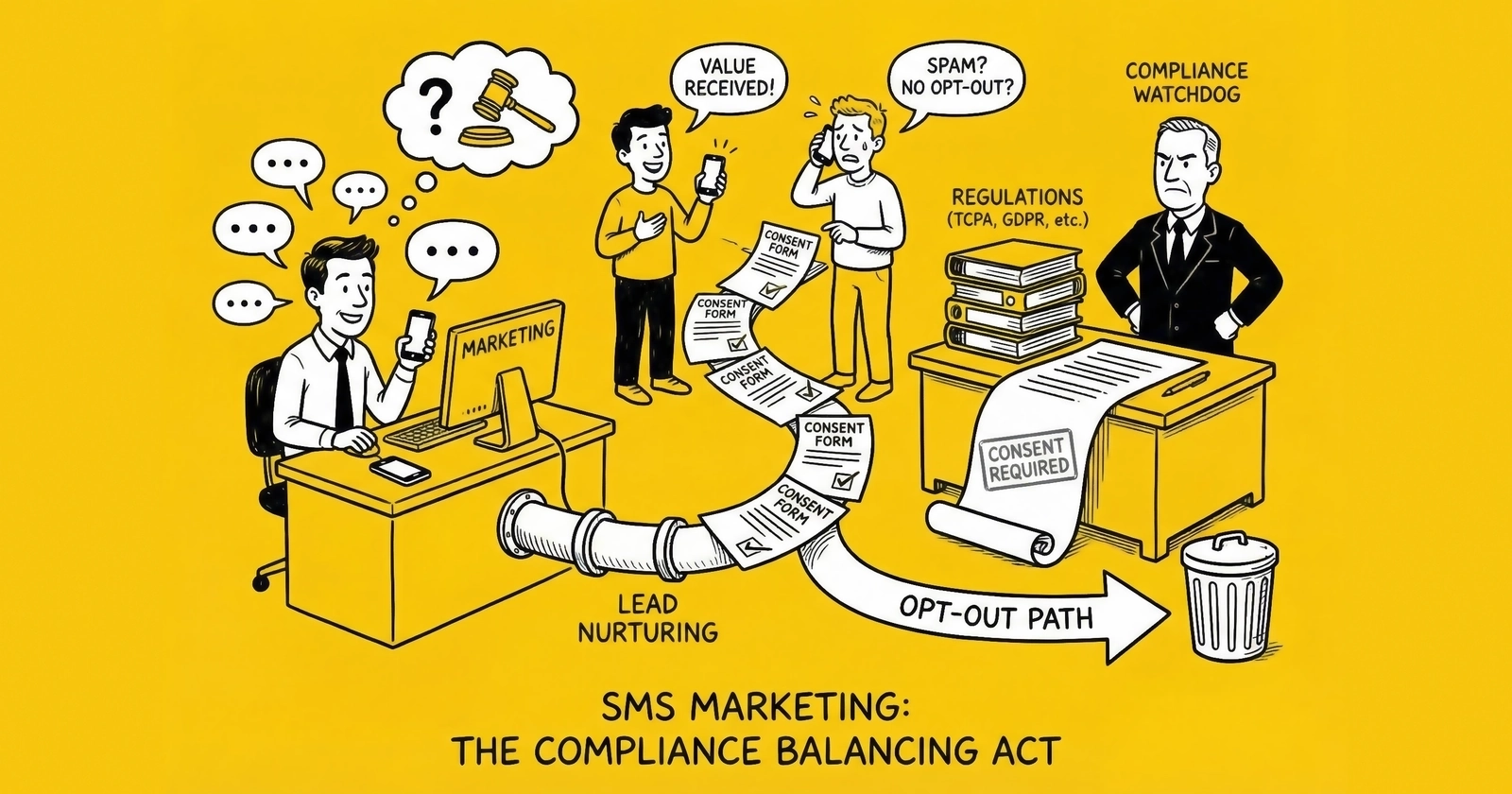
The technical implementation guide for SMS sending infrastructure in lead generation: registration, carrier vetting, throughput configuration, and opt-in/opt-out keyword mechanics.
Compliant SMS consent language on a lead form is necessary but not sufficient. The lead generator who writes a perfect consent disclosure and then sends messages from an unregistered 10DLC number has done half the compliance work and retained most of the risk.
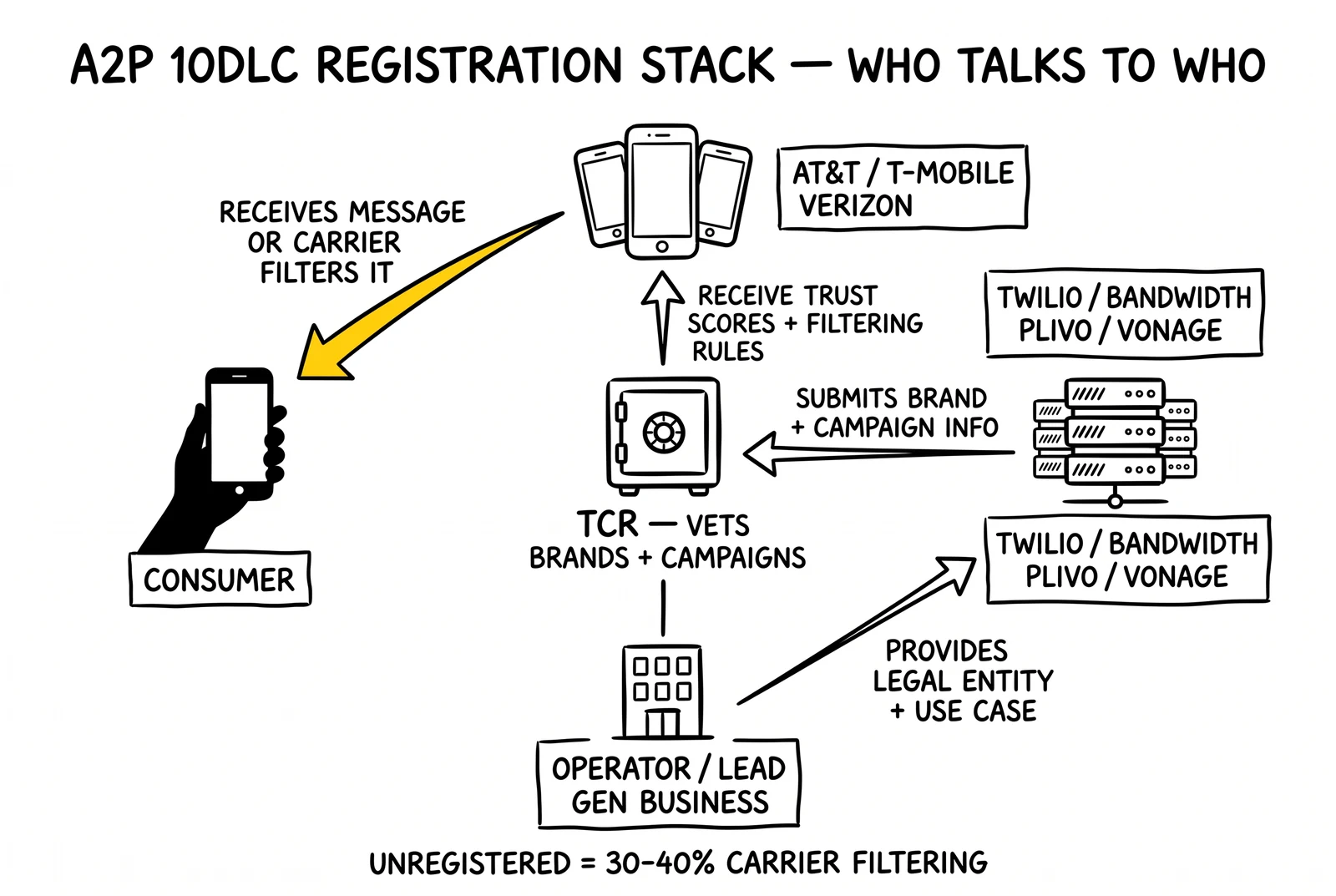
Carrier filtering of unregistered A2P SMS traffic now removes 30-40% of messages before they reach recipients. Carriers can suspend unregistered numbers with no advance notice. And unlike TCPA violations – which require a plaintiff to bring a lawsuit – carrier filtering happens automatically, silently, and immediately.
This guide covers the infrastructure layer: the Campaign Registry, carrier vetting, trust scores, throughput tiers, and the specific technical configuration for opt-in and opt-out keyword handling that determines whether messages get delivered and whether revocations get processed.
The Three SMS Sending Types
Before choosing registration paths, understand that not all business SMS sending is structurally identical. The three sending types have different carrier relationships, registration requirements, cost structures, and throughput ceilings.
Person-to-Person (P2P)
P2P messaging is direct human-to-human communication. An agent manually typing a text to a lead from their personal phone is technically P2P. Carriers permit P2P traffic without registration but limit volume and prohibit automation.
The practical constraint: P2P has a throughput ceiling of approximately 1-15 messages per second from a single number, and carriers monitor for P2P numbers exhibiting automated sending patterns. Numbers that show P2P traffic volumes exceeding human capability face suspension.
For lead nurturing at any meaningful scale, P2P is not viable. An operation sending 500 leads per day through a single agent’s phone – even if technically possible – creates liability under both TCPA (the consent requirements still apply) and carrier policies.
Application-to-Person (A2P)
A2P is the category that covers all business-to-consumer SMS sent via software platforms. Automated lead nurturing sequences, appointment reminders, qualification questions, and re-engagement campaigns are all A2P.
Carriers require registration for A2P traffic. The registration system, managed through The Campaign Registry (TCR), establishes the brand and the use case before messages can be sent. Registered A2P traffic has higher throughput allowances, lower filtering rates, and defined compliance obligations.
All SMS lead generation nurturing is A2P. The registration question is not whether to register – it is which registration path to use.
Over-the-Top (OTT)
OTT messaging uses data connections rather than SMS carrier infrastructure. WhatsApp, iMessage (when both parties have Apple devices), and Facebook Messenger are OTT. These are distinct regulatory environments from TCPA-regulated SMS.
OTT is not covered in this guide – the technical setup differs entirely and the regulatory framework is not TCPA-based.
The Campaign Registry: Structure and Function
The Campaign Registry (TCR) is the central vetting authority for A2P 10DLC SMS in the United States. Established in 2021 through a coordination between the major carriers (AT&T, T-Mobile, Verizon), TCR reviews brands and campaigns before authorizing A2P sending.
How TCR Works
TCR operates as a hub-and-spoke system. Brands register their identity through a Connectivity Service Provider (CSP) – typically the SMS platform they use (Twilio, Bandwidth, Plivo, Vonage, etc.). The CSP submits brand and campaign information to TCR. TCR vets the information and assigns trust scores. Carriers receive trust scores and filtering instructions from TCR.
The operator’s relationship is with their SMS platform, not directly with TCR. The platform manages the TCR API integration and the carrier relationships. The operator provides the information; the platform submits it.
This structure means the SMS platform choice matters significantly for registration outcomes. Platforms with established TCR relationships and high-volume CSP status often achieve better throughput allocations than newer platforms with limited carrier history.
TCR Data as Public Record
Registration data submitted to TCR is shared with all major carriers. Brand information – legal name, EIN, business category, contact information – becomes visible to AT&T, T-Mobile, and Verizon through the carrier vetting process. This is not a privacy concern for most businesses, but it does mean that the information submitted must be accurate. Discrepancies between TCR submissions and public business records are a leading cause of registration rejection.
Brand Registration: Step-by-Step
Brand registration establishes the legal entity sending messages. Every business sending A2P SMS must complete brand registration before campaign registration.
Required Information for Brand Registration
Legal company information:
- Legal business name (must match state registration exactly)
- DBA (if different from legal name)
- Business type: Sole Proprietor, Partnership, Corporation, Co-operative, LLC, Non-profit
- EIN (Employer Identification Number) – required for all business types except sole proprietors
- Business address (registered address, not operational address if different)
- Business phone number
- Website URL
Contact information:
- Name and email of technical contact (person managing SMS platform)
- Name and email of support contact (different from technical contact for larger operations)
Business categorization:
- Vertical (carriers use this to apply vertical-specific filtering rules)
- Industry type
Sole Proprietor Registration
Sole proprietors without EINs register under their Social Security Number. This creates two practical issues:
First, throughput is limited. Sole proprietor brands receive the lowest trust scores and throughput allocations because they cannot be verified against public business registries the way incorporated entities can.
Second, the registration uses personal information submitted to TCR and shared with carriers. This is legally fine but operationally uncomfortable for some operators.
For any lead generation operation at meaningful scale (more than 500 leads per month), forming an LLC and obtaining an EIN before registration is worth the administrative investment. The throughput difference between a verified LLC and a sole proprietor can be 5-10x.
The Vetting Process
After submission, TCR verifies the brand against public data sources: Secretary of State business registries, DUNS records, website content, and other business verification systems. The vetting process typically takes 1-3 business days for standard business types with matching public records.
Common rejection reasons:
- Legal name does not match state business registration
- EIN cannot be verified against IRS records (new businesses whose EIN is not yet in verification databases)
- Business address does not appear in any verifiable records
- Website does not match the stated business type
If the brand registration is rejected, the platform’s support team usually indicates the specific mismatch. Correction and resubmission resets the timeline.
Brand Trust Scores
TCR assigns a Russell 3000 stock index flag for publicly traded companies, which automatically results in high trust scores. For private companies, TCR’s vetting algorithm assigns a trust score based on business verification, industry category, and CSP relationship.
Trust scores are not published directly to brands. The practical indicator is the throughput tier assigned after campaign registration. Higher trust scores result in higher throughput allocations, which the platform typically communicates in their dashboard or documentation.
Campaign Registration: Classifying Your Use Case
Brand registration establishes who is sending. Campaign registration establishes what they are sending and why. Each use case requires a separate campaign registration.
Campaign Use Case Categories
TCR organizes campaigns into use case categories. The category assigned affects vetting scrutiny, throughput, and carrier filtering behavior.
Standard use cases (relevant to lead generation):
Marketing: Commercial messages promoting products or services. Appropriate for re-engagement campaigns, offer-based outreach, and promotional nurturing sequences. This category receives standard vetting.
Lead Generation: Specifically covers messages related to lead capture and qualification. This is the most appropriate use case for most lead nurturing operations. Distinct from Marketing in that it covers qualification and conversion messaging, not just promotional content.
Notifications: Non-marketing informational messages – appointment reminders, delivery confirmations, transaction notifications. Appointment reminders sent to leads fall here if they contain no promotional content.
Conversational: Two-way messaging conversations, including qualification questions and appointment scheduling dialogues. Appropriate for branching conversation flows.
Polling/Surveys: Qualification questions structured as yes/no or multiple-choice responses can fall here if the primary purpose is information gathering rather than conversion.
Higher-scrutiny use cases:
Free Trial: Any message referencing a free trial, free pilot, or no-cost initial offer. This category receives additional carrier review because of historical abuse.
Sweepstakes: Any reference to contests, sweepstakes, or prize-based incentives. High scrutiny.
Prohibited use cases:
Cannabis, payday lending, firearms, gambling, sexually explicit content – these categories are prohibited by major carriers regardless of legal status in a given state.
Campaign Registration: Required Information
Campaign description: A plain-language description of what messages will be sent and why. Vague descriptions fail; specific descriptions pass.
Failing description: “Marketing messages to customers.”
Passing description: “TCPA-compliant lead nurturing messages sent to consumers who have submitted insurance quote requests and provided prior express written consent. Messages include acknowledgment of quote request, appointment scheduling, and qualification questions. Consumers are informed of the purpose at time of consent capture.”
Use case category: Primary category and secondary categories if applicable.
Sample messages: Minimum two, recommended four to six. Sample messages must be representative of actual messages sent. If the samples reference insurance and the campaign later sends messages about mortgage, the discrepancy creates carrier compliance issues.
Sample messages must include:
- Opt-out language (e.g., “Reply STOP to unsubscribe”)
- Any applicable disclosures (e.g., “Msg&Data rates may apply”)
- Representative content reflecting the registered use case
Opt-in mechanism description: How consumers provide consent. Describe the specific process: “Consumers check an unchecked checkbox on a lead form containing the disclosure: [exact text]. The checkbox is not pre-checked. The consumer must actively check it before submitting the form. The consent is captured with timestamp, IP address, and page URL via [verification system].”
Opt-out handling description: How the system processes opt-out requests. Describe keyword detection and suppression process: “Opt-out keywords (STOP, QUIT, CANCEL, UNSUBSCRIBE, END, REVOKE, OPT OUT) are detected in real-time via [platform]. Receipt of any keyword triggers immediate suppression. A one-time confirmation is sent within five minutes. The opted-out number is permanently added to the suppression list and checked before any subsequent message sends.”
Embedded links: Whether messages contain URLs, and what domains will appear. Campaigns with URLs are subject to additional carrier scrutiny. Short URLs from generic shorteners (bit.ly, tinyurl) will be rejected – use full domain URLs or branded short domains.
Embedded phone numbers: Whether messages will include phone numbers for consumers to call. Including phone numbers in messages is permitted but triggers review of the phone number’s registration and carrier reputation.
Campaign Costs
Registration fees vary by platform but follow TCR’s published pricing:
- Brand registration: $4-15 one-time (varies by platform)
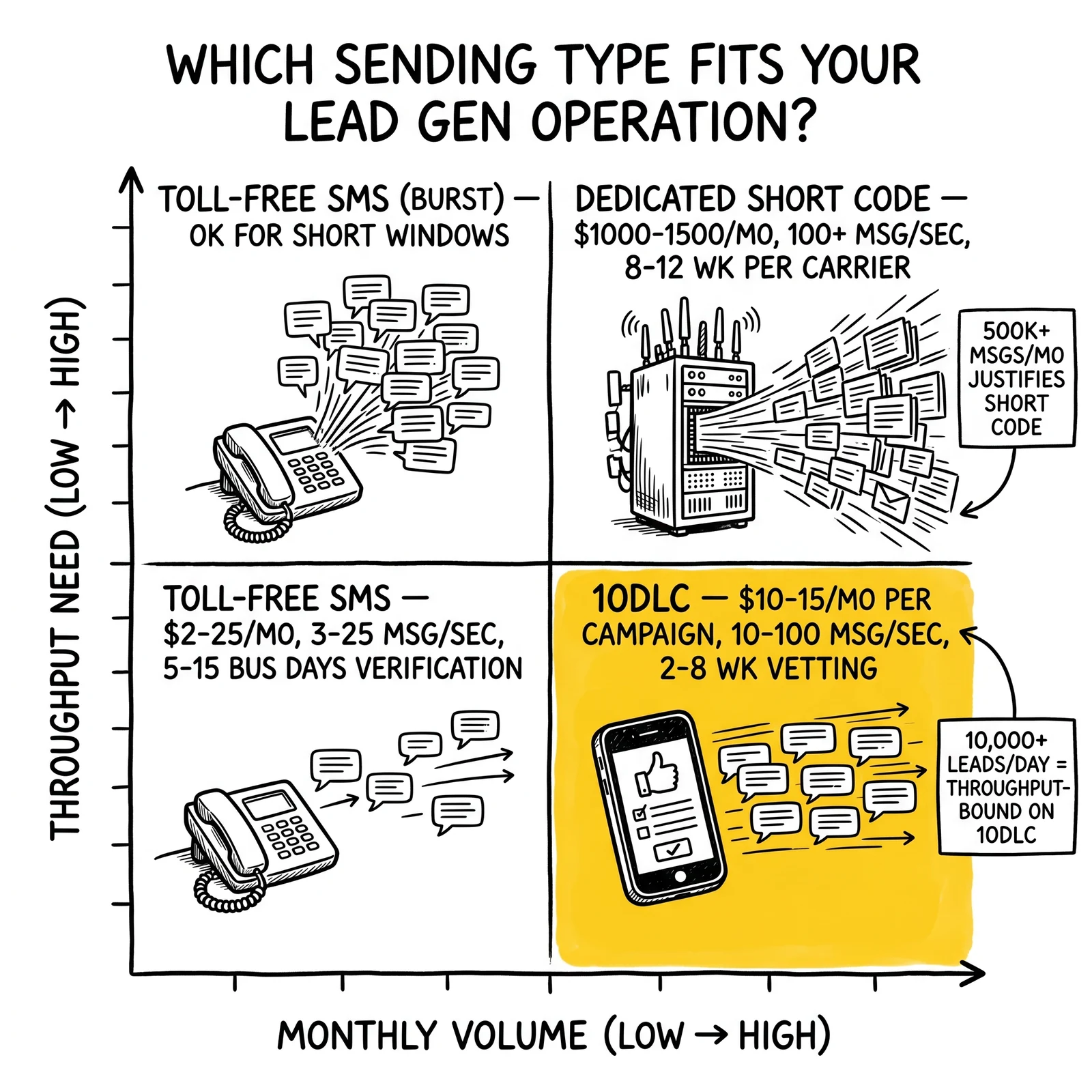
- Campaign registration: $10-15 one-time per campaign
- Monthly campaign maintenance: $10/month per campaign
These fees apply regardless of message volume. A campaign sending 100 messages per month and a campaign sending 100,000 per month pay the same registration fees. The per-message cost is separate.
Short Code Registration: The Enterprise Path
Short codes are 5-6 digit numbers (e.g., 12345, 654321) designed for high-volume, high-throughput A2P messaging. They predate the 10DLC registration system and use a separate registration process managed directly through the major carriers.
When Short Codes Make Sense
Short codes require dedicated registration per carrier, meaning separate applications to AT&T, T-Mobile, and Verizon (plus smaller carriers for comprehensive coverage). The application process typically takes 8-12 weeks per carrier for dedicated codes.
The investment justifies itself at specific volumes:
- Dedicated short codes: $1,000-1,500/month – appropriate for 500,000+ messages per month
- Shared short codes: No longer available for new A2P campaigns as of March 2023 (carriers discontinued shared code approval due to abuse)
Short code throughput runs 100+ messages per second standard, with higher tiers available through carrier agreement. For lead nurturing operations receiving 10,000+ leads per day and running immediate acknowledgment sequences, 10DLC throughput (typically 10-100 messages per second) creates delivery delays. Short codes eliminate the throughput constraint.
Short Code Application Process
Each carrier requires a separate application covering:
- Business identity and contact information
- Campaign description and use case
- Sample messages (each carrier may require different samples)
- Consent and opt-out handling documentation
- Expected monthly volume
- MMS requirements if applicable
After submission, carriers review and may request additional information. Approval timelines vary: AT&T typically 4-8 weeks, T-Mobile 6-10 weeks, Verizon 8-12 weeks. Applications should be submitted to all carriers simultaneously to avoid the shortest timeline being extended by sequential applications.
After carrier approval, the short code is provisioned on the SMS platform and can begin sending. Unlike 10DLC, where the platform handles most carrier coordination, short code operators often interact directly with carrier teams during the provisioning process.
Toll-Free SMS Verification
Toll-free numbers (800, 888, 877, 866, 855, 844, 833 prefixes) can send A2P SMS through a separate verification system that is distinct from 10DLC and short codes.
Toll-Free SMS Characteristics
Toll-free SMS has specific operational profile that makes it appropriate for certain lead generation use cases:
Throughput: 3-25 messages per second after verification, which is lower than short codes but consistent with registered 10DLC for most businesses.
Verification timeline: Historically faster than 10DLC – 5-15 business days for most applications – though 2024-2025 processing times have extended as volume increased.
Dual-use: The same toll-free number can receive both voice calls and SMS, allowing a single number to serve as the contact point in multiple channels.
Cost: Lower monthly cost than short codes. Toll-free number rental costs $2-25/month depending on carrier and platform, plus per-message rates comparable to 10DLC.
Toll-Free SMS Verification Process
Toll-free verification is handled through the platform, which submits the application to the toll-free verification registry. Required information:
- Business information (similar to 10DLC brand registration)
- Use case description
- Sample messages
- Opt-in and opt-out process description
- Expected volume
Unverified toll-free numbers face carrier filtering similar to unregistered 10DLC. The verification process is a prerequisite for consistent deliverability.
When Toll-Free SMS Fits Lead Generation
Toll-free SMS fits operations that:
- Already use a toll-free number for inbound calls and want SMS on the same number
- Need a faster registration path than 10DLC during a specific campaign window
- Are in a high-scrutiny vertical where toll-free’s verification process provides additional carrier credibility
- Need moderate throughput (under 25 messages per second)
Toll-free SMS does not fit operations requiring high throughput (10,000+ messages per hour) or needing local number presence for regional credibility.
Opt-In Keyword Configuration
Opt-in keyword handling is the technical layer that records and verifies consumer consent to receive messages. While the compliance-critical consent is typically captured at the form level (prior express written consent), opt-in keyword mechanics handle post-send consent confirmation and re-subscription after opt-out.
Standard Opt-In Keywords
The industry-standard opt-in keywords recognized by most SMS platforms:
- START
- YES
- HELP (triggers help information, not technically an opt-in but common response)
- JOIN
- SUBSCRIBE
- UNSTOP (specific to re-subscribing after STOP)
When a consumer responds with one of these keywords after an initial outreach or after previously opting out, the system should record the opt-in event with timestamp and the consumer’s phone number, then resume message delivery if the number was previously suppressed.
Configuring Double Opt-In
Double opt-in adds a confirmation step: the consumer receives a message asking them to confirm their opt-in before being added to the active list. While not required by TCPA for consumers who have already provided prior express written consent through a lead form, double opt-in provides additional documentation of engagement.
Double opt-in flow:
- Consumer submits lead form with TCPA-compliant consent
- System sends immediate acknowledgment: “Thanks for your quote request. Reply YES to confirm you’d like text updates about your quote.”
- Consumer replies YES
- System records opt-in with timestamp and message content
- Subsequent messages proceed
The confirmation response (YES) adds a second documented consent touchpoint. In litigation, this creates a defense: not only did the consumer consent on the form, they affirmatively confirmed via text. Some operations find the opt-in response rate (typically 50-70%) actually improves lead quality by filtering for engaged consumers before the sales team calls.
The Opt-In Data Record
Each opt-in event should record:
| Field | Value |
|---|---|
| Phone number | Consumer’s mobile number (E.164 format: +15551234567) |
| Opt-in timestamp | UTC timestamp of form submission or keyword receipt |
| Opt-in method | ”form” or “keyword” |
| Keyword received | If keyword-based, the specific keyword |
| Consent language | Hash or ID referencing the specific disclosure shown at opt-in |
| IP address | For form-based opt-ins |
| Platform message ID | Message ID if opt-in was via SMS keyword response |
This record is the documentation that demonstrates consent in litigation. Retaining it for five years (one year beyond the TCPA’s four-year statute of limitations) is minimum best practice.
Opt-Out Keyword Configuration: The FCC Technical Requirements
The FCC’s April 2025 revocation rules create specific technical requirements for opt-out keyword handling that go beyond what most SMS platforms configure by default.
Mandatory Opt-Out Keywords
The FCC explicitly identified keywords that constitute definitive revocation of consent when received by text:
- STOP
- QUIT
- REVOKE
- OPT OUT
- CANCEL
- UNSUBSCRIBE
- END
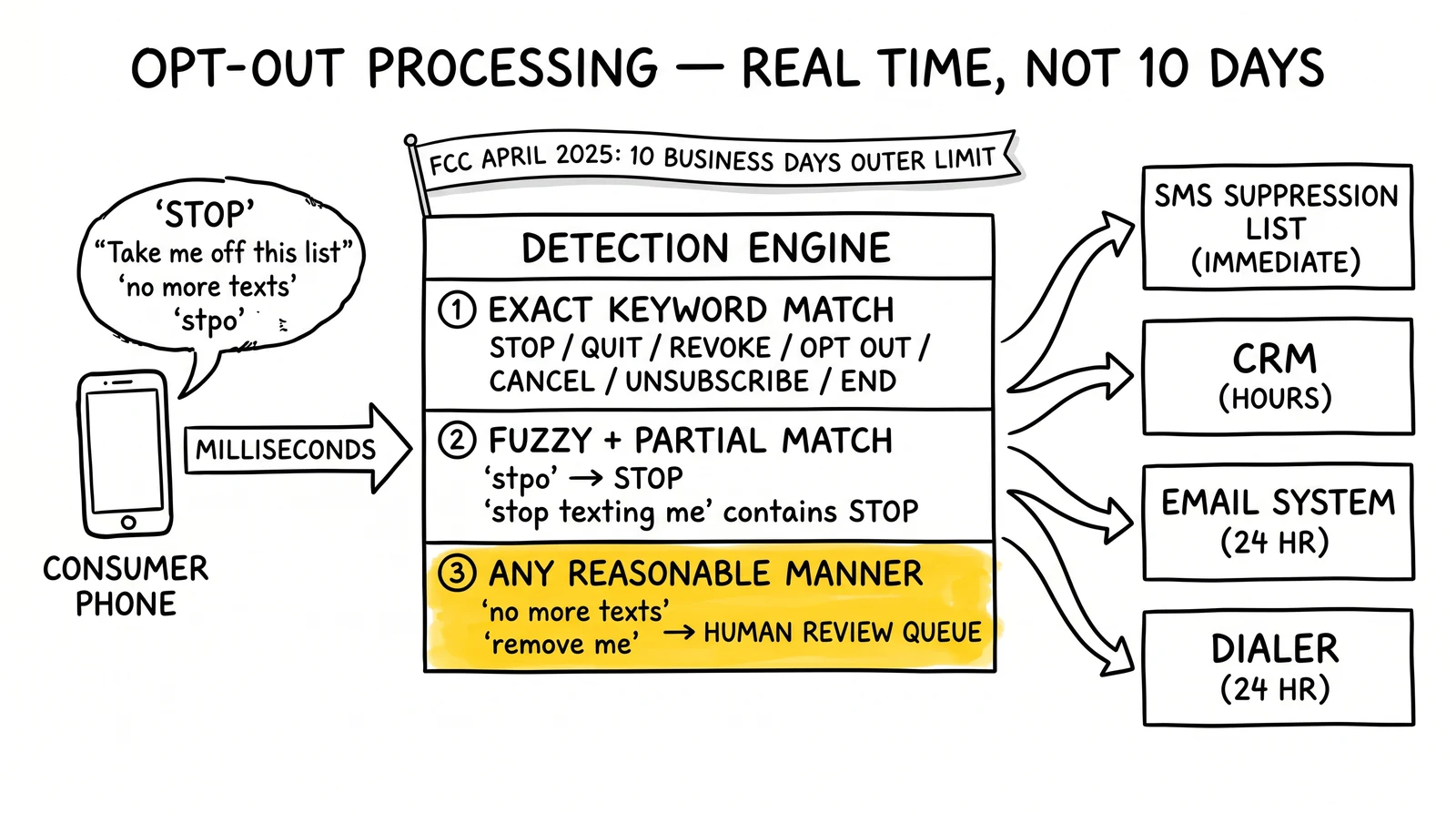
Receipt of any of these terms – in any combination of upper and lower case – requires immediate cessation of messages. The platform must detect these keywords in real time, not in a batch processing cycle.
The “Any Reasonable Manner” Requirement
The mandatory keywords are a floor, not a ceiling. The FCC rules require honoring opt-outs expressed through “any reasonable manner that clearly expresses a desire not to receive further calls or text messages.” This creates an obligation that extends beyond keyword matching.
Messages that constitute opt-out requests under the “any reasonable manner” standard:
- “No more texts”
- “Stop texting me”
- “Remove me from your list”
- “Don’t text me anymore”
- “I don’t want these messages”
- “Please stop”
- “Take me off this list”
These messages do not match the exact keywords, but they clearly express desire to stop receiving messages. A platform that only processes exact keyword matches is not compliant with the “any reasonable manner” standard.
Configuring Expanded Opt-Out Detection
Most enterprise SMS platforms support keyword list expansion beyond the defaults. Technical configuration steps:
1. Build the expanded keyword list. Add phrases beyond the standard keywords: “no more,” “stop texting,” “remove me,” “don’t text,” “don’t contact,” “leave me alone,” “stop calling and texting.” The list should err toward inclusion – a false positive (treating a non-opt-out message as an opt-out) is less costly than a false negative.
2. Implement fuzzy matching. Consumers do not always spell correctly. “STPO” or “Sttop” should trigger the same suppression as “STOP.” Configure the platform’s keyword detection to handle common misspellings of opt-out terms.
3. Configure partial match detection. A message reading “stop sending me these texts please” contains the keyword STOP embedded in a sentence. Configure detection to identify opt-out keywords within longer messages, not just as standalone responses.
4. Human review queue for ambiguous messages. Messages that might be opt-outs but are ambiguous – “I already have insurance” – should route to a human review queue. The reviewer determines whether the message constitutes an opt-out. When in doubt, treat as opt-out.
Opt-Out Processing Flow
The processing flow for a confirmed opt-out should complete in real time:
- Consumer sends opt-out keyword or phrase
- Platform detects opt-out signal (within milliseconds)
- System checks if a confirmation message is appropriate and permitted
- If yes, sends one-time confirmation: “You’ve been unsubscribed from [Company] messages. No further texts will be sent. Reply JOIN to resubscribe. Reply HELP for support.”
- Consumer’s number added to suppression list immediately
- Suppression list queried before any subsequent message attempt to this number
- Opt-out event logged: timestamp, keyword received, confirmation sent, platform message IDs
The confirmation message must meet the FCC’s conditions: sent within five minutes, no marketing content, may offer resubscription option.
Cross-System Suppression Synchronization
The FCC’s April 2025 rules require honoring revocation within ten business days across all contact channels. For SMS operations, this means the opt-out must propagate beyond the SMS platform:
- SMS platform suppression list (immediate)
- CRM contact record (within hours)
- Email marketing system (within 24 hours)
- Dialing/call center system (within 24 hours)
- Any lead distribution platform (within 24 hours)
Building automated synchronization – not manual export/import – is the only operationally viable approach at scale. Most enterprise SMS platforms offer webhooks that fire on opt-out events. These webhooks should trigger synchronization workflows in CRM and other systems automatically.
An opt-out received at 2 AM must not result in a 9 AM call from the sales team because the CRM was not updated until the morning sync.
Trust Scores and Throughput Tiers: What They Mean Operationally
After brand and campaign registration, TCR assigns trust scores that determine throughput – the rate at which messages can be sent.
How Trust Scores Are Calculated
TCR’s algorithm weights several factors:
Business verification: Publicly incorporated businesses with verifiable EINs score higher than sole proprietors or businesses whose registrations cannot be verified against public records.
CSP relationship: Established platforms with high-volume CSP status convey some trust to their registered brands. A brand registered through a major platform (Twilio, Bandwidth, etc.) typically starts with higher baseline scoring than one registered through a smaller platform.
Vertical category: Certain industries receive automatic scrutiny regardless of other factors. Financial services, insurance, and healthcare face standard review. Payday lending, cannabis, and a few others are prohibited entirely.
Sample message quality: Samples with complete opt-out disclosures, clear identification of sender, and consistent use-case alignment score better than ambiguous or sparse samples.
Volume alignment: Stated expected volume that aligns with the business size (a sole proprietor claiming 1,000,000 messages/month raises flags) scores better than implausible volume claims.
Throughput Tier Implications
| Trust Category | Approximate Throughput | Practical Impact |
|---|---|---|
| High | 100+ msg/sec | No delivery delays for any lead gen volume |
| Medium-High | 40-100 msg/sec | Adequate for operations under 10,000 leads/day |
| Medium | 10-40 msg/sec | May create queuing delays during volume spikes |
| Low | 1-10 msg/sec | Creates material delays for operations over 1,000 leads/day |
A lead generation operation receiving 1,000 leads per day and sending immediate acknowledgment messages has a 10,000-second sending window if they batch all messages. At 1 message/second throughput, that batch takes nearly 3 hours to complete. The “immediate acknowledgment” is not immediate.
Improving Trust Scores
Trust scores can be improved through:
Business verification: Completing optional business verification through TCR’s enhanced vetting process. This costs $40-50 and typically improves trust scores and throughput allocations. Worth the investment for any operation that will send sustained volume.
Platform history: Operating on the same platform without incident over time builds carrier reputation. Switching platforms resets some of this history.
Complaint rate management: Operations with low carrier-submitted complaint rates maintain or improve trust scores over time. High complaint rates reduce scores. Monitoring opt-out rates and complaint rates (visible through some platform analytics) provides early warning of score degradation.
Volume consistency: Erratic sending patterns – large volume spikes followed by silence – reduce trust scores. Consistent daily volume within expected ranges supports stable scores.
Common Registration Failures and How to Avoid Them
Registration failures delay campaign launch. Understanding the common causes enables avoiding them.
Business Name Mismatch
The legal name submitted to TCR must match the name in state business registries. “Acme Lead Generation LLC” does not match “Acme Lead Generation, LLC” if the state registry uses the comma. Pull the exact legal name from the state’s Secretary of State website before submitting.
EIN Verification Lag
New businesses whose EINs have not yet propagated to IRS verification databases fail EIN checks. Businesses less than 60-90 days old may need to submit documentation (EIN assignment letter from IRS) through their platform rather than relying on automated verification.
Website Content Mismatch
TCR and carriers review the website URL submitted. If the website promotes a different business type than the registered use case – or worse, promotes prohibited content like payday lending or cannabis – the brand registration fails. Verify the website reflects the registered business before submission.
Sample Message Inadequacy
Sparse or generic samples trigger rejection. Samples should:
- Be actual messages the operation intends to send
- Include opt-out language (“Reply STOP to unsubscribe”)
- Include sender identification (“From: [Company Name]”)
- Reflect the stated use case precisely
“We have an offer for you. Reply YES for details.” is an inadequate sample. “Hi [First Name], your auto insurance quote request is confirmed. An agent will call within 15 minutes. Reply STOP to unsubscribe. -Acme Insurance Leads” is an adequate sample.
Opt-In Description Gaps
“Consumers opt in via our website” fails. The description must specify: what the consumer sees, what action they take, what the consent language says, and how the consent is documented. Every element should be present to pass carrier review.
Deliverability Monitoring After Registration
Registration enables higher throughput and lower filtering rates. It does not guarantee deliverability. Ongoing monitoring catches problems before they become campaign failures.
Carrier-Specific Delivery Rate Monitoring
SMS platforms report delivery status per message, typically with carrier identification. Monitor delivery rates separately by carrier:
| Carrier | Acceptable Delivery Rate | Warning Threshold |
|---|---|---|
| T-Mobile | 97%+ | Below 94% |
| AT&T | 97%+ | Below 94% |
| Verizon | 97%+ | Below 94% |
| US Cellular | 95%+ | Below 92% |
Delivery rate divergence between carriers – T-Mobile at 96% while AT&T is at 88% – indicates carrier-specific filtering likely related to message content patterns. Investigate content for AT&T-specific filtering triggers.
Content Pattern Testing
Carriers update their filtering algorithms frequently. Content that delivered reliably last month may face filtering this month due to algorithm changes. Testing content variations against a small segment before full campaign deployment catches filtering issues early.
Testing process:
- Send 100 messages with variant A content to a test segment
- Send 100 messages with variant B content to a matched test segment
- Compare delivery rates and response rates between variants
- Use the higher-delivering variant for full campaign
This is not optional sophistication for large operations. Filtering changes can reduce delivery rates by 15-25% before the problem is detected in aggregate metrics.
Opt-Out Rate as Health Signal
Opt-out rates serve as a carrier trust signal, not just a consumer engagement metric. High opt-out rates (above 2% per campaign) indicate:
- Consumers are receiving messages they did not expect or want (consent quality problem)
- Message frequency exceeds consumer tolerance (frequency problem)
- Message content is irrelevant or intrusive (targeting or sequencing problem)
- The number is being reached by consumers who never consented (list quality problem)
Sustained high opt-out rates can lead carriers to reduce the trust score assigned to the sending number, creating a filtering spiral: more messages filtered, fewer responses, apparent conversion decline, which operators address by increasing frequency, which increases opt-outs further.
Monitor opt-out rates per campaign and per sending number. Set alerts at 1.5% to catch problems before they compound.
Frequently Asked Questions
How long does 10DLC brand and campaign registration take in total?
Brand registration typically completes in 1-3 business days for businesses with verifiable EINs and matching public records. Campaign registration and carrier vetting takes 2-8 weeks depending on business type, use case category, and carrier-specific review queues. In 2024-2025, vetting timelines have extended compared to the 2021-2022 period due to volume growth. Plan for 4-6 weeks minimum from submission to full campaign launch. Submit registration before you need to send – not on the day you plan to launch.
Can I run a lead nurturing campaign while 10DLC registration is pending?
Technically yes. Practically, the messages face 30-40% carrier filtering rates that eliminate much of the channel’s value. For time-sensitive operations, some platforms offer provisional sending at lower throughput during pending review. The risk: carriers may retrospectively apply filtering to messages sent before approval, and complaint rates from filtered/delivered-but-unwanted messages can affect the trust score of the campaign once approved. Running limited-volume tests during pending review is lower risk than full campaign volume.
What happens if we register a campaign and then change our message content significantly?
Material changes to campaign content – different use case, different sender identification, different URL domains – require campaign re-registration. Minor changes within the same use case category (different message phrasing, same purpose) do not require re-registration but should be reflected in updated sample messages with the platform. Undisclosed material changes that result in carrier complaints can trigger campaign suspension.
Is toll-free SMS verification faster than 10DLC registration?
Historically yes – toll-free verification averaged 5-15 business days versus the 2-8 weeks for 10DLC campaign vetting. However, 2024-2025 processing volume has extended toll-free verification timelines for some carriers to 3-6 weeks. The gap has narrowed. For most lead generation applications, 10DLC is the more appropriate infrastructure choice, and the timeline difference is no longer a strong argument for toll-free.
Can a single 10DLC number be used for multiple lead generation campaigns across different verticals?
No. Each campaign registered with TCR has specific use case parameters. A campaign registered for insurance lead nurturing cannot be used for mortgage nurturing without separate campaign registration. Carriers can detect use-case mismatches through content monitoring and may suspend numbers used across registered use cases. Operate separate numbers with separate campaign registrations for each distinct use case.
How does the 10-business-day opt-out requirement interact with real-time suppression?
The ten-business-day requirement is the outer legal limit, not the target. For SMS, best practice is real-time suppression because the next scheduled message can go out within minutes of an opt-out. The legal framework permits up to ten days; the operational reality requires seconds. Build platform automation that prevents any message send to opted-out numbers immediately upon keyword detection. The ten-day window exists as a grace period for cross-channel synchronization (email, phone), not as permission to continue texting for ten days after an opt-out.
What are the throughput limits for a newly registered 10DLC campaign?
A newly registered campaign with medium trust score typically receives 10-40 messages per second throughput. This handles approximately 36,000-144,000 messages per hour. For most lead generation operations under 5,000 leads per day, this is adequate for real-time acknowledgment. Operations receiving 5,000+ leads per day may experience queuing during peak hours. Throughput can be increased through enhanced business vetting, demonstrated compliant sending history, and in some cases, supplementary number registration to distribute load.
Key Takeaways
10DLC registration, short code provisioning, and toll-free verification are not compliance formalities – they are technical prerequisites for functional SMS delivery. Operations sending A2P messages without registration face 30-40% carrier filtering that makes the channel unreliable regardless of consent quality.
Brand registration requires accurate legal entity information that matches public records. Discrepancies cause rejection. EIN verification lag for new businesses requires documentation workarounds. Allow 4-6 weeks from initial submission to full campaign launch.
Campaign registration requires specific, accurate descriptions of what messages will be sent, to whom, and under what consent conditions. Generic descriptions fail. Specific descriptions pass.
Opt-out keyword configuration must extend beyond the seven mandatory FCC keywords to cover any reasonable expression of desire to stop receiving messages. Platforms that process only exact keyword matches are not fully compliant with the April 2025 FCC rules.
Trust scores determine throughput, which determines whether immediate acknowledgment is actually immediate. Lower trust scores create delivery queues that undermine the primary use case for SMS in lead nurturing. Investing in enhanced vetting and operating compliantly over time improves trust scores.
Cross-system opt-out synchronization is required within ten business days. For SMS, real-time synchronization to CRM, call center, and email platforms is the operationally necessary standard – not a best practice to aspire to.
The investment in proper registration infrastructure pays for itself the first time a carrier filtering issue is avoided. The compliance cost of proper 10DLC registration is hours of setup and $20-30/month. The cost of carrier filtering on an unregistered campaign is 30-40% of message delivery and the loss of the channel’s core value.
Sources
- The Campaign Registry (TCR) official documentation and registration requirements
- FCC Telephone Consumer Protection Act regulations and April 2025 revocation rule documentation
- CTIA (Cellular Telecommunications Industry Association) Messaging Principles and Best Practices
- AT&T, T-Mobile, and Verizon carrier 10DLC guidelines and policy documentation
- Bradley v. Dentalplans.com (D. Md. 2024) – E-SIGN and TCPA electronic consent requirements
- FCC 2024-2025 TCPA declaratory rulings on revocation and opt-out keyword requirements