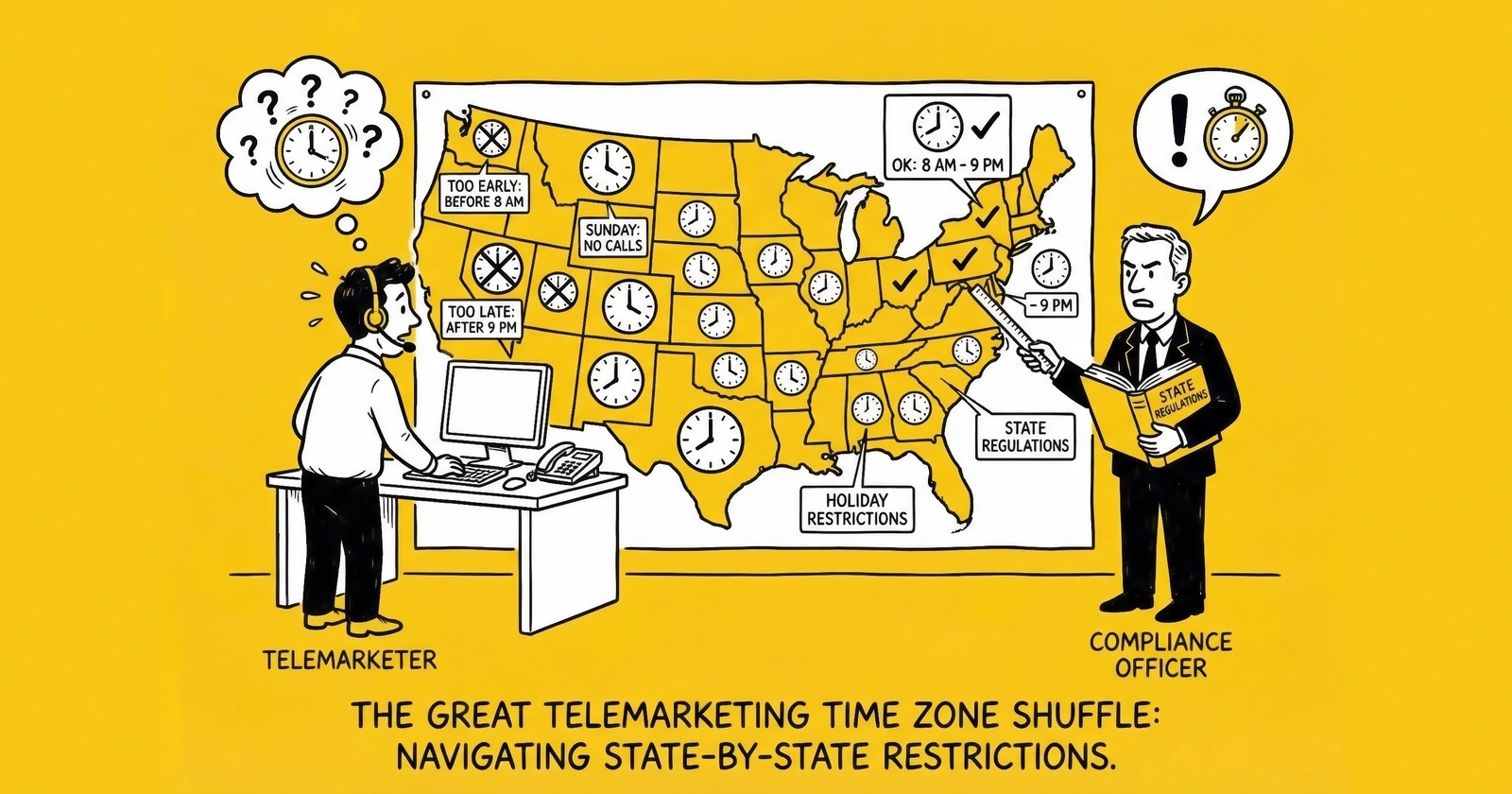
A practical operational guide to navigating the patchwork of federal and state calling hour regulations that create $500-$1,500 per-call liability for every minute you get wrong.
Introduction: The 9:03 PM Problem
A solar lead generation company in Arizona ran a national SMS campaign in September 2024. Their system was configured for the federal TCPA calling window: 8 AM to 9 PM local time. The campaign launched at 6:00 PM Mountain Time.
At 9:03 PM Eastern Time, 847 text messages reached consumers in Florida. Three minutes after the federal cutoff. But Florida law ends the window at 8 PM, not 9 PM. Those 847 messages were actually sent one hour and three minutes after Florida’s state cutoff.
One professional plaintiff received three of those messages. The resulting class action, filed in South Florida in early 2025, alleged 847 violations of Florida’s Telephone Solicitation Act at $500 per message. Potential exposure: $423,500 for what the company’s compliance officer initially dismissed as a “three-minute margin of error.”
This is the operational reality of call time restrictions in 2025. The federal TCPA establishes a floor – 8 AM to 9 PM in the recipient’s local time zone – but at least a dozen states have enacted stricter requirements through state mini-TCPA laws. A few minutes past the cutoff in the wrong state creates the same per-call liability as calling at midnight. The math is binary: either the call was within permitted hours or it was not.
This guide provides the operational framework you need to navigate state-by-state calling restrictions, implement technology solutions that enforce compliance automatically, and avoid the litigation traps that have caught companies at every scale.
The Federal Baseline: Understanding TCPA Calling Hours
Before examining state variations, you need to understand what the federal Telephone Consumer Protection Act actually requires.
The 8 AM to 9 PM Rule
The FCC’s telemarketing sales rule, codified at 47 CFR 64.1200(c)(1), prohibits telephone solicitations before 8:00 AM or after 9:00 PM in the recipient’s local time zone.
Three critical elements define this rule:
“Telephone solicitations” means calls that encourage, directly or indirectly, the purchase, rental, or investment in property, goods, or services. This includes both voice calls and text messages. Courts have consistently held that SMS messages constitute “calls” under the TCPA, meaning the same calling hour restrictions apply to text campaigns.
“Local time at the called party’s location” places the compliance burden on the caller. You cannot use your own time zone. You cannot assume the area code indicates the recipient’s current location. You must determine where the recipient actually is and calculate their local time accordingly.
The 8 AM start and 9 PM end apply to telemarketing specifically. Informational calls – appointment reminders, delivery notifications, account alerts – fall outside this restriction under federal law. However, the distinction between informational and promotional content has generated substantial litigation, and many states apply their calling hour restrictions more broadly.
What Federal Law Does Not Restrict
Federal TCPA calling hour restrictions do not apply to: calls made with prior express consent for non-marketing purposes, tax-exempt nonprofits, survey calls without sales pitches, debt collection calls, business-to-business calls, and calls to numbers the consumer previously provided in connection with a transaction.
However, state law may restrict each of these categories. A debt collection call exempt from federal TCPA hours may still violate a state’s consumer protection statute.
The Time Zone Calculation Problem
The single most litigation-prone aspect of calling hour compliance is determining the recipient’s actual local time. This sounds simple until you consider operational reality.
Area codes do not reliably indicate location. Number portability regulations allow consumers to keep phone numbers when moving. Industry data suggests 15-25% of mobile numbers have area codes that do not match the consumer’s current residence. A 212 (Manhattan) area code could belong to someone living in Los Angeles. A 305 (Miami) area code could belong to someone who relocated to Chicago fifteen years ago.
Split-state complexity compounds the problem. Thirteen states span multiple time zones: Florida, Idaho, Indiana, Kansas, Kentucky, Michigan, Nebraska, North Dakota, Oregon, South Dakota, Tennessee, Texas, and Arizona (where the Navajo Nation observes daylight saving time while the rest of the state does not).
The burden of accuracy falls entirely on the caller. If you guess wrong based on area code and place a call outside permitted hours at the recipient’s actual location, you face full statutory liability. Courts have not recognized “reasonable reliance on area code” as a defense.
State-by-State Calling Hour Restrictions: The Complete Reference
The federal 8 AM to 9 PM window applies unless a stricter state law controls. The following breakdown covers every state with calling hour restrictions that differ from, or add to, federal requirements.
States with Stricter Daily Windows
Florida: 8 AM to 8 PM
Florida’s Telephone Solicitation Act (FTSA) restricts telemarketing calls and text messages to the hours between 8:00 AM and 8:00 PM local time – one hour earlier than the federal cutoff.
Key provisions:
- Applies to all telephonic sales calls and commercial telephone solicitation
- Includes text messages explicitly
- Maximum three calls per 24-hour period on the same subject matter to the same telephone number
- Private right of action with $500 per violation, $1,500 for willful violations
- No calls permitted on Florida state legal holidays
Florida generated 330 TCPA-related lawsuits in 2024, approximately 12% of all filings despite representing 6.5% of the U.S. population. The South Florida plaintiff’s bar has developed particular expertise in time-of-day claims, where timestamps create clear liability.
Operational requirement: Any system calling or texting Florida consumers must enforce an 8 PM cutoff, not the federal 9 PM standard. This is not optional for national campaigns.
Citation: Fla. Stat. 501.059(8)(a)
Maryland: 8 AM to 8 PM
Maryland’s “Stop the Spam Calls Act” restricts telemarketing calls to 8:00 AM to 8:00 PM local time.
Key provisions:
- Applies to telephone solicitation calls
- Maintains a broader autodialer definition than the post-Duguid federal standard
- Potential for state registration requirements
- Private right of action available under certain conditions
Maryland’s combination of stricter hours and broader autodialer definitions creates compounded risk. A call made at 8:30 PM using technology that qualifies as an autodialer under Maryland law but not federal law could trigger state violations without corresponding federal exposure.
Citation: Md. Com. Law 14-3201
Massachusetts: 8 AM to 8 PM
Massachusetts regulations restrict telephone solicitations to 8:00 AM to 8:00 PM local time.
Key provisions:
- Applies to commercial telephone solicitation
- Enforced by the Attorney General’s Consumer Protection Division
- Part of broader consumer protection framework
Citation: 940 CMR 29.05
States with Weekend Restrictions
Several states impose additional restrictions on weekend calling that do not apply during weekdays.
Connecticut: 9 AM to 8 PM Daily
Connecticut’s SB 1058 (effective October 1, 2023) restricts telemarketing calls to 9:00 AM to 8:00 PM local time – both a later start and earlier end than federal law. This is one of the most restrictive daily windows in the nation.
Key provisions:
- 9:00 AM start (one hour later than federal)
- 8:00 PM end (one hour earlier than federal)
- Requires prior express written consent
- Penalties up to $20,000 per violation
Operational requirement: Connecticut requires both a later start (9 AM, not 8 AM) and an earlier cutoff (8 PM, not 9 PM). National campaigns must configure Connecticut-specific rules that differ from both federal standards and other 8 PM cutoff states.
Citation: Conn. Gen. Stat. § 42-288a(c)
Louisiana: 8 AM - 8 PM, No Calls on Sundays
Louisiana restricts telemarketing to 8:00 AM - 8:00 PM local time and prohibits telephone solicitation on all Sundays, not just Sunday mornings.
Key provisions:
- 8 PM cutoff (one hour earlier than federal)
- Complete prohibition on telemarketing calls every Sunday
- No calls permitted on Louisiana state holidays
- Additional restrictions during declared states of emergency
Operational requirement: National weekend campaigns must completely exclude Louisiana on Sundays, and all campaigns must enforce the 8 PM cutoff. This is both a window restriction and a binary Sunday prohibition.
Citation: La. R.S. 45:844.13
Pennsylvania: No Calls Before Noon Sunday
Pennsylvania prohibits telephone solicitation before 12:00 PM (noon) on Sundays.
Operational requirement: Sunday calling campaigns in Pennsylvania can only operate during the afternoon and evening hours. Combined with other Sunday-restricted states, this significantly limits the effective window for national weekend calling.
Citation: 73 P.S. 2245.4
Texas: Restricted Sunday Window (9 AM to 9 PM Weekdays, 12 PM to 9 PM Sundays)
Texas’s updated telemarketing law (effective September 2025 with SB 140 amendments) maintains specific time windows:
- Monday through Saturday: 9:00 AM to 9:00 PM
- Sundays: 12:00 PM (noon) to 9:00 PM
Note that Texas has a later start time than federal law on weekdays (9 AM versus 8 AM) and a significantly later start on Sundays.
Citation: Tex. Bus. & Com. Code 302.101
States with Holiday Restrictions
Beyond daily and weekend restrictions, several states prohibit telemarketing on specific holidays.
Florida State Holidays
Florida prohibits commercial telephone solicitation on nine state holidays:
| Holiday | Date |
|---|---|
| New Year’s Day | January 1 |
| Martin Luther King Jr. Day | Third Monday in January |
| Memorial Day | Last Monday in May |
| Independence Day | July 4 |
| Labor Day | First Monday in September |
| Veterans Day | November 11 |
| Thanksgiving | Fourth Thursday in November |
| Friday after Thanksgiving | Fourth Friday in November |
| Christmas Day | December 25 |
When these holidays fall on a weekend, they may be observed on the adjacent Friday or Monday. Your calling systems must account for observed dates, not just calendar dates.
Louisiana State Holidays
Louisiana prohibits telephone solicitation on all state legal holidays, including several not recognized federally:
| Holiday | Date |
|---|---|
| Mardi Gras (Fat Tuesday) | Varies (February/March) |
| Good Friday | Varies (March/April) |
| Election Day | Primary and general elections |
| All Saints Day | November 1 |
| Plus all standard federal holidays | Various |
The variable nature of Mardi Gras and Good Friday requires annual calendar updates. Your compliance team cannot set these dates once and forget them.
Other State Holidays
Several other states observe unique holidays with potential calling restrictions:
- Alabama: Confederate Memorial Day (fourth Monday in April), Jefferson Davis Birthday (first Monday in June)
- Utah: Pioneer Day (July 24)
- Mississippi: Confederate Memorial Day
- Rhode Island: Victory Day (second Monday in August) – the only state to observe this holiday
States with Emergency Declaration Restrictions
Two states prohibit telemarketing during declared states of emergency.
Louisiana Emergency Restrictions
Louisiana prohibits all commercial telephonic solicitations during any declared state of emergency. This creates a monitoring obligation – your compliance team must track active emergency declarations in Louisiana.
Hurricanes, floods, and public health emergencies can trigger these restrictions with little advance notice. The practical challenge is real-time awareness. Consider integrating automated monitoring of Louisiana emergency management agency declarations into your dialing platform.
New York Emergency Restrictions
New York maintains similar restrictions during declared emergencies, though enforcement specifics vary by emergency type.
Complete State Reference Table
The following table consolidates calling hour restrictions across all 50 states plus the District of Columbia.
| State | Permitted Hours | Weekend Restrictions | Holiday Restrictions | Notes |
|---|---|---|---|---|
| Alabama | 8 AM - 8 PM | No calls on Sundays | State holidays | Confederate Memorial Day, Jefferson Davis Day |
| Alaska | 8 AM - 9 PM | None | None | Federal TCPA applies |
| Arizona | 8 AM - 9 PM | None | None | Note: Navajo Nation observes DST; rest of state does not |
| Arkansas | 8 AM - 9 PM | None | None | |
| California | 8 AM - 9 PM | None | None | |
| Colorado | 8 AM - 9 PM | None | None | |
| Connecticut | 9 AM - 8 PM | None | None | SB 1058 effective Oct 2023 |
| Delaware | 8 AM - 9 PM | None | None | |
| District of Columbia | 8 AM - 9 PM | None | None | |
| Florida | 8 AM - 8 PM | None | 9 state holidays | Major litigation venue |
| Georgia | 8 AM - 9 PM | None | None | New mini-TCPA effective 2024 |
| Hawaii | 8 AM - 9 PM | None | None | Does not observe DST |
| Idaho | 8 AM - 9 PM | None | None | Split time zone state |
| Illinois | 8 AM - 9 PM | None | None | |
| Indiana | 8 AM - 9 PM | None | None | Split time zone state |
| Iowa | 8 AM - 9 PM | None | None | |
| Kansas | 8 AM - 9 PM | None | None | Split time zone state |
| Kentucky | 10 AM - 9 PM | None | None | Latest start time; split time zone |
| Louisiana | 8 AM - 8 PM | No calls on Sundays | All state holidays | Emergency restrictions |
| Maine | 9 AM - 5 PM | Weekdays only (auto) | None | Automated calls restricted |
| Maryland | 8 AM - 8 PM | None | None | Broader autodialer definition |
| Massachusetts | 8 AM - 8 PM | None | None | |
| Michigan | 9 AM - 9 PM | None | None | Later start; split time zone |
| Minnesota | 9 AM - 9 PM | None | None | Later start time |
| Mississippi | 8 AM - 8 PM | No calls on Sundays | Confederate Memorial Day | |
| Missouri | 8 AM - 9 PM | None | None | |
| Montana | 8 AM - 9 PM | None | None | Mini-TCPA has no penalty cap |
| Nebraska | 8 AM - 9 PM | None | None | Split time zone state |
| Nevada | 8 AM - 9 PM | None | None | |
| New Hampshire | 8 AM - 9 PM | None | None | |
| New Jersey | 8 AM - 9 PM | None | None | |
| New Mexico | 8 AM - 9 PM | None | None | |
| New York | 8 AM - 9 PM | None | None | Emergency restrictions |
| North Carolina | 8 AM - 9 PM | None | None | |
| North Dakota | 8 AM - 9 PM | None | None | Split time zone state |
| Ohio | 8 AM - 9 PM | None | None | |
| Oklahoma | 8 AM - 8 PM | None | None | OTSA mirrors FTSA |
| Oregon | 8 AM - 9 PM | None | None | Split time zone state |
| Pennsylvania | 8 AM - 9 PM | No calls before noon Sunday | Some state holidays | |
| Rhode Island | 9 AM - 6 PM M-F; 10 AM - 5 PM Sat | No calls on Sundays | Victory Day, all holidays | Most restrictive state window |
| South Carolina | 8 AM - 9 PM | None | None | |
| South Dakota | 8 AM - 9 PM | None | None | Split time zone state |
| Tennessee | 8 AM - 9 PM | None | None | Split time zone state |
| Texas | 9 AM - 9 PM M-Sa; 12 PM - 9 PM Sun | Sunday noon start | None | SB 140 effective Sept 2025 |
| Utah | 8 AM - 9 PM | No calls on Sundays | Pioneer Day (July 24) | Sunday prohibition |
| Vermont | 8 AM - 9 PM | None | None | |
| Virginia | 8 AM - 9 PM | None | None | 10-year DNC honor period |
| Washington | 8 AM - 8 PM | None | None | HB 1051 updated law |
| West Virginia | 8 AM - 9 PM | None | None | |
| Wisconsin | 8 AM - 9 PM | None | None | |
| Wyoming | 8 AM - 8 PM | None | None | Earlier end time |
The Practical Challenge: Determining Recipient Location
Knowing the restrictions is only half the problem. Determining where each recipient is actually located – and therefore which state’s rules apply – presents the greater operational challenge.
Why Area Codes Fail
Area codes were assigned based on geographic regions, but number portability has severed that connection. When a consumer moves from New York to California, they can keep their 212 area code. Their phone number provides no indication of their current location.
Industry estimates suggest 15-25% of mobile numbers have area codes that do not match the consumer’s current residence. For operations making millions of calls monthly, this means hundreds of thousands of calls where area code-based time zone assumptions may be wrong.
A 2024 analysis of time-violation class actions found that 34% involved defendants who had relied on area code to determine local time. In each case, the court rejected area code reliance as insufficient due diligence.
Multi-Source Location Determination
Compliant operations use multiple data sources to triangulate recipient location:
ZIP code from lead capture: When you capture a lead through a web form, collect the consumer’s ZIP code. ZIP codes map to specific geographic areas with known time zones. This provides stronger evidence of location than area code alone.
IP geolocation at form submission: Capture the IP address when the consumer submits your form, then geolocate that IP to a city or region. This reflects the consumer’s actual location at the moment they expressed interest. VPN usage can defeat accuracy, but most consumers are not using VPNs when filling out lead forms.
Billing address verification: If you have access to billing address data (through payment information or data append services), this provides another location indicator.
Third-party phone verification: Services like Neustar and TransUnion maintain databases linking phone numbers to current subscriber locations, combining multiple data sources for higher accuracy.
Decision Framework for Location Uncertainty
When data sources conflict or certainty is low, apply this decision framework:
If all sources agree: Proceed with the identified location’s calling rules.
If sources conflict: Use the most restrictive time zone or calling window that any source indicates. For example, if area code suggests Eastern Time (9 PM cutoff in most states) but ZIP code indicates Florida (8 PM cutoff), apply Florida’s 8 PM rule.
If location cannot be determined: Apply the safe window – the calling hours that comply with all possible jurisdictions. For national campaigns, this typically means 11 AM to 7 PM Eastern Time, which falls within legal hours across all continental U.S. time zones and satisfies the stricter state windows.
For critical uncertainty: Skip the record entirely. The cost of not calling one lead is far less than the cost of one TCPA violation that triggers litigation.
The Safe Window Strategy
When you cannot reliably determine recipient location, the safest calling window is 11:00 AM to 7:00 PM Eastern Time. Here is why this works:
| Time Zone | 11 AM Eastern | 7 PM Eastern | Within 8-8 Window? |
|---|---|---|---|
| Eastern | 11:00 AM | 7:00 PM | Yes |
| Central | 10:00 AM | 6:00 PM | Yes |
| Mountain | 9:00 AM | 5:00 PM | Yes |
| Pacific | 8:00 AM | 4:00 PM | Yes |
| Alaska | 7:00 AM | 3:00 PM | No (too early) |
| Hawaii | 5:00 AM | 1:00 PM | No (too early) |
For continental U.S. coverage, 11 AM to 7 PM Eastern satisfies even the strictest state windows (Florida/Maryland/Massachusetts 8 PM cutoff, Texas 9 AM start).
For true national coverage including Alaska and Hawaii, the window narrows further. Some operations use 12:00 PM to 6:00 PM Eastern to build additional margin.
This conservative approach leaves potential calling time on the table. An operation following the safe window strategy forgoes four to five hours of potential calling time daily. However, the math favors caution: one class action can cost more than years of expanded calling windows would generate in additional revenue.
Technology Implementation: Automating Compliance
Manual time zone checking does not scale. Any operation making more than a few hundred calls daily needs automated enforcement that cannot be overridden by operators.
Dialer Platform Requirements
Your dialing platform must include these capabilities:
Real-time time zone database: Access to current time zone data that accounts for daylight saving time transitions, split-state boundaries, and the specific rules for Arizona (no DST) and Hawaii (no DST, unique offset).
State-specific rules engine: The platform must apply Florida’s 8 PM cutoff to Florida numbers, Connecticut’s 9 AM - 8 PM window to Connecticut numbers, Louisiana’s complete Sunday prohibition, and Texas’s noon Sunday start to Texas numbers – simultaneously, for a single campaign. This cannot be a single national configuration.
Hard blocks, not soft warnings: The system must prevent calls outside legal hours for the determined location. A warning that operators can override is not compliant. The block must be absolute.
Multiple location data source integration: The dialer should accept ZIP code, IP geolocation, and verified location data from your lead capture process, not just area code.
Audit trail logging: Every call attempt must be logged with the determined time zone, the data sources used, the applicable calling window, and the result. This documentation becomes critical evidence in litigation defense.
Platform Configuration Checklist
Before launching any calling campaign:
- Verify time zone assignment methodology for all records
- Configure state-specific calling windows (Florida, Louisiana, Maryland, Massachusetts, Oklahoma, Wyoming, Washington, Alabama, Mississippi: 8 PM; Connecticut: 9 AM - 8 PM; Kentucky: 10 AM start; Michigan, Minnesota: 9 AM start; Rhode Island: 9 AM - 6 PM M-F, 10 AM - 5 PM Sat; Maine: 9 AM - 5 PM weekdays for automated)
- Configure Sunday restrictions (Louisiana, Alabama, Mississippi, Utah, Rhode Island: complete prohibition; Pennsylvania, Texas: noon start)
- Configure Texas weekday 9 AM start
- Enable Florida state holiday calendar
- Enable Louisiana state holiday calendar (including Mardi Gras, Good Friday)
- Configure Louisiana and New York emergency restriction monitoring
- Test with records in edge-case time zones (Arizona, Hawaii, split-state locations)
- Verify DST transition handling is current
- Enable comprehensive audit logging
- Set up alerts for calls attempted near window boundaries
- Document configuration for compliance file
SMS-Specific Considerations
Text message campaigns face the same calling hour restrictions as voice calls, but implementation differs. SMS platforms queue messages in batches – a message queued at 7:55 PM that sends at 8:03 PM violates Florida’s window. Your platform must calculate actual send time, not queue time. Courts have generally used the sender’s transmission timestamp rather than the recipient’s delivery timestamp.
CRM Integration
Time zone compliance must flow from your CRM to your dialer. Store recipient time zone as a lead field during intake. Pass time zone data during list export. Update time zones when better location data becomes available. Flag records where time zone cannot be reliably determined and route them to manual review or the safe window queue.
Penalties and Litigation Risk: What Violations Cost
Understanding the financial exposure helps calibrate appropriate compliance investment.
Statutory Damages Structure
Both federal TCPA and state mini-TCPA laws provide statutory damages per violation:
| Violation Type | Standard Damages | Willful/Knowing | Notes |
|---|---|---|---|
| Federal TCPA | $500 per call/text | $1,500 per call/text | No aggregate cap |
| Florida FTSA | $500 per call/text | $1,500 per call/text | Class actions permitted |
| Oklahoma OTSA | $500 per call/text | $1,500 per call/text | Mirrors FTSA structure |
| Maryland | Up to $1,000 per violation | Enhanced | AG enforcement primary |
| Georgia | Actual damages (private) | Up to $2,000 (AG) | Class actions now permitted |
There is no cap on aggregate damages. A campaign that contacts 10,000 consumers outside permitted hours creates $5 million to $15 million exposure depending on willfulness finding.
Time Violations Are Easy to Prove
Time-of-day violations present uniquely unfavorable litigation dynamics for defendants:
Clear timestamps: Unlike consent disputes that require retrieving certificates and interpreting disclosure language, time violations are binary. The call log shows 9:03 PM. The recipient’s location is verifiable. Either the call was within permitted hours or it was not.
No good defense: Common TCPA defenses do not apply to time violations:
- Valid consent does not excuse off-hours calls
- The Duguid ATDS narrowing does not affect time restrictions
- Prior business relationship provides no safe harbor
- Good faith reliance on area code has been rejected by courts
Easy class certification: Time violation classes are relatively easy to certify. All consumers called outside permitted hours share a common claim. Call records contain timestamps, making class member identification straightforward. No individualized consent inquiry is required.
Summary judgment favorable to plaintiffs: Defendants rarely prevail at summary judgment in time violation cases because the core facts – timestamp and recipient location – are usually undisputed.
2024-2025 Litigation Trends
In March 2025, a South Florida law firm filed over 100 TCPA lawsuits specifically targeting time-of-day violations. These cases targeted consumers who received text messages after 9 PM local time (or 8 PM in Florida), many involving insurance and solar lead generation campaigns. Clear timestamp evidence made liability difficult to dispute, and cases settled faster than consent-based claims.
Case Examples
Insurance Lead Generator (2024): Settlement of $425,000 for 8,500 texts sent between 8:00 PM and 9:00 PM to Florida consumers – the system used federal 9 PM cutoff without accounting for Florida’s 8 PM rule.
Solar Company (2024): Class claims after automated platform failed to update for DST, sending messages at 9:03-9:15 PM Eastern. Court rejected “de minimis” defense.
Multi-State Configuration (2025): Settlement of $73,500 for 147 calls between 8:00-8:59 AM to Texas consumers – system used 8 AM start instead of Texas’s 9 AM requirement.
Compliance Program Development
Building systematic compliance requires documented policies, trained personnel, and regular verification.
Written Policies
Document your calling hour compliance program in writing. This serves multiple purposes: training new personnel, demonstrating good faith in litigation, and creating auditable standards. Policies should address state-by-state calling windows, holiday calendars, time zone determination methodology, technology configuration, and exception handling for edge cases.
Training and Auditing
All personnel involved in calling operations must understand calling hour restrictions – dialer operators, campaign managers, QA personnel, compliance officers, and technology staff. Document training completion and conduct periodic refreshers.
Quarterly audits should verify that actual practices match documented policies: sample call timing for legal hour compliance, configuration verification against documented policies, data source accuracy testing, and audit trail completeness. Before each major holiday period, verify calendars are updated and restrictions are properly configured.
Incident Response: When Something Goes Wrong
Despite best efforts, compliance failures occur. Your response determines whether an incident becomes a lawsuit and, if so, how that lawsuit resolves.
Immediate Steps
Stop calling: The moment you identify a time violation issue, halt the affected campaign. Every additional call compounds liability.
Document scope: Determine how many calls or messages were sent outside permitted hours, to which recipients, in which states, and over what time period.
Preserve evidence: Lock down call logs, dialer configurations, and any other relevant records. Implementing a litigation hold prevents routine data deletion from destroying evidence you may need.
Do not destroy records: This cannot be overstated. Destroying records after identifying a problem creates separate liability and supports willfulness findings that treble damages.
Root Cause Analysis
Understanding why the violation occurred determines appropriate remediation:
- Configuration error: Fix the configuration, verify no other configurations have similar issues, strengthen change management
- Data error: Identify the data source failure, update affected records, add validation steps
- System failure: Document the failure, work with your vendor on root cause, evaluate platform suitability
- Human override: The most serious scenario – suggests willfulness requiring personnel action and strengthened controls
Cure Period Utilization
Several states provide cure periods before penalties apply:
Florida: 15-day safe harbor from the date a consumer notifies you they don’t want text message solicitations.
Texas: 30-day cure period for certain violations.
Document your cure actions thoroughly. If you identify and remediate a violation within a cure period, that documentation may reduce or eliminate liability.
When Litigation Arrives
If you receive a demand letter or complaint alleging time violations: engage TCPA counsel immediately (general business counsel is not sufficient – you need specialists), implement formal litigation hold across all systems, ensure all plaintiff communication goes through counsel, and begin assembling your defense file with dialer configurations, time zone documentation, training records, and audit logs.
Frequently Asked Questions
What are the federal TCPA calling hours?
The federal TCPA prohibits telephone solicitations before 8:00 AM or after 9:00 PM local time at the called party’s location. This applies to telemarketing calls, autodialed calls, prerecorded messages, and text messages. The caller bears responsibility for determining the recipient’s local time zone – not their own. Area codes are not reliable indicators of current location due to number portability.
Which states have stricter calling hours than the federal 8 AM to 9 PM window?
Multiple states restrict telemarketing calls beyond the federal window. For 8 AM to 8 PM cutoffs: Florida, Louisiana, Maryland, Massachusetts, Oklahoma, Wyoming, Washington, Alabama, and Mississippi (nine states). Connecticut has the unique 9 AM to 8 PM window (SB 1058). Kentucky requires a 10 AM start. Michigan and Minnesota require 9 AM starts. Texas requires 9:00 AM weekdays and 12:00 PM Sundays. Rhode Island has the most restrictive window: 9 AM to 6 PM weekdays, 10 AM to 5 PM Saturdays, no Sundays or holidays. Sunday prohibitions: Louisiana, Alabama, Mississippi, Utah, Rhode Island. Maine restricts automated calls to 9 AM - 5 PM weekdays only.
Do calling hour restrictions apply to text messages?
Yes. Courts have consistently held that SMS text messages constitute “calls” under the TCPA and are subject to the same calling hour restrictions as voice calls. Understanding SMS marketing compliance is critical for any texting operation. A telemarketing text sent at 9:03 PM local time violates calling hour rules the same way a voice call would. State mini-TCPA laws like Florida’s FTSA explicitly include text messages within their calling hour restrictions.
How do I determine the recipient’s time zone if they have ported their number?
You cannot rely solely on area code because number portability allows consumers to keep their phone numbers when moving. Use multiple data sources: ZIP code from lead capture, IP geolocation at form submission, billing address data, and third-party phone verification services. When sources conflict, apply the most restrictive plausible time zone. When location cannot be determined with reasonable confidence, either skip the record or use the safe window (11 AM to 7 PM Eastern for continental U.S. coverage).
What happens if I call during federal hours but violate a stricter state window?
State violations create separate liability. A call made at 8:30 PM to a Florida consumer violates Florida’s FTSA even though it complies with federal TCPA hours. The consumer can pursue claims under state law with $500 per violation statutory damages ($1,500 for willful violations). Florida’s active plaintiff’s bar has filed hundreds of cases specifically targeting the gap between federal and Florida calling hours.
Are there penalties for calling during state holidays?
Yes, in states with holiday restrictions. Florida prohibits calls on nine state holidays and Louisiana prohibits calls on all state holidays (including Mardi Gras and Good Friday). Calling on prohibited holidays creates the same per-violation liability as off-hours calls: $500 to $1,500 per call. Additionally, calling on major holidays typically generates increased consumer complaints and poor contact rates regardless of legal requirements.
Can I rely on my dialer’s built-in time zone features?
Most modern dialer platforms provide time zone management, but you must verify configuration rather than assume compliance. Confirm the platform uses current data (NPA-NXX level preferred over area code alone). Configure state-specific restrictions manually – most platforms default to federal hours and do not automatically apply stricter state rules like Florida’s 8 PM cutoff or Texas’s 9 AM start. Regularly verify that configurations remain accurate, especially after platform updates.
What is the “safe window” for calling when time zone is uncertain?
For continental U.S. coverage, 11:00 AM to 7:00 PM Eastern Time satisfies all state-specific requirements including Florida/Maryland/Massachusetts 8 PM cutoffs and Texas 9 AM start. This window sacrifices several potential calling hours daily but eliminates time-based violation risk. Some operations use an even more conservative 12:00 PM to 6:00 PM Eastern window. For coverage including Alaska and Hawaii, the safe window becomes significantly narrower due to the extreme time zone offsets.
What should I do if I discover calls were made outside permitted hours?
Stop the affected campaign immediately. Document the scope: how many calls, to which recipients, in which states, over what time period. Implement a litigation hold to preserve all relevant records. Conduct root cause analysis to understand why the violation occurred. Consult TCPA defense counsel before taking remediation steps – voluntary disclosure and settlement approaches involve strategic considerations. Do not destroy any records; spoliation creates additional liability and supports willfulness findings.
Does existing customer relationship exempt a call from time restrictions?
No. The federal calling hour restriction applies to telephone solicitations (telemarketing) regardless of whether the recipient is an existing customer. A telemarketing call to an existing customer at 9:15 PM violates calling hour rules the same as a call to a cold prospect. However, truly informational calls – appointment reminders, service notifications, account alerts – fall outside the telemarketing definition and may be exempt from federal time restrictions. State laws vary; some apply calling hour restrictions more broadly than the federal telemarketing-only approach.
Key Takeaways
-
Federal TCPA establishes an 8:00 AM to 9:00 PM window in the recipient’s local time zone, but state laws create stricter requirements. Nine states require 8 PM cutoffs: Florida, Louisiana, Maryland, Massachusetts, Oklahoma, Wyoming, Washington, Alabama, and Mississippi. Connecticut requires 9 AM to 8 PM (SB 1058). Kentucky requires 10 AM start. Michigan and Minnesota require 9 AM start. Rhode Island has the strictest: 9 AM to 6 PM weekdays, 10 AM to 5 PM Saturdays, no Sunday or holiday calls. You must follow the most restrictive applicable law.
-
Area codes do not reliably indicate time zone. Number portability means 15-25% of mobile numbers have area codes that do not match current residence. Use multiple data sources – ZIP code, IP geolocation, third-party verification – and apply the most restrictive plausible time zone when sources conflict.
-
Time violations are among the easiest TCPA claims to prove. Clear timestamps, no good defenses, straightforward class certification. The March 2025 South Florida litigation wave demonstrated active plaintiff pursuit of time-based claims.
-
Florida generated 330 TCPA-related lawsuits in 2024 – 12% of all filings despite 6.5% of population. The gap between federal 9 PM and Florida 8 PM cutoffs is a primary litigation target. Any national operation must enforce the 8 PM cutoff for Florida consumers.
-
Weekend and holiday restrictions add complexity. Five states prohibit Sunday calls: Louisiana, Alabama, Mississippi, Utah, and Rhode Island. Pennsylvania and Texas prohibit calls before noon on Sundays. Louisiana prohibits calls on state holidays including Mardi Gras. Florida prohibits calls on nine state holidays. Maine restricts automated calls to weekdays only (9 AM - 5 PM). Your compliance calendars must track these restrictions.
-
Technology must enforce compliance automatically. Configure dialers with state-specific rules as hard blocks that cannot be overridden. Document configurations and maintain audit trails. Test edge cases before launching campaigns.
-
The safe window for uncertain locations is 11:00 AM to 7:00 PM Eastern. This satisfies all continental U.S. state requirements at the cost of reduced calling hours. The math favors caution: one class action costs more than expanded calling windows generate.
-
Penalties are $500 to $1,500 per violation with no aggregate cap. A single campaign with 10,000 off-hours contacts creates $5 million to $15 million exposure. TCPA insurance may not cover statutory damages. Time violation defense is difficult because the facts – timestamp and location – are usually undisputed.
Sources
- TCPA Statute - 47 U.S.C. 227 - Federal TCPA establishing 8 AM to 9 PM calling hour restrictions
- FCC TCPA Rules - 47 CFR 64.1200(c)(1) - FCC implementing regulations for calling time restrictions
- Florida Telephone Solicitation Act - F.S. 501.059 - Florida’s 8 PM cutoff and state holiday restrictions
- Texas Business & Commerce Code 304.051 - Texas 9 AM weekday start and Sunday restrictions
- National Do Not Call Registry - FTC registry requirements referenced for calling compliance
This reference reflects federal and state telemarketing regulations as of late 2025. State laws change through legislative action and regulatory interpretation. The FCC continues to issue guidance affecting TCPA implementation. Verify current requirements with qualified TCPA counsel before implementing calling programs. For states not specifically addressed, assume federal TCPA requirements apply unless state-specific research indicates otherwise.
About The Lead Economy
This article is adapted from The Lead Economy, the comprehensive guide to lead generation strategy, operations, and compliance.