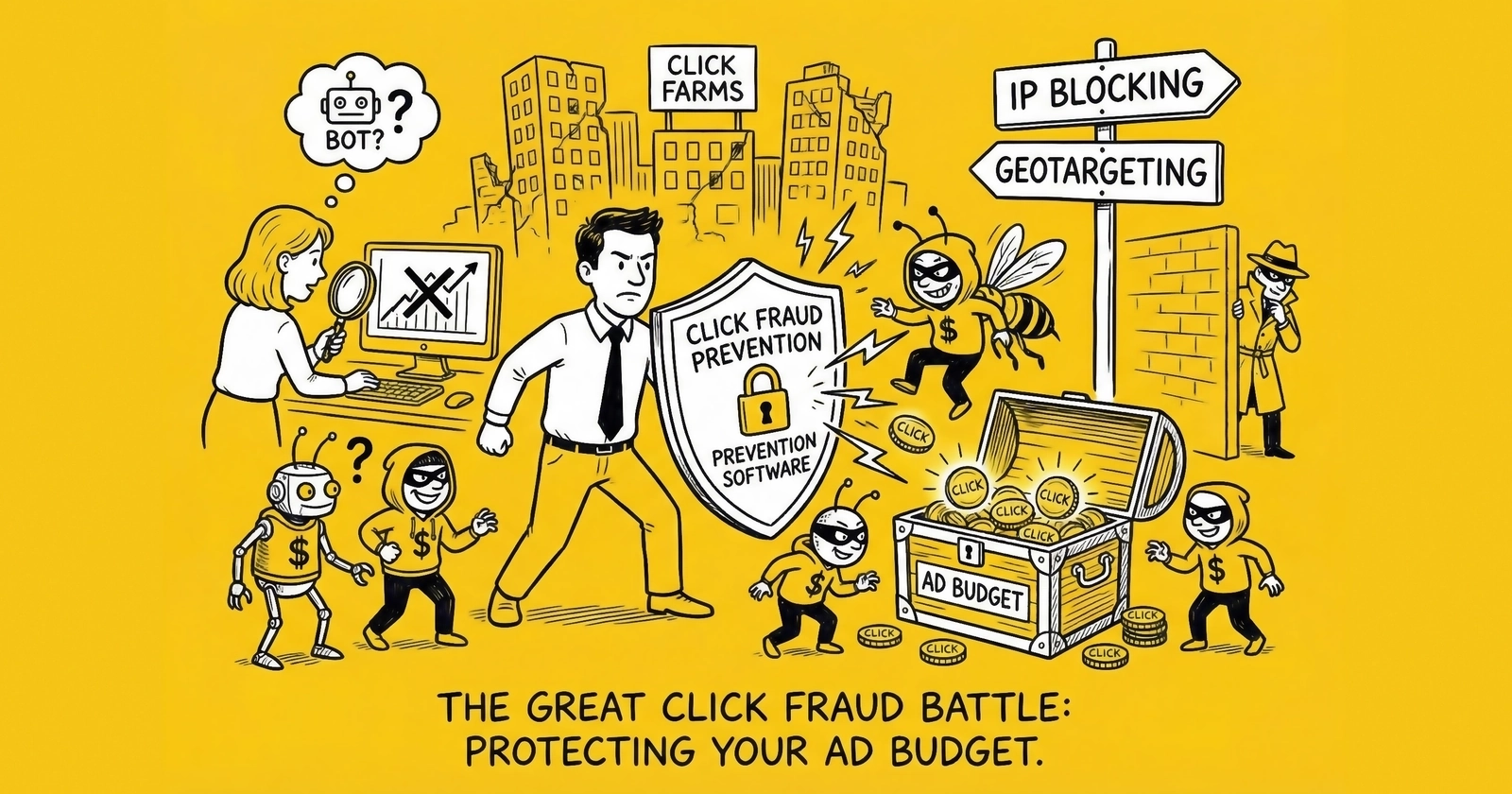
A comprehensive guide to identifying, preventing, and recovering from click fraud – the hidden drain that costs advertisers over $84 billion annually and systematically corrupts lead generation data, margins, and optimization decisions.
Your dashboard shows success. Ten thousand clicks. An 8% conversion rate. 800 leads at what looks like a $50 cost per lead. The numbers look profitable. The campaign appears healthy.
What you cannot see: 1,800 of those clicks came from automated scripts. Another 400 came from competitors systematically draining your budget. The remaining clicks that actually came from humans include traffic from incentivized click farms that will never convert to customers.
Your real cost per lead is not $50. When you strip out the fraudulent clicks you paid for, recalculate based on legitimate traffic only, and factor in the leads that will return as uncontactable, your true cost per qualified lead approaches $85. For a deeper understanding, see our guide on calculating true cost per lead.
This is click fraud. It operates continuously, invisibly, and at scale. It does not announce itself with error messages or failed transactions. It simply siphons budget, corrupts data, and makes profitable campaigns appear marginal while making unprofitable campaigns appear successful.
This guide provides the complete framework for understanding click fraud in lead generation, implementing detection systems that work, and building campaigns that minimize exposure from the start.
The Scale and Economics of Click Fraud in 2025
Click fraud is not a marginal problem affecting the unlucky few. It represents a structural tax on digital advertising that grows alongside the industry itself.
The Numbers That Define the Problem
The data from industry research paints a consistent picture:
- $84 billion: Estimated global ad fraud losses annually (Juniper Research, 2024)
- $172 billion: Projected annual losses by 2028 at current growth trajectories
- 22%: Average percentage of paid clicks that are fraudulent across all industries (CHEQ analysis)
- 14-25%: Click fraud rate specifically on Google Ads, varying by industry (University of Baltimore study)
- 90%: Percentage of PPC campaigns affected by some level of click fraud (ClickCease)
- 32-37%: Percentage of all web traffic that originates from bots (Imperva Bad Bot Report)
These are not outliers or worst-case scenarios. They represent the baseline operating environment for paid digital advertising. If you run paid traffic campaigns, click fraud affects you. The only question is how much and whether you have visibility into it.
Why Lead Generation Faces Elevated Risk
Lead generation campaigns experience higher click fraud rates than e-commerce or brand advertising for structural reasons that amplify exposure.
Higher CPCs create larger fraud incentives. Insurance, legal, and mortgage verticals routinely pay $15-50 or more per click. A fraudster running bots against a $40 CPC campaign extracts $4,000 with 100 fake clicks. The same bot clicking on a $2 retail CPC campaign yields only $200. The math concentrates fraud where the money is.
Delayed feedback loops mask the damage. In e-commerce, fraud is immediately visible – bots do not complete purchases. In lead generation, fraudulent clicks can generate form submissions that look legitimate until someone tries to contact the consumer. By that point, you have paid for the click, processed the lead, and potentially sold it to a buyer. The feedback that reveals the problem arrives days or weeks later.
Competitive intensity in high-value verticals. Industries where lead values justify $30-100+ CPCs attract intense competition for limited inventory. Personal injury law, for example, concentrates enormous value into relatively few clicks. The incentive to drain a competitor’s budget and capture their ad position grows proportionally.
Publisher fraud in affiliate and programmatic channels. When publishers earn revenue per click, some percentage will artificially inflate clicks to boost earnings. This fraud operates at the supply level before traffic ever reaches your landing page.
The Real Cost Beyond Wasted Spend
Wasted ad spend is the obvious damage, but click fraud inflicts broader harm that compounds over time.
Corrupted CPL calculations lead to bad decisions. If 20% of your clicks are fraudulent, your reported cost per lead understates reality by 25%. A campaign showing $50 CPL is actually operating at $62.50 when you account only for legitimate traffic. Decisions about scaling, pausing, or optimizing based on the reported number lead you astray.
Poisoned audience data degrades future performance. Retargeting lists, lookalike audiences, and conversion optimization algorithms all train on your traffic data. Include 20% bots in that data, and you are teaching algorithms to find more traffic that resembles bots. Campaign performance degrades over time as the system optimizes toward the wrong signals.
Quality Score damage increases long-term costs. Click fraud that produces high bounce rates and low conversion rates negatively impacts Quality Score on Google Ads. This directly affects your Google Ads Quality Score optimization. Lower Quality Scores mean higher CPCs and worse ad positions. The fraud keeps costing you even after you have addressed it, until Quality Score recovers.
Attribution models become meaningless. Multi-touch attribution depends on accurate conversion data. When 20% of your conversion events are fraudulent, attribution analysis produces conclusions that do not reflect reality. You cannot optimize toward outcomes that have been contaminated with fraud.
Understanding the Four Types of Click Fraud
Click fraud manifests in distinct forms, each requiring different detection and prevention approaches. Understanding these categories enables targeted defense.
Bot Click Fraud: Automated Scale Attacks
Automated software programs generate fake clicks at scale. This category accounts for an estimated 50-60% of all fraudulent clicks.
Simple bots use basic automation scripts that platforms increasingly detect automatically. They click rapidly, from obvious data center IPs, with no realistic browsing behavior.
Sophisticated bots mimic human behavior patterns. They randomize click timing, simulate mouse movement, scroll through pages, and rotate through residential proxy networks that disguise their origin. Modern bot frameworks like Puppeteer and Playwright can execute full browser sessions that pass many basic detection checks.
Botnets leverage networks of infected consumer devices. Each click appears to originate from a different legitimate user’s computer or phone. The distributed nature makes pattern detection difficult because no single source shows suspicious volume.
Bot traffic has grown increasingly human-like as detection systems have improved. The arms race continues: detection methods advance, bot developers adapt, detection improves again.
Competitor Click Fraud: Strategic Budget Drain
Your competitors benefit directly when your campaigns fail. Some competitors actively exploit this by clicking your ads to exhaust your budget.
The math is straightforward. If your daily budget is $500, generating $500 in fraudulent clicks removes you from the auction for the remainder of the day. In competitive markets where top ad positions capture 75% or more of clicks, removing a competitor’s ads directly increases traffic to remaining advertisers.
Industry research suggests 15-20% of click fraud originates from competitors. In intensely competitive verticals like personal injury law, the percentage runs higher.
Detection signals include repeated clicks from the same IP addresses during business hours, clicks concentrated in geographic areas where competitors operate, and click patterns that correlate with your budget exhausting.
Click Farms: Human-Powered Fraud
Click farms employ actual humans to click ads, bypassing automated detection entirely. Workers using real browsers on real devices produce click behavior that matches legitimate patterns.
Major click farm operations concentrate in regions with low labor costs – Southeast Asia, South Asia, and Eastern Europe host the largest concentrations. A facility with 200 workers clicking 500 times daily generates 100,000 fraudulent clicks per day.
Click farms are particularly dangerous because they defeat most automated detection. The clicks come from real devices with real IP addresses, executed by humans with natural browsing patterns. Detection requires analyzing clusters of unusual geographic concentration, email patterns suggesting coordinated activity, and conversion data that does not match expected patterns.
Publisher Fraud: Gaming the Revenue Share
Publishers in advertising networks earn money when users click ads on their sites. Fraudulent publishers inflate clicks artificially to boost their revenue share.
Common publisher fraud tactics include:
- Click injection: Mobile apps generate fake clicks the moment a user installs an app, claiming credit for organic installs
- Ad stacking: Multiple ads layered on top of each other so clicking one registers clicks on all
- Pixel stuffing: Ads loaded in 1x1 pixel frames invisible to users but counted as impressions that auto-trigger clicks
- Domain spoofing: Misrepresenting low-quality sites as premium inventory to attract higher-paying advertisers
- Traffic laundering: Routing fraudulent traffic through legitimate-looking intermediary sites
A fraudulent publisher generating 10,000 fake clicks daily at $0.50-5.00 per click can earn $5,000-50,000 monthly until detected and removed from networks.
Click Fraud Detection: Signals and Methods
Effective detection combines multiple signals across different dimensions. No single indicator definitively confirms fraud, but clusters of signals reveal patterns with high confidence.
Traffic Pattern Analysis
Unusual traffic spikes not correlated with campaign changes or external events warrant investigation. If your traffic doubles on a Tuesday afternoon without any bid adjustments, new creative, or obvious external driver, something artificial may be occurring.
Time distribution anomalies reveal automated activity. Human traffic follows predictable patterns – lower overnight, ramping up in morning hours, peak during business hours. Bot traffic often shows unnaturally uniform distribution or spikes during off-peak hours when human conversion is unlikely.
Geographic inconsistencies flag suspicious sources. Traffic from countries you do not target, unusually high volume from small cities, or clicks from IP ranges belonging to data centers rather than consumer ISPs all merit scrutiny.
Session and Behavioral Analysis
Time-on-site metrics distinguish legitimate visitors from fraudulent clicks. Real prospects spend time reading content and considering their options. Bots often generate sessions of 0-2 seconds – enough to register the click but no actual page engagement.
Scroll and click patterns reveal automation. Humans scroll irregularly, pause on content, and click with slight positional variation. Bots often show no scroll activity, identical click coordinates, or perfectly linear mouse movement.
Form completion behavior separates humans from automated submissions. Legitimate users take 30 seconds to several minutes to complete forms, typing with natural rhythm. Bots complete forms in 2-5 seconds, often with copy-paste patterns or suspiciously consistent timing.
Technical Indicators
IP address patterns provide foundational detection data. Watch for multiple clicks from single IPs, traffic from VPN exit nodes or data center IP ranges, and requests from IP addresses associated with known fraud operations.
Device fingerprinting catches spoofing attempts. Each browser and device combination produces a semi-unique fingerprint based on configuration details. Identical fingerprints across many clicks, missing or spoofed user agent strings, and JavaScript execution patterns inconsistent with claimed browsers all signal fraud.
Network-level signals include traffic from hosting providers rather than consumer ISPs, requests missing standard browser headers, and TLS fingerprints that do not match claimed browser types.
Conversion Quality Correlation
The most powerful fraud signal comes from tracking what happens after the click.
Monitor lead quality metrics segmented by traffic source:
| Metric | Normal Range | Fraud Indicator |
|---|---|---|
| Phone connect rate | 60-70% | Below 40% |
| Email deliverability | 95%+ | Below 85% |
| Lead return rate | 8-15% | Above 25% |
| Form completion time | 30-120 seconds | Under 10 seconds |
| Geographic consistency | Matches targeting | Significant mismatch |
If a traffic source consistently produces leads that fail these quality benchmarks, fraud is the likely explanation regardless of what click-level analysis shows. Implementing robust lead quality control processes helps identify these patterns early.
Click Fraud Prevention Tools: Platform Comparison
Dedicated prevention platforms add protection layers beyond what advertising platforms provide natively. Here is how the major solutions compare.
ClickCease
What it does: Monitors all clicks on Google Ads and Facebook campaigns in real-time. Uses IP detection, device fingerprinting, and behavioral analysis to identify fraudulent clicks. Automatically adds fraudulent IPs to exclusion lists.
Best for: Small to mid-sized lead generators running Google Ads campaigns. Implementation is straightforward with direct platform integration.
Pricing: Starts at $79/month for up to $5,000 monthly ad spend, scaling with spend volume.
Limitations: Primarily focused on Google and Facebook. Less effective against sophisticated botnets using residential IP rotation.
Reported effectiveness: Claims to detect and block 14-25% of fraudulent clicks on average.
CHEQ
What it does: Enterprise-grade fraud prevention using machine learning models trained on billions of interactions. Provides security across paid search, social, programmatic, and affiliate channels.
Best for: Large operations with significant multi-channel spend requiring comprehensive protection beyond just click-level defense.
Pricing: Enterprise pricing, typically $2,000-10,000+ monthly depending on traffic volume and channel coverage.
Limitations: Higher cost makes it impractical for smaller operations. Full capability use requires implementation effort.
Reported effectiveness: Claims to block over $12 billion in fraud annually across clients. Enterprise users report 15-30% improvements in conversion rates after deployment.
TrafficGuard
What it does: Real-time ad fraud prevention across mobile, web, and in-app advertising. Particularly strong in mobile app install fraud and affiliate marketing fraud detection.
Best for: Lead generators with significant mobile traffic or extensive affiliate network relationships where publisher fraud is common.
Pricing: Starts around $499/month for mid-market plans.
Limitations: Mobile-first heritage means some web-focused features are less mature than specialized competitors.
Reported effectiveness: Claims clients save an average of 20%+ on ad spend through invalid traffic elimination.
Native Platform Tools
Google Ads automatically filters basic bot traffic, repetitive clicks from the same IP, and clicks from known invalid sources. The Invalid Clicks Report (Tools > Billing) shows credits already applied. What Google misses: sophisticated bots using residential IPs, competitor clicks that stay below detection thresholds, and click farms using human clickers.
Meta filters invalid activity before billing, including bots and coordinated inauthentic behavior. Invalid activity simply does not appear in reporting – it is filtered pre-charge rather than credited post-detection.
Selection Framework by Spend Level
| Monthly Ad Spend | Recommended Approach |
|---|---|
| Under $5,000 | Manual monitoring + platform native tools |
| $5,000-$25,000 | ClickCease or similar SMB solution |
| $25,000-$100,000 | TrafficGuard or comprehensive mid-market platform |
| Over $100,000 | CHEQ or enterprise-grade solution |
| Heavy mobile/affiliate | TrafficGuard regardless of total spend |
The ROI math typically works in favor of prevention tools once spend exceeds $10,000 monthly. At a 22% fraud rate, $10,000 monthly spend means $2,200 in fraudulent clicks. Even a prevention tool catching only half the fraud saves $1,100 monthly against a $79-500 tool cost.
Manual Detection Methods
Automated tools catch many fraud types, but manual analysis reveals patterns that software misses. Build these practices into regular operations.
Weekly Traffic Audits
Step 1: Export click-level data from Google Ads (or your analytics platform) for the past seven days.
Step 2: Flag any IP address appearing more than three times. Cross-reference against VPN/proxy databases and data center IP ranges.
Step 3: Compare click geography against your targeting settings. Investigate unusual concentrations from specific cities, ISPs, or countries outside your target.
Step 4: In analytics, examine sessions from paid traffic. Sessions with 0 time on site or bounce rates above 85% suggest traffic quality problems.
Step 5: Calculate conversion rate by source, excluding suspicious traffic. Compare against your baseline to quantify potential fraud impact.
Implementing Honeypot Fields
A honeypot is a hidden form field invisible to human users but visible to bots that scrape and complete all available fields.
Add a hidden text field with a tempting name like “website” or “url”. Set the field to display:none in CSS. Legitimate users never see it; bots programmatically fill it. Any submission containing data in the honeypot field is automatically fraudulent.
Honeypots catch 5-15% of bot submissions with zero false positive rate. They cost nothing to implement and require no ongoing maintenance.
Server Log Analysis
Server logs capture information that JavaScript-based analytics cannot see – requests that never fully load, direct endpoint access, and header anomalies.
Review logs for:
- Requests missing standard browser headers (User-Agent, Accept, Accept-Language)
- Unusual user agent strings that do not match known browsers
- Extremely rapid sequential requests from single IPs
- Requests hitting form submission endpoints without first loading the form page
- Mismatched referrer data suggesting traffic origin is being spoofed
Tools like AWStats, GoAccess, or custom log parsing scripts can surface these patterns systematically.
Campaign Structure for Fraud Resistance
Prevention is more cost-effective than detection and remediation. Structure your campaigns to minimize fraud exposure from the start.
Targeting and Scheduling Optimization
Daypart your campaigns to reduce off-hours fraud exposure. Schedule ads only during hours when your sales team operates and when legitimate consumers are likely to convert. Bot traffic often clicks during periods when human conversion probability is zero.
Implement geographic exclusions for countries you do not serve. Explicit exclusions add protection against international bot farms even when your positive targeting is already domestic-only.
Consider device targeting that reduces bot access. Most sophisticated bot traffic originates from desktop browsers or spoofed environments. Mobile device targeting, while limiting reach, reduces exposure to certain fraud types.
Build placement exclusion lists in display campaigns. Sites that generate high click volume with zero conversions should be immediately excluded. Review placement reports weekly and remove underperformers before they drain significant budget.
Landing Page Defenses
Implement reCAPTCHA v3 or similar invisible challenge systems. Modern CAPTCHAs score visitor behavior without visible challenges, flagging suspicious users for additional verification while passing legitimate traffic through frictionlessly.
Require JavaScript execution for form submission. Many bot frameworks do not fully execute JavaScript. Server-side checks confirming that JavaScript-generated tokens are present filter basic automated traffic.
Use multi-step form flows. Bots optimized for single-page form completion often fail when forms span multiple pages or require user interactions between steps. The additional complexity increases abandonment for legitimate users slightly but dramatically increases bot failure rates.
Capture hidden timestamp fields. Record the time between page load and form submission. Reject submissions under 10 seconds – no human reads content and completes a form that quickly. Log submissions in the 10-20 second range for quality review.
Budget and Bidding Strategies
Daily budget caps limit maximum daily damage. If fraud attacks your campaigns, a $100 daily cap means you lose $100, not your entire monthly budget.
Target CPA bidding reduces exposure over time as algorithms learn which traffic sources do not convert. Smart Bidding strategies deprioritize sources that produce clicks but not conversions.
Manual CPC for high-risk keywords gives you direct control at the cost of some optimization efficiency. In verticals with extreme fraud exposure, the control can be worth the trade-off.
Aggressive audience exclusions remove segments that have clicked but not converted. Build audiences of non-converters and exclude them from campaigns to prevent the same fraudulent sources from repeatedly clicking.
Getting Refunds from Advertising Platforms
When you identify click fraud, platforms provide mechanisms to recover wasted spend. The process requires documentation and persistence.
Google Ads Refund Process
Automatic credits: Google automatically credits your account for invalid clicks their systems detect. Access Reports > Predefined Reports > Invalid Clicks to see credits already applied.
Requesting additional credits: When you identify fraud that Google missed:
- Document the fraudulent activity with specifics – IP addresses, timestamps, behavioral evidence, conversion data showing the traffic never converted
- Navigate to Tools & Settings > Billing > Billing Documents
- Select the invoice period affected
- Choose “Dispute charges” and upload your documentation
- Alternatively, contact Google Ads support via chat or phone with your evidence package
Documentation that strengthens requests:
- IP address lists with click timestamps
- Evidence of repetitive clicking patterns
- Server log data showing bot behavior (missing headers, direct endpoint access)
- Third-party fraud detection tool reports
- Conversion data showing zero conversions from flagged traffic
Success factors: Google approves well-documented requests with specific evidence at higher rates than vague complaints about “high CPL.” Approval rates for properly documented requests run 60-80%.
Timing: Submit requests within 60 days of the fraudulent activity. Older claims are harder to investigate and less likely to receive credits.
Meta Refund Process
Meta handles fraud differently – they filter before billing rather than crediting after detection. When you suspect fraud that passed their filters:
- In Ads Manager, identify campaign periods with suspected fraud
- Contact Meta Business Help Center via chat or callback
- Provide campaign IDs, date ranges, and specific evidence
- Request manual review of flagged activity
Meta’s process is less transparent than Google’s. They may provide credits, extend campaigns at no cost, or decline requests. Document all communications regardless of outcome.
Programmatic and Display Networks
For Google Marketing Platform (DV360), access invalid traffic reporting tools and request credits through your Google representative with documentation.
For The Trade Desk and other DSPs, contact your account manager with evidence packages. Refund policies vary by platform and contract terms.
For direct publisher relationships, address fraud immediately and document everything. Consistent fraud is grounds for contract termination and potential recovery of previous payments.
Measuring Click Fraud Prevention ROI
Click fraud prevention requires investment. Justifying that investment requires measuring its return accurately.
The Basic ROI Calculation
Formula: Prevention ROI = (Fraud Blocked - Prevention Cost) / Prevention Cost x 100
Example scenario:
- Monthly ad spend: $50,000
- Fraud rate before prevention: 22%
- Fraud blocked by prevention tools: $11,000
- Prevention tool cost: $500/month
- Prevention ROI: ($11,000 - $500) / $500 x 100 = 2,100%
Even at 50% prevention effectiveness:
- Fraud blocked: $5,500
- Tool cost: $500
- ROI: ($5,500 - $500) / $500 x 100 = 1,000%
The math strongly favors investment in prevention once spend exceeds approximately $10,000 monthly.
Performance Benchmarks
| Metric | Acceptable | Strong |
|---|---|---|
| Fraud detection rate | 60-70% | 80-90% |
| False positive rate | Under 2% | Under 1% |
| Lead quality improvement | 10-15% | 20-30% |
| Cost per dollar saved | Under $0.10 | Under $0.05 |
| Time to block new threats | Under 24 hours | Real-time |
What Success Looks Like Over Time
Week 1-4: Click volume may decrease as fraudulent clicks are blocked. CPL initially appears to increase as fewer fake leads enter the funnel. This is the system working correctly – you are seeing your true numbers rather than inflated fraudulent metrics.
Month 1-3: Lead quality metrics improve. Conversion rate from lead to customer increases as fraud-contaminated leads stop reaching sales teams. Return rate on sold leads decreases as lead data quality improves.
Month 3+: Budget allocation becomes more efficient as clean data enables better optimization decisions. Buyer relationships strengthen due to consistent lead quality. Quality Score recovers from prior fraud damage, reducing CPCs.
Frequently Asked Questions
What percentage of my clicks are likely fraudulent?
Industry research suggests 14-25% of paid clicks are fraudulent across all industries, with rates higher in competitive verticals. Lead generation campaigns in insurance, legal, and home services typically experience 18-25% fraud rates without prevention measures. Your actual rate depends on your traffic sources, vertical, and existing detection capabilities.
How do I know if competitors are clicking my ads?
Look for patterns: repeated clicks from the same IP addresses during business hours, clicks concentrated in geographic areas where competitors operate, and click timing that correlates with your budget depleting earlier than expected. Prevention tools with competitor detection features identify suspected competitor IPs and enable blocking.
Will blocking fraudulent IPs hurt my legitimate traffic?
Properly implemented IP blocking should not significantly reduce legitimate volume. If blocking decreases your traffic by more than 10-15%, your exclusion lists may include legitimate sources. Review false positive rates and adjust detection thresholds to maintain balance between protection and reach.
How quickly can I expect refunds from Google?
Google typically responds to invalid click investigations within 3-5 business days. Approved credits appear within one billing cycle. Complex investigations may take 2-3 weeks. Submit requests within 60 days of the fraudulent activity for best results.
Can click fraud affect my Google Ads Quality Score?
Yes. Click fraud that produces high bounce rates and low conversion rates negatively impacts Quality Score. Lower scores increase your CPC and reduce ad positions. Preventing fraud protects Quality Score, which compounds into lower costs and better positions over time.
What is the difference between invalid clicks and click fraud?
Invalid clicks include all clicks that should not be charged – accidental clicks, double-clicks, and bot clicks. Google filters these automatically. Click fraud specifically refers to intentional invalid clicks designed to waste advertiser budget or inflate publisher revenue. All click fraud produces invalid clicks, but not all invalid clicks are fraud.
Should I use multiple click fraud prevention tools simultaneously?
Generally no. One comprehensive tool provides better protection than multiple overlapping solutions, which can create conflicts in IP blocking and complicate dashboard management. Choose the tool that best matches your spend level and channel mix, then implement it fully before considering additions.
How do click farms avoid detection?
Click farms use human workers with real devices, rotate through VPN and proxy services, vary clicking patterns, and spread activity across many campaigns. They study detection systems and adjust behavior to remain below thresholds. Sophisticated farms defeat most automated detection, which is why conversion-based quality analysis matters – even human clickers do not convert to customers.
Can I take legal action against competitors for click fraud?
Theoretically, click fraud can constitute tortious interference with business relations or computer fraud. Practically, proving competitor responsibility requires evidence that is difficult to obtain, and litigation costs frequently exceed damages. Prevention and platform refunds offer better ROI for most operations.
What should I do if I discover a publisher generating fraudulent clicks?
Immediately pause that placement or publisher. Document evidence including timestamps, IP addresses, and click patterns. Report the publisher to the advertising platform or network. Request refunds for fraudulent traffic. Depending on contract terms, you may have grounds for direct recovery from the publisher.
Key Takeaways
Click fraud represents a structural tax on digital advertising, not an occasional problem. At $84 billion annually and affecting 90% of PPC campaigns, operating without fraud awareness means accepting 15-25% waste as a hidden cost of doing business.
Lead generation faces elevated exposure due to high CPCs and delayed feedback. The same factors that make lead generation profitable – high per-click values and conversion-based measurement – create amplified fraud incentives. Your most valuable keywords attract the most fraud.
Four fraud types require four different responses. Bot fraud requires technical detection at the IP and device level. Competitor fraud requires IP monitoring and blocking. Click farms require behavioral and geographic analysis. Publisher fraud requires conversion tracking by placement and rapid exclusion.
Platform native tools catch obvious fraud but miss sophisticated attacks. Google and Meta filter the easy cases. Advanced bots, click farms, and determined competitors require dedicated prevention investment.
Prevention ROI typically exceeds 1,000% for operations spending $10,000+ monthly. The math strongly favors investment. A $500 monthly tool that catches half of 22% fraud on $50,000 spend saves $5,500 monthly.
Campaign structure prevents fraud before it happens. Dayparting, geographic exclusions, landing page defenses, and budget controls reduce exposure independent of detection capabilities. Build prevention into campaigns rather than relying solely on after-the-fact identification.
Refunds are available but require documentation. Maintain logs of fraudulent activity with specific evidence. Submit requests within 60 days. Well-documented cases achieve 60-80% approval rates.
Lead quality metrics reveal fraud that click analysis misses. Track contact rates, conversion rates, and returns by source. Sources consistently producing poor outcomes indicate fraud regardless of click-level signals.
Sources
-
Juniper Research: Digital Advertising Fraud - Research source for the $84 billion annual ad fraud estimate and projected $172 billion by 2028.
-
ClickCease - Click fraud prevention platform referenced for detection rates and SMB pricing tiers.
-
CHEQ - Enterprise fraud detection platform cited for 22% average fraudulent click rate and 2,000+ security test methodology.
-
TrafficGuard - Multi-platform fraud prevention solution with mobile and affiliate network detection capabilities.
-
ABA Journal - Legal industry resource for information on click fraud litigation and competitor interference case precedents.
Statistics and research current as of late 2024 and early 2025. Click fraud rates and prevention tool capabilities continue to evolve as the detection and evasion arms race progresses.