The predictable failures that end careers before they start – and how to avoid becoming another statistic in lead generation’s unforgiving learning curve.
The graveyard of lead generation businesses is filled with operators who learned their lessons too late. Not from lack of effort or intelligence – most failed entrepreneurs worked harder and smarter than their employed peers. They failed because they made mistakes that are predictable, documented, and entirely avoidable.
Every mistake described here represents someone else’s lost capital, failed relationships, or shuttered operation. Some mistakes kill businesses overnight. Others bleed them dry over months. A few simply prevent growth, trapping competent operators in permanent mediocrity.
I watched a $2M operation collapse because the founder couldn’t float 45 days of working capital. I saw another lose everything to a TCPA class action over consent language their “compliance expert” approved. These failures weren’t random. They were preventable.
The pattern recognition you develop here could be the most valuable skill you acquire. Learn from this article what others learned from bankruptcy filings.
Mistake #1: Undercapitalization
The Reality
Bank studies consistently show that 82% of small business failures stem from cash flow problems. In lead generation, the numbers are worse. The industry’s payment timing dynamics create structural cash flow challenges that catch even experienced business owners off guard.
The fundamental problem is float – the gap between when you pay for leads and when you receive payment for them. Suppliers typically expect payment on NET 7 to NET 15 terms. Buyers typically pay on NET 30 to NET 60 terms – a reality covered in depth in credit and payment terms for lead transactions. Some enterprise buyers stretch payments to NET 90. This creates a 30 to 75-day gap during which you’ve paid your costs but haven’t collected your revenue.
The math is unforgiving. An operation spending $50,000 per week on traffic acquisition and lead purchases will need to float $200,000 to $300,000 in working capital before receiving its first buyer payments. Double that if your buyer mix includes slower-paying enterprise accounts. Add 20% for return reserves – because buyers will dispute leads and claw back payments, sometimes after you’ve already paid your suppliers.
Why New Operators Fall Into This Trap
Entrepreneurs from other industries bring assumptions that don’t apply here. Service businesses collect at delivery. Product businesses collect before shipping. Lead generation operates on extended credit cycles where buyers hold the leverage.
The “successful month” trap catches many practitioners. A strong month increases the float requirement for following months. Without additional capital, operators find themselves stretched thin exactly when they should be celebrating.
The Prevention Protocol
The minimum capital requirement for any lead generation business is six months of operating expenses plus 20% buffer for unexpected costs and opportunities. This isn’t conservative planning – it’s survival math.
Calculate your actual float requirement before launching. Model your supplier payment terms, buyer payment terms, expected return rates, and growth trajectory. Be realistic about buyer payment behavior – enterprise clients regularly pay late, and your actual collection timeline may be 15 to 30 days beyond contractual terms.
Maintain separate reserves for returns. When buyers return leads, the revenue reversal often comes 30 to 60 days after you’ve already recognized and spent the income. A 10% return reserve – held separately from operating capital – provides buffer against this timing mismatch.
Negotiate payment terms strategically. Faster payment from buyers is more valuable than lower prices. A buyer who pays NET 15 versus NET 30 reduces your float requirement by 50% on their volume.
Mistake #2: Single-Source Dependency
The Reality
Concentration risk kills lead generation businesses quietly. An operator with 50% or more of revenue from a single buyer isn’t running a lead generation business – they’re running an outsourced marketing department with no employment contract.
The statistics from industry analysis are stark: 20% of buyers generate 80% of revenue for most lead operations. This Pareto distribution isn’t problematic by itself – it’s how you manage around it that determines survival.
Buyer concentration creates three fatal vulnerabilities:
Terms erosion: A buyer who represents 50% of your revenue knows it. They can demand price reductions, longer return windows, faster delivery requirements, and more generous dispute resolution. You’ll accept these terms because you can’t afford to lose the volume.
Payment risk: If your largest buyer delays payment – or fails entirely – the cash flow impact cascades through your entire operation. You can’t pay suppliers, can’t fund traffic, can’t maintain operations.
Strategic dependency: Your product development, operational processes, and team structure optimize around your largest buyer’s requirements. When that buyer changes strategy, churns, or gets acquired, you discover that your entire operation was built around assumptions that no longer apply.
The Pattern I’ve Witnessed
I watched a solar lead generator build their entire operation around one regional installer. When that installer got acquired, the new owners brought their existing lead supply chain. The generator had six weeks’ notice and zero buyer diversification. The business didn’t survive Q1.
The Diversification Mandate
No single buyer should represent more than 25% of your revenue. For more conservative practitioners, 20% is a safer ceiling. This isn’t a target – it’s a hard limit that shapes your sales strategy and buyer acceptance decisions.
Build buyer diversification into your business model from launch. Before scaling volume with your first buyer, identify and onboard backup buyers who can absorb that volume if the primary relationship fails.
Monitor concentration metrics actively. Your dashboard should show buyer concentration daily. When any buyer approaches 25% of volume, pause until diversification catches up.
Mistake #3: Ignoring TCPA Compliance
The Litigation Reality
The Telephone Consumer Protection Act has become the single largest legal threat to American businesses engaged in outbound marketing. In Q1 2025 alone, 507 TCPA class actions were filed – a 112% increase over the same period in 2024. By September 2025, monthly filings hit 224 class actions – a 283% spike over the prior year.
These aren’t abstract statistics. The average TCPA class action settlement exceeds $6.6 million. Even smaller companies face existential settlements. National Grid settled for $38.5 million in 2024. Citibank paid $29.5 million. Realogy settled for $20 million over trigger lead calls.
The statutory damages are brutal: $500 to $1,500 per call or text. There is no cap on aggregate damages. A company that makes 10,000 non-compliant calls faces potential exposure of $5 million to $15 million – before attorney’s fees.
Why Operators Underestimate This Risk
newcomers often view compliance through the lens of their previous business experience. In most industries, regulatory violations result in warnings, fines, or at worst, civil penalties negotiated with regulators. TCPA litigation operates differently.
The statute creates a private right of action, meaning any aggrieved consumer – or their attorney – can sue directly. There’s no regulatory buffer, no warning letter, no opportunity for remediation before litigation begins.
Serial litigators – professional plaintiffs who collect multiple phone numbers and deliberately receive calls to generate lawsuits – account for an estimated 33% to 41% of filings. One plaintiff testified in court that she maintained 35 cell phones to support her “business” of filing TCPA complaints.
Building Compliance Infrastructure
Document consent at the moment of capture. TrustedForm certificates, Jornaya LeadiD tokens, or equivalent technologies should record not just that consent was given, but the exact form, language, and timestamp. Retain this documentation for a minimum of five years – beyond the four-year TCPA statute of limitations. See the complete guide on consent documentation and retention for detailed requirements.
Implement litigator scrubbing on every lead before contact. Services like Litigator Scrub and TCPA Litigator List maintain databases of known serial litigators. Cross-reference every phone number against these lists before making contact.
Build internal DNC management into your core systems. The National DNC Registry is the minimum legal requirement, but sophisticated practitioners maintain internal suppression lists, honor verbal stop requests immediately, and track revocation of consent at the individual level.
Audit source compliance continuously. If you’re purchasing leads, you inherit compliance risk from your suppliers. Validate that their consent capture meets your standards.
Mistake #4: Scaling Before Understanding Unit Economics
The Dangerous Assumption
Scaling amplifies inefficiency. An operation with 20% conversion rates and $40 CPAs spending $10,000 monthly is underperforming. The same operation spending $100,000 monthly is hemorrhaging capital. Scale reveals weaknesses that low volume concealed.
The temptation to scale comes from visible success. When a campaign generates leads at acceptable cost, the natural instinct is to increase spend. But “acceptable” at low volume often means “problematic” at high volume.
Quality decline with volume is nearly universal. The first 1,000 leads from any source are typically the highest quality – early traffic captures the most engaged prospects. As volume increases, lead quality regresses toward the mean. Sources that looked exceptional at low volume look average at high volume and poor at very high volume.
What True Cost Per Lead Actually Includes
Most lead generation businesses don’t actually know their true cost per lead. They know acquisition costs, platform fees, and labor expenses as separate line items. They don’t know how those costs combine at the individual lead level.
True cost per lead includes:
- Traffic acquisition cost
- Landing page and form costs
- Validation and verification fees
- Consent documentation costs
- Delivery infrastructure costs
- Return reserves
- Float costs from payment timing
- Labor allocation
- Overhead distribution
When operators price based only on media costs, they systematically underprice their product. If you price a lead at $50 expecting a 10% return rate, but actual returns run 20%, your effective revenue is $40 – not $50. If your true cost per lead is $38, your margin just collapsed from 24% to 5%. Understanding true cost per lead calculation prevents this pricing blindspot.
The Optimization-First Discipline
Establish baseline metrics that must be achieved before scaling. Define minimum conversion rates, maximum cost per lead, acceptable return rates, and quality scores. Don’t increase spend until current campaigns meet these thresholds.
Run optimization cycles before volume increases. For each 2x increase in spend, complete at least one full optimization cycle: test variations, analyze results, implement winners, retest.
Scale incrementally rather than exponentially. Increase spend by 20% to 30% at a time, observe performance at each level, and continue only if metrics hold. Dramatic scaling – 2x, 5x, 10x increases – overwhelms your ability to detect degradation before damage accumulates.
Mistake #5: Trusting Platform Metrics Over Bank Account
The Metrics Mirage
Your dashboard says you’re profitable. Your CPA is $28 and you’re selling leads for $45. That’s $17 margin per lead, times 200 leads a day, times 30 days – you should be clearing $100K monthly.
Except you’re not.
The disconnect between platform metrics and actual profitability comes from multiple sources:
- Returns that haven’t processed yet
- Chargebacks landing weeks later
- Float costs never calculated
- Bad debt from buyers who don’t pay
- Duplicate leakage across sources
- Processing fees on every transaction
Platform CPAs don’t include validation costs. Gross margins don’t account for returns. Revenue projections assume all buyers pay on time.
The Broker Margin Reality Check
Here’s the math everyone avoids. You’re a broker buying at $30 and selling at $50. That’s $20 gross margin – 40% on paper.
Here’s what actually happens:
- 12% return rate (industry average): -$6.00
- Duplicate/invalid leakage: -$2.50
- Payment processing (2.8%): -$1.40
- Float cost (pay in 15, collect in 45): -$0.80
- Bad debt (buyers who don’t pay): -$1.00
Actual margin: $8.30 (16.6%)
Still profitable – but a fundamentally different business than the pitch deck version. And this assumes you have volume. Below 5,000 leads monthly, fixed costs eat most of that $8.30.
The Bank Account Standard
Track actual cash collected, not booked revenue. Your accounting system shows revenue when leads sell. Your bank account shows cash when buyers pay. These are different numbers, and the bank account is the only one that matters for survival.
Calculate return-adjusted revenue weekly. Don’t wait for monthly closes to understand your true economics. Track return rates in real-time and adjust revenue projections accordingly.
Reconcile platform metrics to bank deposits monthly. If your platform says you made $100,000 and your bank shows $85,000, you have $15,000 of problems to diagnose.
Mistake #6: Neglecting Buyer Relationships
The Relationship Reality
Lead generation is a relationship business operating at digital scale. Those who succeed long-term are deeply embedded in industry networks – they know who’s buying, who’s selling, and who’s innovating.
The best buyers don’t post RFPs – they ask trusted suppliers for referrals. The difference between a supplier and a partner: suppliers get evaluated quarterly against alternatives. Partners get called when new opportunities emerge.
Building Buyer Partnership
Communicate proactively about problems. When quality issues arise, tell buyers before they discover it themselves. This builds trust that survives inevitable mistakes.
Provide value beyond leads. Share market intelligence, offer optimization suggestions, highlight trends you’re seeing across your buyer base. Become a source of insight, not just inventory.
Honor commitments precisely. If you promise exclusive delivery, deliver exclusively. If you commit to volume minimums, hit them. Reliability matters more than occasional outperformance.
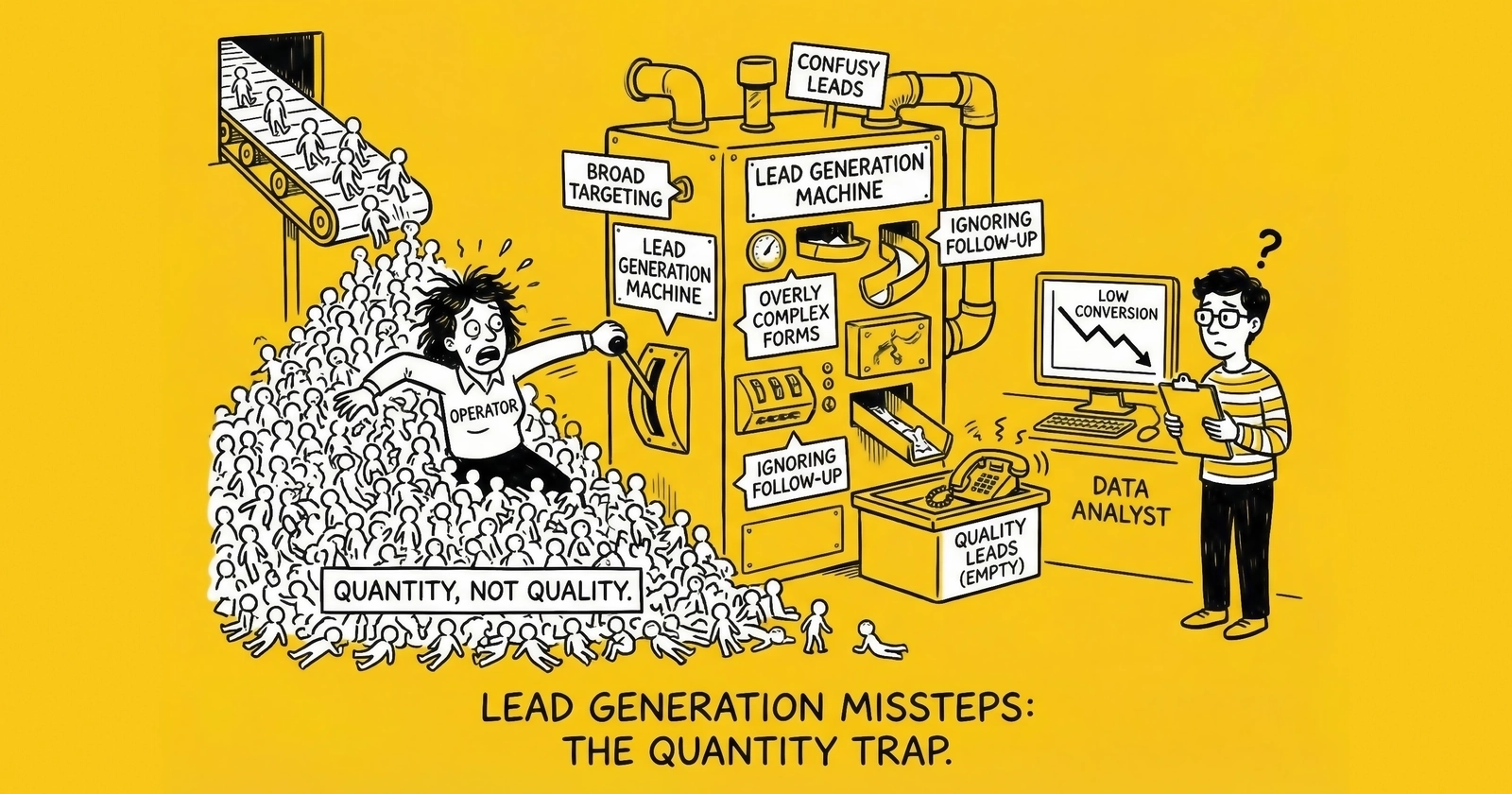
Mistake #7: Chasing Volume Over Quality
The Quality Degradation Spiral
Quality problems compound invisibly. A source that delivers 30% fraudulent leads doesn’t announce itself – it hides in aggregate metrics that look acceptable until you analyze them properly. Industry research suggests that up to 30% of third-party leads may be fraudulent, with some estimates indicating that only 25% of purchased leads are genuinely qualified prospects worth pursuing.
The detection gap is widening. Sophisticated invalid traffic now constitutes 78% of detected invalid traffic in financial services – the obvious bots and click farms are caught by basic filters, but advanced fraud evades traditional detection methods.
Buyers eventually discover quality problems – often before you do. They see conversion rates, contact rates, and return patterns across their entire lead supply. When your leads underperform, buyers don’t always complain immediately. They reduce volume, tighten filters, or simply churn.
The Volume Trap
When buyers demand more leads than your quality sources can provide, the temptation is to supplement with lower-quality supply. This works briefly – until buyer performance metrics catch up and the relationship deteriorates.
I watched a mortgage lead generator chase volume targets by adding three new sources simultaneously without proper validation. Return rates spiked from 8% to 22% over six weeks. By the time they diagnosed which source was responsible, they’d lost two major buyers and their reputation for quality.
Building Quality-First Operations
Build quality measurement into your core systems from day one. Every lead should track: source identification, acquisition cost, validation results, delivery outcome, buyer feedback, return status, and conversion data if available.
Monitor source-level metrics continuously. Return rates, contact rates, and conversion rates by source reveal quality patterns that aggregate metrics obscure. A 10% overall return rate might combine a 2% return rate from your best source with a 35% return rate from your worst.
Cut low-quality sources aggressively. When source quality degrades, reduce volume immediately rather than hoping for improvement. The leads you don’t buy from a poor source cost you nothing.
Mistake #8: Not Tracking Source-Level Performance
The Attribution Blindspot
Aggregate metrics hide everything that matters. Your overall CPL of $35 might combine a $22 CPL from organic search with a $65 CPL from display advertising. Your 12% return rate might combine a 4% return from your best source with a 38% return from your worst.
Without source-level attribution, you cannot:
- Kill underperforming sources before they damage buyer relationships
- Scale high-performing sources with confidence
- Price leads appropriately based on actual quality
- Negotiate effectively with suppliers using data
The Data Infrastructure Requirement
Source-level tracking requires infrastructure: unique source identifiers on every lead, tracking from capture through disposition, integration with buyer feedback, and return rate calculation by source. Those who build this early compound their advantage. Those who defer it hit walls they cannot diagnose.
Implementing Source Tracking
Assign unique source codes to every lead origin. This includes sub-sources within broader channels – not just “Google” but “Google - Auto Insurance - California - Mobile.”
Track source performance weekly. Build dashboards that show CPL, return rate, contact rate, and conversion rate by source. Review these metrics in weekly operations meetings.
Create source scorecards. Rank sources by net margin contribution, not just volume or gross CPL. A source with higher CPL but lower returns may be more profitable than cheaper, lower-quality alternatives.
Mistake #9: Ignoring Return Rate Trends
Why Returns Destroy Margins
Return rates devastate pricing accuracy when ignored. If you price a lead at $50 expecting 10% returns, but actual returns run 20%, your effective revenue is $40. If true cost per lead is $38, your margin collapsed from 24% to 5%.
Returns also create cash flow problems. If a buyer returns leads after you’ve paid your supplier, you bear the loss unless you can dispute it upstream.
Return patterns contain intelligence. Rising returns from a specific source signal quality degradation. Rising returns from a specific buyer might signal changing filters. Ignoring these signals costs money and relationships.
The Return Monitoring Protocol
Track return rates daily, analyze weekly. Returns that spike mid-week indicate problems requiring immediate investigation.
Segment returns by reason code. “Disconnected phone” returns indicate data quality issues. “Duplicate” returns indicate deduplication failures. “Non-responsive” returns might indicate timing problems. Each category requires different remediation. Understanding lead return policies helps you manage this process effectively.
Monitor return rates by source AND by buyer. The same lead that one buyer accepts might be returned by another. Understanding buyer-specific patterns helps you route leads to buyers most likely to accept them.
Mistake #10: Expecting Passive Income
The Active Operations Reality
Lead generation requires relentless operational attention. This is not passive income. This is not a business you can automate and walk away from.
Daily operations include campaign monitoring, source quality management, buyer relationships, compliance updates, cash flow management, and return processing. Weekly operations include source performance analysis, pricing optimization, and financial reconciliation.
The moment you stop paying attention, quality degrades and margins evaporate. I’ve seen profitable operations become unprofitable within 90 days of operator disengagement.
The Time Investment Reality
Plan for 50+ hours per week in year one. Building systems and establishing relationships requires significant time investment before efficiency gains accumulate.
Expect 40+ hours per week once established. Markets shift, regulations change, buyers evolve, and sources degrade. Someone needs to respond.
Build for eventual delegation, not automation. You can hire people for operations. You cannot automate judgment or strategic decision-making.
How to Recover from These Mistakes
If you recognize yourself in these mistakes, the situation is not hopeless. Recovery requires honest assessment and decisive action.
Recovering from Undercapitalization
Stop growth immediately. Reduce volume to a level your current capital can support. Negotiate extended payment terms with suppliers while accelerating collection from buyers. Consider revenue-based financing or lines of credit once you’ve stabilized operations.
Recovering from Concentration
Begin buyer development before your concentration becomes critical. Accept lower margins from new buyers to diversify risk while building alternatives.
Recovering from Compliance Failures
Audit your entire consent process immediately. Retain TCPA defense counsel before you need them. Implement litigator scrubbing and DNC management. Consider stopping outbound contact until you can verify compliance.
Recovering from Quality Problems
Identify and eliminate your worst sources immediately. Rebuild buyer relationships through transparency about problems and commitment to improvement. Invest in quality infrastructure even if it reduces short-term margins.
The General Recovery Principle
The first step in recovery is always the same: stop digging. These mistakes compound when operators try to scale their way out. Slow down, diagnose accurately, fix systematically, then resume growth.
Frequently Asked Questions
Q: How much capital do I need to start a lead generation business?
A: At minimum, six months of operating expenses plus 20% buffer. For an operation spending $50,000 per month on traffic and lead purchases, this means $360,000 or more in available capital. Undercapitalization is the single most common cause of failure in lead generation.
Q: What is the average failure rate for new lead generation businesses?
A: General small business failure rates combined with lead generation’s cash flow challenges suggest 60-70% of new operations fail within three years. Primary causes: undercapitalization, compliance failures, and buyer concentration.
Q: How do I avoid TCPA lawsuits when buying leads?
A: Document consent rigorously using third-party verification tools like TrustedForm or Jornaya. Implement litigator scrubbing on every lead before contact. Maintain comprehensive DNC management. Audit your suppliers’ consent capture processes. Retain TCPA defense counsel before you need them, not after.
Q: What is a healthy buyer concentration percentage?
A: No single buyer should represent more than 25% of your revenue. Conservative practitioners set the limit at 20%. If any buyer exceeds this threshold, pause their growth until you’ve diversified with additional buyers.
Q: How long does it take for a lead generation business to become profitable?
A: Most operations require 6-12 months to reach consistent profitability, assuming adequate capitalization. Operations that rush to profitability often make quality or compliance compromises that create larger problems.
Q: What return rate should I expect when selling leads?
A: Industry averages vary by vertical, but 8-15% return rates are typical for quality operations. Return rates above 20% indicate source quality problems that require immediate attention. Return rates below 5% may indicate that you’re underpricing or that your buyers have loose acceptance criteria.
Q: How do I know if my lead sources are generating fraud?
A: Monitor source-level metrics including contact rate, conversion rate, and buyer feedback. Invest in validation services that check phone validity, email deliverability, and IP intelligence. Watch for leads submitted at unusual hours or identical submission times across multiple leads.
Q: Should I focus on exclusive or shared leads?
A: Both models work. Exclusive leads command higher prices ($50-150+) but require premium source quality. Shared leads generate revenue from multiple buyers but require sophisticated routing. Most practitioners start with shared and add exclusive as they develop quality advantages.
Q: How important is speed to lead in conversion?
A: Response time is the single most important variable in lead conversion. Leads contacted within one minute convert at 391% higher rates. Leads contacted within five minutes are 21x more likely to qualify than those contacted after 30 minutes.
Q: What technology do I need to start a lead generation business?
A: At minimum: lead capture (landing pages/forms), a lead distribution platform (LeadConduit, LeadsPedia, or similar), consent documentation (TrustedForm or equivalent), and basic CRM. Plan to invest 5-15% of revenue in technology as you scale.
Key Takeaways
-
Undercapitalization kills more lead generation businesses than bad strategy. Maintain six months of operating expenses plus 20% buffer before launching. The 30-75 day float between paying suppliers and collecting from buyers is structural, not negotiable.
-
Single-source dependency creates existential risk. No buyer should exceed 25% of revenue, no source should exceed 30% of volume. Diversification is insurance against the inevitable relationship changes.
-
TCPA compliance is non-negotiable. With 507 class actions filed in Q1 2025 alone and average settlements exceeding $6.6 million, casual compliance creates existential risk. Build compliance infrastructure before you generate your first lead.
-
Unit economics must be understood before scaling. True cost per lead includes traffic, validation, consent documentation, float costs, and returns. Operations that scale on gross metrics discover their “profitable” campaigns are actually break-even.
-
Platform metrics lie; bank accounts don’t. Reconcile reported revenue to actual cash collected. The gap contains all the costs that destroy margins.
-
Buyer relationships require active investment. Those who treat buyers as partners rather than transactions build sustainable businesses.
-
Quality degrades when you chase volume. Monitor source-level performance obsessively. Cut underperforming sources immediately rather than hoping for improvement.
-
This is not passive income. Lead generation requires 50+ hours per week in year one and 40+ hours weekly once established. The moment you stop paying attention, quality degrades and margins evaporate.
Sources
- 47 U.S. Code Section 227 - TCPA - Federal statute governing telephone solicitation, autodialer restrictions, and consent requirements
- ActiveProspect TrustedForm - Consent certification platform for lead generation compliance documentation
- LeadsPedia - Lead distribution platform referenced for operational infrastructure
- boberdoo - Lead distribution software for ping/post routing and buyer management
- LeadExec - Scalable, automated lead capture, validation, routing, and distribution platform
- Federal Reserve - Interest rate data relevant to working capital financing costs
- SBA Funding Programs - Small business financing options for lead generation working capital
This article is based on research and operational experience in the lead generation industry. TCPA statistics reflect filings through Q3 2025. This content does not constitute legal advice – consult qualified attorneys for compliance guidance specific to your situation.