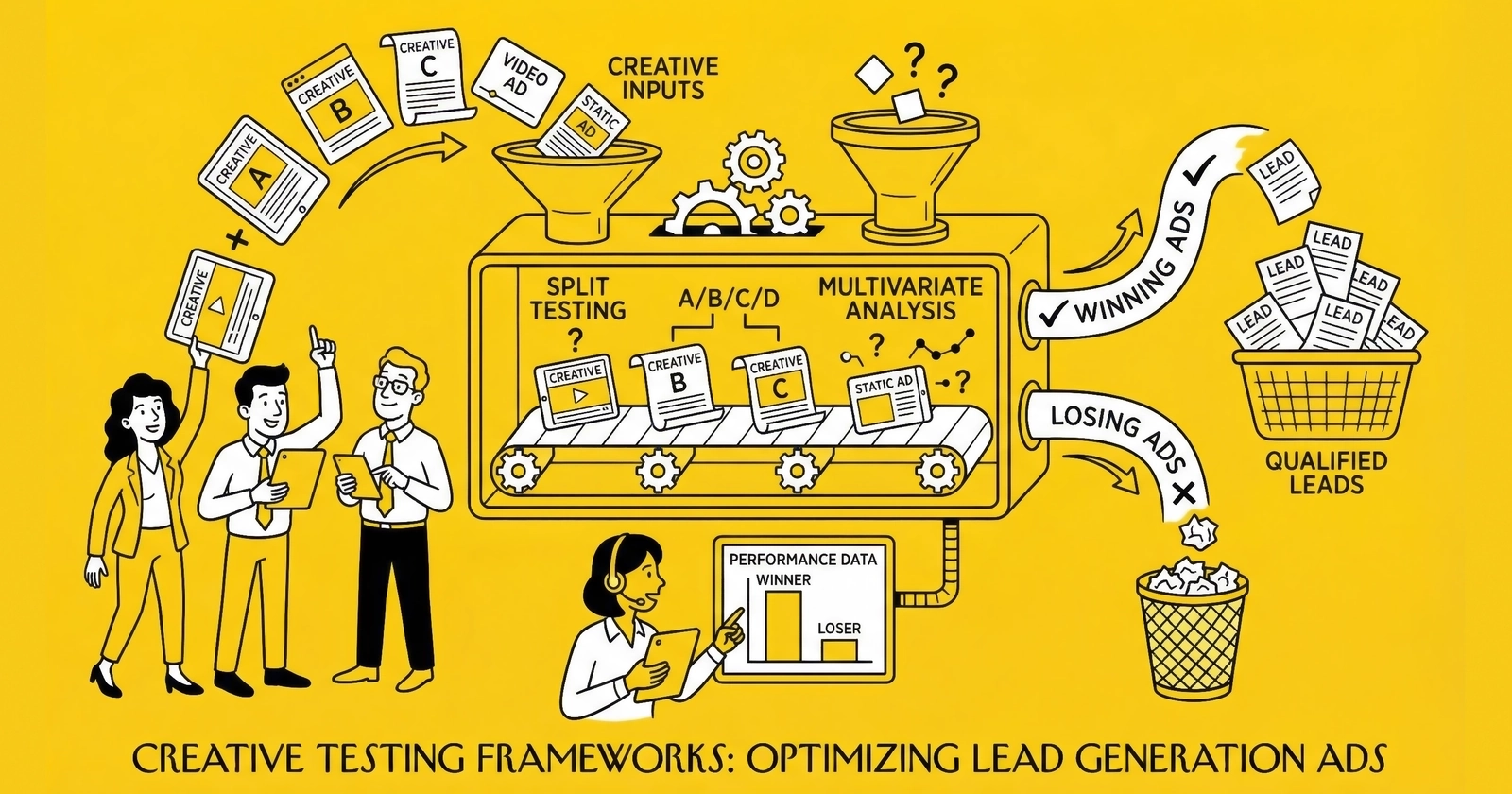
A systematic approach to creative testing that turns ad spend into predictable lead volume through disciplined experimentation.
The difference between a campaign that bleeds money and one that prints leads often comes down to a single variable: the creative. Not the targeting. Not the bid strategy. The image, the headline, the hook, the offer presentation.
Research from Meta consistently shows that creative quality accounts for 56% of a digital ad’s ability to drive outcomes. Google’s internal studies estimate creative effectiveness determines 70% of campaign success. The targeting gets you in front of the right people. The creative determines whether they act.
Yet most lead generation operators approach creative testing backwards. They launch campaigns with a handful of ads, watch for a few days, pick a “winner” based on 200 clicks, and wonder why performance degrades within weeks. They are not testing. They are guessing with extra steps.
This guide provides the systematic framework for creative testing in lead generation advertising. You will learn the testing methodologies that produce statistically reliable results, the creative variables that actually move performance, the budget allocation strategies that maximize learning velocity, and the iteration processes that compound improvements over time.
Those who build sustainable lead generation businesses treat creative testing as infrastructure, not an occasional project. This is how you build that infrastructure.
Why Creative Testing Matters More Than Ever
The paid advertising landscape has fundamentally shifted. Platform algorithms now handle much of what media buyers used to do manually: bid optimization, audience discovery, placement selection. Meta’s Advantage+ campaigns, Google’s Performance Max, and TikTok’s Smart Performance Campaigns all push toward algorithm-driven targeting.
This automation means creative has become the primary lever operators can control. When the algorithm handles distribution, your creative determines whether that distribution converts.
The Performance Gap Is Widening
The gap between best-performing and worst-performing creatives within the same campaign has expanded dramatically. Industry data shows that top-performing ad creatives outperform bottom-tier variants by 5x to 12x on cost per acquisition. A 2024 analysis of 10,000 Facebook lead ad campaigns found the best creative in each campaign generated leads at 67% lower cost than the campaign average.
This dispersion means two things. First, creative quality matters more than it ever has. Second, finding those top performers requires systematic testing, not intuition.
Creative Fatigue Accelerates
Creative fatigue, the decline in performance as audiences see the same ad repeatedly, now happens faster than ever. Data from social platforms shows significant performance degradation beginning within 2-3 weeks for high-frequency campaigns. Lead generation campaigns, which often target narrow audiences, experience fatigue even faster.
The implication: you need a constant pipeline of tested creative assets. A single winning ad is not a strategy. A system for continuously discovering and refreshing winning creative is.
First-Party Data Changes the Creative Equation
Cookie deprecation and tracking limitations have reduced the precision of behavioral targeting. When you can no longer rely on granular audience segmentation to find qualified prospects, your creative must do more of the qualification work.
Effective lead generation creative in 2025 must attract qualified prospects while repelling unqualified ones. This dual function increases the importance of testing different qualification approaches within your creative strategy.
The Creative Testing Hierarchy: What to Test First
Testing capacity is finite. Every test consumes budget, takes time, and delays other experiments. Those who win test the right elements in the right order.
Tier 1: Structural Elements (Highest Impact)
Structural elements determine the fundamental nature of your ad. Changes here typically produce 30-100% performance swings.
Format Type
Video versus static image versus carousel. The format sets the context for every other element. Video ads on Facebook generate 20-30% higher engagement rates than static images, but also require more production investment. The right answer depends on your vertical, audience, and creative capabilities.
Test format type before anything else. A winning headline on a static image may fail completely when translated to video. Establish your primary format, then optimize within it.
Hook Strategy
The first 2-3 seconds of video or the primary visual element of static ads determines whether anyone engages. Research shows 65% of viewers who watch the first three seconds of a video ad will watch at least 10 seconds.
Test radically different hook approaches: problem agitation versus benefit lead versus curiosity gap versus direct offer. The hook is not a minor copy tweak. It is the most important creative decision you make.
Offer Framing
How you present the value exchange fundamentally shapes response. “Get a free quote” performs differently than “Compare rates from 25 carriers” which performs differently than “See how much you could save.”
Different framings attract different prospect psychology. The comparison framing attracts research-mode consumers. The savings framing attracts price-conscious consumers. The right framing depends on your downstream conversion process.
Tier 2: Messaging Elements (High Impact)
Messaging elements shape how audiences interpret your offer. Changes here typically produce 15-50% performance variations.
Headline Copy
The headline either stops the scroll or does not. Industry data shows headlines with specific numbers outperform vague headlines by 36%. Headlines that address a clear pain point outperform benefit-focused headlines by 20-30%.
Test across dimensions: specificity (vague versus concrete), perspective (you versus we versus third-party), urgency (timely versus evergreen), and social proof (with versus without validation).
Body Copy
For ads with substantive copy (Facebook primary text, Google Responsive Search Ad descriptions), test length (short versus long), structure (paragraph versus bullets), and voice (authoritative versus empathetic versus conversational).
Call-to-Action
“Learn More” versus “Get Quote” versus “Compare Now” versus “See Rates.” The CTA sets expectations for what happens next. Aggressive CTAs like “Apply Now” may reduce clicks but improve lead quality. Softer CTAs may increase volume but decrease intent signals.
Tier 3: Visual Elements (Moderate Impact)
Visual elements support the message. Changes here typically produce 10-30% performance variations.
Image Subject
People versus products versus abstract graphics versus screenshots. Lead generation ads featuring people typically outperform product-only images, but the right choice depends on vertical. Insurance ads with diverse family images test differently than solar ads with installation photography.
Color Schemes
Contrast and thumb-stopping visual distinctiveness. High-contrast images and colors that stand out from the platform’s UI generate more attention. Test your creative against the actual feed environment, not in isolation.
Text Overlay Approach
Amount of text on images, typography choices, placement of key messages. Facebook’s historical 20% text rule is gone, but text-heavy images still face distribution challenges. Find the balance between message clarity and visual appeal.
Tier 4: Micro-Optimizations (Lower Impact)
These elements matter at scale but should not be your initial focus. Changes here typically produce 5-15% variations.
Thumbnail selection for video, aspect ratio optimization (1:1 versus 4:5 versus 9:16), caption formatting, emoji usage, and button color variations all have measurable impact at sufficient volume. Optimize these after you have won on structure and messaging.
Statistical Significance: The Foundation of Reliable Testing
Most creative tests fail not because of bad ideas but because of bad statistics. Operators declare winners based on 200 impressions, run tests for three days, and wonder why “winning” creatives underperform after launch.
What Statistical Significance Actually Means
Statistical significance measures the probability that observed differences are real rather than random noise. Industry standard is 95% confidence, meaning only a 5% probability the result is chance variation.
At 80% confidence, one in five “winning” tests will be false positives. At 90% confidence, one in ten. At 95%, one in twenty. Every false positive wastes budget on creative that does not actually outperform.
Sample Size Requirements
Before launching any test, calculate the sample size needed. This depends on three factors:
Baseline conversion rate. Lower-converting ads need larger samples to detect differences. A lead form converting at 2% needs approximately four times the sample size of a form converting at 8%.
Minimum detectable effect (MDE). Smaller improvements require larger samples. Detecting a 10% relative improvement requires roughly four times the sample of detecting a 20% improvement.
Statistical power. Standard is 80%, meaning 80% probability of detecting a real difference when one exists.
For a Facebook lead ad with 5% baseline conversion rate testing for 15% relative improvement (moving from 5% to 5.75%), you need approximately 15,000-20,000 impressions per variant. At 10% baseline testing for 20% improvement, you need approximately 3,000-4,000 impressions per variant.
Use a sample size calculator before every test. This is non-negotiable.
The Peeking Problem
Peeking, checking results repeatedly and stopping when one variant appears to be winning, dramatically inflates false positive rates.
If you check a test 10 times during its run and stop when you see a “winner,” your effective false positive rate increases from 5% to over 30%. You will declare winners that are not actually winners, then wonder why performance does not hold.
The solution is pre-registration: commit to your sample size before the test starts. Run the test to completion regardless of intermediate results. Do not peek. Do not stop early.
Duration Requirements
The Two-Week Minimum Rule
Regardless of sample size, always run tests for at least two complete weeks. This captures:
- Day-of-week effects (weekend behavior differs from weekday)
- Payroll cycles (consumer behavior shifts around paydays)
- Platform algorithm stabilization (ad delivery stabilizes over time)
- Seasonal fluctuations within the test window
A test reaching sample size on day five should still run through day fourteen.
If a test cannot reach statistical significance within 4-6 weeks, the difference between variants is probably too small to matter operationally. Declare no significant difference and move to the next test.
Budget Allocation for Creative Testing
How you allocate budget across testing and scaling determines how quickly you learn and how efficiently you grow.
The 70/20/10 Framework
A foundational budget allocation model for mature lead generation operations:
70% to Proven Creative
The majority of spend goes to ads with established performance. These are your workhorse creatives with documented cost per lead within acceptable targets over statistically significant sample sizes. They fund operations while you test.
20% to Iterative Testing
Variations on winning creative: new headlines on proven formats, modified hooks on successful video frameworks, adjusted offers on high-performing structures. This testing refines and extends what works.
10% to Exploratory Testing
Radically different approaches: new formats, new positioning angles, new visual styles. Most will fail. Occasionally one will outperform everything in your proven stable. This is where breakthrough creative comes from.
Budget Minimums by Platform
Different platforms require different minimum budgets for learning:
Meta (Facebook/Instagram)
Meta’s algorithm needs approximately 50 conversions per week per ad set to exit learning phase. For a $50 cost per lead, that is $2,500 per week per ad set, or roughly $350 per day. Testing multiple variants simultaneously requires multiples of this minimum.
For creative testing specifically, budget $100-$200 per day per creative variant to accumulate meaningful data within 2-4 weeks.
Google Ads
Google recommends 30+ conversions monthly per campaign for reliable automated bidding. For $75 CPL, that is $2,250 per month per campaign. Responsive Search Ads automatically test headline/description combinations, but Performance Max campaigns require sufficient budget to test across placements.
For display and video creative testing, budget $50-$150 per day per variant depending on targeting breadth.
TikTok
TikTok’s algorithm optimizes faster but also fatigues creative faster. Budget $50-$100 per day per creative variant, but expect to test and rotate more frequently than on other platforms.
Budget During Testing Phase Versus Scaling Phase
Testing phase prioritizes learning velocity over efficiency. Accept higher CPL during testing to accumulate data faster. A two-week test at 30% above target CPL that identifies a long-term winner is better than a six-week test at target CPL that delays learning.
Scaling phase prioritizes efficiency and volume. Once creative is proven, shift budget from testing to proven performers. Monitor for fatigue signals and shift back to testing when performance degrades.
Velocity Metrics That Matter
Track testing velocity as an operational KPI, similar to CRO metrics that matter in lead generation:
- Tests completed per month: Aim for 4-8 substantive creative tests per primary platform
- Time to statistical significance: Measure average days to reach 95% confidence
- Learning cost per insight: Total testing budget divided by actionable learnings generated
- Refresh rate: Percentage of active creative replaced monthly
These metrics indicate the health of your testing system, not just individual test results.
Creative Variables to Test: The Complete Checklist
Video Ad Variables
Hook (First 3 Seconds)
- Problem statement opening versus benefit statement versus question hook
- Face-to-camera versus b-roll versus text-on-screen
- Native/authentic style versus polished production
- Sound-on optimized versus sound-off optimized
Structure and Pacing
- Length: 15 seconds versus 30 seconds versus 60 seconds
- Pacing: Fast cuts versus slower storytelling
- Arc: Problem-agitate-solve versus benefit-proof-CTA versus testimonial format
Visual Style
- User-generated content aesthetic versus branded production
- Single spokesperson versus multiple people versus no people
- Environment: Home setting versus office versus outdoors versus studio
Audio Elements
- Music genre and tempo
- Voiceover presence and style
- Caption style and timing
Static Image Ad Variables
Primary Visual
- Photography versus illustration versus graphic design
- People versus products versus abstract concepts
- Single focus versus composite/collage
- Real imagery versus stock photography
Text Overlay
- Amount of text (minimal versus moderate versus text-heavy)
- Placement (top, center, bottom, distributed)
- Typography style (bold, minimal, handwritten)
- Key number or statistic callout versus benefit statement
Color and Contrast
- Brand colors versus platform-native versus high contrast
- Light versus dark backgrounds
- Color psychology alignment with offer type
Copy Variables (All Formats)
Headline Testing
- Question format versus statement versus command
- Specific numbers versus general claims
- Pain point focus versus benefit focus versus curiosity
- Short (under 5 words) versus medium (5-10 words) versus long (10+ words)
Primary Text Testing
- Length: Single sentence versus paragraph versus multiple paragraphs
- Structure: Narrative versus bullet points versus hybrid
- Social proof integration: None versus subtle versus prominent
- Urgency elements: Present versus absent
Call-to-Action Testing
- Action verb: Get, Compare, See, Discover, Find, Start
- Specificity: “Get Quote” versus “Get Your Free Auto Insurance Quote”
- Urgency: “Get Quote Now” versus “Get Quote” versus “Learn More”
The Iteration Process: From Test to Scale
Testing is not a one-time event. It is a continuous cycle that compounds improvements over time.
Phase 1: Hypothesis Generation
Before any test, document your hypothesis. Not “let’s try a video.” Instead: “We hypothesize that a user-generated content style video will outperform our polished brand video because our target audience responds better to authenticity.”
Strong hypotheses include:
- What you believe will happen
- Why you believe it (evidence or reasoning)
- How you will measure success
- What decision you will make based on results
Document every hypothesis before testing. This discipline prevents random experimentation and builds institutional knowledge.
Phase 2: Variant Creation
For each test, create variants that differ on the tested variable while holding other elements constant. If you are testing headlines, the visual, copy structure, and CTA should remain identical across variants.
The isolation principle: Test one variable at a time for clear attribution. Multivariate testing (changing multiple elements simultaneously) requires dramatically larger sample sizes and advanced statistical analysis. Most practitioners should stick to sequential single-variable tests.
Create 2-4 variants per test. Two variants provide cleaner comparison but slower learning. Four variants accelerate discovery but require larger budgets for significance.
Phase 3: Controlled Launch
Launch all variants simultaneously with equal budget allocation. Identical targeting, identical bidding strategy, identical placement settings. The only difference should be the tested variable.
Platform-specific considerations:
On Meta, use A/B Test or create separate ad sets with identical settings. Campaign Budget Optimization (CBO) will not distribute budget equally across variants, so use ad set budgets for testing.
On Google, use Experiments for Search campaigns. For Display and Video, create separate campaigns with identical settings and budgets.
Monitor for technical issues (delivery failures, policy violations) but do not adjust creative or targeting during the test period.
Phase 4: Analysis and Decision
Once the test reaches statistical significance:
- Verify significance: Confirm results meet your predetermined threshold (typically 95% confidence)
- Check secondary metrics: A creative that wins on CPL but loses on lead quality is not a winner
- Consider practical significance: A 3% improvement may be statistically significant but operationally irrelevant
- Document findings: Record what won, why you believe it won, and implications for future tests
Make binary decisions: either the variant wins and replaces control, or it does not. Avoid “partial wins” that muddy your creative library.
Phase 5: Scaling Winners
When a variant wins decisively:
- Expand budget gradually: Increase by 20-30% increments, not 200% jumps
- Monitor performance stability: Confirm CPL holds as scale increases
- Track fatigue signals: Watch for frequency increases and performance degradation
- Create derivative variants: Use the winning element in new combinations
Phase 6: Iteration Loops
Winners generate hypotheses for the next test. If a problem-agitate-solution hook outperformed a benefit-lead hook, your next test might explore variations within problem-agitate-solution: different problems, different agitation angles, different solutions.
This iterative approach compounds learning. Each test builds on previous findings rather than starting from scratch.
Measuring What Matters: Beyond CPL
Cost per lead is the most visible metric. It is not the only metric that matters, and optimizing for CPL alone produces predictable failure modes. Understanding true cost per lead calculation provides a more complete picture of campaign economics.
Lead Quality Signals
Contact Rate
What percentage of leads answer when called? A creative that generates $40 leads with 30% contact rate outperforms a creative that generates $35 leads with 20% contact rate once you factor in contact costs.
Track contact rate by creative source if your lead distribution system supports this attribution.
Qualification Rate
What percentage of leads meet your qualification criteria? Some creative attracts tire-kickers. Other creative attracts buyers. The difference may not appear in CPL.
Sell-Through Rate
For lead sellers: what percentage of leads actually sell to buyers? A creative generating leads that consistently fail buyer acceptance criteria costs more than CPL suggests.
Return Rate
What percentage of sold leads get returned by buyers? Industry benchmarks show 8-18% return rates depending on vertical, but rates vary significantly by creative source. Establishing clear lead return policies helps manage these variations.
Time Horizon Alignment
Different metrics stabilize over different time horizons:
Immediate (1-7 days): CPL, click-through rate, conversion rate. Available fast but may not predict downstream performance.
Short-term (2-4 weeks): Contact rate, qualification rate, sell-through rate. Requires patience but reflects actual lead value.
Medium-term (6-12 weeks): Return rate, customer conversion rate, lifetime value. The ultimate arbiter of creative quality, but available too late for rapid testing.
For testing purposes, optimize for the shortest time horizon metric that reliably predicts longer-term outcomes. In many lead generation operations, sell-through rate (available within 2-3 weeks) predicts downstream value well enough to guide creative decisions. Cohort analysis for lead quality provides framework for this type of time-based performance evaluation.
Attribution Challenges
Platform-reported metrics and actual outcomes diverge. Facebook reports a $40 CPL. Your CRM shows $52 when you factor in duplicate leads, invalid contact information, and non-converting leads the platform counted as conversions.
Reconcile platform reporting against backend data. Use offline conversion imports where possible. Accept that platform reporting is directional rather than precise.
Platform-Specific Testing Considerations
Meta (Facebook/Instagram)
Algorithm Behavior
Meta’s algorithm optimizes toward the conversion event you specify. It will find the cheapest leads it can, which may not be the best leads. Consider optimizing for downstream events (lead qualification, application submission) rather than form submit if you have sufficient conversion volume.
Creative Formats
Facebook supports image, video, carousel, collection, and instant experience formats. Test format type early. Video typically outperforms static for awareness, but static often converts better for lead capture.
Placement Variation
The same creative performs differently across Facebook Feed, Instagram Feed, Stories, Reels, and Audience Network. Platform-optimized creative (9:16 for Stories/Reels) outperforms repurposed creative. Test whether placement-specific creative justifies the production investment.
Advantage+ Creative
Meta’s Advantage+ features automatically optimize creative elements. Test whether manual creative control outperforms algorithm optimization for your specific use case. Results vary by account and vertical.
Google Ads
Responsive Search Ads
RSAs automatically test headline and description combinations. Provide diverse headlines across different themes rather than slight variations on the same message. Google will test combinations; your job is providing diverse raw material.
Performance Max Creative
Performance Max campaigns require assets across formats: images, videos, logos, headlines, descriptions. The algorithm determines which assets appear where. Provide high-quality options across all asset types.
Display Creative
Display ads appear in diverse contexts with varying sizes. Responsive display ads adapt automatically but may produce inconsistent results. Test whether designed static ads for key sizes outperform responsive formats.
TikTok
Authenticity Premium
TikTok users punish obviously branded content. Native-style creative shot on phones with natural audio outperforms polished production. User-generated content and creator partnerships often outperform brand-produced assets.
Velocity and Fatigue
TikTok creative fatigues faster than other platforms. Plan for 2-3 week creative cycles rather than 4-6 week cycles. Test more variants at lower budget per variant.
Spark Ads
Spark Ads boost organic creator content. Test whether boosted creator content outperforms brand-produced content at the same budget. For many verticals, the answer is yes.
Professional Context
LinkedIn users are in professional mode. Creative that works on Facebook (emotional, personal, lifestyle) often fails on LinkedIn. Test professional, data-driven, expertise-focused creative.
Document Ads and Carousel
LinkedIn-native formats (document ads, carousel) often outperform standard image and video. Test format types specific to the platform.
B2B Lead Quality
LinkedIn leads typically cost more but represent higher value. Optimize for lead quality metrics rather than CPL alone. A $300 LinkedIn lead that converts at 5% may outperform a $50 Facebook lead that converts at 0.5%.
Common Testing Mistakes and How to Avoid Them
Mistake 1: Declaring Winners Too Early
A variant leading by 40% after 500 impressions will often reverse by 5,000 impressions. Random variance in small samples produces dramatic but meaningless swings.
Solution: Calculate sample size before testing. Run to completion. Do not peek.
Mistake 2: Testing Trivial Changes
Testing button color when your headline is weak wastes testing capacity on low-impact elements.
Solution: Follow the testing hierarchy. Structure and messaging before design details.
Mistake 3: Testing Too Many Variables Simultaneously
When you change headline, image, and copy together, you cannot attribute results to any specific change.
Solution: Isolate variables. Test one element at a time with all others held constant.
Mistake 4: Ignoring Quality Metrics
A creative that reduces CPL by 30% but doubles return rate costs more money, not less. Tracking CPA benchmarks by vertical helps contextualize whether your creative performance aligns with industry standards.
Solution: Wait for quality signals before scaling. Include sell-through and return rate in winner determination.
Mistake 5: Abandoning Testing After Initial Wins
Finding a winner does not mean testing is complete. Creative fatigues. Competitors adapt. Market conditions shift.
Solution: Maintain ongoing testing cadence. Every account should have at least one active test at all times.
Mistake 6: Copying Competitor Creative Without Testing
What works for a competitor may not work for you. Their audience, offer, and funnel differ from yours.
Solution: Use competitor creative as hypothesis inspiration, not conclusions. Test before deploying.
Mistake 7: Inconsistent Measurement
Comparing platform-reported metrics for one creative against CRM-verified metrics for another produces unreliable comparisons.
Solution: Measure all creative using the same methodology, at the same time horizon, with the same attribution model.
Mistake 8: No Documentation
Running tests without documentation means rediscovering the same insights repeatedly.
Solution: Maintain a testing log with hypothesis, variants, results, quality metrics, decisions, and learnings for every test.
Building a Testing Culture: Organizational Requirements
The Testing Calendar
Mature operations maintain a rolling testing calendar:
Weekly: Review active tests, launch new tests as bandwidth allows Monthly: Summarize learnings, update creative strategy based on cumulative findings Quarterly: Review testing velocity and learning rate, adjust resource allocation
A sample annual calendar:
- Q1: Test format types and hook strategies (structural foundation)
- Q2: Test messaging variations within winning formats
- Q3: Test visual elements and design optimizations
- Q4: Test seasonal messaging and refresh winning creative for new year
Role Clarity
Testing requires clear accountability:
Creative Strategist: Develops hypotheses, designs test structures, interprets results Creative Producer: Develops variants efficiently, maintains asset quality Media Buyer: Implements tests in platform, monitors delivery, flags technical issues Analyst: Tracks results, calculates significance, connects to quality metrics
Small teams combine roles. The functions still need to happen.
Knowledge Management
Every test should produce documentation:
- Hypothesis and rationale
- Variants tested with asset links
- Platform settings and targeting
- Duration and sample sizes achieved
- Results with confidence levels
- Quality metric impact
- Decision made
- Implications for future tests
This documentation becomes organizational intellectual property. New team members can learn from accumulated tests. Patterns emerge across many tests that are invisible in individual results.
Frequently Asked Questions
How much budget should I allocate to creative testing versus proven campaigns?
Start with the 70/20/10 framework: 70% to proven creative, 20% to iterative testing (variations on winners), and 10% to exploratory testing (new approaches). Adjust based on your stage. New campaigns may run 50/30/20 during initial learning. Mature campaigns with limited fatigue can run 80/15/5. The key is maintaining dedicated testing budget rather than only testing when problems arise.
How do I know when a creative has reached statistical significance?
Use a sample size calculator before launching any test. Input your baseline conversion rate, minimum detectable effect (typically 15-20% relative improvement), and 95% confidence level. The calculator provides required sample size per variant. Run the test until you reach that sample size for each variant. Do not declare winners before reaching predetermined thresholds regardless of how promising intermediate results look.
What should I test first when launching a new lead generation campaign?
Start with format type (video versus static versus carousel), then hook strategy within your winning format, then offer framing. These structural elements produce the largest performance swings, often 30-100%. Only after establishing structural winners should you test messaging elements like headlines and copy, which typically produce 15-50% variations. Leave design optimizations like color and button styling for after structure and messaging are proven.
How many creative variants should I test at once?
For single-variable tests, 2-4 variants is ideal. Two variants provide cleanest comparison but slower learning. Four variants accelerate discovery but require proportionally larger budgets for each to reach significance. Avoid testing more than 4 variants unless you have substantial budget, as you will wait months for meaningful data. For multivariate testing (multiple variables simultaneously), the combinations multiply rapidly and require advanced statistical methods most practitioners do not have.
How long should I run a creative test before making decisions?
Minimum two weeks regardless of sample size, to capture weekly variance and allow algorithms to stabilize. For most lead generation campaigns with moderate volume, plan for 3-4 weeks. If your test cannot reach statistical significance within 6 weeks, the difference between variants is probably too small to matter operationally. Declare no significant difference and test a more substantive variation.
How do I prevent creative fatigue from invalidating my test results?
Run tests for fixed duration rather than indefinite periods. Monitor frequency metrics during testing. If frequency exceeds 3-4x during the test period, fatigue may be affecting results. For high-frequency campaigns, use shorter testing windows (2 weeks rather than 4) with larger daily budgets to accumulate data before fatigue sets in. Consider refreshing audiences mid-test if testing creative against the same audience repeatedly.
Should I test creative on cold traffic or remarketing audiences first?
Test on cold traffic first. Cold traffic provides cleaner signal about creative effectiveness because audiences have no prior relationship with your brand. Remarketing audiences convert based on accumulated touchpoints, making it difficult to isolate creative impact. Once you have winners on cold traffic, test whether those winners also perform best on remarketing, or whether remarketing requires different creative approaches.
How do I account for lead quality differences between creative variants?
Wait for downstream quality signals before declaring winners. CPL is available immediately but does not reflect lead value. Contact rate requires 3-7 days. Sell-through rate requires 2-3 weeks. Return rate requires 4-6 weeks. For major creative decisions, wait for at least sell-through data before scaling. For iterative tests on proven creative frameworks, CPL and rapid quality signals may suffice.
What is the difference between A/B testing and multivariate testing for ads?
A/B testing compares two or more variants of a single element (headline A versus headline B). All other elements remain constant. Multivariate testing examines multiple elements simultaneously (headline A versus B combined with image X versus Y), testing all combinations. Multivariate testing requires dramatically larger sample sizes (the combinations multiply) and advanced statistical analysis. Most practitioners should stick to sequential A/B tests until they have substantial volume and statistical sophistication.
How do I test creative across different platforms consistently?
Adapt creative to platform-native formats (9:16 for TikTok/Reels, 1:1 for feeds) but maintain consistent messaging for comparison. Test the same core hypothesis (for example, “problem-agitate-solve hook outperforms benefit-lead hook”) on each platform separately. Results may differ by platform. A hook that wins on Facebook may lose on TikTok. This is valuable learning, not a testing failure.
Key Takeaways
-
Creative quality accounts for 56-70% of digital ad performance according to Meta and Google research. When platforms handle targeting and bidding automatically, creative becomes the primary lever you control. The gap between best and worst performing creative within campaigns ranges from 5x to 12x on cost per acquisition.
-
Follow the testing hierarchy: structure first (format, hook strategy, offer framing), then messaging (headlines, copy, CTA), then design (visuals, colors, layout). Structural tests produce 30-100% swings. Messaging tests produce 15-50%. Design tests produce 10-30%. Testing button colors before establishing structural winners wastes testing capacity.
-
Calculate sample size before every test and run to completion. Most creative tests require 3,000-20,000 impressions per variant depending on baseline conversion rate and minimum detectable effect. The two-week minimum rule ensures you capture weekly variance even if you reach sample size earlier.
-
Allocate budget systematically with the 70/20/10 framework: 70% to proven creative, 20% to iterative testing, 10% to exploratory testing. Maintain dedicated testing budget rather than only testing when performance degrades. Plan for 4-8 substantive tests per platform per month in mature operations.
-
Measure beyond CPL. Contact rate, sell-through rate, and return rate reveal lead quality differences invisible in cost metrics. A creative that reduces CPL by 30% but doubles return rate costs more money. Wait 2-4 weeks for quality signals before scaling major creative changes.
-
Build testing infrastructure: maintain a testing calendar, document every test with hypothesis and learnings, train teams on statistical significance, and track testing velocity as an operational KPI. Those who win treat creative testing as ongoing discipline, not occasional project.
-
Platform-specific considerations matter. Meta requires 50+ weekly conversions per ad set. TikTok creative fatigues faster requiring 2-3 week cycles. LinkedIn users require professional-context creative. Adapt testing cadence and creative approach to each platform rather than applying one-size-fits-all methodology.
Sources
- Meta for Business News - Meta research on creative quality impact, reporting creative accounts for 56% of digital ad outcomes
- Think with Google - Google research on creative effectiveness determining 70% of campaign success
- LinkedIn Marketing Solutions - B2B advertising platform specifications and professional creative testing insights
- HubSpot Marketing Statistics - Lead generation benchmarks, conversion rate data, and A/B testing methodology research
- Forrester Research - Industry research on creative testing frameworks and digital advertising performance optimization
The lead generation operators who scale profitably are not the ones who find one winning creative and run it forever. They build systems for continuous creative discovery, disciplined testing, and rapid iteration. That systematic approach compounds over months and years while competitors chase one-time wins.