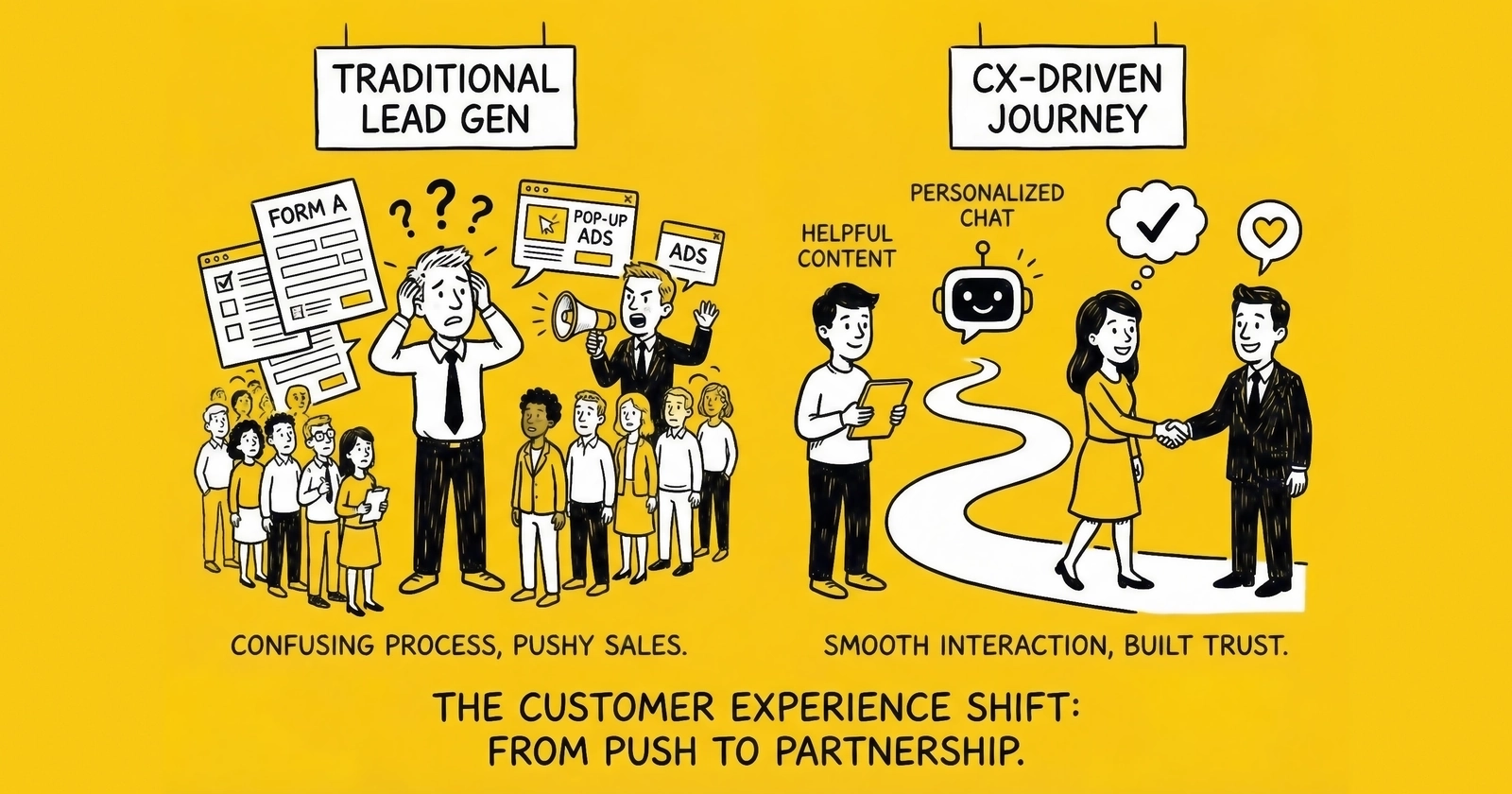
How lead generation operators design and optimize customer experience for both lead buyers and end consumers, driving retention, conversion, and competitive differentiation.
Lead generation operates at the intersection of two distinct customer experiences: the B2B experience of buyers who purchase leads, and the consumer experience of individuals whose information becomes leads. Most operators focus heavily on one while neglecting the other, creating friction that undermines both buyer retention and lead quality. Excellence in customer experience across both relationships creates sustainable competitive advantage that pricing and features alone cannot match.
McKinsey research on customer experience in B2B contexts reveals that companies providing superior CX generate higher customer satisfaction, lower churn, and higher revenue growth than competitors. For lead generation specifically, experience quality directly affects measurable outcomes: buyer retention, dispute rates, referral behavior, and willingness to pay premium pricing. Consumer experience affects conversion rates, lead quality scores, and compliance positioning.
This analysis examines customer experience strategy across both dimensions – buyer experience and consumer experience – providing frameworks for design, measurement, and continuous improvement.
The Dual-Customer Challenge
Lead generation’s unique structure creates dual customer relationships that require distinct but coordinated experience strategies.
Buyer Experience
Lead buyers – the insurance agents, mortgage brokers, contractors, and marketers who purchase leads – experience your business through:
- Sales and onboarding processes
- Lead delivery and quality
- Support and issue resolution
- Account management and communication
- Reporting and analytics
- Billing and financial interactions
Buyer experience determines retention, expansion, and referral. Poor experience drives churn; excellent experience creates switching costs that protect relationships even against competitive pricing.
Consumer Experience
Consumers – the individuals who submit information seeking products or services – experience your business through:
- Advertising and messaging
- Landing page and form interaction
- Privacy and consent communication
- Post-submission communication (if any)
- Handoff to buyers
- Overall trust and transparency
Consumer experience determines lead quality, conversion rates, and compliance positioning. Poor experience generates low-intent leads that don’t convert; excellent experience produces engaged prospects who convert for buyers and create positive market perception.
The Experience Connection
The two experiences connect directly: consumer experience quality affects buyer experience through lead quality. Operators who create positive consumer experiences generate leads that convert better for buyers, improving buyer satisfaction. Operators who create poor consumer experiences generate leads that frustrate buyers, driving disputes and churn.
This connection means consumer experience investment returns through buyer experience improvement – an indirect but significant return on experience investment.
Buyer Experience Design
Buyer experience design encompasses every touchpoint across the buyer relationship lifecycle.
Sales and Onboarding Experience
First impressions establish expectations. Sales and onboarding experience elements:
-
Needs Discovery: Do you understand what buyers actually need, or do you push standard offerings? Effective discovery identifies buyer conversion requirements, volume expectations, quality standards, and operational constraints.
-
Expectation Setting: Do buyers understand what they’ll receive? Overselling creates experience gaps when reality doesn’t match expectations. Accurate expectation setting prevents future disappointment.
-
Onboarding Efficiency: How quickly can buyers begin receiving valuable leads? Lengthy onboarding delays value realization and creates friction. Streamlined onboarding accelerates time-to-value.
-
Training and Enablement: Do buyers know how to maximize value from leads? Training on lead handling best practices, system usage, and optimization techniques enables buyer success. Documented lead generation SOPs and operational playbooks accelerate buyer onboarding.
-
Integration Support: How smoothly do leads flow into buyer systems? Technical integration quality affects daily experience – friction in lead receipt undermines relationship quality.
Lead Delivery Experience
Core product experience occurs with every lead delivery:
-
Quality Consistency: Do leads meet quality expectations consistently? Variable quality creates uncertainty and frustration. Consistent quality enables buyer planning and investment.
-
Delivery Reliability: Do leads arrive as expected – on time, in correct format, through established channels? Delivery failures disrupt buyer operations and erode trust.
-
Information Completeness: Do leads include all necessary information? Incomplete leads require buyer effort to complete, reducing efficiency and satisfaction.
-
Speed-to-Delivery: How quickly do leads move from submission to buyer receipt? Speed affects conversion rates and buyer success with leads.
-
Volume Predictability: Can buyers anticipate lead volume? Unpredictable volume complicates buyer resource planning and operational efficiency.
Support and Issue Resolution
Problems reveal true experience quality:
-
Accessibility: How easily can buyers reach support when needed? Accessible support – multiple channels, reasonable hours, fast response – demonstrates commitment to buyer success.
-
Resolution Speed: How quickly are issues resolved? Fast resolution minimizes disruption and demonstrates operational capability.
-
Resolution Quality: Are issues actually resolved, or do they recur? Effective resolution addresses root causes, not just symptoms.
-
Empowerment: Can support staff resolve issues, or must they escalate? Empowered support staff create better experience than those who can only pass issues upward.
-
Proactive Communication: Are buyers notified of issues before they discover them? Proactive communication builds trust and prevents negative surprises.
Account Management Experience
Ongoing relationship management determines long-term retention:
-
Regular Communication: Do buyers hear from you between problems? Regular check-ins maintain relationship and identify issues early. Email drip campaigns can automate ongoing value delivery.
-
Performance Review: Do you help buyers understand lead performance? Data-driven performance reviews enable optimization and demonstrate value.
-
Strategic Consultation: Do you help buyers improve their lead operations? Strategic guidance beyond lead delivery creates value beyond the transaction.
-
Expansion Opportunity: Do you proactively identify ways to deliver more value? Account growth opportunities benefit both parties when aligned with buyer needs.
Financial Experience
Billing and payment interactions affect relationship quality:
-
Invoice Clarity: Are invoices clear and accurate? Confusing invoices create friction and support burden.
-
Payment Flexibility: Do payment terms accommodate buyer cash flow? Rigid terms may conflict with buyer business cycles.
-
Dispute Resolution: How are billing disputes handled? Fair, efficient dispute resolution maintains trust during conflict.
-
Pricing Transparency: Do buyers understand how pricing works? Opaque pricing creates suspicion; transparent pricing builds confidence.
Consumer Experience Design
Consumer experience design affects lead quality and compliance positioning.
Advertising Experience
Consumer journey begins with advertising:
-
Message Clarity: Do consumers understand what they’re responding to? Clear messaging attracts appropriate prospects; misleading messaging generates misaligned leads.
-
Value Proposition: Is the consumer value proposition genuine? Overselling creates disappointed consumers who don’t convert.
-
Expectation Setting: Do consumers understand what happens after they respond? Clear expectations reduce post-submission friction.
-
Targeting Accuracy: Are you reaching appropriate consumers? Poor targeting generates leads that don’t match buyer requirements.
Landing Page Experience
Conversion experience determines lead quality:
-
Load Performance: Does the page load quickly across devices? Slow loading loses prospects and signals poor operational quality.
-
Mobile Experience: Does the page work well on mobile devices? Significant traffic arrives on mobile; poor mobile experience loses conversions.
-
Form Design: Is the form appropriately designed? Too long loses completions; too short loses qualification. Balance conversion with quality.
-
Progress Indicators: Do consumers know how far they’ve progressed? Progress indicators reduce abandonment on longer forms.
-
Value Communication: Does the page clearly communicate consumer benefit? Value understanding motivates completion.
Consent Experience
Consent experience affects compliance and lead quality:
-
Consent Clarity: Do consumers understand what they’re consenting to? Clear consent language is both legally required and creates better leads.
-
Seller Identification: Do consumers know who will contact them? Specific seller identification creates appropriate expectations.
-
Choice Control: Do consumers feel in control of their information? Control perception improves consent quality and lead engagement.
-
Privacy Communication: Is privacy handling clearly explained? Transparent privacy practices build trust.
Post-Submission Experience
Experience continues after form completion:
-
Confirmation Communication: Do consumers receive appropriate confirmation? Confirmation sets expectations for next steps.
-
Timeline Setting: Do consumers know when to expect contact? Timeline clarity reduces frustration and improves contact rates.
-
Opt-Out Options: Can consumers easily withdraw if circumstances change? Easy opt-out demonstrates respect and maintains compliance.
Measuring Customer Experience
Effective experience management requires systematic measurement.
Buyer Experience Metrics
-
Net Promoter Score (NPS): Would buyers recommend you? NPS captures overall relationship satisfaction and referral likelihood.
-
Customer Satisfaction (CSAT): How satisfied are buyers with specific interactions? CSAT measures experience at touchpoint level.
-
Customer Effort Score (CES): How easy is it to work with you? CES identifies friction points that create frustration.
-
Retention Rate: Are buyers staying? Retention indicates overall experience quality over time.
-
Expansion Rate: Are buyers growing their relationship? Expansion indicates value perception and experience quality.
-
Dispute Rate: How often do quality disputes occur? Dispute frequency signals lead quality and expectation alignment.
-
Support Volume: How often do buyers need help? High support volume may indicate experience friction.
-
Response Time: How quickly do you respond to buyer needs? Response speed affects experience perception.
Consumer Experience Metrics
-
Conversion Rate: Are consumers completing forms? Low conversion indicates experience friction.
-
Form Abandonment: Where do consumers drop off? Abandonment analysis identifies specific experience problems.
-
Contact Rate: Can buyers reach consumers? Low contact rates may indicate poor consumer experience creating disengaged leads.
-
Conversion to Sale: Do leads convert for buyers? Low conversion may reflect consumer experience quality.
-
Complaint Volume: Are consumers complaining about their experience? Complaints indicate experience failures requiring attention.
Experience Analysis
Move beyond individual metrics to experience analysis:
-
Journey Mapping: Map the complete journey for both buyers and consumers, identifying touchpoints, emotions, and friction points.
-
Voice of Customer: Systematically collect and analyze customer feedback from surveys, interviews, support interactions, and complaints.
-
Cohort Analysis: Compare experience metrics across customer segments, time periods, and journey variations to identify patterns.
-
Root Cause Analysis: When experience problems emerge, investigate root causes rather than treating symptoms.
Experience Improvement Framework
Systematic experience improvement follows structured process:
Identify Priority Improvements
Not all experience improvements have equal value. Prioritize based on:
-
Impact: How significantly does this issue affect customer experience?
-
Volume: How many customers experience this issue?
-
Effort: How difficult is the improvement to implement?
-
Strategic Alignment: Does improvement align with competitive strategy?
Focus resources on high-impact, high-volume improvements that align with strategic direction.
Design Solutions
Effective experience improvement requires thoughtful design:
-
Customer Perspective: Design from customer perspective, not internal convenience.
-
Journey Integration: Consider how improvements fit within overall journey, not just isolated touchpoints.
-
Consistency: Ensure improvements maintain consistency with other experience elements.
-
Feasibility: Design solutions that can actually be implemented and maintained.
Implement Changes
Execution determines whether improvements actually improve experience:
-
Pilot Testing: Test improvements with limited audience before full deployment.
-
Staff Training: Ensure staff understand and can execute experience improvements.
-
System Updates: Implement necessary technology changes to support new experience.
-
Communication: Communicate changes to affected customers when appropriate.
Measure Results
Verify that improvements actually improved experience:
-
Before/After Comparison: Compare relevant metrics before and after implementation.
-
Customer Feedback: Gather direct feedback on changes from affected customers.
-
Continuous Monitoring: Continue monitoring to ensure improvements persist.
-
Iteration: Refine based on results if improvements don’t achieve intended outcomes.
Experience Differentiation Strategy
Customer experience becomes competitive differentiation when designed strategically.
Identifying Experience Opportunities
Evaluate where experience differentiation creates value:
-
Competitor Weaknesses: Where do competitors deliver poor experience? Gaps create opportunity.
-
Buyer Priorities: What experience elements matter most to target buyers? Prioritize improvements that align with buyer values.
-
Consumer Expectations: What do consumers expect from the lead submission experience? Meeting or exceeding expectations differentiates.
Building Experience Advantage
Create experience advantages that competitors struggle to replicate:
-
Relationship Depth: Deep relationships built over time create switching costs.
-
Process Excellence: Operational capabilities that deliver consistently superior experience require investment and learning.
-
Technology Enablement: Technology that improves experience requires development investment.
-
Culture Alignment: Organization culture that prioritizes customer experience produces consistent behavior.
Sustaining Experience Differentiation
Maintain experience advantage over time:
-
Continuous Improvement: Ongoing investment in experience improvement prevents competitor catch-up.
-
Feedback Integration: Systematically incorporate customer feedback into improvement priorities.
-
Performance Monitoring: Track experience metrics to identify degradation early.
-
Innovation: Evolve experience as customer expectations change.
Technology Enablement for Customer Experience
Technology infrastructure supports consistent, scalable customer experience delivery.
Buyer-Facing Technology
Technology supporting buyer experience:
-
Client Portal: Self-service access to leads, performance data, account information, and support resources. Portal reduces support burden while improving buyer control and convenience.
-
Real-Time Dashboards: Performance visibility including lead volume, quality metrics, conversion rates, and trend analysis. Real-time data enables buyer optimization and demonstrates transparency.
-
Integration APIs: Clean, well-documented APIs enabling smooth lead delivery into buyer systems. API quality affects daily buyer experience – poorly designed APIs create ongoing friction.
-
Communication Systems: Automated notifications for lead delivery, system issues, and account updates. Proactive communication prevents buyer need to check status manually.
-
Support Infrastructure: Ticketing systems, knowledge bases, and chat capabilities that enable efficient issue resolution. Support technology affects both resolution speed and quality.
Consumer-Facing Technology
Technology supporting consumer experience:
-
Landing Page Optimization: A/B testing tools, page builders, and analytics enabling continuous landing page improvement. Technology enables testing velocity that manual processes cannot match.
-
Form Technology: Progressive forms, conditional logic, and mobile-optimized interfaces that balance conversion with qualification. Form technology affects both completion rate and lead quality.
-
Consent Management: Consent capture, documentation, and verification systems meeting regulatory requirements while creating clear consumer experience.
-
Page Performance: CDN, optimization, and monitoring ensuring fast load times across devices and locations. Performance technology prevents experience degradation that loses conversions.
Experience Analytics
Technology enabling experience measurement and improvement:
-
Journey Analytics: Tools tracking customer journeys across touchpoints, identifying friction points and optimization opportunities.
-
Feedback Collection: Survey tools, feedback widgets, and review monitoring enabling systematic voice of customer capture.
-
Cohort Analysis: Analytics capabilities comparing experience and outcome metrics across customer segments, time periods, and journey variations.
-
Predictive Indicators: Models identifying customers at risk of churn or expansion opportunity based on behavioral and experience signals.
Building Customer-Centric Culture
Technology enables experience delivery, but culture determines whether experience excellence is sustained.
Leadership Commitment
Experience excellence requires leadership prioritization:
-
Visible Prioritization: Leaders demonstrating through decisions and communication that customer experience matters. What leaders emphasize, organizations optimize.
-
Resource Allocation: Budgets and staff reflecting experience investment priority. Verbal commitment without resources produces cynicism.
-
Accountability: Performance evaluation including customer experience metrics. What’s measured and rewarded shapes behavior.
-
Modeling Behavior: Leaders personally demonstrating customer-centric behavior in their interactions and decisions.
Employee Enablement
Frontline employees deliver customer experience daily:
-
Training: Comprehensive training on experience expectations, empathy skills, and resolution authority. Training enables employees to deliver expected experience.
-
Empowerment: Authority to resolve issues without excessive escalation. Empowered employees create better customer experience than those constrained to rigid scripts.
-
Tools: Technology and resources enabling employees to serve customers effectively. Poor tools undermine employee capability regardless of commitment.
-
Recognition: Acknowledging and rewarding excellent customer experience delivery. Recognition reinforces desired behavior.
Feedback Loops
Customer feedback must reach decision-makers and influence action:
-
Collection Systematization: Regular, systematic feedback collection rather than ad hoc customer contact.
-
Analysis Processes: Converting feedback data into actionable insights through regular analysis and reporting.
-
Action Mechanisms: Clear processes connecting feedback insights to improvement initiatives.
-
Communication: Letting customers know their feedback influenced changes demonstrates responsiveness.
Cross-Functional Alignment
Customer experience spans organizational functions:
-
Shared Metrics: Experience metrics that span functions, creating shared accountability.
-
Journey Ownership: Clear ownership of customer journeys that cross functional boundaries.
-
Collaboration Mechanisms: Regular cross-functional meetings focused on experience improvement.
-
Conflict Resolution: Processes for resolving trade-offs between functional priorities and customer experience.
Case Patterns: Experience Excellence in Practice
Understanding how experience strategy works in practice helps operators develop effective programs.
The Onboarding Transformation
A lead generation operator identified high early-stage churn as a significant problem. Investigation revealed that new buyers frequently struggled during first 30 days, leading to disappointment and departure before experiencing value.
Analysis: Onboarding experience audit identified specific friction points: unclear expectations during sales, delayed integration support, no structured guidance on lead handling best practices, and absence of early performance review.
Solution: Redesigned onboarding process including: explicit expectation setting during sales with documented service levels, dedicated onboarding specialist for first 30 days, structured training program covering lead handling best practices, and mandatory 14-day performance review with recommendations.
Results: First-90-day churn reduced 40%. New buyer satisfaction scores improved significantly. Sales close rates improved as clearer expectations reduced prospect hesitation.
Key Insight: Early experience investment prevented later churn – the ROI on onboarding improvement far exceeded the cost.
The Quality Consistency Initiative
A high-volume operator faced increasing buyer disputes despite adequate average lead quality. Investigation revealed that while average quality was acceptable, variance was high – some leads were excellent, others poor.
Analysis: Quality variance created negative buyer experience even when averages looked good. Buyers experienced frustration with poor-quality leads that average metrics obscured. Dispute processing consumed support resources.
Solution: Quality consistency initiative including: tighter quality control at submission to reduce variance, transparency in quality metrics shared with buyers, proactive communication when quality issues occurred, and improved dispute process that resolved issues faster.
Results: Dispute volume reduced 35% despite no change in average quality. Buyer satisfaction improved. Support resources freed for value-add activities. Retention improved among quality-sensitive buyer segments.
Key Insight: Consistency mattered more than average – reducing variance improved experience even without improving mean quality.
The Consumer Experience Upgrade
An operator focused exclusively on buyer metrics noticed declining lead quality feedback despite unchanged lead generation practices. Investigation revealed consumer experience degradation.
Analysis: Landing pages had become cluttered with tracking pixels, slowing load times. Consent language had expanded to address regulatory concerns but become confusing. Form abandonment had increased while contact rates decreased.
Solution: Consumer experience audit and redesign including: page performance optimization, consent flow simplification (while maintaining compliance), form redesign balancing completion with qualification, and mobile experience prioritization.
Results: Form completion improved 20%. Contact rates improved 15%. Buyer lead quality feedback improved. The consumer experience improvement addressed buyer concerns without direct buyer-facing changes.
Key Insight: Consumer experience investment returned through buyer experience – the connection was indirect but significant.
Common Experience Failures and Recovery
Understanding common failures helps operators avoid them – and recover when they occur.
Quality Decline Without Communication
When lead quality declines without proactive buyer communication, buyers discover problems through experience rather than information. This erodes trust and creates frustration beyond the quality issue itself.
Prevention: Monitor quality metrics continuously. Establish thresholds that trigger proactive communication before buyers discover problems independently.
Recovery: Acknowledge the failure to communicate proactively. Explain what happened and what you’re doing to address both the quality issue and communication gap. Over-communicate during recovery period.
Support Unresponsiveness
When buyers can’t reach support or issues languish unresolved, frustration compounds. The experience failure becomes worse than the original issue.
Prevention: Establish and publish response time commitments. Staff support appropriately. Monitor and address response time degradation immediately.
Recovery: Acknowledge the support failure. Resolve the original issue with urgency. Follow up to ensure resolution holds. Consider compensation for the additional frustration caused by support delays.
Expectation Gaps
When buyers receive something different than expected – different quality, volume, timing, or service – experience suffers even if what was delivered was objectively good.
Prevention: Set accurate expectations during sales. Document service levels explicitly. Validate buyer understanding before onboarding completes.
Recovery: Acknowledge the gap between expectation and reality. Clarify what buyers should actually expect going forward. Adjust if your delivery was at fault; re-educate if buyer expectations were unrealistic.
Vertical-Specific Experience Considerations
Customer experience requirements vary across lead generation verticals, reflecting different buyer needs, consumer expectations, and regulatory constraints.
Insurance Lead Experience
Insurance lead generation faces unique experience challenges. For detailed nurturing strategies in this vertical, see our guide on insurance lead nurturing and converting cold leads.
Buyer Experience Elements: Insurance buyers (agents, carriers) value lead exclusivity, contact information accuracy, and compliance documentation. Experience pain points often include: duplicate leads across sources, inaccurate phone numbers, and insufficient compliance records for audit requirements.
Consumer Experience Elements: Insurance consumers often comparison shop, expecting multiple quotes without excessive follow-up. Experience optimization includes: clear disclosure of how many companies may contact them, timeline expectations for contact, and easy opt-out mechanisms if circumstances change.
Medicare Specifics: Medicare leads require CMS-compliant consumer experience with specific disclosures, educational content requirements, and scope-of-appointment handling. Consumer confusion about Medicare options creates experience opportunity through clear, helpful information.
Mortgage Lead Experience
Mortgage lead generation experience reflects rate sensitivity and transaction complexity:
Buyer Experience Elements: Mortgage buyers value speed-to-contact (rates change quickly), credit quality verification, and intent signals. Experience optimization includes: real-time delivery, credit score accuracy, and property information completeness.
Consumer Experience Elements: Mortgage consumers often face life events (purchase, refinance, financial stress) creating emotional context. Experience optimization includes: educational content helping consumers understand options, clear rate expectation setting, and respectful handling of consumers facing financial challenges.
Rate Environment Impact: Consumer and buyer experience requirements shift with rate environment. Rising rates create more stressed consumers and more competitive buyer environment; falling rates create high volumes with less stressed consumers.
Home Services Lead Experience
Home services lead generation reflects urgency and local service dynamics:
Buyer Experience Elements: Home services buyers (contractors, service providers) value geographic precision, service type accuracy, and timeline urgency indicators. Experience pain points include: leads outside service area, mismatched service types, and cold leads with unclear timelines.
Consumer Experience Elements: Emergency service consumers need immediate response; project consumers may be researching over extended periods. Experience optimization requires: differentiating urgent from research mode, matching consumer timeline expectations with buyer availability, and clear communication about response timing.
Seasonality Factors: Seasonal demand patterns affect both buyer and consumer experience. Peak seasons create capacity constraints affecting buyer experience; off-seasons create consumer experience challenges when fewer providers are available.
Legal Lead Experience
Legal lead generation requires sensitivity to client circumstances:
Buyer Experience Elements: Law firms value case qualification accuracy, documentation completeness, and exclusivity. Experience optimization includes: thorough intake information, case merit indicators, and clear compliance documentation given bar advertising rules.
Consumer Experience Elements: Legal consumers often face stressful situations (injury, financial problems, family issues). Experience optimization requires: empathetic tone throughout process, clear explanation of what happens after submission, and privacy sensitivity given potentially sensitive information.
Mass Tort Specifics: Mass tort lead generation involves consumers who may not know they have claims. Experience includes: educational content helping consumers understand potential claims, qualification that identifies relevant exposure, and expectation setting about litigation timelines.
Experience Benchmarks and Standards
Understanding typical performance helps operators evaluate their experience quality relative to industry standards.
Buyer Experience Benchmarks
Typical performance ranges for buyer experience metrics:
-
Net Promoter Score (NPS): Lead generation industry NPS typically ranges from -10 to +30. Top performers achieve NPS above +40. Scores below 0 indicate significant experience problems requiring attention.
-
Dispute Rates: Typical dispute rates range from 3-8% of leads delivered. Top performers maintain rates below 2%. Rates above 10% indicate quality or expectation alignment problems.
-
Retention Rates: Annual buyer retention typically ranges from 70-85%. Top performers maintain retention above 90%. Retention below 65% indicates experience failures requiring systematic attention.
-
Support Response Time: Industry standard for support response ranges from same-day to 24-hour. Top performers respond within 2-4 hours during business hours. Response times exceeding 48 hours create significant experience friction.
Consumer Experience Benchmarks
Typical performance ranges for consumer experience metrics:
-
Form Completion Rates: Landing page to form completion rates typically range from 15-40%, varying significantly by vertical and traffic source. Rates below 10% indicate experience friction; above 50% may indicate insufficient qualification.
-
Contact Rates: Percentage of consumers who answer buyer contact attempts typically ranges from 40-70%. Rates below 30% may indicate poor consumer experience creating disengaged leads.
-
Complaint Rates: Consumer complaint rates vary widely but typically run 0.1-0.5% of leads. Rates above 1% indicate experience problems requiring attention.
-
Mobile Completion: Mobile form completion rates are typically 10-20% lower than desktop. Rates more than 25% below desktop indicate mobile experience optimization opportunity.
Benchmark Limitations
Benchmarks provide context but have limitations:
-
Vertical Variation: Metrics vary significantly across verticals. Insurance benchmarks differ from home services; mortgage differs from legal.
-
Quality Trade-offs: Some metrics trade off against each other. Higher form completion may indicate lower qualification; lower dispute rates may reflect over-generous return policies rather than quality.
-
Context Dependency: Benchmarks reflect industry averages including both excellent and poor performers. Competitive differentiation requires exceeding benchmarks, not merely matching them.
Key Takeaways
-
Lead generation operates dual customer relationships – buyer experience and consumer experience – that require distinct but coordinated strategies, with consumer experience quality directly affecting buyer experience through lead quality and conversion rates.
-
Buyer experience encompasses sales and onboarding, lead delivery, support and issue resolution, account management, and financial interactions – each touchpoint contributes to retention, expansion, and referral behavior.
-
Consumer experience encompasses advertising, landing page, consent, and post-submission interactions – experience quality determines lead engagement, conversion potential, and compliance positioning.
-
Buyer experience measurement includes NPS, CSAT, Customer Effort Score, retention, expansion, dispute rates, and support metrics – combining outcome measures with diagnostic indicators.
-
Consumer experience measurement includes conversion rate, form abandonment, contact rate, lead-to-sale conversion, and complaint volume – indicators of experience quality and lead quality correlation.
-
Experience improvement requires systematic process: identify priorities based on impact and volume, design from customer perspective, implement with proper training and systems, and measure results to verify improvement.
-
Expectation alignment prevents experience gaps: overselling creates disappointed customers when reality doesn’t match promises; accurate expectation setting prevents future friction.
-
Support and issue resolution reveal true experience quality: accessibility, resolution speed, resolution quality, staff empowerment, and proactive communication differentiate excellent support from adequate support.
-
Consumer consent experience affects both compliance and lead quality: clear consent language, specific seller identification, and control perception create better legal positioning and more engaged leads.
-
Experience differentiation becomes competitive advantage when built through relationship depth, process excellence, technology enablement, and culture alignment – advantages that require investment and time, making them difficult for competitors to replicate.
Frequently Asked Questions
How do I prioritize buyer experience versus consumer experience investment?
Prioritize based on current performance gaps and strategic objectives. If buyer retention is the primary challenge, invest in buyer experience improvements. If lead quality and conversion are the primary issues, invest in consumer experience. Most operators benefit from balanced investment because the experiences connect: consumer experience improvements often address buyer concerns about lead quality. Start with the experience dimension showing the largest gap between current performance and target, then address the other dimension. Avoid focusing exclusively on one dimension – both matter for sustainable success.
What’s the relationship between customer experience and lead quality?
Consumer experience directly affects lead quality: positive consumer experience creates engaged, high-intent leads that convert better for buyers. Poor consumer experience – misleading advertising, confusing forms, unclear consent – generates disengaged leads that don’t answer calls, don’t convert, and create buyer dissatisfaction. This relationship means consumer experience investment returns through buyer experience: better consumer experience improves lead quality, which improves buyer satisfaction, which improves retention. The connection justifies consumer experience investment even when returns seem indirect.
How do I measure ROI on customer experience improvements?
Connect experience metrics to business outcomes. For buyer experience: link NPS or CSAT improvements to retention rate changes, then calculate revenue retention value. Link dispute rate reduction to operational cost savings. Link expansion rate improvement to revenue growth. For consumer experience: link conversion rate improvement to cost per lead reduction. Link contact rate improvement to buyer satisfaction and retention. Link lead-to-sale conversion improvement to buyer willingness to pay. Not all experience improvements have easily calculable ROI, but many do when properly connected to business metrics.
How should I handle experience failures that affect buyers?
Proactive communication, fast resolution, and appropriate compensation characterize effective failure handling. Communicate proactively – buyers should hear about problems from you, not discover them independently. Resolve quickly – prolonged problems cause more damage than the initial failure. Compensate appropriately – make buyers whole for legitimate losses caused by your failure. Follow up to prevent recurrence – failures that repeat undermine trust more than initial incidents. Document and analyze failures to identify systemic issues requiring process improvement. Experience failures, handled well, can actually strengthen relationships by demonstrating commitment and capability.
What experience elements most affect buyer retention?
Research and operator experience identify several high-impact elements: lead quality consistency (variable quality drives churn), issue resolution effectiveness (unresolved problems drive departure), account management attention (neglected buyers seek alternatives), and value demonstration (buyers who see clear ROI stay longer). Of these, lead quality consistency typically has the largest impact – it affects daily buyer experience and directly connects to buyer business outcomes. Invest first in quality consistency, then in support and resolution capability, then in account management systematization.
How do I balance consumer experience with form completion goals?
The relationship isn’t necessarily trade-off. Better consumer experience often improves completion: clear value propositions motivate completion, well-designed forms reduce abandonment, and trust signals increase willingness to share information. Where tension exists, balance by testing: measure both completion rate and lead quality when evaluating changes. Shorter forms may improve completion but reduce qualification; test whether the quality trade-off is worthwhile. Clear consent may marginally reduce completion but significantly improve lead engagement; test the net effect on buyer satisfaction. Optimize for quality-adjusted conversion, not raw conversion rate.
How do I maintain experience consistency as I scale?
Scaling challenges experience consistency through: staff growth (new staff may not understand experience standards), volume growth (processes that worked at smaller scale may break), and complexity growth (more products/verticals create more consistency challenges). Address through: documented standards that make experience expectations explicit, training programs that ensure staff understand and execute standards, quality assurance processes that detect consistency gaps, and technology automation that enforces consistency independent of individual performance. Scale experience infrastructure alongside volume growth – don’t let operations outpace experience capability.
What technology investments improve customer experience most?
For buyer experience: client portals enabling self-service access to leads and performance data, real-time dashboards providing visibility without requiring support contact, integration APIs that eliminate delivery friction, and ticketing systems that track issues to resolution. Marketing automation platforms provide infrastructure for systematic buyer communication. For consumer experience: page performance optimization ensuring fast load times, mobile-responsive form technology, A/B testing tools enabling continuous landing page improvement, and consent management systems creating clear, compliant experiences. The common theme: technology that reduces friction for customers while maintaining visibility and control for operations.
How do I create experience differentiation in a commoditized market?
Experience differentiation requires identifying where competitors fail and investing in capabilities that address those gaps. Common competitor weaknesses: inconsistent lead quality, slow issue resolution, limited transparency, poor integration support. Build capabilities that directly address these failures: quality consistency through better verification, faster resolution through empowered support staff, transparency through real-time reporting, and integration excellence through dedicated technical support. Experience differentiation compounds over time – invest early and maintain consistency to build advantage that new competitors cannot quickly replicate.
How do I know if experience investment is worth the cost?
Connect experience investments to measurable business outcomes. For retention-focused investments: calculate customer lifetime value differences between satisfied and dissatisfied customers, model revenue impact of retention improvement. For acquisition-focused investments: measure how experience reputation affects buyer acquisition cost and close rates. For efficiency investments: calculate support cost savings from reduced friction and faster resolution. Not all experience investments have easily calculable ROI, but most impactful ones do. Prioritize investments with clearer business case while recognizing that some experience elements create value that resists precise measurement.
What’s the relationship between employee experience and customer experience?
Employee experience directly affects customer experience. Employees who are well-trained, empowered to resolve issues, and equipped with effective tools deliver better customer experience than those who are poorly trained, constrained by rigid policies, and frustrated by inadequate tools. Investment in employee experience – training, empowerment, tools, recognition – returns through customer experience improvement. Conversely, cost-cutting that degrades employee experience typically degrades customer experience proportionally. Organizations seeking customer experience excellence must invest in employee experience as enabling condition.
Sources
- McKinsey & Company. “Improving the Business-to-Business Customer Experience.” https://www.mckinsey.com/capabilities/growth-marketing-and-sales/our-insights/improving-the-business-to-business-customer-experience
- McKinsey & Company. “Next Best Experience: How AI Can Power Every Customer Interaction.” https://www.mckinsey.com/capabilities/growth-marketing-and-sales/our-insights/next-best-experience-how-ai-can-power-every-customer-interaction
- Forrester Research. “Customer Experience Index.” https://www.forrester.com/research/cx-index
- Gartner. “Customer Experience and Management.” https://www.gartner.com/en/marketing/insights/customer-experience
- Harvard Business Review. “The Value of Customer Experience, Quantified.” https://hbr.org/2014/08/the-value-of-customer-experience-quantified
- Qualtrics. “XM Institute Research on Customer Experience.” https://www.qualtrics.com/xm-institute/