Google states: “Trust is the most important member of the E-E-A-T family because untrustworthy pages have low E-E-A-T no matter how Experienced, Expert, or Authoritative they may seem.” For lead generation content, that statement carries a $500-$1,500 per-incident price tag.
A mortgage lead generation company publishes an article about TCPA compliance. The content is well-written, keyword-optimized, and ranks on page one. But when a user asks ChatGPT about consent requirements for mortgage leads, the article doesn’t appear in the response.
Instead, the AI cites a compliance attorney’s blog post ranking on page three, an industry publication’s guide that barely appears in search results, and a platform vendor’s documentation buried in their help center. Understanding how LLMO differs from traditional SEO helps explain this apparent paradox.
The difference? The cited sources demonstrated E-E-A-T signals that the language model recognized as trustworthy. The page-one article lacked author credentials, contained no citations to primary sources, and provided generic information available everywhere.
This is the reality of E-E-A-T in 2026. Ranking is no longer sufficient. AI systems evaluate whether your content is trustworthy enough to cite – and for lead generation content classified as YMYL (Your Money or Your Life), the evaluation is particularly rigorous. For a complete picture of how the lead economy operates, these trust requirements play a central role.
Why Lead Generation Is YMYL Territory
Google categorizes content using a YMYL framework – Your Money or Your Life. This classification applies to topics where inaccurate information could significantly harm a person’s health, financial stability, safety, or wellbeing.
Lead generation for insurance, mortgage, financial products, legal services, and healthcare falls squarely into YMYL territory. Here’s why:
The Financial Harm Standard
When a consumer fills out a form requesting auto insurance quotes, they’re making a financial decision. If that lead is sold to an unlicensed agent, if their consent wasn’t properly captured, if their data is mishandled – the consumer faces potential financial harm.
Consider the consequences of poor lead generation practices:
| Risk | Consequence |
|---|---|
| Invalid consent capture | Consumer receives unwanted calls, potential TCPA litigation |
| Data mishandling | Identity theft, privacy violations |
| Unlicensed buyer delivery | Consumer works with unqualified agent |
| Misrepresented terms | Consumer makes decisions on false information |
| Aged lead misrepresentation | Consumer contacted about interest they’ve moved past |
Content advising on these practices requires the same credibility standards as financial advice or healthcare information.
TCPA Violations as Trust Signal Failures
The Telephone Consumer Protection Act creates direct financial consequences for lead generation failures. Violations cost $500-$1,500 per incident. Class action settlements in the lead generation space have reached:
- $6.6 million (single settlement)
- $2.7 million (consent capture failure)
- $1.4 million (revocation handling)
When AI systems evaluate lead generation content, they’re assessing whether the source is trustworthy enough to cite for information that could expose businesses to these penalties. A source lacking compliance expertise signals unreliability.
Regulatory Scrutiny Compounds Requirements
Lead generation operates under intensifying regulatory oversight:
- FTC increased enforcement of unfair and deceptive practices
- State mini-TCPA laws (Florida’s FTSA, Oklahoma’s OTSA, Washington’s WTSA)
- Evolving consent requirements and buyer-driven consent standards
- State insurance commissioner advertising regulations
- CMS Medicare marketing compliance (including one-to-one consent effective October 2024)
Content addressing these requirements must demonstrate authoritative understanding. AI systems recognize when content mentions regulations without explaining them accurately – and exclude those sources from responses.
The Four Pillars in Lead Generation Context
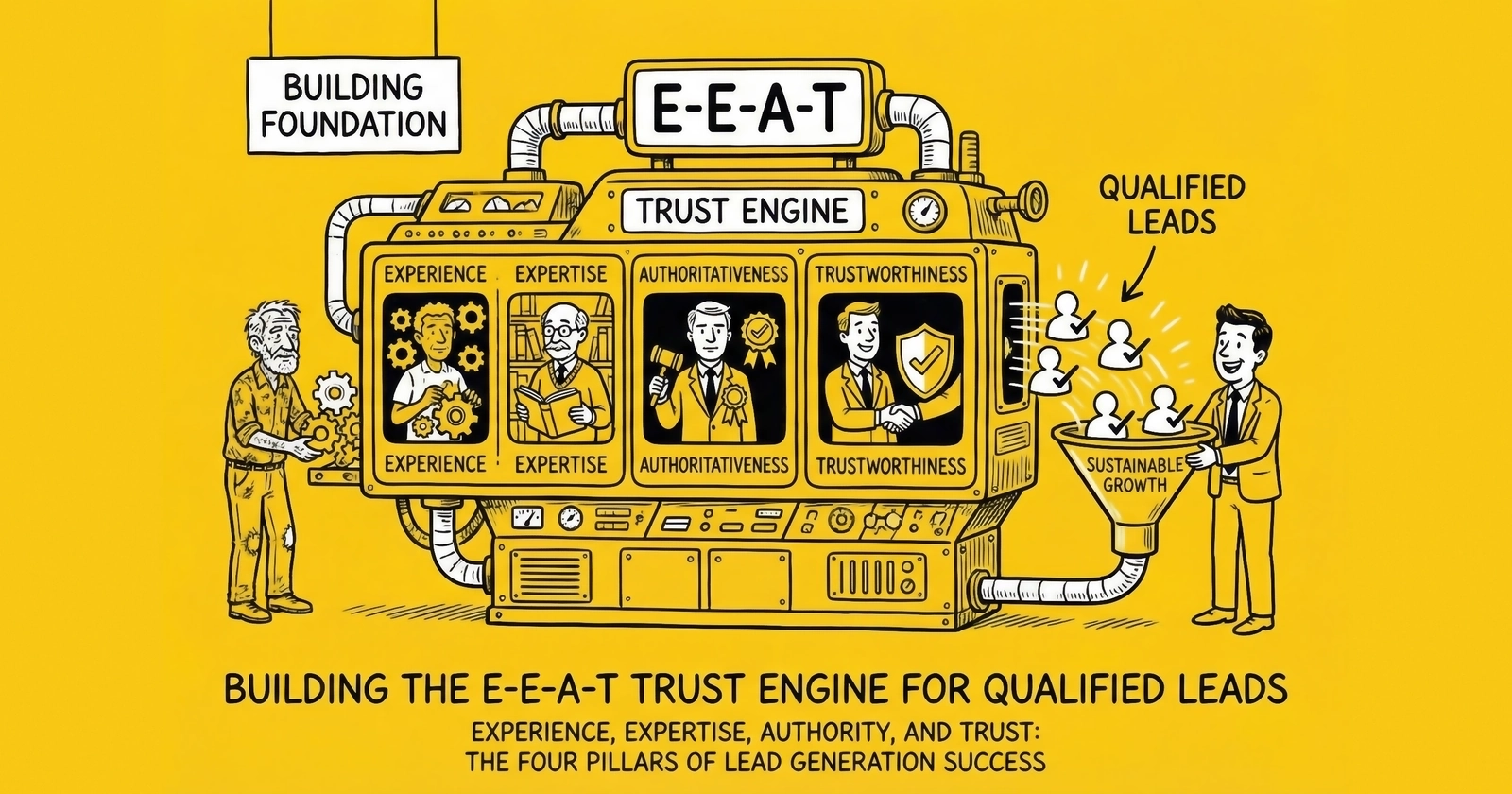
E-E-A-T stands for Experience, Expertise, Authoritativeness, and Trustworthiness. Each pillar has specific implications for lead generation content.
Experience – Real Operational Involvement
Experience means demonstrating first-hand, real-world involvement with the subject matter. Google added this “extra E” in 2023 specifically because expertise alone doesn’t capture whether someone has actually done the work.
For lead generation content, experience signals include:
Operational specifics that only practitioners know:
- “In Q3 2025, we tested 14 consent language variations across 47,000 Medicare leads during AEP. The clearest performer improved contact rates by 23% while maintaining TrustedForm certification.”
Compare this to generic content:
- “Testing consent language can improve contact rates.”
The first version demonstrates experience. The second could be written by anyone who read an article about lead generation.
Campaign data and outcomes:
- Specific CPL benchmarks by vertical and lead type
- Contact rate and conversion rate data from real campaigns
- Before/after results from process changes
- Seasonal patterns observed over multiple years
Challenges only operators face:
- Navigating buyer chargebacks and quality disputes
- Managing compliance audits and documentation requirements
- Handling lead quality degradation during traffic spikes
- Reconciling attribution across multiple distribution partners
Domain expertise demonstrated through specifics: Experience shows through precise details your target audience cares about – not industry jargon they don’t understand. A mortgage content piece demonstrates experience through specific rate scenarios, closing cost breakdowns, and local market knowledge – not by mentioning “ping/post systems” that consumers have never heard of. Match your expertise signals to your reader’s context.
Expertise – What Credentials Matter
Expertise requires demonstrating deep knowledge and skill in the subject area. For lead generation, this means documented qualifications and recognized competence.
Author credentials that signal expertise:
| Credential Type | Examples |
|---|---|
| Industry tenure | ”12 years operating insurance lead generation across 47 states” |
| Volume metrics | ”Managed delivery of 2.3 million Medicare leads during 2025 AEP” |
| Vertical specificity | ”Specialized in home services leads: solar, roofing, HVAC, windows” |
| Platform experience | ”ActiveProspect certified, LeadsPedia implementation specialist” |
| Compliance background | ”Former FTC consent decree compliance monitor” |
| Speaking engagements | ”LeadsCon 2024-2025 speaker, Affiliate Summit faculty” |
Technical depth indicators:
Content demonstrating expertise includes technical understanding that goes beyond surface-level explanations:
- API integration specifics (field mapping, error handling, retry logic)
- Compliance technology implementation (TrustedForm placement, Jornaya configuration)
- Distribution optimization (bid floor strategies, exclusive vs. multi-sell economics)
- Quality scoring methodology (behavioral signals, form completion patterns)
Expertise verification through specificity:
Expertise appears through precision. Vague claims signal lack of expertise:
- Weak: “Lead quality affects campaign performance.”
- Strong: “Contact rates drop 12-18% when lead age exceeds 48 hours, with the steepest decline in the first 4 hours. Mortgage leads show faster decay than auto insurance leads due to rate sensitivity.”
Authoritativeness – Recognition vs. Self-Proclamation
Authoritativeness comes from recognition by others in the field. Self-proclaimed expertise doesn’t create authority; external validation does.
Authority signals AI systems recognize:
Industry recognition:
- Coverage in industry publications (LeadsCon coverage, PerformanceIN features)
- Speaking invitations at industry events
- Awards and recognition (ActiveProspect Partner awards, industry excellence recognition)
- Inclusion in analyst reports or industry studies
Quality backlinks from authoritative sources:
- Links from compliance solution providers (ActiveProspect, Jornaya, Contact Center Compliance)
- Citations in industry association content
- References from platform documentation
- Mentions in regulatory guidance or legal analysis
Building authority also requires understanding organic SEO strategies for lead generation that drive qualified backlinks and citations over time.
Third-party validation:
- BBB accreditation
- Industry association memberships (ATA, DMA)
- Compliance certifications
- Client testimonials from named companies
Consistent entity presence: Your company description should be consistent across:
- Your website
- LinkedIn company page
- Industry directory listings
- Partner and client testimonials
- Press mentions and media coverage
When AI systems scan your digital footprint and find conflicting descriptions, they detect ambiguity. Consistent entity definition builds authority.
Trustworthiness – The Foundation
Google explicitly states that trust is the most important E-E-A-T factor. Without trust, experience, expertise, and authority mean nothing. For lead generation content, trust signals are non-negotiable.
Compliance transparency:
Trust in lead generation requires visible compliance commitment:
- Clear disclosure of lead selling practices
- Published TCPA consent language
- Privacy policy that explains data handling
- Terms of service covering lead quality guarantees
- Refund and chargeback policies
Business legitimacy:
Basic trust signals that AI systems check:
- Physical address (not just a PO box for lead gen businesses)
- Real phone number with business hours
- Named executives and leadership team
- Company history and founding information
- State business registrations where applicable
Technical trust:
AI crawlers evaluate technical trust factors:
- HTTPS encryption (non-negotiable)
- Page speed (under 3 seconds load time)
- Mobile responsiveness
- Core Web Vitals compliance
- No intrusive interstitials or deceptive design
Content accuracy:
Trust requires verifiable accuracy:
- Citations to primary sources (FCC rulings, FTC guidance, state regulations)
- Regular content updates with “last reviewed” dates
- Corrections policy for identified errors
- Clear distinction between fact and opinion
- Acknowledgment of limitations and uncertainties
Social proof:
Trust builds through demonstrated client relationships:
- Client testimonials with named companies and individuals
- Case studies with measurable outcomes
- Client logos (with permission)
- Partnership announcements
- Industry recognition from peers
How AI Systems Evaluate E-E-A-T
Understanding how language models assess trustworthiness reveals what optimization requires.
The 85% Trust Threshold Concept
AI systems function with what approximates an 85% trust threshold. Content must demonstrate sufficient E-E-A-T signals to be considered for citation at all. Below that threshold, content gets filtered out before users ever see it.
This threshold explains why some well-optimized pages never appear in AI responses. They may rank well for keywords but fail the trust evaluation that determines citation eligibility.
The threshold isn’t a literal percentage – it’s a composite assessment across multiple signals:
Signals that push content above threshold:
- Named author with verifiable credentials
- Citations to authoritative primary sources
- Consistent entity information across web presence
- Technical trust factors (HTTPS, performance, mobile)
- External validation (backlinks, mentions, recognition)
Signals that drop content below threshold:
- Anonymous or pseudonymous authorship
- No citations or sources
- Outdated information without update indicators
- Technical issues (slow loading, security warnings)
- Isolated content without external validation
Credibility Markers AI Actually Detects
Language models scan for specific credibility patterns:
Author signals:
- Author bio present and detailed
- Credentials relevant to the topic
- Author byline linking to author page
- Social profiles (especially LinkedIn)
- Other published work by the same author
Source signals:
- Citations to recognized authorities
- Links to primary sources
- References to specific studies or data
- Attribution for claims and statistics
- Quotes from named experts
Structural signals:
- Clear information hierarchy (H1, H2, H3 structure)
- FAQ sections addressing common questions
- Tables and structured data for comparisons
- Lists that enable clean extraction
- Schema markup identifying content type
Consistency signals:
- Alignment with known facts
- No contradictions with established information
- Terminology matching industry standards
- Claims supported by linked evidence
Why Generic Content Never Gets Cited
Generic content fails E-E-A-T evaluation because it lacks differentiation signals. When a lead generation article provides the same information available in a dozen other places, AI systems have no reason to cite that specific source.
Generic content patterns:
- Definitions without operational context
- Best practices without specific implementation
- Statistics without attribution
- Advice without demonstrated experience
- Claims without supporting evidence
Citation-worthy content patterns:
- Unique data from actual campaigns
- Implementation specifics with code examples
- Case studies with named clients and results
- Original research with methodology
- Expert analysis with cited sources
AI systems prioritize sources that add value beyond what’s commonly available. The content worth citing is the content that couldn’t be written without genuine expertise and experience.
Building Experience Signals
Experience is demonstrated through specifics that only practitioners possess. Here’s how to build experience signals into lead generation content.
Use Real Operational Data
Generic statements signal lack of experience. Specific data signals operational involvement:
Instead of:
“Contact rates vary by lead type and time to contact.”
Write:
“Our 2025 auto insurance lead analysis across 340,000 leads showed contact rates of 67% within 5 minutes, 52% within 30 minutes, and 38% after 2 hours. Live transfer leads maintained 89% contact rates regardless of timing because the consumer is already on the line.”
Include data that reflects actual operational experience:
- CPL ranges by vertical and lead type
- Contact rates by time-to-contact bands
- Conversion rates by lead source
- Quality scores by traffic origin
- Seasonal patterns from multi-year observation
Document Specific Challenges
Practitioners face challenges that observers don’t understand. Documenting these challenges signals experience:
Compliance challenges:
“In Q2 2025, Florida’s FTSA implementation required rebuilding our consent flows for all Florida-resident leads. The 30-day implementation window meant parallel systems for two months – doubling our compliance documentation burden during the transition.”
Operational challenges:
“Buyer chargeback rates spiked 23% in March when a major traffic partner’s quality degraded. Identifying the source required tracing 47,000 leads back through three distribution hops. The forensics took 11 days; the revenue impact was $180,000.”
Quality challenges:
“TrustedForm certificate expiration caused 2,340 leads to fail validation during a system upgrade. The 4-hour certificate window meant we lost documentation for leads that were legitimately captured but couldn’t be verified in time.”
Show Domain Expertise Through Audience-Appropriate Details
Experience signals must match your target audience:
For consumer-facing content (landing pages, educational articles):
- Local market knowledge (“In Phoenix, solar installations average 18% higher ROI due to 299 sunny days”)
- Specific process details (“The underwriting review typically takes 3-5 business days for conventional loans”)
- Realistic outcome ranges (“Most homeowners see 20-30% reduction in energy costs within the first year”)
- Regulatory context consumers care about (“Arizona requires all solar installers to be licensed through the ROC”)
For B2B content (targeting other marketers, lead buyers, agencies):
- Industry metrics (CPL benchmarks, contact rates, conversion rates by vertical)
- Platform knowledge (distribution systems, compliance technology)
- Operational insights (quality scoring, routing optimization)
The key: match terminology to your reader. Consumer content using “ping/post” or “waterfall routing” signals you’re writing for the wrong audience. B2B content avoiding these terms when appropriate signals lack of experience.
Include Original Visuals
Screenshots, diagrams, and charts from actual operations demonstrate experience:
- Dashboard views (appropriately redacted)
- Consent flow diagrams
- Lead routing architecture
- Quality score distribution charts
- Before/after performance comparisons
These visuals can’t be fabricated from research alone. They require operational access.
Demonstrating Expertise
Expertise requires demonstrable qualifications. Here’s how to build and display expertise signals.
Author Credentials That Matter
Create detailed author bio pages that include:
Industry experience:
“12 years in performance marketing, including 8 years focused exclusively on insurance lead generation. Former VP of Operations at [Company], managing 400,000+ monthly lead volume across auto, home, and health insurance verticals.”
Vertical specificity:
“Specialized in Medicare lead generation since 2018. Managed AEP campaigns delivering 1.2 million leads to 340+ agents and agencies annually. Deep expertise in CMS marketing compliance, carrier appointment requirements, and state-by-state licensing.”
Platform certifications:
“ActiveProspect Certified Partner since 2020. LeadsPedia implementation specialist. TrustedForm integration expert with 50+ publisher implementations.”
Speaking and publishing:
“LeadsCon speaker (2023, 2024, 2025). Published in PerformanceIN, Business of Apps, and Insurance Journal. Regular contributor to industry discussions on lead quality and compliance.”
Implement Author Schema Markup
Author schema enables search engines and AI systems to identify your expertise signals:
{
  "@context": "https://schema.org",
  "@type": "Person",
  "name": "Author Name",
  "jobTitle": "VP of Lead Operations",
  "worksFor": {
    "@type": "Organization",
    "name": "Company Name"
  },
  "description": "12-year lead generation veteran specializing in insurance verticals",
  "sameAs": [
    "https://linkedin.com/in/authorprofile",
    "https://twitter.com/authorhandle"
  ],
  "knowsAbout": [
    "Lead Generation",
    "TCPA Compliance",
    "Insurance Marketing",
    "Performance Marketing"
  ]
}
Author schema implementation can increase click-through rates by 20-30% and improves AI system recognition of expertise signals.
Document Qualifications
Beyond author bios, document organizational qualifications:
Team credentials:
- Legal/compliance team background
- Technology team certifications
- Operations team industry experience
- Advisory board members
Organizational credentials:
- Years in operation
- Lead volume processed
- Verticals served
- Geographic coverage
- Client count and retention
Compliance credentials:
- TrustedForm/Jornaya partnership status
- Industry association memberships
- Compliance certifications
- Audit history (if favorable)
Building Authoritativeness
Authority comes from external recognition. Here’s how to build authority signals that AI systems recognize.
Industry Recognition
Active industry participation builds authority:
Conference speaking:
- Submit to speak at LeadsCon, Affiliate Summit, PerformanceIN Live
- Host webinars with industry partners
- Participate in panel discussions
- Present at regional industry meetups
Publication features:
- Contribute articles to industry publications
- Respond to journalist inquiries
- Share data for industry research
- Participate in expert roundups
Awards and recognition:
- Submit for industry awards
- Pursue partner program recognition
- Document client success stories for award submissions
Quality Backlinks
Backlinks from authoritative sources signal external validation:
High-value link sources for lead generation:
- Compliance solution providers (ActiveProspect blog, Jornaya resources)
- Industry publications (LeadsCon, PerformanceIN)
- Legal and compliance resources
- Industry associations
- Platform vendor documentation
Link building approaches:
- Create original research others want to cite
- Contribute guest content to partner blogs
- Participate in expert roundups
- Provide quotes for journalist articles
- Document integrations with partner platforms
Third-Party Validation
Independent validation builds authority:
Business legitimacy:
- BBB accreditation
- State business registrations
- Industry association memberships
Technical validation:
- SOC 2 certification for data handling
- SSL certificates and security audits
- Uptime and reliability certifications
Client validation:
- Client testimonials with company names
- Case studies with measurable results
- Client reference availability
- Long-term client retention metrics
Consistent Entity Presence
Authority requires consistent identity across platforms:
Check consistency across:
- Company website
- LinkedIn company page
- Google Business Profile
- Industry directories
- Partner and vendor listings
- Press mentions
- Social media profiles
When AI systems find conflicting information about your company, they reduce confidence in citing you. Consistency signals reliability.
Trust Signals Specific to Lead Generation
Trust requirements for lead generation reflect the industry’s regulatory environment and financial stakes.
Compliance Transparency as Competitive Advantage
Compliance transparency isn’t just a trust signal – it’s a differentiator:
Publish your compliance approach:
- Consent capture methodology
- TCPA compliance documentation
- State-specific handling (Florida, Oklahoma, Washington)
- Revocation and opt-out processes
- Data retention and deletion policies
Show your compliance technology:
- TrustedForm integration
- Jornaya LeadID implementation
- DNC scrubbing processes
- Call recording and consent verification
Document your compliance history:
- Audit results (if favorable)
- Compliance certifications
- Zero litigation history (if applicable)
- Remediation processes
Business Legitimacy Indicators
Lead generation businesses must demonstrate legitimacy:
Physical presence:
- Actual business address (not just registered agent)
- Phone number with business hours
- Local business registrations
Leadership transparency:
- Named executives with backgrounds
- Leadership team LinkedIn profiles
- Company history and founding story
Operational transparency:
- Clear explanation of business model
- Lead sourcing transparency
- Buyer qualification processes
- Quality guarantee terms
Technical Trust Foundations
Technical factors contribute to trust evaluation:
| Factor | Requirement | Why It Matters |
|---|---|---|
| HTTPS | Required | Security baseline |
| Page speed | Under 3 seconds | User experience signal |
| Mobile responsive | Required | Accessibility |
| Core Web Vitals | Pass | Google performance standard |
| No security warnings | Required | Trust red flag if present |
| Accessible design | Required | Inclusion signal |
Regulatory Compliance Evidence
For YMYL content, regulatory compliance signals trust:
Show compliance technology:
- TrustedForm badge or certification
- Jornaya partnership status
- DNC compliance process
- State licensing where applicable
Reference regulatory sources:
- Link to FCC TCPA guidance
- Reference FTC unfair practices rules
- Cite state-specific requirements
- Acknowledge CMS Medicare marketing rules
Demonstrate compliance knowledge:
- Accurate regulatory explanations
- Current information reflecting recent changes
- Nuanced understanding of gray areas
- Practical compliance implementation guidance
Implementation Roadmap
Building E-E-A-T signals requires systematic implementation across your digital presence.
Immediate Actions (Week 1-2)
Create robust author pages:
- Dedicated page for each content creator
- Detailed credentials and experience
- Professional headshot
- LinkedIn link
- Other published work
Implement author schema:
- Person schema for each author
- Link author pages to authored content
- Include knowsAbout and credentials
Establish editorial process:
- Document who writes, reviews, approves
- Show review process (“Reviewed by [Compliance Officer]”)
- Maintain editorial calendar with update schedule
Content Strategy (Week 3-6)
Create industry-specific case studies:
- Real campaign data (appropriately anonymized)
- Before/after comparisons
- Compliance challenges solved
- Client quotes (with permission)
Publish original research:
- Lead quality benchmarks from your data
- Compliance cost analysis
- Market trend observations
- Conversion rate studies – including insights on true ROI calculation for lead generation
Develop authoritative guides:
- TCPA compliance implementation guides
- Vertical-specific lead generation guides
- State-by-state regulatory guides
- Platform integration documentation
Technical Implementation (Week 7-8)
Schema markup expansion:
- Organization schema for company
- Article schema for blog content
- FAQPage schema for FAQ sections
- HowTo schema for process content
Technical trust audit:
- Verify HTTPS everywhere
- Test Core Web Vitals
- Check mobile responsiveness
- Eliminate security warnings
Business information verification:
- Consistent NAP across platforms
- Updated Google Business Profile
- Current industry directory listings
- Accurate LinkedIn company page
Authority Building (Ongoing)
External recognition:
- Speaking submission calendar
- Guest content pitching
- Award submission schedule
- Partner content collaboration
Link earning:
- Original research publication
- Expert quote availability
- Integration documentation
- Community participation
Key Takeaways
-
Lead generation is YMYL content – AI systems apply the strictest quality standards because inaccurate lead generation advice can cause financial harm. TCPA violations cost $500-$1,500 per incident.
-
Trust is the foundation – Google states trust is the most important E-E-A-T factor. Without trust, experience, expertise, and authority mean nothing.
-
AI applies an approximate 85% trust threshold – Content must demonstrate sufficient E-E-A-T signals to be considered for citation. Below threshold, content is filtered before users see responses.
-
Experience requires audience-appropriate specifics – Generic advice signals lack of experience. Real data, specific challenges, and domain expertise demonstrate genuine involvement – but match your terminology to your reader’s context, not your own.
-
Author credentials directly impact visibility – Named experts with verifiable backgrounds outperform anonymous content. Author schema implementation increases CTR by 20-30%.
-
Authority comes from external recognition – Self-proclaimed expertise doesn’t build authority. Industry recognition, quality backlinks, and third-party validation create authority signals.
-
Compliance transparency is a differentiator – In lead generation, visible compliance commitment builds trust. Document your TCPA processes, show your certifications, reference primary regulatory sources.
-
Technical foundation is required – HTTPS, fast loading, mobile responsiveness, and schema markup are table stakes for E-E-A-T compliance.
-
82% of AI citations include structured data – Schema markup isn’t optional for AI visibility. Implement Organization, Article, FAQPage, and Person schemas.
-
Original insights win – AI systems detect generic content. They prioritize depth, originality, and specific data over repackaged information available elsewhere.
Frequently Asked Questions
What is E-E-A-T and why does it matter for lead generation?
E-E-A-T stands for Experience, Expertise, Authoritativeness, and Trustworthiness – the four pillars Google uses to evaluate content quality. For lead generation, E-E-A-T matters because the industry falls under YMYL (Your Money or Your Life) classification. AI systems apply stricter evaluation to lead generation content because bad advice can cause financial harm through compliance violations, consumer protection failures, or poor business decisions.
Why is lead generation classified as YMYL content?
Lead generation for insurance, mortgage, financial products, legal services, and healthcare involves consumer financial decisions and data privacy. Inaccurate lead generation advice can result in TCPA violations ($500-$1,500 per incident), privacy breaches, regulatory enforcement, and consumer harm. Google applies the same scrutiny to lead generation content as to financial advice or healthcare information.
How do AI systems evaluate E-E-A-T before citing content?
AI systems scan for specific credibility markers before including sources in responses. They look for author credentials, citations to authoritative sources, consistent entity information across the web, technical trust factors (HTTPS, performance), and external validation through backlinks and mentions. Content below an approximate 85% trust threshold gets filtered out before users see it.
What author credentials matter for lead generation content?
Relevant credentials include industry tenure, volume metrics (leads managed), vertical specificity, platform certifications (ActiveProspect, LeadsPedia), compliance background, speaking engagements (LeadsCon, Affiliate Summit), and published work. Credentials should be documented on detailed author bio pages with schema markup.
How does experience differ from expertise in E-E-A-T?
Experience demonstrates first-hand operational involvement – you’ve actually done the work. It shows through specific campaign data, operational challenges faced, and precise details that only practitioners know. Expertise demonstrates deep knowledge and qualifications – degrees, certifications, industry recognition. Both are required, but experience provides the specificity that expertise alone cannot. Importantly, experience signals must match your audience – consumer-facing content needs consumer-relevant specifics, not industry jargon.
What trust signals do AI systems look for in lead generation content?
Key trust signals include compliance transparency (published consent language, TCPA processes), business legitimacy (physical address, named executives), technical trust (HTTPS, fast loading), content accuracy (citations to primary sources, update dates), and social proof (client testimonials, case studies). Regulatory compliance evidence like TrustedForm integration particularly matters for lead generation.
How do I implement author schema markup?
Author schema uses JSON-LD format to define person entities with properties including name, jobTitle, worksFor, description, sameAs (linking to social profiles), and knowsAbout (expertise areas). Place the schema on author bio pages and link articles to author pages through bylines. This enables search engines and AI systems to connect content with author credentials.
What’s the difference between authority and trustworthiness?
Authoritativeness comes from external recognition – industry awards, backlinks from respected sources, speaking invitations, media coverage. Trustworthiness is about reliability and accuracy – compliance transparency, accurate information, cited sources, business legitimacy. You can have authority without trust (a famous but unreliable source) or trust without authority (a reliable but unknown source). Both are required for E-E-A-T.
How often should lead generation content be updated for E-E-A-T?
Lead generation content should be reviewed quarterly at minimum, with immediate updates when regulations change. 89.7% of ChatGPT’s most-cited pages were updated in the current year. Add “last reviewed” dates to content, update statistics with current data, and refresh regulatory guidance when rules change (FCC rulings, state mini-TCPA implementation).
What content formats demonstrate E-E-A-T best for lead generation?
Effective formats include case studies with real campaign data and measurable outcomes, original research from proprietary data, compliance implementation guides with specific steps, state-by-state regulatory comparisons, platform integration documentation, and FAQ sections addressing common questions. Avoid generic listicles and repackaged information available elsewhere.
How does E-E-A-T affect AI citation differently than Google ranking?
Traditional SEO rewards keyword optimization, backlink profiles, and technical factors. E-E-A-T for AI citation rewards demonstrated expertise, author credentials, and content trustworthiness. A page can rank well for keywords while lacking the E-E-A-T signals required for AI citation. This explains why 25% of ChatGPT’s most-cited URLs have zero Google visibility.
What role does compliance transparency play in E-E-A-T for lead generation?
Compliance transparency serves as a primary trust signal for lead generation content. Publishing your TCPA consent language, showing TrustedForm or Jornaya integration, documenting your compliance processes, and referencing primary regulatory sources demonstrate that your organization takes compliance seriously. This transparency differentiates trustworthy sources from those cutting corners.
How can smaller lead generation companies compete on E-E-A-T?
Smaller companies build E-E-A-T through specificity and authenticity. Focus on documenting genuine operational experience with specific data from your campaigns. Understand what lead generation actually involves and communicate your specific approach to that process. Build author credentials through industry participation, guest content, and speaking opportunities. Create original research from your proprietary data – even smaller datasets provide unique value. Compliance transparency requires no scale.
What technical factors affect E-E-A-T evaluation?
Technical factors include HTTPS encryption (required), page load speed (under 3 seconds), mobile responsiveness, Core Web Vitals compliance, absence of security warnings, and proper schema markup implementation. AI crawlers evaluate these factors as trust signals. Poor technical performance reduces trust regardless of content quality.
How do I measure E-E-A-T improvement?
Direct E-E-A-T measurement isn’t possible, but proxy metrics indicate progress. Monitor brand search volume (increases when authority grows), direct traffic trends, backlink growth from authoritative sources, citation frequency in AI responses (manual testing), and content performance improvements. Track author page traffic and engagement as indicators of credential recognition.
Sources
- Google Search Quality Evaluator Guidelines - Google’s official documentation defining E-E-A-T evaluation criteria and YMYL classification
- Google Search Central: Creating Helpful Content - Official guidance on content quality signals and E-E-A-T implementation
- Google Core Web Vitals Documentation - Technical trust factors including page speed and performance requirements
- Schema.org Person Specification - Standard for author schema markup enabling AI systems to identify expertise signals
- ActiveProspect - Compliance technology platform for TrustedForm consent verification
- Verisk - Parent company of Jornaya LeadID compliance certification services