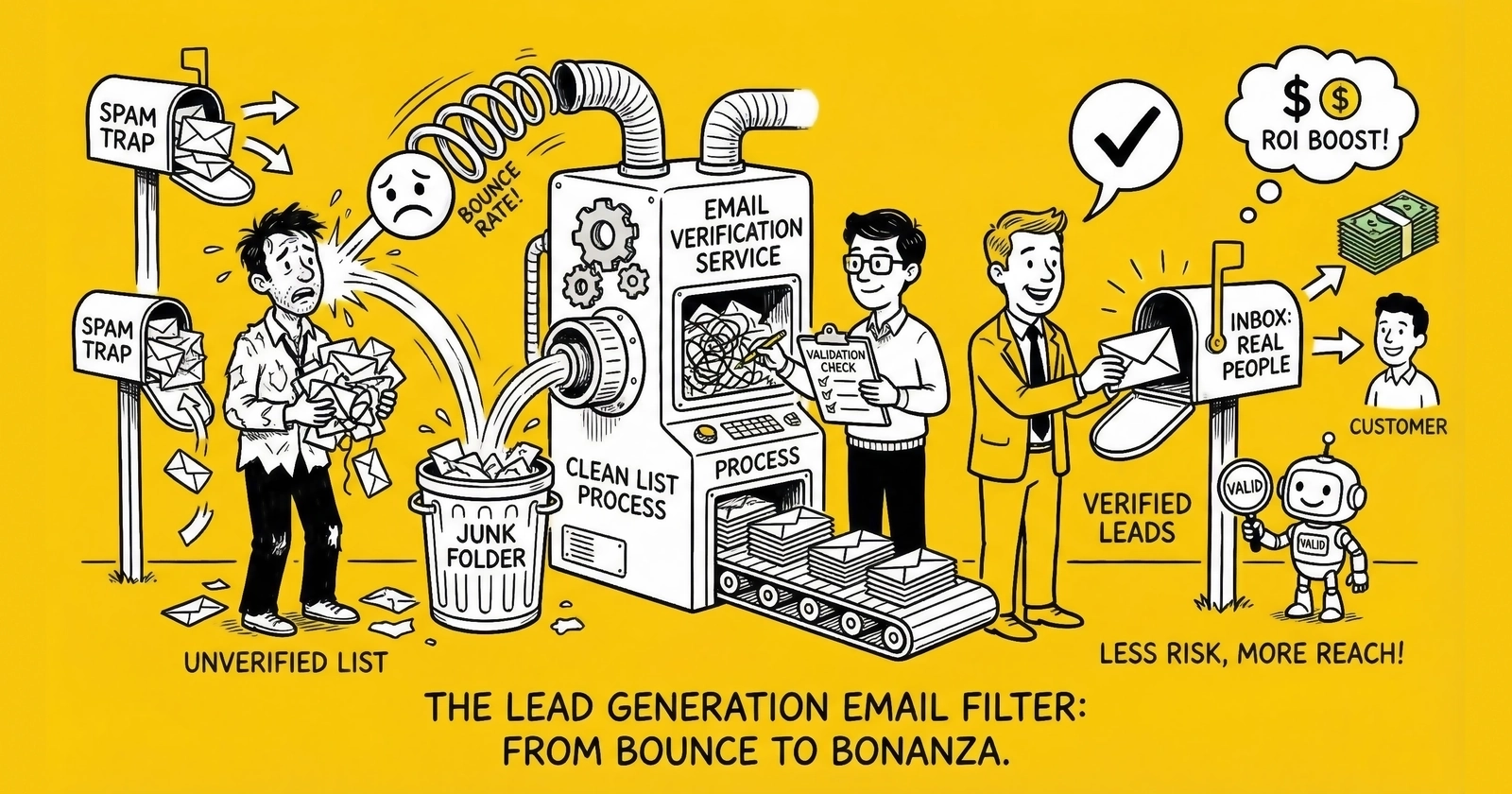
Your email list is a depreciating asset. Every month, 2-3% of addresses become invalid through job changes, domain expirations, and abandoned accounts. Without verification, you are paying to acquire leads that will never convert and damaging the sender reputation that determines whether your legitimate emails reach inboxes.
Email verification separates the leads worth pursuing from the digital dead ends that drain your marketing budget. In lead generation, this distinction matters more than in any other email application. You pay per lead. Every invalid email represents wasted acquisition cost, wasted sales effort, and accumulating damage to your sender reputation.
The email verification market in 2025 offers operators a genuine choice among specialized providers. ZeroBounce, NeverBounce, Emailable, Hunter, DeBounce, EmailListVerify, and BriteVerify each approach the problem differently, with distinct pricing models, accuracy claims, and feature sets.
This comparison provides the information you need to select the right verification service for your lead generation operation. No vendor relationships influenced this analysis. The goal is operational clarity: which service fits your volume, budget, vertical requirements, and integration needs.
I have watched operators lose thousands of monthly dollars to bad email data while paying $50 a month for verification services that would have prevented the loss. I have also watched operators over-invest in verification for list sizes that did not justify the expense. The right service at the right volume delivers returns measured in multiples of cost. The wrong service, or no service at all, creates compounding problems that become increasingly expensive to fix.
Why Email Verification Matters for Lead Generation
Email verification determines whether an address is real, active, and capable of receiving mail. But for lead generators, the implications extend far beyond deliverability.
The Economics of Invalid Emails
Consider a lead generation operation acquiring 10,000 leads monthly at $25 CPL. Industry data indicates 20-30% of unvalidated leads contain invalid or problematic email addresses. The breakdown typically looks like this:
- Hard bounces (invalid addresses): 8-12%
- Spam traps and honeypots: 1-3%
- Disposable/temporary addresses: 3-8%
- Role-based addresses (info@, sales@): 2-5%
- Risky or catch-all domains: 5-10%
At 25% invalid rate, that is 2,500 leads monthly that will never convert. At $25 CPL, you are spending $62,500 annually on addresses that cannot receive email.
But the waste compounds:
Sales time wasted: Your team follows up on leads that cannot respond. At 15 minutes per lead touchpoint and three touches per lead, you are losing 1,875 hours annually chasing dead addresses.
Sender reputation damage: Email Service Providers (ESPs) monitor bounce rates closely. Bounce rates above 2% trigger deliverability penalties. Rates above 5% can result in domain blacklisting, affecting your ability to reach valid leads with valid addresses. Proper email authentication with SPF, DKIM, and DMARC becomes meaningless if you’re sending to invalid addresses.
Buyer returns: If you sell leads to buyers, invalid emails generate returns. A 12% return rate on $50 leads costs $150,000 annually on that same 10,000 lead monthly volume.
Compliance exposure: Sending to spam traps or repeatedly bouncing off domains can trigger complaints that affect your entire email infrastructure, not just lead follow-up campaigns.
The Verification Investment
Quality email verification costs $0.003-$0.01 per address at volume. For 10,000 leads monthly, budget $30-$100. The same operation losing $62,500 to invalid leads spends $1,200 annually on verification to prevent most of that loss.
The ROI is not subtle. It is among the highest-return investments available in lead operations.
How Email Verification Works
Understanding the verification process helps you evaluate service claims and configure appropriate validation levels for your operation.
Syntax and Format Validation
The first layer checks whether an email address follows valid structural patterns. Valid emails require a local part (before the @), an @ symbol, a domain, and a valid top-level domain. Syntax validation catches obvious errors: missing @ symbols, spaces, invalid characters, and malformed structures.
This check is instant and essentially free. It catches the most obvious errors but misses most invalid addresses that follow correct formatting patterns.
DNS and MX Record Verification
Domain verification confirms that the email domain exists and is configured to receive mail. The verification service queries DNS records to confirm the domain resolves, then checks MX (Mail Exchange) records to confirm mail servers are configured.
An email to johndoe@nonexistentdomain.com fails at this layer. So does john@gmial.com (common typo for gmail.com) because gmial.com has no mail servers.
Quality services maintain databases of common typos and can flag or auto-correct addresses like:
- gamil.com, gmial.com, gmal.com → gmail.com
- hotmal.com, hotmial.com → hotmail.com
- yaho.com, yahooo.com → yahoo.com
- outloo.com, outlok.com → outlook.com
This correction capability alone recovers 3-5% of leads that would otherwise be lost to typos.
SMTP Verification
SMTP (Simple Mail Transfer Protocol) verification checks whether the specific mailbox exists on the verified domain. The verification service connects to the domain’s mail server, initiates a mail transaction without actually sending, and requests confirmation that the recipient address exists.
This is the most definitive verification layer. An email to john.smith.12345@gmail.com might pass syntax and DNS checks but fail SMTP verification because that specific mailbox does not exist.
Important limitation: Some mail servers do not provide mailbox verification. These “catch-all” domains accept mail for any address at the domain, regardless of whether the mailbox exists. Corporate email systems often configure as catch-all. Verification services return “unknown” or “accept-all” status for these addresses rather than definitive valid/invalid results.
Disposable Email Detection
Disposable email addresses come from services like Mailinator, Guerrilla Mail, 10MinuteMail, and hundreds of similar providers. Users create temporary addresses to avoid follow-up contact. These addresses technically work but indicate near-zero conversion intent.
Quality verification services maintain databases of 100,000+ known disposable domains, updated continuously as new providers emerge. Detection rates vary significantly between services. Some catch 95%+ of disposable addresses; others miss half.
For lead generation, disposable email detection may be more valuable than SMTP verification. An address that technically works but belongs to someone actively avoiding contact has zero conversion potential.
Spam Trap and Honeypot Detection
Spam traps are email addresses created specifically to identify senders with poor list hygiene. Types include:
Pristine traps: Addresses never used for legitimate signup, published in hidden locations that only scrapers find.
Recycled traps: Abandoned addresses converted to traps after extended inactivity. Hard to detect because they were once legitimate.
Typo traps: Common misspellings of popular domains, capturing both typos and fabricated addresses.
Sending to spam traps instantly damages sender reputation. Major ESPs like Google, Microsoft, and Yahoo use trap hits as definitive signals of poor sending practices. A single trap hit can affect deliverability for your entire domain.
Spam trap detection requires access to trap databases or relationships with trap operators. Not all verification services offer this capability, and those that do vary in detection coverage.
Risk Scoring and Role-Based Detection
Beyond binary valid/invalid determinations, advanced verification provides risk scoring. Factors include:
Role-based addresses: Generic addresses like info@, sales@, support@, webmaster@. These work but often route to shared inboxes with lower engagement rates.
Catch-all domains: Addresses that cannot be definitively verified. Sending is possible but risky.
Recently created domains: New domains have higher fraud correlation.
Known complaint domains: Addresses at domains with high complaint rates.
Historical bounce patterns: Addresses that have bounced from other senders.
Risk scoring allows nuanced treatment rather than binary accept/reject. You might accept medium-risk addresses for low-cost lead sources but reject them for high-CPL verticals.
Email Verification Services Compared
The email verification market includes dozens of providers. Seven services dominate the lead generation conversation: ZeroBounce, NeverBounce, Emailable, Hunter, DeBounce, EmailListVerify, and BriteVerify. Each serves different operational needs.
ZeroBounce
Company Background: ZeroBounce has established itself as an industry leader in email validation accuracy. The company emphasizes data security, maintaining SOC 2 Type II compliance and processing data through secure infrastructure.
Core Capabilities:
ZeroBounce performs 14+ validation checks per email address, including syntax validation, DNS/MX verification, SMTP verification, spam trap detection, abuse email detection, and catch-all identification. The service includes an AI-powered email scoring system that predicts engagement likelihood beyond simple valid/invalid determination.
The platform offers additional services beyond verification:
- Email Finder: Locate email addresses from names and domains ($0.20 per successful find, 20 credits)
- Email Scoring: AI prediction of engagement probability
- Activity Data: Information on when addresses were last active
- Gender Identification: Append gender data from names
- Data Append: Enrich records with additional contact information
Accuracy Claims: ZeroBounce advertises 99%+ accuracy and offers a guarantee on results. The service does not charge for “unknown” results where definitive verification is not possible.
Pricing Structure:
Pay-as-you-go pricing scales with volume:
| Volume | Price Per Email | Total Cost |
|---|---|---|
| 2,000 | $0.0100 | $20 |
| 5,000 | $0.0090 | $45 |
| 10,000 | $0.0080 | $80 |
| 25,000 | $0.0076 | $190 |
| 50,000 | $0.0075 | $375 |
| 100,000 | $0.00425 | $425 |
| 250,000 | $0.00376 | $940 |
| 500,000 | $0.0036 | $1,800 |
| 1 million | $0.00275 | $2,750 |
| 5 million+ | $0.0025 | $12,500+ |
Subscription Option: ZeroBounce ONE costs $99/month ($948/year with 20% savings) and includes 25,000 monthly verification credits plus access to additional tools.
Free Tier: 100 monthly validations for business domain signups.
Best For: Lead generators who need comprehensive validation with additional data enrichment capabilities. The spam trap detection and AI scoring provide value for operations where deliverability directly affects revenue. Premium pricing justifies for high-value leads where invalid data costs significantly exceed verification costs.
NeverBounce
Company Background: NeverBounce operates as a standalone email verification service with emphasis on bulk list cleaning and real-time API verification. The company offers a delivery guarantee: if a verified “valid” email bounces, they credit your account.
Core Capabilities:
NeverBounce performs standard verification including syntax, DNS, SMTP, and disposable email detection. The service categorizes results as:
- Valid: Address exists and can receive mail
- Invalid: Address does not exist or cannot receive mail
- Disposable: Temporary email address
- Accept-All: Catch-all domain, cannot definitively verify
- Unknown: Verification inconclusive
The platform integrates with major email marketing and CRM platforms including Mailchimp, HubSpot, Salesforce, and Constant Contact.
Processing Speed: NeverBounce emphasizes fast processing, claiming verification of 10,000 emails in under 3 minutes for bulk uploads.
Pricing Structure:
Pay-as-you-go with volume discounts:
| Volume | Price Per Email |
|---|---|
| 10,000 | $0.008 |
| 100,000 | $0.005 |
| 250,000 | $0.004 |
| 1 million | $0.003 |
Monthly subscription plans provide credits at lower per-verification costs with unused credits rolling over.
Delivery Guarantee: NeverBounce offers to credit accounts for verified “valid” emails that subsequently bounce. This shifts some risk from the operator to the service provider.
Best For: Operations prioritizing fast processing and delivery guarantees. The integration library suits teams using major email marketing platforms. Competitive pricing at volume makes NeverBounce attractive for high-volume operations focused on core verification without extensive additional features.
Emailable
Company Background: Emailable (formerly known as Email Checker) positions as a straightforward verification service with competitive pricing and API-first architecture.
Core Capabilities:
The service performs syntax validation, DNS/MX verification, SMTP verification, disposable email detection, and role-based address identification. Results categorize as deliverable, undeliverable, risky, or unknown.
Key features include:
- Duplicate detection and removal
- Typo correction suggestions
- Bulk upload and API verification
- Integration with major platforms via Zapier
Accuracy Approach: Emailable provides refunds for unknown results and duplicate verifications, ensuring you only pay for definitive outcomes.
Pricing Structure:
Credit-based pricing with no expiration:
| Credits | Approximate Cost |
|---|---|
| 5,000 | ~$25 |
| 10,000 | ~$45 |
| 25,000 | ~$100 |
| 50,000 | ~$175 |
| 100,000 | ~$300 |
| 250,000 | ~$650 |
| 500,000 | ~$1,100 |
| 1,000,000 | ~$1,900 |
Subscription option provides 15% savings with monthly or annual billing.
Free Tier: 250 free credits with account signup.
Best For: Developers and technical teams needing straightforward API access without complex feature sets. The pricing transparency and no-expiration credits suit operations with variable verification volume.
Hunter
Company Background: Hunter focuses on B2B email discovery and verification. The platform is best known for finding email addresses from company domains and names, with verification as a complementary capability.
Core Capabilities:
Hunter’s Email Verifier performs:
- Syntax and format validation
- DNS and MX record checks
- SMTP verification
- Catch-all detection
- Disposable email detection
The verification service integrates with Hunter’s email finder, allowing discovery and verification in a single workflow. For lead generators focused on B2B prospects, this combination provides significant value.
Credit System: Hunter charges 0.5 credits per verified email. Failed verifications (returning “unknown” status) do not consume credits.
Pricing Structure:
Subscription-based with monthly credit allocations:
| Plan | Monthly Credits | Monthly Cost | Annual Cost |
|---|---|---|---|
| Free | 50 | $0 | $0 |
| Starter | 2,000 | $49 | $34/month |
| Growth | 10,000 | $149 | $104/month |
| Scale | 25,000 | $299 | $209/month |
| Enterprise | Custom | Custom | Custom |
At Growth tier (10,000 credits = 20,000 verifications), the effective cost is approximately $0.0052 per verification when paying annually.
B2B Focus: Hunter’s email pattern detection and company domain searching suit B2B lead generation better than B2C. The service identifies email patterns at target companies (firstname.lastname@company.com, first_last@company.com) and applies those patterns to find specific individuals.
Best For: B2B lead generators who need both email discovery and verification. The combination of finding and verifying addresses in a single platform eliminates workflow complexity. Less suited for B2C lead generation where email discovery is not a primary need.
DeBounce
Company Background: DeBounce positions as a high-value option with aggressive pricing and comprehensive validation. The service emphasizes privacy and does not store email addresses after verification.
Core Capabilities:
DeBounce performs:
- Syntax and format validation
- DNS and MX verification
- SMTP verification
- Disposable email detection
- Spam trap detection
- Role-based detection
- Catch-all identification
The service includes free deduplication with all verifications and supports both bulk upload and real-time API verification.
Unique Features:
- Catch-All Validation: Advanced verification specifically for catch-all domains at 10 credits per check
- Data Enrichment: Additional data append services at 30 credits per successful detection
- List Monitoring: Ongoing monitoring of lists for address degradation
Pricing Structure:
DeBounce uses a credit-based model with exceptionally low per-verification costs:
Base rate: $0.0003 per verification credit
Standard email validation consumes 1 credit. At this rate, 100,000 verifications cost approximately $30, making DeBounce among the most affordable options at scale.
Credits never expire. No monthly minimums or subscription requirements.
Payment Flexibility: Accepts credit cards, PayPal, Bitcoin, and 40+ local payment methods.
Free Tier: 100 free credits on signup.
Best For: High-volume operations where cost matters most. The aggressive pricing makes DeBounce attractive for lead generators processing large lists. The catch-all validation and list monitoring features add value for operations managing ongoing list hygiene.
EmailListVerify
Company Background: EmailListVerify offers both verification and email discovery services, targeting operations that need to build and clean lists.
Core Capabilities:
Verification includes:
- Syntax validation
- DNS/MX verification
- SMTP verification
- Spam trap detection
- Disposable email detection
- Role-based detection
- Catch-all identification
- Abuse and complaint email detection
The Email Finder tool locates addresses from domains and names, consuming 5 credits per medium-confidence or higher result.
Pricing Structure:
Pay-as-you-go pricing with volume discounts:
| Credits | Price | Cost Per Credit |
|---|---|---|
| 1,000 | $5 | $0.0050 |
| 5,000 | $17 | $0.0034 |
| 10,000 | $27 | $0.0027 |
| 25,000 | $54 | $0.00216 |
| 50,000 | $98 | $0.00196 |
| 100,000 | $186 | $0.00186 |
Monthly subscriptions provide additional savings:
| Credits | Monthly Cost | Cost Per Credit |
|---|---|---|
| 5,000 | $16 | $0.0032 |
| 10,000 | $25 | $0.0025 |
| 25,000 | $49 | $0.00196 |
| 50,000 | $89 | $0.00178 |
| 100,000 | $168 | $0.00168 |
| 250,000 | $346 | $0.00138 |
Free Tier: 100 free verifications on registration.
Best For: Operations needing both email discovery and verification at competitive prices. The combined capabilities suit B2B lead generators and list building operations. Strong value at mid-tier volumes (25,000-100,000 monthly).
BriteVerify (Validity)
Company Background: BriteVerify operates as part of Validity’s suite of email deliverability and data quality products. The service targets enterprise operations with emphasis on security, compliance, and integration with major platforms.
Core Capabilities:
BriteVerify performs:
- Bulk, real-time, and API-based verification
- Spam trap detection using Validity’s extensive trap network
- Deliverability scoring
- Phone and address verification (unified platform)
The service emphasizes speed, claiming “industry’s fastest email verification.” Integration with Validity’s broader deliverability suite (Everest, Return Path network) provides insight into inbox placement beyond simple verification.
Enterprise Features:
- CCPA compliance and data protection
- Salesforce native integration
- Enterprise security protocols
- Dedicated account management
Pricing Structure:
BriteVerify uses enterprise pricing models. Contact sales for quotes. Typical enterprise pricing falls in the $0.01-$0.03 per verification range depending on volume commitments and service level.
Multi-Channel Verification: Unlike pure email verification services, BriteVerify offers phone and address verification through the same platform. For lead generators validating complete contact records, the unified platform eliminates vendor complexity.
Best For: Enterprise operations needing unified email, phone, and address verification with enterprise security requirements. The Validity integration provides value for operations where deliverability monitoring matters beyond list cleaning. Premium pricing limits applicability for cost-sensitive or lower-volume operations.
Feature Comparison Table
| Feature | ZeroBounce | NeverBounce | Emailable | Hunter | DeBounce | EmailListVerify | BriteVerify |
|---|---|---|---|---|---|---|---|
| Syntax Check | Yes | Yes | Yes | Yes | Yes | Yes | Yes |
| DNS/MX Check | Yes | Yes | Yes | Yes | Yes | Yes | Yes |
| SMTP Verification | Yes | Yes | Yes | Yes | Yes | Yes | Yes |
| Disposable Detection | Yes | Yes | Yes | Yes | Yes | Yes | Yes |
| Spam Trap Detection | Yes | Limited | Limited | Limited | Yes | Yes | Yes (Extensive) |
| Catch-All Detection | Yes | Yes | Yes | Yes | Yes (Premium) | Yes | Yes |
| Role-Based Detection | Yes | Yes | Yes | Yes | Yes | Yes | Yes |
| Typo Correction | Yes | Yes | Yes | Yes | Yes | Yes | Yes |
| Email Finder | Yes | No | No | Yes | No | Yes | No |
| Phone Verification | No | No | No | No | No | No | Yes |
| Address Verification | No | No | No | No | No | No | Yes |
| AI Scoring | Yes | No | No | No | No | No | Yes |
| Delivery Guarantee | Yes | Yes | Refund Policy | No | No | No | Yes |
| Real-Time API | Yes | Yes | Yes | Yes | Yes | Yes | Yes |
| Free Tier | 100/month | Limited | 250 | 50/month | 100 | 100 | No |
Pricing Comparison at Volume
Understanding true cost requires comparison at your expected volume. Here is what 50,000 monthly verifications costs across services:
| Service | Monthly Cost (50K) | Cost Per Verification | Notes |
|---|---|---|---|
| DeBounce | ~$15 | $0.0003 | Lowest at scale |
| EmailListVerify | ~$89 | $0.00178 | Monthly subscription |
| Emailable | ~$175 | $0.0035 | Pay-as-you-go |
| NeverBounce | ~$250 | $0.005 | Mid-tier volume |
| ZeroBounce | ~$375 | $0.0075 | Premium features included |
| Hunter | ~$149 | $0.003 | Credits = 2x verifications |
| BriteVerify | Custom | $0.01-0.03 | Enterprise pricing |
Key Observations:
- DeBounce offers the lowest per-verification cost at scale, but lacks some premium features.
- ZeroBounce costs 20x more per verification than DeBounce but includes AI scoring, email finder, and comprehensive spam trap detection.
- Hunter’s credit system (0.5 credits per verification) provides good value but requires subscription commitment.
- BriteVerify’s enterprise pricing only makes sense for operations needing multi-channel verification or Validity’s deliverability suite.
Cost is not quality: The cheapest service is not necessarily the worst, nor is the most expensive necessarily the best. Accuracy claims are difficult to verify independently. The right choice depends on which features your operation actually needs.
Accuracy and Detection Rates
All verification services claim high accuracy, typically 95-99%+. These claims are difficult to verify independently. Here is what you can evaluate:
Measurable Accuracy Factors
False Positive Rate: Valid emails incorrectly marked invalid. This loses leads. Target: under 1%.
False Negative Rate: Invalid emails incorrectly marked valid. This wastes follow-up resources. Target: under 3%.
Catch-All Handling: How the service treats unverifiable addresses affects both rates. Aggressive services mark catch-all as invalid (higher false positives). Conservative services mark catch-all as valid (higher false negatives).
Testing Methodology
Before committing to a service, test with a known sample:
-
Create a test list of 100-500 emails including known valid addresses, known invalid addresses (test by attempting delivery), addresses at catch-all domains, disposable addresses, and role-based addresses.
-
Run the same list through multiple services.
-
Compare results, focusing on: agreement rate between services, handling of edge cases (catch-all, role-based), processing speed, and result categorization clarity.
-
Validate results by sending actual emails to a sample of “valid” results and measuring bounce rate.
This testing investment pays for itself by avoiding commitment to an inadequate service.
Real-Time vs. Batch Verification
The timing of verification affects both cost and conversion rates.
Real-Time Verification
Verifies addresses at point of capture, during form submission. Invalid addresses receive immediate feedback or rejection.
Advantages:
- Users can correct typos immediately
- Invalid data never enters your system
- Highest data quality at capture
- Reduces downstream processing costs
Disadvantages:
- Adds 200-500ms latency to form submission
- May reject legitimate leads with temporarily unverifiable data
- Higher per-verification costs (no batch discounts from some providers)
- Potential form abandonment from validation friction
Best for: High-value leads, compliance-sensitive verticals, operations with low tolerance for invalid data.
Batch Verification
Processes leads in bulk after capture, typically in scheduled jobs.
Advantages:
- Lower per-record costs at volume
- No form submission latency
- Can retry failed verifications
- Enables threshold testing (what happens at 95% vs. 98% confidence?)
Disadvantages:
- Invalid leads enter your system before filtering
- Users cannot correct errors
- May waste initial follow-up attempts on invalid leads
- Delays time-to-contact for valid leads
Best for: High-volume campaigns, lower-value leads, purchased lists, operations where capture speed matters more than initial quality.
Hybrid Approach
Most sophisticated operations use both:
- Client-side (instant): Format validation, obvious typo correction, disposable domain blocking
- Server-side (real-time): DNS/MX verification, critical fraud signals
- Queue-based (near real-time): Full SMTP verification, spam trap detection
- Batch (scheduled): Re-verification of aging lists, deep analysis on suspect addresses
This tiered approach balances user experience, cost, and data quality.
Integration Considerations
Your verification service must connect with your lead generation infrastructure.
API Integration
All major services offer REST APIs for real-time verification. Evaluation criteria:
Response Time: For real-time verification during form submission, response time matters. Target: under 500ms average. Test under your expected load, not just single requests.
Rate Limits: Services impose request limits. At 10,000 leads daily, you need capacity for peak traffic, not just average. Verify limits before committing.
Error Handling: How does the API handle temporary failures? Retry logic, timeout handling, and fallback behavior affect reliability.
Documentation Quality: Poor documentation increases implementation time and error risk. Evaluate documentation before committing.
Platform Integrations
Most services offer native integrations with:
- Email marketing platforms (Mailchimp, Constant Contact, ActiveCampaign)
- CRM systems (Salesforce, HubSpot, Zoho)
- Marketing automation (Marketo, Pardot)
- Form builders (Typeform, Gravity Forms)
- Zapier for custom workflows
Verify your specific platforms are supported before selecting a service.
Lead Generation Platform Integration
For operations using lead distribution platforms (boberdoo, LeadsPedia, Phonexa), verification typically integrates via:
Webhook/API: Your distribution platform calls the verification API during lead processing, rejecting or flagging leads based on results.
Pre-processing: Bulk verification runs before importing leads to your distribution platform.
Embedded: Some distribution platforms embed verification services natively or offer pre-built integrations.
Verify integration approaches with both your verification service and distribution platform before committing.
Compliance Considerations
Email verification intersects with compliance requirements in lead generation.
CAN-SPAM Compliance
The CAN-SPAM Act regulates commercial email. Verification supports compliance by reducing bounces (excessive bouncing suggests purchased or scraped lists, a compliance red flag), identifying role-based addresses (some interpretations require additional consent for role-based addresses), and maintaining list hygiene (required under best practices).
GDPR and Data Privacy
For leads from European subjects, GDPR applies. Verification services process personal data (email addresses) and must maintain appropriate data handling practices.
Key questions for GDPR-affected operations:
- Where is data processed? (EU vs. US)
- How long is data retained?
- What subprocessors receive data?
- What security certifications does the service maintain?
Services like ZeroBounce maintain SOC 2 Type II compliance. BriteVerify emphasizes CCPA compliance. Verify data handling practices against your compliance requirements.
TCPA Intersection
While TCPA primarily governs phone communications, email verification affects TCPA compliance indirectly. Invalid email addresses correlate with invalid phone numbers. Leads with fabricated emails often have fabricated phones. Verification helps identify potentially fraudulent submissions before you risk calling numbers without proper consent.
Building Your Verification Strategy
Selecting a service is step one. Implementing effective verification requires strategic decisions.
Verification Threshold Configuration
Most services return results on a scale, not just binary valid/invalid. Configure thresholds based on lead value:
High-value leads ($50+ CPL): Reject invalid, accept valid, manually review unknown/catch-all. The cost of losing one valid lead exceeds the cost of reviewing ambiguous results. For guidance on evaluating lead quality and vendor relationships, see our guide on evaluating lead vendors.
Mid-value leads ($20-50 CPL): Reject invalid, accept valid and low-risk catch-all, flag high-risk for review.
Lower-value leads (under $20 CPL): Reject clearly invalid, accept everything else. Verification cost should not exceed the marginal value of additional valid leads.
Re-verification Cadence
Email lists decay. Job changes, domain expirations, and abandoned accounts invalidate addresses continuously. Industry data suggests 2-3% monthly decay for B2C lists, 2% monthly for B2B lists.
For leads held more than 30 days before contact, re-verify before outreach. For ongoing marketing lists, quarterly re-verification maintains quality. For purchased or aged lead lists, verify before any outreach.
Verification Metrics
Track these metrics to evaluate verification effectiveness:
Pre-verification invalid rate: What percentage of raw leads fail verification? Industry benchmark: 15-25%. Lower suggests clean traffic sources or fraud detection issues. Higher suggests traffic quality problems.
Post-verification bounce rate: What percentage of “valid” emails actually bounce? Target: under 1%. Higher indicates verification accuracy issues.
Verification cost per valid lead: Total verification cost divided by valid leads processed. This is your true unit cost.
Sales contact rate impact: Compare contact rates for verified vs. unverified leads (if you have historical data). This quantifies verification value. The five-minute rule for lead response becomes even more critical when you’ve invested in verification – don’t waste verified leads with slow follow-up.
Frequently Asked Questions
What is email verification and why is it important for lead generation?
Email verification confirms that email addresses are real, active, and capable of receiving mail. For lead generation, verification prevents wasted acquisition costs on invalid leads, protects sender reputation from high bounce rates, and ensures sales teams focus on reachable prospects. Without verification, 20-30% of leads typically contain invalid or problematic email addresses. At $25 CPL, that represents $60,000+ annual waste on 10,000 monthly leads.
How much does email verification cost per lead?
Costs range from $0.0003 per verification (DeBounce at volume) to $0.01+ (premium services like ZeroBounce and BriteVerify). At 50,000 monthly verifications, expect $15-375 monthly depending on service and features. Most operations find the optimal range of $0.002-$0.008 per verification balances cost and quality. The investment typically returns 50-100x through reduced waste and improved deliverability.
What is the difference between real-time and batch email verification?
Real-time verification checks addresses during form submission, providing immediate feedback and preventing invalid data from entering your system. This adds 200-500ms latency but ensures maximum quality. Batch verification processes addresses in bulk after collection, typically at lower per-verification costs but allowing invalid leads into your system before filtering. Most sophisticated operations use hybrid approaches: basic checks in real-time, comprehensive verification in near-real-time queues.
Which email verification service is most accurate?
All major services claim 95-99%+ accuracy, and these claims are difficult to verify independently. Rather than trusting marketing claims, test services with known samples before committing. Create a test list with known valid addresses, known invalid addresses, catch-all domains, and disposable addresses. Run the same list through multiple services and compare results. Services that agree on most results with appropriate handling of edge cases generally perform reliably.
How do I choose between ZeroBounce, NeverBounce, and other services?
Match service capabilities to your needs. Choose ZeroBounce for comprehensive features including AI scoring, email finder, and extensive spam trap detection. Choose NeverBounce for fast processing, delivery guarantees, and strong platform integrations. Choose DeBounce or EmailListVerify for cost-optimized high-volume verification. Choose Hunter for B2B lead generation combining email discovery with verification. Choose BriteVerify for enterprise operations needing unified email, phone, and address verification with enterprise security.
How often should I re-verify my email list?
Email lists decay at 2-3% monthly. For leads held more than 30 days, re-verify before outreach. For ongoing marketing lists, quarterly re-verification maintains quality. For purchased or significantly aged lists, verify before any outreach. The re-verification cost is minimal compared to the deliverability damage from sending to decayed addresses.
What is a catch-all email and how should I handle it?
Catch-all domains accept email for any address, whether or not the specific mailbox exists. Corporate email systems often configure as catch-all. Verification services cannot definitively confirm whether specific addresses at catch-all domains are valid. Treatment depends on lead value: for high-value leads, accept catch-all addresses and monitor bounce rates. For lower-value leads, consider flagging or excluding catch-all addresses to maintain list quality.
Can email verification detect spam traps?
Quality services detect many spam traps, but no service catches all of them. Spam trap detection requires access to trap databases or relationships with trap operators. ZeroBounce and BriteVerify emphasize spam trap detection capabilities. However, the best defense remains good list hygiene practices: never purchase lists, always verify consent, and remove unengaged subscribers regularly.
How does email verification affect sender reputation?
Sender reputation depends heavily on bounce rates. ESPs monitor sending behavior and penalize high bounce rates. Rates above 2% trigger deliverability penalties; above 5% can result in domain blacklisting. Email verification reduces bounces by removing invalid addresses before sending. This protects your sender score and ensures legitimate emails reach inboxes. A single campaign with 10% bounces can affect deliverability for months.
Should I verify emails at point of capture or in batch?
Both approaches have merit. Real-time verification at capture prevents invalid data from entering your system and allows users to correct typos. However, it adds latency and may increase form abandonment. Batch verification costs less per record but allows invalid leads into your system before filtering. Most sophisticated operations use hybrid approaches: basic validation (syntax, common typo correction) at capture, comprehensive verification (SMTP, spam trap) in near-real-time processing queues.
Key Takeaways
-
Email verification delivers 50-100x ROI by preventing wasted acquisition costs and protecting sender reputation. At $0.005 per verification and $25 CPL, catching 20% invalid leads saves $62,500 annually on 10,000 monthly leads while spending $600 on verification.
-
No single service is universally best. ZeroBounce provides comprehensive features for premium pricing. DeBounce offers the lowest per-verification cost at volume. Hunter combines B2B email discovery with verification. BriteVerify serves enterprise needs with multi-channel verification. Match capabilities to your operational requirements.
-
Verification accuracy claims are difficult to verify. Test services with known samples before committing. Compare results across multiple services. Focus on false positive rates (valid emails marked invalid) and false negative rates (invalid emails marked valid) rather than marketing claims.
-
Real-time and batch verification serve different needs. Real-time prevents invalid data at capture but adds latency. Batch costs less but allows invalid leads into your system. Most operations benefit from hybrid approaches combining basic real-time checks with comprehensive near-real-time processing.
-
Email lists decay at 2-3% monthly. Re-verify leads held more than 30 days before outreach. Re-verify marketing lists quarterly. The re-verification cost is minimal compared to deliverability damage from sending to decayed addresses.
-
Verification supports but does not ensure compliance. Reducing bounces, identifying spam traps, and maintaining list hygiene support CAN-SPAM and GDPR compliance. But verification is one component of compliance, not a complete solution.
-
Integration matters as much as features. Verify API reliability, response times, rate limits, and platform integrations before committing. Poor integration increases implementation cost and operational friction.
-
Configure verification thresholds based on lead value. High-value leads justify stricter thresholds and manual review of ambiguous results. Lower-value leads warrant simpler accept/reject rules to minimize verification cost relative to lead value.
-
Track verification metrics to evaluate effectiveness. Pre-verification invalid rate, post-verification bounce rate, verification cost per valid lead, and sales contact rate impact quantify verification value and identify improvement opportunities.
Sources
- ZeroBounce - Email verification with AI scoring and 14+ validation checks
- Hunter - B2B email discovery and verification platform
- DeBounce - High-volume email verification at $0.0003 per credit
- Emailable - API-first email verification with typo correction
- BriteVerify (Validity) - Enterprise email, phone, and address verification platform
Pricing and features verified December 2025. Service offerings and pricing may change. Request current quotes before making selection decisions.