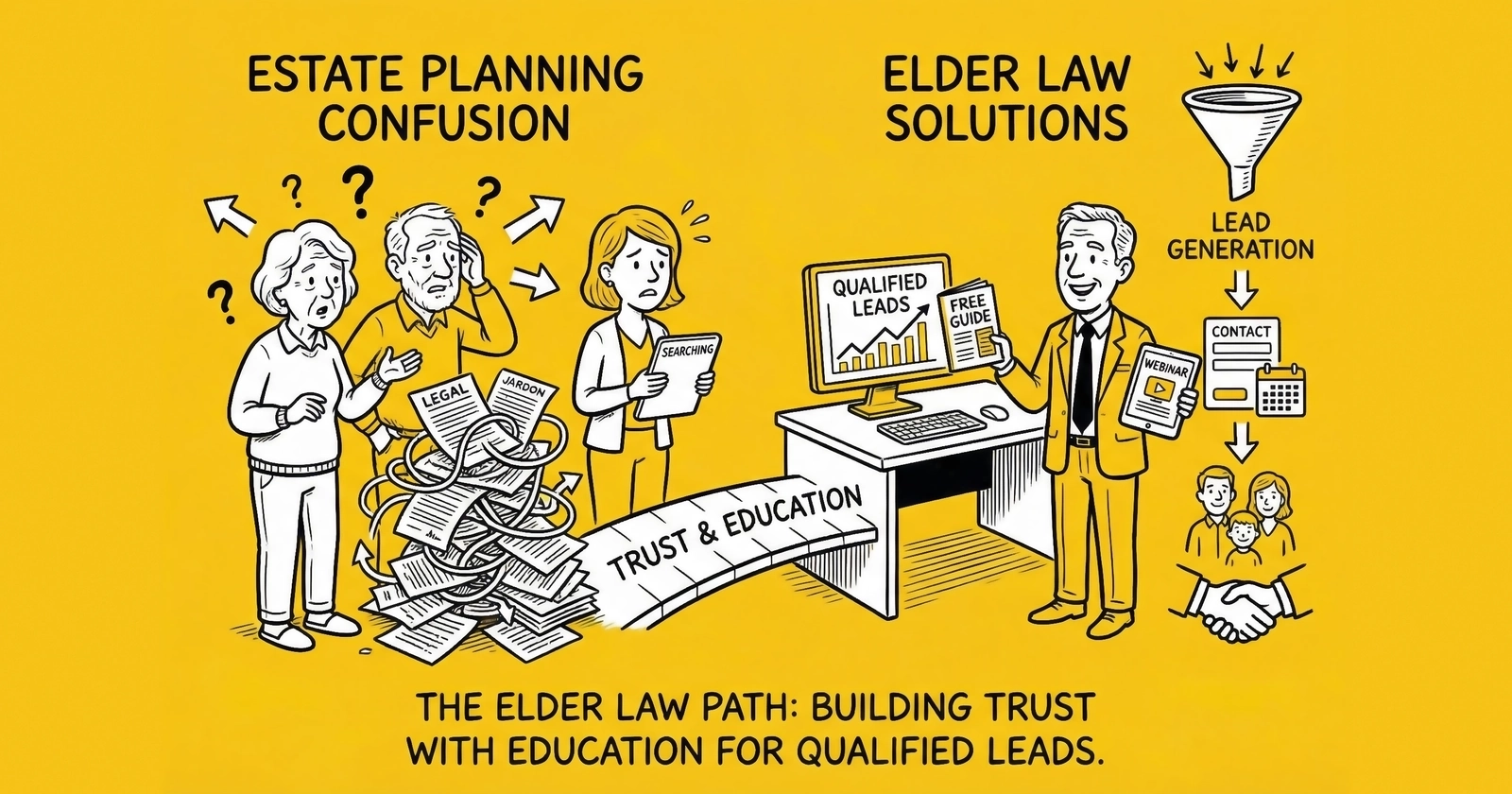
How elder law attorneys acquire estate planning clients, the economics behind CPLs ranging from $75-400, qualification frameworks for high-value cases, and operational strategies for building sustainable lead flow in a demographic boom.
A 68-year-old woman searches “do I need a trust or just a will” on her tablet while her husband naps in the next room. That search query, combined with her demographic profile, location in a high-net-worth ZIP code, and time of day, makes her digital intent worth $150-300 to estate planning attorneys competing for her attention.
This is estate planning lead generation – a vertical experiencing unprecedented demand growth as 73 million Baby Boomers navigate retirement, healthcare directives, and the largest intergenerational wealth transfer in American history. An estimated $84 trillion will pass from older generations to their heirs between 2021 and 2045, according to Cerulli Associates. That wealth movement creates sustained demand for estate planning services that no other demographic shift can match.
Elder law and estate planning lead generation operates differently than high-volume verticals like insurance or home services. The client relationships are deeper, the case values are higher, and the trust requirements are more demanding. A senior considering asset protection planning or Medicaid eligibility is not shopping for the cheapest provider. They are seeking guidance on decisions that affect their family’s financial future for generations.
Understanding these dynamics is essential for lead generators entering this space. The audience is older, often less digitally sophisticated, and highly skeptical of aggressive marketing. The attorneys buying these leads practice in areas requiring specialized knowledge – Medicaid planning, trust administration, guardianship proceedings – and they expect leads that match their expertise. The compliance requirements blend legal advertising ethics with elder abuse prevention regulations that carry significant penalties for violations.
This guide covers the complete landscape of estate planning lead generation for elder law firms – the market opportunity driving current growth, the economics that determine sustainable CPLs, the qualification frameworks that separate valuable leads from tire-kickers, and the operational approaches that build profitable, ethical operations in this space.
The Demographic Opportunity: Why Estate Planning Lead Generation Matters Now
The estate planning lead generation market is experiencing demand growth driven by demographic forces that will persist for decades. Understanding these underlying trends explains why sophisticated lead generators are building capabilities in this vertical.
The Baby Boomer Wealth Transfer
The statistics frame the opportunity:
| Demographic Factor | Impact |
|---|---|
| Baby Boomer population | 73 million Americans |
| Age range (2025) | 61-79 years old |
| Projected wealth transfer | $84 trillion through 2045 |
| Peak estate planning years | 2025-2040 |
| Percentage with estate plans | Only 32% have wills |
The Cerulli Associates research on wealth transfer reveals that approximately $72.6 trillion will flow from households during the next 25 years. This is not a temporary market condition. It is a multi-decade demographic certainty that creates sustained demand for estate planning services.
The timing concentration matters for lead generators. The heaviest wealth transfer activity occurs when estate owners reach ages 65-80 – the period when health concerns, retirement transitions, and family events trigger planning urgency. That window opened for the largest Baby Boomer cohorts around 2020 and will remain open through the mid-2040s.
The Estate Planning Gap
Despite the wealth involved, estate planning completion rates remain remarkably low:
| Planning Status | Percentage |
|---|---|
| Americans with any will | 32% |
| Americans with comprehensive estate plan | 18% |
| Parents with minor children without wills | 64% |
| High-net-worth households without updated plans | 45% |
| Adults who have discussed end-of-life plans | 27% |
These statistics represent both opportunity and challenge. The opportunity: massive unmet demand for services. The challenge: consumers procrastinate on estate planning until triggering events force action. Lead generation strategies must account for this reality by targeting consumers during moments when planning urgency peaks.
Triggering Events That Create Lead Demand
Estate planning leads convert when consumers experience events that overcome natural procrastination. These triggers fall into three categories, each creating different urgency levels and planning needs.
Life Events
Family transitions drive the majority of estate planning inquiries. The birth or adoption of children or grandchildren prompts parents to establish guardianship provisions and inheritance structures. Marriage or remarriage – especially second marriages involving blended families with competing inheritance expectations – creates immediate planning complexity. Divorce finalization requires updating beneficiary designations and revising existing plans. The death of a spouse, parent, or close friend often serves as the most powerful motivator, confronting survivors with their own mortality and planning gaps. Major health diagnoses accelerate timelines that might otherwise stretch indefinitely. Retirement from employment marks a psychological transition point where people begin thinking seriously about legacy planning.
Financial Events
Significant financial changes create both planning needs and planning capacity. The sale of a business or major asset introduces capital gains considerations and asset protection questions. Receiving an inheritance prompts beneficiaries to consider how they will eventually pass that wealth forward. Real estate transactions, particularly the purchase of vacation properties or investment real estate, complicate estate structures. Retirement account distribution planning forces engagement with tax-advantaged transfer strategies. Any period of significant asset accumulation – whether from investment gains, business success, or property appreciation – elevates the stakes of proper planning.
External Triggers
Events beyond individual circumstances also drive demand. Tax law changes, particularly modifications to estate tax exemptions, generate waves of planning activity as consumers and their advisors reassess strategies. Media coverage of celebrity estate disputes – from Prince to Aretha Franklin – raises public awareness about the consequences of inadequate planning. The COVID-19 pandemic drove unprecedented planning interest as mortality risk became suddenly tangible for millions. Family conflicts over aging parent care often reveal the absence of healthcare directives and financial powers of attorney.
Lead generation campaigns targeting these triggering moments outperform general awareness campaigns by 3-5x in conversion rates. A consumer who just received an inheritance is fundamentally different from someone vaguely aware they “should probably do something about their will.”
Understanding the Elder Law Practice Areas
Elder law encompasses multiple practice areas with different economics, client needs, and lead generation approaches. Effective lead generation requires matching leads to the appropriate practice area and understanding the case economics that determine sustainable CPLs.
Estate Planning Core Services
Estate planning services exist along a complexity spectrum, and understanding where each service type falls determines appropriate CPL expectations and buyer targeting.
Basic Estate Planning
The foundational tier includes simple wills, power of attorney documents, healthcare directives, and beneficiary designations. These document packages typically command fees of $500-$2,500, which limits sustainable CPLs to the $50-100 range. The typical client is a middle-income household with a straightforward family situation – married couple with children, clear asset distribution wishes, no complex business interests or blended family dynamics.
Comprehensive Estate Planning
The middle tier centers on revocable living trusts supplemented by pour-over wills, asset protection planning, and tax planning strategies. Trust-based plans generate fees of $2,500-$10,000, supporting CPLs in the $100-250 range. Clients at this level are upper-middle to high-net-worth households with more complex asset structures – multiple real estate holdings, significant retirement accounts, small business interests, or family situations requiring more sophisticated distribution planning.
Advanced Estate Planning
The premium tier involves irrevocable trusts, charitable planning vehicles, business succession planning, and family limited partnerships. These engagements generate fees from $10,000 to $50,000 or more, supporting CPLs of $200-400+. Clients are high-net-worth individuals and business owners requiring multi-generational planning strategies that address estate tax exposure, business continuity, and philanthropic objectives.
Medicaid Planning and Long-Term Care
Medicaid planning represents a specialized niche within elder law with unique economics and urgency factors. The practice divides into two distinct scenarios that create very different lead dynamics.
Crisis Medicaid Planning
Crisis planning occurs when a family member needs nursing home care immediately and assets must be protected or restructured to qualify for Medicaid coverage. These engagements command fees of $3,000-$15,000 depending on complexity, and the high urgency supports CPLs of $150-350. The typical client is an adult child suddenly managing an aging parent’s finances, often with moderate assets at risk of being consumed by care costs. Time sensitivity is extremely high – nursing home costs of $8,000-15,000 monthly create immediate urgency that compresses decision timelines from months to days.
Pre-Planning Medicaid Strategies
Pre-planning serves clients working 5+ years in advance to structure assets before potential nursing home needs arise. Fee ranges of $2,500-$10,000 support CPLs of $75-200 – lower than crisis cases because urgency is reduced. The typical client is a healthy retiree concerned about future care costs but not facing immediate need. Time sensitivity is moderate; Medicaid look-back periods require advance planning, but the absence of immediate crisis allows for more deliberate decision-making.
Guardianship and Conservatorship
When individuals can no longer manage their own affairs, courts appoint guardians or conservators. These cases typically involve contested family situations where siblings disagree about a parent’s care, adult children seeking legal authority over aging parents who resist giving up control, or state-initiated proceedings for vulnerable adults lacking family advocates.
Fee ranges are highly variable, running from $3,000 for uncontested proceedings to $25,000 or more when family conflicts require litigation. This variability makes CPL economics complex, but qualified leads typically support $100-300 pricing. The client profile spans adult children, social workers, and healthcare facilities – each approaching the need from different angles. Time sensitivity is often high because guardianship needs typically emerge from health crises that demand rapid response.
Trust Administration and Probate
Post-death services encompass trust administration for assets held in trust, probate proceedings for assets passing through wills, will contests when beneficiaries dispute validity or interpretation, and estate litigation when conflicts require court resolution.
Fee structures often differ from planning services – attorneys frequently charge percentage-based fees of 2-5% of estate value or hourly rates rather than flat fees. High case values support CPLs of $150-400 for qualified leads. The typical client is a surviving spouse or adult child serving as executor or trustee, suddenly responsible for legal processes they have never navigated. Time sensitivity is moderate; death triggers the need, but probate timelines typically allow for deliberation in selecting counsel.
CPL Benchmarks and Lead Economics
Understanding current market pricing enables realistic budget planning and sustainable business model development. These benchmarks reflect 2024-2025 market conditions across the estate planning and elder law vertical.
Lead Type Pricing
| Lead Type | CPL Range | Key Characteristics |
|---|---|---|
| Basic estate planning | $50-$100 | Simple document needs, price-sensitive |
| Trust-based planning | $100-$200 | Asset protection focus, middle-market |
| High-net-worth estate | $200-$400 | Complex planning, significant assets |
| Medicaid crisis | $150-$350 | Urgent timing, nursing home trigger |
| Medicaid pre-planning | $75-$175 | Lower urgency, health-focused |
| Probate/administration | $125-$300 | Death-triggered, executor-focused |
| Guardianship | $100-$250 | Family crisis situations |
| Live transfer | $200-$500+ | Real-time phone connection |
Geographic Variation
Estate planning CPLs vary significantly by market, reflecting both competition levels and average case values.
Premium markets run 25-50% above national average pricing. New York City metro, San Francisco Bay Area, Los Angeles, Miami, Boston, Washington DC metro, and Chicago all command premium CPLs driven by higher attorney density, elevated case values reflecting regional wealth, and intense competition for qualified leads.
Standard markets – most suburban areas, mid-size metros like Phoenix, Dallas, Atlanta, and Denver, plus state capitals with professional populations – cluster around national average pricing. These markets balance sufficient demand against manageable competition.
Value markets run 20-40% below national average. Rural areas, lower-cost-of-living states, and markets with fewer elder law specialists offer lower CPLs but also present distribution challenges. Finding qualified buyer attorneys in underserved markets can be difficult, though the reduced competition creates opportunities for generators willing to develop those relationships.
The Math That Determines Sustainable CPLs
Estate planning attorneys evaluate lead costs against case economics. Here is how the calculation works:
Example: Trust-Based Estate Planning Practice
| Metric | Value |
|---|---|
| Average case fee | $4,500 |
| Target marketing cost (20% of revenue) | $900 |
| Lead-to-consultation conversion | 60% |
| Consultation-to-client conversion | 50% |
| Overall lead-to-client conversion | 30% |
| Maximum sustainable CPL | $270 |
At 30% conversion, an attorney can pay up to $270 per lead while staying within marketing budget targets. Higher conversion rates support higher CPLs; lower conversion rates require lower lead costs.
Example: Medicaid Crisis Planning
| Metric | Value |
|---|---|
| Average case fee | $7,500 |
| Target marketing cost (25% of revenue) | $1,875 |
| Lead-to-consultation conversion | 70% |
| Consultation-to-client conversion | 60% |
| Overall lead-to-client conversion | 42% |
| Maximum sustainable CPL | $446 |
The higher urgency of Medicaid crisis situations produces better conversion rates, supporting premium CPLs despite the emotional difficulty of these cases.
Lead Generation Channels for Estate Planning
Estate planning lead generation requires channel strategies calibrated to an older demographic with different digital behaviors than younger consumer segments.
Search Marketing: The Foundation
Search marketing captures consumers actively seeking estate planning services. Google Ads remains the primary channel for high-intent lead capture.
Keyword Strategy
| Keyword Category | Example Keywords | Intent Level | CPCs |
|---|---|---|---|
| Service + Location | ”estate planning attorney Phoenix” | Very High | $15-45 |
| Specific Document | ”living trust lawyer” | High | $12-35 |
| Problem-Based | ”protect assets from nursing home” | High | $10-30 |
| Question-Based | ”do I need a trust or will” | Medium | $8-20 |
| General | ”estate planning” | Low | $5-15 |
Campaign Structure
Effective campaign architecture separates campaigns by service type – estate planning, Medicaid, probate – to enable distinct bidding strategies and messaging. Geographic targeting should align precisely with attorney service areas; leads outside practice jurisdictions are worthless. Device bid adjustments deserve attention because tablets convert particularly well for this demographic. Time-of-day adjustments should favor daytime hours when seniors are more likely to research and convert. Age demographic targeting should prioritize 55+ as the primary audience with 45-54 as secondary.
Landing Page Requirements
Estate planning landing pages must address unique audience concerns. Professional credibility signals – bar memberships, relevant certifications, specialized training – establish expertise in ways this audience respects. Trust indicators including reviews, testimonials, and years of experience reduce the skepticism inherent in engaging legal services. Clear explanation of services without legal jargon helps consumers understand what they are buying. Contact options should make phone prominent and forms simple; many seniors prefer calling. Accessibility considerations – larger fonts, clear contrast, uncluttered layouts – accommodate vision changes common in older audiences. Mobile optimization matters because many seniors use tablets rather than desktop computers for research.
Content Marketing and SEO
Content marketing builds long-term organic traffic by answering estate planning questions that trigger initial research. The most valuable topics address fundamental decisions and common concerns: “Will vs. Trust: Which Do I Need?” captures consumers at the earliest planning stage. “How to Protect Assets from Nursing Home Costs” attracts Medicaid planning prospects. “Estate Planning Checklist for Seniors” serves those ready to act but unsure where to start. “What Happens If You Die Without a Will” leverages fear of intestacy consequences. “Power of Attorney vs. Guardianship Explained” reaches families navigating incapacity issues. “How the Estate Tax Exemption Works” attracts higher-net-worth planners. “Medicaid Look-Back Period Rules by State” captures pre-planners researching timing strategies.
This audience prefers longer, more comprehensive content. Short blog posts underperform compared to thorough guides that answer complete questions. Video content works well but requires professional production – this audience responds poorly to casual or overly informal video styles. The investment in quality production pays dividends in trust and conversion rates.
Social Media: Platform Selection Matters
Social media advertising for estate planning requires platform selection based on demographic presence.
Facebook stands as the primary social platform for reaching 55+ demographics. The platform offers detailed age and interest targeting that other channels cannot match, life event targeting for moments like becoming a new grandparent or recently retiring, lookalike audiences built from existing client data, and lead form ads that simplify conversion by eliminating the need to navigate to external landing pages.
YouTube reaches consumers researching estate planning topics through pre-roll and in-stream video advertising. Educational content advertising – not direct response – builds awareness effectively by positioning attorneys as knowledgeable guides rather than salespeople.
LinkedIn proves effective for reaching business owners considering succession planning and high-net-worth professionals approaching retirement. The professional context aligns well with sophisticated planning discussions.
Instagram, TikTok, and Snapchat have minimal presence in target demographics for estate planning. Advertising spend on these platforms is generally wasted – the audience simply is not there in meaningful numbers.
Referral and Partner Channels
Estate planning leads often originate through professional referral networks, and building these relationships produces leads with higher conversion rates and lower acquisition costs than paid advertising.
Financial advisors represent the most valuable referral source. Wealth managers and financial planners identify clients needing estate planning during routine financial reviews – conversations about retirement income naturally lead to questions about asset transfer. Lead sharing arrangements or referral fees, where state rules permit, create consistent lead flow from advisors who regularly encounter planning needs.
CPAs and tax professionals see planning gaps that clients themselves may not recognize. Tax preparation reveals beneficiary designation problems, assets held in inefficient structures, and families facing estate tax exposure. Many CPAs refer clients needing planning beyond tax strategy, creating a steady stream of qualified prospects.
Senior living communities – assisted living facilities and continuing care retirement communities – often connect residents with estate planning resources. New residents frequently arrive without updated plans, and the transition prompts families to address planning gaps they had previously ignored.
Healthcare systems provide crisis-driven referrals. Hospital discharge planners and geriatric care managers encounter families needing Medicaid planning during health emergencies. These leads convert quickly because urgency is immediate.
Funeral homes connect families settling estates with probate services and trust administration help. The timing is sensitive but the need is clear, and families often welcome guidance during difficult transitions.
Direct Mail: Not Dead for This Demographic
Direct mail remains viable for estate planning lead generation despite its decline in other verticals. The target demographic still responds to physical mail at rates significantly higher than younger audiences.
The most effective direct mail approaches leverage education rather than hard selling. Seminar invitations offering free educational workshops draw prospects who want to learn before committing. Asset protection guides and planning checklists provide tangible value that recipients keep rather than discard. Life event triggered mailings – targeting new homeowners aged 55+, recent retirees, or those who recently purchased long-term care insurance – arrive when planning relevance peaks. Existing client referral programs turn satisfied clients into lead sources through structured incentive programs.
Estate planning direct mail typically achieves 0.5-1.5% response rates – significantly higher than the 0.1-0.3% typical for general consumer direct mail. Combined with lower mailing costs for targeted lists, the channel can be cost-effective despite appearing antiquated to those focused exclusively on digital channels.
Lead Qualification Frameworks
Estate planning leads require qualification approaches that identify case fit, urgency level, and client readiness to engage. Proper qualification reduces attorney time spent on unqualified consultations and improves lead monetization.
Essential Qualification Data Points
Thorough qualification requires collecting information across five categories, each contributing to lead scoring and buyer matching.
Demographic Information
Core demographics establish baseline fit. Age of the primary decision maker determines which service tiers are most relevant. Marital status – single, married, widowed, or divorced – affects planning complexity and indicates whether both spouses need to participate in consultations. Children and grandchildren, including their ages, shape inheritance planning discussions. State of residence determines jurisdiction for planning and ensures geographic match with buyer attorneys.
Financial Indicators
Financial qualification determines case value potential. Approximate asset range – under $500K, $500K-$2M, $2M-$5M, or $5M+ – using ranges rather than specific numbers reduces form abandonment while providing sufficient qualification data. Real estate ownership indicates assets requiring trust structures. Business ownership signals succession planning needs. Retirement account holdings and life insurance policies reveal assets that pass outside wills and require beneficiary designation review.
Current Planning Status
Existing planning documents indicate both need and competitor presence. Whether the prospect has an existing will or trust, and the age of those documents, determines whether this is new planning or update work. Power of attorney documents and healthcare directives already in place suggest some level of prior engagement. When documents were last reviewed – recently, years ago, or never – indicates urgency and awareness of updating needs.
Triggering Circumstances
Recent triggering events create the urgency that drives conversion. Life events including health changes, death in the family, or births motivate action. Specific concerns – asset protection, tax planning, care planning – indicate service type matching. Timeline for completion distinguishes urgent needs from advance planning, affecting both CPL value and buyer matching.
Consultation Readiness
Logistical factors determine practical convertibility. Preferred contact method ensures outreach matches preferences. Best times to reach reduce wasted contact attempts. Who will participate in the consultation – whether both spouses, adult children, or the decision maker alone – affects scheduling and sets consultation expectations.
Lead Scoring Model
Assign point values to qualification factors to prioritize lead distribution:
| Factor | High Value (3 pts) | Medium Value (2 pts) | Low Value (1 pt) |
|---|---|---|---|
| Assets | $2M+ | $500K-$2M | Under $500K |
| Age | 65-80 | 55-64 or 80+ | Under 55 |
| Urgency | Immediate need | 1-3 months | Just researching |
| Existing plan | None or 10+ years old | 5-10 years old | Recently updated |
| Decision maker | Both spouses ready | Single or one spouse | Adult child inquiring |
| Trigger event | Health crisis, recent death | Retirement, inheritance | General planning |
Scores of 15-18 points indicate premium leads warranting immediate distribution at the highest CPL tier – these prospects combine high assets, optimal age, urgent need, and decision-maker readiness. Scores of 11-14 points represent qualified leads suitable for standard distribution. Scores of 7-10 points identify nurture leads that may convert with sustained follow-up but are not ready for immediate attorney engagement. Scores under 7 points indicate low-priority prospects likely not ready to engage – these may enter long-term nurture sequences but should not consume immediate distribution capacity.
Disqualifying Factors
Screen for these factors to reduce returns and improve buyer satisfaction.
Hard Disqualifiers
Certain factors should eliminate leads from distribution entirely. Prospects already working with an attorney on this matter represent duplicate outreach that wastes buyer time. Those located outside attorney service areas cannot become clients regardless of qualification. Consumers looking for free legal advice only – seeking document templates or DIY guidance rather than professional services – will not convert to paying clients. Prospects with no assets requiring planning, such as renters with no savings, lack the economic basis for engagement. Inquiries from attorneys or competitors represent research or competitive intelligence rather than genuine client need.
Soft Disqualifiers
Other factors reduce lead value without necessarily eliminating distribution potential. Adult children inquiring without parent involvement may be researching on behalf of resistant parents – valuable if parents can be engaged, worthless if they cannot. Timelines longer than 6 months indicate low urgency that reduces conversion likelihood. Price as the primary consideration suggests prospects unsuitable for attorneys focused on comprehensive planning. Recent negative experience with another attorney may indicate unrealistic expectations or difficult client behavior. Complex family conflict situations can become profitable litigation cases but may also signal prospects seeking validation rather than legal services.
Compliance Considerations for Elder Law Lead Generation
Estate planning lead generation operates within ethical frameworks governing attorney advertising plus additional regulations protecting vulnerable senior populations.
Attorney Advertising Rules
State bar rules govern attorney advertising with requirements similar to other legal lead generation.
Model Rule 7.1 requires that all advertising be truthful and not misleading. Claims about outcomes, experience, or capabilities require substantiation. Testimonials require appropriate disclaimers clarifying that results vary by case. Lead generators must ensure that advertising copy, landing pages, and qualification scripts avoid impermissible claims.
Model Rule 7.2 permits attorney advertising through public media and electronic communications. Lead generators operate within this framework when creating advertising for attorney clients, but the attorney remains responsible for ensuring compliance with applicable state variations.
Model Rule 7.3 restricts direct solicitation of known prospective clients through live contact. This affects how lead generators can reach identified individuals – advertising to audiences is permitted, but targeting specific identified individuals known to need services may constitute prohibited solicitation. The distinction between advertising and solicitation matters particularly for retargeting campaigns and personalized outreach sequences.
Elder Abuse and Financial Exploitation Laws
Lead generation targeting seniors carries additional compliance considerations under elder abuse prevention laws.
Prohibited practices include using scare tactics or pressure to force immediate decisions, misrepresenting urgency of legal situations, targeting seniors based on vulnerability indicators such as cognitive decline or isolation, and sharing lead data with parties who may exploit seniors. Violations can trigger state elder abuse statutes, consumer protection enforcement, and civil liability.
Best practices require avoiding pressure language such as “act now or lose everything,” providing accurate information about planning timelines, including family members in communication when appropriate, and documenting consent and communication carefully. The line between effective urgency messaging and exploitative pressure requires constant attention – what works for younger demographics may cross legal lines when targeting seniors.
TCPA Compliance
Standard TCPA requirements apply, with additional considerations for this demographic.
Prior Express Written Consent is required for autodialed calls, prerecorded messages, and text messages to cell phones. Consent language must clearly identify the specific parties who may call. The one-to-one consent requirements under the 2024 FCC ruling make consent hygiene particularly important – leads generated for one attorney cannot be sold to another without fresh consent. For more on TCPA requirements, see our TCPA compliance guide.
Several senior-specific considerations merit attention. Many seniors still use landlines, which receive different TCPA treatment than mobile phones – autodialed calls to landlines do not require prior express consent. However, consent language for mobile contact must be readable and understandable by this audience; avoid fine print and ensure font sizes accommodate aging eyes. Easy opt-out mechanisms are essential, and all consent must be documented with timestamps for potential regulatory review.
Calling hours under most state laws restrict contact to 8 AM - 9 PM local time. Consider narrower windows for this demographic – many seniors prefer daytime calls and may find evening calls intrusive or alarming. Morning and early afternoon contact attempts typically produce better results than late afternoon or evening outreach.
Data Privacy
Estate planning leads contain sensitive financial information requiring careful handling. Financial data including asset levels and account information, health information when Medicaid planning is involved, family structure details, and contact information for vulnerable populations all require protection beyond standard lead data practices.
Implement appropriate data security measures – encryption at rest and in transit, access controls limiting who can view lead details, and retention policies that delete data after appropriate periods. Buyer agreements should specify acceptable use of lead information, prohibit resale or sharing beyond intended use, and require similar security standards from attorney buyers. The combination of financial sensitivity and vulnerable population status makes data protection particularly important in this vertical.
Working with Estate Planning Attorneys
Building sustainable buyer relationships requires understanding what estate planning attorneys need and how they evaluate lead sources.
What Estate Planning Attorneys Want
Estate planning attorneys prioritize lead quality above volume. Geographic match comes first – clients must be in their licensed and practicing jurisdictions, and leads outside service areas are worthless regardless of other qualifications. Service alignment matters because not all elder law attorneys handle all services; a Medicaid planning specialist may have no interest in basic will preparation leads. Asset qualification thresholds vary by practice – some focus exclusively on high-net-worth clients while others serve the middle market, and leads must match the practice’s target client profile. Readiness to engage distinguishes leads who will schedule and attend consultations from those merely gathering information. Compliance documentation including consent records and advertising archives must be available to address potential bar inquiries.
Operationally, estate planning attorneys strongly prefer exclusive leads because shared leads underperform significantly in conversion. They expect real-time or near-real-time delivery to enable rapid response. Complete contact and qualification information reduces time spent on discovery during initial outreach. The ability to set geographic and demographic filters ensures leads match practice parameters. Responsive support when quality issues arise builds long-term relationship trust.
Buyer Types and Their Needs
Different buyer types have distinct capacity and quality requirements that affect distribution strategy.
Solo and Small Firm Practitioners
Solo attorneys and small firms have limited lead volume capacity, typically 20-50 leads monthly before intake becomes overwhelming. They are price-sensitive but quality-focused – each lead represents significant time investment, so poor quality creates immediate pain. They require pre-qualified leads to minimize consultation time because the attorney handles intake personally. Many are geographic specialists serving specific communities. Practice area focus may be narrow, handling only certain service types within elder law.
Mid-Size Elder Law Firms
Mid-size firms offer higher volume capacity of 50-200 leads monthly and can absorb leads across service types because they employ multiple attorneys with different specialties. Intake processes are more sophisticated, often involving dedicated intake staff or paralegals. Some operate across multiple office locations, expanding geographic coverage. These firms provide more stable relationships with consistent volume needs.
Estate Planning Departments in Large Firms
Large firm estate planning departments have significant volume capacity and sophisticated lead evaluation processes. They often focus on high-net-worth clients only, setting asset minimums that exclude middle-market leads. Dedicated intake staff handle lead processing. Payment terms may be longer – net 30 or net 45 – but payment is reliable. These buyers are selective but valuable for premium leads.
Legal Service Organizations
Legal service organizations including prepaid legal plans and legal aid adjacent services offer high volume capacity and consistent demand. They often serve moderate-income clients, accepting leads that higher-end practices reject. CPL tolerance is lower, but volume and consistency compensate. Some have specific demographic requirements based on their service model. Many operate across multiple states, providing broad geographic coverage for lead distribution.
Building Your Distribution Network
Effective distribution combines multiple buyer types into a tiered structure that maximizes lead value while ensuring coverage across geographies and lead types.
Primary distribution should consume 50-60% of volume through direct relationships with 8-15 qualified elder law attorneys. These partners provide consistent demand, quality feedback, and relationship stability. They receive your best leads – highest qualification scores, strongest geographic matches, most urgent needs. The depth of these relationships determines overall operation quality.
Secondary distribution handles 25-35% of volume through relationships with larger firms and legal service organizations. These buyers absorb additional volume across broader geographic areas, taking leads that do not match primary partner parameters but still meet quality standards.
Overflow distribution captures 10-20% of volume through aged lead buyers and secondary market relationships. Understanding the economics of exclusive vs. shared leads helps optimize your distribution strategy. Leads that do not fit primary or secondary distribution – geographic orphans, lower qualification scores, extended timelines – can still generate revenue through appropriate channels rather than being discarded.
Operational Best Practices
Sustainable estate planning lead generation requires operational approaches calibrated to this demographic’s expectations and behaviors.
Form Design for Seniors
Lead capture forms for estate planning audiences require specific design considerations that differ from general consumer forms.
Accessibility Requirements
Senior-friendly forms must accommodate age-related changes in vision and dexterity. Use minimum 16px font size, with 18px preferred for body text. High contrast color schemes – dark text on light backgrounds – ensure readability. Clear labels and instructions eliminate guesswork about what each field requires. Large click/tap targets of at least 44x44 pixels prevent frustrating mis-taps. Simple, uncluttered layouts reduce cognitive load and help users focus on completing the form.
Form Length Optimization
This audience tolerates longer forms better than younger demographics, making multi-step forms particularly effective. Each step feels manageable rather than overwhelming. Progress indicators provide satisfaction and motivation to continue. Qualification happens naturally through the flow of questions. Dropoff at later stages indicates lower intent, serving as a natural filter that improves lead quality.
Field Recommendations
Essential fields include name and contact information, state and ZIP code for jurisdiction matching, age range for demographic qualification, current planning status, primary planning concern, approximate asset range using ranges rather than specific numbers, preferred contact method and time, and how they heard about the service. This combination captures qualification data while respecting privacy and avoiding abandonment from overly intrusive questions.
Response Time Considerations
Estate planning leads have different speed-to-contact dynamics than emergency services, but response time still matters significantly.
Response within 15 minutes produces premium conversion rates – leads are still engaged, remember submitting the form, and have not yet moved on to other activities or competitors. The five-minute rule applies to legal leads just as strongly as other verticals. Response within 15-60 minutes achieves good conversion rates, catching most prospects while interest remains fresh. Response within 1-4 hours is acceptable for non-urgent matters but shows some conversion decline. Same-day response represents the minimum standard that maintains any reasonable conversion expectation. Next-day response produces significant conversion decline as prospects have cooled, forgotten details, or engaged with competitors.
Many seniors in this demographic prefer phone calls to text messages or emails. Lead delivery should enable rapid phone contact as the primary response method, with email and text serving as backup channels for those who do not answer initial calls.
Timing considerations for contact attempts matter. Weekday business hours produce highest contact rates – seniors are awake, alert, and not engaged with evening family activities. Early morning and late evening calls should be avoided; what feels like convenient evening outreach to a working-age intake team may feel intrusive to a retired prospect. Weekend calls are acceptable for urgent matters like Medicaid crisis planning. National operations should consider time zone matching to ensure calls arrive during appropriate local hours.
Lead Nurturing for Long Sales Cycles
Estate planning decisions often take weeks or months from initial inquiry to engagement. Lead nurturing maintains connection during deliberation and captures value from leads not ready for immediate conversion.
Effective nurturing approaches provide value rather than simply asking for engagement. Educational email sequences delivering planning guides and checklists position the sending attorney as helpful and knowledgeable. Reminder communications about consultation availability keep the option visible without pressure. Information about relevant legal changes – new estate tax rules, Medicaid policy updates – demonstrates ongoing expertise. Testimonials and success stories from clients in similar situations build confidence. Invitations to educational seminars or webinars provide low-commitment engagement opportunities that can advance prospects toward consultation.
The nurturing timeline should match estate planning decision rhythms. Days 1-7 focus on active follow-up attempts with multiple contact methods. Days 8-30 shift to regular educational content that maintains presence without pressure. Days 31-90 reduce to monthly touchpoints that stay visible without overwhelming. Days 91 and beyond move to quarterly reengagement campaigns for leads that have gone dormant.
Leads that do not convert immediately often convert months later when triggering events occur or when they complete their decision-making process. A lead submitted in January may become a client in October after a health scare or a conversation with a friend about their own planning experience. Nurturing maintains the connection until readiness arrives.
Frequently Asked Questions
1. What is the average cost per lead for estate planning attorneys?
Estate planning leads range from $50 to $400 depending on lead type, qualification level, and geographic market. Basic estate planning leads (simple wills and documents) typically cost $50-$100. Trust-based planning leads cost $100-$200. High-net-worth estate planning leads command $200-$400. Medicaid crisis planning leads, due to their urgency, often price at $150-$350. Live transfer leads where consumers are connected by phone in real-time can exceed $300-$500. These prices reflect 2024-2025 market conditions and vary significantly by metropolitan area and competition level.
2. Why is the Baby Boomer generation creating a boom in estate planning lead demand?
The 73 million Baby Boomers (born 1946-1964) are entering their peak estate planning years (ages 65-80) simultaneously. This generation controls an unprecedented $84 trillion in assets that will transfer to heirs over the next two decades according to Cerulli Associates research. The combination of demographic size, wealth concentration, and age-related triggering events (health changes, retirement, deaths of peers) creates sustained demand growth that will continue through the 2040s. Additionally, only 32% of Americans have wills, meaning the majority of this generation still needs planning services.
3. How do I generate leads for Medicaid planning services?
Medicaid planning leads come from two primary sources: crisis situations and pre-planning. Crisis leads originate when families face immediate nursing home placement – these consumers search terms like “protect assets from nursing home” or “Medicaid planning attorney.” Pre-planning leads come from healthier seniors concerned about future care costs. Crisis leads convert faster (days, not weeks) and tolerate higher CPLs due to urgency, while pre-planning leads have longer sales cycles but lower competition. Search marketing targeting Medicaid-specific keywords, content marketing addressing asset protection questions, and referral relationships with hospital discharge planners and senior care facilities are the most effective channels.
4. What information should estate planning lead forms collect?
Essential fields include: contact information with preferred method and time, state of residence for jurisdiction matching, age range, current planning status (has will, has trust, nothing), primary planning concern, approximate asset range using ranges rather than specific numbers, triggering event if any, and timeline for completing planning. Avoid requiring precise financial details – ranges work better and reduce form abandonment. Multi-step forms work well for this demographic because seniors tolerate longer forms and the progressive disclosure naturally qualifies leads while those who complete all steps demonstrate higher intent.
5. How do estate planning leads differ from personal injury or other legal leads?
Estate planning leads have longer sales cycles (weeks or months versus days), lower urgency in most cases, higher trust requirements, and different demographic targeting. Unlike personal injury where accidents create immediate need, estate planning often involves planned decisions with no external deadline. The target demographic (primarily 55+) has different digital behaviors, preferring phone calls over text, longer-form content over quick summaries, and professional presentation over casual approaches. CPLs are generally lower than personal injury ($50-$400 versus $200-$800) but case values and conversion economics still support profitable lead generation.
6. What makes a high-quality estate planning lead?
High-quality leads combine demographic fit, financial qualification, planning readiness, and accurate contact information. Ideal leads are 55-80 years old, own real estate or have $500K+ in assets, have no current estate plan or an outdated plan, are experiencing a triggering event creating urgency, have identified themselves as decision-makers (not adult children researching for parents without parent involvement), and have provided verified contact information with stated availability for consultation. Leads meeting all criteria command premium pricing and convert at rates justifying higher CPLs.
7. How should lead generators handle the compliance requirements for targeting seniors?
Compliance requires attention to both standard attorney advertising rules and elder protection regulations. For attorney advertising: ensure all claims are truthful and substantiated, maintain advertising archives, capture proper consent documentation. For elder protection: avoid scare tactics or false urgency, do not target based on vulnerability indicators, ensure marketing language is clear and not misleading, include family members in communication where appropriate. TCPA compliance includes obtaining proper consent for calls and texts, respecting calling hours, and providing clear opt-out mechanisms. Document all compliance processes to address regulatory inquiries.
8. What conversion rates should I expect for estate planning leads?
Industry benchmarks by stage: 50-65% contact rate (leads who answer calls or respond to messages), 40-55% consultation scheduling rate (contacted leads who schedule consultations), 55-70% consultation attendance rate, and 40-60% engagement rate (consultations that become clients). End-to-end lead-to-client conversion typically ranges from 12-25% for quality exclusive leads. Medicaid crisis leads convert faster and at higher rates (20-35% end-to-end) due to urgency. Pre-planning leads convert slower but can achieve similar rates with proper nurturing. Track conversion by lead source to identify your best performers.
9. What marketing channels work best for reaching estate planning prospects?
Search marketing (Google Ads) captures high-intent consumers actively researching planning services – this is the highest-converting channel. Content marketing and SEO build long-term organic traffic through educational content answering planning questions. Facebook advertising reaches the 55+ demographic with life event and interest targeting. Direct mail remains viable for this demographic with response rates of 0.5-1.5%, significantly higher than younger audiences. Referral relationships with financial advisors, CPAs, and senior care providers produce high-quality leads with strong conversion rates. YouTube advertising works for awareness building but requires professional production quality.
10. How do I build relationships with estate planning attorney buyers?
Start by understanding their practice focus – not all elder law attorneys handle all service types. Research their geographic coverage, typical case types, and client demographics. Approach with qualified sample leads demonstrating your quality standards. Offer exclusive arrangements with clear terms covering delivery method, return policies, and payment timing. Provide compliance documentation including consent records and advertising examples. Be responsive to quality feedback and adjust targeting based on conversion data. Build trust through consistent quality rather than volume promises. Most attorneys prefer fewer high-quality leads over higher volumes of unqualified leads. Long-term relationships are built on the performance of leads you send, measured by how many become paying clients.
Key Takeaways
-
Estate planning lead generation is experiencing unprecedented demand driven by 73 million Baby Boomers entering peak planning years. The $84 trillion wealth transfer through 2045 ensures sustained demand for decades.
-
CPLs range from $50-$400 depending on service type, with basic estate planning at $50-$100, trust-based planning at $100-$200, high-net-worth planning at $200-$400, and Medicaid crisis planning at $150-$350. Geographic markets and asset qualification significantly affect pricing.
-
Qualification is essential. High-value leads combine demographic fit (55-80 years old), financial qualification ($500K+ assets), planning readiness (no current plan or outdated documents), and triggering events creating urgency. Screen for disqualifiers early to reduce returns.
-
The target demographic requires different approaches. Seniors prefer phone calls over texts, longer educational content over quick summaries, professional presentation over casual approaches, and accessible form design with larger fonts and simple layouts.
-
Channel strategy must match demographic presence. Search marketing captures high-intent traffic. Facebook reaches 55+ audiences effectively. Direct mail remains viable. Referral relationships with financial advisors and healthcare providers produce high-converting leads.
-
Compliance combines attorney advertising rules with elder protection considerations. Avoid scare tactics or false urgency. Maintain advertising archives and consent documentation. Be especially careful with vulnerability targeting.
-
Lead nurturing matters because estate planning decisions take weeks or months. Educational email sequences, reminder communications, and reengagement campaigns convert leads who are not ready to engage immediately.
-
Build buyer relationships based on quality, not volume. Estate planning attorneys prefer fewer high-quality leads that convert to clients over higher volumes of unqualified inquiries that waste consultation time.
Conclusion
Estate planning lead generation offers a compelling opportunity for lead generators willing to understand its unique dynamics. The demographic fundamentals – 73 million Baby Boomers navigating the largest wealth transfer in history – ensure sustained demand growth through the 2040s. The economics work: case values from $2,500 to $50,000+ support CPLs that create profitable operations for generators who deliver quality.
But success requires calibration to this audience. The consumers are older, less digitally aggressive, and deeply skeptical of pressure tactics. They are making decisions that affect their families for generations, and they take those decisions seriously. The attorneys buying these leads practice specialized law requiring specific expertise, and they evaluate lead sources based on conversion to paying clients, not lead volume.
Those who succeed in this vertical build for the long term. They create accessible, professional marketing that respects the audience. They qualify leads thoroughly to match practice areas and asset levels. They nurture leads through longer decision cycles rather than demanding immediate conversion. They build relationships with attorney buyers based on consistent quality and responsive service.
The estate planning lead market rewards operators who respect its complexity and invest in understanding their audience. The demographic opportunity is real and sustained. The question is whether you are willing to build the operation that captures it appropriately.
Sources
- Federal Reserve Distributional Financial Accounts - Household wealth distribution data by age cohort supporting intergenerational wealth transfer statistics
- ACTEC (American College of Trust and Estate Counsel) - Professional organization establishing standards for trust and estate practitioners
- Medicare Long-Term Care Coverage - Medicare’s explanation of what long-term care services Medicare covers and doesn’t cover
- Medicaid Eligibility - Federal Medicaid eligibility guidelines and spend-down requirements relevant to asset protection planning
Pricing and compliance information current as of late 2025. State bar rules and elder protection regulations vary by jurisdiction. This article provides general information and does not constitute legal advice. Consult with attorneys specializing in advertising ethics and elder law for jurisdiction-specific guidance.