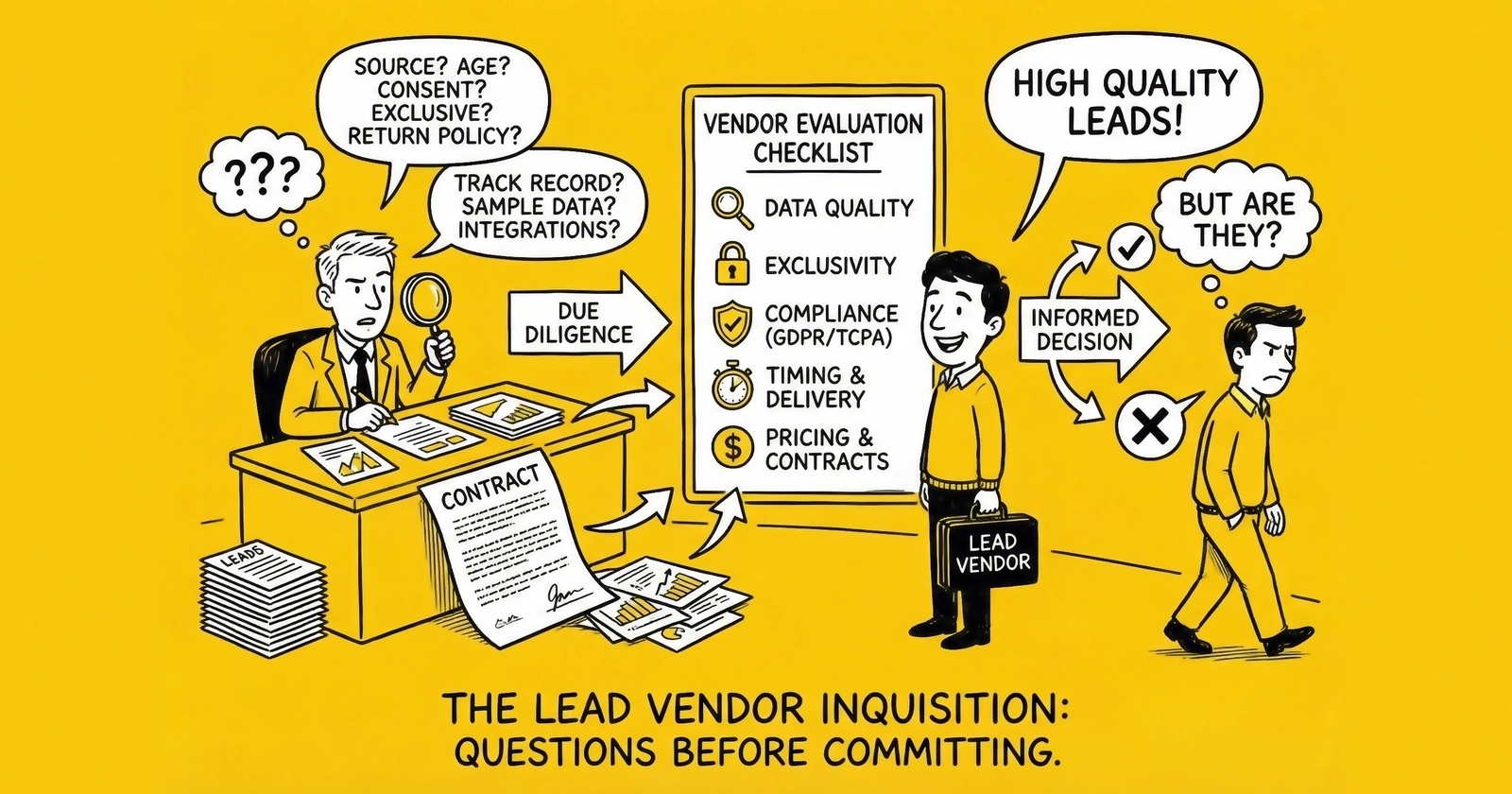
The due diligence framework that separates operators who build profitable lead programs from those who burn through capital wondering what went wrong.
The first time you buy leads from a vendor, you remember it. The sales call was convincing. The sample leads looked clean. The pricing seemed competitive. Then reality arrived: 30% of phone numbers disconnected, contact rates half what you projected, and a return dispute that consumed three weeks of operational attention. Your $15,000 test budget generated two customers.
This experience is so common in the lead generation industry that veterans have a name for it: “tuition.” The lesson costs money because most buyers don’t know what questions to ask before committing capital. They evaluate vendors the way they might evaluate other business services – checking references, comparing prices, trusting professional presentations. But lead generation operates differently. The product is intangible until you buy it, quality varies dramatically between sources even within the same vendor, and the consequences of poor selection include not just wasted budget but potential legal liability that can threaten your entire business.
The tuition doesn’t have to be expensive, though. The framework that follows comes from operators who have evaluated hundreds of vendors across insurance, mortgage, solar, legal, and home services verticals. These fifteen questions – and the follow-up probes that reveal whether answers are genuine – will help you identify quality vendors before your money is on the line. The questions fall into five categories: Lead Source and Quality, Compliance and Documentation, Pricing and Economics, Operations and Integration, and Relationship and Support. Each category addresses a different failure mode that can destroy your lead program economics. Miss any one of them, and you may find yourself among the operators who conclude that “leads don’t work” when the truth is that lead vendor selection didn’t work.
Category 1: Lead Source and Quality
Understanding where leads actually come from is the foundation of everything else. This sounds obvious, but most buyers never ask – and most vendors don’t volunteer the information. They talk about “high-intent consumers” and “qualified prospects” without explaining the mechanics of how someone becomes a lead in their system. The distinction matters enormously. A consumer who searched “auto insurance quotes” on Google and completed a detailed form demonstrates genuine purchase intent. A consumer who clicked a flashy banner ad promising a “$500 Walmart gift card” and checked a box to “receive offers from partners” demonstrates something else entirely. Both might arrive in your CRM looking identical, but their likelihood of becoming customers differs by an order of magnitude.
The first question you need to ask any vendor is this: “Walk me through exactly how a consumer becomes a lead in your system. What traffic sources do you use? What does the consumer see? How do they express intent?” Vendors who aggregate from multiple publishers – which is common in the industry – may not even know where individual leads originate, and that’s a significant red flag. Quality control becomes impossible when you can’t trace leads to sources. When you push on this question, ask follow-ups about what percentage of leads come from organic search versus paid advertising versus affiliate networks, whether they can show you sample landing pages that consumers interact with, and whether they own their traffic sources or aggregate from third-party publishers. A quality vendor can walk you through their consumer journey with specifics – which platforms they advertise on, what their landing pages look like, how many form fields consumers complete, what disclosures they see. They can provide sample URLs and even screen recordings of the form completion process. Responses like “we have proprietary methods” or “we aggregate from our network of trusted partners” without the ability to demonstrate what those partners actually do should give you serious pause. Opacity about sources almost always correlates with quality problems.
Once you understand where leads come from, you need to understand what happens to them before they reach you. Ask the vendor to walk you through every validation step between the moment a consumer submits a form and the moment that lead reaches your system. Industry research indicates that approximately 30% of third-party leads contain fraudulent or materially false information, and without systematic validation, you’re buying contaminated inventory. Every bad lead you purchase costs you twice: once when you pay for it, and again when your sales team wastes time attempting contact.
The validation chain should be comprehensive. Phone number verification should cover line type, carrier, and connection status to ensure you’re reaching valid, active numbers. Email verification should check syntax, domain, and deliverability to confirm messages will reach actual inboxes. For property-related verticals, address validation with CASS certification confirms the physical location exists and is correct. Duplicate checking against your suppression files and industry databases prevents paying for consumers already in your pipeline. Bot and fraud detection through IP analysis, device fingerprinting, and behavioral signals filters out the fake submissions that plague the industry. Press vendors on which specific validation vendors they use and whether they can show you sample validation outputs. Ask what percentage of submitted leads fail validation and never reach their inventory, and how they detect bot traffic and click farms.
Quality answers sound specific and detailed: “We use Neustar for phone validation, which verifies line type, carrier, and connection status. We check emails against ZeroBounce for deliverability. We run IP addresses through IPQS for bot indicators. Approximately 18% of submitted leads fail validation and never enter our sellable inventory.” Responses like “we have quality controls in place” without specifics, or “we validate everything” without being able to describe what “everything” includes, tell you the vendor either lacks proper validation or doesn’t want you to understand it.
Return rates reveal the truth about lead quality better than any marketing claim, which makes asking about actual return rates by lead type essential. For buyers with targeting criteria similar to yours, what is the vendor’s average return rate, and what are the most common return reasons? A vendor quoting 8% return rates operates fundamentally differently than one running 25% returns. At $50 CPL, every 10-point increase in return rate costs you $5 per lead – before you account for the operational cost of processing returns.
Industry averages vary by vertical, but general benchmarks provide useful context. Top-performing sources run 5-8% return rates, representing the quality tier you should target. Acceptable sources run 8-15%, which is workable if other economics align. Problematic sources exceed 15%, and at these levels the return processing burden alone may make the relationship uneconomical. Ask whether they can segment return rates by lead source within their inventory, how return rates vary by geographic region, and what their process looks like when return rates spike.
A quality vendor tracks return rates at the source level and can share this data with appropriate confidentiality. They should know which of their sources perform best and which are on watch, and they should demonstrate active management with statements like: “When we see returns exceed 12% from a source for two consecutive weeks, we pause that source and investigate.” Vague responses like “our return rates are very low” without specific numbers, or inability to segment performance by source, indicate a vendor who can’t manage quality because they don’t measure it properly.
Lead freshness is the final critical quality dimension. Ask what the average time is between consumer form submission and lead delivery to buyers, and what the maximum age of leads is in available inventory. Lead value decays rapidly – research from multiple sources confirms that leads contacted within one minute have 391% higher conversion rates than those contacted after an hour, and within five minutes, qualification rates are 21x higher. The five-minute rule is foundational to understanding lead economics. Every hour of delay between submission and contact erodes your conversion probability.
For most verticals, “fresh” means delivered within minutes of submission, while “aged” leads more than 48-72 hours old may still have value but at dramatically reduced prices, typically 10-30% of fresh lead pricing. Probe whether delivery is real-time or batched, whether they sell the same leads as both “real-time” and “aged” inventory, and what happens to leads that go unsold for 24 or 48 hours.
Good answers sound like: “Real-time leads are delivered within 60 seconds of submission via API push. We separate real-time and aged inventory completely – a lead that doesn’t sell within 2 hours moves to our aged pool with different pricing and disclosure to buyers.” Inability to specify delivery timing, or mixing “fresh” and “aged” without clear separation, should concern you. Some vendors present leads submitted yesterday as “real-time” – this is deceptive and will show up in your contact rates.
Category 2: Compliance and Documentation
Compliance failures can destroy your business faster than quality problems. In 2024, 2,788 TCPA cases were filed – a 67% increase over 2023. The average TCPA class action settlement exceeds $6.6 million. In Q1 2025, class action filings increased 112% year-over-year, and nearly 80% of all TCPA lawsuits are now filed as class actions. The leads you buy carry compliance risk, and if the consent documentation is deficient, that liability transfers to you when you make contact. These questions must be answered thoroughly before your exposure becomes their problem.
Start by asking what consent documentation the vendor captures and retains for every lead they sell, and how you can access that documentation. Prior express written consent (PEWC) is required for telemarketing calls to cell phones using automated technology or prerecorded messages. Proving consent requires documentation: not just that consent existed, but what the consumer saw, when they saw it, and what action they took.
The industry standard is third-party consent verification through services like TrustedForm or Jornaya, which provide independent documentation of the consumer’s interaction with the lead form, including visual evidence of what was displayed and captured signatures. Ask whether they provide TrustedForm certificates or Jornaya LeadiDs with every lead, how long they retain consent documentation, and whether you can retrieve the actual consent certificate showing what the consumer saw.
Quality answers sound like: “Every lead includes a TrustedForm certificate or Jornaya LeadiD. Certificates are claimable for 72 hours after delivery and retained for five years. The certificate includes session replay showing exactly what the consumer saw on the form, including our TCPA disclosure language.” Responses like “we capture consent” without third-party verification, or “our forms include TCPA language” without the ability to prove what specific consumers saw, should end the conversation. A vendor’s assertion of compliance means nothing without verifiable documentation.
Beyond the existence of documentation, you need to understand what the actual consent disclosure language says. Ask to see the exact consent disclosure language displayed to consumers and who is identified as an authorized contact in that disclosure. TCPA consent must clearly authorize the seller to deliver marketing communications using automated technology, and the disclosure language determines who can legally contact the consumer. If your company isn’t identified – directly or through a properly structured comparison shopping consent – you may lack authorization to call.
The FCC’s one-to-one consent rule was vacated in January 2025, but many sophisticated buyers still require clear identification in consent disclosures because cleaner consent documentation provides stronger litigation defense even without the formal rule. Understanding TCPA compliance requirements helps you evaluate whether vendors meet the bar. Ask whether all callers who will contact these leads are specifically named in the consent, how the disclosure handles lead routing to multiple potential buyers, and whether the consent language has been reviewed by TCPA counsel in the past 12 months.
A quality vendor can produce the exact disclosure language and explain its structure. For comparison shopping sites, the disclosure might identify the platform and describe that partner companies will contact the consumer, and the vendor should be able to show how their disclosure has evolved with regulatory changes. Vague responses like “we have standard industry language” or inability to produce the actual disclosure should disqualify the vendor. If they can’t show you what consumers agreed to, they can’t prove compliance – and neither can you.
Litigator and DNC scrubbing represents another critical compliance question. Ask whether the vendor scrubs against known TCPA litigator lists before selling leads, and whether they remove leads with phone numbers registered on the National Do Not Call Registry. Professional TCPA plaintiffs – individuals who maintain multiple phone numbers specifically to generate litigation opportunities – account for an estimated 31-41% of TCPA filings. These “serial litigators” actively seek non-compliant contacts, and one plaintiff testified in court that she maintained 35 cell phones to support her “business” of filing TCPA complaints. Scrubbing against known litigator databases maintained by services like Contact Center Compliance and PossibleNOW removes these high-risk numbers before they reach your sales team. Similarly, DNC registry scrubbing prevents violations of both federal and state do-not-call requirements.
Ask which litigator suppression services they use, how frequently their DNC and litigator lists are updated, and what their policy is if a litigator-flagged number appears in a lead batch. Good answers sound like: “We scrub all leads against both the National DNC Registry and TCPA Litigator List before delivery. These lists are updated daily. Flagged numbers are removed from inventory and not sold. We also scrub against state-specific DNC registries for leads in states with separate requirements.” When a vendor says “buyers handle their own DNC compliance,” treat it as a warning sign. While you do need to maintain your own suppression processes, a vendor that doesn’t pre-filter increases your operational burden and risk exposure considerably.
Category 3: Pricing and Economics
Price is what you pay; value is what you get. Understanding the true economics of your lead purchase – including returns, conversion rates, and lifetime value – matters more than the headline CPL number. Sophisticated buyers know that a $100 lead that converts at 8% yields a $1,250 cost-per-acquisition, while a $50 lead that converts at 2% yields a $2,500 cost-per-acquisition. The cheaper lead is actually more expensive, and only a full economic analysis reveals this.
Return policy is where economics become concrete. Ask what the accepted return reasons are, what the return window is, and how you submit returns and receive credit. Your effective CPL isn’t what you pay – it’s what you pay minus returns. A $45 lead with 20% returns effectively costs $45 divided by 0.80, which equals $56.25. Understanding return policies upfront prevents surprises that can destroy your projections.
Typical return windows range from 3 to 14 days depending on vertical. Acceptable return reasons generally include disconnected or invalid phone numbers, duplicate leads where the consumer is already in your system, leads that don’t match agreed targeting filters, and consumers who deny submitting the form, which indicates potential fraud. Vendors typically reject returns for consumers not answering after reasonable attempts, consumers who are not interested after contact, or consumers who misrepresented their situation on the form.
Ask what documentation you need to provide for a return to be accepted, what the dispute resolution process looks like if you believe a return was wrongly rejected, and whether there are caps on return rates before the vendor terminates the relationship. Quality answers include clear, written policies provided before purchase, reasonable windows that give you time to attempt contact with 7-14 days being typical, an electronic submission process with response within 48 hours, and fair dispute resolution that doesn’t automatically favor the vendor. Vague or verbal-only policies, extremely short return windows of 24-48 hours that prevent proper evaluation, and return caps so low at 5% that normal quality variation triggers termination all indicate problematic vendor relationships.
Beyond return policy, you need to understand how pricing compares to the leads’ economic value. Ask what conversion rates the vendor typically sees for buyers in your vertical with similar targeting, and what the typical cost-per-acquisition is for buyers working their leads effectively. Understanding buyer economics enables value-based purchasing decisions.
Conversion benchmarks vary significantly by vertical. In auto insurance, typical CPL ranges from $25-50 with close rates of 6-12% and effective CPA between $300-600. Medicare leads run $30-80 CPL with 6-10% close rates and $400-1,000 CPA. Mortgage leads cost $50-150 CPL with 2-5% close rates and $1,500-5,000 CPA. Solar leads range from $75-200 CPL with 4-8% close rates and $1,500-3,500 CPA. Legal personal injury leads command the highest prices at $200-500 CPL with 1-4% close rates and $6,000-25,000 CPA.
Ask whether you can connect with reference buyers who can share their conversion experience, whether the vendor has aggregate performance data from buyers using similar filters, and what the range of conversion outcomes looks like between best performers and average. A quality vendor has performance data and can share directional benchmarks even if they protect individual buyer information. They should be able to describe what differentiates their high-performing buyers from average ones – typically speed to contact, sales process quality, and technology infrastructure. If a vendor provides no performance data or only shares “success stories” without typical outcomes, they either don’t track outcomes or don’t like what the data shows.
Payment terms and volume commitments round out the economic picture. Ask what payment terms apply, whether minimum volumes or commitments are required, and what happens if you need to pause or reduce volume. Cash flow kills lead businesses – if you’re paying vendors on NET 15 terms while your sales cycle runs 45-60 days, you’re floating significant capital that strains your operations. Understanding payment timing is essential for working capital planning.
Volume commitments can trap you in relationships that aren’t working. A vendor demanding 1,000 leads per month minimum when you need 200 to test isn’t offering partnership – they’re managing their inventory at your expense. Ask whether they offer testing periods with reduced minimums, what their prepayment versus credit policy is for new buyers, and whether you can pause the relationship without penalty if quality degrades. Reasonable answers include standard payment terms around NET 30, low or no minimums for initial testing periods, flexibility to pause if quality issues emerge, and willingness to extend credit once you’ve established payment history. Aggressive prepayment requirements with no track record, high minimums without testing flexibility, and penalties for pausing even when quality is the issue all indicate a vendor more focused on their revenue than your success.
Category 4: Operations and Integration
How leads flow into your systems and how quickly you can respond determines conversion success. The best leads in the world produce poor results if operational friction slows contact – a lesson many buyers learn only after watching promising lead programs underperform because their technology couldn’t keep pace with consumer expectations.
Lead delivery method is the foundational operational question. Ask the vendor to describe their delivery methods, whether they can push leads directly to your CRM via API, and what the typical latency is from consumer submission to your team receiving the lead. Speed to contact determines conversion, and leads delivered via CSV file at 6 PM are already cold by the time your team sees them tomorrow morning. Real-time API delivery into your dialer queue enables immediate outreach that captures consumer interest while it’s still fresh.
Modern lead delivery should meet several requirements. Real-time API push with sub-60 second delivery ensures leads arrive while consumer intent is hot. Direct CRM integration with systems like Salesforce, HubSpot, or vertical-specific platforms eliminates manual import steps. Lead-level data including all form fields, validation results, and consent tokens gives your team complete context for each conversation. Delivery confirmation with retry logic for failed posts ensures no leads fall through the cracks.
Ask whether they have pre-built integrations with your CRM, what happens if a delivery fails and whether there’s retry logic, and whether you can receive webhook notifications when new leads arrive. Quality responses sound like: “We deliver via API push in real-time, typically within 30-45 seconds of consumer submission. We have native integrations with Salesforce, HubSpot, and LeadsPedia. Failed deliveries retry three times over 15 minutes before falling to our backup notification system.” Manual download processes through email batches or portal access introduce delays that hurt conversion significantly – avoid vendors who can’t deliver in real-time.
Data completeness affects routing, prioritization, and sales effectiveness substantially. Ask for a complete list of data fields included with leads and which fields are always populated versus sometimes populated. A lead with just name and phone differs dramatically from one that includes credit score tier, coverage needs, property information, and timeline indicators.
The critical fields vary by vertical. Insurance leads benefit from coverage types, current carrier, policy expiration, credit tier, and home ownership status. Mortgage leads need loan amount, property value, credit score range, loan purpose, and timeline. Solar leads require property ownership, electric bill estimate, roof age, shading conditions, and utility provider. Legal leads depend on case type, incident date, injury severity, representation status, and statute limitations.
Ask what percentage of leads have complete data in key qualification fields, whether additional data like property records or demographic information is appended to leads, and how leads with missing or incomplete data are handled. A quality vendor provides a field-by-field data dictionary with population rates and is transparent about which fields are required versus optional on their forms. Inability to specify data fields before purchase, or vague descriptions like “standard lead data,” signals a vendor whose product will surprise you – and not in good ways.
Filtering and segmentation capability determines whether you receive leads you can actually use. State your specific targeting criteria and ask whether the vendor can filter leads to match before delivery and how granular the filtering can get. Broad targeting wastes money – if you only serve homeowners in specific states with credit scores above 650, paying for renters in non-target states with poor credit destroys economics entirely. Pre-delivery filtering ensures you only receive leads matching your capacity and targeting.
Common filter dimensions span several categories. Geographic parameters include state, county, zip code, and radius from location. Demographic factors cover age range, homeowner status, and marital status. Financial indicators encompass credit score tier, income range, and debt levels. Intent signals reveal timeline, coverage types, and project scope. Exclusions filter out current customers, previous declines, and competitor customers.
Ask whether you can upload your customer file for suppression before delivery, how frequently you can adjust filters as you learn what works, and what the volume impact of applying your targeting filters to the vendor’s inventory would be. Good answers sound like: “We can filter on all standard dimensions plus custom rules. You can upload suppression files daily. Filter changes take effect within 24 hours. Based on your targeting, you’re looking at approximately X leads per month from our current inventory.” Limited filtering options or inability to apply your specific criteria means you’ll waste budget on leads you can’t use.
Category 5: Relationship and Support
Lead relationships are ongoing partnerships, not one-time transactions. How a vendor handles problems, communicates issues, and supports your success matters as much as initial quality – perhaps more, because quality inevitably fluctuates and the vendor’s response to problems determines whether fluctuations become crises.
Ongoing performance reporting is essential for optimization. Ask what reporting the vendor provides, how frequently, and whether you’ll see performance metrics at the source level within their inventory. You can’t optimize what you can’t measure, and quality vendors provide reporting that helps you understand performance, identify issues early, and make data-driven decisions about the relationship.
Useful reporting includes delivery volume by day, week, and month to track trends. Return rates and reasons identify quality issues before they compound. Source-level performance data, if the vendor aggregates from multiple publishers, reveals which sources drive value. Validation pass rates show whether upstream quality is consistent. Duplicate rates against your suppression files indicate inventory freshness.
Ask whether you can access real-time dashboards or whether reporting is batch and manual, whether they’ll share performance data from your leads compared to other buyers, and how quickly after delivery leads will appear in reporting. Quality responses include: “You’ll have access to a real-time dashboard showing delivery volume, return rates by reason, and validation outcomes. We provide weekly performance summaries and can schedule monthly review calls to discuss optimization.” Responses limited to “we send monthly invoices with lead counts” without performance detail indicate a vendor who either doesn’t track quality or doesn’t want you to see it.
Support and escalation paths become critical when problems arise, and problems always arise eventually. Ask who you call when there’s a problem, what the escalation path is if your primary contact can’t resolve an issue, and what the response time SLA is. Quality degrades. Systems fail. Disputes arise. How quickly and effectively a vendor responds determines whether problems become crises that threaten your entire lead program.
Quality vendor support includes a named account manager with direct contact information rather than anonymous support queues. Clear escalation paths to operations leadership ensure issues don’t stall at the front line. Defined response time commitments set expectations with 24-48 hours for non-urgent issues and same-day response for critical ones. Regular check-in cadence even when things are working well keeps the relationship healthy and catches problems early.
Ask what happens if quality suddenly drops and how quickly they’ll investigate, whether you can pause delivery if issues aren’t being resolved, and how they handle disputes about lead validity. Good answers sound like: “Your account manager is Sarah, reachable at this direct phone and email. For urgent issues outside business hours, we have an on-call rotation. Our SLA is same-business-day response for quality issues and 4-hour response for system outages.” Generic support emails with no direct contact, vague promises without SLAs, and histories of slow response in reference checks all indicate vendors who will leave you stranded when you need help most.
Red Flags That Should End the Conversation
Beyond inadequate answers to the fifteen questions, certain patterns indicate fundamental vendor problems that no amount of negotiation or relationship building can overcome. Recognizing these red flags early saves you the time and money of learning through painful experience.
A vendor who cannot provide references is hiding something significant. Any established vendor should have satisfied buyers willing to speak with prospects, and inability or unwillingness to provide references suggests problems they’re trying to hide. You might hear excuses about confidentiality or competitor concerns, but legitimate vendors have relationships they’re proud to showcase. When someone can’t find three buyers willing to vouch for them, that tells you everything about the experience those buyers had.
Pressure tactics represent another immediate disqualifier. Phrases like “this pricing expires tomorrow” or “limited inventory available” are sales techniques, not partnership building. Quality vendors let their product speak and don’t need urgency games to close deals. The time pressure almost always serves the vendor’s interests, not yours, and vendors who start the relationship with manipulation tend to continue that pattern throughout.
Opacity about sources is perhaps the most common red flag and one of the most dangerous. “Proprietary network” and “trade secrets” are excuses for not disclosing questionable traffic sources. Legitimate vendors can describe their lead sources in reasonable detail because they have nothing to hide. When a vendor won’t tell you where leads come from, it’s usually because the answer would make you uncomfortable – incentivized surveys, misleading advertising, or purchased lists repackaged as “fresh leads.”
Related to this is resistance to testing. A vendor who demands large commitments before you can test quality is prioritizing their sales targets over your success. Quality vendors welcome tests because they know their product performs and recognize that successful tests lead to long-term relationships. If a vendor needs your money before you can evaluate their product, they’re betting you won’t like what you find.
On the compliance front, selling leads without TrustedForm, Jornaya, or equivalent consent verification in 2025 is simply reckless. Vendors who claim “we have consent” without independent documentation expose you to TCPA liability that could threaten your entire business. The incremental cost of proper consent verification is trivial compared to the risk – any vendor who hasn’t made this investment either doesn’t understand compliance or doesn’t care about your exposure.
Additionally, public TCPA case filings are searchable, and a vendor with multiple settlements or judgments has demonstrated compliance failures that create ongoing risk for their buyers. Past behavior predicts future behavior when it comes to compliance infrastructure. A vendor who has already been sued for consent violations may have cleaned up their processes – or they may still be operating the same way and hoping not to get caught again. Due diligence on litigation history takes minutes and can save you millions.
Finally, watch for misaligned incentives throughout the evaluation process. Vendors who won’t share performance data, resist return policies, or penalize pausing when quality degrades are prioritizing their revenue over your results. These relationships tend to get worse over time, not better, because the incentive structure rewards the vendor for behavior that harms you. Partnership requires aligned interests, and when a vendor’s economics depend on selling you leads regardless of whether they work, you should expect problems.
The Evaluation Process: Putting It Together
Evaluating lead vendors is not a single conversation – it’s a structured process that moves from initial qualification through testing to ongoing partnership. Rushing any phase increases the likelihood that you’ll discover problems only after your money is committed and your team is dependent on the relationship.
The initial qualification phase typically requires one to two calls during which you cover questions from all five categories. Take detailed notes and request documentation including sample landing pages, consent disclosures, data dictionaries, and return policies. Identify follow-up questions where answers were incomplete or seemed evasive. Most importantly, disqualify vendors who cannot adequately address compliance questions or demonstrate opacity about lead sources. These are fundamental issues that don’t improve with further discussion – a vendor lacking proper consent infrastructure today won’t magically develop it next month.
Reference checks deserve significant weight in your evaluation and should involve three to five conversations with actual buyers. Request references from buyers in your vertical with similar targeting and volume, as their experience will most closely predict yours. Ask these references about actual return rates rather than what the vendor claims, how responsive the vendor is when problems arise, what they would change about the relationship, and whether they would recommend the vendor to a colleague. Weight reference feedback heavily because vendors control what they tell you but references share what actually happens. A reference who hesitates or offers qualified endorsements is telling you something important.
Before committing to volume, run a structured test over 30 to 60 days. Negotiate a test period with reduced minimums – 50 to 200 leads depending on your typical volume – and track every metric obsessively: delivery timing, contact rate, conversation rate, conversion rate, and return rate. Calculate true cost-per-acquisition versus your initial projections. Document any support interactions and response times. Test results matter more than sales presentations because a vendor who performs well under testing conditions has demonstrated capability rather than just marketing prowess. The investment of time and limited capital in a proper test pays dividends in avoided mistakes.
After successful testing, establish ongoing partnership norms that keep the relationship healthy. Implement weekly performance reviews combining automated reporting with periodic calls. Set clear thresholds for escalation such as return rates exceeding a specific percentage or contact rates dropping below a certain level. Schedule quarterly business reviews to discuss optimization and market changes. Document all commitments and SLAs in writing so that expectations are clear for both parties. Lead vendor relationships require active management – set aside time for review and optimization rather than assuming performance will remain constant. Quality vendors appreciate engaged buyers because engaged buyers become long-term partners who grow with them.
Key Takeaways
-
Lead vendor selection determines whether your lead program succeeds or fails – the difference between vendors with 8% return rates and those with 25% return rates represents a complete change in economics.
-
Compliance documentation is non-negotiable in 2025 – TCPA litigation is at historic highs, and leads without TrustedForm or Jornaya certificates expose you to class action risk averaging $6.6 million in settlements.
-
Source transparency reveals quality – vendors who cannot explain where leads originate cannot manage quality at the source level, and problems will eventually appear in your return rates.
-
Test before committing – any vendor confident in their quality will accommodate a structured test period, and vendors demanding large commitments without testing are prioritizing their revenue over your results.
-
Price is not cost – effective CPL after returns and conversion rates tells you what you’re actually paying, and a $30 lead with 20% returns and 3% conversion costs more per acquisition than a $60 lead with 5% returns and 8% conversion.
-
Operational integration matters – leads delivered in real-time to your CRM convert better than leads requiring manual download, and every hour of delay costs conversion probability.
-
Relationships require management – ongoing performance monitoring, regular reviews, and clear escalation paths distinguish partnerships from transactions.
Frequently Asked Questions
What is the most important question to ask a lead vendor?
The most important question concerns consent documentation: “Do you provide TrustedForm certificates or Jornaya LeadiDs with every lead, and can I retrieve the certificate showing what the consumer saw?” TCPA litigation is at historic highs with class action settlements averaging $6.6 million. Without independent consent verification, you cannot prove compliance if challenged. This question also reveals vendor sophistication – quality vendors have already invested in compliance infrastructure, and those who haven’t either don’t understand the risk or don’t care about your exposure.
How do I know if a lead vendor’s pricing is fair?
Fair pricing depends on the leads’ economic value, not just the vendor’s costs. Calculate your expected cost-per-acquisition by dividing lead price by expected conversion rate. A $50 lead converting at 8% costs $625 per customer. Compare this to your acceptable customer acquisition cost based on lifetime value. If your customer lifetime value is $2,000, that’s profitable. If LTV is $500, it’s not. Ask vendors for conversion rate benchmarks from similar buyers to calibrate your expectations, and remember that the cheapest lead is rarely the best value when you account for returns and conversion rates.
What return rate should I expect from lead vendors?
Return rates vary by vertical and lead quality, but general benchmarks provide useful guidance. Top-performing sources run 5-8% return rates, representing the quality tier you should target. Acceptable sources run 8-15%, which can work if other economics align. Problematic sources exceed 15%, where return processing burden alone may make the relationship uneconomical. For your first vendor relationship, target vendors with documented return rates under 12%. As you gain experience, you can evaluate whether higher-return, lower-price sources make economic sense for your operation.
How quickly should leads be delivered after consumer submission?
For most verticals, leads should be delivered within 60 seconds of consumer form submission via real-time API push. Research shows leads contacted within one minute have 391% higher conversion rates than those contacted after an hour. Batch delivery via email or manual download introduces delays that significantly reduce conversion probability. Real-time delivery directly to your CRM or dialer queue is the standard for quality vendors, and any vendor who can’t meet this bar is operating with outdated infrastructure that will hurt your results.
What is TCPA compliance and why does it matter for lead buying?
The Telephone Consumer Protection Act (TCPA) regulates marketing calls and texts to consumers. Violations carry statutory damages of $500-$1,500 per call, with no cap on aggregate damages. In 2024, 2,788 TCPA cases were filed, and 80% of filings are class actions with average settlements exceeding $6.6 million. When you buy leads and make contact, you assume compliance risk. If the lead vendor captured inadequate consent, you may face liability for calls made in good faith. This is why consent documentation through TrustedForm or Jornaya is essential – it provides evidence of valid consent if you’re challenged and can mean the difference between winning a lawsuit and settling for millions.
Should I require exclusivity when buying leads?
Exclusivity – where a lead is sold only to you – typically costs 2-3x more than shared leads sold to multiple buyers. Whether to require it depends on your economics and competitive situation. Exclusive leads eliminate competition for the consumer’s attention but significantly increase acquisition cost. Shared leads cost less but mean competing with other buyers who received the same lead. For a detailed analysis, see our exclusive vs. shared leads comparison. For most practitioners, starting with shared leads to understand baseline performance, then testing exclusive leads to measure the conversion lift, allows data-driven decisions about the premium’s value. Some verticals with high customer lifetime value justify exclusivity more readily than others.
How many leads should I buy for an initial test with a new vendor?
An effective test needs sufficient volume to be statistically meaningful while limiting risk. For most verticals, 50-200 leads provides enough data to evaluate key metrics: delivery timing, contact rate, conversation rate, return rate, and initial conversion indicators. Negotiate test periods with reduced minimums before committing to ongoing volume. Quality vendors welcome testing because they’re confident in performance – resistance to reasonable test terms often indicates a vendor who knows their product won’t hold up to scrutiny.
What should I do if lead quality drops after starting with a vendor?
Act quickly when quality degrades. First, document the quality degradation with specific data including return rate increases, contact rate declines, and conversion changes. Second, communicate immediately with your account manager, providing evidence and requesting investigation. Third, request source-level data to identify whether problems are widespread or concentrated in specific lead sources within the vendor’s inventory. Fourth, establish clear timelines for improvement with specific metrics you expect to see. Fifth, be prepared to pause the relationship if quality doesn’t recover – continuing to buy poor-quality leads hoping for improvement is a common and expensive mistake that operators often regret.
How do I compare lead vendors when pricing structures differ?
Normalize to effective cost-per-acquisition for true comparison. Two vendors might quote $40 and $60 CPL, but if the first has 18% returns and 4% conversion while the second has 6% returns and 9% conversion, the expensive vendor is actually cheaper. Vendor A with $40 CPL, 18% returns, and 4% conversion yields a CPA of $1,220. Vendor B with $60 CPL, 6% returns, and 9% conversion yields a CPA of $709. Request conversion benchmarks and return rate data from each vendor, then calculate true acquisition cost. The lowest price is rarely the best value when all economics are considered.
What contract terms should I negotiate with lead vendors?
Key negotiating points start with testing periods that include reduced minimums before long-term commitment. Reasonable return windows of 7-14 days give you time to properly evaluate leads. Clear return policies should specify accepted reasons in writing. The ability to pause without penalty if quality degrades protects you from being trapped in broken relationships. Payment terms that don’t strain your cash flow – NET 30 is standard – keep your working capital healthy. SLAs for support response times set expectations for issue resolution. Termination provisions should allow exit if performance consistently underperforms. Avoid long-term commitments with new vendors until you have performance data proving the relationship works.
Sources
- ActiveProspect TrustedForm - Consent verification platform providing independent documentation of consumer interactions with lead forms
- National Do Not Call Registry - FTC-administered registry for consumers who wish to opt out of telemarketing calls
- ZeroBounce Email Verification - Email validation service for verifying deliverability and detecting invalid addresses
- TCPA Statute (47 U.S.C. 227) - Telephone Consumer Protection Act statutory text governing telemarketing calls
The framework in this article draws from operational experience across major lead generation verticals. Individual vendor evaluation should incorporate your specific vertical requirements, volume needs, and risk tolerance. Compliance requirements evolve continuously – verify current TCPA requirements with qualified legal counsel before launching lead programs.