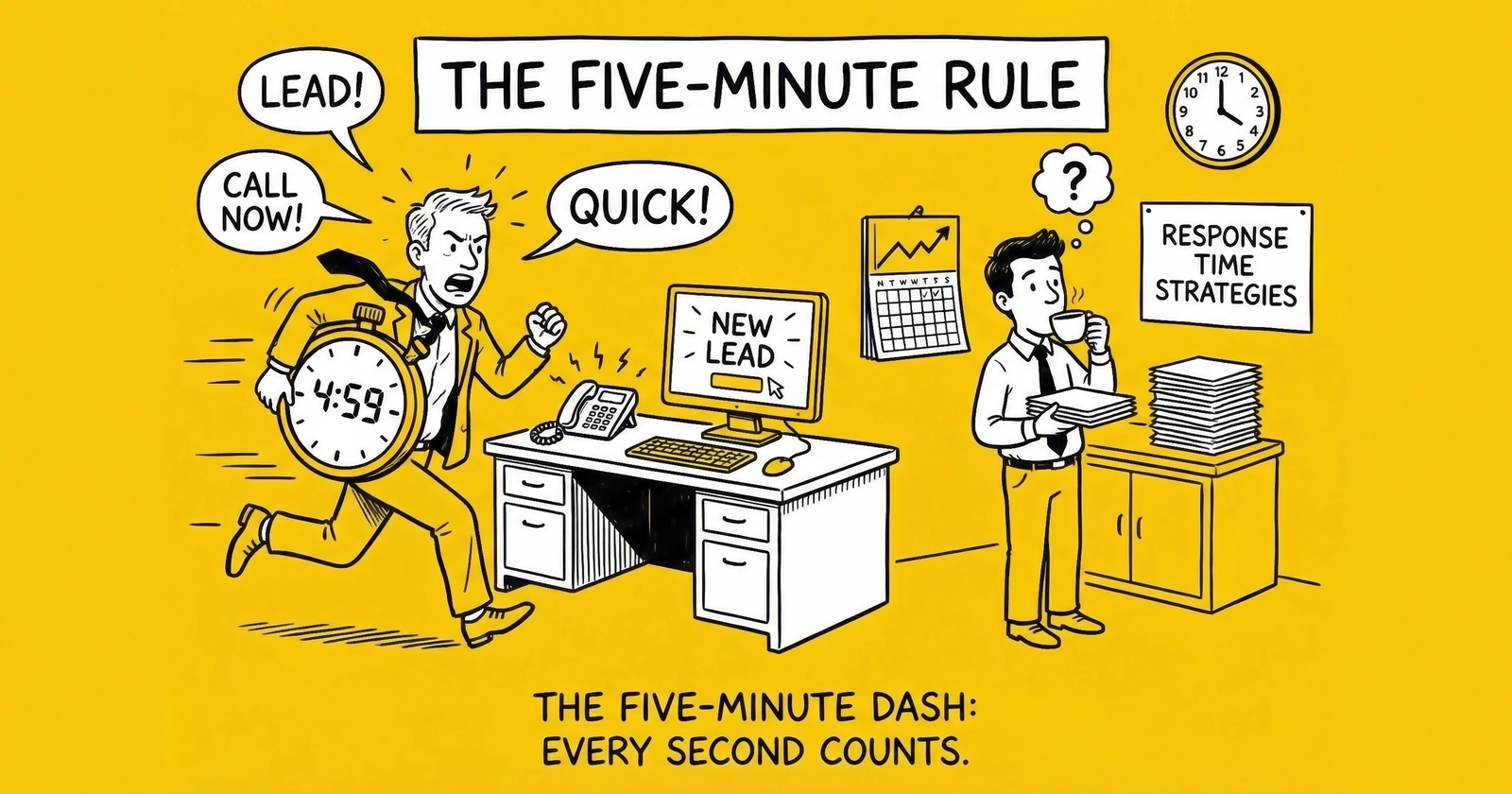
The difference between winning and losing a sale often comes down to minutes, not hours. Learn the science behind response time, the data that proves speed wins, and how to build a system that responds before your competition.
Five minutes.
That is the empirical boundary between high-converting lead operations and everyone else.
Not thirty minutes. Not “the same day.” Not “within business hours.” Five minutes separates the companies that capture 80% of available opportunities from those competing for scraps.
This boundary has been validated across multiple research studies spanning 15+ years, millions of leads, and every major B2B and B2C vertical. The data is unambiguous: respond in five minutes and you are 21 times more likely to qualify a lead than if you wait 30 minutes. Wait an hour and your odds of meaningful contact drop tenfold. For operations managing high lead volumes, enterprise-grade lead distribution architecture ensures leads reach the right rep within seconds.
The uncomfortable truth: 55% of companies take more than five days to respond to leads. Twenty-three percent never respond at all.
This gap between what research proves and what companies actually do represents the single greatest arbitrage opportunity in lead management. The technology exists. The data is clear. Most organizations simply fail to execute.
This guide breaks down the science behind the 5-minute rule, the research that validates it, what happens in the consumer’s mind during those critical first minutes, and exactly how to build a response system that puts you in the top 10% of responders.
What Is the 5-Minute Rule and Why Does It Matter?
The 5-minute rule is a research-backed standard for lead response time stating that sales teams should contact inbound leads within five minutes of form submission or inquiry. This timeframe has been established through multiple peer-reviewed studies as the optimal window for maximizing contact rates, qualification rates, and conversion probability.
The rule matters because lead intent decays rapidly after initial expression. A consumer who fills out a form requesting insurance quotes is at peak motivation the moment they click submit. With each passing minute, their attention fragments. They visit competitor sites. They get distracted by other tasks. Their urgency fades.
Speed-to-lead is not about courtesy or customer service – it is about capturing a psychological window that closes quickly. The companies that respond first win disproportionately, regardless of whether they offer the best price or the most comprehensive solution.
What Makes 5 Minutes the Threshold?
Research from multiple sources converges on five minutes as a critical inflection point:
- The Lead Response Management Study (MIT and InsideSales.com) found that contact success drops “more than tenfold” after one hour and qualification drops “over sixfold”
- LeanData research shows an 80% decrease in odds of qualifying a lead between 5-minute and 10-minute response times
- Chili Piper benchmarks identify a 391% increase in conversions when responding within 60 seconds
After five minutes, the decline accelerates. After 30 minutes, you have likely lost the lead to a faster competitor or to the consumer’s shifting priorities.
The Science Behind the 5-Minute Rule: Cognitive Psychology of Intent Decay
Understanding why speed matters requires understanding what happens in a consumer’s brain between submitting a form and receiving a response.
The Intent Expression Window
When a consumer fills out a lead form, they are at the peak of what psychologists call “implementation intention” – the mental state where motivation meets action. They have moved past passive consideration into active shopping. Their working memory holds the specific problem they want solved. Their emotional state is engaged.
This mental configuration is temporary. Working memory degrades rapidly. Competing tasks intrude. The emotional urgency that drove the form submission begins to fade.
Attention Fragmentation in Digital Environments
Modern consumers operate in hyper-fragmented attention environments. The average person switches between apps and browser tabs every 47 seconds. A consumer who submits a form at 10:00 AM has likely shifted to three different tasks by 10:15 AM.
When your call comes in at 10:15, you are interrupting their new context. They need to mentally reconstruct why they filled out that form. The conversation starts with friction rather than momentum.
When your call comes at 10:02, you catch them in context. The problem is still top of mind. The form they filled out is likely still visible on their screen. The conversation starts with continuity.
The Competition Factor
Speed matters even more in competitive markets. Research from Lead Connect found that 78% of customers purchase from the first vendor to respond – not the best, not the cheapest, the first.
This first-responder advantage compounds the psychological factors. By the time your competitor calls at the 20-minute mark, the consumer has already engaged with your sales rep, begun a qualification conversation, and potentially scheduled a follow-up. Your competitor is now selling against an incumbent rather than introducing themselves to an open prospect.
Decision Fatigue and Form Abandonment Regret
Consumers experience a psychological phenomenon researchers call “post-submission vulnerability.” Having expended cognitive effort to complete a form, they are temporarily open to engagement but also second-guessing whether submitting was the right choice.
A fast response validates their decision. It signals competence, organization, and responsiveness – all positive associations that reduce buyer resistance.
A slow or absent response triggers regret. The consumer concludes they made a mistake, were targeted by a low-quality company, or exposed themselves to spam. When your call finally comes, you start with a trust deficit.
The Data: Multiple Studies Confirm Speed Wins
The 5-minute rule is not marketing wisdom or sales folklore. It is an empirical finding replicated across multiple peer-reviewed studies, millions of data points, and diverse industries.
The Lead Response Management Study (MIT/InsideSales.com, 2007-2011)
The foundational research comes from a collaboration between MIT’s Kellogg School of Management and InsideSales.com. This study analyzed over 15,000 leads and 100,000+ call attempts across three years.
Key findings:
- Contact success drops more than tenfold if response is delayed just one hour
- Qualification success falls over sixfold in the first hour
- 21-fold decrease in qualification odds occurs between 5-minute and 30-minute response windows
- Qualification chances drop fourfold between 5 and 10 minutes
- Contacting leads after 20 hours may be counterproductive – worse than not calling at all
The study also identified optimal contact timing patterns:
- Wednesday and Thursday show highest contact and qualification rates
- 4-6 PM maximizes contact chances at 114% more effective than 11 AM-12 PM
- 8-9 AM and 4-5 PM are prime for qualifying leads
Harvard Business Review Audit Study (2011)
Researchers from Harvard Business School audited 2,241 U.S. companies by submitting lead forms and measuring response times.
Key findings:
- 37% of companies responded within one hour
- 16% responded within one to 24 hours
- 24% took more than 24 hours to respond
- 23% of companies never responded at all
- Average response time (among companies that responded within 30 days): 42 hours
The study found that companies contacting leads within one hour were nearly seven times more likely to qualify the lead compared to those waiting just one additional hour. Firms were more than 60 times as likely to qualify leads when responding immediately versus waiting 24+ hours.
Velocify Research (2012-2017)
Velocify (now part of ICE Mortgage Technology) studied conversion data across the mortgage industry and found:
- 391% higher conversion rate when responding within one minute
- Optimal persistence requires 6-9 contact attempts
- Multi-channel follow-up (phone, email, SMS) outperforms single-channel approaches
LeanData Studies (2020-2023)
More recent research from LeanData confirmed the earlier findings still hold in modern selling environments:
- 21x more likely to qualify a lead when responding within five minutes compared to one hour
- 80% decrease in qualification odds between 5-minute and 10-minute response times
- First responder still wins 78% of deals
Drift State of Conversational Marketing (2019-2023)
Drift’s research on B2B buying behavior found:
- Average B2B website response time: 42 hours
- Only 7% of B2B companies respond within five minutes
- 55% of companies take more than five days to respond
- Companies using conversational marketing (chatbots + live chat) achieve 10-second average response times
Chili Piper Benchmarks (2024)
The latest research from Chili Piper emphasizes that the traditional 5-minute standard is now considered conservative:
- 391% increase in conversions when responding within 60 seconds
- After 5 minutes, qualification chances drop by 80%
- The modern benchmark is sub-60-second response for high-intent leads
What Happens in Minutes 1-5: Consumer Psychology During the Wait
Understanding the consumer’s experience during the wait illuminates why speed matters and how to optimize the response when it arrives.
Minute 0-1: Peak Engagement
The consumer has just clicked submit. Their attention is focused. They are watching for a confirmation page, checking their email, perhaps expecting an immediate callback.
This is the maximum opportunity window. A response in this window feels seamless – a natural continuation of the interaction they initiated.
Consumer mental state: Engaged, expectant, open to conversation
Minute 1-2: Active Waiting
The consumer is still engaged with their request but beginning to transition. They may scroll the thank-you page looking for next steps. They might check if a confirmation email arrived.
A response in this window still captures engaged attention. The consumer remembers exactly what they requested and why.
Consumer mental state: Attentive, curious, still committed
Minute 2-3: Attention Drift Begins
The consumer starts transitioning to other tasks. They may open a new browser tab, check social media, or return to whatever they were doing before.
A response in this window requires a brief reorientation. The consumer needs to recall the context of their request, but the memory is still fresh.
Consumer mental state: Distracted but recoverable
Minute 3-5: Context Switching
The consumer has moved on mentally. They are engaged with a new task. Their working memory has largely released the details of the form they submitted.
A response in this window interrupts rather than continues. The conversation starts with friction: “Hi, you recently submitted a request about…” The consumer needs to mentally reconstruct their situation.
Consumer mental state: Disengaged, requires re-selling
Minute 5+: The Fade Zone
After five minutes, you are no longer responding to an active lead – you are resurrecting a dormant one. The psychological dynamics shift fundamentally:
- The consumer may not remember submitting the form
- Competitive responses may have already arrived
- The emotional urgency that drove action has dissipated
- Trust must be re-established from scratch
Consumer mental state: Skeptical, possibly defensive, may not recall initial interest
Why Most Companies Fail at Speed
The data is clear. The technology exists. The ROI is proven. Yet the majority of companies still fail to respond within the 5-minute window.
Understanding why companies fail is essential for building a system that succeeds.
Failure Mode 1: Lead Routing Complexity
Enterprise organizations often route leads through multiple systems before they reach a human. A form submission triggers:
- Form platform captures data
- Data syncs to marketing automation
- Lead scoring evaluates qualification
- Assignment rules determine routing
- CRM creates a record
- Task or notification alerts rep
Each integration adds latency. Batch syncs that run every 15 or 30 minutes are common. By the time the lead lands in a rep’s queue, the 5-minute window has closed.
Solution: Real-time, event-driven integrations. Webhook-based routing that triggers immediately on form submission. Eliminate batch processes from the hot path.
Failure Mode 2: Queue-Based Distribution
Traditional lead distribution assigns leads to a queue and waits for reps to claim them. This model depends on:
- Reps actively monitoring their queue
- Reps being available when leads arrive
- Reps prioritizing new leads over existing tasks
None of these dependencies are reliable. Reps in meetings miss leads. Reps engaged in conversations delay claiming new ones. Leads age in queue while reps complete other activities.
Solution: Push-based distribution with accountability. Leads assigned to specific reps with response time tracking. Escalation paths when primary reps don’t respond.
Failure Mode 3: Understaffed Hours
Many companies staff for average load rather than peak demand. They have coverage from 9-5 but not for early morning, evening, or weekend form submissions.
Consumers do not restrict their research to business hours. A homeowner comparing solar quotes at 8 PM expects a response – not a callback tomorrow morning.
Solution: After-hours response protocols. Automated SMS acknowledgment. Outsourced call center coverage. AI-powered initial response with human escalation.
Failure Mode 4: No Measurement, No Accountability
What gets measured gets managed. Most organizations track lead volume and conversion rates but not response time. They have no visibility into how long leads wait before first contact.
Without measurement, there is no accountability. Reps are not incentivized for speed. Managers cannot identify bottlenecks. System latency goes undetected.
Solution: Time-to-first-contact as a primary KPI. Real-time dashboards. Rep-level and team-level metrics. SLA alerting when response times exceed thresholds.
Failure Mode 5: Technology Limitations
Legacy CRM systems were not designed for real-time response. They were built for record-keeping and pipeline management, not instant lead engagement.
Many organizations have technology stacks that structurally cannot support sub-5-minute response:
- Phone systems that require manual dialing
- Email systems that batch-process sends
- CRMs that sync on scheduled intervals
- No SMS or chat capabilities
Solution: Modern lead engagement platforms. Power dialers that auto-initiate calls. Workflow automation that triggers immediately. Multi-channel communication tools.
Building a Sub-5-Minute Response System
Achieving consistent sub-5-minute response requires intentional system design. Speed cannot be an afterthought bolted onto existing processes – it must be architected from the start.
Core Architecture Principles
Real-Time Data Flow: Every component must operate in real-time. Form Submission -> Webhook -> Distribution Engine -> Rep Notification -> Dialer Initiation. No batch processes. No scheduled syncs.
Parallel Processing: Validation, scoring, and routing happen simultaneously. Rep notification triggers dial initiation concurrently. Pre-fetch customer data while dialing.
Push Over Pull: Reps should not monitor queues. The system should push leads via automated dialer and mobile notifications. Screen pop with lead context appears as phone rings.
Redundant Coverage: Primary rep has 60 seconds to respond. Secondary rep receives escalation. Team pool serves as backup. After-hours routing activates automatically.
Technology Stack Requirements
A sub-5-minute response system typically requires:
| Component | Function | Speed Requirement |
|---|---|---|
| Form Platform | Lead capture | Real-time webhook |
| Lead Router | Assignment logic | <500ms processing |
| Power Dialer | Call initiation | Auto-dial on arrival |
| SMS Platform | Text engagement | Instant send |
| CRM Integration | Record creation | Real-time sync |
| Mobile App | Rep notification | Push alerts |
| Analytics | Response tracking | Real-time dashboards |
Recommended platforms that support these requirements:
- Lead routing: LeanData, Chili Piper, Lead Assign
- Power dialers: PhoneBurner, Kixie, Orum
- Conversational platforms: Drift, Qualified, Intercom
- CRM with real-time APIs: Salesforce, HubSpot, Pipedrive
- SMS/Voice: Twilio, RingCentral, Five9
Speed by Channel: Phone, SMS, Email Optimization
Not all response channels are equal. Optimizing channel selection maximizes the value of fast response.
Phone: The Highest-Value Channel
Phone calls convert at the highest rate for complex sales because they enable real-time dialogue and objection handling. Dial within 60 seconds. Attempt 6-9 contact attempts before deprioritizing. Use local presence dialing for 40%+ improvement in answer rates.
Challenge: Consumer answer rates declining to 16-20% for unknown numbers. Requires staffed resources.
SMS: The Speed Champion
SMS delivers messages instantly and achieves 98% open rates versus 20% for email. Send within 30 seconds. Personalize with lead data. Include clear next step. Enable two-way messaging.
Challenge: Requires explicit opt-in for marketing messages (TCPA compliance). Less effective for complex qualification.
Email: The Documentation Channel
Email serves as documentation and follow-up rather than primary response. Send immediately but recognize it supplements phone/SMS. Include calendar link for self-scheduling. Trigger drip sequence for multiple touches.
Optimal Multi-Channel Sequence
The highest-performing response sequences combine all three channels:
Minute 0-1:
- Automated SMS acknowledging request
- Power dialer initiates call
- Email sends with confirmation and value proposition
Minute 1-5:
- If no answer, leave voicemail
- Send second SMS: “Just tried calling - when’s a good time?”
Hour 1-24:
- Three additional call attempts
- Email with additional resources
- SMS reminder if no response
Day 2-7:
- Daily call attempt
- Email drip sequence
- Final SMS before deprioritization
After-Hours Lead Response Strategies
Consumers submit forms 24/7, but most sales teams operate 9-5. After-hours response strategy determines whether you capture or lose significant lead volume.
Available Options
Automated Engagement: Automated SMS acknowledges the request and sets expectations. AI-powered chatbots achieve 30-40% engagement rates and can qualify leads and schedule appointments. Self-scheduling tools via Calendly, Chili Piper, or HubSpot Meetings reduce dependency on live response.
Extended Shift Coverage: Early shift (6 AM - 2 PM) and late shift (1 PM - 9 PM) plus weekend rotation captures 60-70% of after-hours volume without true 24/7 staffing. Proper lead distribution architecture can automatically route after-hours leads to available agents or queues.
Outsourced Call Center: Specialized centers provide 24/7 coverage at $15-50 per qualified appointment. Quality varies significantly by provider.
Recommended Hybrid Approach
- Immediate automated acknowledgment (SMS + email) for all leads
- Chatbot or self-scheduling for basic engagement
- Extended shifts covering 7 AM - 9 PM in your primary time zone
- Priority flagging to ensure overnight leads receive morning attention
Measuring Response Time Accurately
Improving response time requires measuring it accurately. Poor measurement leads to false confidence while leads age in queue.
What to Measure
Time to First Touch (TTFT): Time from lead creation to first outbound contact attempt (call, SMS, or email). This measures system speed and rep responsiveness.
Time to First Contact (TTFC): Time from lead creation to first meaningful two-way communication (answered call, replied SMS, email response). This measures actual engagement success.
Time to First Qualification (TTFQ): Time from lead creation to first qualification conversation. This measures business outcome, not just activity.
Measurement Best Practices
Use system timestamps, not manual entry. Measure from form submission, not CRM creation. Track by lead source to identify routing-specific problems. Segment by business hours vs. after-hours. Dashboard in real-time to enable intervention rather than just trend identification. Proper GA4 implementation enables accurate measurement of these timing metrics.
Response Time Benchmarks by Industry
| Industry | Target TTFT | Top Performer | Average |
|---|---|---|---|
| Insurance | <1 minute | 30 seconds | 42 hours |
| Mortgage | <1 minute | 45 seconds | 38 hours |
| Solar | <2 minutes | 60 seconds | 18 hours |
| SaaS/B2B | <5 minutes | 2 minutes | 42 hours |
| Home Services | <5 minutes | 3 minutes | 24 hours |
| Legal | <10 minutes | 5 minutes | 47 hours |
The gap between top performers and industry average represents competitive opportunity. Moving from average to top-performer territory typically increases qualification rates 3-5x.
Frequently Asked Questions
What is the 5-minute rule for lead response?
The 5-minute rule states that sales teams should respond to inbound leads within five minutes of form submission. Studies from MIT, Harvard Business School, and sales technology companies demonstrate that responding within five minutes dramatically improves contact and qualification rates. After five minutes, qualification chances drop by approximately 80%.
Why is lead response time so important?
Lead response time directly impacts conversion rates because consumer intent decays rapidly. Research shows companies responding within one hour are nearly seven times more likely to qualify a lead compared to those waiting just one additional hour.
What is the ideal lead response time?
Under 60 seconds for high-intent leads, under five minutes for all leads. Research shows a 391% increase in conversions when responding within 60 seconds.
What happens if I respond after 5 minutes?
LeanData research shows an 80% decrease in qualification odds between 5-minute and 10-minute response times. After 30 minutes, qualification odds drop 21-fold. After 20 hours, contact attempts may be counterproductive.
What percentage of companies respond to leads within 5 minutes?
Only 7% of B2B companies respond within five minutes. The average response time is 42 hours. 55% take more than five days, and 23% never respond at all.
How do I improve my lead response time?
Implement real-time integrations, push-based distribution, power dialers that auto-initiate calls, multi-channel response, time-based escalation, and real-time measurement with accountability.
Should I call, text, or email leads first?
Combine all three channels immediately. SMS provides instant acknowledgment (98% open rate). Phone enables qualification. Email provides documentation. Send SMS within 30 seconds, phone within 60 seconds, email concurrently.
How do I handle leads that come in after hours?
Use automated SMS, chatbot or self-scheduling tools for immediate engagement, extended shift coverage, and priority flagging to ensure overnight leads receive first attention the following morning.
What tools do I need for fast lead response?
Form platform with real-time webhooks, lead routing engine with sub-second processing, power dialer, SMS platform, CRM with real-time sync, and analytics dashboards. Recommended: LeanData or Chili Piper for routing, PhoneBurner or Kixie for dialing.
How do I measure lead response time accurately?
Use system timestamps, not manual entry. Track from form submission to first contact attempt. Segment by lead source and business hours. Dashboard in real-time. Key metrics: Time to First Touch (TTFT), Time to First Contact (TTFC), Time to First Qualification (TTFQ).
Key Takeaways
-
The 5-minute rule is empirically validated: Responding within five minutes makes you 21x more likely to qualify a lead than waiting 30 minutes. This finding has been replicated across multiple studies spanning millions of leads.
-
Most companies fail spectacularly: 55% take more than five days to respond. 23% never respond at all. The average response time among companies that do respond is 42 hours. This gap represents competitive opportunity.
-
Consumer psychology explains why speed wins: Intent decays rapidly after expression. Working memory releases context. Competing tasks intrude. The consumer who submitted a form at peak motivation becomes a skeptical prospect within minutes.
-
First responder advantage is decisive: 78% of customers purchase from the vendor that responds first – not the best, not the cheapest, the first.
-
Sub-5-minute response requires intentional architecture: Real-time data flow, parallel processing, push-based distribution, redundant coverage, and appropriate technology stack.
-
Multi-channel response outperforms single channel: Combine SMS (instant acknowledgment), phone (qualification conversation), and email (documentation and follow-up) for optimal results.
-
After-hours strategy prevents significant leakage: Automated acknowledgment, chatbot engagement, extended shifts, and outsourced coverage capture leads that would otherwise age overnight.
-
Measurement enables improvement: Track Time to First Touch from system timestamps, not manual entry. Dashboard in real-time. Hold reps and teams accountable to SLAs. Understanding first-touch vs last-touch attribution helps optimize the complete lead journey.
-
The modern benchmark is sub-60 seconds: The traditional 5-minute rule is now the minimum standard. Top performers target responses within the first minute for high-intent leads.
Sources
- Harvard Business Review - The Short Life of Online Sales Leads - Research showing companies responding within 1 hour are 7x more likely to qualify leads; 23% never respond at all
- Lead Response Management Study - MIT/InsideSales.com research proving 21x qualification improvement at 5 minutes vs 30 minutes; 10x contact success drop after 1 hour
- Vendasta Lead Response Research - Industry benchmarks showing 78% of customers buy from the first responder
- Drift State of Conversational Marketing - Data showing only 7% of B2B companies respond within 5 minutes; average response time of 42 hours
- LeanData Lead Routing Research - Statistics on 80% decrease in qualification odds between 5-minute and 10-minute response
- InsideSales.com - Original research partner with MIT on lead response timing and contact optimization
This article synthesizes research from the MIT/InsideSales.com Lead Response Management Study, Harvard Business Review, Drift, Chili Piper, LeanData, and Vendasta. Statistics cited are from peer-reviewed research and industry benchmarks current as of 2024-2025.