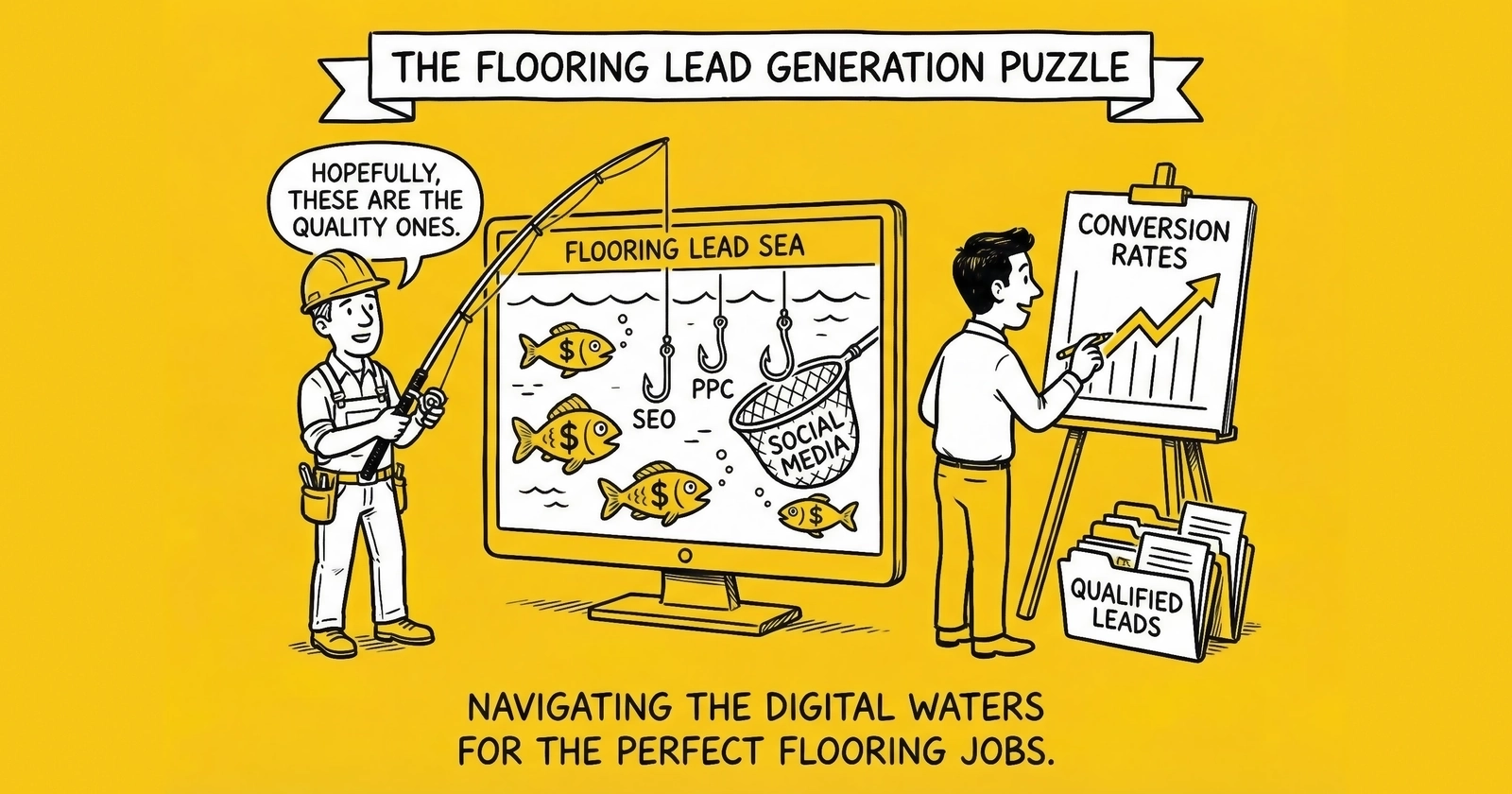
Project complexity, material margins, and the qualification requirements that separate profitable flooring operations from contractors bleeding money on tire-kickers. Everything you need to know about generating and buying flooring leads.
The flooring lead vertical operates at the intersection of home improvement urgency and considered purchase behavior. A homeowner with water-damaged hardwood needs help today. A homeowner considering a kitchen renovation with new tile may take six months to decide. Both represent legitimate flooring leads, but they require fundamentally different acquisition strategies, qualification processes, and contractor follow-up systems.
The U.S. flooring market generates approximately $48 billion in annual revenue, with residential applications representing roughly 55% of that total. The contractor services segment specifically ranges from $22-26 billion annually. For lead generators and contractors buying leads, this represents a substantial market with mature demand patterns and established competition. Yet flooring remains underserved compared to HVAC, roofing, or solar leads because the project complexity varies dramatically and qualification requirements are not standardized across the industry.
This comprehensive guide provides the complete framework for flooring lead generation: market dynamics, CPL benchmarks by flooring type, project qualification requirements, seasonal patterns, marketplace platform strategies, contractor relationship management, and the booking rate optimization that separates profitable operations from those wasting money on leads that never convert.
Every recommendation comes from operational experience in home services lead generation. The numbers reflect current market conditions as of late 2024 and early 2025.
Understanding the Flooring Lead Market
Flooring installation sits in a unique position among home improvement verticals. Unlike HVAC (where system failure creates urgent demand) or roofing (where damage requires immediate attention), flooring projects often begin as aesthetic upgrades that evolve through extended consideration periods. Understanding these dynamics shapes every aspect of lead generation strategy.
Market Size and Structure
The U.S. flooring market reached approximately $48 billion in 2024, with projections showing steady growth of 4-5% annually through 2030. Residential flooring represents roughly 55% of total market value, or approximately $26 billion. Within residential, professional installation accounts for roughly 60-65% of projects (the remainder being DIY), creating a serviceable market of $16-18 billion for flooring contractors.
The contractor landscape is highly fragmented. Unlike roofing or HVAC where regional players dominate significant market share, flooring installation spans thousands of small local contractors running 1-5 person crews alongside specialty retailers with installation services like Lumber Liquidators and Floor & Decor. Big-box programs from Home Depot and Lowe’s compete with multi-trade home improvement companies that include flooring in their offerings, while carpet-specific retailers like Empire Today and Luna Flooring focus on their niche.
This fragmentation creates both opportunity and challenge. Many potential lead buyers lack sophisticated lead management systems, making lead quality and contractor matching critical for success.
Lead Type Segmentation
Flooring leads segment into distinct categories with different economics:
Carpet installation and replacement represents the largest volume category. Average project values range from $1,500 to $4,500 for whole-home installations, with individual room projects averaging $400-$1,200. Carpet leads convert relatively quickly because the product is familiar and pricing is transparent.
Hardwood flooring commands premium project values, typically $5,000 to $15,000 for significant installations. These leads require longer nurture sequences because customers invest time researching wood species, finish types, and installation methods. Refinishing versus new installation represents a critical qualification point.
Luxury Vinyl Plank (LVP) and Luxury Vinyl Tile (LVT) has become the fastest-growing flooring category, now representing approximately 30% of the U.S. market. LVP projects typically range $2,500 to $8,000 and attract value-conscious homeowners seeking the look of hardwood with improved durability and water resistance. Lead qualification should distinguish between DIY-interested and professional installation seekers.
Tile installation spans wide price ranges based on material cost and installation complexity. Basic ceramic tile projects start at $1,000 while premium porcelain or natural stone installations can exceed $20,000. Tile leads require detailed project scoping because labor-to-material ratios vary dramatically.
Laminate flooring occupies the budget end of the market with project values typically under $3,000. The DIY-friendly nature of laminate means many leads are information-seekers rather than installation customers. Qualifying for professional installation intent is essential.
Specialty flooring includes epoxy garage floors, commercial flooring, and specialty applications like athletic surfaces. These leads command premium prices ($50-$150 CPL for qualified commercial leads) but represent smaller total volume.
Current Lead Pricing Benchmarks
Flooring lead prices vary significantly by flooring type, project scope, and lead quality:
| Lead Type | Exclusive CPL | Shared CPL | Typical Booking Rate |
|---|---|---|---|
| Carpet (whole home) | $25-$45 | $12-$22 | 15-25% |
| Carpet (single room) | $15-$30 | $8-$15 | 10-18% |
| Hardwood (new install) | $40-$70 | $20-$35 | 12-22% |
| Hardwood refinishing | $30-$55 | $15-$28 | 18-28% |
| LVP/LVT | $30-$50 | $15-$25 | 14-24% |
| Tile (bathroom/kitchen) | $35-$60 | $18-$30 | 12-20% |
| Laminate | $20-$35 | $10-$18 | 8-15% |
| Commercial/specialty | $50-$150 | $25-$75 | 15-25% |
These prices represent leads with basic qualification (verified contact information, confirmed project interest). Premium leads with detailed project scope, verified property ownership, and confirmed timeline can command 30-50% premiums. Understanding the difference between exclusive and shared leads helps contractors make informed purchasing decisions.
The booking rate ranges reflect contractor execution variation as much as lead quality. Contractors who respond within 30 minutes book at rates 2-3x higher than those who wait until the next business day – research behind the five-minute rule confirms response speed is the primary conversion driver. The numbers above assume moderately good contractor follow-up.
Traffic Sources and Acquisition Strategies
Flooring leads flow from multiple traffic sources, each with distinct characteristics and economics. Successful lead generators diversify across channels while optimizing for the specific project types that match their buyer network.
Paid Search (Google Ads)
Google search remains the primary traffic source for flooring leads. Homeowners researching flooring options naturally turn to search, making intent-based advertising highly effective.
High-Intent Keywords
The most valuable search terms signal immediate purchase intent. Searches for “flooring installation near me” typically command CPCs of $4-$8, while “hardwood floor installers [city]” runs $5-$10. “Carpet replacement cost” attracts clicks at $3-$6, “tile floor installation” at $4-$8, and “LVP flooring contractors” at $3-$6.
Lower-Funnel Commercial Keywords
Terms indicating active shopping convert well: “get flooring estimate,” “flooring installation quote,” “hire flooring contractor,” and “[flooring type] installation prices” all signal consumers ready to take action.
Informational Keywords
These require careful handling because intent varies. “Best flooring for [room type]” captures early-stage researchers who may be months from purchase. “How much does [flooring type] cost” attracts price shoppers, while “[flooring type] pros and cons” indicates comparison shopping still underway.
The economics work as follows: At $6 average CPC with a 5% landing page conversion rate, your cost per lead is $120. If you sell exclusive leads at $45 and 80% sell through, your effective revenue per click is $1.80 against a $6 cost. This does not work.
The math improves dramatically with better conversion rates. At 12% landing page conversion (achievable with optimized, mobile-first forms), the same traffic produces leads at $50 cost against $45 revenue. Add shared buyer arrangements (selling to 2-3 contractors at $20 each) and economics become sustainable.
The critical insight: flooring paid search only works with conversion rate optimization and multi-buyer distribution models or premium exclusive pricing with detailed qualification.
Google Local Services Ads (LSA)
Google LSA has become increasingly important for flooring contractors. The pay-per-lead model (rather than pay-per-click) shifts risk from the contractor and provides the “Google Guaranteed” badge that builds trust.
LSA costs for flooring typically range $20-$50 per lead depending on market competition and job type. The leads come with higher intent because consumers clicking LSA listings are specifically seeking contractors rather than researching options.
Lead generators cannot directly access LSA (only contractors can), but understanding the channel matters because it competes for the same consumers. Contractors who manage their own LSA effectively become less dependent on third-party leads, affecting buyer demand.
Home Services Marketplaces
Platforms like Angi (formerly Angie’s List and HomeAdvisor), Thumbtack, and Yelp for Business generate significant flooring lead volume.
Angi/HomeAdvisor dominates the marketplace category. Flooring leads through Angi typically cost $15-$40 depending on project type and geographic market. Leads are shared among 3-4 contractors, making speed-to-contact critical. Conversion rates from Angi flooring leads typically range 8-15% for contractors with good follow-up systems.
The platform’s strength is volume and consumer trust. The weakness is lead quality variability. Angi leads include genuine project-ready consumers alongside early-stage researchers and price-shoppers. Experienced contractors learn to qualify quickly during first contact.
Thumbtack operates on a quote-request model where contractors pay to submit quotes rather than receiving lead contact information directly. Flooring contractors report costs of $10-$30 per quote opportunity. The model works better for contractors who can differentiate on quality and professionalism rather than competing purely on price.
Porch focuses specifically on home improvement and connects contractors with leads from their retail partnerships. Flooring leads through Porch typically cost $15-$35.
Organic Search (SEO)
For lead generators building long-term assets, SEO-driven flooring content generates leads at significantly lower cost than paid advertising. The trade-off is time and investment required to build organic rankings.
Effective SEO strategy for flooring leads spans several content categories.
Local Service Pages
Pages targeting “[flooring type] installation in [city]” capture geographic intent. Each major market requires dedicated pages with unique content about local conditions, pricing factors, and specific service offerings.
Cost Guide Content
This ranks for high-volume informational queries like “How much does hardwood flooring cost?”, “Average cost to replace carpet,” and “Tile installation prices per square foot.” These pages capture consumers early in the research process. Conversion to leads requires compelling calls-to-action offering free estimates or detailed project consultations.
Comparison Content
This addresses consumer decision-making directly. Pages covering “Hardwood vs. LVP: Which is right for your home?”, “Carpet vs. hardwood in bedrooms,” and “Best flooring for kitchens with pets and kids” attract consumers actively weighing options.
Educational Content
Authority-building pieces like “How to prepare for flooring installation,” “What to expect during hardwood refinishing,” and “Signs your floors need replacement” establish expertise and capture early-stage researchers.
The SEO approach requires patience. Expect 6-12 months before content reaches first-page rankings for competitive terms. However, once established, organic leads flow at $5-$15 effective CPL compared to $50-$100+ for paid search.
Social Media Advertising
Facebook and Instagram advertising work for flooring leads, though with different dynamics than search.
Targeting Approaches
Homeownership targeting is essential for flooring leads since renters cannot authorize installation. Layer this with recent home purchase signals (within 6-12 months), home improvement interests, and life event targeting for new parents, empty nesters, or recent moves. Lookalike audiences built from converting customers often outperform interest-based targeting once you have sufficient conversion data.
Creative Considerations
Flooring is visual. Before/after project photos and video content outperform text-heavy ads. Short-form video showing transformation projects generates engagement and leads.
Funnel Approach
Social advertising works better for lead nurturing than direct conversion. Capture email and contact information with content offers like flooring guides, cost calculators, and design inspiration, then nurture toward project consultation requests. Direct “get a quote” campaigns on social typically underperform compared to search.
CPCs on Facebook/Instagram for home improvement audiences typically range $1-$3, but conversion rates are lower than search (2-4% typical). The effective CPL of $50-$100+ requires multi-step funnels to become economically viable.
Qualification Requirements for High-Quality Flooring Leads
The difference between a flooring lead that closes and one that wastes contractor time often comes down to qualification depth. Generic contact information produces return rates of 25-35% and low conversion. Properly qualified leads achieve return rates under 10% and conversion rates 2-3x higher.
Essential Qualification Data Points
Project Scope and Square Footage
This is the most important qualification factor. A lead for a 2,000 square foot whole-home flooring replacement has fundamentally different value than a 150 square foot bathroom tile project. Capture square footage or room count to enable proper lead routing and pricing.
Forms should capture approximate square footage using ranges that work for consumers (under 500 sq ft, 500-1000, 1000-2000, over 2000), along with the number of rooms and specific areas involved such as bedrooms, living room, kitchen, bathroom, or basement. Ask whether the project includes subfloor work or preparation, as this affects complexity and pricing significantly.
Flooring Type Selection
Confirm the specific flooring types the consumer is considering: carpet, hardwood (solid vs. engineered), LVP/LVT, tile (ceramic, porcelain, or natural stone), laminate, or other/unsure. “Unsure” responses indicate earlier-stage leads that may need education before converting. Route these to contractors prepared to guide product selection rather than pure installation specialists.
Installation vs. Materials
This critical distinction affects lead routing entirely. Consumers needing materials plus installation represent standard leads. Those seeking installation only (customer has materials) require different pricing and may indicate DIY partially completed. Materials-only requests are not contractor leads and should be filtered or redirected.
Property Ownership Verification
Renters generally cannot authorize flooring installation. Verify ownership through direct questioning (“Do you own or rent this property?”), property database matching for premium leads, or landlord consent questions for potential renter conversions.
Current Flooring Condition
Removal and disposal of existing flooring affects project scope significantly. Capture what flooring is currently installed, whether existing flooring needs removal, and any known subfloor issues such as water damage, unevenness, or squeaking. Water damage or subfloor issues indicate potentially larger projects but also more complex estimates.
Project Timeline
Timeline indicates urgency and conversion likelihood. Immediate needs (within 2 weeks) represent highest value and are likely motivated by specific events. “Soon” timelines of 1-3 months are standard project cycles. Planning-stage leads (3-6 months) have lower urgency and may need nurturing. “Just researching” indicates early stage that may not convert short-term but has long-term value.
Budget Range
This is optional but valuable. Many consumers resist providing budget information, so frame as ranges: under $2,000, $2,000-$5,000, $5,000-$10,000, over $10,000, or not sure yet. Budget information enables better contractor matching and reduces quote-shopping behavior.
Verification Methods
Phone Verification
Verify phone numbers at form submission through SMS code or automated call-back. This single step eliminates 15-25% of invalid submissions from typos, fake numbers, or intentional fraud.
Email Confirmation
Double opt-in email confirmation validates email address and confirms intent. Consumers who click confirmation links demonstrate higher conversion intent.
Address Validation
Standardize and validate addresses against postal databases. Invalid addresses indicate fake submissions or entry errors. Valid addresses enable property database lookups for ownership verification.
Property Database Matching
Services like ATTOM, CoreLogic, or LexisNexis provide ownership verification and property characteristics. Cost ranges from $0.50-$2.00 per lookup. For premium leads selling at $50+, this verification pays for itself through reduced returns.
Building and Managing Contractor Relationships
For lead generators, contractor relationships determine success more than traffic acquisition capability. The best traffic strategy fails if you cannot connect leads with contractors who convert them into customers.
Contractor Selection Criteria
Operational Capacity
Evaluate whether contractors can actually handle lead volume effectively. Look for team size of minimum 2-3 installers for consistent capacity, scheduling systems in place, ability to provide estimates within 24-48 hours, and installation availability within 2-3 weeks.
Solo contractors often make excellent installers but poor lead buyers because they cannot respond quickly during busy periods.
Service Area and Specialization
Map contractor capabilities precisely. Determine which ZIP codes they service, which flooring types they install, their minimum project size thresholds, and whether they have commercial capability.
Mismatched leads create returns and frustration. Build detailed capability profiles before routing leads.
Follow-Up Capability
Assess lead handling systems thoroughly. How quickly do they call leads? Target under 30 minutes during business hours. Do they have CRM or lead tracking? Can they execute multi-channel follow-up across call, text, and email? Is there a dedicated sales person, or is an installer also selling?
Contractors without systematic follow-up waste leads regardless of quality. Consider providing basic CRM or lead management tools to smaller contractors.
Reputation Indicators
Verify contractors represent your leads well. Google reviews should show a minimum 4.0 average with 50+ reviews. Check BBB rating and complaint history. Confirm state licensing verification and current insurance certificates.
Poorly-reviewed contractors convert at lower rates, generate customer complaints, and damage your lead generation brand.
Pricing and Terms
Pricing Models
Per-lead pricing is the industry standard. Simple to understand and manage, it works for most contractor relationships. Performance-based pricing offers lower base cost plus bonus for leads that book or close, aligning incentives but requiring feedback data from contractors that some resist providing. Subscription models provide fixed monthly cost for agreed lead volume, reducing cash flow variability for contractors while providing predictable revenue for generators. Territory exclusivity arrangements guarantee contractors exclusive access to leads in specific geographic areas in exchange for volume commitments and premium pricing.
Return Policies
Clear return policies prevent disputes. Define what qualifies for return: wrong contact info, not a homeowner, outside service area, or duplicate leads. Equally important is defining what does not qualify: leads that did not answer phone, decided not to proceed, or chose a competitor. Establish return request timeframes (typically 48-72 hours) and return processing time (typically 24-48 hours for credits).
Document policies clearly in contracts. Require specific documentation for return claims.
Payment Terms
Standard arrangements include prepaid accounts with lead credits, Net 15 or Net 30 invoicing for established relationships, and credit card on file for automatic billing.
New contractor relationships should start with prepaid accounts. Extend credit terms only after 60-90 days of consistent payment and lead utilization.
Performance Monitoring
Track metrics that identify relationship health.
Contact rate measures what percentage of leads answer when contractors call. Target 70%+ for leads delivered during business hours. Rates below 50% indicate lead quality issues requiring investigation.
Response time measures how quickly contractors attempt first contact. Track via CRM integration or sampling. Contractors who consistently exceed 4-hour response time should receive coaching or be terminated.
Booking rate measures leads that convert to scheduled estimates. Track through contractor feedback, confirmation callbacks, or disposition tracking. Rates below category averages indicate contractor execution problems or lead mismatch issues.
Return rate measures rejected leads as percentage of delivered. Target under 15% for properly qualified leads. Rates above 25% require source-level analysis and qualification improvement.
Feedback quality assesses contractor willingness to provide disposition data. Contractors who refuse to share feedback limit your ability to optimize. Incentivize reporting through pricing advantages for data-sharing contractors.
Seasonal Patterns and Market Timing
Flooring demand follows predictable seasonal patterns that affect both traffic acquisition strategy and contractor relationship management. Understanding these patterns enables budget optimization and capacity planning.
Spring Peak (March-May)
Spring represents the highest-demand period for flooring leads as multiple factors converge.
Home selling and buying season drives flooring updates, with sellers updating flooring to improve listing appeal and buyers renovating after closing. Real estate activity peaks in spring, pulling flooring demand with it. Post-winter assessment motivates projects as homeowners notice floor damage from winter salt, moisture, and wear, and cabin fever translates into renovation energy. Tax refund availability provides funding, with many homeowners using refunds for home improvement projects and creating a spending wave in March-April. Wedding and graduation seasons drive event-motivated renovations as homeowners hosting events want homes looking their best.
Expect 15-25% higher CPLs during peak spring months. Contractor capacity fills quickly. Build contractor relationships in winter to secure capacity commitments.
Summer Plateau (June-August)
Summer maintains strong demand with some softening factors.
Vacation schedules reduce decision-making availability, with homeowners traveling or hosting distracted from renovation decisions. Contractor capacity constraints become apparent as installation crews booked in spring develop 4-6 week backlogs, reducing urgency for new leads. Heat considerations affect certain projects, making large flooring jobs in non-air-conditioned homes uncomfortable.
Maintain acquisition but monitor contractor capacity closely. Increased return rates or slowing response times indicate oversupply. Adjust accordingly.
Fall Secondary Peak (September-October)
Fall creates a secondary demand spike driven by several factors.
Holiday preparation motivates home improvement as homeowners want updated homes for Thanksgiving and December entertaining. Real estate market activity continues through October, driving both seller and buyer renovation projects. Kids back to school frees homeowner attention for projects deferred during summer. Weather window awareness creates urgency before winter as homeowners know projects become harder in November-December.
This represents the second-highest value period after spring. Scale acquisition in September-October for premium pricing opportunity.
Winter Trough (November-February)
Winter presents challenges in most markets.
Holiday distraction reduces renovation focus, with November-December spending going to gifts rather than flooring. Contractor availability actually improves as backlogs clear, creating an advantage for lead generators if homeowner demand is cultivated. Weather complications in northern markets delay or prevent some installations. Budget constraints post-holiday affect January-February spending.
Lower acquisition costs accompany lower demand. Focus on relationship building with contractors. Nurture leads captured earlier for spring conversion. Target the subset of homeowners with specific winter needs like basement moisture issues or holiday damage.
Regional Variations
Seasonal patterns vary by geography.
Sunbelt markets including Florida, Texas, Arizona, and Southern California experience flattened seasonality, with demand remaining more consistent year-round because weather does not impede installation. Northern markets in the Upper Midwest and Northeast experience pronounced seasonality, with deeper winter troughs and sharper spring peaks. Resort and vacation markets follow different patterns based on population fluctuations and seasonal occupancy.
Adjust budget allocation and contractor capacity planning based on regional patterns.
Marketplace Platform Optimization
Home services platforms generate significant flooring lead volume. Understanding platform mechanics helps both contractors buying leads and generators competing against platforms.
Angi (HomeAdvisor) Platform Dynamics
Angi dominates the flooring lead marketplace following the 2021 merger of Angie’s List and HomeAdvisor.
How the Platform Works
Homeowners describe their project through the platform. Angi matches them with 3-4 contractors who pay per lead. Contractors see basic project information before accepting or declining leads. Accepted leads incur costs regardless of outcome.
Flooring Lead Pricing on Angi
Carpet replacement leads run $15-$30, hardwood installation $25-$45, tile work $20-$40, and LVP/LVT $20-$35. Prices vary by market competition and project scope.
Success Strategies for Contractors
Speed matters enormously. The first contractor to call a shared lead captures significant advantage. Angi provides real-time notifications, and contractors who call within 5-10 minutes book at rates 3-4x higher than those who wait hours.
Review generation on the platform pays dividends since Angi profiles display reviews prominently. Contractors with more positive reviews appear higher in matching algorithms and convert leads at higher rates.
Lead filtering optimization helps profitability. Use Angi’s targeting settings to filter for projects matching your expertise. Accepting leads outside your wheelhouse wastes money on low-conversion attempts.
Dispute invalid leads promptly. Wrong numbers, wrong service areas, and duplicate leads qualify for credits. Submit disputes within the platform’s required timeframe.
Thumbtack Strategies
Thumbtack’s quote-based model differs from per-lead platforms. Homeowners describe projects, then contractors see project details and pay to send quotes. Pricing depends on how many competitors quote the same project. Homeowners see quotes and choose contractors to contact. Flooring quote costs typically run $10-$30 depending on project size and market competition.
Success Strategies
Compete on presentation, not just price. Quotes include contractor photos, reviews, and written messages, so professional, personalized responses outperform generic templated quotes.
Target projects matching your strengths. Unlike per-lead platforms, you choose which projects to quote. Focus on project types where you have competitive advantage.
Quick response within the first hour matters. Early quotes get seen first, and homeowners often choose from first few responses rather than waiting for all quotes.
Google Local Services Ads
Google LSA has become essential for flooring contractors. The platform operates on a pay-per-lead model rather than per-click, and the “Google Guaranteed” badge provides a powerful trust signal. LSA listings appear above standard search ads for local queries but require background checks and license verification to participate.
Flooring LSA costs typically run $25-$50 per lead, varying by market competition.
Success on the platform requires several factors working together. Complete your profile with photos and service details. Actively generate reviews since LSA visibility correlates with review quantity and recency. Respond quickly to leads because Google tracks response time. Manage lead disputes for invalid contacts to maintain profitability.
Platform Strategy for Lead Generators
Lead generators compete with these platforms for consumer attention and must differentiate strategically.
Traffic source differentiation matters because platforms capture intent-based search traffic effectively. Lead generators may find better economics through content marketing, social advertising, or partnership channels that platforms underserve.
Lead quality differentiation provides competitive advantage. Platform leads are minimally qualified. Lead generators offering deeper qualification, verified data, and exclusive delivery provide value that justifies premium pricing.
Contractor relationship depth creates moats. Platforms maintain arms-length relationships with many contractors. Lead generators who build deep partnerships with select contractors create mutually dependent relationships with switching costs.
Booking Rate Optimization
The booking rate, the percentage of leads that convert to scheduled estimates, determines flooring lead generation profitability more than lead acquisition cost. A $40 lead with a 25% booking rate produces better economics than a $25 lead with a 10% booking rate.
Speed-to-Contact Requirements
Response time is the single most important controllable factor in flooring lead conversion. The data is clear: leads contacted within 5 minutes convert 3-5x better than those contacted after 1 hour. After 30 minutes, each additional 30-minute delay reduces contact rate by 10-15%. Leads not contacted within 24 hours have conversion rates approaching zero.
Implementation Requirements
Real-time lead delivery is essential. Leads must reach contractors immediately via push notification, SMS, or API integration. Batched email delivery fails.
Dedicated intake staffing during business hours ensures someone is available to call leads immediately. This cannot be a sideline task for busy installers.
After-hours systems handle leads submitted after 5 PM with immediate automated acknowledgment (“Thank you for contacting [Company]. We’ve received your request and will call you first thing tomorrow morning.”) followed by priority callback at 8 AM.
SMS as backup maintains connection when calls go unanswered: “Hi [Name], this is [Company] regarding your flooring project. When would be a good time to discuss?”
Follow-Up Sequences
Not all leads answer the first call. Systematic follow-up captures homeowners who were busy, screening calls, or needed time to decide.
Recommended Flooring Lead Follow-Up Sequence
Day 1 starts with the first call within 5 minutes of lead receipt, followed immediately by SMS after an unanswered call. A second call attempt 2-4 hours after the initial attempt keeps engagement high. End the day with email including company information and project gallery.
Day 2 includes a morning call at a different time than Day 1 attempts, plus a mid-day SMS with a specific offer (“Scheduling free estimates this week, would [day] work?”).
Day 3 focuses on an evening attempt around 6-7 PM to catch people home from work.
Days 4-7 continue with a mid-week call at a different time of day, plus an email with flooring guide or design inspiration content.
Week 2 represents the final push: one last call attempt plus a “last chance” email with limited-time offer messaging.
Long-term nurture continues with monthly email including project showcases and seasonal specials, plus reactivation campaigns before peak seasons.
Estimate Appointment Optimization
Converting calls to scheduled estimates requires specific skills.
Qualification During Call
Confirm project details match lead information. Identify any changes or clarifications. Ask about other decision-makers who should attend the estimate.
Availability Offering
Provide specific time slots rather than asking open-ended “When works for you?” questions. “I have availability Thursday at 2 PM or Friday at 10 AM. Which works better?” closes more effectively.
Confirmation Process
Send immediate text and email confirmation including contractor name, photo, and company information. Follow up with a reminder 24 hours before appointment and a morning-of confirmation for same-day appointments.
No-Show Reduction
Track no-show rates by source and day-of-week. Implement reminder sequences. Call to confirm morning of appointment. Consider slight overbooking for high-no-show time slots.
Lead Quality Challenges and Fraud Prevention
Flooring leads face quality challenges common to home services, plus category-specific issues. Building verification systems protects buyer relationships and enables premium pricing.
Common Quality Issues
Renter submissions present a fundamental problem since renters cannot authorize flooring installation in most cases. Self-reported ownership is unreliable, and verification through property databases catches 15-25% of false ownership claims.
DIY researchers are common because the DIY-friendly nature of some flooring types like LVP and laminate means many lead form submitters are gathering information for self-installation. Qualification questions about professional installation preference filter these leads.
Early-stage researchers 6+ months from project readiness submit forms seeking general information. These leads have value for nurturing but should not route to contractors as immediate opportunities.
Price-only shoppers submit to multiple services collecting quotes with no intention of hiring. Extended form friction and timeline qualification reduce this segment.
Commercial misrepresentation occurs when leads from property managers, landlords, or commercial properties appear as residential. Project scope and property type questions clarify.
Verification Stack
Phone validation verifies phone numbers are real and reachable through SMS confirmation or callback. This step alone eliminates 15-25% of invalid submissions.
Email verification confirms email addresses are deliverable and not disposable domains. Double opt-in confirms genuine interest.
Address standardization validates and standardizes addresses against postal databases. Invalid addresses indicate fraud or errors.
Property ownership lookup through services like ATTOM or CoreLogic verifies name-to-address matches and ownership status. Cost runs $0.50-$2.00 per lead and is justified for leads selling at $30+.
Behavioral analysis tracks form completion time, mouse movements, and interaction patterns. Forms completed too quickly or with mechanical patterns indicate bot or fraud activity.
Consent documentation through TrustedForm or Jornaya captures session recordings proving consent and providing behavioral data. This is required for compliance and useful for quality analysis.
Return Rate Management
Track returns by source, geography, and contractor to identify patterns.
Target Return Rates
Under 10% is excellent and justifies premium pricing. 10-15% is acceptable with standard qualification. 15-25% is concerning and requires investigation. Over 25% is problematic and requires source evaluation.
Root Cause Analysis
When return rates spike, investigate systematically. Has the traffic source changed? Have form modifications affected qualification? Is a new contractor applying different standards? Has geographic expansion moved into unfamiliar markets?
Return Category Tracking
Separate returns into categories for analysis: invalid contact (wrong number, bad email), not a homeowner, outside service area, not interested in professional installation, already purchased, or other/unspecified.
Category patterns reveal specific quality issues for targeted fixes.
Frequently Asked Questions
Q: What is a good cost per lead for flooring installation?
A: Flooring CPL varies significantly by flooring type and lead quality. Exclusive carpet leads typically cost $25-$45, hardwood leads $40-$70, and tile leads $35-$60. Shared leads run 40-50% lower but convert at lower rates. The meaningful metric is cost per booked estimate, not cost per lead. A $50 lead with 25% booking rate ($200 cost per estimate) outperforms a $30 lead with 12% booking rate ($250 cost per estimate). Calculate your acceptable cost per estimate based on close rate and average project value, then work backward to determine sustainable CPL.
Q: How does seasonality affect flooring lead generation?
A: Flooring demand peaks in spring (March-May) when home buying/selling activity increases, tax refunds arrive, and homeowners emerge from winter with renovation energy. A secondary peak occurs in fall (September-October) as homeowners prepare for holiday hosting. Winter months (November-February) represent the lowest demand period, though contractor availability is often best. Expect CPLs 15-25% higher during peak months. Adjust acquisition budgets seasonally and build contractor relationships during slower periods.
Q: Which flooring type generates the highest-value leads?
A: Hardwood flooring generates highest-value leads with typical project values of $5,000-$15,000 and CPLs of $40-$70. However, conversion cycles are longer because customers research extensively. LVP/LVT leads offer balanced value: $2,500-$8,000 project values with $30-$50 CPLs and faster conversion. Commercial flooring leads command premium CPLs ($50-$150) with high project values but require specialized contractor networks. The “best” lead type depends on your contractor network capabilities.
Q: Should I buy exclusive or shared flooring leads?
A: Exclusive leads cost 60-80% more but convert at 1.5-2x higher rates because you are not competing with other contractors. Shared leads cost less per lead but total cost per booked estimate is often similar or higher due to lower conversion. Start with exclusive leads when building a new contractor relationship to demonstrate lead quality without competition variables. Consider shared leads once contractors have proven their conversion capability and want volume over exclusivity.
Q: How quickly should contractors respond to flooring leads?
A: Target first contact attempt within 5-10 minutes during business hours. Leads contacted within 5 minutes convert 3-5x better than those contacted after an hour. If immediate call is not possible, send an automated text message acknowledging the inquiry and promising callback. For after-hours leads, acknowledgment text immediately and priority callback at 8 AM the next business day. Response time is the most controllable factor affecting conversion rate.
Q: What qualification data should flooring lead forms capture?
A: Essential fields include: contact information (phone, email, address), flooring type of interest, project scope (square footage or room count), timeline (immediate, 1-3 months, just researching), homeownership status, and whether professional installation is desired. Valuable additional fields include: current flooring condition, subfloor concerns, budget range, and specific rooms involved. Each additional field reduces form completion rate 3-8% but improves lead quality. Balance qualification depth against volume needs.
Q: How do I verify flooring leads are homeowners?
A: Self-reported ownership is unreliable with 15-25% error rates. Three verification methods work: property database matching through services like ATTOM or CoreLogic ($0.50-$2.00 per lead) provides ownership confirmation. Utility account verification confirms residency and ownership. Mortgage database matching identifies property title holders. For shared leads at $15-$25, basic form verification may be sufficient. For exclusive leads at $40+, property database verification is cost-justified.
Q: What platforms work best for flooring leads?
A: Google Ads provides highest-intent traffic but requires strong conversion optimization to achieve sustainable economics. Google Local Services Ads (for contractors directly) costs $25-$50 per lead with strong conversion rates. Angi/HomeAdvisor provides volume at $15-$45 per lead but leads are shared among multiple contractors, making speed-to-contact critical. Thumbtack works for contractors who can differentiate on presentation rather than price. Organic SEO provides lowest CPL but requires 6-12 months investment. Diversify across platforms while tracking performance rigorously.
Q: How do I handle flooring leads that are just researching?
A: Early-stage leads have value but should not route to contractors as immediate opportunities. Identify researchers through timeline questions (“When are you planning to start this project?”). Leads with 3+ month timelines should enter nurture sequences with educational content (flooring guides, cost calculators, design inspiration) rather than immediate sales calls. Reactivate nurtured leads with targeted outreach as their timeline approaches. Some operators separate “research” leads at lower pricing from “project-ready” leads at premium pricing.
Q: What is a good booking rate for flooring leads?
A: Booking rates (leads that schedule estimates) vary by flooring type and contractor execution. Carpet leads typically book at 15-25%, hardwood at 12-22%, tile at 12-20%, and laminate at 8-15%. These rates assume moderately good contractor follow-up. Top-performing contractors achieve rates 30-50% higher through faster response times, multi-channel follow-up, and better phone skills. Track booking rate by contractor to identify who needs coaching versus lead quality issues requiring source-level investigation.
Q: How do I build exclusive relationships with flooring contractors?
A: Start by proving lead quality with standard terms. Deliver consistent volume with low return rates. Track and share performance data including contact rates and booking rates. Once you have demonstrated value, propose exclusivity arrangements: dedicated leads in specific territories in exchange for volume commitments and premium pricing. Exclusive relationships require ongoing performance monitoring. Contractors who take exclusivity then underperform hurt your traffic monetization. Build performance clauses into exclusive agreements. Having a clear framework for evaluating lead vendors helps establish proper vetting criteria from both sides.
Key Takeaways
-
Flooring lead economics vary dramatically by project type. Hardwood leads command $40-$70 CPL with $5,000-$15,000 project values. Carpet leads run $25-$45 with $1,500-$4,500 projects. LVP/LVT represents the growth category with balanced economics. Match lead acquisition strategy to your contractor network’s capabilities.
-
Speed-to-contact determines conversion more than lead quality. Leads contacted within 5 minutes convert 3-5x better than those contacted after an hour. Implement real-time delivery, dedicated intake staffing, and automated acknowledgment systems. This single factor explains more variance in booking rates than lead source quality. Proper lead distribution architecture enables the sub-minute routing required for competitive response.
-
Qualification depth enables premium pricing. Basic contact verification is table stakes. Property ownership verification, project scope confirmation, and timeline qualification differentiate premium leads. Return rates under 10% justify 30-50% price premiums. The additional verification cost of $2-$5 per lead pays for itself through reduced returns and better buyer relationships.
-
Seasonal patterns create optimization opportunities. Spring peak (March-May) commands 15-25% higher CPLs but faces capacity constraints. Winter trough offers lower acquisition costs and relationship-building opportunities. Budget allocation should follow seasonal demand patterns while maintaining contractor relationships year-round.
-
Contractor relationships matter more than traffic volume. The best traffic strategy fails without contractors who can convert leads effectively. Select contractors with operational capacity, verify reputation, monitor response time, and manage capacity proactively. Build fewer, deeper relationships rather than distributing leads to every available buyer.
-
Platform diversification reduces risk. Reliance on any single lead source creates vulnerability. Google Ads, Local Services Ads, marketplace platforms (Angi, Thumbtack), and organic SEO each serve different roles. Track performance by channel and adjust allocation based on cost per booked estimate, not just cost per lead.
-
DIY-friendly flooring types require extra qualification. LVP, laminate, and basic tile attract DIY researchers alongside professional installation customers. Form questions confirming professional installation preference filter leads appropriately. Route early-stage researchers to nurture sequences rather than immediate contractor contact.
-
The booking rate improvement opportunity exceeds cost reduction opportunity. Improving contractor booking rate from 15% to 20% reduces effective cost per estimate by 25%, the equivalent of a major CPL reduction that is typically impossible to achieve. Focus on follow-up systems, response time, and contractor coaching alongside lead quality optimization.
Sources
- Grand View Research - Flooring Market Analysis - U.S. flooring market size ($48 billion) and growth projections (4-5% annually through 2030)
- Statista - Floor Coverings Market, United States - Market segmentation data including residential share (55%) and LVP/LVT growth (30% of market)
- IBISWorld Industry Reports - Flooring contractor services market size ($22-26 billion) and industry structure analysis
- Research and Markets - Flooring industry competitive landscape and market dynamics research
- Thumbtack - Home services marketplace data on contractor lead pricing and quote-based model economics
Understanding flooring lead generation requires recognizing the category’s unique characteristics: project complexity variation, material-specific qualification requirements, and the balance between urgent needs and considered purchases. Practitioners who master these nuances build sustainable lead operations that serve both contractors and homeowners effectively. The market rewards quality differentiation and contractor relationship depth over pure volume optimization.