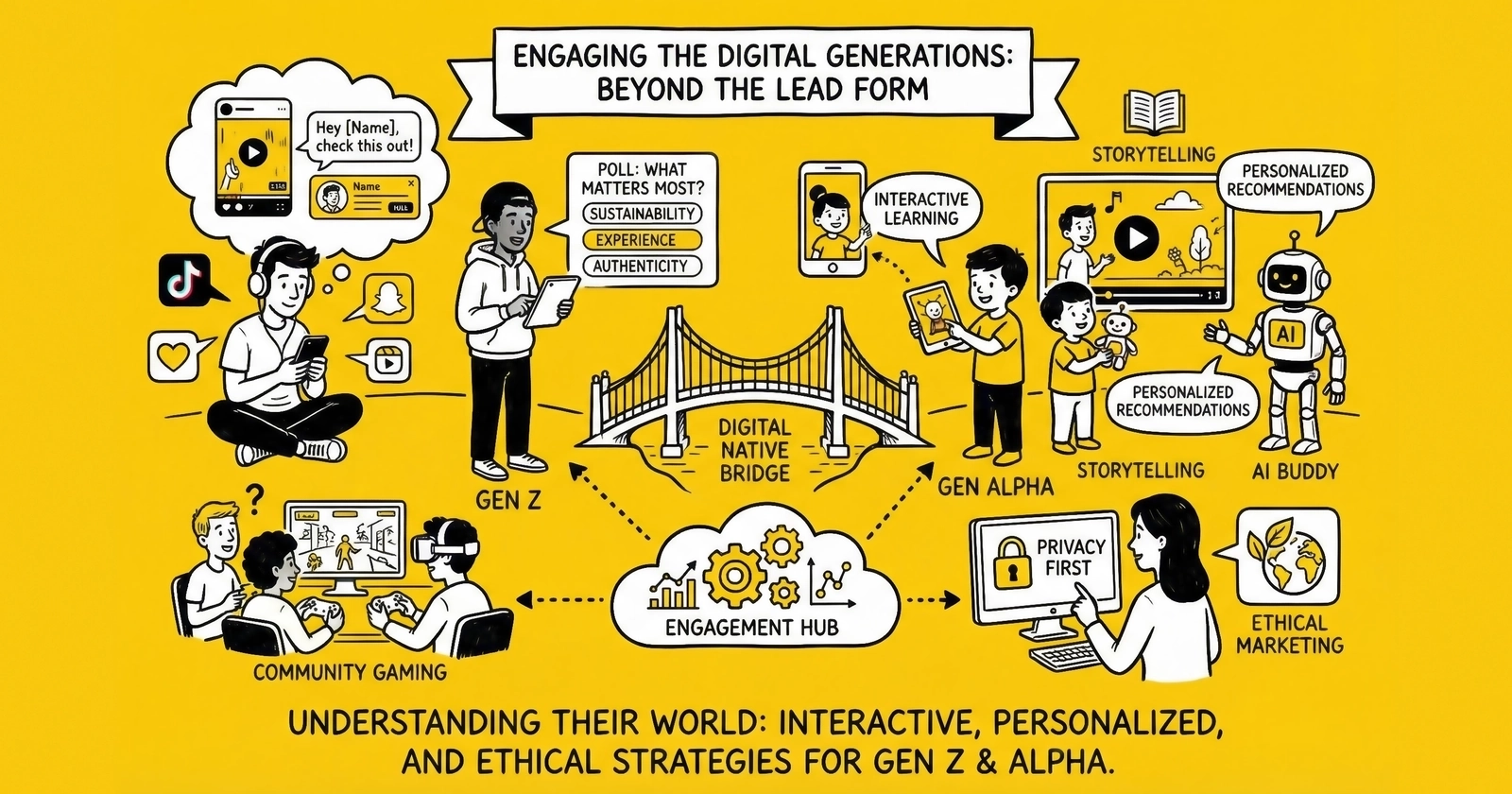
Two generations are reshaping commercial engagement. Gen Z controls $360 billion in spending power and influences trillions more through household decisions. Gen Alpha is already driving purchasing behavior before most can earn their own income. Here’s how lead generation operators must adapt their strategies, channels, and authenticity standards to capture these digital-native consumers.
The playbook that built your current lead generation business will not work on the generations coming next.
Gen Z – born between 1997 and 2012 – has never known a world without smartphones. They grew up watching their parents get targeted by personalized ads and understand marketing mechanics intuitively. They can smell inauthenticity from three scrolls away.
Gen Alpha – born 2013 and later – is the first generation to be raised entirely in an AI-augmented world. These children learned to swipe before they could walk. Their digital fluency makes Gen Z look like novices.
Together, these generations represent the future of every lead generation vertical. Insurance companies will insure them. Mortgage lenders will finance their homes. Solar installers will power their houses. Home service providers will maintain their properties. Those who learn to reach them now will dominate the market for decades.
This guide provides the strategic framework for marketing to Gen Z and Gen Alpha – covering their distinct preferences, the channels that reach them, the authenticity requirements that determine success, and the social commerce revolution they are driving.
Understanding the Generational Landscape
Who Is Gen Z?
Gen Z encompasses anyone born between 1997 and 2012, making the oldest members 28 in 2025 and the youngest 13. This generation has been shaped by formative experiences that differ radically from their predecessors:
- Economic uncertainty: They came of age during the Great Recession, witnessing parents lose jobs and homes. This created financial pragmatism that contrasts with Millennial optimism.
- Social media natives: Unlike Millennials who adopted social media in adolescence, Gen Z grew up with it from birth. They understand the platform economy instinctively.
- Climate awareness: Environmental concerns are not abstract policy debates but existential threats they expect to face personally.
- Diversity as default: The most diverse generation in American history, where multicultural identity is unremarkable rather than exceptional.
- Mental health openness: They discuss anxiety, depression, and therapy without stigma, having normalized mental health conversations that previous generations avoided.
Current data indicates Gen Z represents approximately 68 million people in the United States, comprising roughly 20% of the population. They control an estimated $360 billion in direct spending power, with influence over an additional $600 billion in household purchases. By 2030, Gen Z will represent 30% of the workforce and an even larger share of consumer spending.
Who Is Gen Alpha?
Gen Alpha includes anyone born from 2013 onward – the children of Millennials. The oldest Gen Alphas are just 12 in 2025, but their influence on household spending is already substantial.
Defining characteristics:
- AI-native: They are growing up with voice assistants, recommendation algorithms, and generative AI as normal features of daily life. To them, talking to machines is unremarkable.
- Video-first communication: Text is their parents’ medium. Video is how they consume, learn, and communicate.
- Global connectedness: Through gaming, social platforms, and content creators, they form relationships across borders more naturally than any previous generation.
- Blended reality: The distinction between physical and digital is not meaningful to them. Experiences are experiences regardless of medium.
- Educated parents: With Millennial parents who are the most educated generation in history, Gen Alpha receives more intentional parenting around technology, education, and consumption.
Researchers project approximately 2.5 million Gen Alphas are born globally every week. By 2025, the generation will exceed 2 billion people worldwide. They will begin entering the workforce around 2030, but their consumer influence is already measurable through parent-directed purchasing.
Why These Generations Matter for Lead Generation
The lead generation industry operates on understanding consumer intent and capturing it efficiently. Both Gen Z and Gen Alpha express intent differently than previous generations.
Discovery patterns have shifted dramatically. Gen Z does not Google products – they search TikTok and Instagram. Forty percent of Gen Z uses TikTok and Instagram as their primary search engines rather than Google. For Gen Alpha, YouTube and voice assistants are the discovery mechanisms. This represents a fundamental break from the search-driven acquisition that built many lead generation empires.
Form tolerance has declined precipitously. Generations raised on frictionless app experiences will not complete lengthy lead forms. Traditional multi-field forms that convert at 15% for older demographics convert at 8% or less for Gen Z. Every additional field costs you completions at a rate that would have seemed impossible a decade ago.
Trust structures have inverted entirely. Previous generations trusted institutions – banks, insurers, established brands – by default and required persuasion to trust individuals. Gen Z and Alpha trust individuals – creators, influencers, peers – by default and require persuasion to trust institutions. Your brand recognition means less than a creator’s endorsement.
Attention economics have intensified beyond recognition. TikTok trained Gen Z on 15-60 second content loops. Gen Alpha content consumption often fragments into even shorter bursts. The 3-second hook that works for Millennials is too slow. You have one second to earn the next one.
These shifts require fundamental adaptation in how lead generation operators acquire, qualify, and convert younger consumers.
Generational Preferences That Shape Strategy
Communication Preferences
Gen Z has a clear communication hierarchy. Their preferred channel is direct messaging on social platforms, followed by text messaging, then video calls. Email sits a distant fourth, and phone calls are actively avoided. This is not preference – it borders on aversion.
Research indicates 75% of Gen Z considers phone calls too time-consuming. They prefer asynchronous communication that respects their attention sovereignty. For lead generation, this means SMS and social DMs outperform cold calls dramatically for this demographic. The operator still dialing Gen Z leads with traditional call center operations is burning money.
Email remains relevant for Gen Z but requires different treatment. Subject lines must compete with social notifications. Body content must be scannable. Any email that looks like marketing gets filtered – mentally if not technically. The dense, information-rich emails that work for Boomers trigger instant deletion from Gen Z.
Gen Alpha communication patterns are still emerging, but clear tendencies have developed. They favor voice messaging within apps rather than phone calls, video messages over text, interactive communication like polls and reactions, and gaming chat as their primary social infrastructure. For practitioners targeting families with Gen Alpha children, the communication flows through parents (Millennials) but the messaging must appeal to children’s influence. Children ages 8-14 influence 80% of household purchase decisions in categories ranging from groceries to technology to family services.
Value Hierarchies
Understanding what Gen Z values in brands is essential to effective marketing. Authenticity over polish stands paramount – perfectly produced content signals inauthenticity while raw, behind-the-scenes, imperfect content builds trust. Purpose beyond profit matters deeply, with 77% of Gen Z having taken action to support causes they believe in, though performative activism backfires catastrophically.
Diversity must be default – not diversity marketing, but diverse representation that reflects actual demographics without self-congratulation. Mental health acknowledgment resonates; brands that acknowledge stress, pressure, and imperfection connect while aspirational perfection alienates. Environmental consciousness must be integrated into operations, not treated as a separate sustainability marketing initiative. And financial transparency is non-negotiable – no hidden fees, no deceptive pricing. Gen Z shares screenshots of bad experiences widely.
Gen Alpha value patterns are still emerging, but several tendencies are clear. They crave interactive experiences; passive consumption holds limited appeal as they want to participate, create, and contribute. Creator relationships have unusual power, with parasocial relationships with YouTubers and streamers rivaling peer relationships in influence. Gamification is expected – everything should have progress, achievements, and rewards, and static experiences feel incomplete. Personalization is assumed; they expect experiences tailored to them specifically, not segments. And safety and security matter intensely, as their Millennial parents have emphasized online safety extensively.
Platform Preferences
Gen Z platform usage as of 2024-2025 shows TikTok leading with 67% daily usage, primarily for discovery and entertainment, and high relevance for both organic and paid lead generation. Instagram follows at 62%, used mainly for social proof and shopping, particularly effective for Stories. YouTube captures 58% daily use for long-form education, serving as a medium-relevance upper-funnel channel.
Snapchat reaches 51% daily, used for private communication, with medium relevance particularly for geo-targeting. Discord engages 42% for community and gaming but has low lead generation relevance due to brand aversion. Facebook has fallen to 28% daily usage, limited mostly to Marketplace and groups, with lead gen relevance declining fast. Twitter/X sits at 31% for news and debate, with context-dependent medium relevance. LinkedIn captures 24% for professional networking, highly relevant for B2B and job seekers. Pinterest reaches 29% for shopping and inspiration, with medium relevance but notably high intent.
TikTok dominance requires emphasis. The platform has fundamentally changed content consumption patterns, creating the expectation that entertainment should be free, algorithm-curated, and endless. Content that would have performed on YouTube in 2015 dies on TikTok in 2025 if it does not hook within the first second.
Gen Alpha platform usage remains parent-mediated but shows clear patterns. YouTube Kids sees daily viewing with moderate parental oversight, reaching Gen Alpha through parents. Roblox combines gaming and social interaction with low parental oversight, creating in-game brand awareness opportunities. Minecraft serves creative play with low oversight, enabling community building. YouTube provides educational and gaming content with moderate oversight, enabling family targeting. TikTok delivers entertainment with variable parental oversight, influencing household decisions.
Consumption Behaviors
Gen Z purchasing patterns combine digital sophistication with practical frugality. They research extensively before purchasing, consulting multiple sources including social proof from creators, peer reviews, and price comparison tools. The average research cycle involves 7-10 touchpoints before conversion in considered purchases. Social validation is essential – 85% check reviews before purchasing, and 72% trust peer reviews over brand content.
Price sensitivity runs high, with keen awareness of discounts, coupons, and “deal” culture. Buy Now Pay Later adoption has reached 55%, higher than any other generation. Return tolerance is low – they expect to keep what they buy and research accordingly. Subscription fatigue is mounting, with resistance to ongoing commitments and preference for one-time purchases.
For lead generation, these behaviors have direct implications. Forms asking for purchase timeline must account for longer research cycles. Social proof elements on landing pages directly impact conversion. Price transparency is non-negotiable; hidden fees destroy trust. Lead capture earlier in the research journey is required.
Gen Alpha consumption patterns, viewed through the parental lens, show the generation exercising purchasing influence primarily through “pester power” and preference expression. Their parents – Millennials – generally have higher disposable income, stronger educational values, and more intentional consumption patterns. Influence channels include YouTube unboxing videos, peer discussions, and in-game exposure. Category influence spans electronics, entertainment, food choices, family activities, and educational products. Most purchases require parental approval and funding. And value transmission is active, with Millennial parents emphasizing sustainability and quality over quantity.
Channel Strategies for Reaching New Generations
TikTok: The Discovery Engine
TikTok has replaced Google for Gen Z product discovery. Forty percent of young people use TikTok as a search engine, and the platform’s algorithm surfaces content based on engagement rather than following, creating viral reach opportunities unavailable elsewhere. For a deeper dive into TikTok lead generation strategies, operators should understand the platform’s unique dynamics.
Organic content strategy on TikTok requires creating educational content that provides value before asking for anything. Use trending sounds and formats while maintaining authenticity. Post consistently – 3-7 times weekly minimum. Engage with comments to boost algorithmic distribution. Accept that production quality should look native, not professional. Polished content signals that you do not understand the platform.
Paid advertising on TikTok offers several approaches. Spark Ads that boost organic content outperform traditional ads. Lead generation objectives are available with in-app forms. Cost per lead typically runs $8-25 depending on vertical. Audience targeting includes interests, behaviors, and lookalikes. Creative fatigue sets in faster than other platforms – refresh weekly.
Creator partnerships represent the highest-potential strategy. Micro-influencers with 10K-100K followers often outperform macro-influencers. Authentic integration outperforms obvious sponsorship. Whitelisting creator content extends reach while preserving creator trust. Cost structure ranges from $200-2,000 per post for micro-influencers to $5,000-50,000 for macro-influencers.
TikTok lead generation benchmarks show that good view-through rates run around 15% while excellent exceeds 25%. Good engagement rates hit 5% and excellent reaches 10% or higher. Click-through rates should target 0.8% as good and 1.5% as excellent. Cost per lead below $20 is good; below $12 is excellent. Form completion rates of 40% are good while 60% and above is excellent.
The platform’s Instant Form feature reduces friction but limits qualification depth. For considered purchases requiring detailed information, driving to landing pages may yield lower volume but higher quality leads.
Instagram: Social Proof and Shopping
Instagram remains central to Gen Z commercial activity, particularly through Stories, Reels, and the shopping functionality integrated throughout the platform.
Stories strategy leverages ephemeral content that drives urgency. Poll and question stickers boost engagement and qualify interest. Swipe-up links for accounts with access drive traffic efficiently. Stories ads blend naturally with organic content and feel less intrusive than feed placements.
Reels strategy focuses on reach. The algorithm prioritizes Reels, providing organic reach opportunities. Educational content with a value-first approach performs best. Behind-the-scenes content builds authenticity. Cross-posting TikTok content without the watermark extends reach across platforms.
Shopping integration options include product tagging in posts and Stories, the Shop tab for direct purchase, live shopping events for real-time engagement, and collection features for organized product presentation. Instagram is building toward seamless commerce that never requires leaving the app.
DM automation offers sophisticated lead capture. Keyword triggers can initiate conversations. You can qualify interest before human handoff. Send lead magnets directly in DMs. Integration with CRM enables proper lead capture and routing. The conversational nature of DM engagement feels less transactional than forms.
Instagram lead generation benchmarks target reach rate of 20% of followers as good and 35% or more as excellent. Story completion should hit 70% as good and 85% as excellent. Link click rate of 1% is good while 2.5% or more is excellent. Cost per lead below $25 is good; below $15 is excellent. DM response rate of 30% is good and 50% or more is excellent.
YouTube: Long-Form Education
YouTube serves as the educational backbone for both generations. Gen Z uses YouTube for product research, how-to content, and reviews. Gen Alpha consumes YouTube as their primary entertainment medium.
Content strategy should target educational content for search queries. Product comparisons and reviews perform consistently. “Day in the life” and authentic content builds connection. Shorts capture algorithm reach while long-form drives conversion. The two formats serve different purposes within the same channel.
Advertising options include skippable in-stream ads with lead forms, discovery ads appearing in search results, bumper ads for awareness, and YouTube Shorts ads reaching younger demographics. The cost structure varies significantly by targeting and competitive dynamics.
Creator collaborations take several forms: sponsored integrations in creator content, dedicated review videos, affiliate relationships with tracking, and content creator partnerships for credibility transfer. The right creator partnership can outperform direct advertising by an order of magnitude.
Production quality expectations are higher on YouTube than TikTok or Instagram. Content must provide genuine value – thin content gets punished algorithmically and damages brand perception. Lead forms within YouTube reduce friction but limit targeting capabilities versus driving to owned landing pages. The tradeoff between convenience and control depends on your qualification requirements.
Snapchat: Geographic Targeting
Snapchat reaches 75% of 13-34 year-olds in the U.S. and offers unique targeting capabilities around location and augmented reality experiences.
Geo-targeting capabilities are unusually powerful. Location-based targeting can focus on specific addresses. Radius targeting works for local businesses. Event-based targeting covers conferences, concerts, and venues. Weather-based targeting enables seasonal service promotion. These location capabilities exceed what other platforms offer.
Ad formats include Story ads appearing between friends’ Stories, collection ads for product catalogs, AR lenses for interactive experiences, and commercials for premium placement. The AR lens format is unique to Snapchat and can generate significant engagement when executed well.
Messaging capabilities enable direct-to-message ads that drive conversations, bot integration for qualification, and lead capture within the chat interface. The conversational environment feels natural for younger users.
Snapchat works particularly well for local lead generation – home services, local retail, event-based marketing. The platform’s cost per lead is competitive with TikTok and Instagram for relevant audiences.
Emerging Platforms and Considerations
Discord reaches 42% of Gen Z, primarily for gaming and community. Direct advertising is limited and brand presence risks backlash from the platform’s culture. Community building and organic engagement may yield leads but requires substantial investment and authentic participation. This is not a quick-win channel.
BeReal, the “anti-Instagram” platform emphasizing authenticity, has relevance but no advertising infrastructure. Brand presence must be genuinely authentic to avoid platform-cultural violations. The opportunity is more about understanding Gen Z values than direct lead generation.
Threads, Instagram’s text-based platform, has potential but advertising products remain immature. Early presence may pay future dividends as the platform develops.
Gaming platforms like Roblox, Fortnite, and similar environments offer brand integration opportunities reaching younger demographics but require specialized expertise and significant budget. These are Gen Alpha plays that require patience and different success metrics.
Authenticity Requirements: The Trust Architecture
Why Authenticity Matters More Than Ever
Gen Z grew up watching influencers evolve from relatable creators to polished celebrities. They witnessed the Fyre Festival debacle. They saw brands face cancellation for performative activism that contradicted operational reality. This exposure created sophisticated pattern recognition for inauthenticity.
Research paints a clear picture. Eighty-two percent of Gen Z trusts a company more if it uses images of real customers. Seventy-nine percent trusts reviews with photos and videos more than text only. Seventy-six percent will unfollow brands they feel are inauthentic. Eighty-eight percent say authenticity is important when deciding which brands to support.
The consequences of perceived inauthenticity are severe. Gen Z does not just stop buying – they actively share negative experiences. One viral TikTok exposing deceptive practices can generate millions of views and lasting reputational damage. The risk is asymmetric: authenticity gains trust slowly, but inauthenticity destroys it instantly and publicly.
What Authenticity Looks Like in Practice
User-Generated Content Over Produced Content
The most effective Gen Z marketing often features no professional production at all. User testimonials shot on phones, unfiltered reviews, behind-the-scenes content with visible imperfections – these outperform polished productions. The rough edges signal realness.
For lead generation, this means featuring customer testimonials in ad creative, using employee-generated content showing real operations, accepting lower production quality for higher authenticity signals, and A/B testing UGC against produced content. UGC typically wins.
Transparent Pricing and Terms
Any appearance of hidden information triggers suspicion. Gen Z expects full pricing visible before lead submission, clear explanation of what happens after form submission, no surprise calls or emails beyond stated expectations, and easy opt-out from communications.
For lead generation operators, this requires displaying pricing ranges on landing pages when possible, explaining the lead process transparently, setting clear expectations for follow-up timing and method, and honoring stated contact preferences absolutely. Violating these expectations does not just cost you the lead – it creates a vocal critic.
Values Alignment Without Performance
Gen Z expects brands to have values but punishes performative activism. The calculus is simple: genuine operational values that affect business decisions are good; marketing values that contradict operational reality are catastrophic; silent competence beats loud performance.
For lead generation, this means only making claims you can substantiate with operations. If you claim environmental values, your operations must reflect them. Diversity in marketing must reflect diversity in your organization. Social causes should connect authentically to business purpose. The audit trail from marketing claim to operational reality must be clean.
Responsiveness and Conversation
Authenticity includes accessible humanity. Brands that engage in genuine conversation – responding to comments, addressing criticism, participating in community – build trust. Brands that broadcast without dialogue feel corporate and distant.
For lead generation, this means responding to ad comments on all platforms since algorithms now weight engagement. Engage with user content mentioning your brand. Address negative feedback publicly and constructively. Show human personalities behind the brand. Silent brands feel like corporations; responsive brands feel like people.
The Authenticity Audit
Before launching Gen Z campaigns, conduct a thorough authenticity audit. Examine your ad creative – does this look like real customers or stock photos? Review your landing page – are claims verifiable and transparent? Analyze your follow-up process – does stated contact match actual experience? Check your reviews and testimonials – are these genuine and current? Assess your social presence – do you engage or just broadcast? Verify your values claims – can you prove these with operational evidence? Inspect your pricing – is everything visible before submission? And review your data usage policy – is it honest and comprehensible?
Any failure point in this audit represents a vulnerability that Gen Z will find and share.
Social Commerce: The Converging Experience
The Rise of Social Commerce
Social commerce – purchasing directly within social platforms – has grown from novelty to substantial channel. Global social commerce sales reached $700 billion in 2024 and are projected to exceed $1.2 trillion by 2027.
Gen Z leads adoption. Ninety-seven percent use social media as their primary source of shopping inspiration. Fifty-eight percent have purchased something directly through a social platform. Forty-three percent have purchased from a brand solely because of an influencer recommendation. These are not fringe behaviors – this is mainstream commerce.
This represents a fundamental shift in the purchase funnel. Discovery, research, social proof, and transaction collapse into a single platform experience. The lead generation implications are significant – the funnel you built for the desktop web does not translate to social commerce.
Social Commerce for Lead Generation
Traditional lead generation separates traffic acquisition from conversion from transaction across different properties and experiences. Social commerce compresses these stages into unified platform flows.
In-platform lead forms offer streamlined capture. TikTok Lead Generation objective captures leads without leaving the app. Instagram lead ads collect information directly in Stories or feed. Facebook Lead Ads have established patterns for form optimization. LinkedIn Lead Gen Forms work within the professional context. The advantage is friction reduction – users never leave their current experience.
The tradeoff between reduced friction and reduced qualification is real. In-platform forms reduce friction – users do not leave their current experience – but limit qualification depth. Platform forms typically allow fewer fields and less customization than owned landing pages. Higher completion rates (often 40-60% versus 15-30% on landing pages) come with lower lead quality (less committed, less qualified), platform data dependency (limited custom tracking), and faster follow-up requirements (less committed means faster decay).
Hybrid approaches offer the best of both worlds. Many practitioners use platform forms for initial capture, then qualify through follow-up sequences. The flow captures basic information in-platform – name, phone, high-level intent – then follows immediately with SMS or messaging containing qualification questions. Qualified leads route to sales while unqualified leads enter nurture sequences or are dismissed. Non-converters receive retargeting with additional content.
Influencer Commerce Integration
Influencer marketing and social commerce converge. Creators drive discovery and provide the social proof that enables purchase confidence.
Affiliate structures offer performance alignment. Unique tracking links enable attribution. Commission on completed leads or sales aligns incentives. Performance-based compensation ensures skin in the game. Scaling across multiple creators extends reach.
Sponsored content provides creative control at predictable cost. Flat fees for dedicated posts enable budget certainty. Creative control must be negotiated carefully – too much control and content feels inauthentic, too little and messaging drifts. Brand safety requires vetting. Performance varies highly by creator and execution.
Whitelisting and Spark Ads combine credibility with targeting. Running paid media through creator accounts combines creator credibility with targeting precision. This format often delivers the highest performance for cost per lead. Creator partnership agreements must specify whitelisting rights explicitly.
Live shopping creates urgency and engagement. Real-time product demonstration builds confidence. Q&A addresses concerns in the moment. Limited availability creates urgency. The format works best for e-commerce but can be adapted for lead generation through exclusive offers and time-limited opportunities.
Influencer selection for lead generation should weight audience alignment at 30% – demographics, interests, and location must match your target. Engagement rate warrants 25% weight – true engagement matters more than follower count. Content quality deserves 20% – production, messaging, and authenticity must meet standards. Brand safety requires 15% weight – past content and controversy risk must be evaluated. Responsiveness rounds out the criteria at 10% – professionalism and reliability affect execution.
Micro-influencers with 10K-100K followers typically deliver better cost per lead than macro-influencers. Their audiences are more targeted, engagement rates are higher, and their recommendations carry more weight due to perceived relatability. The mega-influencer is a celebrity; the micro-influencer is a trusted friend.
Digital-Native Expectations
Speed Expectations
Gen Z expects instant everything. Page load tolerance maxes out at 3 seconds versus 5-7 for older demographics. Response to inquiry should come within minutes, not hours. Resolution of issues should happen in the same session when possible. Content consumption must deliver value apparent in the first second.
For lead generation operations, landing page optimization is non-negotiable. Core Web Vitals compliance is mandatory. Mobile-first design is essential since 80% or more of Gen Z traffic is mobile. Above-fold value proposition must be immediately visible. Progress indicators for multi-step forms reduce abandonment.
Response time directly determines outcomes. Sub-60-second response to submitted leads increases contact rate by 391% – a principle explored in depth in the speed-to-lead research. SMS or messaging response is preferred over calls. Autoresponders must be conversational, not corporate. Expectation setting for follow-up timing reduces friction.
Form experience must be optimized for speed. Smart defaults and autofill support reduce effort. Single-column mobile-optimized layout eliminates confusion. Clear progress indicators for multi-step processes reduce abandonment. Immediate confirmation of submission provides closure.
Mobile-First Reality
For Gen Z and Alpha, mobile is not a device – it is the computing environment. Desktop is a work tool. Mobile is life.
The behavioral split is dramatic. Social browsing is 88% mobile and only 12% desktop. Product research is 65% mobile. Lead form completion is 75% mobile. Video consumption is 80% mobile. Messaging is 95% mobile. Any optimization for desktop first is optimization for the wrong platform.
Mobile-first lead generation has specific requirements. Design must feature thumb-friendly tap targets, single-column layouts, and no horizontal scrolling. Forms need minimal fields, appropriate input types, and SMS verification over email. Speed requires page weight under 1.5MB and lazy loading for below-fold content. Payment integration should include Apple Pay and Google Pay for immediate transactions. Communication needs click-to-call and click-to-text functionality.
Privacy Consciousness
Despite their digital openness, Gen Z has nuanced privacy awareness. Eighty-seven percent express concern about data privacy. Sixty-four percent have adjusted privacy settings on social platforms. Fifty-five percent would pay more for products from companies that protect their data. Seventy-eight percent expect transparency about how their data is used.
This creates an apparent paradox – deeply engaged on platforms that collect extensive data while expressing privacy concern. The resolution lies in understanding that Gen Z trades data for value consciously but resents data collection without perceived benefit. They will share information when they understand why and receive something in return. They will revolt against collection that feels exploitative or opaque.
For lead generation, this means explaining clearly why you collect each piece of information. Offer value exchange for data – content, access, functionality. Provide genuine control over data use. Never sell or share data beyond stated purposes. Make privacy policies comprehensible, not legalese. Transparency is not a compliance requirement; it is a trust requirement.
Experience Over Transaction
Gen Z and Alpha prioritize experiences over possessions. This extends to commercial interactions. Seventy-four percent would pay more for personalized experiences. Sixty-eight percent value experiences over products. Seventy-nine percent expect personalized engagement based on previous interactions.
For lead generation, this has profound implications. The form submission IS an experience, not just data collection. The design, the flow, the feedback – all of it signals whether you value the prospect as a person or merely as a data point. Post-submission journey matters as much as capture. What happens after the form submission shapes perception of your brand. Personalization should extend throughout the funnel. Educational content and value delivery should precede conversion requests. Give before you ask.
Adapting Lead Generation for Each Vertical
Insurance Leads
Gen Z insurance behaviors differ from previous generations. Driver’s license acquisition is happening later, reducing auto insurance urgency. Delayed home ownership reduces homeowner’s insurance demand. A higher renter population creates increased renter’s insurance opportunity. Health insurance through gig economy creates coverage gaps and complexity. Pet insurance adoption runs significantly higher than previous generations.
Adaptation strategies should lead with renter’s and pet insurance rather than auto and home. Emphasize flexibility and digital servicing. Use social proof from peers, not traditional testimonials. Price transparency is mandatory. Digital quote processes should replace phone-based ones.
Mortgage Leads
Gen Z faces a different housing market than Millennials or Gen X. Home prices have risen higher relative to income. Student debt burdens affect qualification. Household formation is happening later. Preference for urban rental over suburban ownership is shifting slowly. Interest in alternative paths to ownership is growing.
Adaptation strategies should focus on educational content about the homebuying process. Transparency about qualification requirements builds trust. Down payment assistance program information addresses real barriers. First-time buyer focused messaging resonates. Alternative product awareness – FHA, USDA, renovation loans – expands possibilities.
Solar Leads
Gen Z environmental values align naturally with solar, but barriers exist. Lower homeownership rates limit direct solar sales. Renter solar options remain underdeveloped. Skepticism of high-pressure sales tactics common in solar runs high. Interest in community solar and alternative models is growing.
Adaptation strategies should lead with environmental impact, not just cost savings. Promote community solar options for renters. Provide transparent financing and incentive information. Avoid high-pressure tactics that backfire with this generation. Peer testimonials and social proof are essential.
Home Services Leads
Gen Z home service needs center on rental maintenance and first-home ownership. They bring higher expectations for digital scheduling and tracking. Tolerance for service windows like “9 AM - 5 PM” is low. Price transparency is required before booking. Review consciousness runs high – they will check and share experiences. Preference for recurring service subscriptions is emerging.
Adaptation strategies should provide real-time availability and booking. Offer fixed pricing or clear estimates before service. Cultivate reviews and respond to them. Provide subscription options for recurring services. Use text-based communication throughout.
Legal Leads
Gen Z legal needs differ from older demographics. Higher student loan issues exist with limited discharge options. Employment disputes around gig economy classification are common. Consumer protection claims are rising. Privacy and data breach issues have personal relevance. Lower personal injury volume reflects less driving and safer behaviors.
Adaptation strategies should emphasize educational content demystifying legal processes. Offer clear fee structures and billing transparency. Provide digital-first consultation options. Use social proof from peers in similar situations. Avoid intimidating or formal communication styles.
Measuring Success with New Generations
Metrics That Matter
Traditional lead generation metrics remain relevant but require contextual adjustment for Gen Z and Alpha campaigns. Cost per lead targets remain vertical-dependent, but Gen Z may deliver lower volume with higher intent. Form completion rate benchmarks of 15-30% shift – expect lower for desktop but higher for in-platform forms. Speed to contact under 5 minutes for traditional channels should become under 1 minute for messaging. Contact rate of 60-80% looks different when messaging contact runs higher than phone. Conversion rate of 10-20% requires different measurement given longer sales cycles. Customer acquisition cost must include the full journey, not just the lead.
Additional metrics matter specifically for Gen Z campaigns. Engagement rate measures content resonance before conversion. Share rate indicates authentic value perception. Sentiment analysis tracks brand perception across platforms. Message response rate is more relevant than call contact rate. Time to conversion must be tracked with patience for longer cycles.
Attribution Challenges
Gen Z research journeys fragment across platforms and devices, creating attribution complexity. Multiple touchpoints precede conversion. Platform-hopping for research obscures the path. Influence by creators occurs without tracking. Device switching happens between discovery and conversion. Offline conversations affect online decisions.
Attribution approaches must adapt. Multi-touch attribution assigns partial credit across touchpoints. Marketing mix modeling provides statistical analysis of channel contributions. Incrementality testing measures lift from specific channel investment. Survey-based attribution asks customers directly how they discovered you. Influencer tracking through unique codes or links measures creator contribution.
Cohort Analysis
Gen Z should be analyzed as a distinct cohort, not blended with general population metrics. Create separate campaigns for Gen Z targeting. Track lifetime value by generation. Compare acquisition costs by cohort. Monitor retention and reactivation by generation. Adjust lead scoring models for generational patterns. Blended reporting obscures the reality of generational performance differences.
Building a Gen Z-Ready Operation
Organizational Readiness
Reaching Gen Z effectively requires more than campaign tactics – it requires organizational capability.
Team composition matters. Include Gen Z team members in marketing decisions. Avoid “youth-washing” campaigns without authentic input. Empower young team members to flag inauthenticity. If your entire marketing team is over 40, your Gen Z instincts are probably wrong.
Process adaptation is essential. Creative cycles must accelerate to weekly rather than monthly. Platform-specific content should be native, not repurposed. Real-time engagement capability is necessary. Rapid response to cultural moments creates relevance. The monthly planning cycle of traditional marketing cannot keep pace with platform culture.
Technology requirements include mobile-optimized everything, fast page loads, in-platform integration, messaging-based communication, and real-time analytics. Technical debt that creates mobile friction directly costs conversions.
Partner selection shapes capability. Influencer relationship management requires specific skills. Creator negotiation capability is distinct from traditional media buying. Platform advertising expertise differs by platform. Content production velocity must match platform demands.
Investment Priorities
For practitioners serious about Gen Z acquisition, priority investments include content production capability – internal or agency capacity for platform-native content at volume. Messaging infrastructure for SMS and platform messaging automation and response is essential. Mobile optimization requires technical investment in mobile experience. Analytics must enable cross-platform attribution and generational cohort analysis. Creator relationships need either in-house management or agency partnership. Speed to contact requires sub-minute response capability for leads.
Timeline for Transition
The transition to Gen Z-optimized lead generation should be phased.
Phase 1 in months 1-3 focuses on audit and foundation. Audit current assets for Gen Z compatibility. Complete mobile optimization. Implement messaging capability. Establish platform presence. This phase builds the infrastructure for everything that follows.
Phase 2 in months 3-6 addresses content and channel. Launch platform-native content production. Establish initial influencer partnerships. Test in-platform lead forms. Implement messaging-based follow-up. This phase establishes active presence.
Phase 3 in months 6-12 drives optimization and scale. Analyze performance by cohort. Scale successful channels. Expand creator partnerships. Refine processes based on data. This phase compounds early learnings.
Phase 4 runs ongoing and addresses continuous evolution. Adapt continuously to platform changes. Prepare for Gen Alpha. Test emerging platforms. Build cultural moment responsiveness. The platforms will keep changing; the capability to adapt is the enduring asset.
Frequently Asked Questions
1. How do Gen Z and Gen Alpha differ in their approach to marketing?
Gen Z (born 1997-2012) developed sophisticated ad awareness after growing up with targeted marketing, making them skeptical of traditional approaches but receptive to authentic, value-driven content. They prefer short-form video, prioritize brand values alignment, and actively research before purchasing. Gen Alpha (born 2013+) are truly AI-native, expect interactive experiences, and exercise purchasing influence primarily through parents. While Gen Z can be marketed to directly, Gen Alpha strategies must work through family dynamics and the platforms they actually use (YouTube, Roblox, gaming environments).
2. What platforms should lead generators prioritize for reaching Gen Z?
TikTok has become the primary discovery platform, with 40% of Gen Z using it as a search engine. Instagram remains essential for social proof and shopping integration. YouTube serves educational and research functions. Snapchat offers unique geographic targeting for local lead generation. The right mix depends on your vertical and geographic focus, but TikTok should be part of nearly every Gen Z strategy in 2025.
3. Why do traditional lead forms perform poorly with Gen Z?
Gen Z has lower tolerance for friction, higher expectations for mobile optimization, and greater skepticism of data requests without clear value exchange. Traditional multi-field forms designed for desktop users with high motivation underperform. Successful Gen Z lead capture uses minimal fields, explains why information is needed, offers immediate value, and provides mobile-native experience. In-platform lead forms often outperform landing pages for volume, though with lower qualification.
4. How important is influencer marketing for reaching these generations?
Critically important. 72% of Gen Z trusts influencer recommendations over brand advertising. Influencers provide the social proof and authenticity that Gen Z requires before engaging with brands. Micro-influencers (10K-100K followers) typically deliver better cost per lead than macro-influencers due to higher engagement and perceived authenticity. Any serious Gen Z acquisition strategy includes influencer partnerships.
5. What does authenticity mean practically for lead generation?
Authenticity requires: transparent pricing without hidden fees, honest representation of what happens after form submission, user-generated content over polished production, values claims backed by operational reality, responsive engagement rather than broadcast-only presence, and respect for stated communication preferences. Inauthenticity risks viral negative exposure – one bad experience can generate millions of views on TikTok.
6. How should follow-up differ for Gen Z leads?
Gen Z prefers messaging (SMS, platform DMs) over phone calls. Response expectations are immediate – ideally within one minute of submission. Communication should be conversational, not scripted. Transparency about next steps is essential. Opt-out must be respected immediately. Follow-up that feels automated or ignores stated preferences damages both conversion and reputation.
7. How do we reach Gen Alpha given their age?
Gen Alpha marketing works through parents (Millennials) and the platforms Gen Alpha actually uses. YouTube, Roblox, and gaming environments reach Gen Alpha directly. Marketing to families rather than children maintains ethics while capturing household influence. Children ages 8-14 influence 80% of household purchases in many categories. Your messaging must appeal to children while your commercial relationship is with parents.
8. What metrics should we track differently for Gen Z campaigns?
Beyond traditional CPL and conversion metrics, track engagement rate (content resonance before conversion), share rate (organic amplification indicating authentic value), message response rate (more relevant than call contact rate), and sentiment analysis across platforms. Attribution requires multi-touch approaches as Gen Z research journeys fragment across platforms and devices. Cohort analysis separating Gen Z from general population provides accurate performance assessment.
9. How is social commerce changing lead generation?
Social commerce collapses discovery, research, social proof, and conversion into single-platform experiences. In-platform lead forms reduce friction (40-60% completion rates versus 15-30% on landing pages) but limit qualification depth. Operators increasingly use platform forms for initial capture, then qualify through follow-up sequences. The distinction between content, commerce, and lead generation is blurring.
10. How should we prepare for Gen Alpha becoming primary consumers?
Gen Alpha will begin entering the workforce around 2030 and become primary consumers shortly after. Preparation includes: building presence on platforms they use now (YouTube, gaming), understanding AI-native expectations (voice, personalization, interactivity), developing interactive and gamified experiences, and building relationships with their Millennial parents. The groundwork laid now will compound as this generation gains purchasing power.
Key Takeaways
-
Gen Z controls $360 billion in direct spending power and represents 68 million Americans. By 2030, they will comprise 30% of the workforce and an even larger share of consumer spending.
-
TikTok has replaced Google for Gen Z discovery, with 40% using it as a primary search engine. Platform-native strategies are no longer optional.
-
Authenticity is non-negotiable. 82% of Gen Z trusts companies more when they use real customer images, and 76% will unfollow brands perceived as inauthentic.
-
Gen Z communication preferences invert traditional sales tactics: messaging before calls, transparency before trust, value before ask.
-
In-platform lead forms deliver higher completion rates (40-60%) but lower qualification. Hybrid approaches capture broadly, then qualify through follow-up.
-
Micro-influencers (10K-100K followers) typically deliver better cost per lead than macro-influencers due to higher engagement and perceived authenticity.
-
Mobile-first is the only option. 75%+ of Gen Z lead form completions happen on mobile devices.
-
Response speed expectations are severe. Contact within one minute dramatically outperforms traditional speed-to-contact standards.
-
Gen Alpha influence already shapes household purchases despite their age. Marketing to families while building platform presence positions for future dominance.
-
The transition to Gen Z-ready operations requires investment in content production velocity, messaging infrastructure, mobile optimization, and creator relationships.
Sources
- Pew Research Center: Gen Z Social Trends - Comprehensive demographic and behavioral research on Gen Z characteristics
- Pew Research Center: Social Media Fact Sheet - Platform usage statistics across age demographics
- Statista: Gen Z and Alpha Demographics - Population size and spending power data for emerging generations
- Statista: TikTok Global User Age Distribution - TikTok usage statistics by age group
- Statista: Social Commerce Global Market Size - Social commerce growth projections ($700B in 2024 to $1.2T+ by 2027)
- Meta Technologies: Instagram - Platform capabilities and commerce features
- HubSpot: Google Search Statistics - Search behavior patterns and platform preferences
Demographics and platform data current as of December 2025. Generational behaviors and platform preferences continue to evolve rapidly.