Bidding strategy, budget structure, audience targeting, frequency management, and creative A/B testing–the five variables that determine YouTube CPL for lead generation campaigns.
Most lead generators running YouTube treat bidding as an afterthought. They pick Target CPA, enter a number close to their goal, and expect the algorithm to close the gap. It rarely does. The algorithm needs signals, and the signals come from deliberate configuration choices made before the campaign launches.
CPL on YouTube is not primarily a creative problem–though creative matters. It is a systems problem. Bid strategy interacts with budget pacing. Budget pacing determines which auctions you enter. Auction participation shapes the audience you reach. Audience composition drives the view rates that feed the bidding model. Getting one variable wrong degrades the others.
This article works through the five variables in the order they affect each other: bid strategy selection, campaign budget architecture, audience targeting layers, frequency capping, and creative A/B testing. Benchmarks throughout reflect campaigns spending $15,000-$200,000 per month in lead generation verticals.
Bid Strategy Selection: Matching the Tool to the Data Signal
Google Ads offers four primary bid strategies for YouTube campaigns. Each requires a different volume of conversion data to function correctly. Deploying a smart bidding strategy without sufficient data produces unstable CPL.
Manual CPV: The Starting Position
Manual cost-per-view bidding sets a maximum you pay per view (counted at 30 seconds watched or earlier engagement). The algorithm does not optimize for conversions–it only manages view cost.
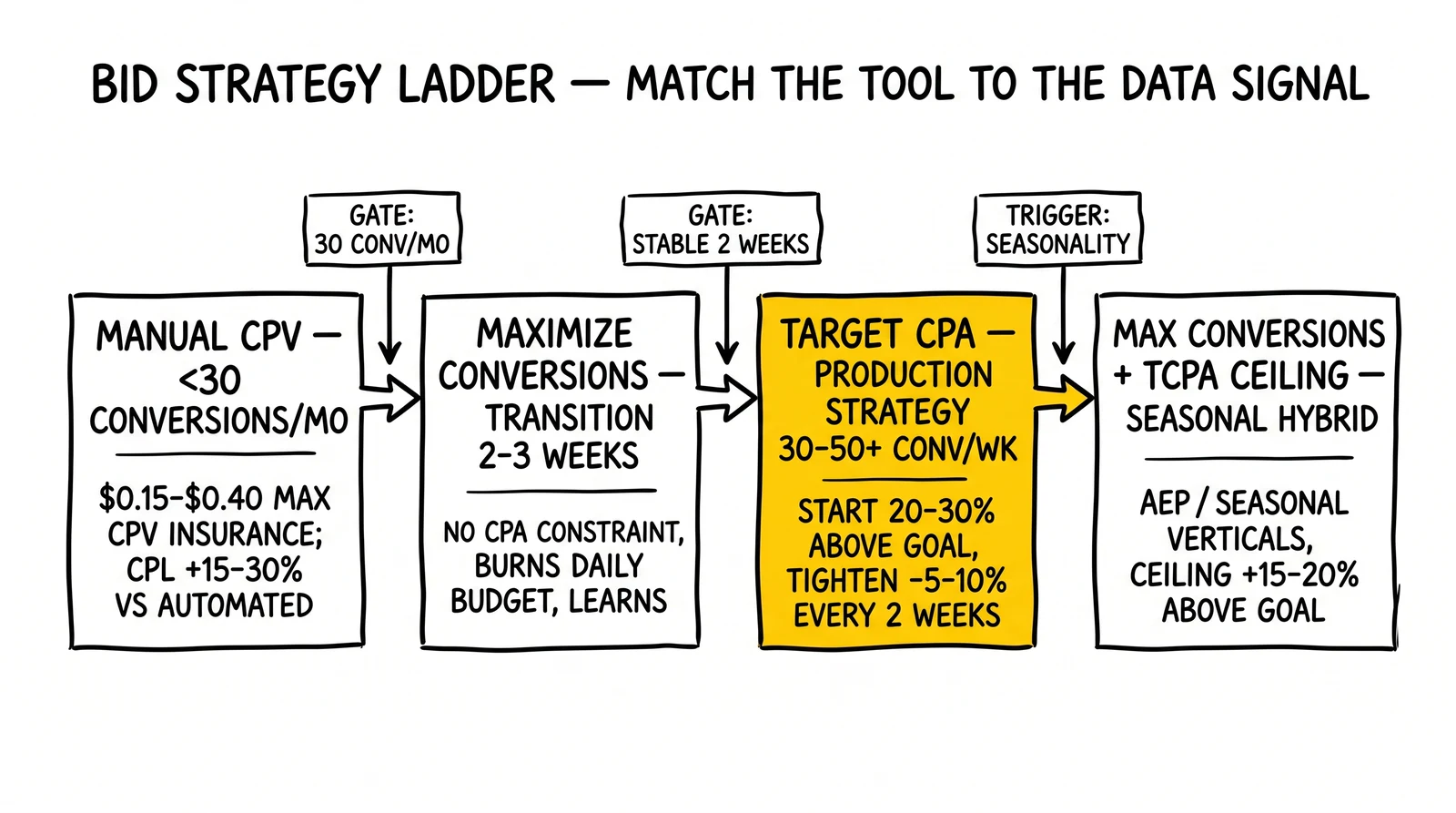
When to use it: New campaigns with fewer than 30 conversions in the past 30 days. Smart bidding strategies require conversion history to calibrate. Without that history, automated strategies bid randomly, often overshooting CPL targets in either direction.
How to set the max CPV: Research competitive CPVs in your vertical before launch. Insurance and legal campaigns typically see market CPVs of $0.15-$0.40. Home services runs $0.08-$0.20. Start your max CPV at the midpoint of the market range. If competitors are paying $0.15-$0.30, set $0.22. This positions you competitively without paying premiums for unproven inventory.
Transition signal: Move off Manual CPV once a campaign accumulates 30+ conversions per month. At that volume, automated strategies have enough signal to outperform manual bidding.
CPL impact: Manual CPV campaigns typically run 15-30% higher CPL than equivalent automated campaigns once automated campaigns are properly trained, because manual bidding cannot optimize impression selection based on conversion probability.
Maximize Conversions: The Learning Phase Tool
Maximize Conversions instructs the algorithm to generate as many conversions as possible within the daily budget. No CPA target is set. The system bids to win auctions it predicts will convert.
When to use it: Transitioning from Manual CPV, or launching a new campaign structure where you want the algorithm to explore the auction landscape. The absence of a CPA constraint gives the system room to gather signal across a wider range of inventory.
Budget relationship: Maximize Conversions will spend the full daily budget every day. Set daily budgets you are comfortable spending regardless of CPL outcome. If you set $500/day, expect $500/day in spend–with CPL varying widely during the first 2-3 weeks.
Learning period: Expect 2-3 weeks of unstable CPL while the algorithm learns. CPL in week one is often 40-80% above eventual steady-state. Resist making targeting or creative changes during this period–each change resets the learning clock.
Transition signal: Move to Target CPA once weekly conversion volume exceeds 30-50 conversions and CPL has stabilized within 20% of your goal for two consecutive weeks.
Target CPA: The Production Bidding Strategy
Target CPA instructs the algorithm to generate conversions at or near a specified cost target. The system adjusts bids auction-by-auction based on predicted conversion probability, raising bids when it predicts high conversion likelihood and lowering them when probability is low.
Setting the initial Target CPA: Set it 20-30% above your actual CPL goal during the first 4-6 weeks. If your target is $60 CPL, start at $75-$80. This gives the algorithm room to participate in auctions while it calibrates. Aggressive targets during learning constrain bid participation and underdeliver volume, starving the system of conversion data needed for calibration.
Adjustment cadence: Reduce Target CPA by 5-10% every two weeks as CPL stabilizes. A campaign starting at $80 target and hitting $72 actual CPL after three weeks can have the target lowered to $72-$75. Track at least 50 conversions between adjustments. Faster reduction triggers unstable behavior.
Volume vs. CPL trade-off: Tightening Target CPA always reduces volume. The algorithm narrows the auction set it participates in, favoring high-confidence conversions. A campaign hitting 200 leads/month at $70 Target CPA might deliver 120 leads at $55 Target CPA. The right balance depends on your lead capacity and unit economics.
Portfolio strategies: Running multiple campaigns against the same conversion goal? Use portfolio bid strategies to share Target CPA learning across campaigns. This pools conversion data, accelerating algorithm calibration for campaigns that individually have thin conversion volume.
Maximize Conversions with Target CPA: The Hybrid Approach
This hybrid–Maximize Conversions with a Target CPA constraint–functions differently than pure Target CPA. It prioritizes conversion volume up to the daily budget while respecting the CPA ceiling. When auction conditions are favorable (high predicted conversion rates at low cost), it bids aggressively. When conditions deteriorate, it pulls back rather than overspending.
Best application: High-seasonality verticals where weekly CPL variance is expected. Medicare campaigns during Annual Election Period (October-December) see CPL drop 30-50% due to increased consumer research activity. Setting a permissive Target CPA with the Maximize Conversions driver captures volume during favorable windows without hard CPA ceilings that cause underdelivery.
Configuration note: Set the CPA constraint at 15-20% above your actual goal rather than at your goal. This preserves algorithm flexibility during favorable auction periods.
Campaign Budget Architecture: Structure Before Scale
How you structure campaigns and budgets affects CPL independent of bid strategy. Three architecture decisions matter most: shared budget pools versus individual budgets, campaign segmentation, and daily budget floors.
Shared Budgets vs. Individual Campaign Budgets
Google Ads allows campaigns to draw from a shared budget pool, with the algorithm allocating spend across campaigns dynamically based on conversion opportunity.
Shared budgets work best when: You run multiple campaigns targeting the same conversion goal in the same geographic market. The algorithm can shift budget toward whichever campaign is seeing favorable auction conditions that day.
Individual budgets work best when: Campaigns serve different markets or have different performance expectations. A solar campaign in California and one in Texas should have separate budgets–California will consume the pool during high-season windows, starving Texas even when Texas conditions are favorable.
Practical rule: Use shared budgets within a single market for a single vertical. Use individual budgets across markets or verticals. This prevents cross-contamination of budget signals between structurally different campaigns.
Campaign Segmentation for CPL Precision
Segmenting campaigns by audience type–cold prospecting versus remarketing–is the single highest-impact architectural decision for CPL reduction.
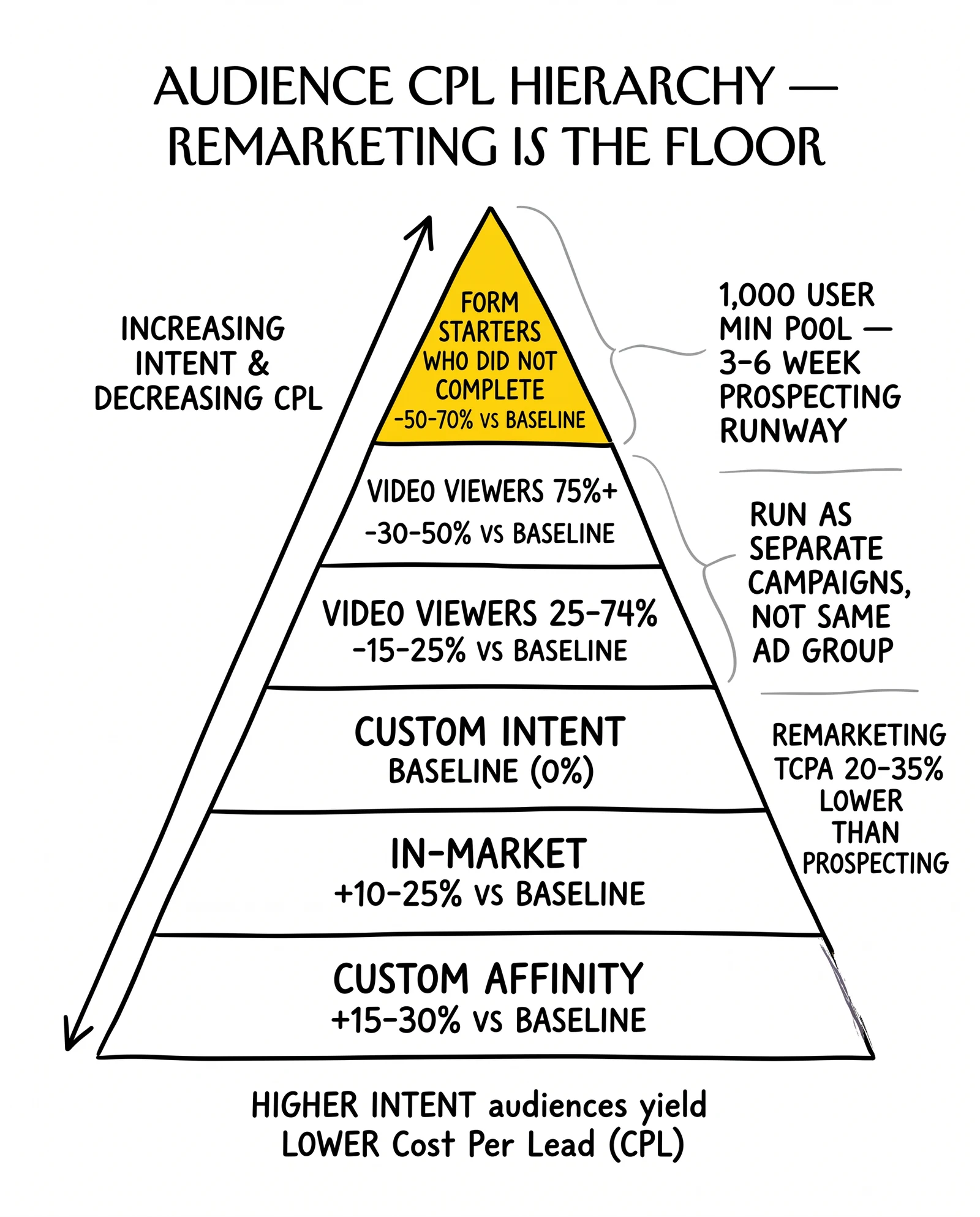
Remarketing audiences convert at 40-60% lower CPL than cold audiences for the same offer. Running them in the same campaign forces the algorithm to balance these two population types, often over-investing in cold inventory at the expense of remarketing efficiency.
Recommended structure:
| Campaign Type | Audience | Expected CPL Relative to Cold |
|---|---|---|
| Prospecting – Custom Intent | Google Search behavior | Baseline (0%) |
| Prospecting – In-Market | Google category signals | +10-25% |
| Prospecting – Custom Affinity | Browsing behavior | +15-30% |
| Remarketing – Site Visitors | Landing page + form start visitors | -40-55% |
| Remarketing – Video Viewers (75%+) | Watched 75%+ of previous ads | -30-50% |
| Remarketing – Email List | CRM upload of non-converted leads | -20-40% |
Each campaign type should have its own budget, its own bid strategy (often with different CPA targets), and its own creative set matched to the audience’s prior exposure.
Daily Budget Floors for Algorithm Stability
Smart bidding algorithms require minimum spend levels to function. Too-small daily budgets produce inconsistent delivery and CPL spikes because the algorithm lacks enough daily auction participation to calibrate.
Minimum daily budget rule of thumb: Your daily budget should be at least 5-10x your Target CPA. If Target CPA is $70, daily budget should be $350-$700 minimum. Below this threshold, the algorithm may not gather enough daily conversion signal to maintain stable bidding.
For new campaigns in the learning phase, set daily budgets higher than steady-state targets. A campaign with a $300/day steady-state budget should start at $400-$500/day during learning to accelerate signal accumulation. Scale back once the campaign exits the learning phase.
Audience Targeting: The Layers That Move CPL
Targeting selection directly determines which users enter your auction set. Each layer added–or removed–shifts CPL. The following configurations represent the high-impact combinations for lead generation verticals.
Custom Intent: The Highest-Signal Audience
Custom Intent audiences target users based on their recent Google Search queries. You upload a keyword list; Google identifies users who searched those terms within the past 7-30 days and shows your ads to them on YouTube.
CPL performance: Custom Intent consistently delivers 20-35% lower CPL than other cold audience types because it reaches users who have already demonstrated search-level purchase intent.
Keyword list construction:
- Target 50-150 keywords per audience (broader lists reach more users; narrower lists have higher intent concentration)
- Include competitor brand terms–users searching “[Competitor] quote” are evaluating options and are reachable
- Mix high-intent transactional terms (“auto insurance quote,” “solar panels cost”) with mid-funnel research terms (“best home insurance coverage,” “how solar financing works”)
- Refresh lists monthly by pulling search term reports from Google Search campaigns
Vertical-specific configurations:
For auto insurance: Include state-specific terms (“Texas car insurance,” “Florida auto insurance quotes”), rate-comparison terms (“cheapest auto insurance,” “compare car insurance rates”), and event triggers (“got a speeding ticket,” “just bought a car”).
For solar: Include ownership signals (“homeowner solar,” “my electricity bill”), incentive terms (“solar tax credit 2026,” “solar rebates”), and evaluation terms (“solar panel reviews,” “is solar worth it”).
For legal (personal injury): Include incident-specific terms (“car accident settlement,” “slip and fall attorney”), timeline terms (“statute of limitations personal injury”), and state-specific attorney terms.
In-Market Audiences: Volume at Acceptable CPL
Google’s In-Market audiences aggregate users who are actively researching specific purchase categories. Available segments for lead generation include Auto Insurance Shoppers, Home Insurance Seekers, Mortgage Refinance Seekers, Personal Injury Lawyers seekers, Solar Energy Products, and Home Improvement Leads.
CPL performance: In-Market audiences run 10-25% higher CPL than Custom Intent but deliver significantly more volume. They are the right choice when Custom Intent reaches scale limits or when starting a new vertical without an existing Custom Intent keyword library.
Layering In-Market with Custom Intent: The standard approach is to run Custom Intent and In-Market in separate campaigns rather than combining them in a single ad group. Combining them creates an “or” condition–users who match either signal–which can dilute the Custom Intent efficiency by mixing in lower-intent In-Market users.
Demographic Layering: CPL Reduction Through Exclusion
Demographic targeting does not just define who you reach–it determines who you exclude. Exclusion is often more impactful on CPL than inclusion because it prevents spend on viewers who cannot convert.
High-impact demographic exclusions by vertical:
| Vertical | Exclude | CPL Impact |
|---|---|---|
| Mortgage (purchase) | Renters | -15-25% |
| Medicare | Under 60 | -20-30% |
| Home improvement | Renters | -10-20% |
| Auto insurance (premium) | Household income bottom 30% | -10-15% |
| Solar | Renters, household income bottom 30% | -20-30% |
Household income targeting: Google provides household income quartile targeting (Top 10%, 11-20%, 21-30%, Lower 50%). For higher-ticket products–solar, premium insurance, mortgage–excluding the lower 50% income bracket typically reduces CPL 10-20% by eliminating viewers who cannot qualify or afford the product.
Age targeting precision: Do not simply set a minimum age. Use age range targeting to select the highest-converting brackets. For Medicare, the target is adults 64-67 who are approaching or just past Medicare eligibility–not all adults 65+. For home equity leads, 45-64 often outperforms 35+ because equity accumulation takes time.
Remarketing Configuration: The CPL Floor
Remarketing to prior visitors and video viewers represents the lowest achievable CPL on YouTube for most lead generation verticals. These audiences have prior exposure to your brand and have self-selected through behavior.
Audience hierarchy by CPL:
- Form starters who did not complete – Highest intent. These users started the conversion process. CPL runs 50-70% below cold prospecting.
- Landing page visitors (non-converters) – Visited the page, did not submit. CPL 40-55% below cold.
- Video viewers 75%+ – Watched substantial portions of your pre-roll ads. CPL 30-50% below cold.
- Video viewers 25-74% – Partial engagement. CPL 15-25% below cold.
- YouTube channel visitors – Small audience, variable quality.
Minimum audience size requirements: Google requires remarketing audiences to reach at least 1,000 users before campaigns can serve. For smaller lead generation operations, this means prospecting campaigns must run for 3-6 weeks before remarketing pools are large enough to use. Budget for this runway.
Bid differentiation: Remarketing campaigns should carry higher CPA targets (or Manual CPV with higher max CPV) than prospecting campaigns to win these high-value auctions. If your prospecting Target CPA is $70, remarketing Target CPA can go to $55-$60 while still improving blended CPL because the conversion rate is significantly higher.
Frequency Capping: The Overlooked CPL Driver
Frequency capping controls how many times the same user sees your ads within a defined period. Without caps, campaigns concentrate impressions on a small subset of highly reachable users, creating negative sentiment and wasted spend.
How Frequency Affects CPL
The relationship between frequency and conversion follows a curve, not a line. Initial exposures increase conversion probability. But after a threshold–typically 5-8 exposures in two weeks for lead generation–additional exposures generate diminishing returns and eventually drive negative sentiment that reduces conversion probability.
Measured frequency effects:
| Frequency Range | CPL Effect | Mechanism |
|---|---|---|
| 1-2 impressions | Baseline | First exposure; awareness building |
| 3-5 impressions | -10-20% CPL | Recognition, increased trust |
| 6-8 impressions | Neutral | Saturation threshold for most verticals |
| 9-12 impressions | +15-30% CPL | Diminishing returns, mild irritation |
| 13+ impressions | +30-50% CPL | Active avoidance, negative sentiment |
These ranges vary by vertical. High-consideration purchases (solar, mortgage) tolerate higher frequency–8-12 impressions–before sentiment turns negative, because the decision cycle is longer. Urgent or lower-consideration purchases (emergency home services, short-term insurance) hit the diminishing return threshold faster.
Setting Frequency Caps by Campaign Type
Prospecting campaigns (cold audiences):
- Recommended cap: 5-7 impressions per user per 7 days
- Rationale: Cold audiences need sufficient exposure to build awareness, but capping at 7 prevents budget concentration on highly reachable but non-converting users
Remarketing campaigns:
- Recommended cap: 3-5 impressions per user per 7 days
- Rationale: Remarketing audiences have prior exposure. Lower frequency caps prevent over-serving these high-value impressions and preserve the CPL advantage
Bumper ad remarketing sequences:
- Recommended cap: 2-3 impressions per user per 3 days
- Rationale: Bumpers are reminder-format ads meant for light reinforcement. Over-serving them undermines their low-intrusion positioning
Frequency and Creative Rotation Interaction
Frequency caps and creative rotation interact directly. If you cap at 5 impressions per week and rotate 5 creative variants, the same user may see a different ad each time–effectively resetting the irritation cycle. If you cap at 5 with only 1 creative variant, the user watches the same ad five times in seven days.
For campaigns running more than $20,000/month, maintain at least 3 active creative variants per campaign. This enables frequency caps to operate as intended without over-exposing users to identical content.
A/B Testing Creative: Variables, Sequencing, and Sample Requirements
Creative testing on YouTube differs from testing on search or display because the test unit is a video asset rather than a headline combination. Each variable requires sufficient impression and conversion volume before conclusions are valid.
Variables Worth Testing vs. Variables That Don’t Move CPL
Not all creative variables produce measurable CPL differences. Testing lower-impact variables consumes budget without improving performance.
High-impact variables (test first):
| Variable | Typical CPL Range of Effect | Why It Matters |
|---|---|---|
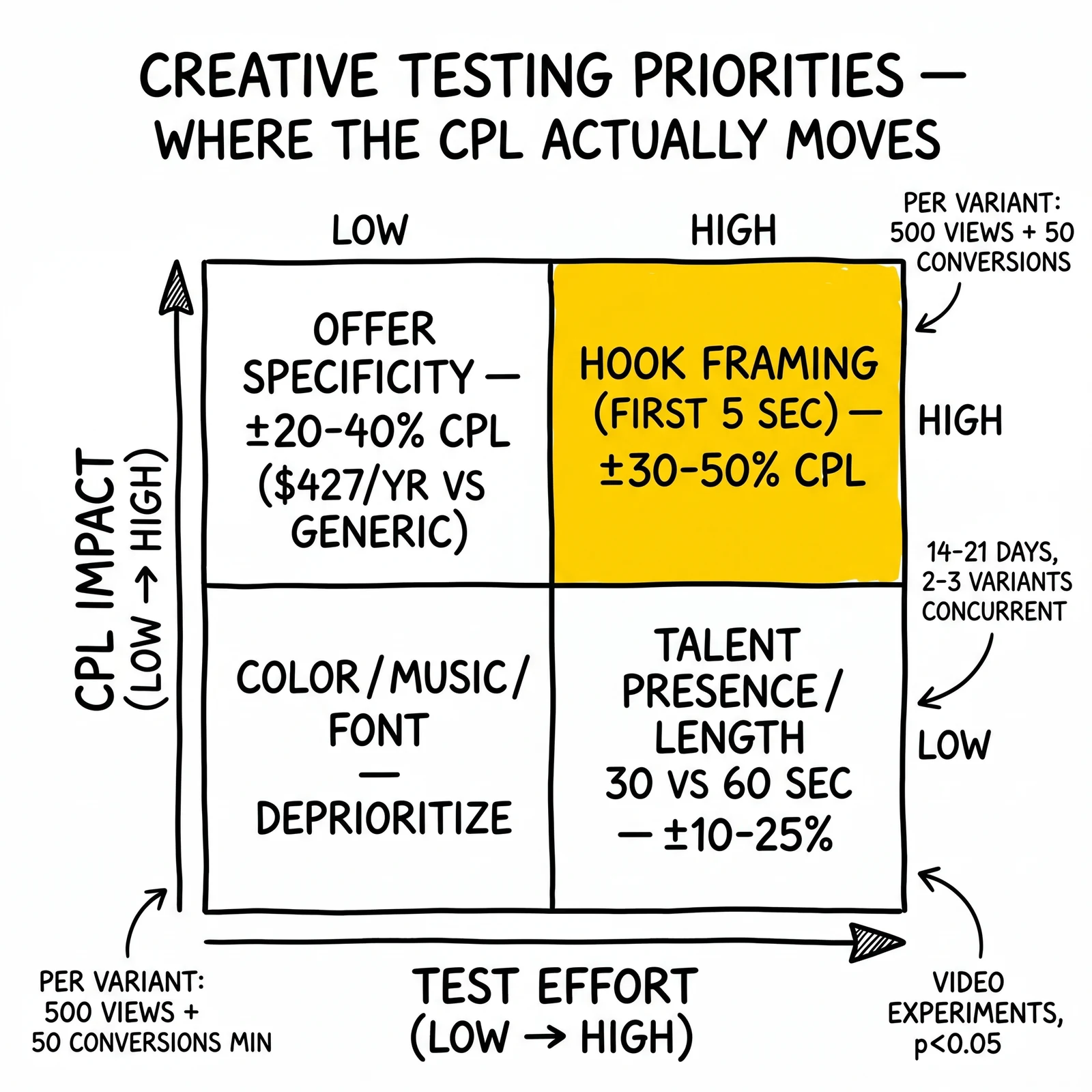
| Hook framing (first 5 seconds) | ±30-50% CPL | Determines view rate; view rate determines conversion pool size |
| Offer specificity | ±20-40% CPL | Specific offers (“save $427/year”) vs. generic (“save money”) |
| Call to action phrasing | ±15-30% CPL | Directness and specificity of the action request |
| Talent presence vs. no talent | ±10-25% CPL | Varies by vertical; legal benefits more than insurance |
| Length (30s vs. 60s) | ±10-20% CPL | Affects drop-off and conversion timing |
Lower-impact variables (test later):
- Color palette within the same brand language
- Background music style
- Animation vs. live action (when both are professional quality)
- Font choices in text overlays
Sample Requirements for Valid Test Results
YouTube creative tests require higher conversion volume than search ad tests because conversion events are further downstream (view → click → landing page → form submission). The compounding conversion steps reduce the signal reaching the creative level.
Minimum sample requirements:
- Per variant, per test: 500 views minimum; 50 conversions minimum for statistically meaningful CPL comparison
- Test duration: 14-28 days minimum to account for day-of-week and time-of-day variance
- Concurrent variants: Test 2-3 variants at a time. Testing more than 3 simultaneously dilutes volume across variants, extending the time to reach minimum sample size
For campaigns spending $10,000-$20,000/month, running more than 2 simultaneous creative tests typically means each test takes 4-6 weeks to reach minimum conversion thresholds. At $50,000+/month, 3 simultaneous tests often resolve in 2-3 weeks.
A/B Testing Structure: Campaigns vs. Ad Groups
Google Ads Video Experiments (found under Drafts & Experiments) enables proper holdout-based testing where a percentage of traffic is split at the campaign level. This avoids the selection bias problem inherent in running two ad groups within the same campaign (where the algorithm may serve one variant more based on early performance signals, before statistical significance is reached).
Recommended test structure:
- Use Video Experiments for tests where budget allows (splits 50/50 at campaign level)
- Set minimum experiment duration at 14 days; 21 days preferred
- Measure on CPL and view rate; CPL is primary, view rate explains why CPL differs
- Declare a winner only when the primary metric shows statistical significance (p < 0.05 in the Experiments interface)
When not to use Video Experiments: Very low-volume campaigns ($5,000-$10,000/month) may not reach statistical significance within a reasonable timeframe. In these cases, run variants sequentially (same creative for 30 days, then switch) and compare CPL across periods, accepting lower statistical confidence.
Hook Testing Protocol
The first-5-second hook is the highest-CPL-impact creative variable on YouTube. Test hooks before testing anything else. A hook that improves view rate from 20% to 28% increases the conversion pool by 40%–lowering effective CPL even if the post-hook content is identical.
Hook test variants to run first:
- Direct address vs. problem statement: “California homeowners…” vs. “Your energy bill is going up every summer…”
- Question vs. claim: “What if you could cut your insurance bill in half?” vs. “Arizona drivers cut their insurance bill by an average of $380”
- Visual interrupt vs. verbal interrupt: An unexpected visual in the first 2 seconds vs. an opening verbal hook with standard visual
Test one hook dimension at a time. Running direct address vs. problem statement with simultaneous visual changes makes it impossible to attribute CPL differences to the correct variable.
Post-Winner Iteration
Winning a creative test should immediately trigger the next test iteration. If direct address beats problem-statement by 18% on CPL, the next test should hold direct address constant and test two variants of the value promise delivered in seconds 3-4.
This ladder structure–test one variable, establish a winner, hold it constant, test the next variable–builds toward optimized creative in 3-4 test cycles rather than requiring a full creative overhaul.
Putting the Variables Together: A Configuration Example
A solar lead generation campaign illustrates how the five variables interact in practice.
Bid strategy: Launch with Manual CPV ($0.18 max CPV) for 3-4 weeks to gather conversion data. Transition to Maximize Conversions for 2-3 weeks until 30+ conversions per week. Then move to Target CPA at $95 (20% above $80 CPL goal), reducing by $5 every two weeks as performance stabilizes.
Budget architecture: Separate campaigns for prospecting (Custom Intent, In-Market) and remarketing (site visitors, 75%+ video viewers). Prospecting daily budget: $300/day. Remarketing daily budget: $75/day with separate Target CPA of $55 (reflecting expected conversion rate advantage).
Targeting: Custom Intent campaign uses 80 keywords including “solar panel cost,” “solar installation near me,” “solar tax credit 2026,” and competitor terms. Demographic layer excludes renters and household income bottom 30%. Geographic targeting set to California (highest CPL arbitrage vs. search in this example). Remarketing campaign targets landing page visitors from the past 60 days and YouTube video viewers who watched 75%+ of prospecting ads.
Frequency caps: Prospecting campaigns: 6 impressions per user per 7 days. Remarketing campaigns: 4 impressions per user per 7 days.
Creative testing: Three hook variants running simultaneously in prospecting campaign (minimum 14-day test, target 50+ conversions per variant before evaluating). Remarketing campaign uses the current winning hook with a remarketing-specific call to action (“You were interested before–see your savings estimate now”).
This configuration–running coordinated across all five variables–typically reaches target CPL 4-8 weeks faster than campaigns that optimize one variable in isolation.
Frequently Asked Questions
When should I switch from Manual CPV to Target CPA bidding?
Transition from Manual CPV once a campaign accumulates 30 or more conversions per month and has run for at least 4 weeks. Below that threshold, smart bidding strategies lack sufficient data to calibrate. The transition sequence is Manual CPV → Maximize Conversions (2-3 weeks) → Target CPA. Skipping the Maximize Conversions phase forces Target CPA to learn without conversion history, producing unstable CPL in the first 2-4 weeks.
What Target CPA should I enter when starting a campaign?
Set your initial Target CPA 20-30% above your actual CPL goal. If you need $70 CPL to be profitable, start with a $88-$91 Target CPA. The algorithm needs room to explore the auction landscape before it can efficiently hit tighter targets. Reduce the target by 5-10% every two weeks as performance stabilizes. Track at least 50 conversions between Target CPA adjustments.
How do I prevent YouTube from spending my entire budget on a small audience?
Frequency caps prevent over-concentration. Set a cap of 5-7 impressions per user per 7 days for prospecting campaigns. Without frequency caps, algorithms naturally concentrate spend on highly reachable users–typically those with strong Google account signals–regardless of whether additional exposures produce conversions. Frequency caps force broader reach, which typically reduces CPL by 10-20% compared to uncapped campaigns with the same budget.
Should remarketing campaigns use the same CPA target as prospecting?
No. Remarketing audiences convert at significantly higher rates than cold audiences–typically 2-4x higher. Setting the same Target CPA across both campaign types causes the algorithm to under-bid in remarketing auctions (where you should be willing to pay more because conversion probability is higher) and over-bid in prospecting (where conversion probability is lower). Set remarketing Target CPA 20-35% lower than prospecting Target CPA to reflect the conversion rate advantage.
How many creative variants do I need to run at once?
Three is the practical minimum for campaigns spending more than $15,000/month. Running a single creative exposes the campaign to creative fatigue (typically 3-5 weeks at this spend level) with no alternative when performance declines. Running more than 5 variants simultaneously fragments impressions and extends the time required to reach statistical significance on A/B tests. Three to four variants balances creative freshness with testability.
How do I know if my frequency cap is too tight or too loose?
Too tight: Campaign underdelivers budget–the algorithm cannot find enough eligible users within the cap. Symptoms include consistent underspending (delivering less than 80% of daily budget) and CPL rising over time as the algorithm reaches cap limits earlier in the day. Too loose: CPL rises as reach frequency increases past the saturation point. Check your frequency report (Campaigns → Columns → View-Based → Avg. frequency) and look for correlation between higher frequency and higher CPL. The inflection point is typically 6-9 impressions per user per 7 days for cold audiences in lead generation.
What is the minimum budget for a valid YouTube creative A/B test?
Each creative variant needs at least 500 views and 50 conversions before CPL comparison is meaningful. At a $0.20 CPV and 2% CTR with 10% landing page conversion rate, 50 conversions requires roughly 2,500 paid views per variant–a budget of approximately $500 per variant for the view cost alone, plus landing page costs. For a 2-variant test, plan $1,500-$2,500 in test budget per variant over 14-21 days. This means meaningful creative testing requires $3,000-$5,000 in dedicated budget per test cycle, separate from ongoing campaign spend.
When does it make sense to use portfolio bid strategies?
Portfolio bid strategies work best when you run 3 or more campaigns targeting the same conversion goal in the same market, where individual campaigns each generate fewer than 30 conversions per month. Pooling conversion data across campaigns accelerates algorithm calibration. The trade-off is reduced transparency–portfolio strategies make it harder to identify which campaign is driving efficiency or inefficiency. Use them during the scaling phase when volume is insufficient for individual campaign smart bidding; shift to campaign-level Target CPA once individual campaigns hit 30+ monthly conversions.
Key Takeaways
-
Bid strategy selection is a data volume decision, not a preference. Manual CPV for campaigns with fewer than 30 monthly conversions. Maximize Conversions during the learning transition. Target CPA as the production strategy once data is sufficient.
-
Set Target CPA 20-30% above your actual CPL goal when launching. The algorithm needs room to calibrate. Tighten the target by 5-10% every two weeks as performance stabilizes.
-
Separate prospecting and remarketing into different campaigns with different CPA targets. Remarketing audiences convert at 2-4x higher rates; they deserve lower CPA targets that reflect higher conversion probability.
-
Frequency capping at 5-7 impressions per user per 7 days typically reduces CPL 10-20% versus uncapped campaigns by forcing broader reach rather than concentration on highly reachable but non-converting users.
-
Test hooks first. A hook improvement that raises view rate from 20% to 28% increases the conversion pool by 40% without changing anything else in the creative. Hook testing outperforms testing color, music, or production style.
-
Each creative A/B test needs 500 views and 50 conversions per variant. Below this threshold, CPL comparisons are not statistically meaningful. Budget for test volume before drawing conclusions.
-
Demographic exclusions reduce CPL more reliably than demographic inclusions. Excluding renters from home improvement campaigns, excluding under-60 viewers from Medicare campaigns, and excluding the bottom 30% income bracket from solar campaigns each reduce waste by 10-30% with minimal volume impact.
-
Budget increases above 20% per week destabilize smart bidding algorithms. The learning phase resets on large budget changes, causing temporary CPL spikes. Patient scaling maintains efficiency.
Sources
- Google Ads Help: Smart Bidding overview and Target CPA recommendations (support.google.com/google-ads)
- Google Ads Help: About Video Experiments (support.google.com/google-ads)
- Google Ads Help: Frequency management in video campaigns (support.google.com/google-ads)
- Google Ads Help: About audience segments – In-Market audiences (support.google.com/google-ads)
- Google Ads Help: Custom segments based on search activity (support.google.com/google-ads)
Performance benchmarks reflect aggregated campaign data from lead generation verticals (insurance, solar, legal, mortgage) at spend levels of $15,000-$200,000/month. Individual campaign results vary based on vertical, creative quality, geographic market, and competitive auction conditions.