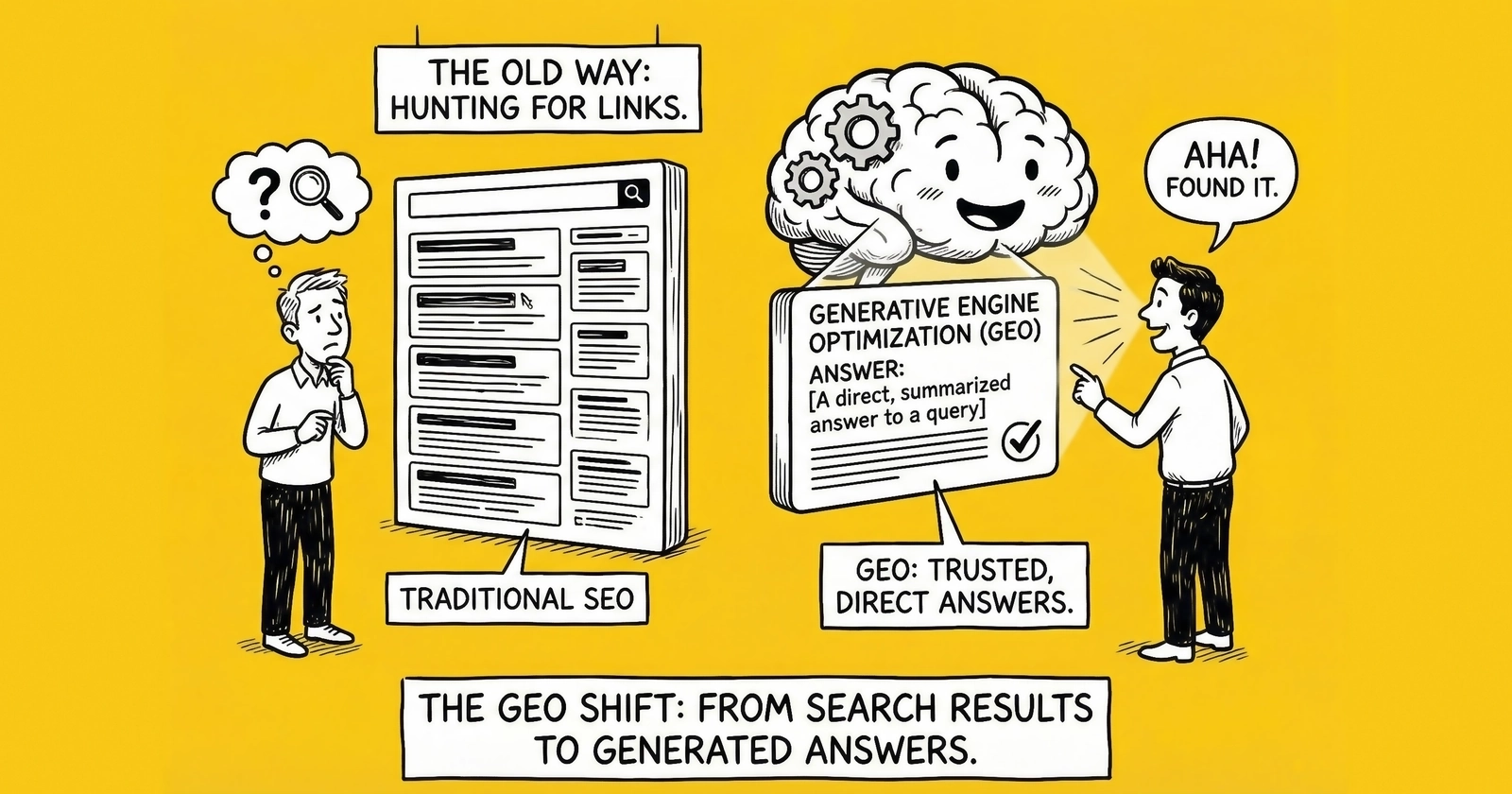
The rules of organic discovery are being rewritten. Here is how to ensure your content gets cited by AI, not just indexed by Google.
The Discovery Revolution You Cannot Ignore
For two decades, the game was simple: rank on Google, capture traffic, convert leads. That game is not ending, but it is fundamentally expanding.
When a consumer asks ChatGPT “What is the best solar installer in Phoenix?” or queries Perplexity about “TCPA compliance requirements for lead generators,” something different happens than a traditional Google search. The AI does not return ten blue links. It synthesizes information from across the web and delivers a direct answer, often citing just three to five sources.
Here is the uncomfortable reality: if your content is not among those cited sources, you do not exist in that conversation. The consumer never sees your website. Never knows you had an answer. Never becomes a lead.
This is Generative Engine Optimization (GEO), and it represents the most significant shift in organic discovery since Google displaced the Yellow Pages.
Research from Princeton, Georgia Tech, The Allen Institute for AI, and IIT Delhi published in 2024 demonstrates that GEO strategies can increase content visibility in AI-generated responses by up to 40%. That is not a marginal improvement. That is the difference between owning a conversation and being invisible to it.
What Makes GEO Different from Traditional SEO
Traditional SEO optimizes for ranking algorithms that present links. GEO optimizes for synthesis algorithms that present answers. The distinction matters more than most practitioners realize.
The Fundamental Shift
Google’s traditional search returns results. AI search engines return responses. This difference cascades through every optimization decision you make.
When Google ranks your page at position one, you still compete with nine other results on the first page. According to Backlinko research, the first organic search result captures 27.6% of clicks, but the top three positions combined receive 54.4% of all clicks. Competition remains fierce even at the top.
When ChatGPT or Perplexity cites your content, you become part of the answer itself. The AI weaves your information into its response, often with direct attribution. The competition is not for clicks; it is for inclusion in the synthesis.
How AI Search Engines Actually Work
Understanding the mechanics reveals the optimization opportunities.
Generative engines like ChatGPT, Perplexity, Google Gemini, and Claude process queries through large language models trained on vast text corpora. When users ask questions, these systems parse the query for intent and context, retrieve relevant information from their training data and (for some) real-time web sources, synthesize retrieved information into coherent responses, and cite sources that contributed to the synthesis when configured to do so.
The retrieval and citation process differs fundamentally from traditional search ranking. Google asks: “Which pages best match this query?” AI systems ask: “What information best answers this question, and which sources contain it?”
This distinction creates new optimization imperatives. Content that ranks well for keywords may not be structured for AI synthesis. Conversely, content optimized for AI citation may perform differently in traditional search results.
The Dual Optimization Challenge
smart practitioners are not choosing between SEO and GEO. They are mastering both. Understanding the fundamentals of SEO for lead generation provides the foundation for GEO success.
Google AI Overviews now appear in approximately 6.71% of searches across all industries, according to Semrush Sensor analysis from December 2024. But prevalence varies dramatically by sector. Health queries show the highest AI Overview presence at 23.02%, followed by Science at 20.13%, Internet and Telecom at 11.72%, Travel at 9.99%, and Computers and Electronics at 8.75%. Real Estate shows the lowest presence at just 0.41%.
For lead generation verticals, this means AI Overviews are more likely to appear for insurance and health-related queries than for mortgage or home services queries. Your optimization strategy should reflect this reality.
The good news: research from FirstPageSage indicates that sources cited within AI Overviews now garner click-through rates rivaling those of top three to five organic search results. Being cited is not just visibility; it drives traffic.
The AI Search Engine Landscape in 2026
Understanding where AI-powered search is heading requires mapping the current competitive landscape.
Google AI Overviews (Formerly SGE)
Google’s AI Overviews represent the most significant integration of generative AI into traditional search. When they appear, users receive AI-synthesized answers above organic results, with cited sources displayed as clickable links.
AI Overviews appear in 6.71% of searches overall but reach up to 23% in health-related queries. Google typically cites three to five sources within each overview. Initial concerns about reduced organic clicks have not materialized at scale; sources cited in AI Overviews receive comparable click-through rates to top organic positions. Google states there is “nothing special for creators to do to be considered other than to follow our regular guidance for appearing in search.”
Google’s Shopping Graph integration means AI Overviews for product-related queries pull from more than 35 billion product listings updated hourly. For lead generators in e-commerce adjacent verticals, structured product data becomes critical.
ChatGPT with Web Search
OpenAI’s integration of real-time web search into ChatGPT fundamentally changed the platform from a static knowledge base to a dynamic information retrieval system.
ChatGPT’s search functionality retrieves current web content in response to queries, synthesizes information into conversational responses, provides source citations when drawing from specific web pages, and handles complex, multi-step queries that traditional search struggles with.
For practitioners, ChatGPT represents both a discovery channel and a research tool. The same optimization that makes your content citable to ChatGPT users also makes it findable when ChatGPT itself researches topics for its responses.
Perplexity AI
Perplexity positions itself as an “answer engine” rather than a search engine. Its approach differs from both Google and ChatGPT through real-time web retrieval for every query, inline source citations that make attribution clear, follow-up capability that retains context across questions, and Pro Search for deeper research on complex queries.
Perplexity’s growth signals market appetite for AI-native search. The platform has attracted significant venture funding, with valuations reflecting investor confidence in the AI search category.
Microsoft Copilot and Bing AI
Microsoft’s integration of AI into Bing through Copilot creates another discovery surface. While Bing’s market share remains smaller than Google’s, the AI integration means Copilot responses synthesize information from Bing’s index, enterprise users accessing Copilot through Microsoft 365 receive AI-enhanced search, and Edge browser users encounter AI features by default.
For B2B lead generators, the enterprise penetration of Microsoft products makes Copilot optimization increasingly relevant.
Emerging Players and Specialized AI
The landscape continues to evolving. Claude (Anthropic), Gemini (Google’s consumer AI), and vertical-specific AI tools create additional discovery surfaces. Each may have different retrieval mechanisms and citation behaviors.
The pattern is clear: AI-powered search is fragmenting across multiple platforms, each with distinct optimization requirements. Those who succeed will develop content strategies that work across this fragmented landscape.
The GEO Framework: Optimizing Content for AI Citation
Research published in 2024 by academic teams studying Generative Engine Optimization identified specific strategies that increase visibility in AI-generated responses. These strategies form the foundation of practical GEO implementation.
Understanding What AI Systems Prioritize
AI systems optimizing for helpful, accurate responses naturally prioritize certain content characteristics.
Clarity and Directness
AI synthesis works best with content that states information clearly. Buried insights, vague language, and excessive qualification reduce the likelihood of citation.
Authoritative Sourcing
Content that itself cites credible sources signals reliability. AI systems trained to be accurate prefer sources that demonstrate their own commitment to accuracy.
Comprehensive Coverage
Content that thoroughly addresses a topic provides more synthesis material than thin content. Depth matters.
Structured Information
Content organized with clear headings, logical flow, and identifiable sections is easier for AI to parse and extract.
Unique Value
Information available nowhere else, or presented with unique expertise, becomes essential to accurate synthesis.
The Nine GEO Optimization Strategies
Based on research findings and emerging best practices, these strategies increase AI citation probability.
Strategy 1: Cite Authoritative Sources Within Your Content
Content that references credible external sources performs better in AI synthesis. When you cite research, statistics, or expert opinions with attribution, AI systems gain confidence in your content’s reliability.
Effective implementation means including specific statistics with source attribution, referencing industry reports, academic research, and official data, linking to primary sources when possible, and updating citations regularly to maintain currency.
Strategy 2: Include Statistics and Quantitative Data
AI systems synthesizing answers benefit from specific numbers. Vague claims like “significant improvement” provide less synthesis value than “40% increase in visibility.”
Lead with specific numbers in key claims and provide context for statistics through benchmarks and comparisons. Use current data within two years for most applications, and include ranges when precision is not possible.
Strategy 3: Add Quotations from Recognized Experts
Expert quotes serve multiple purposes: they add credibility, provide synthesis-ready snippets, and demonstrate the depth of your research. Include direct quotes from industry experts with clear attribution of names and credentials. Use quotes to support key points rather than as filler, and seek original quotes when possible through interviews.
Strategy 4: Simplify Complex Concepts
AI systems must synthesize information for users with varying expertise levels. Content that explains complex topics accessibly provides more synthesis value. Define technical terms on first use, use analogies and examples for abstract concepts, break complex processes into clear steps, and provide both overview and detail layers.
Strategy 5: Structure Content with Clear Headings and Sections
Semantic structure helps AI systems identify and extract relevant information. Clear organization maps directly to synthesis efficiency. Use hierarchical headings (H2, H3, H4) consistently, create logical section flow, use descriptive heading text rather than clever but vague phrasing, and include summary sections for longer content.
Strategy 6: Provide Direct Answers to Specific Questions
Content that directly answers common questions in clear, concise language becomes citation-ready. AI systems seeking to answer user queries prefer sources that do the same. Identify the questions your audience asks, answer those questions explicitly in your content, place answers near the beginning of relevant sections, and use question-and-answer formatting for FAQ content.
Strategy 7: Demonstrate Topical Authority and E-E-A-T
Google’s E-E-A-T framework (Experience, Expertise, Authoritativeness, Trustworthiness) influences both traditional SEO and AI citation. Content from demonstrably authoritative sources receives preference. Include author credentials and experience, link to author profiles and other work, demonstrate real-world experience in content, and build topical clusters that establish domain expertise.
Strategy 8: Optimize for Featured Snippets and Position Zero
Content that earns featured snippets in traditional search often performs well in AI synthesis. The optimization overlap is significant. Structure content to answer questions directly, use formatting that matches snippet types (paragraphs, lists, tables), target question-based queries, and provide concise answers followed by detailed explanation.
Strategy 9: Implement Comprehensive Structured Data
Schema.org markup helps AI systems understand content semantically. While primarily associated with traditional SEO, structured data increasingly influences AI discovery. Implement Article schema for content pages, FAQ schema for question-and-answer content, Organization schema for brand pages, and relevant industry-specific schemas.
Structured Data: The Foundation of AI Discoverability
Structured data implementation deserves particular attention in the GEO context. Schema.org vocabulary provides machine-readable definitions that AI systems use to understand content semantically.
Why Structured Data Matters for GEO
AI systems processing web content benefit from explicit semantic markup. When your content includes structured data, AI understands content type (article, FAQ, product, service), relationships between entities become clear, key information is explicitly identified, and content becomes more reliably extractable.
Schema.org supports multiple implementation formats: JSON-LD (recommended), Microdata, and RDFa. JSON-LD embedded in HTML remains the preferred method for most implementations.
Priority Schema Types for Lead Generation Content
Article Schema applies to blog posts, guides, and educational content:
{
  "@context": "https://schema.org",
  "@type": "Article",
  "headline": "Your Article Title",
  "author": {
    "@type": "Person",
    "name": "Author Name"
  },
  "datePublished": "2026-01-15",
  "dateModified": "2026-01-15"
}
FAQPage Schema applies to FAQ content and is critical for GEO:
{
  "@context": "https://schema.org",
  "@type": "FAQPage",
  "mainEntity": [{
    "@type": "Question",
    "name": "Your Question Here",
    "acceptedAnswer": {
      "@type": "Answer",
      "text": "Your answer here"
    }
  }]
}
Additional priority schemas include Organization Schema for company and brand pages, LocalBusiness Schema for location-specific lead generation, Service Schema for service descriptions, and HowTo Schema for instructional content.
Implementation Best Practices
Validate all structured data using Google’s Rich Results Test and keep structured data current with content updates. Avoid markup spam by only marking up content that exists on the page. Use specific schemas rather than generic alternatives, and test implementation across major AI platforms when possible.
Citation Strategies: Getting AI to Reference Your Content
Understanding how AI systems decide what to cite reveals actionable optimization opportunities.
The Citation Decision Process
When AI systems generate responses, citation decisions involve relevance matching (does this source address the query?), authority assessment (is this source credible on this topic?), recency evaluation (is this information current?), and synthesis suitability (can this content be effectively incorporated?). Optimizing for citation means excelling across all four dimensions.
Building Citable Content
Lead with Citable Statements
The first paragraph of your content often determines citation potential. Front-load your most valuable, unique insights.
Instead of: “In this comprehensive guide, we will explore the many factors that contribute to lead generation success…”
Use: “Lead response time remains the single most predictive factor in conversion rates. Leads contacted within one minute convert at 391% higher rates, according to Velocify research.”
The second version provides a specific, citable claim with attribution in the opening.
Create Synthesis-Ready Snippets
AI systems extract and synthesize information. Content structured in extractable units performs better. Effective formats include numbered lists with clear, complete points, definition statements (“X is Y”), comparison statements (“Unlike X, Y provides Z”), statistical claims with context, and process descriptions with clear steps.
Establish Unique Value
Content that merely synthesizes existing information provides limited value to AI systems already capable of synthesis. Unique value comes from original research and data, expert interviews and quotes, real-world case studies with specifics, proprietary frameworks and methodologies, and first-hand experience and observations.
AI systems seeking comprehensive answers naturally gravitate toward sources offering information unavailable elsewhere.
Topical Authority and Content Clusters
Individual content pieces exist within broader topical contexts. AI systems assess not just the page but the source’s overall authority on a topic.
Building topical authority requires creating comprehensive content clusters around core topics, interlinking related content meaningfully, updating and expanding existing content regularly, demonstrating expertise across topic dimensions, and building external citations and references to your content.
For lead generation businesses, this means developing deep content assets around your core verticals and expertise areas, not just scattered blog posts on trending topics. The same principle applies to first-party data strategies – depth and authority compound over time.
The Future of Organic Traffic: Where GEO Is Heading
Understanding trajectory helps operators invest appropriately for coming changes.
Gartner’s Prediction: 25% Search Volume Decline by 2026
Gartner research predicts traditional search engine volume will decline by 25% by 2026 as users shift to AI-powered alternatives. This does not mean organic discovery becomes less important; it means the nature of organic discovery changes.
For lead generators, this carries significant implications. Traffic from traditional search may decline even with stable rankings. AI-powered discovery surfaces become increasingly critical. Content optimization must serve multiple discovery mechanisms. Attribution models must account for AI-mediated discovery.
The Convergence of Search and AI
Google’s integration of AI Overviews signals the future: traditional search and AI synthesis converging into unified experiences. Users will not “choose” between Google and AI; they will receive AI-enhanced results by default.
This convergence means GEO and SEO increasingly overlap. The optimizations that help content rank may also help it get cited, though the emphasis differs.
AI Agents and Autonomous Discovery
The next frontier extends beyond human-initiated search to AI agent-initiated discovery. As AI agents increasingly research on behalf of users, content must be discoverable by machines operating without direct human guidance.
This agentic commerce trajectory accelerates the importance of machine-readable content formats, API-accessible information, structured data implementation, and real-time accuracy and currency.
Lead generators preparing for this future are investing in content infrastructure that serves both human and machine discovery.
The Attention Economy Shift
Traditionally, organic traffic meant capturing attention through rankings and clicks. In AI-mediated discovery, attention capture happens within the AI response itself.
When Perplexity answers a query citing your content, the user absorbs your information without necessarily visiting your site. The “conversion” happens in the citation and summary, not the click.
This shifts how operators think about content ROI. Brand mentions in AI responses have value independent of clicks. Authoritative citation builds trust even without traffic. Content that gets cited influences decisions without visits. Traditional traffic metrics undercount AI-mediated influence.
Zero-Click Answers and Lead Generation Strategy
The rise of zero-click search results (where users get answers without clicking through to websites) has concerned marketers for years. AI-powered search accelerates this trend dramatically.
For lead generation specifically, this creates strategic choices. Information content like educational articles may increasingly serve brand-building rather than direct lead capture, as users learn from your cited expertise without visiting your site. Conversion content designed for lead capture, such as landing pages and forms, requires different strategies since these pages need traffic, not just citations. Hybrid approaches create content that provides value in AI responses while also compelling users to click through for complete solutions, tools, or personalized assessments.
The operators adapting most effectively recognize that not all content serves the same purpose. Some content builds authority and trust through AI citation. Other content drives direct conversions through traffic. The strategy is knowing which is which and optimizing accordingly.
Industry-Specific GEO Considerations
Different lead generation verticals face distinct GEO challenges and opportunities. Understanding these nuances improves optimization targeting.
Insurance Lead Generation
Insurance queries trigger AI Overviews at higher rates than many other verticals. Health-related queries (including health insurance) show 23% AI Overview prevalence.
For insurance lead generators, regulatory accuracy is critical because outdated compliance information damages authority. State-specific content clusters build geographic relevance. Comparison content structured for synthesis performs well. Expert credentials matter more in regulated industries than in less regulated spaces.
Legal Lead Generation
Legal queries often trigger AI responses, but AI systems are cautious about providing legal advice. This creates opportunities for authoritative legal content that AI can cite without crossing into advice.
Informational content (what is, how does, when should) outperforms advice content in legal GEO. Attorney credentials and bar membership add authority signals. Case outcome statistics and settlement data provide citable value. Jurisdiction-specific content earns targeted citations.
Home Services Lead Generation
Home services queries show moderate AI Overview prevalence. Local intent often dominates these queries, creating different optimization requirements.
Local business structured data becomes essential for home services. Service-specific content with clear scope definitions helps AI understand your offerings. Pricing transparency provides unique citable value that competitors often lack. Project timeline and process explanations serve AI synthesis well.
Solar and Energy Lead Generation
Solar queries combine research intent with local considerations. AI responses often synthesize technical and financial information.
Incentive and rebate information requires constant updates to maintain accuracy and citation value. ROI calculators and payback period explanations provide synthesis value. Geographic eligibility content builds local authority. Technical specifications with comparison context earn citations.
Implementation Roadmap: Bringing GEO Into Your Operations
Theory becomes value only through execution. Here is a phased approach to GEO implementation.
Phase 1: Audit and Foundation (Weeks 1-4)
Begin by auditing current content to identify highest-value content assets, assess existing structured data implementation, evaluate content structure and formatting, and review authority signals including citations, author credentials, and E-E-A-T factors.
Establish baselines by documenting current organic traffic by content piece, noting existing AI Overview inclusions using rank tracking tools that monitor AI features, and testing current content discoverability in ChatGPT, Perplexity, and other AI platforms.
Pursue priority quick wins by adding FAQ schema to existing Q&A content, updating author information and credentials, improving opening paragraphs with citable statements, and adding statistics and source citations to thin content.
Phase 2: Strategic Optimization (Weeks 5-12)
Content enhancement involves restructuring key content for AI synthesis, adding expert quotes and authoritative citations, implementing comprehensive structured data, and creating content specifically designed for AI citation.
Topical authority building requires developing content clusters around core topics, creating pillar content with comprehensive depth, building internal linking structure, and pursuing external citations and references.
Technical implementation includes completing Schema.org implementation across your site, ensuring mobile optimization and page speed, implementing clear content hierarchy, and adding machine-readable elements like tables, lists, and definitions.
Phase 3: Measurement and Iteration (Ongoing)
Monitor AI discovery by tracking mentions in AI-generated responses, monitoring citation frequency across platforms, measuring traffic from AI-enhanced search features, and assessing brand visibility in AI contexts.
Iterate based on performance by identifying content that gets cited versus ignored, analyzing patterns in successful content, updating underperforming content with GEO optimizations, and developing new content based on citation success patterns.
Stay current by monitoring AI platform changes and new features, tracking industry GEO research and best practices, testing new optimization strategies, and adapting to evolving AI search landscapes.
Measuring GEO Success: Metrics That Matter
Traditional SEO metrics only partially capture GEO performance. A comprehensive measurement approach includes multiple metric categories.
Traffic and Engagement Metrics
Track organic traffic from AI-enhanced search features, click-through rates from AI Overviews, referral traffic from AI platforms like Perplexity and ChatGPT browse mode, and engagement metrics for AI-referred visitors.
Visibility Metrics
Monitor frequency of AI Overview inclusion, citation frequency in AI platform responses, featured snippet capture rate, and position within AI-generated responses.
Authority Metrics
Measure external citation growth, backlink quality and quantity, domain authority trends, and expert association and mentions.
Business Impact Metrics
Track lead volume from AI-mediated sources, conversion rates by traffic source, cost per lead from organic and AI channels, and attribution across AI touchpoints.
Tracking Challenges
AI-mediated discovery creates attribution challenges. When a user reads your cited content in an AI response and later searches directly for your brand, the AI influence may not appear in traditional analytics.
Approaches to address this include monitoring branded search volume as a proxy for AI influence, using assisted conversion analysis in attribution models, surveying new leads about discovery channels, and tracking content performance across AI platforms manually.
Common GEO Mistakes and How to Avoid Them
Operators new to GEO often make predictable mistakes. Learning from others’ errors accelerates success.
Mistake 1: Treating GEO as Separate from SEO
The optimization overlap between GEO and SEO is substantial. Content that ranks well often gets cited. Content optimized for citation often ranks. Treating them as entirely separate initiatives creates redundant work and missed synergies.
Instead, develop unified content optimization processes that address both ranking and citation requirements.
Mistake 2: Chasing AI Platform Algorithm Details
Unlike Google, AI systems do not publish ranking factor guides. Trying to reverse-engineer exact algorithms wastes effort on an unknowable target.
Instead, focus on content quality signals that all AI systems value: clarity, authority, accuracy, structure, and unique value.
Mistake 3: Ignoring Existing Content Assets
Operators often focus on creating new “AI-optimized” content while neglecting existing high-value content that could be enhanced.
Instead, prioritize enhancing existing strong content with GEO optimizations before developing new content.
Mistake 4: Over-Optimizing for One Platform
Optimizing exclusively for ChatGPT or Perplexity creates platform concentration risk. AI search is fragmenting, not consolidating.
Instead, develop content strategies that work across multiple AI platforms while monitoring platform-specific patterns.
Mistake 5: Neglecting E-E-A-T Fundamentals
GEO-specific tactics cannot compensate for weak authority foundations. AI systems still prefer credible sources on topics.
Instead, build genuine expertise, experience, and authority signals alongside GEO-specific optimizations.
Mistake 6: Forgetting the Human Reader
Content optimized exclusively for AI extraction may read awkwardly to humans. Since humans still visit your site and convert to leads, human readability remains essential.
Instead, write for humans first, then ensure the content is also AI-synthesis friendly. Good writing often serves both purposes.
Tools and Resources for GEO Implementation
Practical implementation benefits from appropriate tooling. Here are resources for GEO optimization across key categories.
Structured Data Validation
Google Rich Results Test validates Schema.org implementation and previews how content may appear in search features, making it essential for confirming structured data accuracy. Schema Markup Validator tests structured data against Schema.org specifications and proves useful for debugging complex implementations. Merkle Schema Markup Generator assists in creating structured data for common schema types without manual JSON-LD coding.
AI Search Monitoring
Manual platform testing involves regularly querying ChatGPT, Perplexity, and other AI platforms for terms relevant to your business, documenting when your content appears and when it does not. Rank tracking tools with AI features from several SEO platforms now track AI Overview inclusion alongside traditional rankings. Brand monitoring tracks mentions of your brand and content across AI platforms to understand citation frequency and context.
Content Optimization
Natural language processing tools analyze content readability and structure, with tools that identify question-answer patterns helping optimize for featured snippets and AI synthesis. Content gap analysis identifies topics where competitors receive AI citations but you do not, allowing prioritization of content development in these gaps. Authority assessment uses domain authority metrics, backlink analysis, and E-E-A-T audits to identify authority-building opportunities.
Performance Measurement
Google Search Console monitors performance for queries where AI Overviews appear and tracks clicks and impressions from AI-enhanced results. Analytics segmentation creates segments for traffic from AI-related referrers when identifiable and compares behavior to traditional organic traffic. Attribution modeling develops attribution approaches that account for AI-mediated touchpoints in the customer journey.
Frequently Asked Questions
What is Generative Engine Optimization (GEO)?
Generative Engine Optimization (GEO) is the practice of optimizing content to increase visibility and citation in AI-powered search engines and generative AI platforms like ChatGPT, Perplexity, Google AI Overviews, and Claude. Unlike traditional SEO, which focuses on ranking in search results, GEO focuses on getting content cited within AI-generated responses. Research shows GEO strategies can increase content visibility in AI responses by up to 40%.
How is GEO different from traditional SEO?
Traditional SEO optimizes for ranking algorithms that present links; GEO optimizes for synthesis algorithms that present answers. SEO success means appearing in search results where users choose which link to click. GEO success means having your content incorporated into the AI’s response itself, often with direct citation. While overlap exists between the two disciplines, GEO places greater emphasis on content structure, authoritative sourcing, direct answers, and machine-readable formatting.
Which AI search engines should I optimize for?
The major AI search platforms include Google AI Overviews (appearing in approximately 6.71% of searches), ChatGPT with web browsing capability, Perplexity AI, Microsoft Copilot/Bing AI, and Claude. Rather than optimizing for a single platform, develop content strategies that work across multiple AI systems. The fundamentals of quality, authority, structure, and clarity benefit visibility across all platforms.
Does GEO replace traditional SEO?
No. GEO complements traditional SEO rather than replacing it. Google remains the dominant search platform, and traditional organic rankings continue to drive significant traffic. However, as Gartner predicts a 25% decline in traditional search volume by 2026 due to AI alternatives, operators need both disciplines. The most effective approach integrates GEO and SEO strategies, recognizing their substantial overlap while addressing their distinct requirements.
How do AI search engines decide which sources to cite?
AI systems evaluate sources based on relevance to the query, perceived authority and credibility, information recency, and synthesis suitability. Content that directly answers questions, cites authoritative sources, provides specific data, and is structured for easy extraction tends to receive more citations. The exact algorithms are not public, but these quality signals consistently correlate with citation success.
What is the role of structured data in GEO?
Structured data (Schema.org markup) helps AI systems understand content semantically. By implementing appropriate schemas (Article, FAQPage, Organization, HowTo, etc.), you make your content more machine-readable and easier for AI systems to accurately parse and cite. While structured data alone does not guarantee citations, it improves content discoverability and interpretation by AI systems.
How do I measure GEO success?
GEO measurement combines traditional metrics with AI-specific tracking. Monitor organic traffic from AI-enhanced search features, track citation frequency across AI platforms, measure featured snippet capture rates, and assess referral traffic from AI platforms. Business metrics like lead volume and conversion rates from AI-mediated sources complete the picture. Attribution remains challenging since AI influence may not appear in traditional analytics.
How long does it take to see GEO results?
GEO results typically emerge within two to four months for content optimization efforts, though this varies based on existing authority, competitive landscape, and implementation quality. Quick wins like adding FAQ schema or improving content structure may show faster results. Building topical authority through content clusters requires six to twelve months of sustained effort.
Can small businesses compete in GEO against larger competitors?
Yes. Unlike traditional SEO where domain authority heavily influences rankings, AI citation decisions focus more on content quality and relevance. A small business with genuinely expert, well-structured content on a specific topic can earn citations over larger competitors with generic content. Niche expertise and unique value become competitive advantages in GEO.
What are the biggest mistakes to avoid in GEO?
The most common mistakes include treating GEO as entirely separate from SEO (they overlap significantly), chasing unknowable algorithm details instead of focusing on quality fundamentals, neglecting existing content in favor of new creation, over-optimizing for a single AI platform, ignoring E-E-A-T authority signals, and optimizing so heavily for AI that content becomes awkward for human readers.
Key Takeaways
-
GEO is essential, not optional. AI-powered search is capturing market share from traditional search. Practitioners who ignore GEO risk declining organic visibility regardless of traditional SEO performance.
-
GEO and SEO overlap significantly. Quality content, clear structure, authoritative sourcing, and technical optimization serve both disciplines. Integrated strategies outperform siloed approaches.
-
Citation, not just ranking, determines visibility. In AI-mediated discovery, being cited within the response matters more than appearing in a results list. Optimize content for synthesis, not just indexing.
-
Structured data is foundational. Schema.org implementation makes content machine-readable and improves AI discoverability. Prioritize FAQ, Article, and Organization schemas for lead generation content.
-
Authority signals transcend platforms. E-E-A-T (Experience, Expertise, Authoritativeness, Trustworthiness) influences both traditional search and AI citation. Build genuine authority, not just optimization tactics.
-
Content structure enables extraction. Clear headings, direct answers, numbered lists, and logical organization make content easier for AI systems to parse and synthesize. Structure is strategy.
-
Unique value earns citations. AI systems synthesizing existing information need sources with unique insights, original data, or expert perspectives. Commodity content rarely gets cited.
-
Multi-platform optimization reduces risk. The AI search landscape is fragmenting across Google, OpenAI, Perplexity, Microsoft, and others. Optimize for quality fundamentals that work across platforms.
-
Measurement requires new approaches. Traditional analytics undercount AI-mediated influence. Track AI-specific metrics, monitor citation frequency, and recognize that brand awareness impacts may not show in direct traffic.
-
Start now; the window is closing. Early GEO adopters establish authority and citation patterns before competition intensifies. The operators building GEO capabilities today will own the AI-mediated discovery landscape tomorrow.
Sources
- GEO: Generative Engine Optimization (arXiv) - Princeton, Georgia Tech, Allen Institute for AI research on GEO strategies increasing visibility by up to 40%
- Backlinko: Google CTR Statistics - Research showing first organic result captures 27.6% of clicks, top three positions receive 54.4%
- Semrush Sensor - Real-time tracking of Google algorithm changes and AI Overview prevalence by industry
- Gartner: Search Engine Volume Decline Prediction - Prediction of 25% traditional search volume decline by 2026
- Google Structured Data Documentation - Official guidance for Article schema implementation
- Schema.org - Official schema vocabulary for structured data markup
- Google FAQ Page Structured Data - Official FAQPage schema documentation
- Perplexity AI - AI answer engine platform reference
The rules of organic discovery are being rewritten. The question is not whether to adapt, but how quickly you can build the capabilities that AI-mediated discovery demands. Those who move first will define the competitive landscape. Everyone else will wonder where their traffic went.