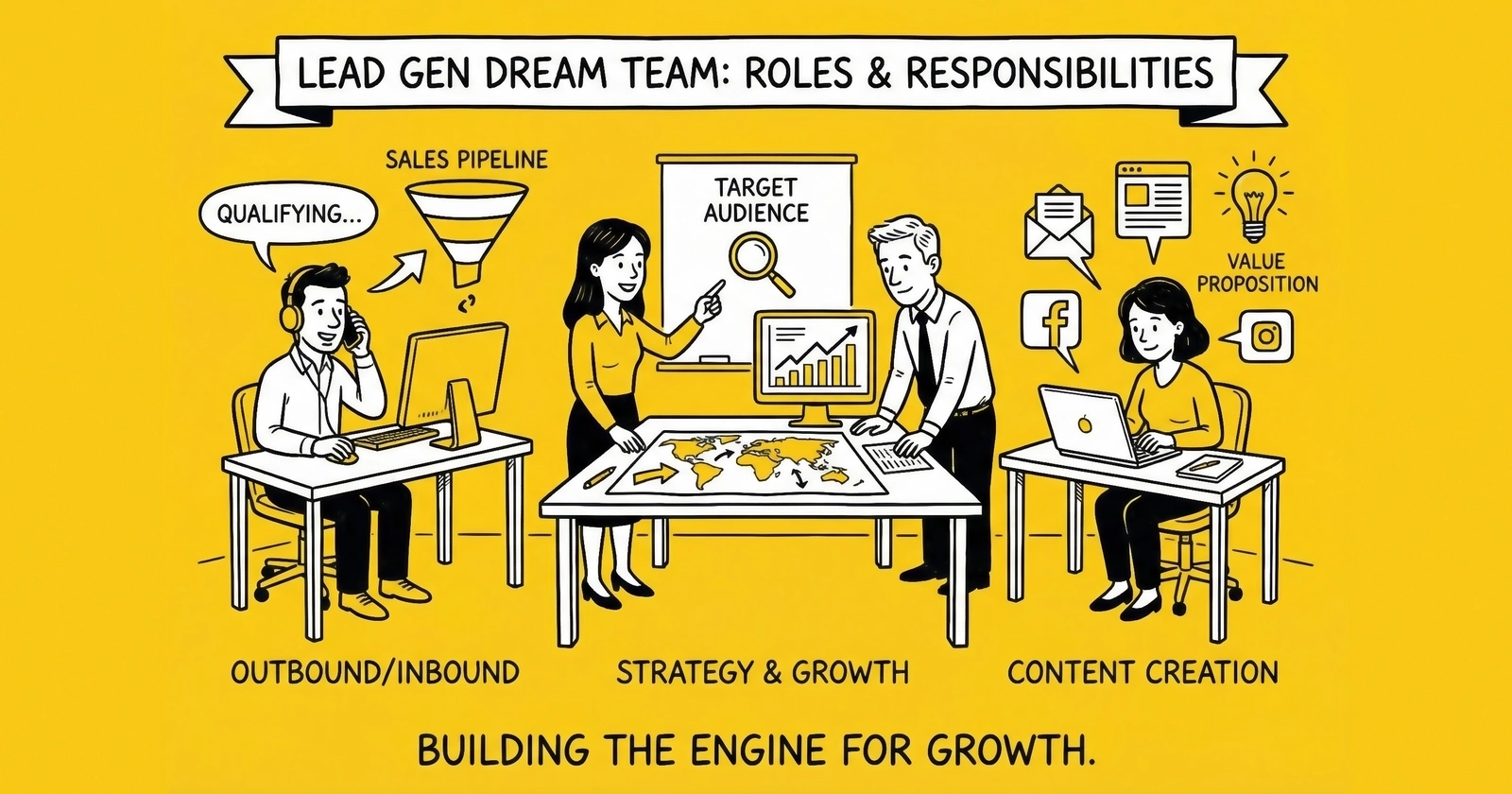
The practical guide to building a lead generation team from scratch – who to hire, when to hire them, what they should do, and how to structure compensation for performance.
Introduction: The Transition from Solo Operator to Team Leader
You have proven the model. Campaigns are profitable. Buyers are paying. The unit economics work. But you are hitting a ceiling that has nothing to do with market demand or campaign quality. The constraint is you.
Every hour you spend on campaign optimization is an hour you cannot spend on buyer development. Every day consumed by operations is a day lost to strategy. The pattern is clear: to grow beyond what one person can handle, you need people.
Building your first lead generation team is among the most consequential decisions you will make as an operator. The right hires multiply your capabilities. The wrong hires consume capital, create management overhead, and distract from the work that generates revenue.
This guide covers the specific roles that lead generation businesses need, the sequence in which to hire them, how to structure compensation, and how to avoid the hiring mistakes that kill growing operations. The numbers are based on 2024-2025 market rates, verified against industry salary data and operator experience across multiple verticals.
Most lead generation businesses fail to scale not because the model does not work, but because founders either hire too early, hire the wrong roles, or fail to structure teams for the unique demands of performance marketing. Understanding what makes lead generation team-building different from general business hiring is the first step toward doing it correctly.
When to Start Building a Team
The Signs You Need Help
The decision to hire should be driven by data, not desperation. Several indicators suggest you have reached the point where team-building makes economic sense.
The clearest signal is that you are personally maxed out and leaving money on the table. Calculate your theoretical capacity. If you could clone yourself, how much additional revenue could you capture? When this number exceeds the fully-loaded cost of a hire by 2x or more, the math favors hiring. This is not about feeling busy – it is about quantifiable opportunity cost.
Equally important is identifying specific functions that clearly constrain growth. Perhaps you have buyer demand you cannot fulfill because campaign management consumes all your time. Or your campaigns could scale but creative testing has stalled. The constraint must be specific before you hire to address it.
Financial runway matters too. You should be able to fund the role for 6-12 months without depending on that role generating immediate returns. New hires take time to become productive. If you need immediate ROI to make payroll, you are hiring from a position of weakness. Build runway before building team.
Finally, your unit economics must be proven and repeatable. Hiring amplifies what works. If you do not yet know what works, hiring amplifies experimentation costs. Wait until you have validated economics before adding headcount.
The Math Behind Your First Hire
Consider a concrete example. You are generating $50,000 monthly in lead revenue at 25% net margin after all costs – $12,500 monthly profit. You are working 60+ hours per week and cannot scale further without help.
A junior media buyer costs approximately $60,000-$75,000 annually fully loaded, or $5,000-$6,250 monthly. For this hire to be neutral, they need to generate an additional $20,000-$25,000 in monthly lead revenue at your current margins.
Is that realistic? If you have buyer demand you cannot currently fulfill, or campaigns that would scale with more attention, then yes. If you are struggling to sell the leads you already generate, adding production capacity makes no sense.
The formula: Hire when proven demand exceeds proven capacity by more than the cost of adding capacity.
Common Mistakes in Timing
Hiring too early is the most expensive mistake. You bring on a media buyer before validating unit economics. Their salary becomes a fixed cost while you are still learning what campaigns work. Every month of negative unit economics with payroll drains capital twice as fast.
Hiring too late creates different problems. You wait until you are so overwhelmed that operations suffer. Buyers complain about quality drops. Campaigns deteriorate without attention. By the time you hire, you are rebuilding rather than growing.
The third mistake is hiring for aspiration rather than current reality. You envision a team of eight but have revenue to support two. Hire for what you have proven, not what you hope to prove.
Core Roles in a Lead Generation Business
Lead generation operations require a specific mix of capabilities. While titles vary across companies, the functions remain consistent.
Media Buyer / Traffic Manager
The media buyer is your frontline revenue generator. This role acquires the traffic that becomes leads. Everything downstream depends on their performance.
Core Responsibilities
Media buyers handle daily management of paid media campaigns across platforms including Facebook/Meta, Google, TikTok, and native networks. They own budget allocation and bid optimization based on performance data, working closely with design resources on creative testing and iteration. Audience development, testing, and expansion falls under their purview, as does conversion tracking implementation and monitoring. They report against CPL, ROAS, and lead volume targets while maintaining platform compliance to avoid account suspensions.
Skills Required
Strong media buyers need hands-on expertise in at least one major platform – Facebook Ads Manager, Google Ads, or TikTok Ads. They must possess analytical capability to interpret data, identify patterns, and draw actionable conclusions. Understanding lead generation economics is essential: CPL, conversion rates, return rates, and how they interconnect. Technical ability to implement tracking, troubleshoot attribution issues, and work with server-side implementations separates good candidates from great ones. Above all, they must be comfortable with rapid iteration and data-driven decision-making.
What Distinguishes Top Performers
Average media buyers react to yesterday’s metrics. Excellent media buyers anticipate tomorrow’s problems. They recognize creative fatigue before click-through rates collapse. They spot traffic quality degradation before return rates spike. They understand the delayed feedback loops inherent in lead generation – where the consequences of today’s decisions may not appear for weeks.
The best media buyers in lead generation also understand the buyer side. They know that a $35 CPL lead that converts to sales at 8% is more valuable than a $25 CPL lead that converts at 4%. This downstream awareness shapes their optimization decisions. Understanding lead quality metrics helps media buyers optimize for outcomes, not just cost.
Salary Ranges (2024-2025)
| Experience Level | Base Salary | With Performance Bonus | Monthly Spend Managed |
|---|---|---|---|
| Junior (0-2 years) | $50,000-$65,000 | $60,000-$85,000 | Under $50K |
| Mid-level (2-5 years) | $65,000-$95,000 | $85,000-$130,000 | $50K-$200K |
| Senior (5+ years) | $95,000-$140,000 | $120,000-$200,000+ | $200K+ |
Remote positions typically pay 10-15% less than major metropolitan markets. Lead generation-specific experience commands a 15-25% premium over general performance marketing backgrounds.
Account Manager / Buyer Relations
The account manager maintains your revenue relationships. In lead generation, this means keeping buyers happy, resolving quality issues, and expanding wallet share with existing accounts.
Core Responsibilities
Account managers serve as the primary point of contact for lead buyers, communicating performance metrics and campaign results while resolving quality disputes and managing the returns process. They identify upsell opportunities – additional states, verticals, or volume – and gather buyer feedback on lead quality and specifications. Coordination between buyers and internal teams on requirements and issues falls to them, as does managing buyer onboarding and integration.
Skills Required
Communication skills sufficient to explain technical concepts to non-technical stakeholders are essential. Account managers need a problem-solving orientation – buyers rarely call with good news. Understanding lead quality metrics and what makes leads valuable to buyers enables meaningful conversations. Basic technical literacy helps them coordinate integration requirements, while sales acumen allows them to identify and pursue expansion opportunities.
What Distinguishes Top Performers
Average account managers are reactive – they solve problems when buyers complain. Excellent account managers are proactive – they identify issues before buyers notice them, they surface opportunities before buyers ask, and they build relationships that survive temporary quality dips.
The best account managers become indispensable to their buyers. They understand the buyer’s business well enough to anticipate needs, and they advocate internally for changes that benefit buyers while protecting margins.
Salary Ranges
| Experience Level | Base Salary | With Commission/Bonus |
|---|---|---|
| Junior (0-2 years) | $45,000-$55,000 | $55,000-$70,000 |
| Mid-level (2-4 years) | $55,000-$75,000 | $70,000-$100,000 |
| Senior (4+ years) | $75,000-$100,000 | $100,000-$150,000 |
Account managers often receive commission on account expansion or retention bonuses, which can add 20-40% to base compensation.
Operations Manager
As volume grows, operational complexity multiplies. The operations manager ensures that leads flow from generation to delivery without breaking, and that systems handle scale without manual intervention.
Core Responsibilities
Operations managers own lead flow management – monitoring delivery, identifying bottlenecks, and resolving failures. They oversee technology systems including lead distribution platforms, CRM, validation services, and consent documentation. Process documentation and improvement is ongoing work, as is vendor management – negotiating with technology providers and managing validation services. Compliance monitoring ensures consent documentation, validation rates, and delivery meet requirements. They build dashboards, identify trends, and support decision-making through reporting and analytics. Team coordination keeps media buyers, account managers, and other roles working together effectively.
Skills Required
Systems thinking – understanding how components interact – is foundational. Technical capability with APIs, data flows, and troubleshooting enables real problem-solving. Project management skills help them track multiple initiatives simultaneously. Detail orientation catches small issues before they become big problems. Communication skills translate technical realities into business language.
What Distinguishes Top Performers
Average operations managers keep systems running. Excellent operations managers make systems better. They identify automation opportunities, eliminate manual work, and build infrastructure that scales ahead of volume.
The best operations managers treat their role as enabling leverage. Every hour they invest in automation or process improvement creates hours of capacity for everyone else.
Salary Ranges
| Experience Level | Base Salary |
|---|---|
| Junior (0-2 years) | $50,000-$65,000 |
| Mid-level (2-5 years) | $65,000-$90,000 |
| Senior (5+ years) | $90,000-$130,000 |
Operations managers rarely receive large performance bonuses but may have retention bonuses or equity participation in more mature companies.
Creative Specialist / Designer
In lead generation, creative is the lever that moves performance most dramatically. A winning creative can carry a campaign for months. A stale creative library guarantees declining performance.
Core Responsibilities
Creative specialists develop ad creatives across formats: static images, video ads, carousels, and stories. They handle landing page design and optimization, designing and executing A/B tests while developing creative testing roadmaps. Brand consistency across campaigns requires ongoing attention, as does performance analysis to understand which creative elements drive results. Rapid iteration based on performance data completes the cycle.
Skills Required
Proficiency in design tools – Figma, Adobe Creative Suite, Canva for rapid iteration – is table stakes. Video editing capabilities in CapCut, Premiere, or After Effects expand their range. Understanding direct response design principles separates lead generation designers from brand designers. The ability to produce high volume without sacrificing quality is essential, as is data literacy connecting creative choices to performance metrics.
What Distinguishes Top Performers
Average designers make things look professional. Excellent lead generation designers understand that professional sometimes means boring. They know when to break design rules because pattern interruption drives attention. They balance brand consistency with the visual disruption required to stop a scroll.
The best creative specialists think in hypotheses. They do not just make ads – they design experiments. Every creative is a test of a specific premise about what drives conversion.
Salary Ranges
| Experience Level | Base Salary |
|---|---|
| Junior Designer (0-2 years) | $45,000-$60,000 |
| Mid-level Designer (2-5 years) | $60,000-$85,000 |
| Senior Designer / Creative Director (5+ years) | $85,000-$130,000 |
Creative specialists in lead generation often earn less than their counterparts in brand agencies but may have greater earning potential through performance bonuses tied to campaign results.
Data Analyst
Lead generation involves complex attribution and delayed feedback loops. The data analyst connects advertising spend to lead quality to downstream revenue – the full chain from click to customer.
Core Responsibilities
Data analysts build and maintain performance dashboards, tracking attribution across channels, campaigns, and creatives. They analyze lead quality by source, audience, and traffic type while connecting advertising platform data to CRM and lead distribution outcomes. Modeling customer lifetime value and return patterns provides strategic insight. They surface actionable insights for media buyers and leadership while supporting financial reporting and unit economics analysis.
Skills Required
SQL and database querying form the technical foundation. Dashboard development in Looker, Tableau, Google Data Studio, or Power BI enables visualization. Understanding advertising platform APIs and data exports connects disparate data sources. Statistical fundamentals – significance testing and regression basics – ensure sound analysis. Knowledge of lead generation economics and metrics contextualizes the numbers. Communication skills translate data into decisions.
What Distinguishes Top Performers
Average analysts produce reports. Excellent analysts produce decisions. They do not wait for questions – they surface the insights that should be driving strategy. They translate data into language that operators understand: “Scale campaign X” or “Source Y has a return rate problem that will eliminate margin by next month.”
The best data analysts in lead generation understand the business context. They know that a 15% return rate is a crisis in some verticals and acceptable in others. They contextualize numbers rather than just reporting them.
Salary Ranges
| Experience Level | Base Salary |
|---|---|
| Junior Analyst (0-2 years) | $55,000-$70,000 |
| Mid-level Analyst (2-5 years) | $70,000-$100,000 |
| Senior Analyst (5+ years) | $100,000-$150,000 |
Data analysts increasingly command premium salaries due to demand across industries. Lead generation-specific experience is less critical than general analytical capability.
The Optimal Hiring Sequence
Not all roles are equally important at every stage. The sequence in which you hire shapes both capital efficiency and organizational capability.
First Hire: The Role That Removes Your Constraint
Your first hire should directly address whatever currently limits growth. For most practitioners, this is one of two roles.
If you have buyer demand you cannot fulfill because you lack traffic generation capacity, hire a media buyer. This is the case when buyers want more leads than you currently generate, or when campaigns could scale but you lack time to optimize them.
If operational tasks consume time you should spend on strategy or sales, hire operations support or a virtual assistant. This applies when you are personally handling lead validation, buyer communication, data entry, or system monitoring.
The wrong first hire is often an account manager. Account management matters, but early-stage operations typically have few enough buyers that the founder can manage relationships while prioritizing what actually constrains growth.
Second and Third Hires: Building the Core Team
After your first hire proves successful, the second and third hires typically fill out the core team. If your first hire was a media buyer, your second hire should be operations support or an account manager, depending on which is more pressing. The third hire fills the remaining gap.
If your first hire was operations support, your second hire should be a media buyer (assuming you have validated demand). The third hire is then either an account manager or an additional media buyer depending on where volume demands attention.
Creative specialist timing typically comes after you have media buying and operations in place. Before hiring a dedicated designer, most operations use contractors, agencies, or freelancers for creative production. The economics of a full-time creative hire usually work when you are spending $75,000+ monthly on advertising and need the iteration velocity that only dedicated resources provide.
Data analyst timing follows a similar pattern – they are later-stage hires. Early operations can rely on platform native reporting plus spreadsheets. When you have multiple media buyers, multiple traffic sources, and buyer-reported quality data that needs triangulation, a data analyst becomes valuable.
Team Structure by Revenue Stage
Revenue stage dictates team composition more reliably than aspirational org charts.
At $0-$250K annual revenue, the founder handles all roles with perhaps one contractor or virtual assistant providing support. The business is not yet large enough to justify payroll.
At $250K-$500K annual revenue, the founder shifts to strategy, major accounts, and oversight while one media buyer or operations person handles day-to-day execution. Contractors cover creative and development needs.
At $500K-$1M annual revenue, the founder focuses on strategy and business development. One to two media buyers manage campaigns while one operations/account management person keeps the business running. A contractor or part-time designer handles creative.
At $1M-$2.5M annual revenue, the founder or CEO concentrates on strategy, partnerships, and vision. Two to three media buyers (possibly specialized by platform) generate leads while one to two account managers maintain buyer relationships. One operations manager oversees systems, one designer (in-house or dedicated contractor) produces creative, and part-time or shared analytics support provides data insight.
At $2.5M+ annual revenue, the structure expands to include executive leadership, a media buying team with a manager, an account management team, an operations team, a creative team, and dedicated analytics. Depending on vertical, compliance or legal support may also be necessary.
Compensation Structures That Drive Performance
Lead generation is a performance business. Compensation structures should reflect this reality while avoiding perverse incentives.
Base Salary Considerations
Base salary should be competitive enough to attract qualified candidates but not so high that it eliminates performance incentive.
Geographic adjustment plays a significant role. Major metros like New York, San Francisco, and Los Angeles command 15-25% premiums. Remote positions generally align with secondary market rates, though this gap is narrowing as remote work becomes standard.
Experience premium follows predictable patterns. Each year of relevant experience typically adds 5-8% to base salary within a level. Transitions between levels – junior to mid, mid to senior – add 20-30%.
Lead generation commands its own premium. Candidates with direct lead generation experience, especially in your specific vertical, command 15-25% above general performance marketing backgrounds. The learning curve is real, and hiring someone who already understands ping-post, consent documentation, and buyer economics saves months of onboarding.
Performance Bonus Structures
Effective bonus structures align employee incentives with business outcomes without creating gaming opportunities.
Media Buyer Bonuses
| Component | Weight | Metric | Threshold |
|---|---|---|---|
| Efficiency | 40% | CPL vs. target | Meet or beat target |
| Volume | 30% | Leads delivered | Meet monthly goal |
| Quality | 30% | Return rate | Under vertical benchmark |
Require meeting at least two of three criteria for partial bonus, all three for full bonus. This prevents the common failure mode of hitting CPL targets by sacrificing quality.
Typical bonus ranges scale with experience: junior media buyers can earn $5,000-$15,000 in annual bonus potential, mid-level buyers $15,000-$40,000, and senior buyers $30,000-$75,000 or more.
Account Manager Bonuses
Account manager bonuses should tie to account health and expansion.
| Component | Weight | Metric |
|---|---|---|
| Retention | 50% | Accounts retained vs. churn |
| Expansion | 30% | Revenue growth in existing accounts |
| Satisfaction | 20% | Buyer feedback or NPS scores |
Operations Bonuses
Operations bonuses are harder to structure but should tie to efficiency and reliability.
| Component | Weight | Metric |
|---|---|---|
| System uptime | 40% | Lead delivery reliability |
| Efficiency gains | 30% | Process improvements implemented |
| Cost reduction | 30% | Technology or vendor cost optimization |
Structuring Bonuses to Avoid Gaming
Performance incentives fail when they can be gamed.
Single-metric bonuses create distorted behavior. If you bonus only on CPL, media buyers will sacrifice quality. If you bonus only on volume, they will sacrifice efficiency. Multi-factor structures prevent optimization for one metric at the expense of others.
Bonuses without guardrails invite problems. Include claw-back provisions for quality issues discovered after bonus payment. If a media buyer earns a bonus in January based on December leads, but February return data shows those leads were problematic, the structure should address this.
Bonuses on metrics the employee cannot control create frustration without performance improvement. Tie compensation to metrics the employee directly influences. Do not bonus media buyers on account manager retention. Do not bonus account managers on CPL.
Bonus periods that are too short or too long each have drawbacks. Monthly bonuses reinforce behavior but can create short-term thinking. Annual bonuses lose the connection between action and reward. Quarterly bonuses often strike the right balance.
Finding and Evaluating Candidates
Hiring the wrong person is expensive. A failed hire costs 6-12 months of salary in recruiting, onboarding, management time, and opportunity cost. Investing in hiring process quality pays dividends.
Where to Find Lead Generation Talent
Several channels consistently produce qualified candidates for lead generation roles.
Specialized job boards and communities offer targeted reach. LinkedIn Jobs works well when searching for performance marketing, paid media, and lead generation terms. WeWorkRemotely and FlexJobs attract remote candidates. Performance marketing Slack communities and Discord servers connect you with active practitioners. Foxwell Founders and similar industry groups have dedicated talent pools. LeadsCon and Affiliate Summit attendee networks provide vertical-specific candidates.
Agencies serve as talent pools worth cultivating. Media buying agencies train hundreds of junior buyers annually. Agency alumni understand pace, multiple accounts, and pressure. The trade-off: they may need to unlearn agency behaviors that do not translate to in-house environments.
Competitors and adjacent companies employ people who understand your vertical. Your competitors train people who know the economics. Approach with care – aggressive poaching damages relationships. Industry conferences are natural networking venues where recruiting feels less transactional.
Referrals from existing networks often yield the best candidates. Current employees often know qualified candidates. Consider referral bonuses of $1,000-$5,000 for successful hires. Industry contacts may refer candidates transitioning between roles.
Interview Process for Key Roles
Media Buyer Interviews
Media buyer interviews should include five components. Portfolio review has candidates walk through campaigns they have managed – what was the goal, what strategies did they employ, what worked, what failed, and why.
Scenario exercises test diagnostic ability. Present this situation: “CPL jumped 40% week-over-week. Walk me through your diagnostic process.” Strong candidates have a mental checklist. They consider creative fatigue, audience saturation, competitive pressure, landing page issues, tracking problems, and platform changes – in a logical sequence.
Data interpretation exercises give candidates a simplified performance report and ask them to identify the three most important insights and what actions they would recommend.
Lead generation understanding questions reveal whether candidates grasp delayed feedback loops. Do they understand return rates? Do they know how lead quality connects to buyer economics? Can they explain why a low CPL might actually be bad? Candidates from e-commerce often struggle with these concepts.
Platform-specific questions surface depth of knowledge. What happens when conversion tracking breaks? How do you recover from a learning phase reset? What do you do when creative testing shows no clear winner? Surface knowledge reveals itself quickly.
Account Manager Interviews
Account manager interviews should probe relationship and translation skills.
Relationship scenarios test empathy and problem-solving: “A buyer calls angry because return rates doubled this month. Walk me through the call.” Look for the ability to represent both the buyer’s interests and the company’s position.
Technical translation tests accessibility: “Explain ping-post to a buyer who has never bought leads before.” Can they make complex concepts accessible without being condescending?
Expansion thinking reveals strategic capability: “You have a buyer taking 100 leads per week. How do you identify opportunities to grow the relationship?” Look for thinking about volume, new geographies, additional products, or deeper integration.
Red Flags Across All Roles
Certain patterns signal problems regardless of role. Candidates who cannot explain failures or learn from them lack self-awareness. Those who blame external factors without self-reflection will repeat patterns. Showing no curiosity about your specific business suggests low engagement. Platform knowledge that is only surface-deep will not survive real challenges. Inability to provide specific metrics from previous roles suggests embellishment. References that are lukewarm or unavailable indicate problems worth investigating.
The 90-Day Onboarding Framework
Successful onboarding follows a predictable pattern across four phases.
During weeks one and two, orientation provides access to all platforms, tools, and documentation. New hires review existing campaigns, buyers, and historical performance. They meet key stakeholders and learn communication norms. Understanding company culture and expectations completes the foundation.
During weeks three and four, guided participation begins. New hires shadow existing work and observe decision-making. They make recommendations that are reviewed before implementation. They begin managing a subset of responsibility with oversight. Daily check-ins address questions and calibrate judgment.
Month two brings managed ownership. New hires take ownership of specific campaigns or accounts with weekly performance reviews and feedback. They begin testing new approaches with approval but still require sign-off on major decisions.
Month three delivers full ownership with accountability. Clear KPI targets and performance expectations are set. Autonomy operates within defined guardrails. Monthly performance reviews replace weekly oversight. Escalation protocols handle exceptions.
Document expectations at each stage. The clarity prevents misunderstandings and creates a framework for addressing performance issues early.
Common Hiring Mistakes and How to Avoid Them
Mistake 1: Hiring for Growth That Has Not Happened
You project $200,000 in monthly revenue six months from now. You hire a team to support that scale. The revenue does not materialize. Now you have $40,000 monthly in payroll with $80,000 monthly in revenue.
Prevention requires hiring based on trailing revenue, not projections. Add headcount when current revenue justifies it. Err on the side of under-hiring – stretched teams that hit numbers are better than comfortable teams burning cash.
Mistake 2: Prioritizing Experience Over Fit
You hire a senior media buyer with impressive credentials from a large agency. They are accustomed to big budgets, large teams, and specialized support. Your environment has tight budgets, no support, and requires them to do everything themselves. They flounder.
Prevention requires evaluating candidates for the role you have, not the role you wish you had. Someone who succeeded at $10M annual spend may struggle with $500K. Someone who thrived with a team of 15 may fail as a solo contributor.
Mistake 3: Unclear Expectations
You hire a media buyer expecting them to handle everything from strategy to execution to reporting. They expect to focus on campaign optimization while someone else handles creative and analytics. The mismatch creates frustration.
Prevention requires documenting specific responsibilities before interviewing. Review them during the hiring process. Confirm alignment before extending an offer. Write them into the offer letter.
Mistake 4: Delayed Performance Conversations
A hire is underperforming. You hope they will improve. You avoid the conversation. Three months later, the situation is unchanged, and you have lost a quarter of productivity.
Prevention requires setting 30-day and 60-day check-in expectations. Be direct about performance gaps early. Most people appreciate honest feedback and the opportunity to course-correct. If improvement is not happening by day 60, you likely have a structural problem.
Mistake 5: Single-Source Dependency on Key Hires
Your one media buyer manages all campaigns. They leave. You have no documentation, no institutional knowledge, and no immediate replacement. Campaigns deteriorate while you scramble.
Prevention requires documentation as part of every role. Cross-train team members on critical functions. Create systems that survive individual departures. No single person should be irreplaceable.
Building Team Culture in Lead Generation
Lead generation teams operate in high-pressure, data-driven environments. Culture shapes whether that pressure drives performance or burnout.
Performance Orientation Without Toxicity
Lead generation is a metrics business. Performance matters. But sustainable performance requires more than pressure – it requires support, resources, and psychological safety.
Effective performance culture combines clear metrics and expectations with resources to achieve those expectations. Accountability operates without blame. Wins are celebrated alongside analysis of losses. Investment in skill development demonstrates commitment to people, not just outcomes.
Ineffective approaches couple metrics without support, blame for factors outside employee control, all criticism with no recognition, and treating people as interchangeable. These patterns produce short-term results and long-term turnover.
Transparency About Business Reality
Lead generation teams make better decisions when they understand the business context. Share unit economics. Explain why buyer relationships matter. Help people connect their work to revenue.
This transparency also helps during difficult periods. When everyone understands the business is navigating a challenging quarter, they can contribute to solutions rather than wonder why leadership seems stressed.
Learning From Failure
Every lead generation operation has failed campaigns, lost buyers, and compliance scares. The question is whether the team learns from these experiences or repeats them.
Create space for post-mortems. Analyze what went wrong without assigning blame. Document lessons learned. Celebrate the learning as much as the eventual success.
Frequently Asked Questions
1. What is the minimum revenue to justify my first hire?
most practitioners find that $300,000-$500,000 annual revenue is the inflection point where first hires make economic sense. At this level, you have proven unit economics, established buyer relationships, and generate enough margin to fund a salary while maintaining runway.
Below $300,000, the math often does not work. Above $500,000 while still operating solo, you are likely leaving growth on the table.
2. Should I hire full-time employees or start with contractors?
Start with contractors for roles where project-based work makes sense: creative development, specific technical integrations, specialized analytics projects. Transition to full-time when you need consistent daily attention and institutional knowledge development.
Media buying typically requires full-time attention early. Creative can remain contract-based longer. Operations and account management sit in between – contractors can work initially but full-time staff are needed as volume scales.
3. How do I evaluate candidates when I do not have deep expertise in their role myself?
Focus on process rather than conclusions. Ask candidates to walk you through how they approach problems. Listen for structured thinking, curiosity, and the ability to explain their reasoning. Strong candidates can make complex topics accessible to non-experts.
Use case studies and exercises. Give candidates real scenarios (with sensitive data removed) and evaluate their recommendations. You may not know the optimal answer, but you can evaluate logical coherence and reasonableness.
Check references carefully. Ask previous employers specific questions: “What were their monthly CPL numbers?” “How did they handle conflict with difficult clients?” “Would you rehire them?” Vague or hesitant references are red flags.
4. What is a realistic timeline for a new hire to become fully productive?
Plan for 90 days minimum. Some roles may take longer depending on complexity and the hire’s background. Weeks one and two cover orientation and learning systems. Weeks three and four involve guided participation with oversight. Month two brings managed ownership of defined scope. Month three delivers full productivity within role.
Rushing this timeline typically backfires. Hires without adequate onboarding make avoidable mistakes, develop bad habits, and may never achieve full potential.
5. How do I structure performance reviews for lead generation roles?
Quarterly reviews work well for most roles. Monthly check-ins address tactical issues, but quarterly provides enough data to evaluate trends.
Structure reviews around performance against agreed metrics (actual vs. target), qualitative assessment of work quality, skill development progress, goal-setting for next quarter, and two-way feedback (employee to manager as well as manager to employee).
Document everything. Written records protect both parties and create continuity if management changes.
6. When should I hire a manager versus individual contributors?
Most operations can delay management hires until they have 3-4 individual contributors in a function. Below this size, founders or senior individual contributors can provide oversight alongside their execution responsibilities.
Hire dedicated managers when you have 3+ people performing similar roles, the management burden is distracting senior contributors from execution, the team needs more coaching and development than you can provide, or you are preparing to scale the function significantly.
7. How do I compete for talent against larger companies with bigger budgets?
Smaller operations compete on different dimensions. Scope and autonomy means candidates own more of the function than they would at a large company. Learning velocity through exposure to all aspects of the business accelerates career development. Impact visibility lets their work directly affect business outcomes rather than disappearing into a large organization. Flexibility through remote work, flexible hours, and less bureaucracy appeals to many. Equity or profit-sharing offers ownership stakes that larger companies rarely provide.
Position your opportunity honestly. Some candidates prefer stability and resources. Others prefer scope and growth potential. Find the ones who value what you offer.
8. What legal considerations apply when building a lead generation team?
Essential legal infrastructure includes employment agreements that define terms, compensation, expectations, and confidentiality. Non-compete and non-solicitation clauses protect buyer relationships and proprietary processes, though enforceability varies by state. Intellectual property assignment ensures the company owns work product. At-will employment documentation clarifies the employment relationship. Proper employee vs. contractor classification prevents significant liability exposure.
Consult an employment attorney in your state before making first hires. The investment in proper documentation prevents expensive problems later.
9. How do I handle poor performance or necessary terminations?
Address performance issues early and directly. Document specific concerns with examples. Set clear improvement expectations and timelines. Provide resources and support for improvement. Follow up consistently on agreed actions. Make termination decisions if improvement does not occur.
For terminations, consult an employment attorney, especially for first terminations. Document everything leading to the decision. Have a witness present for termination conversations. Prepare final pay, benefits information, and required notices. Collect company property and revoke access immediately. Be brief and factual – do not over-explain.
10. What tools and systems should I have in place before hiring?
Before your first hire, establish platform access procedures for provisioning and managing accounts. Set up communication tools including Slack, email, and project management. Create a documentation repository where SOPs, playbooks, and training materials live. Implement time tracking if applicable, especially for hourly workers. Build performance tracking dashboards and reporting they will use. Configure payroll and HR systems for payment, time off requests, and benefits access.
Preparing these systems before the hire starts demonstrates professionalism and accelerates onboarding.
Key Takeaways
-
Hire when the math works. The revenue impact of adding capacity should exceed the fully-loaded cost of the hire by at least 2x. Hire based on current reality, not projected growth.
-
Sequence matters. Your first hire should address whatever currently constrains growth – usually a media buyer or operations support. Account managers and specialists come later as volume justifies the investment.
-
Compensation should align incentives. Multi-factor bonus structures prevent gaming while driving performance. Tie compensation to metrics the employee directly controls.
-
Invest in onboarding. The first 90 days determine long-term success. Clear expectations, structured ramp-up, and early feedback prevent costly mis-hires from lingering.
-
Document everything. Roles, responsibilities, processes, and performance. Systems survive turnover; undocumented knowledge leaves when people leave.
-
Culture matters in performance environments. High expectations without support creates burnout. Transparency, learning orientation, and recognition alongside accountability creates sustainable high performance.
-
Avoid common mistakes. Do not hire for projected growth. Do not prioritize credentials over fit. Do not delay performance conversations. Do not create single points of failure.
-
Start with proven patterns. Follow the hiring sequence and compensation structures that work for operations at your stage, then adapt as you learn what works for your specific context.
Building a team is the transition from solo operator to business builder. Done well, it creates leverage that multiplies your capabilities and builds an asset that operates beyond your personal effort. Done poorly, it consumes capital and creates management burden without corresponding returns. The difference is in the details – hiring the right roles in the right sequence, structuring compensation correctly, investing in onboarding, and addressing problems early.
Every successful lead generation operation eventually becomes a team. The question is whether that team multiplies your effectiveness or divides your attention. Start with clear thinking about what you need, hire deliberately, and build the systems that make each person more effective. Those who build strong teams compound their advantages over time in ways solo operators never can.
Sources
- Bureau of Labor Statistics Occupational Outlook Handbook - Federal salary and employment data for marketing, advertising, and management roles across experience levels
- SHRM Talent Acquisition Resources - Society for Human Resource Management research on hiring practices, compensation benchmarks, and retention strategies
- PayScale Salary Research - Crowdsourced salary data for media buyers, account managers, and marketing operations roles
- Harvard Business Review: Hiring and Recruitment - Research-backed guidance on interview processes, onboarding frameworks, and performance management
- HubSpot Marketing Statistics - Industry benchmarks for digital marketing roles and performance marketing team structures
- Forbes Agency Council - Agency perspectives on media buyer compensation and career development in performance marketing
This guide is part of The Lead Economy series on building and scaling lead generation businesses.