The home services industry generates over $650 billion annually in the United States, and three platforms dominate how contractors acquire customers. Understanding their economics, pricing models, and strategic differences determines whether you build a profitable business or bleed money chasing low-quality leads.
The home improvement lead marketplace represents one of the most competitive and consequential segments of the lead generation industry. Every day, millions of homeowners search for contractors to remodel kitchens, repair roofs, install HVAC systems, and complete hundreds of other projects. Three platforms have emerged as the primary intermediaries connecting this demand with contractor supply: Angi (which absorbed HomeAdvisor), Thumbtack, and the remaining HomeAdvisor brand presence.
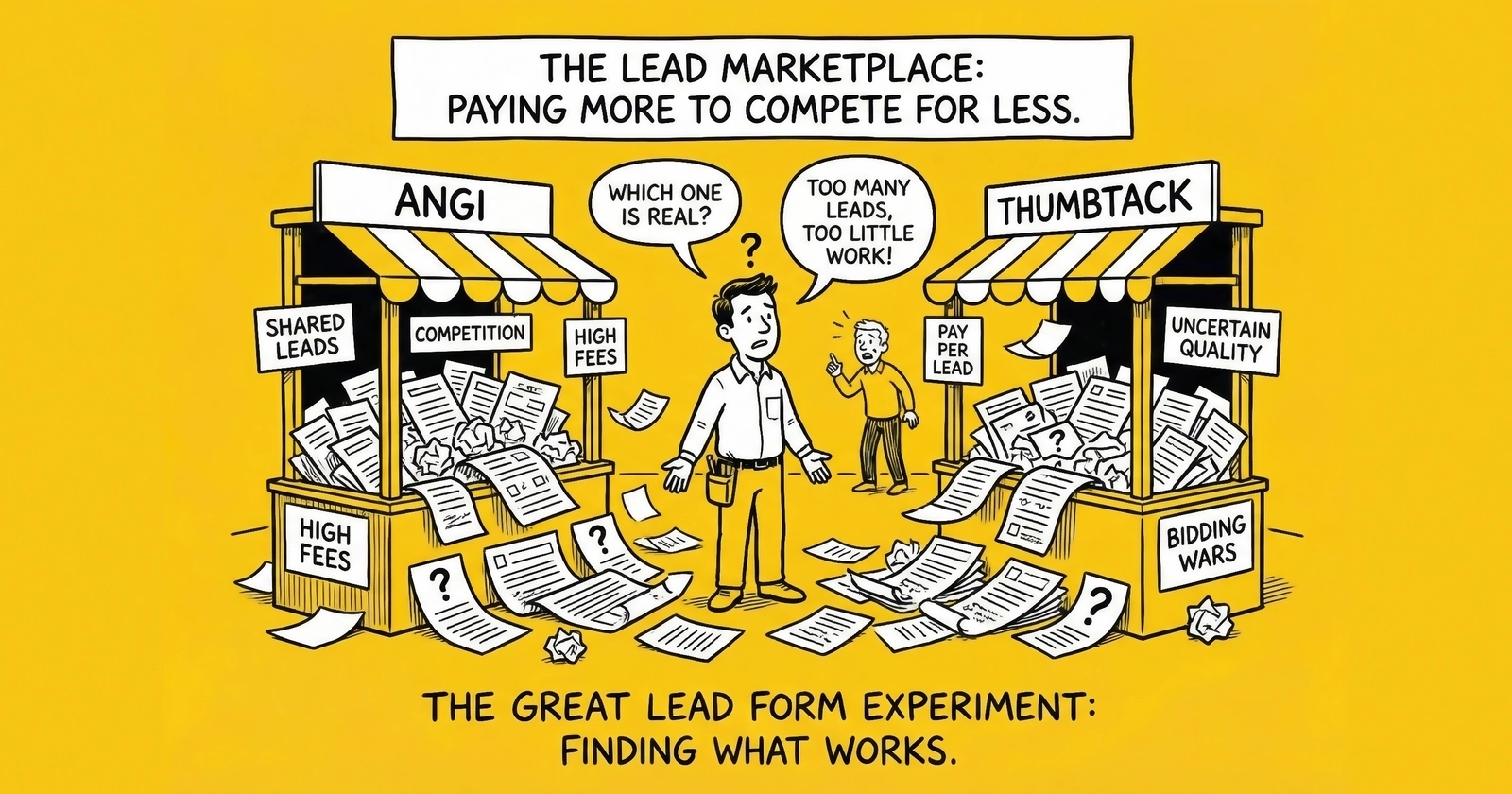
For contractors, these platforms represent both opportunity and risk. The opportunity is access to consumer demand without building marketing infrastructure. The risk is paying for leads that never convert, competing with multiple contractors for the same customer, and becoming dependent on platforms that can change pricing and rules at will.
For lead generation professionals, understanding these marketplaces provides insight into one of the most mature performance marketing verticals. The pricing models, quality challenges, and competitive dynamics mirror what happens across insurance, mortgage, solar, and legal lead markets – but with distinctive characteristics shaped by the local, service-based nature of home improvement. For a broader understanding of the industry, see how the lead economy works.
This guide provides the complete framework for understanding and succeeding in home improvement lead marketplaces: platform economics, pricing structures, lead quality optimization, strategic positioning, and the critical metrics that separate profitable operations from money-losing ones.
The Home Services Lead Market: 2024-2025 Landscape
The home services industry represents one of the largest addressable markets in the United States. Estimates place annual spending on home improvement, maintenance, and repair between $600-700 billion, with approximately 60% of that spending flowing through professional contractors rather than DIY efforts. This creates a massive market for customer acquisition – and lead generation platforms have captured a significant share of how contractors find new business.
Market Size and Structure
The addressable market for home services lead generation is substantial but fragmented. Unlike insurance or mortgage, where a handful of large buyers dominate demand, home services features millions of small contractors competing for local business. A typical plumbing company might employ 5-15 technicians. A roofing contractor might have 8-20 crew members. These businesses lack sophisticated marketing departments and depend heavily on word-of-mouth referrals and platform-based lead acquisition.
Industry estimates suggest the home services lead generation market transacts $3-5 billion annually across all platforms and channels. This includes the major marketplaces (Angi, Thumbtack), Google Local Services Ads, direct lead generation companies, and affiliate networks. The market has grown consistently at 8-12% annually, driven by increasing digital adoption among homeowners and contractors alike.
The Major Players
Angi (ANGI Homeservices) dominates the market following the 2021 merger of Angie’s List and HomeAdvisor. The combined entity operates multiple brands serving different market segments. Angi reported approximately $1.5 billion in revenue for 2023, with revenue declining in 2024 as the company restructured following years of aggressive expansion. The platform serves over 250,000 home service professionals and reaches more than 35 million monthly unique visitors across its properties.
The Angi business model has evolved through multiple iterations. The original Angie’s List operated as a subscription service where homeowners paid for access to contractor reviews. HomeAdvisor pioneered the pay-per-lead model that now dominates the industry. The merged entity has attempted various hybrid approaches, including subscription options for contractors, advertising packages, and the core pay-per-lead model.
Thumbtack operates as the primary alternative to the Angi family of services. Founded in 2008, Thumbtack has raised over $700 million in venture funding and operates a quote-based marketplace where contractors pay to send quotes to interested homeowners. The platform serves over 300,000 professionals across 1,000+ service categories, though home improvement represents the core of their business.
Thumbtack’s model differs meaningfully from Angi’s traditional approach. Rather than paying for leads (contact information), contractors pay for the opportunity to quote projects. This shifts risk in interesting ways – contractors only pay when they choose to engage, but they compete directly with other quotes visible to the homeowner.
Google Local Services Ads (LSA) has emerged as an increasingly important channel for home services lead generation. The pay-per-lead model with “Google Guaranteed” trust signals has proven attractive to contractors who appreciate Google’s brand authority and the direct attribution of leads to search intent. LSA pricing typically runs $25-100 per lead depending on service category and geography.
Platform Revenue Models
Understanding how these platforms make money reveals the incentives that shape contractor experience and lead quality.
Angi/HomeAdvisor generates revenue through multiple streams:
- Pay-per-lead fees ranging from $15-100+ depending on project type and location
- Annual subscription fees for enhanced visibility and features
- Advertising fees for premium placement
- Transaction fees on jobs booked through the platform
The pay-per-lead model creates tension with contractor interests. The platform profits when leads are distributed to contractors, regardless of whether those leads convert to customers. This misalignment has generated substantial contractor frustration and legal action over lead quality and billing practices.
Thumbtack charges contractors to send quotes, typically $10-80 per quote depending on project value and competition. The model theoretically aligns platform revenue with contractor engagement – you only pay when you choose to pursue a project. However, contractors still face the risk of paying for quotes that never result in booked jobs, and competitive dynamics can drive up costs as contractors bid against each other.
Google LSA charges per verified lead, with pricing set through auction dynamics similar to traditional search advertising. Contractors set budgets and Google optimizes delivery within those constraints. The integration with Google Search and Maps provides visibility advantages that standalone marketplaces cannot match.
Angi and HomeAdvisor: The Merged Giant
The 2021 combination of Angie’s List and HomeAdvisor created the dominant player in home services lead generation. Understanding this platform’s history, current structure, and operational dynamics is essential for anyone competing in this space.
Historical Context
Angie’s List launched in 1995 as a consumer subscription service providing verified reviews of local contractors. The model was simple: homeowners paid membership fees for access to trustworthy information about service providers. This created a pre-qualified audience of serious buyers willing to invest in finding quality contractors.
HomeAdvisor (originally ServiceMagic, founded in 1998 and rebranded in 2012) pioneered the pay-per-lead model. Rather than charging consumers for access, HomeAdvisor offered free lead capture and charged contractors for each consumer contact received. This model scaled aggressively because it eliminated consumer friction – anyone could request quotes without paying.
The merger attempted to combine Angie’s List’s brand trust and qualified consumer base with HomeAdvisor’s lead generation scale. The integration has proven challenging, with multiple strategic pivots, leadership changes, and revenue pressure as the combined entity sought sustainable growth.
Current Pricing Structure
Angi/HomeAdvisor lead pricing varies substantially by service category, geography, and project complexity. Based on current market data and contractor reports:
| Service Category | Typical CPL Range | Lead Share |
|---|---|---|
| HVAC | $20-50 | 3-5 contractors |
| Plumbing | $15-40 | 3-5 contractors |
| Roofing | $25-60 | 3-5 contractors |
| Electrical | $15-35 | 3-5 contractors |
| Kitchen Remodeling | $50-100+ | 3-4 contractors |
| Bathroom Remodeling | $40-80 | 3-4 contractors |
| Painting | $15-35 | 4-6 contractors |
| Landscaping | $15-40 | 4-6 contractors |
| Windows/Doors | $25-60 | 3-5 contractors |
These prices represent what contractors pay per lead – shared leads distributed to multiple contractors simultaneously. The lead share column indicates how many contractors typically receive the same lead, creating direct competition for each customer.
Premium pricing applies for larger projects. A whole-home renovation inquiry might cost $150+ per lead, while a simple faucet repair might cost $12-18. Geographic variation is significant – leads in high-income urban areas cost more than leads in rural markets with less competition.
The Shared Lead Challenge
The fundamental tension in Angi/HomeAdvisor’s model is the shared lead structure. When a homeowner requests quotes for a kitchen remodel, that request might go to 4-5 contractors, each paying $75 or more for the lead. Total platform revenue: $300-375. But only one contractor can win the job.
This arithmetic creates predictable outcomes:
For contractors: Win rates on shared leads typically run 15-25%, meaning effective cost per acquisition is 4-7x the stated lead price. A $50 lead with a 20% win rate costs $250 in actual customer acquisition cost.
For homeowners: Receiving 4-5 calls within minutes of submitting a request creates a chaotic experience. Research consistently shows that homeowners often hire the first contractor who responds professionally, regardless of whether better options existed among the other callers.
For the platform: Maximizing leads per request maximizes revenue, but degrading homeowner and contractor experience risks long-term platform health. Angi has experimented with reducing lead distribution to improve quality, but revenue pressure constrains these efforts.
Contractor Success Strategies
Contractors who succeed on Angi/HomeAdvisor share common characteristics and approaches:
Speed-to-contact determines outcomes. The first contractor to reach the homeowner books the job at dramatically higher rates than slower responders. Research from Velocify found that leads contacted within one minute convert 391% better – a principle explored in depth in our guide to lead response time optimization. On shared platforms, this advantage is even more pronounced – 78% of customers buy from the first responder according to Lead Connect data.
Implementation requirements for speed advantage:
- Real-time lead notifications via push notification or SMS
- Dedicated intake staff during business hours
- After-hours voicemail with immediate callback commitment
- Automated text acknowledgment within 60 seconds
Quote presentation differentiates beyond price. When homeowners receive 4-5 quotes, they often become price-focused. Contractors who win consistently differentiate on factors beyond price:
- Technician qualifications and certifications
- Warranty and guarantee terms
- Insurance and licensing documentation
- Customer references and case studies
- Financing options for larger projects
Review optimization creates compounding advantage. Angi displays contractor reviews prominently. Contractors with more reviews and higher ratings receive more leads at better quality. Systematic review generation – requesting reviews after every completed job, responding to all reviews, addressing negative feedback professionally – creates competitive advantage that compounds over time.
Lead filtering reduces waste. Angi offers targeting options that allow contractors to specify service types, geographic areas, and project parameters. Precise filtering reduces lead volume but improves relevance. A roofing contractor who only accepts leads for full roof replacements in specific zip codes pays more per lead but achieves higher conversion rates.
Dispute management recovers wasted spend. Angi has a lead credit policy for leads that don’t meet quality standards – wrong contact information, out-of-service-area requests, duplicate submissions, or non-genuine inquiries. Contractors who systematically review and dispute invalid leads recover 10-20% of their spend. This requires tracking every lead outcome and understanding what qualifies for dispute.
Thumbtack: The Quote-Based Alternative
Thumbtack operates on a fundamentally different model than Angi/HomeAdvisor, creating distinct economics and strategies for contractors.
The Quote Model Explained
On Thumbtack, homeowners describe their project needs and receive quotes from interested contractors. The key difference: contractors choose which projects to quote and only pay when they submit a quote. This shifts the decision point from platform (pushing leads to contractors) to contractor (pulling opportunities worth pursuing).
The mechanics work as follows:
- Homeowner submits project request with details
- Platform notifies contractors matching the project criteria
- Contractors review the opportunity and decide whether to quote
- Quoting contractors pay a fee, typically $10-80 depending on project value
- Homeowner receives quotes with pricing, reviews, and contractor information
- Homeowner chooses a contractor or decides not to proceed
This model has several implications:
Contractors control their spend. You never pay for a lead you didn’t choose to pursue. If a project looks problematic – vague requirements, unrealistic budget expectations, difficult location – you skip it and pay nothing.
Competition is visible. Homeowners see competing quotes side-by-side, creating direct price comparison pressure. Contractors can see how many others have quoted, influencing their own decision to participate.
Quality signals matter more. When homeowners compare contractors directly, reviews, photos, and profile completeness influence selection beyond just price and speed.
Thumbtack Pricing Structure
Thumbtack pricing varies by project type and estimated value:
| Project Category | Typical Quote Cost | Estimated Project Value |
|---|---|---|
| House Cleaning | $10-15 | $100-300 |
| Lawn Care | $10-20 | $50-200 |
| Minor Plumbing | $15-25 | $150-500 |
| Electrical Work | $15-35 | $200-800 |
| Painting (Room) | $20-40 | $300-1,000 |
| HVAC Service | $25-45 | $200-1,000 |
| Roofing | $35-70 | $5,000-15,000 |
| Kitchen Remodel | $50-100 | $15,000-50,000 |
Quote costs generally correlate with project value – higher-value projects cost more to quote but offer greater revenue potential if won.
Strategic Considerations for Thumbtack
The quote model creates different optimization strategies than pay-per-lead platforms:
Selective quoting improves economics. The ability to choose which projects to quote means conversion rates depend heavily on selection criteria. Contractors who quote every opportunity dilute their resources across marginal prospects. Those who selectively quote high-potential projects – clear requirements, reasonable budgets, good location match – achieve higher win rates.
Indicators of high-potential opportunities:
- Detailed project descriptions (engaged homeowner)
- Realistic budget expectations (qualified buyer)
- Specific timing requirements (genuine urgency)
- Location within core service area (efficient operations)
- Project type matching core competency (competitive advantage)
Quote quality determines selection. When homeowners compare multiple quotes, the quality of your response influences their decision beyond price alone. Effective quotes include:
- Personalized response addressing specific project details
- Clear scope of work and pricing breakdown
- Timeline and availability information
- Relevant photos of similar completed projects
- Professional communication tone
Timing matters for visibility. Thumbtack shows quotes in the order received, with early quotes getting more visibility. However, rushing to quote before understanding the project risks submitting a weak response. The optimal approach is responding quickly with a high-quality, personalized quote.
Profile optimization creates compounding returns. Thumbtack profiles display reviews, photos, response times, and hire rates. Strong profiles receive more quote opportunities and convert at higher rates. Investment in profile quality – professional photos, detailed descriptions, systematic review collection – pays dividends across all platform activity.
Thumbtack vs. Angi: Which Works Better?
The relative performance of these platforms depends on contractor characteristics and strategic priorities:
Thumbtack advantages:
- Control over which opportunities to pursue
- No payment for leads you don’t want
- Better for contractors who can write compelling quotes
- Lower risk of paying for garbage leads
- More transparent competition dynamics
Angi/HomeAdvisor advantages:
- Higher volume of leads in most markets
- Speed advantage more actionable (contact vs. quote)
- Better for high-velocity, quick-response operations
- Broader geographic coverage
- Stronger brand awareness among consumers
Hybrid approach often optimal: Many successful contractors maintain presence on both platforms, optimizing their approach to each. Angi for volume and speed-based selling, Thumbtack for selective pursuit of high-value projects with time for quality quotes.
Google Local Services Ads: The Emerging Competitor
Google Local Services Ads (LSA) has become the fastest-growing lead generation channel for home services contractors. The integration with Google Search and Maps, combined with the “Google Guaranteed” trust badge, provides advantages that standalone marketplaces cannot match.
How LSA Works
Google LSA appears at the top of local search results for relevant queries. When someone searches “plumber near me” or “HVAC repair [city],” LSA listings display above standard paid search ads and organic results. This premium placement drives significant lead volume.
The consumer experience is straightforward:
- Search for a home service on Google
- See LSA contractors with reviews, photos, and Google Guaranteed badge
- Click to call or message directly through Google
- Contractor receives the lead and pays Google
Contractors pay per verified lead – a phone call lasting at least 30 seconds or a message exchange – rather than per click or impression. Pricing is set through auction dynamics, with contractors setting weekly budgets and Google optimizing delivery.
LSA Pricing and Economics
LSA pricing varies by service category and geography, typically ranging from $25-100 per lead:
| Service Category | Typical LSA CPL | Lead Exclusivity |
|---|---|---|
| Plumbing | $30-60 | Exclusive |
| HVAC | $35-75 | Exclusive |
| Electrical | $25-50 | Exclusive |
| Roofing | $50-100 | Exclusive |
| Pest Control | $20-40 | Exclusive |
| Locksmith | $25-45 | Exclusive |
| Garage Door | $30-60 | Exclusive |
The critical difference from Angi: LSA leads are exclusive. When a homeowner clicks on your listing and calls, they are calling only you. This exclusivity dramatically improves conversion economics compared to shared lead platforms.
Google Guaranteed Requirements
Earning the Google Guaranteed badge requires:
- Business license verification
- Insurance verification (general liability minimum)
- Background checks on company owner and field workers
- Positive reviews and rating thresholds
- Adherence to Google’s quality standards
The verification process takes 2-6 weeks and involves submitting documentation to Google’s verification partner. Once approved, the badge provides trust signals that improve click-through and conversion rates.
Google backs the guarantee with a money-back promise to consumers – up to $2,000 if the consumer is dissatisfied with work quality. This creates accountability pressure but also reassures consumers considering an unfamiliar contractor.
LSA Optimization Strategies
Succeeding with Google LSA requires attention to several factors:
Review volume and quality drive ranking. Google heavily weights reviews in LSA ranking. Contractors with more reviews and higher ratings receive more prominent placement and more leads. Systematic review generation – requesting reviews after every job, making the process easy for customers, responding to all reviews – creates compounding advantage.
Response time affects ranking. Google tracks how quickly contractors respond to LSA leads. Faster response times improve ranking in the LSA carousel. The speed-to-contact dynamics that matter on Angi also matter here, though the mechanism is different – it affects future lead quality rather than just the current lead.
Budget optimization balances volume and cost. LSA uses auction dynamics, meaning you compete with other contractors for lead volume. Higher budgets generally mean more leads but at potentially higher costs per lead. Finding the balance between volume and efficiency requires ongoing optimization.
Geographic targeting improves relevance. LSA allows precise service area definition. Targeting only areas you can serve efficiently improves lead quality and conversion rates. Avoid accepting leads from locations that require excessive travel or fall outside your true service area.
Category selection matters. Contractors can appear for multiple service categories on LSA. Selecting categories that match your actual capabilities and competitive strengths improves conversion. Appearing for services you rarely provide or cannot price competitively wastes budget on leads unlikely to convert.
Lead Quality: The Critical Variable
Across all home services lead platforms, lead quality determines whether paid lead acquisition is profitable or ruinous. Understanding what drives quality – and how to measure and optimize it – separates successful operators from those who bleed money.
Defining Lead Quality in Home Services
A quality home services lead has several characteristics:
Valid contact information. The phone number works, the person answers or returns calls, and the contact matches the project request. Invalid contact information is the most common quality complaint across all platforms.
Genuine service need. The homeowner actually needs the service requested, has a realistic timeline, and is authorized to make purchase decisions. Leads from renters, people collecting quotes for future reference, or those with no real intent waste contractor resources.
Appropriate geography. The project location falls within the contractor’s actual service area with reasonable travel requirements. Leads requiring 2-hour drives to job sites rarely convert profitably.
Qualified budget. The homeowner’s budget expectations align with market pricing for the requested service. Leads seeking $500 kitchen remodels or $100 roof replacements cannot convert at any lead cost.
Contactable and responsive. The homeowner answers calls, responds to messages, and engages in the sales process. Leads who never respond despite valid contact information still waste contractor time and money.
Measuring Lead Quality
Tracking lead quality requires systematic data collection across the entire funnel:
Contact rate: What percentage of leads can you actually reach by phone or message? Target: 50-60% for fresh leads.
Qualification rate: Of contacted leads, what percentage have genuine, appropriately-scoped projects? Target: 60-80% of contacts.
Quote rate: What percentage of qualified leads receive formal quotes? Target: 70-90% of qualified leads.
Win rate: What percentage of quoted leads become customers? Target: 20-40% of quoted leads.
Revenue per lead: Total revenue divided by total leads purchased. This should substantially exceed lead cost.
Cost per acquisition: Total lead spend divided by customers acquired. This determines true unit economics.
Platform Quality Comparison
Lead quality varies meaningfully across platforms:
Angi/HomeAdvisor: Quality has been a persistent concern, with contractor lawsuits and class actions alleging deceptive practices around lead quality and billing. The platform’s scale generates high volume but requires aggressive filtering and dispute management to achieve profitable economics. Contact rates of 40-55% and qualification rates of 50-70% are typical.
Thumbtack: The quote model creates self-selection that can improve quality – homeowners who receive and compare quotes are more engaged than those simply requesting information. However, price comparison dynamics can attract budget-focused buyers. Contact rates of 45-60% and qualification rates of 55-75% are typical.
Google LSA: The search intent signal and exclusive delivery generally produce higher-quality leads. Homeowners who search and click on a specific contractor have higher purchase intent than those filling out generic forms. Contact rates of 50-65% and qualification rates of 60-80% are typical.
Improving Lead Quality
Contractors can take action to improve lead quality beyond what platforms provide:
Precise targeting: Use every available filter to match leads with actual service capabilities and geographic reach. Accepting leads you cannot serve efficiently harms overall economics.
Speed response: Quick response reaches homeowners while intent is high and before competitors poison the opportunity. Speed correlates with quality because high-intent leads respond immediately.
Qualification process: Implement consistent intake processes that assess project scope, budget, timeline, and decision-making authority before investing time in quotes or site visits.
Source tracking: Track quality metrics by lead source, platform, and campaign. Cut underperforming sources; expand winning sources.
Dispute management: Systematically dispute leads that violate platform quality standards. This recovers wasted spend and signals to platforms that you monitor quality.
Economic Analysis: Making the Numbers Work
Understanding the true economics of platform-based lead acquisition requires looking beyond stated lead prices to actual customer acquisition costs and lifetime value.
Cost Per Acquisition Calculation
The true cost of acquiring a customer through lead platforms is calculated as:
CPA = Lead Cost / (Contact Rate x Qualification Rate x Quote Rate x Win Rate)
For example, using typical metrics on Angi for a roofing contractor:
- Lead cost: $50
- Contact rate: 50%
- Qualification rate: 65%
- Quote rate: 80%
- Win rate: 25%
CPA = $50 / (0.50 x 0.65 x 0.80 x 0.25) = $50 / 0.065 = $769
This means each $50 lead actually costs $769 per acquired customer when you account for the full conversion funnel. This CPA must be compared against customer value to assess profitability.
Customer Value Analysis
Home services customer value depends on project type and relationship development:
One-time project value: A roof replacement might generate $12,000-25,000 in revenue. A kitchen remodel might generate $25,000-75,000. Large projects can absorb high CPAs if margins are healthy.
Repeat service value: HVAC, plumbing, and electrical contractors can develop ongoing relationships with customers. Annual maintenance contracts, emergency repairs, and referrals create lifetime value exceeding $3,000-8,000 per customer relationship.
Referral value: Satisfied customers generate referrals. The referral value of a good customer multiplies their direct contribution. Contractors with strong referral programs report 30-50% of new business from referrals, effectively halving their customer acquisition costs.
Profitability Thresholds
For platform-based lead acquisition to be profitable:
CPA must be less than acceptable percentage of first-job margin. If a roofing job generates $5,000 gross profit, a $769 CPA represents 15% of that profit – generally acceptable. If a small plumbing job generates $150 profit, a $250 CPA (typical for plumbing leads with conversion factors) is clearly unprofitable.
Volume must be sufficient to amortize learning costs. Early platform activity involves learning curve costs – figuring out targeting, refining intake processes, training staff. These costs are fixed; you need enough volume to spread them across sufficient customers.
Quality must be consistent. Occasional excellent leads cannot compensate for systematic quality problems. If 30% of leads are garbage that should be disputed, your team wastes time processing them even if credits are eventually received.
Platform Comparison Economics
Applying economic analysis across platforms reveals comparative attractiveness:
Angi/HomeAdvisor: High volume, lower per-lead costs, but shared leads compress win rates. Works best for contractors with rapid-response capabilities who can win the speed game. Profitable for high-volume, lower-ticket services where speed determines outcomes.
Thumbtack: Moderate volume, higher per-opportunity costs, but contractor control over which opportunities to pursue. Works best for contractors who can assess opportunities quickly and write compelling quotes. Profitable for considered purchases where quality differentiation matters.
Google LSA: Growing volume, moderate-to-high per-lead costs, but exclusive leads improve win rates dramatically. Works best for contractors with strong reviews and Google profile optimization. Profitable across most service categories due to exclusivity and search intent.
Strategic Positioning: Beyond Platform Dependence
While lead platforms provide valuable customer acquisition, over-dependence creates strategic vulnerability. The most successful home services companies use platforms as one channel within a diversified acquisition strategy.
The Platform Dependency Risk
Contractors who rely entirely on lead platforms face several risks:
Pricing power shifts to platforms. When platforms control your customer acquisition, they control your costs. Price increases, policy changes, or algorithm adjustments directly impact your profitability without recourse.
Quality fluctuations hurt performance. Platform lead quality varies based on their traffic acquisition, competitive dynamics, and policy enforcement. You absorb these fluctuations without control over causes.
Competition intensifies over time. As more contractors join platforms and competition increases, costs rise and win rates fall. Early adopters of platforms enjoyed better economics than late entrants typically experience.
Platform changes disrupt operations. Platforms regularly change pricing, policies, and features. What works today may not work next year. Contractors dependent on platform-specific tactics suffer when platforms pivot.
Building Diversified Acquisition
Reducing platform dependency requires developing alternative customer acquisition channels:
Referral systems: Satisfied customers are the best lead source. Systematic referral programs – asking for referrals, making referring easy, rewarding referral behavior – convert existing customers into ongoing lead sources.
Local SEO and Google Business Profile: Optimizing for local SEO captures customers before they reach lead platforms. Google Business Profile, local content, and citation building drive organic leads at zero marginal cost.
Content marketing: Educational content addressing homeowner questions builds trust and captures search traffic. “How to know when to replace your roof” or “Signs your HVAC needs service” attract people researching services you provide.
Email and relationship marketing: Past customers, estimate recipients, and website visitors become owned audiences. Regular communication keeps your company top-of-mind when needs arise.
Direct mail and local advertising: Traditional channels still work in home services. Targeted direct mail, local sponsorships, and community involvement generate leads outside platform ecosystems.
Optimal Channel Mix
The ideal acquisition mix varies by service type, market, and contractor capabilities:
High-urgency services (plumbing, HVAC repair, locksmith): Speed matters. Platform leads are valuable when you can respond instantly. Google LSA and Angi provide volume; referrals and repeat customers provide margins.
Considered purchases (remodeling, roofing, major improvements): Research periods are longer. Content marketing and SEO capture early-stage interest. Thumbtack allows competing on quality. Referrals and reviews close decisions.
Repeat services (lawn care, cleaning, maintenance): Customer retention drives economics. Platform acquisition for initial customers, then relationship marketing for retention and referrals.
Successful contractors typically derive 30-50% of new customers from platforms, 30-40% from referrals and repeat customers, and 20-30% from direct marketing and organic search. This diversification provides stability against any single channel’s fluctuations.
Technology and Operations for Platform Success
Succeeding with lead platforms requires technology infrastructure and operational processes that maximize conversion from every lead purchased.
Essential Technology Stack
CRM integration: Leads must flow directly from platforms into a CRM system that tracks status, follow-up activities, and outcomes. Manual processes leak leads and lose data.
Call tracking: Unique phone numbers for each lead source enable attribution tracking. Understanding which platforms, campaigns, and lead types produce revenue – not just leads – guides optimization.
Speed-to-lead automation: Automated response systems acknowledge leads instantly while human follow-up is prepared. Text acknowledgments, email auto-responses, and callback scheduling reduce time-to-contact.
Quote and proposal systems: Professional quote presentation, delivered quickly, improves win rates. Template-based systems speed quote generation without sacrificing quality.
Review management: Tools that automate review requests, monitor review sites, and facilitate responses increase review volume and protect reputation.
Operational Requirements
Dedicated intake resources: Someone must respond to leads immediately during business hours. Letting leads sit while technicians complete jobs wastes the speed advantage.
Standardized qualification process: Consistent questions and qualification criteria ensure every lead receives appropriate assessment. Script-based intake improves consistency across team members.
Follow-up sequences: Not every lead converts on first contact. Systematic follow-up – multiple calls, texts, and emails over days – captures leads who were busy, distracted, or needed time.
Dispatch coordination: Converting leads to booked appointments requires availability visibility. Integration between intake and dispatch prevents overcommitting or losing leads due to scheduling confusion.
Performance tracking: Regular review of lead-to-customer metrics by source, time period, and team member enables continuous optimization. Without tracking, you cannot improve.
Process Excellence Example
Here is what excellent platform lead handling looks like:
Minute 0: Lead arrives. CRM creates record. Automated text: “Thank you for reaching out to [Company]. A specialist will call you within 5 minutes.”
Minute 1-3: Intake specialist receives notification, reviews lead details, calls homeowner.
Minute 3-5: If no answer, leave professional voicemail and send follow-up text offering callback scheduling.
Hour 2-4: Second call attempt at different time of day.
Day 1 end: Email with company overview, recent project photos, and review highlights.
Day 2-3: Additional call and text attempts. Offer flexible scheduling options.
Week 2: If no engagement, move to monthly nurture sequence for future opportunities.
Outcome tracking: Every lead disposition recorded – contacted, quoted, won, lost (with reason), invalid (for dispute).
This systematic approach extracts maximum value from every purchased lead and generates the data needed for continuous improvement.
Frequently Asked Questions
What is the average cost per lead for home improvement on Angi and HomeAdvisor?
Angi and HomeAdvisor lead costs typically range from $15-100+ depending on service category, project size, and geographic market. Simple services like gutter cleaning or minor repairs cost $15-25 per lead. Complex projects like kitchen remodeling or whole-home renovations can exceed $100 per lead. Leads are shared among 3-6 contractors, meaning effective cost per acquisition is 4-7x the stated lead price when accounting for competition. HVAC leads average $20-50, plumbing $15-40, roofing $25-60, and major remodeling projects $50-100+.
How does Thumbtack pricing compare to Angi?
Thumbtack charges per quote sent rather than per lead received. Quote costs typically range from $10-80 depending on estimated project value. This model gives contractors control over which opportunities to pursue – you only pay when you choose to quote. However, the competitive quote format means homeowners directly compare your pricing against competitors. Thumbtack can be more cost-effective for contractors who are selective about opportunities and can write compelling quotes, while Angi may work better for high-volume operations optimized for speed-based selling.
What conversion rates should I expect from home services lead platforms?
Realistic conversion benchmarks for home services platforms: contact rates of 40-60% (reaching the homeowner), qualification rates of 50-75% (genuine, appropriate projects), quote rates of 70-90% (of qualified leads), and win rates of 15-30% (of quoted leads). End-to-end conversion from lead to customer typically runs 5-15% on shared lead platforms like Angi and 10-25% on exclusive lead platforms like Google LSA. Contractors with excellent speed-to-contact, professional presentation, and strong reviews can exceed these benchmarks significantly.
Is Google Local Services Ads better than Angi for contractors?
Google LSA offers several advantages: exclusive leads (no competition for the same customer), search intent signals (higher buyer readiness), and Google Guaranteed trust badge. LSA leads typically cost $25-100 depending on service category and convert at higher rates due to exclusivity. However, Angi provides higher volume in most markets and may reach consumers who search through multiple channels. Many successful contractors use both – LSA for higher-quality exclusive leads and Angi/Thumbtack for volume. The optimal mix depends on your service type, market, and operational capabilities.
How do I reduce wasted spend on bad leads from Angi or HomeAdvisor?
Reducing wasted spend requires four strategies: precise targeting using all available filters for geography, project types, and customer characteristics; speed response reaching homeowners before they hire competitors or lose interest; systematic dispute of leads that violate quality standards (wrong contact info, out-of-service-area, non-genuine inquiries); and ongoing tracking of lead quality metrics by source to identify and eliminate underperforming lead types. Most contractors can recover 10-20% of spend through proper dispute management and reduce waste by 20-30% through better targeting and speed.
What is the true cost of acquiring a customer through lead platforms?
True customer acquisition cost (CAC) equals lead cost divided by end-to-end conversion rate. If leads cost $50 and you convert 8% to customers, your CAC is $625. This must be compared against customer gross profit to assess viability. A roofing job with $5,000 profit can absorb $625 CAC. A minor plumbing repair with $150 profit cannot. Successful contractors track CAC by platform, service type, and time period, optimizing toward sources that deliver profitable customer acquisition economics.
Should I focus on one platform or use multiple home services platforms?
Diversification across platforms reduces dependency risk and captures different customer segments. Each platform has distinct strengths: Angi for volume, Thumbtack for quote-based competition, Google LSA for exclusive search-intent leads. Most successful contractors maintain presence on 2-3 platforms while also building non-platform channels (referrals, SEO, direct marketing). Allocate more budget to better-performing platforms, but maintain minimum presence on alternatives for diversification and competitive intelligence.
How important is speed to contact for home services leads?
Speed to contact is the single most important factor in lead conversion. Research shows leads contacted within one minute convert 391% better (Velocify). On shared lead platforms like Angi, 78% of customers hire the first responder (Lead Connect). Contractors who consistently respond in under 5 minutes book jobs at 3-5x the rate of those waiting an hour. This requires real-time notifications, dedicated intake staff during business hours, and automated acknowledgment systems for immediate homeowner engagement.
What is the Google Guaranteed badge and how do I get it?
Google Guaranteed is a trust badge displayed on Google Local Services Ads indicating that Google has verified the contractor and backs their work with up to $2,000 in customer protection. Requirements include: valid business license, general liability insurance verification, background checks on owners and field employees, positive review ratings, and adherence to Google quality standards. The verification process takes 2-6 weeks and involves submitting documentation to Google’s verification partner. The badge significantly improves click-through rates and consumer trust compared to unverified listings.
How do I track ROI across different lead platforms?
Tracking platform ROI requires: unique phone numbers for each platform (call tracking), CRM integration that attributes leads to sources throughout the sales cycle, consistent outcome recording (contacted, quoted, won, lost with reason, invalid), and regular reporting that calculates cost per acquisition and revenue per lead by source. Essential metrics include contact rate, qualification rate, quote rate, win rate, average project value, and customer lifetime value. Monthly review of these metrics enables budget reallocation toward better-performing platforms and campaigns.
Key Takeaways
-
The home services lead market transacts $3-5 billion annually across major platforms, with Angi/HomeAdvisor, Thumbtack, and Google Local Services Ads capturing the majority of digital lead generation for contractors.
-
Angi/HomeAdvisor leads cost $15-100+ depending on service type and are typically shared among 3-6 contractors, creating effective customer acquisition costs of 4-7x stated lead prices due to competition.
-
Thumbtack’s quote-based model charges $10-80 per quote attempt, giving contractors control over which opportunities to pursue but creating direct price competition visibility for homeowners.
-
Google Local Services Ads provides exclusive leads with search intent signals at $25-100 per lead, typically delivering higher conversion rates than shared lead platforms due to exclusivity and the Google Guaranteed trust badge.
-
Speed to contact is the critical success factor across all platforms – leads contacted within one minute convert 391% better, and 78% of customers hire the first responder.
-
True customer acquisition cost must be calculated through the full funnel: Lead Cost / (Contact Rate x Qualification Rate x Quote Rate x Win Rate), typically resulting in CAC 4-10x higher than stated lead prices.
-
Successful contractors diversify across multiple platforms while building non-platform channels (referrals, local SEO, content marketing) to reduce dependency and improve overall acquisition economics.
-
Technology infrastructure (CRM integration, call tracking, automated response, review management) and operational processes (speed response, systematic follow-up, dispute management) determine whether platform lead acquisition is profitable or money-losing.
Sources
- Statista: Home Improvement Industry Statistics - Market size and growth data for the US home improvement sector
- NAHB Housing Economics - National Association of Home Builders research on remodeling activity and contractor economics
- Angi Inc. Investor Relations - Public filings and financial data from the parent company of HomeAdvisor and Angi
- Yelp Investor Relations - Platform performance metrics and local services market data
- IBISWorld Home Improvement Stores Industry - Industry research on home services market structure and competitive dynamics
- ServiceTitan Industry Blog - Contractor operational benchmarks and home services booking rate data
- Harvard Business Review: Lead Response Time - Original research on speed-to-contact impact on conversion rates
The home improvement lead marketplace rewards operators who understand platform economics, execute on speed-to-contact, track metrics rigorously, and build diversified acquisition channels. Platform dependency creates strategic vulnerability; platform mastery creates competitive advantage. The contractors who win treat lead acquisition as a systematic discipline, not an expense line to minimize.