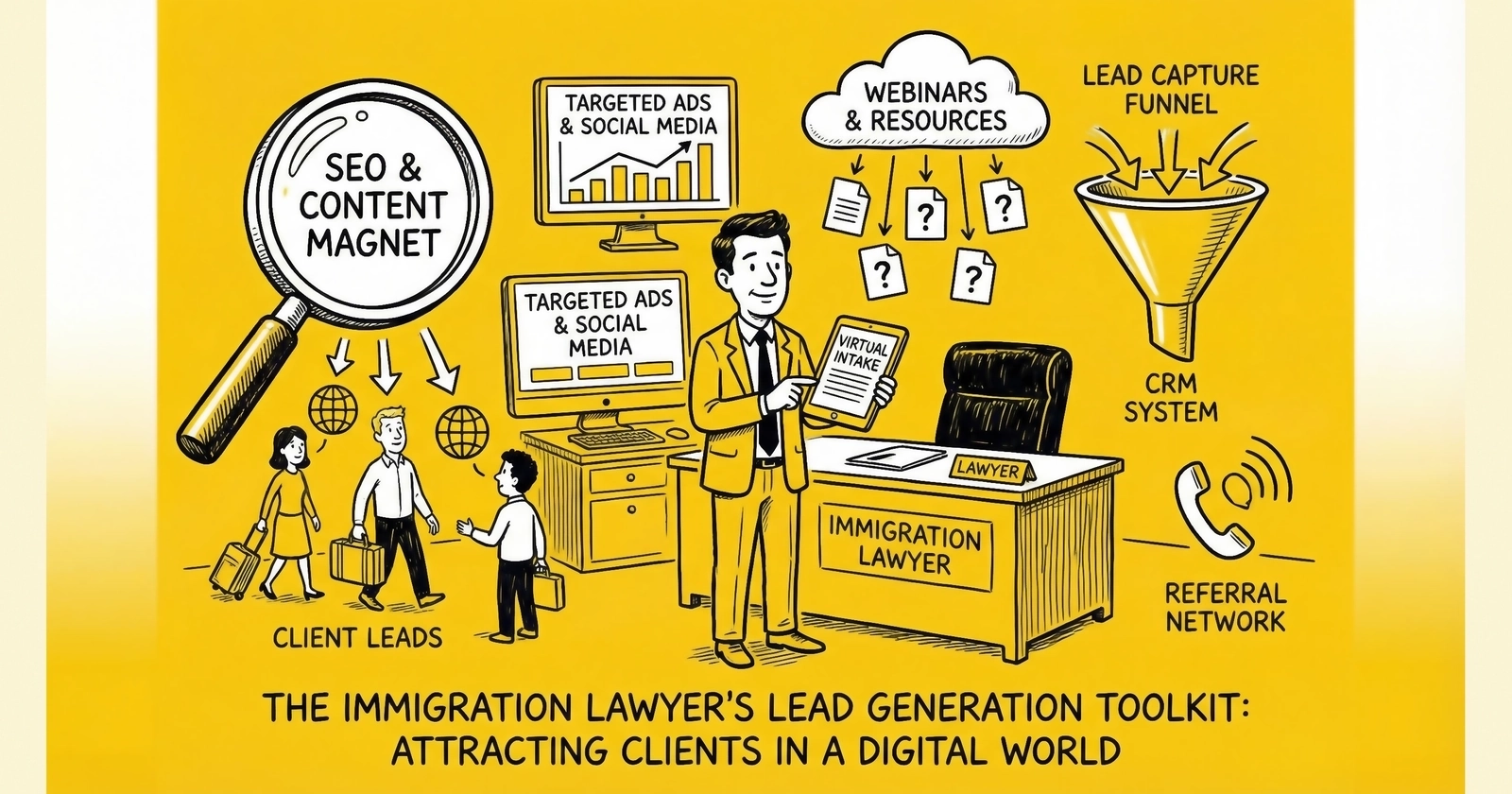
How policy volatility creates unprecedented demand, why multilingual marketing separates winners from losers, and what smart practitioners know about building sustainable lead generation in the most policy-sensitive legal vertical.
A family in Texas receives notice that their asylum case will be heard in three weeks. A tech worker in Silicon Valley discovers their H-1B renewal has been flagged for additional review. A business owner in Miami learns that their employee’s work authorization expires in 90 days with no clear path forward.
Each of these moments represents urgent legal need. Each creates a consumer actively searching for qualified legal representation. Each translates to a lead worth $75-350 to immigration attorneys competing for their case.
Immigration law lead generation operates in a unique environment. Unlike personal injury, where case types remain consistent regardless of who sits in the White House, immigration demand surges and shifts with every policy announcement, executive order, and court decision. The immigration court backlog exceeded 3.7 million pending cases as of late 2024, creating sustained demand for legal representation that far outpaces supply.
This volatility creates opportunity for lead generators who understand the dynamics. It also creates risk for those who chase short-term spikes without building sustainable operations.
This guide covers everything you need to build a profitable immigration law lead generation operation: the market dynamics that drive demand, the multilingual marketing strategies that capture diverse audiences, the compliance frameworks that keep you operating legally, and the operational infrastructure that converts traffic into qualified leads.
The Immigration Law Market in 2026
Understanding the market context is essential before investing in traffic or building infrastructure. Immigration law operates differently from other legal verticals, and those differences shape every aspect of lead generation strategy.
Market Size and Structure
The immigration law market generates an estimated $4.5-5.2 billion annually in legal fees across the United States. This market serves multiple distinct client populations with different legal needs, budgets, and acquisition channels.
The American Immigration Lawyers Association represents over 16,000 immigration attorneys and law office staffers, though the total number of attorneys practicing immigration law exceeds 25,000 when including those with partial immigration practices.
| Client Segment | Estimated Annual Cases | Average Case Value | Lead Value Range |
|---|---|---|---|
| Family-based immigration | 900,000+ | $3,500-$8,000 | $75-$200 |
| Employment-based immigration | 500,000+ | $5,000-$15,000 | $100-$300 |
| Removal defense | 400,000+ | $5,000-$25,000 | $150-$350 |
| Asylum cases | 200,000+ | $5,000-$20,000 | $125-$300 |
| Naturalization | 800,000+ | $1,500-$3,500 | $50-$125 |
| DACA renewals | 500,000+ | $500-$1,500 | $35-$75 |
These segments operate on different timelines, respond to different policy triggers, and require different marketing approaches. A lead generation operation focused on employment-based immigration targets different demographics and uses different channels than one focused on removal defense.
The Backlog Factor
The immigration court backlog represents the single most significant demand driver in this market. With over 3.7 million cases pending as of 2024 and average wait times exceeding four years in many jurisdictions, the need for legal representation has never been higher.
This backlog creates sustained demand that differs from the episodic nature of personal injury. A car accident creates immediate need that fades. An immigration case creates ongoing legal need that persists for years. This distinction affects lead lifetime value and client retention patterns.
Consider the economic implications. An immigration case that begins with an initial consultation and filing might generate additional revenue through status adjustments and renewals, family member petitions, employment authorization renewals, travel document applications, responses to requests for evidence, and appeals and motions. The lifetime value of an immigration client often exceeds the initial case fee by 200-400%, making lead acquisition economics more favorable than the single-case CPL might suggest.
Policy Sensitivity and Demand Volatility
Immigration law demand correlates directly with policy changes and political developments. This creates both opportunity and risk for lead generators.
Several categories of events trigger demand spikes. Executive orders affecting immigration policy create immediate search volume increases. Court decisions on DACA, TPS, or asylum rules shift demand toward specific case types. Changes to visa processing timelines affect employment-based immigration planning. New enforcement priorities drive removal defense inquiries. Even legislative proposals unlikely to pass generate consumer concern and legal consultations. International events driving migration create new client populations seeking representation.
The 2024-2026 period illustrates this volatility. Policy changes following the November 2024 election triggered immediate spikes in search volume for terms related to deportation defense, expedited naturalization, and visa renewals. Operators positioned to capture this demand saw lead costs drop as conversion rates increased.
Immigration-related search volume typically increases 40-80% within 72 hours of major policy announcements. This creates opportunity for operators with flexible budgets and pre-built campaigns that can scale quickly. However, chasing policy spikes without sustainable baseline operations leads to boom-bust cycles. Those who thrive build steady operations that can capitalize on spikes without depending on them.
Client Segments and Lead Economics
Immigration law encompasses distinct practice areas with different lead economics. Understanding these differences enables targeted campaign strategies and appropriate pricing.
Family-Based Immigration
Family-based immigration represents the largest volume category, encompassing spousal visas, parent petitions, sibling sponsorship, and fiancé visas.
These leads show high volume with moderate urgency, as most applications have multi-month timelines. Clients tend to be price-sensitive, often middle-class families managing household budgets. Strong referral potential exists because one successful case leads to additional family members needing representation. Multilingual marketing proves essential, with Spanish, Chinese, Tagalog, and Vietnamese serving as primary languages.
Typical Lead Metrics:
| Metric | Range |
|---|---|
| CPL (exclusive) | $75-$175 |
| CPL (shared 3-way) | $35-$75 |
| Lead-to-consult rate | 25-40% |
| Consult-to-retain rate | 35-55% |
| Average case fee | $3,500-$8,000 |
Family-based leads convert well when operators qualify for case type, relationship category, and any complicating factors such as prior immigration violations, criminal history, or prior denials. Attorneys pay premiums for leads that include this qualifying information.
Employment-Based Immigration
Employment-based immigration serves both corporate clients seeking H-1B, L-1, and O-1 visas and individual professionals pursuing permanent residency through employment.
These leads involve higher case values and more sophisticated clients. Corporate decision-makers often participate in the engagement, including HR departments and in-house legal teams. Seasonality matters significantly, with activity peaking around the H-1B lottery in April and following premium processing changes. English dominates for corporate inquiries, while multilingual capability matters for individual professionals.
Typical Lead Metrics:
| Metric | Range |
|---|---|
| CPL (exclusive) | $100-$250 |
| CPL (corporate inquiry) | $200-$400 |
| Lead-to-consult rate | 30-50% |
| Consult-to-retain rate | 40-60% |
| Average case fee | $5,000-$15,000+ |
Employment-based leads often come through professional channels: LinkedIn, industry associations, tech community forums. Google Ads targeting job titles and industries outperforms broad immigration keywords for this segment.
Removal Defense and Deportation
Removal defense represents the highest-urgency category in immigration law. Clients facing deportation proceedings have immediate need and limited time to secure representation.
Extreme urgency characterizes these leads, often with days or weeks to respond to legal deadlines. Higher case values reflect the complexity and stakes involved. Fear-based decision making means clients may be reluctant to provide information online or over the phone. Strong demand follows enforcement announcements, creating predictable volume spikes.
Typical Lead Metrics:
| Metric | Range |
|---|---|
| CPL (exclusive) | $150-$350 |
| Lead-to-consult rate | 35-50% |
| Consult-to-retain rate | 50-70% |
| Average case fee | $5,000-$25,000 |
Removal defense leads require careful handling. Clients may be hesitant to provide personal information online, making phone-based lead generation through live transfers more effective than form-based capture. Trust signals matter enormously: attorney credentials, language accessibility, and community reputation all influence conversion.
Asylum and Humanitarian Protection
Asylum leads represent a specialized category requiring specific expertise and often involving vulnerable populations.
These cases involve complex qualification requirements that require careful screening. Potential pro bono or low-cost representation needs may affect case viability for some attorneys. Language diversity depends on sending countries, requiring flexible multilingual capabilities. Sensitive personal circumstances demand careful handling throughout the intake process.
Typical Lead Metrics:
| Metric | Range |
|---|---|
| CPL (qualified) | $125-$300 |
| Lead-to-consult rate | 20-35% |
| Consult-to-retain rate | 25-45% |
| Average case fee | $5,000-$20,000 |
Asylum leads require nuanced qualification. Country of origin, basis of persecution claim, and timeline since arrival affect case viability. Leads from countries with high asylum grant rates, historically including Venezuela, El Salvador, Guatemala, and Honduras, command premiums.
Naturalization and Citizenship
Naturalization represents the highest volume, lowest complexity category with correspondingly lower lead values.
High volume and commoditized service define this segment. Price competition among providers keeps lead values modest. DIY alternatives reduce conversion rates as many applicants attempt the process themselves. Upsell potential exists for complex cases involving criminal history, extended absences, or other complicating factors.
Typical Lead Metrics:
| Metric | Range |
|---|---|
| CPL (exclusive) | $50-$125 |
| CPL (shared) | $25-$50 |
| Lead-to-consult rate | 20-30% |
| Consult-to-retain rate | 30-45% |
| Average case fee | $1,500-$3,500 |
Naturalization leads compete with legal services companies and notarios, making attorney differentiation essential. Leads that indicate complications such as criminal history, extended travel, or prior immigration violations command significant premiums as these cases require actual attorney expertise.
Multilingual Marketing Strategies
Immigration law serves immigrant communities by definition. Monolingual English marketing reaches only a fraction of the potential market. Practitioners who invest in multilingual infrastructure capture audience segments that competitors ignore.
Language Market Sizing
Understanding which languages matter in which markets enables efficient resource allocation.
Primary Languages by Search Volume (National):
| Language | Estimated Immigration Search Volume Share |
|---|---|
| English | 45% |
| Spanish | 35% |
| Chinese (Simplified/Traditional) | 8% |
| Tagalog | 3% |
| Vietnamese | 3% |
| Korean | 2% |
| Hindi/Urdu | 2% |
| Portuguese | 2% |
Geographic concentration patterns guide market prioritization. Spanish reaches national audiences but concentrates heaviest in Texas, California, Florida, Arizona, New Mexico, and New York. Chinese-speaking populations cluster in California (San Francisco and Los Angeles), New York, Washington, and Texas. Tagalog speakers concentrate in California, Hawaii, Nevada, and Washington. Vietnamese communities center in California, Texas, Washington, and Virginia. Korean speakers cluster in California, New York, New Jersey, and Virginia.
These concentrations mean that a Spanish-language campaign in Texas reaches a fundamentally different market than an English-only campaign targeting the same geography.
Spanish-Language Campaign Infrastructure
Spanish represents the single largest opportunity for immigration lead generators. The Spanish-speaking immigrant population exceeds 45 million, and many prefer consuming legal information in their primary language.
Native translation is non-negotiable. Machine translation fails for legal content. Legal terminology, cultural references, and tone require native fluency. A poorly translated landing page destroys trust with an audience already wary of scams targeting immigrant communities.
Keyword research requires Spanish-specific approaches. “Abogado de inmigracion” and “abogado migratorio” both translate to “immigration lawyer” but have different search volumes and competition levels. Conduct Spanish-specific keyword research rather than translating English keyword lists.
Landing page localization goes beyond translation. Effective Spanish landing pages incorporate culturally appropriate imagery, references to relevant community organizations, testimonials from Spanish-speaking clients, Spanish-language phone support indicated clearly, and trust signals recognized in Hispanic communities.
Ad creative also requires more than translation. Cultural communication patterns differ: Spanish-language marketing often performs better with warmer, more personal tones compared to the direct, assertive tone that works in English legal marketing.
Performance Benchmarks (Spanish vs. English):
| Metric | English | Spanish |
|---|---|---|
| CPC (immigration keywords) | $8-$25 | $4-$15 |
| CTR | 3.5-5.5% | 4.0-6.5% |
| Conversion rate | 8-12% | 10-15% |
| CPL (exclusive) | $100-$200 | $60-$150 |
The economics favor Spanish-language campaigns: lower competition reduces CPCs while strong community networks increase conversion rates. Many immigration attorneys neglect Spanish-language digital marketing, creating opportunity for operators who invest properly.
Chinese-Language Marketing
Chinese-language marketing requires different infrastructure than Spanish due to platform differences and character encoding requirements.
Platform considerations shape strategy significantly. Google Ads provides limited reach, as many Chinese-speaking users prefer Baidu or WeChat for search. WeChat proves essential for reaching Chinese immigrant communities but requires specialized knowledge. Weibo offers secondary platform with advertising options. Chinese-language newspapers and community sites often provide underpriced inventory.
Technical requirements demand attention. Simplified Chinese targets Mainland China immigrants while Traditional Chinese serves Taiwan and Hong Kong communities. Landing pages must handle Chinese characters properly. Mobile optimization matters especially because Chinese users skew heavily mobile.
Chinese immigration keywords have much lower search volume on Google, but the competition is correspondingly lower. CPCs for Chinese-language immigration terms often run 40-60% below English equivalents.
Vietnamese and Tagalog Markets
Vietnamese and Tagalog represent smaller but concentrated markets where operators can establish dominant positions.
The Vietnamese market concentrates in California (Orange County and San Jose), Texas (Houston), and Washington State. Community newspaper and radio advertising generate strong response. Facebook groups and community pages provide effective reach. Lower digital sophistication in some community segments creates opportunity for basic SEO to deliver outsized results.
The Tagalog market concentrates heavily in California and Hawaii. Strong Facebook usage for community communication makes the platform particularly effective. Radio advertising remains effective for reaching older demographics. Community organization partnerships build valuable trust for lead conversion.
For both markets, the investment in translation and localization pays outsized returns due to limited competition. An operator with quality Vietnamese-language landing pages in Orange County faces minimal competition compared to English-language campaigns in the same geography.
Multilingual Content Strategy
Content marketing in immigration law requires sustained investment across languages to build organic traffic and authority.
Content Types by Language:
| Content Type | Priority Languages | Purpose |
|---|---|---|
| Service pages | All target languages | Conversion |
| Policy update articles | Spanish, English | Traffic, authority |
| How-to guides | All target languages | SEO, trust |
| FAQ content | All target languages | Voice search, featured snippets |
| Video content | Spanish, English | Engagement, trust |
Policy changes create immediate content opportunities. Practitioners who publish Spanish-language explanations of policy changes within 24-48 hours capture search traffic that competitors miss.
A sustainable content operation produces two to four policy update articles per month in English and Spanish at minimum, one to two evergreen how-to guides per month, quarterly updates to major service pages, and ongoing FAQ expansion based on search query data.
Traffic Acquisition Channels
Immigration law lead generation uses familiar channels but with vertical-specific tactics. Understanding channel dynamics and typical performance enables efficient budget allocation.
Google Ads
Google Ads remains the primary paid channel for immigration lead generation, though competition has increased significantly in major markets.
Immigration keywords fall into several categories with different economics. High-intent keywords like “immigration lawyer near me” carry CPCs of $15-$45 with highest conversion intent. “Deportation lawyer” commands CPCs of $20-$60 reflecting urgent need. “Asylum attorney” runs $12-$35 with specific case type targeting.
Case-type keywords show different profiles. “H-1B visa lawyer” ranges $10-$30 with employment focus. “Green card attorney” runs $8-$25 spanning family and employment categories. “Citizenship lawyer” offers lower CPCs of $6-$20 for naturalization inquiries.
Policy-triggered keywords create special opportunities. Keywords incorporating policy names vary widely in CPC based on news coverage intensity. “DACA attorney” runs $8-$25 with cyclical demand based on court decisions. “TPS lawyer” ranges $10-$30 with country-specific demand patterns.
Location targeting requires strategic budget allocation based on market tiers.
| Market Tier | Example Markets | Typical CPCs | Competition Level |
|---|---|---|---|
| Tier 1 | Los Angeles, New York, Miami | $20-$50 | Very High |
| Tier 2 | Houston, Chicago, San Francisco | $15-$40 | High |
| Tier 3 | Phoenix, Dallas, Atlanta | $10-$30 | Moderate |
| Tier 4 | Secondary cities | $8-$20 | Lower |
Tier 1 markets command the highest CPCs but also offer the greatest volume. Tier 3 and 4 markets offer better CPL economics for operators willing to aggregate volume across multiple markets.
Effective immigration law Google Ads campaigns typically include brand campaigns capturing existing demand for buyer attorneys, case-type campaigns segmented by immigration category, geographic campaigns with city-specific landing pages, language campaigns in Spanish, Chinese, and other target languages, and competitor campaigns bidding on competing firm names where permitted.
Quality Score optimization enables CPCs in the 7-10 range with proper landing page alignment. Key factors include landing page content matching keyword intent, fast page load times under 3 seconds, mobile optimization, clear calls to action, and trust signals including attorney photos, credentials, and reviews.
Meta Advertising (Facebook/Instagram)
Meta platforms offer lower CPCs than Google but require different creative strategies for immigration law.
Meta’s targeting capabilities enable reaching immigrant communities directly. Language targeting identifies Spanish speakers, Chinese speakers, and other language communities. Interest targeting reaches those engaged with immigration, citizenship, and visa-related content. Behavioral targeting finds expats and frequent international travelers. Geographic targeting focuses on neighborhoods with high immigrant populations. Lookalike audiences extend reach based on existing client data.
Immigration law advertising on Meta requires sensitivity to audience concerns. Fear-based messaging that could feel exploitative should be avoided. Community-focused imagery and messaging builds connection. Attorney credentials and experience establish authority. Language accessibility information signals capability. Testimonials from clients with similar backgrounds build trust.
Meta Lead Ads perform well for immigration because they reduce friction for mobile users. However, lead quality from instant forms typically runs 20-30% lower than landing page leads. Pre-qualification questions are essential to filter low-intent submissions. Integration with CRM for immediate follow-up is critical.
Typical Performance:
| Metric | Range |
|---|---|
| CPC | $1.50-$5.00 |
| CTR | 0.8-2.0% |
| Conversion rate | 5-12% |
| CPL | $25-$75 |
| Lead quality (contact rate) | 50-70% |
Meta leads require faster follow-up than Google leads due to lower intent levels. Operators should target sub-5-minute response times to maximize conversion.
Local SEO
Local SEO represents the highest-ROI long-term investment for immigration law lead generation. Immigration clients often search for local representation, and Google Maps/Local Pack results capture significant search volume.
Google Business Profile optimization forms the foundation. Complete profiles with all services listed, photos of office, attorneys, and staff, regular posts about policy updates, active review generation and response, and Q&A sections populated with common questions all contribute to local visibility.
Citation building through immigration-specific directories offers targeted opportunities. AILA lawyer search, Avvo immigration attorneys, legal services directories by language, community organization partner listings, and local bar association directories all provide valuable citations.
Reviews in multiple languages demonstrate language accessibility. Encourage Spanish-speaking and other non-English clients to leave reviews in their preferred language.
City-specific and state-specific content improves local rankings. Service pages targeting “[City] immigration lawyer” keywords, state-specific immigration court information, local USCIS office guides, and community organization resources all strengthen local relevance signals.
Community Marketing Channels
Immigration law lead generation benefits from community-based channels that mainstream digital marketing often overlooks.
Community radio and newspapers provide cost-effective reach. Spanish-language radio stations in major markets, Chinese-language newspapers like World Journal and Sing Tao, Vietnamese-language media like Nguoi Viet Daily News, and community newsletters and bulletins all offer access to audiences that may not be reached through digital channels. These channels typically offer lower cost per reach and higher trust levels than digital advertising for many immigrant communities.
Community organization partnerships create referral relationships and trust signals. Immigrant rights organizations, cultural and ethnic community centers, religious institutions serving immigrant populations, and chambers of commerce focused on immigrant entrepreneurs all provide partnership opportunities that improve conversion rates across all channels.
Social media community groups extend organic reach. Facebook groups for specific immigrant communities, WhatsApp groups particularly for Latin American communities, WeChat groups for Chinese communities, and community forums and discussion boards all offer opportunities for engagement. Participation in these communities, not just advertising, builds trust and generates organic referrals.
Landing Page Optimization
Immigration law landing pages must address unique visitor psychology: people making high-stakes decisions while often operating in a second language, with concerns about their legal status, and healthy skepticism based on past experiences with immigration scams.
Trust Signal Requirements
Immigration clients are rightfully cautious. The immigrant community has been targeted by notario fraud, visa scams, and unlicensed practitioners for decades. Landing pages must overcome this skepticism.
Essential trust elements include state bar license numbers and verification links, AILA membership badges, attorney photographs that appear professional and approachable, physical office addresses with Google Maps integration, clear identification as “licensed attorney” distinguishing from notarios, client testimonials with video preferred especially in target languages, and case result highlights where ethically permitted.
Language accessibility signals matter significantly. Prominent display of “Hablamos Espanol” or other language capabilities, staff photos with language capabilities noted, language-specific phone lines advertised clearly, and high-quality translated content all communicate accessibility. Poor translation destroys trust immediately.
Explicit scam differentiation helps overcome community skepticism. Messaging like “Licensed attorneys only - no notarios,” “Free consultation - no payment required,” and “Legitimate legal services” distinguishes your operation from fraudulent actors.
Conversion Optimization
Immigration landing pages typically achieve conversion rates of 8-15% depending on traffic quality and page optimization.
Form design significantly impacts completion rates. Shorter forms collecting name, phone, email, and case type outperform longer qualification forms for top-of-funnel traffic. Progressive disclosure through multi-step forms improves completion rates for more detailed qualification. Spanish-language form fields on Spanish landing pages feel more natural. Mobile-optimized input fields with phone number keyboards and dropdown selectors reduce friction.
Call-to-action optimization follows predictable patterns. “Free Consultation” outperforms “Submit” or “Get Quote” across testing. Phone number click-to-call buttons prove essential for mobile traffic. Live chat increases engagement for hesitant visitors. WhatsApp integration performs well for Latin American audiences.
Page speed often suffers on immigration landing pages due to heavy translation plugins, multiple language detection scripts, and unoptimized images. Target under 3-second load times. Each additional second reduces conversion rates by 4-7%.
Multilingual Landing Page Architecture
Building landing pages for multiple languages requires systematic architecture.
Subdirectory structure uses paths like example.com/es/immigration-lawyer and example.com/zh/immigration-lawyer. This approach offers simple implementation and shared domain authority but provides limited language-specific SEO optimization.
Subdomain structure uses paths like es.example.com/immigration-lawyer and zh.example.com/immigration-lawyer. This enables language-specific technical optimization but requires separate domain authority building.
Separate domains like abogadodeinmigracion.com or immigration-lawyer-chinese.com allow maximum language and cultural customization but require separate brand building and carry higher maintenance costs.
For most practitioners, subdirectory structure with language selectors provides the best balance of efficiency and effectiveness.
Proper hreflang tags prevent duplicate content issues and ensure correct language versions appear in search results:
<link rel="alternate" hreflang="en" href="example.com/immigration-lawyer" />
<link rel="alternate" hreflang="es" href="example.com/es/abogado-de-inmigracion" />
Lead Qualification and Distribution
Immigration leads require more careful qualification than many legal verticals due to case complexity and visa category specificity.
Qualification Frameworks
Different immigration case types require different qualification questions.
Family-based immigration qualification covers relationship to petitioner (spouse, parent, sibling, child), petitioner status (citizen or permanent resident), any prior immigration violations, current location (in US or abroad), and any criminal history.
Employment-based immigration qualification covers current visa status, employer sponsorship availability, education credentials, priority date if applicable, and country of birth for backlog countries.
Removal defense qualification covers type of proceedings (removal, deportation, expedited removal), current location (detained or released), hearing date if known, prior immigration history, and potential relief options such as asylum or cancellation.
General qualification benefiting all immigration leads includes contact information validation, preferred language for consultation, preferred contact method and time, general timeline urgency, and prior attorney consultation history.
Lead Scoring for Immigration
Immigration lead scoring differs from other legal verticals due to case complexity variation:
| Factor | Points | Rationale |
|---|---|---|
| Urgency indicated (detention, deadline) | +20 | Higher conversion, premium pricing |
| Corporate/business immigration | +15 | Higher case values |
| Complex case type (asylum, removal) | +10 | Premium pricing potential |
| Simple case type (naturalization) | -10 | Lower case values |
| Prior denial or complication | +5 | Attorney expertise required |
| Complete contact information | +10 | Higher contact rate |
| Spanish/English bilingual | +5 | Larger buyer pool |
| Specific case type indicated | +10 | Better buyer matching |
Distribution Models
Immigration leads distribute through several models depending on operator scale and buyer relationships.
Exclusive distribution sends each lead to a single buyer at premium pricing. This works best for high-quality leads with complete qualification data. Pricing typically ranges $100-$350 depending on case type and geography.
Shared distribution sends leads to two or three buyers simultaneously. This approach suits moderate-quality leads where competition benefits the consumer. Pricing runs $40-$125 per buyer.
Ping-post distribution enables real-time bidding where lead attributes are submitted to multiple buyers who bid before receiving contact information. This works best for high-volume operations with multiple buyer relationships. Pricing is market-driven, typically $75-$250 for exclusive winning bids.
Live transfer creates real-time phone connections between consumers and intake staff. Premium pricing reflects immediate contact value, typically $150-$400 depending on case type.
Buyer Qualification
Immigration law firm buyers vary significantly in capabilities and requirements.
Solo practitioners typically have limited intake capacity, tend toward price sensitivity, often have specific language capabilities, and face geographic constraints limiting their service area.
Small firms of two to ten attorneys offer moderate volume capacity. Case type specialization is common. They may have specific language requirements and typically provide regional coverage.
Large immigration firms can handle high volume across multiple offices. They offer full service across case types and pay premium pricing for quality leads. Exclusive arrangements often make sense at this scale.
National intake operations handle very high volume through multiple attorney network distribution. They often accept all case types and offer volume pricing with reliable payment.
Matching lead attributes to buyer capabilities improves conversion rates and reduces returns. A family-based lead from someone in Houston should route to buyers with Houston representation capability and Spanish-language intake.
Policy Monitoring and Response
Immigration law lead generation requires active policy monitoring because demand shifts with policy changes. Practitioners who anticipate and respond to policy developments capture market share.
Monitoring Infrastructure
Build systematic monitoring for policy developments.
Primary sources include USCIS policy manual updates, Department of State visa bulletin releases, executive orders affecting immigration, federal court decisions on immigration cases, and AILA practice alerts.
Secondary sources provide context and analysis. Immigration attorney blogs and newsletters offer practitioner perspectives. Immigration news outlets like Law360 and Bloomberg Law provide timely coverage. Academic immigration law centers publish analysis. Advocacy organization alerts flag policy concerns.
Monitoring tools streamline information gathering. Google Alerts for key terms capture news mentions. RSS feeds from primary sources provide direct updates. Twitter/X lists of immigration policy accounts track announcements. Email subscriptions to key newsletters ensure nothing slips through.
Response time targets should guide operations. Major policy announcements warrant campaign adjustment within 4 hours. Court decisions should trigger content publication within 24 hours. Regulatory changes require landing page updates within 48 hours.
Campaign Playbooks
Pre-built campaign templates enable rapid response to common scenarios.
The enforcement announcement playbook activates when new deportation priorities, ICE actions, or enforcement surges occur. Response includes activating removal defense campaigns within 4 hours, publishing “know your rights” content in Spanish and English, increasing bid adjustments on deportation and removal keywords, and launching community-focused social media messaging.
The visa program changes playbook responds to H-1B rule changes, visa bulletin movement, or processing time updates. Response includes updating affected service pages within 24 hours, creating explanatory content for affected populations, adjusting employment-based campaign targeting, and sending email notification to relevant buyer attorneys.
The court decision impact playbook activates following DACA rulings, TPS decisions, or asylum policy changes. Response includes immediate content creation explaining implications, campaign activation for affected populations, social media outreach to community groups, and buyer notification with lead opportunity preview.
The naturalization surge playbook responds to approaching elections, citizenship benefits emphasis, or fear of policy changes. Response includes scaling naturalization campaigns, creating urgency messaging around processing times, partnering with community organizations for citizenship drives, and adjusting buyer allocation for naturalization case capacity.
Budget Flexibility
Immigration lead generation requires budget flexibility to capitalize on policy-driven demand spikes.
Recommended budget structure allocates 60% to steady-state baseline campaigns, 25% to flexible allocation for opportunity response, and 15% to testing and optimization.
When demand spikes occur, reallocate from testing budget to flexible response budget within 24 hours. Pre-approved budget increases of 50-100% for major policy events prevent missed opportunities.
Compliance Considerations
Immigration law lead generation faces standard legal advertising compliance requirements plus vertical-specific considerations.
State Bar Advertising Rules
Attorney advertising rules vary by state and apply to lead generators working with attorneys.
Common requirements include no guarantee of results, clear identification of advertising, accurate representation of attorney credentials, required disclaimers varying by state, and review requirements for attorney approval of advertising.
Lead generator responsibilities require operators generating leads for attorneys to ensure landing pages comply with bar rules in target states, claims about services are accurate and approved, attorney credentials are correctly represented, and required disclaimers are present.
Risk mitigation measures include attorney review of all client-facing content, compliance disclaimers on landing pages, documentation of attorney approval, and regular compliance audits.
Unauthorized Practice of Law
Immigration law has specific risks around unauthorized practice.
Prohibited activities include providing legal advice as opposed to general information, filling out immigration forms for clients, representing clients before USCIS or immigration courts, and charging for services that constitute legal practice.
Safe harbor activities allow lead generators to provide general information about immigration processes, collect contact information for attorney referral, describe attorney services available, and connect potential clients with licensed attorneys.
The line between information and advice requires careful navigation. Landing page content should inform about processes without advising on individual cases.
Consent and TCPA Compliance
Immigration leads require standard TCPA compliance for phone and text contact.
Consent requirements include prior express written consent for automated calls and texts, clear disclosure of marketing intent, one-to-one consent specifying which party will contact, and consent documentation and retention.
Immigration-specific considerations require that consent language be understandable to non-native English speakers. Consider translated consent disclosures for primary language audiences. Ensure consent covers both lead generator and attorney contacts. Document language preference as part of consent record.
Documentation should maintain consent records including timestamp of consent, IP address and device information, language version of consent presented, specific consent text agreed to, and TrustedForm or Jornaya certification.
Immigrant Protection Considerations
Operating in the immigration space carries ethical responsibilities beyond legal compliance.
Avoiding exploitative practices means no fear-based marketing that exaggerates risks, accurate information about legal processes and timelines, clear pricing expectations before attorney referral, and honest representation of case success probabilities.
Protecting sensitive information requires secure handling of immigration status information, limited data retention for non-converted leads, no sharing of status information with non-attorney parties, and compliance with privacy regulations.
Operators in this space serve vulnerable populations. Building sustainable operations requires treating potential clients with dignity, providing accurate information, and connecting them with qualified legal help.
Building Operations Infrastructure
Sustainable immigration lead generation requires infrastructure beyond traffic acquisition. This section covers the operational systems that convert traffic into revenue.
Technology Stack Requirements
Core systems must address immigration-specific needs:
| System | Purpose | Immigration-Specific Requirements |
|---|---|---|
| Landing page platform | Lead capture | Multilingual support, fast loading |
| CRM/Lead management | Lead routing | Language field tracking, case type classification |
| Phone system | Live transfers | Spanish-speaking agents, call recording |
| Distribution platform | Buyer delivery | Real-time routing, case type matching |
| Analytics | Performance tracking | Multi-language attribution, policy event correlation |
Every system in the stack must handle multilingual operations. CRM must track preferred language. Phone routing must connect to appropriate language agents. Email templates must exist in all target languages. SMS must comply with language-specific regulations.
Seamless data flow between systems prevents lead leakage. Form submission to CRM should complete in under 3 seconds. CRM to distribution platform connection must operate in real-time. Call tracking must integrate with attribution. Consent documentation must link to lead records.
Team Structure
Immigration lead generation operations require specialized roles.
Traffic teams need media buyers with multilingual campaign experience, content creators fluent in target languages, and SEO specialists understanding multilingual optimization.
Operations teams need bilingual (minimum) intake specialists, lead qualification agents, and distribution operations managers.
Compliance teams need bar advertising rule expertise, TCPA compliance monitoring, and policy monitoring and response coordination.
Scaling considerations vary with volume:
| Monthly Lead Volume | Minimum Team Size | Key Roles |
|---|---|---|
| Under 500 leads | 2-3 | Owner/media buyer + bilingual intake |
| 500-2,000 leads | 4-6 | Dedicated media buyer, 2-3 intake specialists |
| 2,000-5,000 leads | 8-12 | Team leads per function, QA roles |
| 5,000+ leads | 15+ | Full department structure |
Quality Assurance
Immigration lead quality directly affects buyer retention and pricing power.
Quality Metrics:
| Metric | Target | Minimum Acceptable |
|---|---|---|
| Contact rate | >75% | 60% |
| Duplicate rate | <3% | 5% |
| Invalid phone rate | <5% | 8% |
| Language accuracy | >95% | 90% |
| Case type accuracy | >90% | 85% |
Quality processes include real-time phone and email validation, duplicate checking across all buyer feeds, language preference verification, case type confirmation through qualification, and post-delivery quality callbacks.
Clear return policies with buyers establish expectations. Invalid contact information warrants full refund. Wrong case type warrants partial refund or replacement. Consumer unreachable after multiple attempts requires case-by-case evaluation. Quality dispute resolution processes should be documented.
Financial Modeling
Understanding immigration lead generation economics enables appropriate pricing, buyer negotiations, and growth planning.
Cost Structure
Typical Cost Breakdown:
| Cost Category | Percentage of Revenue |
|---|---|
| Traffic acquisition | 40-55% |
| Technology platforms | 5-10% |
| Labor (intake, operations) | 15-25% |
| Compliance/legal | 3-5% |
| Overhead | 5-10% |
| Gross margin | 15-30% |
Immigration leads command lower CPLs than personal injury but also cost less to generate due to lower CPCs. The net margin opportunity is comparable to other legal verticals.
An exclusive family-based immigration lead illustrates unit economics. Revenue per lead of $125 breaks down into traffic cost of $50 (40%), technology cost of $8 (6%), intake labor of $25 (20%), and compliance/overhead of $12 (10%), yielding gross profit of $30 (24%). Scale improves these economics through technology leverage and buyer pricing power.
Pricing Strategies
Cost-plus pricing calculates fully loaded cost per lead and adds target margin. This approach is simple but may leave money on the table in high-demand periods.
Market-based pricing sets prices based on competitive intelligence and buyer willingness to pay. This requires ongoing market monitoring.
Value-based pricing ties prices to lead conversion value for buyers. This requires buyer transparency on downstream metrics.
Dynamic pricing adjusts based on policy environment (higher prices during demand spikes), lead attributes (premium for complex cases), buyer performance (higher prices for high-conversion buyers), and volume commitments (discounts for contracted volume).
Buyer Negotiation
Immigration lead buyers range from solo practitioners to large firms with different priorities.
Price-focused buyers emphasize volume discounts, accept quality-for-price tradeoffs, prefer short-term contracts, and require careful quality monitoring.
Quality-focused buyers pay premiums for specific attributes, orient toward long-term relationships, generate lower volume but higher margins, and make strong partners for sustainable operations.
Negotiation leverage comes from exclusive inventory access, geographic coverage, language capabilities, response time guarantees, return policies, and payment terms.
Standard payment terms of Net 15-30 days create working capital requirements. Negotiate shorter terms with volume commitments or offer discounts for faster payment.
Frequently Asked Questions
What is the typical cost per lead for immigration law leads?
Immigration law leads range from $35-350 depending on case type, exclusivity, and lead quality. Naturalization leads represent the lowest end at $35-75 for shared leads, while removal defense and complex deportation cases command $150-350 for exclusive, qualified leads. Employment-based immigration (H-1B, L-1) typically falls in the $100-250 range for exclusive leads. These figures reflect 2024-2026 market conditions and vary significantly by geography, with Tier 1 markets (Los Angeles, New York, Miami) commanding 20-40% premiums over secondary markets.
How does policy change affect immigration lead demand?
Policy changes create immediate demand spikes, typically increasing search volume 40-80% within 72 hours of major announcements. Practitioners who maintain flexible budgets and pre-built campaign templates can capitalize on these spikes, often seeing cost-per-lead decrease as conversion rates increase during high-urgency periods. However, building sustainable operations requires steady baseline performance rather than depending on policy volatility. The 2024-2026 period demonstrates this pattern, with enforcement-focused policy shifts driving significant increases in removal defense and expedited naturalization inquiries.
Why is multilingual marketing essential for immigration lead generation?
Approximately 55% of immigration-related searches occur in languages other than English, with Spanish representing 35% of total search volume. Practitioners who invest in native-quality translation, culturally appropriate creative, and language-specific landing pages capture audience segments that English-only competitors ignore. Spanish-language campaigns typically achieve 30-40% lower CPCs due to reduced competition while maintaining similar or higher conversion rates. Chinese, Vietnamese, and Tagalog represent smaller but concentrated markets where operators can establish dominant positions with relatively modest investment.
What are the highest-value immigration lead categories?
Removal defense and deportation cases command the highest per-lead prices ($150-350) due to case complexity, urgency, and high stakes for clients. Employment-based immigration, particularly H-1B and O-1 visas, generates case values of $5,000-15,000 with correspondingly strong lead values ($100-300). Asylum cases vary widely based on country of origin and case strength. While naturalization represents the highest volume category, case values of $1,500-3,500 support lower lead prices. The lifetime value of immigration clients often exceeds initial case fees by 200-400% through renewals, family petitions, and additional services.
How do I ensure compliance with attorney advertising rules for immigration leads?
Attorney advertising rules vary by state and require careful navigation. Key compliance steps include: obtaining attorney approval for all client-facing content, including required state bar disclaimers, accurately representing attorney credentials and experience, avoiding guarantees of results, and clearly identifying content as advertising. Work with attorneys who have reviewed and approved your landing pages and advertising materials. Document this approval and maintain regular compliance audits. For multi-state operations, the most restrictive applicable rules should govern your content.
What response time is needed for immigration leads?
Immigration leads require response within 5 minutes for optimal conversion, similar to other legal verticals. However, certain case types demand even faster response: removal defense leads involving detained individuals or imminent hearings may require immediate live transfer capability. For family-based and employment immigration leads, sub-5-minute response by phone with appropriate language capability typically achieves 30-50% higher conversion compared to delayed contact. Email-only follow-up significantly underperforms phone contact for immigration leads.
How do I build a multilingual intake team?
Start with Spanish as the first additional language, as it represents the largest non-English market segment. Hire native or fluent speakers rather than relying on translation services for live intake. Train intake staff on immigration terminology in both languages and on cultural communication patterns. As you scale, add language capabilities based on your target geographies: Chinese for California and New York, Vietnamese for California and Texas, Tagalog for California and Hawaii. Consider timezone coverage for evening and weekend intake when many immigrant community members are available to talk.
What is the immigration court backlog and why does it matter for lead generation?
The immigration court backlog exceeded 3.7 million pending cases as of late 2024, with average wait times exceeding four years in many jurisdictions. This backlog creates sustained demand for legal representation that differs from the episodic nature of personal injury or other legal verticals. An immigration case creates ongoing legal need over years, not a single event. This extended relationship increases client lifetime value and makes initial lead acquisition more economically attractive. The backlog also means attorneys need consistent lead flow to maintain case pipelines over multi-year representation periods.
Can I generate immigration leads without Spanish-language capabilities?
Yes, but you will miss approximately 35% of the market and face higher competition for English-language traffic. English-only operations remain viable, particularly for employment-based immigration serving corporate clients and professional workers. However, family-based immigration, removal defense, and asylum categories have significantly higher Spanish-language demand. Starting with English-only and adding Spanish capability as you scale represents a reasonable growth path. Chinese-language capability offers similar advantages in specific geographic markets (California, New York) with less competition than Spanish.
How do seasonal patterns affect immigration lead generation?
Immigration lead demand follows several seasonal patterns: H-1B visa lottery preparation peaks December through March, naturalization demand increases 6-12 months before presidential elections, and DACA renewal cycles create predictable demand spikes. Summer months often see reduced activity in employment-based immigration as corporate decision-making slows. However, policy-driven demand can override seasonal patterns entirely. Unlike home services or even personal injury, immigration lead generation responds more to policy cycles than calendar seasons. Build baseline campaigns that perform year-round while maintaining flexibility to capitalize on policy-driven opportunities.
Key Takeaways
Building a successful immigration law lead generation operation requires understanding the unique dynamics of this policy-sensitive vertical. The core principles that separate profitable operations from struggling ones:
Invest in multilingual infrastructure. Fifty-five percent of immigration search volume occurs in languages other than English. Spanish-language campaigns achieve 30-40% lower CPCs with equal or better conversion rates. Native-quality translation and culturally appropriate creative are non-negotiable investments.
Build policy monitoring and response systems. Immigration demand shifts with every executive order, court decision, and enforcement announcement. Practitioners who publish content within 24 hours and adjust campaigns within 4 hours capture market share that slower competitors miss.
Understand case type economics. Lead values range from $35 for shared naturalization leads to $350+ for exclusive removal defense cases. Match your traffic acquisition strategy to case types where you can compete effectively.
Focus on trust building. Immigrant communities have been targeted by scams and fraud for decades. Landing pages must overcome legitimate skepticism through attorney credentials, bar license verification, language accessibility signals, and community trust indicators.
Build for the long term. Client lifetime value in immigration often exceeds initial case fees by 200-400%. Sustainable operations that treat clients with dignity and connect them with qualified attorneys build referral networks and repeat business that policy-chasing competitors cannot match.
Maintain compliance discipline. State bar advertising rules, TCPA consent requirements, and unauthorized practice of law boundaries require careful navigation. Documentation, attorney approval processes, and regular compliance audits prevent regulatory problems.
Scale gradually with quality focus. Start with a single language and limited case types. Validate unit economics and buyer relationships before expanding. Quality leads with appropriate follow-up generate better returns than high-volume operations with poor conversion.
The immigration law lead generation market will continue growing with the sustained court backlog and ongoing policy uncertainty. Practitioners who build sustainable, compliant, community-respecting operations will capture their share of a multi-billion dollar legal services market.
Sources
- TRAC Immigration Court Backlog Data - Syracuse University research tracking 3.7+ million pending immigration cases
- American Immigration Lawyers Association - Professional association representing 16,000+ immigration attorneys with practice resources
- USCIS Reports and Studies - Official data on visa processing times, application volumes, and policy changes
- DHS Immigration Statistics - Department of Homeland Security data on immigration enforcement and visa issuance
- TRAC Immigration Reports - Research on immigration court outcomes, asylum grant rates, and deportation statistics
- CFPB Advertising Rules - Consumer protection guidance applicable to legal services marketing compliance
This guide is part of The Lead Economy series, providing operational frameworks for building sustainable lead generation businesses across high-value verticals.