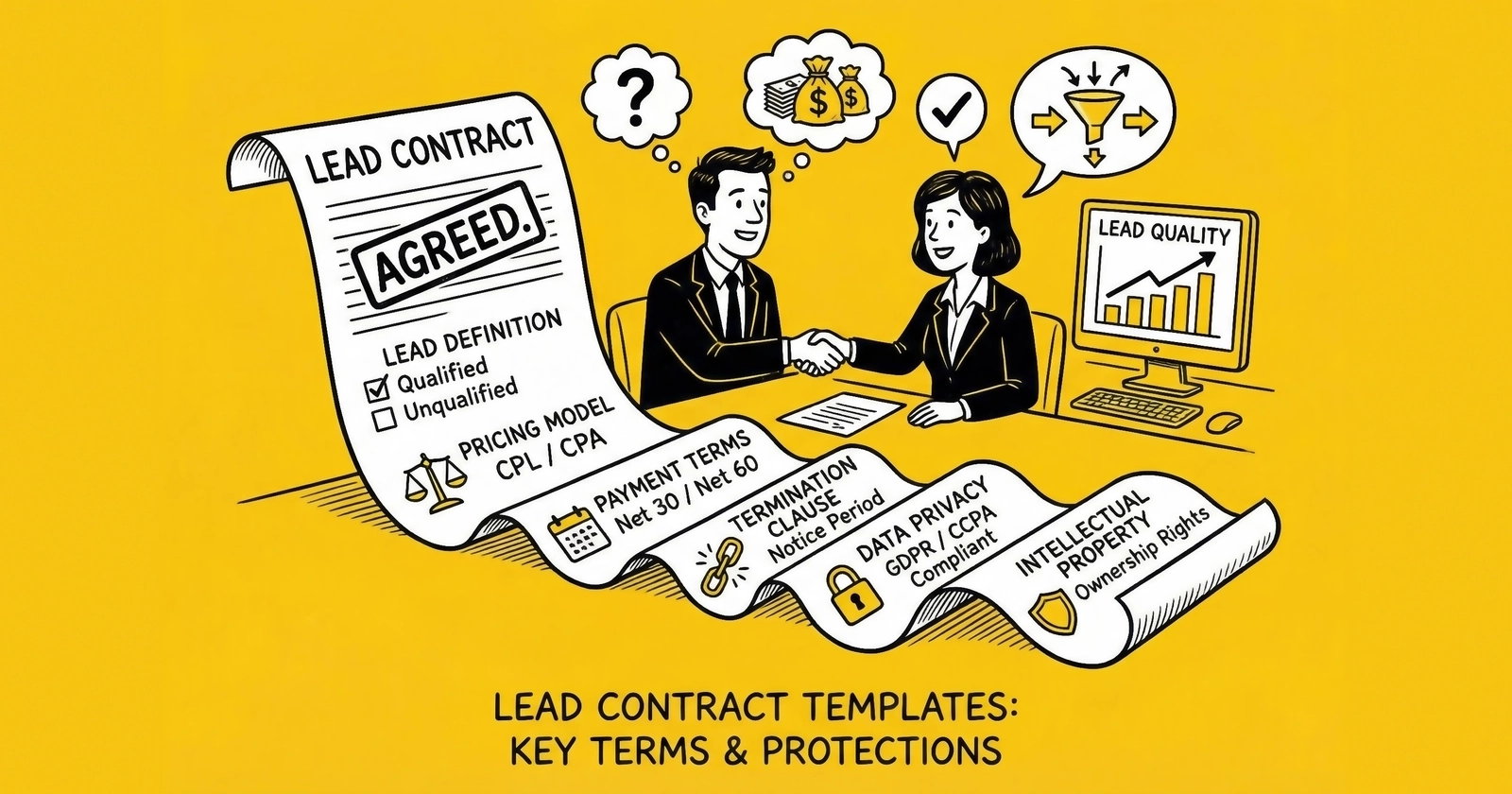
The comprehensive guide to structuring lead generation agreements that protect your business, define clear expectations, and survive TCPA litigation.
In fifteen years of operating in the lead economy, I have reviewed hundreds of lead purchase agreements, insertion orders, and publisher contracts. The pattern is consistent: operators who treat contracts as administrative afterthoughts eventually pay the price in disputed returns, uncollected receivables, or litigation exposure that threatens their entire operation.
The lead generation industry moves fast. Deals close on Slack. Relationships start with handshakes at conferences. Volume flows before paperwork catches up. This informality works until it does not. When a buyer disputes $50,000 in returns, when a publisher delivers leads that trigger TCPA lawsuits, when a partner disappears owing you six figures – that is when the contract you never properly structured becomes the most expensive document you never wrote.
This guide provides the essential framework for lead generation contracts. Whether you are a publisher selling leads, a network routing volume, or a buyer building acquisition infrastructure, these terms and protections will help you build relationships that survive disputes, scale challenges, and regulatory scrutiny.
Why Lead Contracts Require Special Attention
Standard commercial contracts fail in lead generation because leads are not standard commercial products. A lead is a bundle of consumer consent, contact information, and purchase intent that degrades rapidly, transfers complex legal obligations, and creates liability chains that extend across multiple parties.
Three characteristics make lead contracts uniquely challenging:
Time-sensitivity creates urgency that bypasses due diligence. A lead loses approximately 10% of its value per hour after generation, as documented in our analysis of the lead decay curve. This decay curve pressures operators to start flowing volume before contracts are finalized. The buyer who waits three weeks for legal review loses the opportunity. The seller who flows leads on a handshake absorbs risk that proper contracts would allocate.
Consent transfers create liability exposure. When a consumer provides prior express written consent to receive marketing communications, that consent travels with the lead through every subsequent sale and transfer. Each party in the chain – publisher, network, aggregator, buyer – inherits potential TCPA liability based on the original consent capture. In 2024, 2,788 TCPA cases were filed, a 67% increase over 2023. Average settlements exceed $6.6 million. The contract between you and your lead source may determine whether you survive that litigation.
Return disputes compound over volume. A 5% return rate disagreement on 10,000 leads at $50 CPL represents $25,000 in contested revenue – from a single month’s transactions with a single partner. Without clear contractual definitions of valid returns, these disputes erode margins and poison relationships.
The Insertion Order: Foundation of Every Lead Transaction
The Insertion Order (IO) is the governing contract between lead seller and buyer. Never sell leads on a handshake – even with trusted partners. The IO establishes the fundamental terms that govern every lead transaction between the parties.
Essential IO Components
A complete IO addresses seven critical areas. Weakness in any area creates exposure that will eventually manifest as financial loss or legal liability.
1. Definition of a Billable Lead
The most common source of contract disputes is ambiguity about what constitutes a valid, billable lead. Vague definitions like “qualified leads” or “interested consumers” invite interpretation conflicts. Precise definitions eliminate these disputes before they occur.
A proper billable lead definition specifies every requirement the lead must meet. Start with uniqueness: no duplicate within a specified window, typically 30-90 days, from the same buyer. The phone number must be valid, verified via HLR (Home Location Register) or carrier lookup, not just formatted correctly. Email addresses require both syntax verification and deliverability confirmation.
Geographic scope matters more than most practitioners realize. Specify the exact states, zip codes, or regions where the consumer must reside. Demographic criteria should be equally precise: age range, homeowner status, credit tier, or other vertical-specific requirements that define your target audience. Every required data field must be present and populated – partial leads are not billable leads.
Consent documentation is non-negotiable. Every lead must include a valid TrustedForm certificate, Jornaya LeadiD token, or equivalent verification. Timing requirements ensure leads are submitted during the campaign active period. Fraud screening confirms the lead passes specified detection requirements, including bot indicators and velocity checks.
The more specific your billable lead definition, the fewer disputes you will face. If a lead fails any specified criterion, it is not billable – period. This clarity protects both parties by establishing objective standards that eliminate subjective interpretation.
2. Delivery Method Specification
Lead delivery terms must specify exactly how leads will transfer between parties. Ambiguity here creates operational failures that damage relationships even when both parties intend to perform.
For real-time API delivery using ping/post architecture (see our guide on lead delivery methods), the contract should specify the endpoint URL and authentication method, the request and response format (whether JSON, XML, or Form POST), timeout thresholds (typically 500-2000 milliseconds), error handling and retry logic, and the acceptance/rejection response codes each party will use. These technical details seem mundane until a misconfigured timeout causes thousands of leads to fail delivery.
Batch delivery requires different specifications: the frequency of delivery (hourly, daily, weekly), the exact delivery time and time zone, file format (CSV, Excel, or API batch), and the delivery method (SFTP, encrypted email, or portal). For portal access arrangements, specify the access URL and credential management process, available hours and downtime notification requirements, and export capabilities and format. The goal is eliminating any scenario where both parties believe they are doing the right thing but remain incompatible.
3. Return Policy
Return policies represent the most contested area of lead contracts. Buyers want broad return rights to protect against low-quality leads. Sellers want narrow windows and limited reasons to protect revenue predictability. The contract must balance these interests while establishing clear, enforceable terms.
Valid Return Reasons
Returns should be accepted for leads that genuinely fail to meet billable criteria. The distinction matters: a valid return reflects a lead that never should have been delivered, not a lead that failed to convert.
Disconnected or invalid phone numbers qualify, but only when verified by HLR lookup, not just “no answer.” Duplicate leads received from another source within the specified deduplication window are valid returns. Leads outside agreed criteria – wrong geography, age, or other demographic mismatch – should be returned. Hoax or spam submissions with demonstrably fake data qualify, though “seemed uninterested” does not meet this bar. Missing required consent documentation, such as no valid TrustedForm certificate, justifies return. Invalid emails that hard bounce (not soft bounce) qualify. Leads from consumers under minimum age or outside service area should be returned. Clear fraud indicators, including velocity flags and known fraud patterns, constitute valid return reasons.
Invalid Return Reasons
Returns should not be accepted for outcomes that reflect buyer performance rather than lead quality. This distinction is where most disputes arise, and your contract must draw the line clearly.
“No answer or voicemail” is not a valid return – the consumer exists but did not pick up. Consumer “not interested” reflects a sales objection, not a lead defect, and should be rejected. Buyer capacity exceeded represents the buyer’s operational failure, not the lead’s quality. Consumer changed mind after submission, consumer requested Do Not Call after lead delivery, and credit or qualification issues discovered during the sales process all represent post-delivery events, not lead defects. “Could not reach after specified number of attempts” reflects contact effort, not lead validity. Leads considered “too old” should be rejected if they were delivered within contract timing windows.
Return Windows
Industry standard return windows vary by vertical, as detailed in our lead return rates benchmarks. Auto insurance typically uses 7-14 days, allowing time to attempt contact and verify information. Medicare follows a similar 7-14 day window with seasonal sensitivity during AEP and OEP periods. Mortgage leads often have 5-10 day windows due to faster decision cycles. Solar leads may extend to 10-14 days because site qualification takes time. Legal leads often use 3-7 days since qualification determination happens quickly.
Whatever window you establish, enforce it consistently. A policy that bends under pressure invites gaming. Buyers learn that persistence yields out-of-window return acceptance, which undermines the entire framework. Consistency matters more than generosity.
Return Rate Caps
Smart sellers include return rate caps that trigger consequences when exceeded. If a buyer’s return rate exceeds 15-20% of volume, the contract should authorize campaign pause pending review, price renegotiation, volume reduction, or contract termination after consecutive periods exceeding the cap. These provisions protect sellers from buyers who systematically abuse return policies while maintaining flexibility for legitimate quality concerns. The cap creates accountability: if you are returning that many leads, either the source has a problem or you do.
4. Payment Terms
Payment terms in lead generation carry more weight than in most industries due to the structural timing mismatch between traffic costs and collections. You pay for traffic immediately. You collect from buyers in 30-60 days. Every day of payment delay compounds your working capital requirement.
Pricing Structure
Your pricing structure should define the base price per billable lead and any applicable modifiers. Volume tiers create incentives for scale: perhaps 1-500 leads at one price, 501-1000 at a lower price, and 1000+ at your best rate. Exclusive versus shared lead pricing matters significantly – exclusive leads typically command a 20-40% premium because the buyer faces no competition. Quality tier pricing becomes relevant if you grade leads into A-tier, B-tier, and so on. Some operators include time-of-day or day-of-week adjustments when lead value varies by when it arrives.
Payment Schedule
The payment schedule options range from seller-favorable to buyer-favorable. Prepay, where the buyer deposits funds before lead delivery, carries the lowest risk for sellers. Net 7 and Net 15 provide short payment cycles that limit exposure. Net 30 represents the industry standard for established relationships. Net 45 or Net 60 extended terms for enterprise buyers carry higher risk and should command pricing premiums.
For new buyer relationships, require prepayment or Net 7 terms until payment history is established. The credit you extend to unproven buyers is capital at risk. I have seen too many practitioners learn this lesson the hard way, flowing $50,000 or $100,000 in leads to a new buyer who then disappears.
Late Payment Provisions
Late payment consequences must be specified in advance, not improvised during collection calls. Include a late payment fee, typically 1.5-2% per month or a flat fee. Specify a delivery suspension threshold – perhaps deliveries pause at 15 days past due. Document the collection action timeline, such as account referred to collections at 60 days past due. These provisions are only valuable if you enforce them.
Credit Limits
Establish and document credit limits for each buyer. Set an initial credit limit for new relationships based on your risk tolerance, not their promises. Define credit review triggers based on both time and volume. Specify prepay requirements for buyers with payment history issues. Credit limits should increase with demonstrated payment behavior, not with sales pressure.
5. Indemnification and Compliance
Indemnification clauses allocate risk between parties. In lead generation, the primary risks are regulatory (TCPA, FTC, state laws) and operational (fraud, quality failures). Both parties need protection, but the allocation must reflect who controls what.
Seller Representations
The seller should represent and warrant that all leads delivered were generated in compliance with applicable laws including TCPA, include valid prior express written consent for telemarketing contact, were not obtained through deceptive or fraudulent means, include accurate consent documentation such as TrustedForm or Jornaya certificates, and meet the specifications defined in the IO. These representations form the foundation of the buyer’s right to use the leads.
Buyer Representations
The buyer should represent and warrant that all contact will comply with TCPA and applicable state laws, consent revocations will be honored within required timeframes (10 business days under current FCC rules), DNC scrubbing will be performed before contact, contact will occur only within permitted calling hours (8 AM to 9 PM recipient local time federally, stricter in some states), and the calling technology used is authorized by the delivered consent. These representations protect the seller from liability arising from the buyer’s misuse of properly delivered leads.
TCPA-Specific Indemnification
TCPA exposure is significant enough to warrant explicit indemnification provisions beyond general representations. The buyer should indemnify the seller against TCPA claims arising from calling after the consumer revokes consent, calling outside permitted hours, using prohibited dialing technologies when the consent does not authorize ATDS, failure to honor DNC requests, and any contact not authorized by the delivered consent. These are buyer-side failures that the seller cannot control.
Conversely, the seller should indemnify the buyer against claims arising from invalid or fabricated consent documentation, leads generated through deceptive practices, and consent that fails to meet PEWC (Prior Express Written Consent) requirements. These are seller-side failures that contaminate the buyer’s good-faith contact attempts.
Mutual Indemnification
Each party should indemnify the other against claims arising from that party’s breach of representations and warranties. This creates balanced accountability – each party bears responsibility for their own failures. The symmetry matters: neither party can pass the consequences of their own mistakes to the other.
6. Term and Termination
Initial Term and Renewal
Specify the initial contract term, typically 3-12 months, and whether the agreement auto-renews. Auto-renewal with notice requirements is common and ensures continuity while allowing exit. Most practitioners find that 30-day notice windows balance flexibility with planning needs.
Termination for Convenience
Most lead IOs allow either party to terminate with 30 days notice for any reason. This flexibility recognizes that lead relationships may need to end for business reasons unrelated to breach. Markets shift, strategies change, and partnerships that made sense last quarter may not fit next quarter. Allowing clean exits protects both parties.
Termination for Cause
Immediate termination rights should exist for material breach, including failure to pay when due, delivery of leads that do not meet specifications, compliance violations, and fraud or misrepresentation. These provisions protect against partners whose behavior rises to the level where continued performance becomes untenable. The threshold matters: not every minor issue should trigger immediate termination rights, but serious violations should not require 30-day notice periods.
Post-Termination Obligations
The contract should address what happens after termination. Outstanding payments should be due within specified days, typically 15-30. Confidential information should be returned or destroyed. Indemnification obligations typically survive termination because the claims they address may arise long after the relationship ends. Lead data retention or deletion requirements should be specified, balancing operational cleanup with compliance documentation needs.
7. Data Usage and Restrictions
Lead data contains personally identifiable information subject to privacy regulations and consumer expectations. Clear data usage terms protect all parties and prevent the kind of data misuse that generates regulatory scrutiny and consumer complaints.
Permitted Uses
Specify exactly how lead data may be used. Direct contact for specified products or services represents the primary purpose. Internal analysis and reporting support performance optimization. Quality improvement and training help refine operations. Beyond these uses, explicit permission should be required.
Prohibited Uses
Equally important is specifying what the buyer may not do. Resale to third parties without prior written consent exceeds the scope of most lead purchases. Contact for purposes not specified in the original consent violates consumer expectations and potentially TCPA requirements. Contact after consent revocation creates direct liability. Retention beyond specified periods exposes both parties to data breach risk and regulatory violations.
Data Retention and Deletion
Specify how long lead data may be retained. Active use periods typically run 12-24 months, while compliance documentation may need longer retention to cover the TCPA statute of limitations. The contract should specify what happens at termination: whether data is deleted, returned, or retained for specific compliance purposes.
Publisher and Source Agreements
When you are buying leads rather than selling them, the contractual focus shifts. Now your concern is ensuring that your lead sources deliver compliant, quality leads that will not create downstream liability. The publisher agreement is your primary defense against inheriting problems you did not create.
Traffic Source Disclosure
Require publishers to disclose their traffic sources. You need to know whether leads come from paid search (Google, Bing), paid social (Facebook, TikTok), native advertising, display and programmatic channels, email (and critically, the source of those email lists), organic search and SEO, or affiliate sub-sources.
Certain traffic sources carry higher risk. Email leads from unknown list sources, incentivized traffic, and co-registration leads have historically higher fraud and return rates. Your agreement should specify which sources are approved and require notification before source changes. A publisher who suddenly shifts from paid search to email traffic has changed the risk profile of every lead they send.
Consent Requirements
Your publisher agreement should specify exact consent requirements. Every lead should include a TrustedForm certificate URL. If you use both verification services, require Jornaya LeadiD tokens as well. The lead record should include the timestamp of consent capture, IP address of the consumer, and page URL where consent was captured. Attach the exact required consent language as an exhibit to the agreement.
The consent language requirement is critical. Your agreement should require that consent language meets TCPA prior express written consent standards, includes specific disclosure of marketing purpose, lists your company or provides a clear description of authorized parties, meets minimum font size and visibility requirements, and is approved by you before campaign launch. Consent language that looks good to the publisher’s lawyer may not meet your compliance team’s standards.
Quality Standards
Set quality targets and consequences for failure. Validation pass rate should exceed 95%. Duplicate rate should stay below 2%. Return rate should remain under 10%. Contact rate, if you measure it, should exceed 80%. These are not arbitrary numbers – they represent the thresholds below which a lead source becomes unprofitable or risky.
When publishers miss these targets, the agreement should authorize volume reduction, price renegotiation, or termination. Without consequences, quality standards become suggestions.
Audit Rights
Reserve the right to audit publisher compliance at any time. This includes landing page review, consent flow testing, certificate verification, and traffic source documentation requests.
Publishers who resist audit provisions may have something to hide. Legitimate publishers welcome transparency because it differentiates them from low-quality competitors. The publisher who says “trust us” while refusing to show their landing pages is telling you something important.
Exclusivity Terms
Address whether the relationship is exclusive, semi-exclusive, or non-exclusive. Exclusive arrangements mean the publisher sells leads only to you, which commands premium pricing. Semi-exclusive limits sales to a maximum of 2-3 buyers per lead. Non-exclusive allows the publisher to sell to unlimited buyers, which should be reflected in lower pricing.
Your pricing should reflect the exclusivity level, and your agreement should specify consequences for exclusivity violations. A publisher who promises exclusivity but sells leads to five buyers is not a partner worth keeping.
Compliance Program Documentation
Beyond transactional contracts, lead generation businesses require internal compliance program documentation that demonstrates systematic commitment to legal requirements. This documentation serves multiple purposes: it guides daily operations, provides evidence of good faith in regulatory examinations, and supports defense in TCPA litigation.
Consent Capture Procedures
A written TCPA compliance program should begin with consent capture procedures. Document your written TCPA compliance policy and the specific procedures for capturing consent, including examples from your actual forms. Ensure consent language has been approved by legal counsel and that TrustedForm or equivalent certificate capture is implemented across all lead sources. Store consent with lead records for a minimum of 5 years to cover the statute of limitations with buffer. Implement consent language version control to track changes over time, and conduct regular consent language audits to ensure continued compliance.
DNC Management
DNC management requires systematic attention. Maintain an active subscription to the National DNC Registry and perform DNC scrubbing within the 31-day requirement. Maintain and regularly update an internal DNC list. Add revocations to your internal DNC within 10 business days per current FCC rules. Register with state DNC programs where required. This is not glamorous work, but it prevents the kind of violations that generate class action exposure.
Calling Practices
Calling practices must be programmed into your systems, not left to agent discretion. Implement time zone management for calling hours (8 AM to 9 PM recipient time federally). Program state calling hour restrictions where states impose stricter windows. Enforce holiday calling restrictions. Implement call frequency caps to prevent harassment claims. Display a valid callback number on caller ID. Verify STIR/SHAKEN attestation for outbound calls to ensure calls are properly authenticated.
Training and Documentation
Training and documentation create the human element of compliance. Provide initial TCPA training for all staff handling leads or making calls. Conduct annual refresher training to address regulatory changes and reinforce best practices. Maintain training records as evidence of your compliance investment. Require compliance acknowledgment signatures from employees. This documentation proves good faith if regulators or plaintiffs question your practices.
Monitoring and Audit
Monitoring and audit functions ensure your compliance program works in practice, not just on paper. Conduct regular call monitoring for compliance. Audit consent certificates to verify they match expectations. Analyze returns and complaints for patterns that might indicate systemic problems. Monitor litigation in your vertical to stay ahead of emerging legal theories.
Incident Response
Incident response capabilities determine how quickly you recover from problems. Document your complaint escalation procedure. Establish a demand letter response protocol before you receive one. Identify legal counsel for TCPA matters in advance, not during crisis. Verify and document insurance coverage so you know what protection you actually have.
Due Diligence Checklists
Before entering into any lead relationship, conduct systematic due diligence. The time invested in vetting partners saves multiples in avoided problems. A bad partner costs far more than the leads they provide are worth.
New Publisher Evaluation
Start with company verification. Check business registration through Secretary of State records. Confirm the physical address is real, not just a virtual office. Identify key personnel and conduct background checks on principals. Document how long the company has been in business. Obtain industry references and actually call them. Research online reputation to catch problems that references might not volunteer.
Traffic source evaluation comes next. Ensure all traffic sources are disclosed upfront. Review and approve each channel before leads flow. Confirm no prohibited sources like incentivized traffic or undisclosed co-registration. Request source documentation to verify claims.
Consent practices require direct verification. Review landing pages yourself, do not rely on descriptions. Have your compliance team review and approve consent language. Verify TrustedForm or Jornaya implementation is actually working. Review the publisher’s privacy policy and terms of service for compatibility with your practices.
Technical capability must be confirmed before launch. Verify API capability meets your requirements. Deliver test leads and validate they meet specifications. Confirm response time is acceptable, typically under 500ms for ping/post. Verify error handling works correctly before production volume.
Compliance history reveals patterns you need to know. Check for TCPA litigation where the publisher was a defendant. Search for FTC or FCC enforcement actions. Look for state attorney general actions. Verify platform standing with Google and Meta to ensure no policy violations that might indicate problematic practices.
Financial assessment protects your receivables. Agree on payment terms before launch. Verify banking information. Obtain credit references if you are extending payment terms to a publisher (less common, but relevant in some arrangements).
New Buyer Evaluation
Buyer evaluation follows a similar pattern with different emphases. Company verification confirms business registration and, critically, industry licenses such as insurance or mortgage licenses that may be required for the buyer to legally contact leads. Confirm the physical address and identify key personnel. Document time in business to assess stability.
Compliance capability evaluation protects you from downstream liability. Confirm a TCPA compliance program exists. Identify dedicated compliance personnel who actually manage the program. Verify call recording capability if applicable to the buyer’s operations. Document their DNC scrubbing process. Confirm calling hour management capability. Check for history of TCPA litigation as a defendant – buyers who have been sued may create liability chains that reach you.
Operational capability determines whether the buyer can actually use the leads you provide. Confirm API or integration capability meets your technical requirements. Verify lead volume capacity matches anticipated flow. Document response time commitment for real-time delivery. Confirm disposition feedback capability if you need conversion tracking for optimization.
Financial assessment is critical for buyers because you are extending credit through net terms. Agree on payment terms before launch. Complete credit checks for any net terms arrangement. Establish the payment method. Determine prepay requirements for new or questionable buyers.
Contractual requirements should be completed before any leads flow. Sign the IO before lead delivery begins, not after. Confirm indemnification provisions are acceptable to both parties. Agree on return policy terms. Obtain insurance certificates documenting the buyer’s coverage.
Return Dispute Resolution
Despite clear policies, disputes will arise. How you handle them determines whether disagreements strengthen or damage relationships.
Formal Dispute Process
Most disputes resolve at the operational level with basic fact-finding. The account manager should determine: Was the phone actually disconnected, verified by HLR lookup? Did the lead match targeting criteria? Was consent documentation valid and retrievable? Was the return submitted within the window? Account managers should have authority to resolve straightforward disputes without escalation. Empowering front-line staff to make reasonable decisions speeds resolution and reduces frustration on both sides.
When disputes involve pattern issues, escalate to operations management. If a buyer claims 50% of leads are invalid, that is not a one-off dispute – it signals a systematic problem requiring investigation. If a source generates unusual return rates across multiple buyers, operations leadership needs to investigate systemically and propose structural solutions. If consent documentation is failing consistently, the problem lies in process, not individual leads.
Commercial disputes that threaten valuable relationships require executive resolution. Sometimes the right answer is splitting a disputed amount to preserve a partnership worth more than the specific dollars at stake. Executives can make these business judgment calls in ways that account managers cannot.
Documentation Requirements
Document every dispute regardless of outcome. Record the initial claim and supporting evidence, the response and counter-evidence, the resolution and reasoning, and any pattern tracking for future reference.
Dispute history informs both policy refinement and partner evaluation. If you repeatedly dispute the same issues with the same partner, that signals a need to clarify policy or reconsider the relationship. Patterns matter more than individual cases.
Insurance and Risk Transfer
Contracts allocate risk between parties, but not all risk can be transferred. Insurance provides the backstop that protects against catastrophic exposure. The best contract in the world does not help if your partner cannot pay the judgment.
Required Insurance Coverage
Errors and Omissions (E&O) coverage protects against claims arising from professional services failures. For lead generation, this might include claims that you failed to deliver leads meeting specifications or that your leads caused downstream problems. E&O is foundational coverage for any service business.
Cyber liability coverage protects against data breaches and technology failures. Lead data includes personally identifiable information that creates significant breach liability. As data privacy regulations expand, cyber coverage becomes increasingly important.
Media liability coverage protects against advertising-related claims, which may include claims related to how leads were generated or marketed. This coverage matters more for publishers than buyers, but any party involved in lead generation advertising should consider it.
TCPA-specific coverage requires special attention because standard policies often exclude TCPA claims. Specialized TCPA coverage has become more available and addresses this gap. Confirm that your coverage explicitly includes defense costs for TCPA claims, settlement or judgment coverage, and adequate limits for class action exposure. With average settlements exceeding $6.6 million, coverage limits matter significantly.
Insurance Requirements in Contracts
Require your partners to maintain adequate insurance. Set minimum coverage amounts appropriate to the relationship scale – a partner flowing 100 leads per month needs less coverage than one flowing 10,000. Require certificates of insurance before lead flow begins. Include notice requirements if coverage lapses so you can pause the relationship until coverage is restored. Request that your company be named as additional insured where appropriate to ensure direct protection.
Indemnification Limitations
Understand that indemnification is only as valuable as the indemnifying party’s ability to pay. A lead vendor who disappears or declares bankruptcy cannot honor indemnification obligations. Due diligence on partner financial stability matters because your indemnification rights are worth nothing against an empty bank account.
Emerging Contract Considerations
The lead industry continues evolving, and contracts must address new challenges. What seemed unnecessary to document last year may be essential next year.
Data Clean Room Provisions
As third-party cookies disappear and privacy regulations tighten, data clean rooms are emerging as mechanisms for collaborative data analysis without direct data sharing. Contracts for clean room participation should address data contribution specifications that define what each party brings to the collaboration. Processing limitations should restrict operations to within the clean room only. Output restrictions should limit results to aggregated or anonymized data only. Minimum aggregation thresholds prevent re-identification of individuals. Privacy compliance representations ensure all parties meet regulatory requirements. Term and data deletion requirements define what happens when the collaboration ends.
AI and Automation Provisions
As AI increasingly automates lead generation and processing, contracts should address emerging risks. Disclosure of AI-generated content in lead capture matters because consumers may not realize they are interacting with artificial intelligence. AI-assisted calling or messaging limitations may be required under evolving FCC interpretations. Model training data restrictions prevent your lead data from becoming training data for systems that may compete with you. Accountability for AI-driven decisions must be allocated when automated systems make qualification or routing decisions.
One-to-One Consent Provisions
Although the FCC’s one-to-one consent rule was vacated in January 2025, many sophisticated buyers now require individual company consent as a condition of lead purchase. Contracts should specify whether one-to-one consent is required for this buyer. Document how consent scope is captured and verified. Define verification requirements for seller-specific consent, such as TrustedForm certificate content review. Specify consequences for consent scope violations, which may include return rights or contract termination.
Contract Negotiation Strategies
Strong contracts result from thoughtful negotiation that protects both parties’ interests while maintaining commercial viability.
Know Your Leverage
Your negotiating position depends on supply and demand dynamics. If you have premium, exclusive leads that buyers cannot easily source elsewhere, you have leverage on pricing and terms. If you are a new entrant competing for commodity leads, buyers have leverage. If you are evaluating a buyer who represents potential concentration risk, protect yourself with terms even if it means lower volume. Understanding your position prevents both overreaching and unnecessary concessions.
Prioritize Non-Negotiables
Identify which terms you will not compromise before negotiations begin. Consent documentation requirements are non-negotiable because your TCPA exposure depends on them. Payment security for new relationships, whether through prepay or verified payment history, protects your working capital. Return policy fundamentals including valid reasons and reasonable windows ensure predictable economics. Indemnification for your own compliance violations must flow in both directions.
Be flexible on negotiable elements. Volume commitments can adjust based on performance. Pricing tiers can be tested and modified as you learn the relationship economics. Reporting frequency represents operational detail, not legal exposure. Knowing the difference between non-negotiables and preferences strengthens your position.
Document Everything
Every negotiation concession should be documented in the final agreement. Verbal understandings create disputes. If you agree to a special return arrangement for a specific campaign, write it into an IO addendum. If you promise extended payment terms for a particular month, document the exception. What is not written does not exist when disputes arise.
Review Before Renewal
Before auto-renewal kicks in, review the relationship systematically. Are current terms still appropriate given how the relationship has evolved? Has the partner’s payment behavior or quality changed since the original agreement? Have market conditions shifted pricing in ways that should be reflected? Have regulatory requirements changed in ways that affect contract terms? Use renewal as an opportunity to update terms that no longer serve the relationship rather than passively rolling into another year of suboptimal arrangements.
Key Takeaways
-
Never flow leads on a handshake. The Insertion Order is the governing contract for every lead transaction – treat it as foundational infrastructure, not administrative overhead.
-
Define “billable lead” with surgical precision. Vague definitions invite disputes. Every requirement should be objective, measurable, and documented.
-
Return policies require balance. Buyers need protection against genuinely defective leads. Sellers need protection against unlimited chargebacks. Clear windows, valid reasons, and rate caps create workable frameworks.
-
Payment terms carry working capital implications. Every day of extended payment increases your float requirement. Price accordingly and manage credit limits actively.
-
Indemnification allocates TCPA risk. With 2,788 TCPA cases filed in 2024 and average settlements exceeding $6.6 million, the indemnification provisions in your contracts may determine whether your business survives litigation.
-
Due diligence prevents downstream problems. The time invested in vetting publishers and buyers saves multiples in avoided quality issues, compliance failures, and payment disputes.
-
Compliance documentation demonstrates good faith. Written policies, training records, and audit trails support defense positions and may mitigate penalties in regulatory examinations.
-
Insurance provides the backstop. Contracts allocate risk between parties, but insurance protects against catastrophic exposure that exceeds any partner’s ability to indemnify.
-
Contracts are living documents. Review annually, update for regulatory changes, and use renewals as opportunities to improve terms that no longer serve the relationship.
Frequently Asked Questions
What is an Insertion Order (IO) in lead generation?
An Insertion Order is the governing contract between a lead seller and buyer that establishes the fundamental terms for lead transactions. It defines what constitutes a billable lead, how leads will be delivered, pricing and payment terms, return policies, and compliance obligations. Think of the IO as the constitution of your lead relationship – it provides the framework that governs every transaction between the parties.
What should be included in a billable lead definition?
A proper billable lead definition should specify every requirement a lead must meet: unique consumer (no duplicates within a specified window), valid phone number verified via HLR lookup, valid email address, geographic scope, demographic criteria (age, homeowner status, etc.), all required data fields, valid consent documentation (TrustedForm certificate or equivalent), timing requirements, and fraud screening results. The more specific your definition, the fewer disputes you will encounter.
How long should lead return windows be?
Return windows vary by vertical. Auto insurance typically uses 7-14 days. Mortgage leads often have 5-10 day windows due to faster decision cycles. Solar leads may have 10-14 days for site qualification. Legal leads often use 3-7 days for quick qualification determination. Whatever window you establish, enforce it consistently – policies that bend under pressure invite gaming and undermine the entire framework.
What are valid versus invalid reasons for lead returns?
Valid return reasons typically include disconnected or invalid phone numbers (verified by HLR lookup), duplicate leads from another source within the deduplication window, leads outside agreed criteria (wrong geography or demographics), hoax or spam submissions with demonstrably fake data, and missing required consent documentation. Invalid reasons include no answer or voicemail, consumer “not interested” (a sales objection, not a lead defect), buyer capacity exceeded, and consumer changed mind after submission.
How should TCPA compliance be addressed in lead contracts?
Lead contracts should include specific representations from sellers that leads were generated in compliance with TCPA, include valid prior express written consent, and are accompanied by proper consent documentation. Buyers should represent that all contact will comply with TCPA requirements, including honoring revocations within 10 business days, scrubbing against DNC lists, and calling only within permitted hours. Mutual indemnification provisions should allocate liability based on which party’s failure caused the violation.
What payment terms are standard in lead generation?
Industry standard for established relationships is Net 30 (payment due 30 days from invoice). New relationships often require prepayment or Net 7 terms until payment history is established. Enterprise buyers sometimes negotiate Net 45 or Net 60. Given that lead generation involves paying for traffic immediately but collecting from buyers 30-60 days later, every day of payment extension increases your working capital requirement. Some operators calculate that a buyer who pays Net 15 instead of Net 30 is worth a 2-3% price discount due to reduced float costs.
What due diligence should I conduct before signing with a new lead source?
Before signing with any publisher or lead source, verify their business registration, confirm physical address, check industry references, review all traffic sources they will use, examine their landing pages and consent flows, verify TrustedForm or Jornaya implementation, review their privacy policy and terms of service, test their API integration, confirm no history of TCPA litigation or regulatory actions, and verify their platform standing (no Google or Meta policy violations). Publishers who resist transparency may have something to hide.
What insurance coverage do lead generation companies need?
Lead generation businesses should carry Errors and Omissions (E&O) coverage for professional services failures, Cyber Liability coverage for data breaches, and Media Liability coverage for advertising-related claims. Critically, standard business insurance often excludes TCPA claims. Specialized TCPA coverage has become more available and should explicitly include defense costs and settlement or judgment coverage with limits adequate for class action exposure. Verify coverage before you need it – the time to discover a gap is not during litigation.
How should contracts address data usage and retention?
Contracts should specify exactly how lead data may be used (direct contact for specified products, internal analysis) and what is prohibited (resale without consent, contact after revocation). Data retention terms should align with compliance requirements – consent documentation should be retained for at least 5 years to cover the 4-year TCPA statute of limitations plus buffer. Post-termination provisions should address whether data must be returned or destroyed and what compliance documentation may be retained.
What happens if a lead partner breaches the contract?
Contracts should specify termination rights for material breach, including failure to pay when due, delivery of non-compliant leads, compliance violations, and fraud. Post-termination, outstanding payments should be due within a specified period (typically 15-30 days), confidential information should be returned or destroyed, and indemnification obligations should survive termination. For ongoing breach concerns, contracts should include cure periods for minor issues but allow immediate termination for serious violations like TCPA non-compliance.
This guide provides general information about lead generation contracting. Contract requirements vary by jurisdiction, vertical, and specific business circumstances. Consult qualified legal counsel to adapt these frameworks to your specific situation.
Information current as of late 2025. Regulatory requirements evolve continuously.