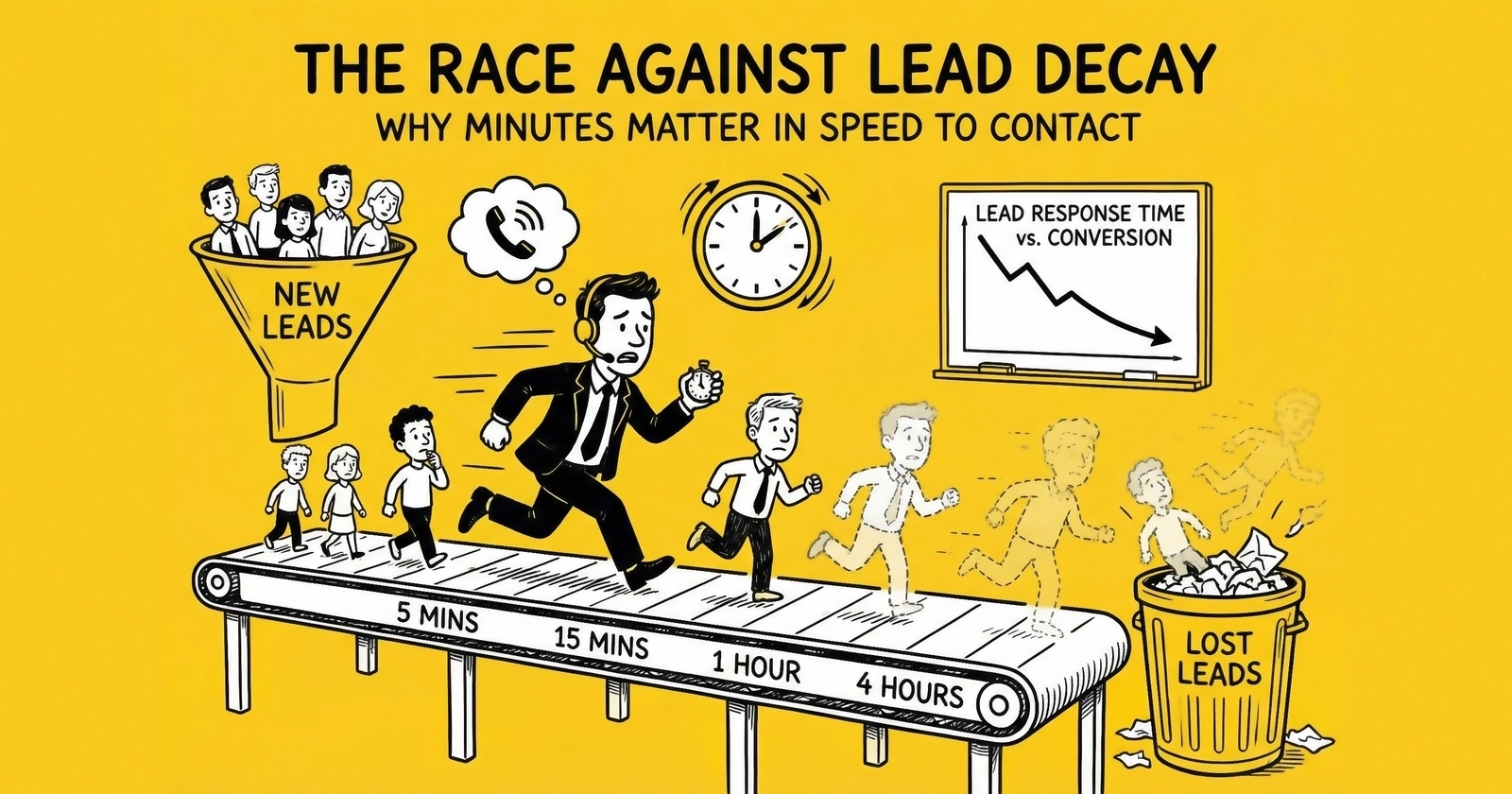
The difference between a profitable lead operation and a failing one often comes down to minutes, not days. Understanding the lead decay curve transforms how you think about every lead in your pipeline.
The Perishable Nature of Consumer Intent
Consumer intent is one of the most valuable commodities in modern commerce. It is also one of the most perishable.
When a consumer fills out a form requesting information about insurance, mortgage rates, solar installation, or any other considered purchase, they are expressing genuine buying intent. They have a problem. They want a solution. They are ready to engage.
But that readiness has a half-life measured in minutes, not hours.
The moment between form submission and first contact represents a critical window that determines whether that lead converts into a customer or becomes worthless data in a spreadsheet. This window is governed by what industry veterans call the lead decay curve: the mathematical relationship between response time and conversion probability.
Understanding this curve is not optional for lead generation professionals. It is foundational. Every pricing decision, technology investment, staffing model, and operational process must account for the relentless decay of lead value over time.
The statistics are stark: leads contacted within one minute convert at rates 391% higher. Leads contacted within five minutes are 21 times more likely to qualify than those contacted at 30 minutes. And 78% of customers ultimately purchase from whichever company responds first.
These are not marginal improvements. They are order-of-magnitude differences that separate profitable operations from money-losing ones.
What Is the Lead Decay Curve?
The lead decay curve describes the relationship between elapsed time from lead capture and the probability of successful contact and conversion. It is not a gradual, linear decline. It is a steep exponential decay that accelerates with each passing minute.
The Science Behind Intent Decay
When a consumer submits a lead form, four psychological factors are at peak levels: active attention (they are at their device, engaged with the topic), problem salience (the issue is front of mind), decision readiness (submitting personal information represents commitment), and competitive exclusivity (they have not yet submitted forms elsewhere).
Each factor degrades rapidly. Within five minutes, attention shifts. Within an hour, problem salience diminishes. Within a day, the consumer may have moved on entirely or already purchased from a competitor.
The Mathematical Reality
Research across multiple industries and millions of leads has quantified this decay. While exact rates vary by vertical and lead source, the pattern is consistent:
- Minutes 0-5: Peak value. Highest contact rates, highest conversion probability, highest consumer engagement.
- Minutes 5-30: Rapid decline. Each additional minute reduces contact probability by measurable percentages.
- Hours 1-24: Steep decay continues. Value drops to a fraction of initial levels.
- Days 1-7: Approaching aged lead territory. Value at 10-30% of fresh lead prices.
- Days 7+: Aged lead category. Value typically 5-20% of fresh lead prices.
The curve is steepest in the first hour. By the time most sales organizations respond to leads (industry average: 42-47 hours), the decay curve has already extracted most of the value from the original intent.
The Research: Why Speed Matters
The importance of speed to contact is not speculation or sales mythology. It is backed by substantial research conducted across industries, lead types, and time periods. The findings are consistent and unambiguous.
Velocify Research: The One-Minute Advantage
Research from Velocify studied millions of sales interactions and found that responding within one minute increases conversion rates by 391%.
This finding has been replicated across multiple studies and verticals. A consumer who just submitted a form is actively thinking about the product and available to engage. Two minutes later, they may have opened a new browser tab or stepped away from their device. The one-minute window represents peak accessibility.
Lead Response Management Study: The 21x Qualification Gap
The Lead Response Management Study, conducted in partnership with MIT and InsideSales.com, produced one of the most cited findings in lead generation: you are 21 times more likely to qualify a lead if you respond within five minutes versus waiting 30 minutes.
This is not a 21% improvement. It is a 21x improvement. The difference between five-minute response and 30-minute response is the difference between a profitable lead operation and a failing one.
Lead Connect Survey: First Responder Advantage
The Lead Connect Survey found that 78% of customers purchase from the company that responds first. Not the best. Not the cheapest. The first.
This has profound implications for shared lead economics. If you purchase a shared lead sent to four buyers, and three have faster response systems, your expected value drops to roughly 22% of what it would be if you consistently responded first. Speed becomes a competitive moat that compounds over time.
InsideSales.com: The 63% That Never Respond
Perhaps the most sobering statistic: 63% of leads never receive any response at all. Most sales organizations lack the technology, staffing, or process discipline to contact leads within the windows that matter.
Simply responding puts you ahead of nearly two-thirds of your competition. Responding quickly puts you in an elite minority that captures disproportionate value from every lead investment.
Mortgage Industry: The 100x Advantage
In mortgage, speed reaches its most extreme expression. Industry research demonstrates leads contacted within five minutes show 100 times better outcomes than those contacted after 30 minutes. Consumers are comparing rates in real-time, and the first loan officer to engage often locks in the relationship before competitors make contact.
Lead Value by Time Interval
Understanding how lead value changes over time informs pricing, staffing, and technology decisions.
0-5 Minutes: Maximum Value Zone
Contact rates run 80-95% (consumer still at device). Conversion probability is at peak. First-mover advantage is available. Exclusive real-time leads in competitive verticals (insurance, mortgage, solar) command $30-150 per lead.
5-30 Minutes: Rapid Decline Zone
Contact rates drop to 50-70%. Conversion probability falls 50-80% from peak. The first-responder advantage may already be lost. If you consistently respond in this window while competitors respond faster, you are systematically leaving value on the table.
30 Minutes to 1 Hour: Critical Degradation
Contact rates: 30-50%. Conversion probability down 70-90% from peak. The consumer has had time to research competitors, receive calls from faster responders, or lose interest.
1-24 Hours: Day-Old Leads
Contact rates: 20-40%. Conversion probability down 80-95% from peak. Many buyers discount day-old leads by 40-60% from real-time prices.
1-7 Days: Approaching Aged Territory
Contact rates: 15-30%. Conversion probability down 90-97% from peak. Pricing drops to 20-40% of fresh value. These leads require more touchpoints and different messaging.
7+ Days: Aged Leads
Contact rates: 10-25%. Conversion probability: 2-5% (versus 15-25% for fresh). Aged leads sell for 5-20% of fresh value. They require high-volume dialing and systematic multi-touch outreach.
Why 78% of Customers Buy from the First Responder
The Psychology of First Contact
When a consumer submits a lead form, they enter a brief window of heightened receptivity. The first responder captures this window, becoming associated with the solution before competitors introduce alternatives.
Subsequent responders face a different situation. The consumer has already begun a conversation with someone else. They must justify why they should engage with additional providers rather than proceeding with the established relationship.
Reduced Decision Fatigue
Consumers want to solve their problem with minimal cognitive effort. The first responder who provides helpful engagement gives the consumer permission to stop searching. For complex purchases like insurance, mortgages, and home improvements, a competent first responder earns substantial preference simply by being first.
Implications for Shared Lead Economics
Consider a $50 shared lead sold to four buyers (for more on the economics, see our exclusive vs shared leads comparison). If response speeds are random, expected value is roughly $12.50 per buyer. But if one buyer has systematically faster response capability, they capture first-responder status on most leads. Their expected value rises to $30-40 per lead while slower competitors realize $5-10.
Speed is not an operational detail. It is a structural competitive advantage that compounds with every lead purchased.
The Five-Minute Rule in Practice
Building systems that consistently achieve speed is the operational challenge that separates winners from losers.
Establishing Response Time Standards
Set internal standards:
- Target: First contact attempt within 60 seconds
- Acceptable: First contact attempt within 5 minutes
- Unacceptable: First contact attempt beyond 5 minutes
Track these metrics obsessively. Speed-to-lead is the highest-leverage operational metric in lead generation.
Staffing for Speed
Achieving consistent sub-minute response requires adequate staffing during all lead generation hours.
Coverage hours must match lead flow hours. If you generate leads from 6 AM to 11 PM, you need sales coverage during all those hours. Leads generated at 8 PM deserve the same response speed as leads generated at 10 AM. Many operations fail this test, responding instantly during peak business hours but leaving evening and weekend leads to languish until Monday morning.
Staffing ratios must account for peak volumes. If you receive 20 leads per hour during peak periods and each call takes 10 minutes, you need at least 4 agents just to keep pace. Account for breaks, administrative tasks, and volume variability. Understaffing during peak hours creates a bottleneck that can take hours to clear.
Backup systems must handle overflow. What happens when lead volume exceeds capacity? Leads should route to overflow queues, backup teams, or automated engagement systems rather than sitting uncontacted. Consider after-hours answering services, distributed teams across time zones, or automated SMS sequences that buy time until a human can follow up.
Process Design for Speed
Every step between lead submission and first contact is an opportunity for delay. Audit each component:
Lead routing: How long does it take for a lead to move from submission to a sales agent’s screen? Real-time routing should take seconds, not minutes. For best practices, see our guide on lead distribution systems. If leads batch-process or queue for manual assignment, you are bleeding value.
Agent notification: How are agents alerted to new leads? Pop-up notifications, screen pops, and auto-dial systems beat email notifications and manual queue checking by orders of magnitude.
Dialing process: Does the agent have to look up the phone number, enter it manually, and wait through rings? Auto-dialers and click-to-call systems eliminate this friction entirely.
Information presentation: Is all necessary lead information visible immediately, or does the agent have to navigate between screens? Every click is a delay, and every delay reduces conversion probability.
Technology for Speed to Lead
Manual processes cannot reliably achieve sub-minute response times at scale. The right technology stack makes speed a default rather than an exception.
Auto-Dialers and Power Dialers
Auto-dialing systems eliminate friction between receiving a lead and initiating contact. When a lead arrives, the system automatically initiates the call and connects the agent only when the consumer answers. Benefits: zero dialing delay, increased attempts per hour, consistent process, and automatic retry for unanswered calls.
For high-volume operations, power dialers managing multiple simultaneous call attempts can dramatically increase contact rates. Configure carefully for TCPA compliance.
CRM Automation and Triggers
Modern CRM systems execute automated workflows when leads arrive: instant SMS establishing first contact within seconds, email acknowledgment setting expectations, screen pops alerting agents, and real-time scoring prioritizing high-value leads for fastest response.
SMS and Multi-Channel Engagement
SMS provides a speed advantage over voice. A text reaches a consumer in 2-3 seconds while a phone call requires waiting for connection. Best practice: send immediate SMS when the lead arrives, then follow with a phone call. Multi-channel sequences combining SMS, email, voice, and voicemail increase overall contact rates.
Real-Time Lead Distribution
For lead buyers, real-time distribution is critical. Ping-post systems enable real-time bidding and delivery: when a consumer submits a form, the generator pings buyers, interested parties bid, and the winner receives the lead for immediate contact. This eliminates supply chain delays that consume valuable minutes.
Aged Leads: The Economics of Decay
Leads that go uncontacted or unconverted become aged inventory. Understanding aged lead economics helps you extract remaining value.
Pricing in the Aged Lead Market
Aged leads typically price at 5-20% of fresh value. For a detailed comparison, see our analysis of aged leads vs fresh leads economics:
- 7-14 days: 20-30% of fresh price
- 15-30 days: 10-20% of fresh price
- 30-60 days: 5-15% of fresh price
- 60-90 days: 3-10% of fresh price
- 90+ days: Pennies per lead
Conversion Economics
Aged lead conversion rates run 2-5% versus 15-25% for fresh. But pricing drops faster than conversion rates.
Example: Fresh lead at $50 with 20% conversion = $250 cost per acquisition. Aged lead (30 days) at $5 with 3% conversion = $167 cost per acquisition. The aged lead delivers lower CPA despite lower conversion rates.
Operational Requirements
Aged leads require fundamentally different operational approaches:
Higher volume capacity. Because conversion rates are lower, you need more leads to generate the same number of conversions. If fresh leads convert at 20% and aged leads convert at 3%, you need roughly 7x the lead volume to produce the same number of customers. Your dialing capacity must scale accordingly.
Persistent outreach. Aged leads rarely convert on first contact. Plan for 6-12 contact attempts over 2-4 weeks. The consumer who did not answer on day one may answer on day seven. Persistence matters more than speed when working aged inventory.
Different messaging. Acknowledge that time has passed. “I know you inquired about insurance a few weeks ago. Are you still looking for coverage?” beats pretending the lead is fresh. Consumers appreciate honesty and respond better to authentic outreach.
Multi-channel approach. Combine calls, texts, and emails to maximize contact probability. Aged leads have already proven harder to reach; use every available channel. A sequence that combines phone attempts with email and SMS touchpoints extracts more value than phone-only approaches.
Realistic expectations. Staff, compensate, and measure based on aged lead economics, not fresh lead benchmarks. An agent working aged leads should be evaluated on different metrics than an agent working fresh leads.
Measuring and Improving Your Response Time
Building a speed-to-lead culture requires consistent measurement and systematic improvement.
Key Metrics to Track
- Median response time: Time at which half of leads receive first contact. Better than average because not skewed by outliers.
- 90th percentile response time: Reveals long-tail slow responses dragging down performance.
- First-minute response rate: The gold standard for speed-to-lead excellence.
- Five-minute response rate: Minimum acceptable standard for competitive operations.
- Contact and conversion rate by response time cohort: Demonstrates the decay curve in your own data.
Benchmarks for Speed-to-Lead Performance
| Performance Level | Median Response Time | 90th Percentile |
|---|---|---|
| World-class | Under 30 seconds | Under 2 minutes |
| Excellent | Under 1 minute | Under 5 minutes |
| Acceptable | Under 5 minutes | Under 15 minutes |
| Poor | 5-30 minutes | 30+ minutes |
| Industry average | 42-47 hours | Days |
The gap between 47-hour response and 1-minute response represents enormous economic opportunity.
Improvement Tactics
If your response times are not where they should be, focus on these high-impact improvements:
Implement auto-dialing. If agents are manually dialing leads, the time savings from automation alone can cut minutes from response time. Auto-dialers eliminate the delay between lead arrival and call initiation.
Add real-time notifications. Agents should receive immediate alerts when leads arrive. Waiting for leads to appear in a queue check adds delay. Screen pops and audio alerts create instant awareness.
Extend coverage hours. Every lead that arrives outside your staffed hours is a lead that cannot receive rapid response. Extend hours, implement after-hours solutions, or consider distributed teams across time zones.
Create overflow routing. When primary agents are occupied, leads should route to backup resources rather than waiting in queue. Overflow capacity prevents backlogs during volume spikes.
Deploy instant SMS. Automated text messages can establish first contact within seconds, buying time for voice follow-up. Many consumers actually prefer text communication.
Audit your technology stack. Measure the delay at each step: lead receipt, routing, notification, dialing. Identify and eliminate bottlenecks. Small improvements at each step compound into significant overall gains.
Tie compensation to speed. What gets measured gets managed, and what gets compensated gets prioritized. Bonus agents for speed performance. Create leaderboards that celebrate fast response.
Frequently Asked Questions
What is the optimal lead response time for maximum conversion?
Research from Velocify found that responding within one minute increases conversion rates by 391%. The Lead Response Management Study found that leads contacted within five minutes are 21 times more likely to qualify than those contacted at 30 minutes. For maximum conversion, target response within 60 seconds; for acceptable performance, respond within five minutes.
How much does lead value decay over time?
Lead value decays approximately 50% within the first 24-48 hours for most verticals, with the steepest decline in the first hour. By day 7, leads enter “aged” territory where value drops to 5-20% of fresh lead prices. The decay curve is exponential, not linear: value drops faster in the first five minutes than in the next five hours.
What percentage of leads never receive any response?
According to research from InsideSales.com, 63% of leads never receive any response at all. The industry average response time is 42-47 hours, by which point most lead value has already decayed. Simply responding to leads puts you ahead of nearly two-thirds of competitors.
Why do 78% of customers buy from the first responder?
The first responder captures the consumer during their window of highest receptivity, immediately after form submission. They establish the relationship before competitors introduce alternatives. Consumers experience decision fatigue and prefer to proceed with the first competent solution rather than evaluate multiple options. This dynamic is documented in the Lead Connect Survey.
What is the difference between fresh leads and aged leads?
Fresh leads are newly generated, typically under 24-48 hours old, and command premium pricing based on their conversion potential. Aged leads are unsold or unconverted inventory, typically 7-90+ days old, that sell for 5-20% of fresh prices. Aged leads require different sales approaches: higher volume, more touchpoints, persistent outreach, and adjusted expectations.
How can I improve my speed-to-lead performance?
Key tactics include: implementing auto-dialing systems to eliminate manual dialing delay, adding real-time notifications for instant agent alerts, extending coverage hours to match lead flow, creating overflow routing for peak periods, deploying instant SMS for immediate first contact, and tying agent compensation to speed metrics.
What technology do I need for sub-minute response times?
Essential technology includes: auto-dialer or power dialer systems, CRM with real-time lead routing and notifications, SMS automation for instant text response, and real-time lead distribution if purchasing from generators. The stack must be integrated so leads flow from source to agent screen to outbound call without manual intervention.
Is speed-to-lead more important than lead quality?
They are both essential. High-quality leads contacted slowly will underperform low-quality leads contacted rapidly. The optimal approach combines quality lead sources with rapid response systems. However, if you must prioritize improvement, response time often delivers faster ROI than source quality improvements because the fix is operational rather than requiring new vendor relationships.
How do aged leads fit into a lead generation strategy?
Aged leads serve operators with high-volume contact center capacity who can profitably work leads at 2-5% conversion rates. The economics work when purchase prices drop proportionally faster than conversion rates. Aged leads should not replace fresh lead strategies but can provide supplemental volume and improve overall cost per acquisition when worked systematically.
What response time benchmarks should I target?
World-class performance: median response under 30 seconds, 90th percentile under 2 minutes. Excellent: median under 1 minute, 90th percentile under 5 minutes. Acceptable: median under 5 minutes, 90th percentile under 15 minutes. The industry average of 42-47 hours represents massive economic waste.
Key Takeaways
-
The one-minute advantage is real. Velocify research found 391% higher conversion rates for one-minute response. Every second of delay costs money.
-
The five-minute rule is minimum acceptable performance. Leads contacted within five minutes are 21 times more likely to qualify than those contacted at 30 minutes. If you cannot respond within five minutes, you are not competitive.
-
78% of customers buy from the first responder. Speed is not just about contact rates; it is about capturing the sale before competitors have a chance to compete. First is best.
-
63% of leads never receive any response. The bar for excellence is surprisingly low. Simply responding puts you ahead of most competitors.
-
Lead value decay is exponential, not linear. The steepest decline occurs in the first minutes and hours. By day 7, leads are worth 5-20% of fresh value.
-
Technology enables speed. Auto-dialers, real-time CRM triggers, instant SMS, and real-time lead distribution are not luxuries. They are competitive necessities.
-
Measure obsessively. Track median response time, 90th percentile, first-minute rate, and conversion by response time cohort. What gets measured gets managed.
-
Speed is a structural competitive advantage. In shared lead environments, the fastest responder captures disproportionate value from every lead purchased. This compounds over time.
-
Aged leads are a different business. They require different operations, expectations, and economics. Do not apply fresh lead standards to aged lead performance.
-
The opportunity is now. With most competitors responding in hours or days, achieving minute-level response creates immediate competitive advantage.
The lead decay curve is unforgiving, but its math works both ways. Those who understand it and build systems for speed capture disproportionate value from every lead they touch. Those who ignore it watch their investments decay into worthless data. The choice is yours, and the clock is already running.