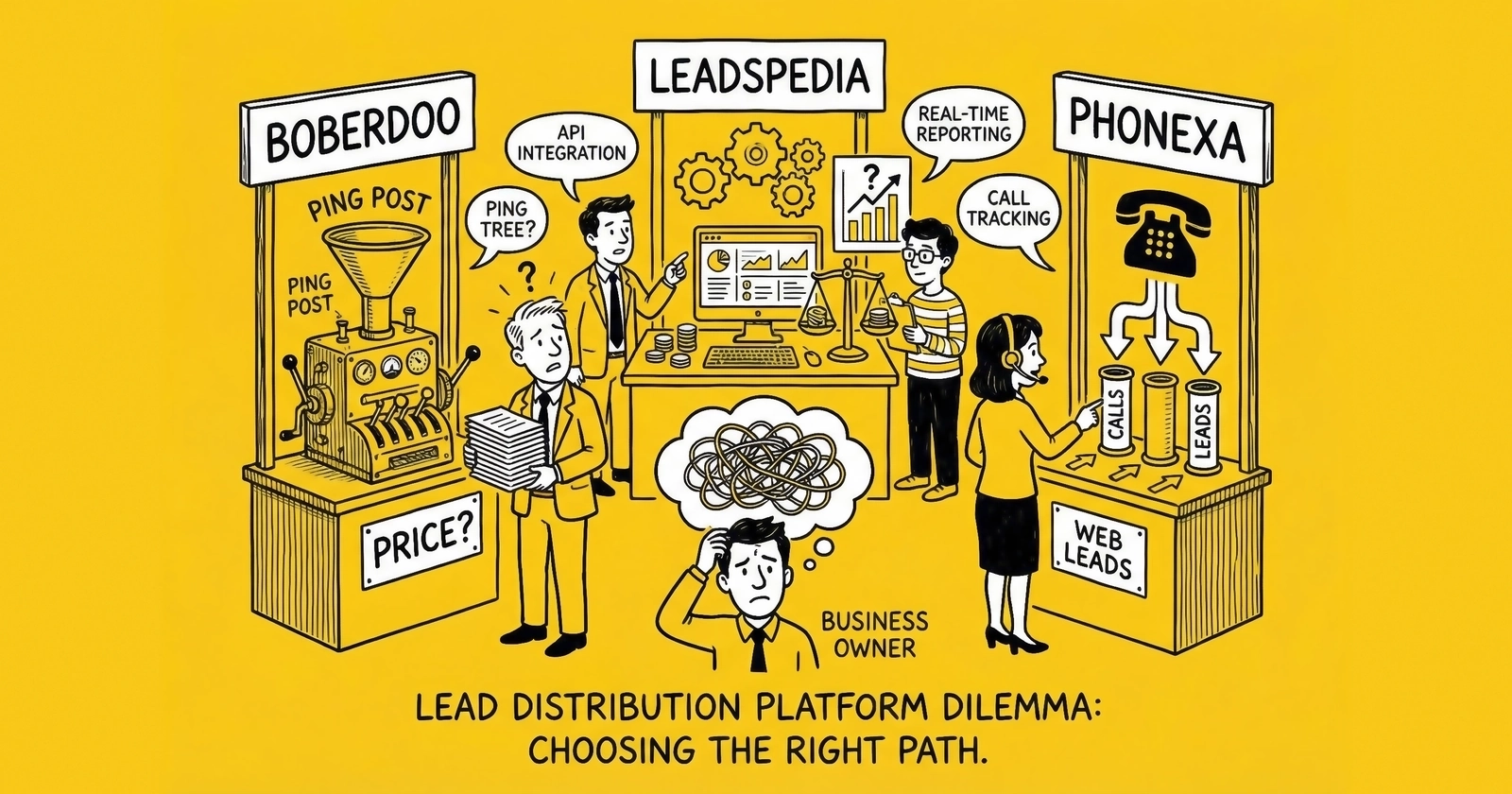
Your lead distribution platform touches every dollar that flows through your operation. Choose wrong, and you spend years fighting limitations that should have been features. Choose right, and your platform becomes invisible infrastructure that scales with your business.
The lead distribution platform market in 2025 presents operators with a genuine decision. Three platforms dominate conversations in performance marketing circles: boberdoo, LeadsPedia, and Phonexa. Each serves different operational models, scales differently, and prices differently. This comparison provides the information you need to make an informed decision, free from vendor relationships or sales motivation. The goal is operational clarity.
The platform you select today will determine how quickly you can onboard new buyers, how accurately you can route leads, how defensibly you can document consent, and whether your business can scale beyond your current capacity to manage it manually. This is not a software decision. It is an operational decision with software implications.
I have watched operators spend months evaluating platforms based on feature checklists, only to discover six months after implementation that they chose the wrong architecture for their business model. The platform with the longest feature list is not always the right platform. The platform that matches your specific operational requirements – your volume, your vertical mix, your buyer relationships, your compliance posture – is the right platform. Let’s examine what each platform actually delivers.
Understanding Lead Distribution Platforms
Before comparing specific platforms, it helps to understand what lead distribution software accomplishes. These systems sit at the center of lead operations, handling four core functions that determine operational effectiveness.
Lead routing and distribution forms the foundation. When a lead enters your system, the platform determines which buyer receives it based on configurable criteria: geography, lead type, price, buyer capacity, time of day, and dozens of other factors. For a deeper look at routing mechanics, see our lead distribution systems guide. Sophisticated platforms support multiple routing algorithms including price-based auctions, priority cascades, round-robin distribution, and weighted allocation. The flexibility of these routing options directly affects how well you can optimize revenue while meeting buyer requirements.
Ping/post processing represents the industry-standard protocol for real-time lead trading. A “ping” sends lead attributes to potential buyers asking “do you want this lead?” Buyers respond with bids. A “post” delivers the complete lead data to the winning buyer. Platforms differ dramatically in how efficiently they handle ping/post workflows, particularly at high volumes. boberdoo has processed over 36.5 billion pings since inception, demonstrating the scale these systems can achieve when engineered for performance.
Financial management adds another layer of complexity. Lead distribution generates intricate financial flows: buying from sources, selling to buyers, managing returns, tracking margins, processing payments, reconciling accounts. Understanding the sixty-day float rule is essential for managing these cash flows. Your platform should automate billing, manage buyer orders, track profitability by source and buyer, and handle the accounting complexity that scales with volume. Operations that underestimate this requirement find themselves buried in spreadsheets that should have been automated.
Compliance documentation has become non-negotiable. As detailed in our guide on consent and TCPA compliance, TCPA litigation increased 67% year-over-year in 2024, with average settlements exceeding $6.6 million. Your platform must integrate with consent documentation services like TrustedForm and Jornaya, store certificates for years, and provide retrieval capabilities when compliance inquiries arise. The platforms we’re comparing approach these functions differently, and understanding those differences matters more than feature checklists.
The Three-Pillar Framework
Lead distribution platforms generally fall into one of three operational pillars: Lead Distribution Automation (handling data transit, monetization, and compliance), Affiliate Management (tracking clicks, commissions, and publisher relationships), and Call Tracking (routing voice traffic and IVR). While all-in-one suites exist, understanding which pillar a platform prioritizes helps predict where it will excel and where it will require workarounds.
boberdoo prioritizes the Lead Distribution Automation pillar. The platform treats lead distribution as fundamentally a financial engineering problem, with every feature oriented toward maximizing revenue per lead while maintaining operational control.
LeadsPedia bridges the Lead Distribution Automation and Affiliate Management pillars. The hybrid architecture serves operations running both functions, eliminating the integration complexity that typically accompanies multi-platform stacks.
Phonexa spans all three pillars through its eight-product suite, with particular strength in Call Tracking. The breadth appeals to operations needing multi-channel orchestration, though it comes with corresponding complexity.
This framework shapes the detailed analysis that follows.
boberdoo: Financial Engineering for Lead Operations
History and Market Position
boberdoo has operated since 2000, making it the longest-running lead distribution platform still actively serving the market. Founded by Brad Seiler in Chicago, the company has spent over two decades building infrastructure that processes millions of pings daily for lead sellers and buyers across multiple verticals – and that longevity shows in the platform’s depth. boberdoo treats lead distribution as fundamentally a financial engineering problem. When you are managing cash flow between buying and selling, optimizing revenue per lead, handling complex billing relationships, and maintaining margin discipline across thousands of transactions, you need instrumentation designed for that complexity. The platform emphasizes 99.99% uptime and has built fraud detection and regulatory compliance automation into its core infrastructure. This reliability matters when your revenue depends on continuous operation across time zones and market conditions.
boberdoo’s market position is enterprise and high-volume operations. The platform handles the most complex distribution scenarios, the largest transaction volumes, and the most sophisticated financial reporting requirements in the industry. This positioning means smaller operations may find the platform more powerful than necessary, while high-volume operators may find nothing else meets their needs.
Core Capabilities
The platform’s “Shotgun Ping Post” sends pings to all matching buyers simultaneously rather than sequentially. The system collects bids, evaluates scenarios, and routes optimally. When sequential processing means your tenth buyer waits while you work through the first nine, parallel processing compresses that latency into milliseconds – a speed advantage that compounds at scale, where every millisecond of processing delay represents potential revenue loss.
Scenario optimization takes this further by automatically calculating whether selling exclusively to one buyer or sharing among multiple buyers generates more total revenue, then executing the optimal scenario. After any buyer rejection, the system recalculates remaining scenarios. boberdoo claims 20-40% additional revenue recovery from leads that initial buyers declined through this secondary optimization. For aggregators handling significant volume, that recovery rate represents substantial margin improvement.
The platform’s AI Savings Model recalculates optimal matches every 10 minutes based on disposition feedback loops. This continuous optimization means your routing logic adapts to changing buyer performance rather than relying on static configurations. When a buyer’s conversion rates shift – whether due to internal changes, market conditions, or seasonal factors – your routing adapts automatically.
Financial instrumentation runs deep, with approximately 85 standard reports covering every dimension of lead operations: source performance, buyer conversion rates, profit analysis, billing reconciliation, and margin tracking. The “factoring” capabilities address the cash flow timing gap that kills undercapitalized operations. When you are buying leads with immediate payment while buyers pay on 30-day terms, visibility into these flows prevents cash crises.
Customization depth sets boberdoo apart. Custom filter sets for each buyer define exactly what they can buy at what price. Custom billing cycles align with specific cash flow requirements. Custom reporting provides the metrics your business needs. The platform bends to your operational requirements rather than forcing you into predefined workflows.
Additional capabilities include a no-code form builder that eliminates developer dependency for lead capture forms, LeadQC validation providing quality checks at $0.02 per lead (Lite) or $0.20 per lead (Full), native integration with TrustedForm, Jornaya, and Blacklist Alliance for compliance documentation, and call routing functionality with smart distribution matching calls to appropriate buyers via Twilio integration.
Pricing Structure
boberdoo uses volume-based pricing with a transparent cost structure. The monthly platform fee starts at $1,075/month, with a one-time $250 onboarding fee covering training and system configuration. Average active client spend ranges from $1,075 to $3,000/month depending on volume and add-ons. Billing operates month-to-month, billed in arrears based on average daily inbound actions only – outbound actions do not count toward billing.
Add-on services include LeadQC Full at $0.20 per lead, LeadQC Lite at $0.02 per lead, Bid Experiments at $500/month, Cherry Picker at $500/month, Direct DB Access at $500/month, and consulting at $195/hour.
All tiers include unlimited admin users, buyers, and vendors, unlimited outbound actions, unlimited timed reports, the no-code form builder, 50+ webhooks, 100+ reports, Active Vendor Directory listing, buyer auto rebilling, the ability to use your own Twilio account with no upcharges on minutes or numbers, and full API access. No long-term contracts required, no throttling or scaling restrictions, and automatic volume discounts apply as you scale.
Ideal Use Cases
boberdoo serves lead aggregators processing 10,000+ leads monthly who need sophisticated routing logic and financial instrumentation. The platform excels for operations requiring complex waterfall distributions with revenue optimization, multi-buyer parallel ping/post processing, detailed financial reporting and margin analysis, high-volume transaction processing, advanced scenario evaluation (exclusive vs. shared optimization), and multi-channel operations handling leads, calls, and clicks through unified systems.
The learning curve is real. Users consistently report that boberdoo takes time to set up properly. But operators who make that investment also report that the platform scales from early-stage operations to seven-figure monthly revenues without requiring migration. The initial configuration investment pays dividends through operational capabilities that simpler platforms cannot match.
LeadsPedia: Bridging Affiliate and Lead Management
History and Market Position
LeadsPedia occupies a distinctive market position by combining a Lead Distribution System with an Affiliate Management System in a unified architecture. This hybrid approach allows operators to track both the “click” (EPC, conversion rates, publisher payouts) and the “lead” (routing, delivery, buyer billing) in a single dashboard.
For operations that both generate traffic through affiliate relationships and monetize that traffic through lead distribution, LeadsPedia removes the integration complexity that typically accompanies multi-platform stacks. The platform serves verticals including insurance, home services, education, and financial services – anywhere affiliate-driven traffic feeds lead distribution workflows. The unified view helps operators identify which traffic sources produce leads that actually convert with buyers, not just leads that meet initial quality filters.
Core Capabilities
The platform’s unified lead and affiliate tracking eliminates data reconciliation headaches that plague operators running separate systems. When your affiliate network sends traffic that converts to leads that route to buyers, seeing that entire journey in a single dashboard provides clarity that siloed systems cannot. You can trace performance from initial click through final buyer delivery, understanding true traffic source value rather than intermediate metrics that may not correlate with actual revenue.
Automated lead routing handles distribution based on predefined criteria including geographic location, lead quality, product type, and custom fields. Distribution supports price-based (highest bidder wins), priority-based (ranked buyer preference), round-robin (sequential rotation), and weighted (proportional allocation) distribution methods. The flexibility accommodates different buyer relationship types within the same operation.
Real-time analytics provide immediate visibility into campaign effectiveness, lead flow, and buyer performance. The reporting provides hybrid visibility into both traffic acquisition metrics and lead distribution performance, surfacing the complete picture from initial click through final buyer delivery. Customizable distribution rules allow operators to tailor routing logic to specific business models with advanced configuration options for geography, quality criteria, and buyer requirements.
Third-party integrations connect natively with Zapier, Stripe, Authorize.net, Jornaya, TrustedForm, Anura, DNC.com, The Blacklist Alliance, and webhooks for custom connections. The integration library covers major validation and compliance services for enhanced workflow automation. Call tracking and routing handles both web leads and phone calls within the same interface, with advanced call distribution and customizable IVR systems ensuring every call routes appropriately.
User reviews consistently praise LeadsPedia’s interface accessibility. Operators report becoming productive quickly without extensive training. For teams without dedicated technical staff, this accessibility reduces implementation time and ongoing operational friction. The platform was designed with non-technical users in mind, which shows in the interface design and workflow organization.
Pricing Structure
LeadsPedia offers tiered subscription pricing based on volume and features. The Lite Plan runs $1,500/month and includes 25,000 leads, 1,000,000 pings, 150,000 clicks, 50,000 conversions, local numbers at $3.00, toll-free numbers at $4.00, cost per minute at $0.055, and standard support.
The Premium Plan costs $2,500/month and includes 100,000 leads, 5,000,000 pings, 300,000 clicks, 150,000 conversions, local numbers at $1.50, toll-free numbers at $2.00, cost per minute at $0.045, and priority support.
Enterprise Plans offer custom pricing with custom volume allocations, custom phone rates, annual billing, and elite support tier.
Core features available at all tiers include API access, lead import, batch delivery, queue management, webhooks, and call tracking and routing.
Ideal Use Cases
LeadsPedia serves mid-market operations running both affiliate programs and lead distribution. The platform excels for hybrid affiliate/lead distribution businesses, operations frustrated by data reconciliation across separate systems, teams without dedicated technical staff who need accessible interfaces, multi-vertical operations in insurance, home services, education, and financial services, and businesses needing unified click and lead tracking.
LeadsPedia’s sweet spot is operators processing 25,000 to 100,000 leads monthly who value interface accessibility and unified affiliate/lead management over maximum customization depth. The hybrid architecture provides value that separate systems cannot replicate, while the accessible interface reduces the technical barrier to effective operation.
Phonexa: Multi-Channel Marketing Automation
History and Market Position
Phonexa positions itself as an all-in-one marketing automation solution bundling eight proprietary products into an integrated suite. The platform handles calls, leads, email, SMS, click tracking, suppression management, user behavior analytics, and automated accounting within a unified system.
Founded in September 2016 by David Gasparyan, Phonexa initially focused on lead generation optimization for the financial services sector before expanding significantly across both geographies and capabilities. The company now maintains offices in the United States (headquartered in Glendale, California), United Kingdom, Canada, Argentina, and Ukraine. Key milestones include joining Google Cloud Marketplace in March 2023 and continuous expansion into new markets and verticals through 2024, supported by a substantial workforce across multiple continents and multiple Great Place to Work certifications since 2019.
Core Capabilities
Phonexa’s flagship Ping Post Calls 2.0 capability handles all five lead flows: Ping-Post Web Leads, Calls, Click Listings, Direct Post, and Ping Post Calls. This comprehensive coverage matters for operations monetizing consumer intent across multiple channels. Rather than cobbling together separate systems for each flow type, operators manage everything through a unified interface.
LMS Sync, the lead tracking and distribution module, captures attribution data from web campaigns, provides detailed analytics, and automates distribution with configurable criteria. Ping tree optimization expands earning possibilities by routing organic decline leads to new destinations. The platform tracks leads from generation to monetization with granular analytical data on marketing campaign impact.
Call Logic provides sophisticated call tracking and distribution capabilities. Predictive modeling analyzes historical data to route calls to buyers most likely to convert. The module includes dynamic phone number insertion for detailed attribution, IVR creation and customization for caller journeys, AI call agents for 24/7 automated call handling, sophisticated routing logic optimizing for pay-per-call performance, real-time call data insights to identify trends and optimize funnel performance, and GoogleAds reporting comparing ad spend against conversion and revenue outcomes.
E-Delivery provides integrated email and SMS capabilities with volume-based pricing ranging from $0.11 to $0.20 per 1,000 emails depending on tier.
The full eight-product bundle includes LMS Sync (lead tracking and distribution), Call Logic (call tracking and distribution), E-Delivery (email and SMS marketing), Cloud PBX (cloud-based phone system with call scoring), Lynx (click tracking and conversion monitoring), Opt-Intel (suppression list management and compliance), HitMetrix (user behavior recording and analytics), and Books360 (automated accounting and invoicing).
Because all eight products are built on the same platform, data flows seamlessly between modules. A consumer journey spanning web form submission, callback, and inbound call can be tracked in a single system rather than stitched together from multiple point solutions. The platform integrates with over 100 third-party systems including Salesforce, HubSpot, Google Ads, and Oracle for comprehensive workflow automation, with desktop and mobile apps enabling campaign management from anywhere on iOS and Android.
Customer support operates 24/7 with dedicated customer success representatives. Phonexa reports customers achieving 20% increase in monthly lead conversion rates and 40 hours per month reduction in manual accounting through Books360 automation.
Pricing Structure
Phonexa uses tiered pricing with both platform fees and usage-based components. The Lite Suite costs $250/month plus a $500 setup fee and includes 25 employee users, 180-day data storage (summaries), LMS Sync at $0.002 per post, Call Logic at $0.045/minute, E-Delivery at $0.20 per 1,000 emails, and Lynx at $0.30 per 1,000 clicks.
The Premium Suite runs $500/month plus a $1,000 setup fee and includes 50 employee users, extended data storage, LMS Sync at $0.001 per post, Call Logic at $0.040/minute, E-Delivery at $0.15 per 1,000 emails, and Lynx at $0.25 per 1,000 clicks.
The Enterprise Suite costs $1,000/month plus a $2,000 setup fee and includes unlimited employee users, 1,100-day data storage, LMS Sync at $0.0003 per ping, Call Logic at $0.035/minute, E-Delivery at $0.11 per 1,000 emails, and Lynx at $0.20 per 1,000 clicks.
Custom plans are available for high-volume pricing through sales consultation. Pay-as-you-go monthly agreements are available for Lite and Premium plans, with no long-term contracts required at lower tiers.
Ideal Use Cases
Phonexa serves enterprise-scale operations in verticals where phone calls drive significant revenue. The platform excels for insurance, home services, financial services, and legal verticals, operations monetizing the same consumer intent across web, voice, and email, pay-per-call specialists needing predictive routing, enterprises wanting call tracking fully integrated with lead and email systems, high-volume operations that can leverage the eight-product bundle, and networks, affiliates, brands, advertisers, and performance agencies.
Phonexa’s complexity and capabilities may be excessive for modest-volume operations. The platform targets operators processing substantial call and lead volumes who need multi-channel orchestration in a unified system. The eight-product bundle provides value when you use multiple modules; less so if you only need lead distribution.
Feature Comparison
The following table provides a direct comparison of key capabilities across all three platforms:
| Feature | boberdoo | LeadsPedia | Phonexa |
|---|---|---|---|
| Core Focus | Lead distribution with financial engineering | Hybrid lead distribution + affiliate management | Multi-channel marketing automation |
| Founded | 2001 | - | 2016 |
| Ping/Post | Parallel (Shotgun) processing | Standard ping/post | Ping Post Calls 2.0 (all five flows) |
| Total Pings Processed | 36.5+ billion | - | - |
| Call Tracking | Via integration with Twilio | Included with IVR | Full Call Logic suite with IVR and AI agents |
| Affiliate Management | Limited | Full affiliate system included | Via Lynx click tracking |
| Standard Reports | ~85 | Comprehensive | Full suite analytics |
| Scenario Optimization | Exclusive vs. shared auto-calculation | Manual configuration | Yes |
| Revenue Recovery | 20-40% from rejected leads | Standard waterfall | Ping tree optimization |
| AI/ML Optimization | AI Savings Model (recalculates every 10 min) | - | Predictive modeling for calls |
| Email/SMS | Via integration | Via integration | E-Delivery included |
| TrustedForm Integration | Native | Native | Native |
| Jornaya Integration | Native | Native | Native |
| DNC Scrubbing | Via partners | DNC.com integration | Opt-Intel included |
| Fraud Detection | Built-in | Anura integration | Native |
| API Depth | Extensive (50+ webhooks) | Comprehensive | Full API suite (100+ integrations) |
| Mobile Apps | Limited | Limited | iOS and Android |
| White-Label | Available | Available | Available |
| Uptime Guarantee | 99.99% | - | - |
| Learning Curve | Steep | Moderate | Moderate-Steep |
| Minimum Contract | Month-to-month | Monthly billing | Month-to-month (lower tiers) |
Pricing Comparison
| Component | boberdoo | LeadsPedia | Phonexa |
|---|---|---|---|
| Entry Monthly Fee | $1,075 | $1,500 | $250 |
| Mid-Tier Monthly | ~$1,500-2,500 | $2,500 | $500 |
| Enterprise Monthly | $3,000+ | Custom | $1,000+ |
| Setup Fee | $250 | Not disclosed | $500-2,000 |
| Leads Included | Volume-based pricing | 25K-100K by tier | Usage-based |
| Per-Lead Validation | $0.02-0.20 | Via integrations | Included in post fees |
| Per-Minute (Calls) | Use own Twilio | $0.045-0.055 | $0.035-0.045 |
| Contract Length | Month-to-month | Monthly | Month-to-month |
When evaluating total cost of ownership, several considerations emerge beyond the base subscription fees. boberdoo has higher base fees but includes unlimited users and outbound actions. Operations with large teams and high outbound volume may find better value despite the higher entry price, and the $250 setup fee is notably lower than competitors.
LeadsPedia bundles leads into tiers, which can be economical for operations within those volume bands but creates overages for those exceeding tier limits. Understanding your volume patterns helps determine whether tier-based pricing aligns with your operation.
Phonexa has the lowest entry point but usage-based pricing scales with volume. The eight-product bundle provides value if you use multiple modules; less so if you only need lead distribution. Setup fees range from $500 to $2,000 depending on tier, which should factor into initial investment calculations.
The bottom line: calculate your actual expected volume and compare total monthly cost across platforms rather than focusing on base subscription fees alone.
Implementation Complexity
Platform implementation complexity affects time-to-value and total cost of ownership. Understanding what each platform requires helps set realistic expectations and budget appropriately.
boberdoo Implementation
Implementation timelines run 4-8 weeks for standard operations and 8-16 weeks for complex multi-vertical implementations. The platform’s customization depth requires configuration expertise, with operations benefiting from having staff who understand ping/post mechanics, routing logic, and financial instrumentation.
Integration work reflects boberdoo’s philosophy of flexibility over simplicity. The platform’s 50+ webhooks and API access provide extensive flexibility, but you build most integrations rather than using pre-built connectors. The “bring your own Twilio” approach exemplifies this: more control, more configuration work.
Training investment is substantial. Users report the learning curve is real but worthwhile. Budget 2-4 weeks for core team training on campaign setup, routing configuration, and reporting. The $250 setup fee includes onboarding and system training, with ongoing consulting available at $195/hour for complex implementations or optimization projects.
LeadsPedia Implementation
Implementation timelines run 2-4 weeks for basic operations and 4-8 weeks for operations with substantial affiliate networks. Technical requirements are low to moderate, with the accessible interface enabling non-technical operators to become productive quickly. Complex custom integrations still require development resources.
Native integrations with major services (Stripe, Jornaya, TrustedForm, Zapier) reduce integration complexity for common use cases. The hybrid architecture means less stitching together separate systems. Training investment is moderate, with the interface accessibility reducing training time. Budget 1-2 weeks for core team training. Standard and priority support tiers are available, with enterprise tier including elite support.
Phonexa Implementation
Implementation timelines run 4-8 weeks for single-module implementations and 8-12 weeks for multi-module deployments across the eight-product suite. Technical requirements are moderate, with platform complexity increasing when implementing multiple modules, though each module is designed for accessibility.
Over 100 third-party integrations reduce custom development needs. Native CRM integrations with Salesforce and HubSpot simplify common use cases. Training investment ranges from moderate to substantial depending on modules deployed, as each product in the suite requires separate training. Budget 2-4 weeks for comprehensive suite training. 24/7 live support with dedicated customer success representatives is included, with higher setup fees ($500-$2,000) including more comprehensive onboarding.
Integration Capabilities
All three platforms integrate with the major services lead operations require. The differences lie in integration depth and native versus third-party implementation.
CRM Integrations
| CRM | boberdoo | LeadsPedia | Phonexa |
|---|---|---|---|
| Salesforce | API/Webhook | API/Webhook | Native |
| HubSpot | API/Webhook | API/Webhook | Native |
| Zoho | API/Webhook | API/Webhook | API |
| Oracle | API/Webhook | API/Webhook | Native |
| Custom CRM | Full API support | Webhook support | API support |
Compliance Services
| Service | boberdoo | LeadsPedia | Phonexa |
|---|---|---|---|
| TrustedForm | Native | Native | Native |
| Jornaya | Native | Native | Native |
| Blacklist Alliance | Native | Native | Via Opt-Intel |
| DNC.com | Via partner | Native | Via Opt-Intel |
| Anura (Fraud) | Via integration | Native | Native |
Payment Processing
| Processor | boberdoo | LeadsPedia | Phonexa |
|---|---|---|---|
| Stripe | Supported | Native | Native |
| Authorize.net | Supported | Native | Native |
| PayPal | Supported | Supported | Supported |
| ACH | Supported | Supported | Books360 included |
Communication Platforms
| Platform | boberdoo | LeadsPedia | Phonexa |
|---|---|---|---|
| Twilio | Use your own account (no upcharges) | Integrated | Cloud PBX included |
| SendGrid | Via integration | Via integration | E-Delivery included |
| Custom SMS | API support | API support | Native |
The integration philosophy differs meaningfully across platforms. boberdoo emphasizes “bring your own” integrations, particularly for telephony where you use your own Twilio account with no upcharges. This provides flexibility and avoids vendor lock-in but requires more integration setup.
LeadsPedia includes many integrations natively through the hybrid affiliate/lead platform, reducing integration complexity for common use cases. The approach prioritizes accessibility over customization.
Phonexa includes the most capabilities out of the box through its eight-product bundle, but this means paying for modules you may not need. The bundled approach works well when you use multiple modules, less so for focused use cases.
Choosing the Right Platform
Platform selection should follow a structured decision framework rather than feature comparison alone. Your business model, volume, and technical capacity matter more than any feature checklist.
Evaluate Your Business Model First
If you are primarily a lead aggregator or broker, boberdoo’s financial engineering capabilities, scenario optimization, and revenue recovery from rejected leads directly impact your margins. The platform is built for the aggregator business model. The 20-40% revenue recovery from rejected leads through secondary optimization can meaningfully impact profitability, especially at scale.
If you run affiliate programs alongside lead distribution, LeadsPedia’s hybrid architecture eliminates the integration complexity of managing separate affiliate and lead systems. The unified dashboard provides visibility that separate systems cannot. Track EPC, conversion rates, and publisher payouts alongside lead routing and buyer billing in a single interface.
If phone calls drive significant revenue, Phonexa’s Call Logic module with predictive routing, IVR, and AI call agents provides capabilities the other platforms lack natively. The pay-per-call optimization features justify the platform if voice is your primary channel.
Assess Your Volume and Scale
Under 10,000 leads monthly, consider whether you need an enterprise platform at all. boberdoo’s starting price may not justify the investment for smaller operations. LeadsPedia’s Lite tier or Phonexa’s Lite Suite may provide sufficient capabilities at lower cost.
Between 10,000 and 100,000 leads monthly, all three platforms serve this range effectively. Your choice should depend on business model fit and specific feature requirements rather than scale concerns.
Over 100,000 leads monthly, boberdoo’s processing infrastructure and parallel ping/post become increasingly valuable. The platform has processed over 36.5 billion pings total, demonstrating enterprise-scale capability. Phonexa’s Enterprise tier also handles substantial volume. Request performance benchmarks and conduct load testing during evaluation.
Consider Your Technical Capacity
With limited technical staff, LeadsPedia’s accessible interface reduces implementation time and ongoing operational friction. Operators report becoming productive quickly without extensive training.
With a strong technical team, boberdoo’s customization depth and API capabilities reward technical investment. The platform’s flexibility requires configuration expertise but provides operational control that simpler platforms cannot match.
If you need a turnkey solution, Phonexa’s all-in-one bundle reduces vendor management and integration complexity. If you need lead distribution, call tracking, email, SMS, and accounting, a single vendor simplifies operations.
Factor in Growth Trajectory
For rapid scaling, choose a platform that handles your projected volume three years out, not just current needs. boberdoo’s track record of scaling from early-stage to seven-figure monthly revenues without migration addresses this concern directly. Migrating platforms under growth pressure is operationally disruptive and financially costly.
For stable operations where volume is predictable and you are optimizing rather than scaling, choose based on current needs and budget. The platform that best serves your operation today matters more than theoretical future capabilities.
Decision Framework Summary
| If Your Priority Is… | Consider |
|---|---|
| Maximum revenue per lead | boberdoo (scenario optimization, 20-40% revenue recovery) |
| Unified affiliate + lead tracking | LeadsPedia (hybrid architecture) |
| Multi-channel with strong call focus | Phonexa (Call Logic, AI agents, eight-product bundle) |
| Lowest entry cost | Phonexa Lite ($250/month) |
| Fastest implementation | LeadsPedia (accessible interface) |
| Maximum customization | boberdoo (deep configuration, 50+ webhooks) |
| All-in-one solution | Phonexa (eight products bundled) |
| Best uptime guarantee | boberdoo (99.99% uptime) |
| Lowest setup fee | boberdoo ($250 setup) |
Migration Considerations
Switching lead distribution platforms involves more complexity than typical software migrations. The systems touch every transaction, every buyer relationship, and years of compliance documentation. Plan accordingly.
Data Migration Requirements
Historical lead data presents the first challenge. Your existing platform contains lead records, transaction history, and performance data. Decide how much history to migrate versus archive. Most operations migrate 12-24 months of active data and archive older records separately.
Buyer configurations require meticulous documentation. Pricing, filters, caps, delivery methods, and relationship settings for each buyer must be recreated in the new platform. Document configurations comprehensively before beginning migration – you will reference this documentation throughout the process.
Source mappings add another layer. Traffic source integrations, field mappings, and validation rules require rebuilding. Inventory all source integrations and their configuration details before starting migration work.
Consent certificates present the largest challenge for compliance. TCPA defense depends on accessible consent documentation. Ensure certificates transfer with lead records or maintain access to your previous platform for historical certificate retrieval. Given that average TCPA settlements exceed $6.6 million, this is not an area for shortcuts.
Parallel Operation Period
Run your new platform alongside your existing infrastructure for a minimum of 30 days before full cutover. This parallel operation verifies production performance matches proof-of-concept results, identifies integration issues that only emerge at scale, provides fallback if critical problems arise, and allows gradual traffic migration rather than hard cutover.
Budget time and operational complexity for this parallel period. It extends timelines but provides insurance against migration problems. Operations that skip parallel testing often regret the decision.
Training and Adoption
Platform capabilities are worthless if your team cannot use them effectively. Build training time into your migration timeline with formal training on platform capabilities and workflows, hands-on practice in staging environments before production access, documentation of your specific configurations and procedures, and designated experts who can support team members during transition.
Identify which team members need comprehensive training versus specific functional knowledge. Plan training tracks accordingly.
Timeline Expectations
Realistic migration timelines vary by operational complexity. Single vertical operations with few buyers typically require 4-6 weeks. Multi-vertical operations with moderate buyer counts need 8-12 weeks. Complex operations with many integrations may require 3-6 months.
These timelines include requirements gathering, platform configuration, integration development, testing, parallel operation, and cutover. Rushed migrations create technical debt that haunts future operations. Plan conservatively.
Cost Considerations
Migration costs extend beyond new platform subscription fees. The overlap period requires running two platforms simultaneously. Integration development requires rebuilding source and buyer connections. Training time represents staff time learning new systems. Productivity loss reflects reduced efficiency during the learning curve. Consulting fees may be needed for platform vendor or third-party implementation assistance.
Budget for total migration cost, not just new platform fees. The investment is typically worthwhile for the right platform, but hidden costs surprise unprepared operators.
Frequently Asked Questions
Which platform is best for insurance lead distribution?
All three platforms serve the insurance vertical effectively, but they serve it differently. boberdoo’s sophisticated routing and financial instrumentation suit high-volume insurance aggregators who need to optimize revenue across multiple carriers and agents. LeadsPedia’s hybrid architecture works well for insurance affiliate networks managing publisher relationships. Phonexa’s Call Logic excels for insurance operations where phone calls drive significant conversion, with AI call agents providing 24/7 availability. Your choice depends on whether you are primarily handling web leads, phone leads, or both, and whether affiliate management is a core requirement.
Can I switch platforms without losing historical data?
Yes, but plan carefully. Lead records, transaction history, and buyer configurations can be migrated, though the process requires careful mapping between platforms. Consent certificates present the largest challenge. Ensure certificates transfer with records or maintain access to your previous platform for historical certificate retrieval. TCPA defense depends on accessible documentation. Budget 4-12 weeks for migration depending on complexity.
What is the real cost difference between these platforms?
Entry costs range from $250/month (Phonexa Lite) to $1,500/month (LeadsPedia Lite) to $1,075/month (boberdoo). But entry cost misleads. Calculate total monthly cost at your expected volume including per-lead fees, call minutes, add-ons, and overage charges. An operation processing 50,000 leads monthly might pay similar total costs across platforms despite different pricing structures. Consider setup fees as well: boberdoo’s $250 setup fee is significantly lower than Phonexa’s $500-$2,000 range.
Do I need a developer to implement these platforms?
LeadsPedia emphasizes accessibility for non-technical operators. Basic implementation is achievable without developers. boberdoo’s depth rewards technical investment but requires more configuration expertise. Phonexa falls between, with moderate complexity and 100+ pre-built integrations. For any platform, custom integrations with non-standard sources or buyers typically require development resources.
How do these platforms handle TCPA compliance?
All three integrate with TrustedForm and Jornaya for consent documentation. boberdoo and LeadsPedia integrate with DNC.com and Blacklist Alliance for number scrubbing. Phonexa includes Opt-Intel for suppression management. No platform makes you “TCPA compliant.” They provide tools for compliance documentation that your operational practices must use correctly. Given that TCPA litigation increased 67% year-over-year in 2024 with average settlements exceeding $6.6 million, robust compliance integration is essential.
Which platform has the best reporting?
boberdoo offers approximately 85 standard reports covering lead flow, profit analysis, buyer activity, and financial reconciliation. LeadsPedia provides hybrid reporting across affiliate and lead metrics in a unified dashboard. Phonexa’s eight-product suite includes analytics across all channels. “Best” depends on what questions you need to answer. All provide drill-down capabilities and custom reporting options. boberdoo’s financial instrumentation provides the deepest margin and profitability analysis for aggregator operations.
Can these platforms handle pay-per-call campaigns?
Phonexa’s Call Logic module provides the most sophisticated pay-per-call capabilities including predictive routing, IVR creation, and AI call agents for 24/7 handling. LeadsPedia includes call distribution within its platform. boberdoo supports call routing via Twilio integration and includes earnings-per-lead algorithm routing. If pay-per-call is your primary business model, Phonexa deserves serious consideration for its specialized voice capabilities.
What happens if I outgrow my platform?
boberdoo is designed to scale from early operations to seven-figure monthly revenues. The platform has processed over 36.5 billion pings and high-volume operators report running without performance degradation at enterprise scale. LeadsPedia’s Enterprise tier provides custom capacity. Phonexa’s Enterprise suite offers unlimited users and extended capabilities. Growth typically requires tier upgrades rather than platform migration, though extremely high-volume operations (millions of leads monthly) should request performance benchmarks before committing.
How long does implementation typically take?
Basic implementation runs 2-4 weeks for single-vertical operations with few buyers. Standard implementation takes 4-8 weeks for typical operations with moderate complexity. Enterprise implementation requires 8-16 weeks for complex operations with many integrations and custom requirements. Add 30+ days for parallel operation testing before full cutover. LeadsPedia’s accessible interface typically enables faster implementation for teams without dedicated technical staff.
Should I evaluate platforms beyond these three?
Yes. While boberdoo, LeadsPedia, and Phonexa dominate market conversations, other platforms serve specific needs effectively. Lead Prosper offers accessible entry-level distribution with “bid penalties” for high-return buyers. Ringba specializes in pay-per-call with ring tree real-time bidding. ActiveProspect (LeadConduit) excels as compliance middleware and is the native home of TrustedForm. CAKE and Everflow serve affiliate-heavy operations. LeadHoop serves aggregators needing full funnel visibility. Evaluate platforms that match your specific business model rather than defaulting to market leaders.
Key Takeaways
boberdoo excels at financial engineering for high-volume aggregators. Parallel ping/post processing, scenario optimization, and 20-40% revenue recovery from rejected leads directly impact margins. Starting at $1,075/month with a low $250 setup fee, the platform rewards operators who invest in configuration. The platform has processed over 36.5 billion pings with 99.99% uptime. Best for lead aggregators processing 10,000+ leads monthly who need sophisticated routing and financial instrumentation.
LeadsPedia uniquely combines lead distribution with affiliate management in a unified platform. The hybrid architecture eliminates integration complexity for operations running both functions. Accessible interface enables faster implementation without dedicated technical staff. Pricing from $1,500/month with tiered lead volumes. Best for mid-market operations running affiliate programs alongside lead distribution who value unified tracking.
Phonexa bundles eight products into an all-in-one marketing automation suite. Call Logic provides the most sophisticated pay-per-call capabilities among these platforms with AI call agents and predictive routing. Multi-channel orchestration suits operations monetizing consumer intent across web, voice, and email. Entry at $250/month makes it accessible, with usage-based pricing that scales with volume. Best for enterprise operations where phone calls drive significant revenue and multi-channel integration matters.
Platform selection is an operational decision, not a software decision. Match platform capabilities to your business model, volume, and technical capacity rather than comparing feature lists. The right platform becomes invisible infrastructure that scales with your business. The wrong platform becomes a constant friction point that limits growth.
Migration requires careful planning. Budget 4-12 weeks depending on complexity. Run parallel operation for 30+ days before full cutover. Factor in training time and productivity loss during transition. The investment is worthwhile for the right platform, but underestimating migration complexity leads to operational disruption.
Total cost of ownership matters more than entry pricing. Calculate expected monthly cost at your actual volume including all per-lead, per-call, and add-on fees before comparing platforms. The platform with the lowest base fee may not be the most economical at your volume.
Implementation complexity varies significantly. LeadsPedia offers the fastest path to productivity for non-technical teams. boberdoo rewards technical investment with maximum flexibility. Phonexa provides the most capabilities out of the box if you use multiple modules. Match the platform’s implementation requirements to your team’s capabilities.
Platform pricing and features verified December 2025. Pricing may vary. Request current quotes before making selection decisions.