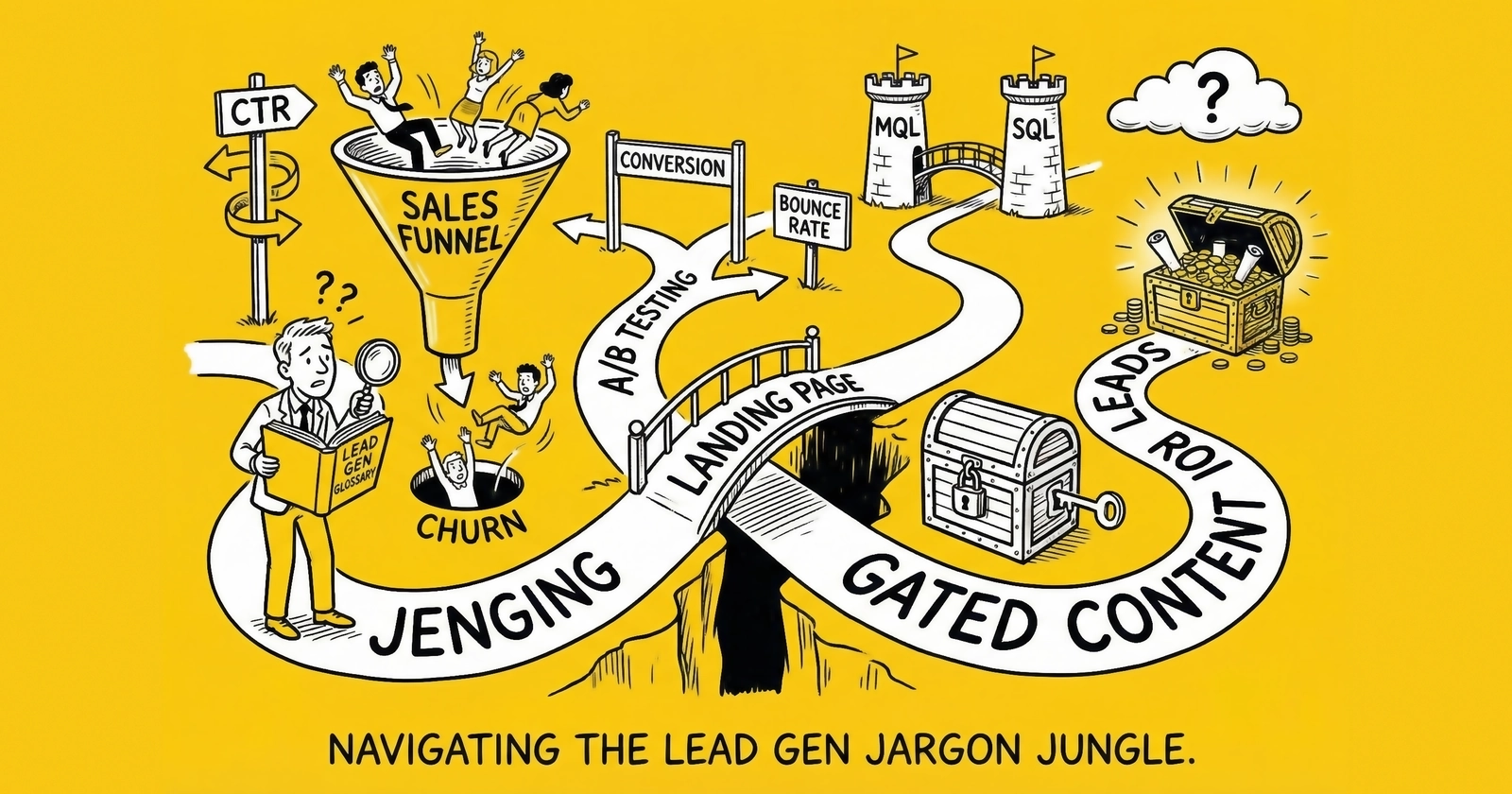
When a buyer defines “exclusive lead” one way and a seller defines it another, the resulting contract dispute costs more than any terminology guide ever would. Shared vocabulary is operational infrastructure.
The lead generation industry operates with specialized vocabulary that can confuse newcomers and even trip up experienced practitioners when terminology varies across verticals. A publisher in insurance might use “ping-post” while a mortgage buyer describes the same mechanism as “real-time bidding” – both referring to the auction-based lead distribution that dominates modern marketplaces.
This glossary exists because unclear terminology creates real business problems. Contract disputes arise when parties define “exclusive lead” differently. Integration projects stall when technical teams lack shared vocabulary for describing delivery mechanisms. Compliance conversations fail when legal and marketing teams cannot bridge the gap between regulatory language and operational reality.
The terms collected here represent the working vocabulary of the lead generation ecosystem – from the fundamental concepts that shape business models to the technical specifications that govern data exchange. Rather than abstract definitions, each entry emphasizes practical usage in real operational contexts.
Understanding this terminology matters for several stakeholder groups. Lead buyers need shared language to negotiate effectively with vendors. Publishers must communicate clearly with technology platforms and distribution partners. Compliance teams require precise definitions to interpret regulations correctly. And entrepreneurs entering the space need foundational vocabulary before the subtleties of business model selection begin to make sense.
A
A/B Testing
A controlled experiment comparing two versions of a marketing element to determine which performs better. In lead generation, A/B testing most commonly applies to landing page headlines, form field sequences, call-to-action button copy, and ad creative variations. Statistical significance requirements typically demand sample sizes of 1,000+ conversions per variant before declaring a winner, though optimal sample size depends on the expected effect size and baseline conversion rate. Organizations running continuous testing programs commonly report double-digit cumulative conversion improvements over 12-month periods.
Abandonment Rate
The percentage of visitors who begin but do not complete a lead form. Abandonment rates vary dramatically by form complexity, vertical, and device type. Single-step forms typically see 60-70% abandonment while multi-step forms optimized with progress indicators often achieve 40-50% abandonment rates. The first form field abandoned most frequently indicates friction points requiring optimization.
Account-Based Marketing (ABM)
A B2B marketing strategy that treats individual target accounts as markets of one, concentrating resources on high-value prospects rather than broad audience targeting. ABM programs in lead generation contexts often combine intent data signals with personalized outreach sequences tailored to specific companies. Research from ITSMA indicates ABM programs deliver 208% higher revenue attribution than non-ABM approaches, though implementation complexity limits adoption to organizations with average deal sizes exceeding $50,000.
Acquisition Cost
The total expense required to generate or purchase a lead, encompassing media spend, technology costs, labor, and overhead allocation. Acquisition cost calculations should include both direct costs (advertising, lead purchases) and indirect costs (platform fees, personnel time) for accurate unit economics assessment. The distinction between acquisition cost and cost per lead (CPL) matters: CPL typically represents media-only expense while true acquisition cost includes operational overhead.
Affiliate
An independent marketer who promotes offers in exchange for performance-based compensation. In lead generation, affiliates typically drive traffic to advertiser landing pages or operate their own lead capture properties under agreed-upon compliance guidelines. Affiliate-generated leads historically carry higher fraud rates than direct campaigns, requiring enhanced validation protocols. Major affiliate networks in the lead generation space include CJ Affiliate, Impact, and vertical-specific networks like QuoteWizard for insurance.
Aged Lead
A lead record that has exceeded its fresh delivery window, typically defined as 24-90 days from original capture depending on vertical. Aged leads trade at 70-90% discounts versus fresh leads but require different sales approaches. The economic case for aged leads depends on close rate degradation – research from Velocify suggests contact rates decline approximately 10% for each 24-hour period a lead ages, but some verticals show substantial ROI even with 30-day-old records.
Aggregator
A business that consolidates leads from multiple sources before reselling to end buyers. Aggregators add value through quality normalization, compliance verification, and buyer matching. Major insurance aggregators include QuoteWizard, EverQuote, and MediaAlpha. Aggregators typically operate on 15-30% margins depending on vertical and competitive dynamics.
API (Application Programming Interface)
A standardized interface allowing software systems to exchange data. In lead generation, APIs enable real-time lead delivery, validation service integration, and CRM connectivity. REST APIs dominate the industry, with most platforms supporting JSON data formats. Response time requirements for ping-post systems typically demand sub-200ms latency for competitive participation in real-time auctions.
Attribution
The process of assigning conversion credit to marketing touchpoints. Attribution models range from simplistic (last-click) to sophisticated (algorithmic/machine learning). Multi-touch attribution in lead generation faces particular challenges because conversion events often occur offline via phone calls or in-person meetings. Server-side tracking and call tracking integration help bridge the attribution gap.
ATDS (Automatic Telephone Dialing System)
A technology capable of storing or producing telephone numbers and dialing them automatically. The legal definition of ATDS carries significant TCPA implications – the 2021 Supreme Court decision in Facebook v. Duguid narrowed the definition to require random or sequential number generation capability, excluding systems that dial from pre-established contact lists. This ruling substantially reduced TCPA exposure for lead generation operations using human-curated lead data.
Auto-Dialer
Generic term for technology that automatically places outbound telephone calls. Distinct from ATDS in that modern auto-dialers typically dial from specific lead lists rather than generating numbers randomly. Preview dialers, progressive dialers, and predictive dialers represent common variants with different regulatory implications.
B
Batch Delivery
Lead delivery method where records transfer in scheduled groups rather than real-time. Batch delivery typically occurs via SFTP file transfer or email delivery. While less immediate than API posting, batch delivery suits buyers lacking real-time integration capability or purchasing aged inventory where minutes-level timing provides no competitive advantage.
Bid Floor
The minimum acceptable price a lead seller will accept in a ping-post auction. Bid floors may vary by lead attributes, buyer tier, time of day, or geographic factors. Dynamic bid floor optimization represents a key revenue lever for sophisticated publishers.
Bid Response
The buyer’s pricing offer in a ping-post auction, submitted in response to the lead details shared in the initial ping. Bid responses must meet system latency requirements (typically under 200ms) and include accept/reject decisions along with offered price. Complex bid logic may incorporate buyer-side scoring models and inventory position algorithms.
Bounce Rate
In landing page contexts, the percentage of visitors who leave without taking any action. High bounce rates (above 70%) typically indicate landing page relevance problems, slow load times, or poor ad-to-page message match. In email contexts, bounce rate refers to undelivered messages, with hard bounces (permanent failures) and soft bounces (temporary issues) requiring different remediation approaches.
Buyer
The end purchaser of lead data who intends to convert leads into customers. Buyers include insurance agents, solar installers, mortgage lenders, attorneys, and their representatives. Buyer types range from individual practitioners to enterprise call centers purchasing thousands of leads daily. Understanding buyer economics helps publishers optimize for buyer success, which correlates with long-term purchasing relationships.
Buyer Caps
Maximum lead volume limits that buyers set to control inventory intake. Caps may apply hourly, daily, weekly, or monthly. Cap management systems must handle real-time tracking to prevent over-delivery, which creates return disputes and relationship damage.
Buyer Filters
Targeting criteria that buyers apply to accept or reject leads based on specific attributes. Common filters include geographic restrictions, credit score minimums, property value thresholds, and demographic parameters. Granular filter matching represents a core competency of lead distribution platforms.
C
Call Center
An operation employing agents to make outbound calls or receive inbound inquiries. Lead generation call centers focus on speed-to-contact as a primary conversion driver. Research consistently shows contact rate drops of 40-50% when outbound attempts delay beyond five minutes from lead capture.
Call Tracking
Technology that assigns unique phone numbers to marketing campaigns, enabling attribution of phone calls to specific traffic sources. Dynamic number insertion (DNI) on landing pages allows visitor-level call attribution. Major call tracking providers include CallRail, Invoca, and DialogTech.
Campaign
An organized marketing effort with defined objectives, budget, targeting parameters, and measurement criteria. Lead generation campaigns typically optimize toward cost per lead (CPL) or cost per acquisition (CPA) goals rather than awareness metrics.
Cap Management
The system and processes governing lead volume limits across buyer relationships. Sophisticated cap management includes automatic routing adjustments when buyers approach limits, waitlist functionality for overflow inventory, and notification systems alerting sales teams to capacity constraints.
CCPA (California Consumer Privacy Act)
California privacy legislation granting consumers rights to access, delete, and opt-out of personal information sales. CCPA applies to businesses meeting revenue, data volume, or data sale thresholds. The California Privacy Rights Act (CPRA) amendments that took effect in 2023 expanded requirements, including data minimization obligations relevant to lead generation operations.
Click Fraud
Invalid or fraudulent clicks on pay-per-click advertisements generated by bots, click farms, or competitors. Click fraud in lead generation campaigns drains advertising budgets without producing valid prospects. Detection relies on behavioral analysis, device fingerprinting, and traffic quality scoring. Industry estimates suggest 15-25% of paid search clicks involve some fraud element.
Close Rate
The percentage of leads that convert to customers. Close rates vary enormously by vertical, lead source, and buyer capability. Insurance leads typically see 5-15% close rates, while mortgage leads in favorable rate environments may achieve 3-8%. Close rate data shared between buyers and sellers enables quality optimization.
Co-registration
A lead capture method where users opt-in to multiple offers during a single registration process. Co-registration traditionally involved checkbox lists of partner offers below a primary form submission. Quality concerns and compliance requirements have reduced co-registration prevalence, though it remains common in some B2B lead generation contexts.
Compliance
Adherence to applicable laws, regulations, and contractual obligations. Lead generation compliance spans TCPA telemarketing restrictions, state privacy laws, vertical-specific requirements (insurance licensing, mortgage regulations), and advertising platform policies. Compliance failures create liability exposure ranging from FTC enforcement actions to multi-million dollar class action settlements.
Consent
The permission granted by a consumer to receive marketing communications. TCPA Prior Express Written Consent (PEWC) requires clear disclosure, consumer signature, and specific identification of authorized callers. The FCC’s one-to-one consent rule was vacated by the Eleventh Circuit in January 2025, but many sophisticated buyers still require consent specific to each seller rather than multi-seller disclosures.
Contact Rate
The percentage of leads reached via the intended communication channel. Contact rates for phone outreach typically range from 20-40% depending on lead freshness and dial attempt persistence. Text message contact rates often exceed 90% for initial delivery, though response rates are lower.
Conversion
The completion of a desired action, which in lead generation may occur at multiple funnel stages: ad click to landing page visit, visit to form submission, submission to sales contact, or contact to customer acquisition. Clear conversion definitions prevent measurement confusion.
Conversion Rate
The percentage of opportunities that achieve the designated conversion outcome. Landing page conversion rates in lead generation typically range from 5-20% depending on traffic quality and page optimization. Sales conversion rates from lead to customer vary by vertical and buyer capability.
Cost Per Acquisition (CPA)
The total expense to acquire one customer, calculated by dividing total marketing and sales costs by customers acquired. CPA represents the comprehensive efficiency metric for lead-to-customer operations. Some lead generation models operate on CPA basis where sellers receive payment only when leads convert to sales.
Cost Per Lead (CPL)
The expense to generate or purchase one lead record. CPL serves as the primary pricing metric in performance-based lead generation. CPL varies dramatically by vertical – insurance leads range from $15-200+, solar leads from $50-150, mortgage leads from $30-100, and legal leads from $100-800+ depending on practice area and case type.
CRM (Customer Relationship Management)
Software systems managing customer and prospect data, interactions, and workflows. Major CRM platforms in lead-buying contexts include Salesforce, HubSpot, and industry-specific solutions like Velocify for high-velocity sales environments. CRM integration represents a critical component of lead distribution architecture.
CTR (Click-Through Rate)
The percentage of ad impressions that result in clicks. CTR serves as a quality signal in paid media platforms, influencing cost efficiency through quality score mechanisms. Lead generation campaigns typically see CTR ranges of 2-5% for search ads and 0.5-1.5% for display advertising.
D
Data Append
The process of enriching lead records with additional information from third-party data sources. Common append elements include demographic data, property values, credit indicators, and intent signals. Data append services face increasing accuracy challenges as third-party data availability contracts due to privacy regulations.
Data Broker
An entity that aggregates and sells consumer data collected from various sources. Data brokers in lead generation provide enrichment services, audience data for targeting, and sometimes lead records derived from public records or survey panels. Regulatory scrutiny of data brokers has intensified, with the FTC and state attorneys general pursuing enforcement actions.
Data Quality
The accuracy, completeness, and validity of lead information. Data quality directly impacts buyer close rates and thus willingness to pay. Quality indicators include contact rate, duplication rate, validation pass rate, and complaint rate. Sophisticated buyers implement quality scorecards measuring multiple dimensions.
Dead Lead
A lead record deemed non-viable due to invalid contact information, explicit non-interest, or regulatory restriction (such as DNC registration). Dead lead rates provide quality signals, with rates above 15-20% indicating source problems requiring investigation.
Delivery Method
The technical mechanism for transferring lead data from seller to buyer. Common delivery methods include real-time API posting, webhook notifications, email delivery, SFTP batch transfer, and portal access. Method selection depends on buyer technical capability and speed-to-contact requirements.
Demographics
Statistical characteristics of a population including age, income, education, household composition, and similar attributes. Demographic data on leads enables segmentation and targeting optimization. Accuracy of demographic append data varies considerably by source and recency.
Direct Response
Marketing focused on generating immediate, measurable actions rather than brand awareness. Lead generation represents a pure direct response discipline where every dollar spent expects quantifiable return in lead volume.
Distribution
The routing of lead records from capture point to buyers. Distribution systems must manage buyer prioritization, filter matching, cap checking, pricing logic, and delivery confirmation. Enterprise distribution platforms like boberdoo, LeadsPedia, and Phonexa provide these capabilities. For a detailed comparison of major platforms, see our lead distribution platform comparison.
DNC (Do Not Call)
A registry allowing consumers to opt-out of telemarketing calls. The National Do Not Call Registry maintained by the FTC contains over 258 million active phone number registrations. DNC compliance requires scrubbing contact lists against the registry before outbound calling. State-level DNC registries add additional requirements in certain jurisdictions.
Drip Campaign
An automated sequence of communications sent over time to nurture leads toward conversion. Drip campaigns may include email, SMS, or voice drops. Effective drip sequences in lead generation typically span 5-15 touches over 30-90 days, with content progressing from educational to promotional.
Duplicate
A lead record that matches an existing record in the buyer’s system based on defined matching criteria (typically phone and/or email). Duplicate policies vary – some buyers accept duplicates beyond defined time windows while others reject any match regardless of age. Duplicate rates provide quality indicators, with improved rates suggesting traffic source recycling.
E
E-SIGN Act
The Electronic Signatures in Global and National Commerce Act establishing legal validity of electronic signatures and records. E-SIGN compliance matters for lead generation consent capture, ensuring electronic consent records carry the same legal weight as wet signatures.
Enrichment
The process of adding data fields to lead records beyond what consumers directly provide. Enrichment may occur at capture time or post-delivery. Common enrichment elements include demographic data, property information, intent indicators, and identity verification results.
Exclusive Lead
A lead record sold to only one buyer. Exclusive leads command premium pricing (typically 2-4x shared lead rates) due to reduced competition. “Exclusive” definitions vary – some sellers interpret exclusivity within a time window, vertical, or buyer category rather than absolute singularity. For detailed analysis of when exclusive leads justify their premium, see our guide on whether exclusive leads are worth the investment.
Exit Intent
A technology detecting when users prepare to leave a webpage, typically by tracking mouse movement toward the browser close button or address bar. Exit intent triggers display overlays or pop-ups as a final conversion attempt before abandonment.
F
FCC (Federal Communications Commission)
The federal agency with authority over TCPA regulations and telemarketing rules. FCC rulemaking directly impacts lead generation operations, including the 2024 one-to-one consent rule that was vacated in January 2025 but still influenced industry practices through market forces.
Field Mapping
The process of aligning data field names between source and destination systems. API integrations require field mapping to ensure lead attributes transfer correctly. Standard field naming conventions reduce integration complexity but remain inconsistently applied across the industry.
Filter
A rule applied to accept or reject leads based on specified criteria. Buyers configure filters on distribution platforms to control lead intake. Filter granularity varies from simple geographic restrictions to complex conditional logic incorporating multiple attributes.
First-Party Data
Information collected directly from consumer interactions with a company’s owned properties. First-party lead data (captured on owned landing pages) typically outperforms third-party purchased data due to recency and relevance.
Float
The time period between seller payment obligations and buyer payment receipts. Managing cash flow across payment terms creates working capital requirements. The industry standard 30-60 day payment cycle creates float exposure that benefits financially stable operators.
Form Abandonment
When visitors begin but do not complete a lead capture form. Form abandonment analysis identifies friction points in conversion flows. Abandoned form recovery tactics include retargeting, email capture for partial submissions, and progressive form simplification.
Fraud
Intentional deception in lead generation, encompassing fake lead submissions, click fraud, traffic fraud, and identity misrepresentation. Fraud rates vary by traffic source, with incentivized traffic and certain affiliate channels historically showing improved fraud. Detection requires multi-layered validation including behavioral analysis, identity verification, and pattern recognition.
Fresh Lead
A lead record within its optimal response window, typically defined as 0-24 hours from capture depending on vertical. Fresh leads command premium pricing due to higher contact and conversion rates. Speed-to-contact research consistently shows dramatic performance degradation as leads age.
FTC (Federal Trade Commission)
The federal agency enforcing consumer protection regulations including advertising standards and data privacy. FTC enforcement actions against lead generators have addressed deceptive advertising claims, unauthorized data sharing, and unfair practices.
Funnel
The conceptual progression of prospects through stages toward conversion. Lead generation funnels typically include awareness, consideration, and decision stages, with drop-off at each transition. Funnel analysis identifies optimization opportunities at stage transitions.
G
GDPR (General Data Protection Regulation)
European Union privacy regulation establishing data subject rights and processor obligations. While primarily European in scope, GDPR impacts U.S. lead generators working with EU residents or partnering with EU-based companies.
Geographic Targeting
Restricting marketing or lead distribution to specific locations. Geographic filters may apply at country, state, metro area, county, or zip code level. Insurance and home services verticals commonly require geographic filtering to match licensed service areas.
Google Ads
Google’s advertising platform encompassing search, display, and video inventory. Google Ads represents a primary traffic source for lead generation campaigns, with Search campaigns typically delivering highest-intent traffic at premium CPCs.
H
Holdout Test
An experimental design where a control group receives no marketing exposure, enabling measurement of incremental impact. Holdout tests in lead generation can measure true channel contribution by comparing conversion rates between exposed and unexposed audiences.
Hot Transfer
An immediate phone connection between a prospect and sales representative, typically facilitated by a call center agent. Hot transfers achieve highest conversion rates due to immediate buyer engagement but require real-time agent availability.
I
ICP (Ideal Customer Profile)
A detailed description of the company or individual characteristics defining the best-fit customer. Lead generation targeting and scoring align to ICP attributes to maximize conversion probability.
Identity Resolution
The process of connecting data points across sources to establish unified consumer profiles. Identity resolution enables cross-device tracking and data enrichment but faces increasing challenges from privacy regulations and platform restrictions.
Inbound Lead
A prospect who initiates contact with a business, as opposed to outbound prospecting. Inbound leads typically demonstrate higher purchase intent and convert at improved rates compared to outbound contacts.
Intent Data
Signals indicating a consumer’s likelihood to purchase based on their research and browsing behavior. Intent data providers aggregate behavioral signals from content consumption, search activity, and website visits. Lead generators use intent data for targeting optimization and lead scoring.
Intent Signal
A specific behavior indicating purchase consideration, such as visiting product comparison pages, downloading buying guides, or searching for vendor reviews. Strong intent signals correlate with accelerated sales cycles.
Integration
The technical connection between software systems enabling data exchange. Lead distribution requires integrations with CRM systems, validation services, and buyer delivery endpoints. Integration complexity varies from simple webhook posts to bidirectional API synchronization.
Invalid Lead
A lead record failing validation requirements, typically due to unreachable contact information, duplicate status, or fraud detection triggers. Invalid lead rates serve as primary quality metrics in buyer-seller relationships.
J
Jornaya
A consent verification and compliance technology provider. Jornaya’s LeadID product creates unique identifiers tracking consumer journeys across lead capture events. Integration with Jornaya provides evidence of consent for TCPA defense.
K
KPI (Key Performance Indicator)
A quantifiable metric measuring progress toward business objectives. Core lead generation KPIs include cost per lead, lead volume, conversion rate, and return on ad spend.
L
Landing Page
A standalone webpage designed to capture leads, distinct from general website pages. Landing page optimization focuses on headline relevance, form design, trust elements, and page speed. High-performing landing pages achieve 10-20% conversion rates from qualified traffic.
Lead
A person or entity expressing interest in a product or service, identified through contact information submission, call inquiry, or other engagement. Leads represent the core unit of commerce in performance marketing.
Lead Buyer
An individual or organization purchasing leads with intent to convert them to customers. Lead buyers span from solo practitioners to enterprise operations processing millions of leads annually.
Lead Cap
The maximum number of leads a buyer will accept within a time period. Caps prevent over-purchasing beyond sales capacity and manage budget allocation.
Lead Distribution
The systematic routing of leads from capture to buyers based on matching criteria, pricing logic, and delivery preferences. Distribution platforms provide the technological infrastructure for lead marketplace operations.
Lead Form
An interface collecting prospect information, typically including name, contact information, and qualifying questions. Form design significantly impacts conversion rates and data quality.
Lead Generation
The process of identifying and cultivating potential customers through marketing activities. Lead generation spans multiple acquisition channels including paid media, content marketing, affiliate programs, and direct response advertising. For a comprehensive introduction to lead generation business models and economics, see our complete guide to how the lead economy works.
Lead Marketplace
A platform facilitating transactions between lead sellers and buyers. Marketplaces provide price discovery, quality assurance, and transaction infrastructure. Major lead marketplaces operate in insurance, mortgage, and home services verticals.
Lead Nurturing
Communication sequences maintaining engagement with prospects not yet ready to purchase. Nurturing programs educate, build trust, and move leads toward conversion readiness over time.
Lead Quality
The relative value of a lead based on its likelihood to convert and expected customer value. Quality assessment incorporates contact validity, purchase intent, demographic fit, and timing factors.
Lead Score
A numeric value representing lead quality or conversion probability, typically calculated from form responses, behavioral data, and third-party enrichment. Scoring enables prioritization and tiered pricing.
Lead Seller
An entity generating or aggregating leads for sale to buyers. Sellers include publishers, affiliates, and aggregators operating at various scale levels.
Lead Source
The origin point of a lead record, tracking which marketing channel, campaign, or partner generated the prospect. Source attribution enables optimization and partner management.
Lead Transfer
The transmission of lead data from seller to buyer, whether via API post, file delivery, or manual entry. Transfer timing and data completeness impact buyer success.
Lead Validation
Verification processes confirming lead data accuracy and authenticity. Validation layers include email verification, phone validation, address standardization, and fraud detection.
Lead Volume
The quantity of leads generated or purchased within a time period. Volume targets must balance with quality standards to maintain unit economics.
LeadsPedia
A lead distribution and management platform serving publishers and buyers. LeadsPedia provides routing, reporting, and buyer integration capabilities.
Lifetime Value (LTV)
The total revenue expected from a customer over the full relationship duration. LTV calculations inform acceptable acquisition costs and lead pricing.
Live Transfer
An immediate connection of a qualified prospect to a sales agent. Live transfers achieve highest conversion rates but require coordinated call center operations.
LLMO (Large Language Model Optimization)
Strategies for ensuring content visibility in AI-powered search and information systems. LLMO represents an emerging consideration for lead generation content marketing as AI assistants influence consumer research patterns.
Long-Tail Keywords
Specific, multi-word search queries with lower volume but higher purchase intent. Long-tail targeting in paid search often delivers superior lead quality at lower cost than broad keywords.
M
Match Rate
The percentage of lead records successfully matched against a reference database. Match rates apply to identity verification, data enrichment, and audience matching processes.
Media Buying
The procurement of advertising inventory across channels. Media buying expertise in lead generation focuses on CPL optimization rather than reach or frequency metrics.
Meta Ads
Advertising products across Meta platforms including Facebook and Instagram. Meta lead ads provide native form experiences while conversion campaigns drive traffic to landing pages.
Mortgage Lead
A prospect interested in purchasing or refinancing a home loan. Mortgage leads segment by loan type (purchase, refinance, FHA, VA, conventional), property value, credit profile, and rate sensitivity.
MQL (Marketing Qualified Lead)
A lead meeting defined criteria indicating readiness for sales engagement. MQL thresholds vary by organization and represent a handoff point between marketing and sales functions.
Multi-Step Form
A lead capture interface presenting questions across sequential screens rather than a single page. Multi-step forms typically achieve higher completion rates through progressive commitment psychology.
N
Native Advertising
Paid content matching the form and function of surrounding editorial content. Native placements in lead generation drive traffic to landing pages through article-style ads on publisher sites.
Net Promoter Score (NPS)
A customer loyalty metric measuring likelihood to recommend. Some lead generation operations track buyer NPS to gauge satisfaction with lead quality and service.
Non-Exclusive Lead
A lead record available for sale to multiple buyers. Non-exclusive leads price lower than exclusive but create competitive dynamics requiring fast buyer response.
Nurture Sequence
An automated series of communications progressing leads toward sales readiness. Effective nurture sequences combine educational content with progressive calls to action.
O
Opt-In
Explicit consumer consent to receive marketing communications. Opt-in quality depends on consent language clarity and process transparency.
Opt-Out
Consumer request to stop receiving marketing communications. Opt-out handling must comply with CAN-SPAM (email) and TCPA (phone/SMS) requirements.
Outbound
Sales or marketing outreach initiated by the business rather than the prospect. Lead generation typically supplies fuel for outbound sales activities.
Overlay
A pop-up or modal element appearing over page content, commonly used for exit-intent offers or promotional messaging.
P
Pay Per Lead (PPL)
A pricing model where advertisers pay fixed amounts for each lead delivered. PPL shifts conversion risk from buyer to seller compared to cost-per-click models.
Persona
A semi-fictional representation of an ideal customer segment based on research and data. Persona development guides targeting and messaging decisions.
PEWC (Prior Express Written Consent)
The TCPA consent standard required before autodialed or prerecorded marketing calls. PEWC requires clear written disclosure, consumer signature, and specific caller identification.
Phonexa
A lead management and tracking platform providing distribution, analytics, and compliance tools for lead generation operations.
Ping
In ping-post systems, the initial data transmission sharing lead details with potential buyers before full delivery. Ping content typically includes enough demographic and intent information for bid evaluation without complete PII.
Ping-Post
A real-time bidding system where sellers transmit partial lead data (ping) to multiple buyers who respond with pricing offers, after which the seller delivers the full lead to the winning bidder. Ping-post systems maximize seller revenue through auction mechanics while enabling buyer-side quality control.
Pixel
A tracking element placed on webpages to collect visitor data and enable conversion measurement. Facebook Pixel, Google Analytics tags, and conversion pixels enable attribution and optimization.
Platform
In lead generation contexts, a technology system managing distribution, tracking, or buyer/seller interactions. Platform selection significantly impacts operational capability and scalability.
Portal
A web interface providing access to lead data, reporting, and account management. Buyer portals enable lead review, acceptance/rejection, and quality feedback.
Post
In ping-post systems, the delivery of complete lead data to the winning bidder following successful auction completion.
PPC (Pay Per Click)
An advertising model where advertisers pay for each click on their ads. PPC represents a primary traffic acquisition mechanism for lead generation.
Pre-Qualification
Assessment of lead quality or fit before full processing or sale. Pre-qualification questions on forms help segment leads by intent and qualification level.
Predictive Dialer
Call center technology that initiates outbound calls before agents become available, predicting call completion times to maximize agent utilization. Predictive dialing efficiency must balance against TCPA compliance requirements.
Publisher
In lead generation, an entity operating websites or advertising that captures lead data. Publishers may work as affiliates under brand guidelines or operate independently.
Q
QA (Quality Assurance)
Processes and systems ensuring lead quality meets defined standards. QA in lead generation includes validation automation, manual review, and feedback loop analysis.
Qualified Lead
A prospect meeting defined criteria indicating genuine purchase consideration. Qualification standards vary by buyer and vertical.
Quality Score
A platform-assigned metric reflecting ad relevance and expected performance. Google Ads Quality Score impacts cost per click and ad position.
Query
In search marketing, the specific words or phrases users enter when searching. Query analysis guides keyword targeting and negative keyword implementation.
R
Real-Time Bidding (RTB)
Auction-based ad buying where inventory sells in milliseconds as pages load. In lead generation, RTB concepts apply to ping-post systems where buyers compete for leads in real-time.
Referral
A lead generated through existing customer recommendation. Referral leads typically convert at improved rates due to trust transfer.
Remarketing
Advertising to users who previously visited a website or interacted with a brand. Remarketing in lead generation targets form abandoners and previous converters.
Response Rate
The percentage of contacted leads who engage with outreach. Response rates vary by channel, timing, and messaging relevance.
Return
A lead returned to the seller due to invalid contact information, failure to meet quality standards, or other contractual triggers. Return policies define acceptable reasons and timeframes for return claims.
Return Policy
Contractual terms governing when buyers may return leads for refund or credit. Standard return policies allow returns for invalid contact info, duplicates, and out-of-criteria leads within defined windows (typically 24-72 hours).
Revenue Share
A pricing model where lead sellers receive percentage of buyer revenue rather than fixed per-lead payment. Revenue share aligns seller incentives with buyer success but requires trust and tracking transparency.
ROI (Return on Investment)
The ratio of net gain to cost, measuring investment efficiency. Lead generation ROI calculations should incorporate full costs including technology, labor, and overhead alongside lead purchase expenses. For detailed formulas and calculation frameworks, see our lead generation ROI calculation guide.
ROAS (Return on Ad Spend)
Revenue generated per dollar of advertising investment. ROAS focuses specifically on media efficiency, distinct from full ROI calculations.
Routing
The logic determining which buyer receives a specific lead. Routing rules incorporate filters, caps, pricing, and prioritization to optimize distribution outcomes.
S
Sales Funnel
The progression from initial awareness through consideration to purchase decision. Funnel analysis identifies drop-off points and optimization opportunities.
Scrubbing
The process of cleaning lead data by removing invalid records, duplicates, or regulatory exclusions (like DNC numbers). Scrubbing improves contactability and compliance.
Segmentation
Dividing audiences or lead pools into distinct groups based on shared characteristics. Segmentation enables targeted messaging and differentiated pricing.
SEM (Search Engine Marketing)
Paid advertising on search engines, primarily Google Ads and Microsoft Advertising. SEM provides high-intent traffic for lead generation campaigns.
SEO (Search Engine Optimization)
Organic search visibility improvement through content, technical, and authority signals. SEO generates leads through content marketing and comparison site strategies.
Shared Lead
A lead record sold to multiple buyers, typically 3-5 in standard configurations. Shared leads price lower than exclusive but require competitive speed-to-contact.
SMS Marketing
Text message-based marketing communications. SMS in lead generation includes autoresponders, appointment reminders, and nurture sequences. SMS requires explicit opt-in consent under TCPA.
Solar Lead
A prospect interested in residential or commercial solar installation. Solar leads segment by homeownership status, utility cost, roof characteristics, and geographic sun exposure.
Source Tracking
Attribution methodology identifying which marketing channel or campaign generated each lead. Source tracking enables optimization and partner performance management.
Speed to Contact
The elapsed time between lead capture and first sales outreach attempt. Speed to contact research consistently identifies dramatic conversion advantages for sub-5-minute response times.
SQL (Sales Qualified Lead)
A lead vetted by sales as ready for direct engagement and opportunity creation. SQL designation typically requires budget, authority, need, and timeline confirmation.
Suppression
The removal of records from marketing lists based on prior relationship, opt-out status, or regulatory requirements. Suppression list management ensures compliance and reduces wasted outreach.
T
TCPA (Telephone Consumer Protection Act)
Federal legislation regulating telemarketing calls, auto-dialers, and prerecorded messages. TCPA compliance represents a fundamental requirement for lead generation operations involving phone contact.
Test
In marketing contexts, a controlled experiment measuring performance variations. Testing disciplines include A/B testing, multivariate testing, and holdout tests.
Third-Party Data
Consumer information purchased from external providers rather than collected directly. Third-party data availability has contracted due to privacy regulations and platform restrictions.
Throttling
Controlling lead delivery pace to match buyer processing capacity. Throttling prevents overwhelming sales teams and ensures quality engagement with each lead.
TPS (Telephone Preference Service)
The UK equivalent of the U.S. Do Not Call registry. International lead operations must comply with relevant national telemarketing registries.
Tracking
Technology and processes monitoring lead movement from capture through conversion. Comprehensive tracking enables attribution, optimization, and partner management.
Traffic
Website visitors or advertising impressions. Traffic quality directly impacts lead quality in performance marketing campaigns.
Transfer
The movement of leads from seller to buyer systems. Transfer mechanisms include API posting, file delivery, and real-time phone transfers.
TrustedForm
A consent documentation product from ActiveProspect that records user sessions and captures consent events, providing evidence for TCPA compliance defense.
Turnkey
A complete solution requiring minimal buyer customization or development. Turnkey lead distribution platforms provide immediate operational capability.
U
Unique Lead
A lead record not previously sold within a defined time window or buyer set. Uniqueness definitions vary by contract terms.
UTM Parameters
URL tags enabling campaign tracking in analytics platforms. UTM parameters identify source, medium, campaign, content, and term dimensions.
V
Validation
Verification processes confirming lead data accuracy. Validation layers include format checking, existence verification, and fraud detection.
Velocity
The speed at which leads move through pipeline stages. Higher velocity correlates with conversion success due to maintained prospect engagement.
Vendor
A supplier in the lead generation ecosystem, potentially including traffic sources, technology providers, data enrichment services, or lead sellers.
Vertical
An industry category with specialized characteristics. Major lead generation verticals include insurance, mortgage, solar, legal, and home services.
Voice Drop
A prerecorded voicemail delivered directly to a recipient’s voicemail system without ringing. Voice drops face TCPA scrutiny regarding consent requirements.
W
Warm Transfer
A phone handoff where the transferring agent introduces the prospect to the receiving representative before disconnecting. Warm transfers achieve higher conversion than cold transfers due to maintained context.
Waterfall
A sequential distribution method where leads route to buyers in priority order until one accepts. Waterfall systems differ from auction-based ping-post in that price typically remains fixed. For a comparison of waterfall versus round-robin routing methods, see our lead routing methods guide.
Webhook
An HTTP callback transmitting data between systems when events occur. Webhooks enable real-time lead delivery and status notifications.
White Label
Products or services rebranded for resale by third parties. White label lead distribution platforms enable agencies and brokers to operate under their own branding.
Z
Zero-Click Search
A search query answered directly in the search results without requiring the user to click through to a website. Zero-click results impact lead generation content strategies as AI-powered search increasingly provides direct answers.
Zero-Party Data
Information voluntarily provided by consumers about their preferences and intentions. Zero-party data in lead generation includes form responses and preference declarations, representing high-quality signals due to explicit sharing.
Zip Code Targeting
Geographic filtering based on five-digit postal codes. Zip code targeting enables localized lead distribution matching service area restrictions.
Sources
- TCPA Statute – 47 U.S.C. § 227 - Full text of the Telephone Consumer Protection Act on Cornell Law Institute, the primary federal statute governing telemarketing and lead contact practices
- FTC Telemarketing Sales Rule - Federal Trade Commission rule establishing requirements for telemarketing calls, disclosures, and Do Not Call compliance
- FTC National Do Not Call Registry Data Book - Annual FTC report on DNC registrations, complaint volumes, and enforcement actions against violators
- National Do Not Call Registry - Official FTC consumer registration portal and compliance resource for telemarketers and lead generators
- CFPB Financial Terms Glossary - Consumer Financial Protection Bureau definitions of financial terminology relevant to mortgage, insurance, and lending lead verticals
- ActiveProspect TrustedForm - Industry-standard consent documentation platform providing independent certificates of consumer consent for TCPA compliance
Key Takeaways
-
Terminology precision prevents costly misunderstandings – when contracts define “exclusive” differently for each party, disputes follow. Shared vocabulary enables clear agreements and aligned expectations.
-
The ping-post system represents the technological backbone of modern lead marketplaces – understanding this auction mechanism helps both buyers and sellers optimize their participation in real-time lead trading.
-
Compliance terminology carries legal weight – misunderstanding ATDS definitions, PEWC requirements, or DNC obligations creates liability exposure that ignorance cannot excuse.
-
Quality metrics require common definitions – when buyers and sellers measure “invalid rate” or “duplicate rate” differently, performance conversations lose meaning. Standardized definitions enable meaningful quality discussions.
-
First-party versus third-party data distinctions matter increasingly – privacy regulation trends favor first-party data strategies, making this distinction central to future-proofing lead generation operations.
-
Speed-to-contact appears repeatedly across terminology because it represents a universal performance driver – whether discussing warm transfers, fresh leads, or contact rates, time sensitivity shapes outcomes.
-
Distribution platform vocabulary (routing, caps, filters, waterfall) defines operational capability – fluency in these terms enables meaningful platform evaluation and comparison.
Frequently Asked Questions
What is the difference between a lead and a prospect?
The terms often overlap, but in strict usage, a lead represents an individual who has provided contact information and expressed interest, while a prospect refers to a lead that has been qualified as fitting the ideal customer profile and showing genuine purchase consideration. The lead-to-prospect conversion occurs when initial interest verification reveals actual fit and intent. Some organizations reverse this definition or use the terms interchangeably, making explicit definition important when collaborating across companies.
How does ping-post differ from traditional lead distribution?
Traditional lead distribution operates on fixed pricing with sequential routing – a lead either meets buyer criteria and delivers at the contracted price, or it routes to the next buyer in line. Ping-post introduces real-time auction dynamics where multiple buyers bid competitively on each lead, with partial lead data shared in the “ping” phase before full delivery to the winning bidder in the “post” phase. This auction mechanism typically increases seller revenue by 15-30% compared to fixed pricing while enabling buyers to dynamically adjust pricing based on lead attributes and inventory position.
What does TCPA compliance actually require for lead generation?
TCPA compliance for lead generation primarily concerns consent documentation and calling practices. For autodialed or prerecorded marketing calls, sellers must obtain Prior Express Written Consent (PEWC) that includes clear disclosure of the marketing purpose, specific identification of the calling parties, consumer signature, and the phone number being authorized. Though the FCC’s 2024 one-to-one consent rule was vacated by the Eleventh Circuit in January 2025 before taking effect, many sophisticated buyers now require one-to-one consent through market forces – each seller needing separate consent rather than blanket authorization. Compliance also requires honoring the Do Not Call registry, maintaining internal suppression lists, and respecting time-of-day calling restrictions.
What is the typical cost per lead across major verticals?
Lead pricing varies dramatically by vertical, lead type, and quality tier. Insurance leads range from $15-30 for shared auto insurance leads to $150-300+ for exclusive Medicare supplement leads. Solar leads typically fall between $50-150 depending on geographic market and credit tier. Mortgage leads range from $30-75 for shared refinance leads to $100+ for exclusive purchase leads. Legal leads show the widest variance, from $50-100 for bankruptcy leads to $200-800+ for personal injury and mass tort leads. These ranges represent market conditions as of 2025 and fluctuate with demand cycles.
How do lead sellers verify consent documentation?
Sophisticated lead sellers implement multi-layered consent verification combining technical capture with third-party documentation. TrustedForm from ActiveProspect records user sessions including form interactions and consent language display. Jornaya’s LeadID creates unique identifiers tracking consumer journey across lead capture events. Beyond these platforms, sellers maintain consent records including IP address, timestamp, user agent string, form version with consent language, and any supplementary authentication. This documentation becomes critical evidence in TCPA litigation, with well-documented consent dramatically reducing legal exposure.
What factors determine lead quality scores?
Lead quality scoring typically incorporates three factor categories: contact validity, purchase intent, and demographic fit. Contact validity assessments verify that phone numbers are reachable, emails deliverable, and addresses real. Purchase intent signals include form completion behavior (time spent, fields completed), stated timeline urgency, and any third-party intent data overlay. Demographic fit measures alignment with buyer ICP including income proxies, credit indicators, property ownership, and location. Advanced scoring models weight factors by their predictive power for actual conversion, calibrated through closed-loop feedback from buyer conversion data.
How has one-to-one consent changed lead generation operations?
The FCC’s one-to-one consent rule was vacated by the Eleventh Circuit in January 2025 before taking effect. However, the rule’s intended prohibition on single forms authorizing calls from multiple vendors has largely been implemented through market forces. Many sophisticated buyers now require each seller to be specifically identified and separately authorized by the consumer, regardless of regulatory minimums. This change disrupted comparison shopping sites and lead aggregators who previously captured consent for multiple buyers simultaneously. Operational adaptations include implementing separate consent checkboxes for each buyer, restructuring publisher-buyer relationships to maintain consent chains, and increased investment in direct-to-consumer lead capture versus aggregated models.
What technology stack do lead distribution platforms typically include?
Enterprise lead distribution platforms generally incorporate several integrated components: a lead intake system handling form submissions and API posts, a routing engine applying filters and prioritization logic, a ping-post auction system for real-time bidding, validation integrations (phone verification, email validation, fraud detection), buyer delivery mechanisms (API posting, email, SFTP), reporting dashboards with real-time and historical analytics, billing systems tracking buyer charges and seller credits, and compliance tools including consent documentation and DNC scrubbing. Major platforms like boberdoo, LeadsPedia, and Phonexa bundle these capabilities with varying emphasis and specialization.
What return policy terms are standard in lead buying agreements?
Standard return policies allow buyers to return leads within defined windows (typically 24-72 hours) for specific reasons including invalid contact information (disconnected phones, undeliverable emails), duplicate records matching existing database entries, out-of-criteria leads not matching filter specifications, and fraud indicators. Return claims typically require documentation – call recordings demonstrating unreachable numbers, duplicate match evidence, or specific explanation of criteria violations. Return rate monitoring appears in most quality agreements, with improved return rates triggering quality reviews or relationship termination. Industry standard return rates range from 5-15% depending on vertical and source quality.
This glossary represents terminology in active use across the lead generation industry as of February 2026. Definitions reflect common industry usage, though precise meanings may vary by organization, contract, or context. For legally consequential terms, consult qualified legal counsel regarding specific compliance requirements.