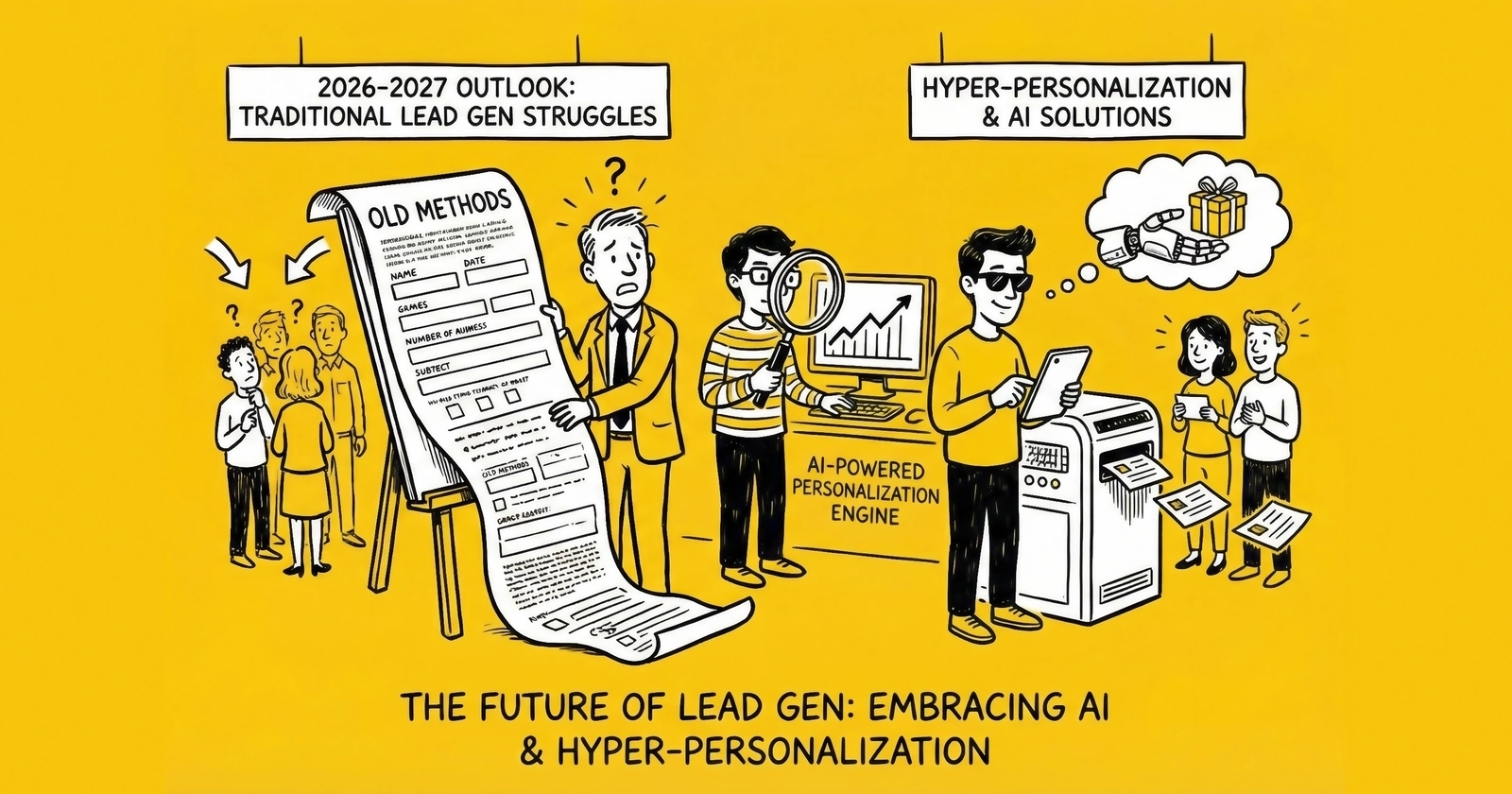
What lead generation operators should expect through 2026-2027: AI transformation, regulatory shifts, privacy changes, and strategic opportunities for positioning and growth.
The lead generation industry enters 2026 at an inflection point. AI integration has moved from experimental to operational for leading operators, regulatory frameworks continue tightening, privacy technology reshapes tracking and attribution, and market consolidation accelerates among both vendors and buyers. Operators who understand these dynamics can position for advantage; those who don’t will find margins compressed and market position eroded.
This outlook examines the forces shaping lead generation through 2026-2027, providing strategic context for planning and investment decisions. The analysis covers AI transformation, regulatory and compliance evolution, privacy and consent infrastructure, market structure changes, and vertical-specific dynamics that operators must navigate. For a foundational understanding of how the lead generation industry works, that context helps frame these emerging trends.
AI Integration Reaches Operational Scale
The AI transformation of lead generation has passed the experimentation phase. McKinsey’s State of AI research indicates marketing and sales functions saw AI adoption more than double between 2023 and 2025 – faster than any other business function. For lead generation specifically, AI applications in scoring, routing, content generation, and customer interaction have moved from competitive advantage to operational necessity.
The New Baseline
What constituted AI leadership in 2024 represents baseline capability in 2026. Predictive lead scoring, AI-assisted content creation, and algorithmic campaign optimization are no longer differentiators – they’re expected. Organizations without these capabilities compete at structural disadvantage against operators who can:
- Score leads in real-time with higher accuracy than rule-based systems
- Generate landing page variations at scale for continuous testing
- Optimize campaigns automatically based on conversion outcomes
- Respond to leads instantly through conversational AI
The competitive frontier has moved to more sophisticated applications: agentic systems that operate autonomously, multi-model architectures that combine specialized AI capabilities, and AI-to-AI interfaces where buyer and seller systems negotiate without human involvement.
Agentic Systems Emerge
Gartner projects that 40% of enterprise applications will integrate task-specific AI agents by end of 2026 – up from less than 5% in early 2025. For lead generation, agentic AI appears in several applications:
Autonomous Campaign Management: AI agents that monitor campaign performance, identify optimization opportunities, and implement changes without human approval for each action.
Lead Qualification Agents: Systems that conduct qualification conversations, assess intent, and route leads based on AI-determined criteria.
Buyer-Side Agents: Enterprise lead buyers deploying AI agents to evaluate, negotiate, and process lead transactions – Forrester predicts 20% of B2B sellers will engage in agent-led negotiations by 2026.
The operational implication: lead generation systems must be designed for AI-to-AI interaction, not just human interfaces. APIs, structured data, and machine-readable specifications become competitive infrastructure.
The AI Investment Reality
Despite AI’s prominence, measurable returns remain elusive for most organizations. McKinsey reports that more than 80% of companies surveyed see no measurable EBIT impact from AI investments. The gap between AI capability and AI value creation separates organizations that integrate AI strategically from those that deploy tools without workflow transformation.
For lead generation operators, this suggests focusing AI investment on high-impact, measurable applications rather than comprehensive AI transformation. Lead scoring, response automation, and creative testing offer clearer ROI pathways than ambitious but diffuse AI initiatives.
Regulatory Environment Tightens
The regulatory framework governing lead generation continues evolving, with several significant changes affecting operations through 2026-2027.
Consent Standards Evolution
The FCC’s one-to-one consent rule was vacated by the Eleventh Circuit in January 2025, but the market dynamics it anticipated have largely materialized through buyer-driven requirements rather than regulation. Many sophisticated lead buyers now require consent specific to their organization, regardless of federal minimums.
This buyer-driven shift has reshaped lead aggregation economics. While multi-seller consent remains legally permissible under federal law, practical market conditions have changed:
- Sophisticated buyers increasingly require seller-specific consent
- Consent management infrastructure remains critical for buyer qualification
- Exclusive leads command premiums as the practical default for quality buyers
- CMS Medicare one-to-one consent (effective October 2024) remains in effect for that vertical
Operators who anticipated stricter consent standards – whether through regulation or market forces – find themselves better positioned than those who relied on regulatory minimums.
State-Level Regulation Proliferation
Beyond federal rules, state-level regulation continues expanding. Mini-TCPA laws in Florida (FTSA), Oklahoma (OTSA), and other states impose requirements beyond federal standards. California’s privacy framework (CCPA/CPRA) and similar laws in other states add data handling requirements. State insurance departments increasingly scrutinize lead generation practices.
The compliance burden scales with geographic scope. National operators must track and comply with a patchwork of state requirements that differ in consent standards, calling hours, data retention, and enforcement. Compliance infrastructure – legal expertise, technology systems, training programs – becomes operational necessity rather than overhead.
FTC Enforcement Intensification
FTC enforcement against lead generation practices intensified through 2024-2025 and shows no sign of relaxing. Enforcement actions target deceptive advertising, misleading consent practices, and data handling violations. The agency has demonstrated willingness to pursue substantial penalties against both lead generators and their downstream buyers.
The enforcement environment rewards operators with genuine compliance programs over those relying on technical compliance that violates regulatory intent. Documentation, training, monitoring, and good-faith compliance efforts provide both legal protection and competitive positioning.
Privacy Infrastructure Transformation
Privacy technology evolution fundamentally alters lead generation tracking, attribution, and optimization capabilities.
Cookie Deprecation Effects
While Google’s timeline for third-party cookie deprecation has shifted repeatedly, the practical effect is already evident: cookie-based tracking provides diminishing value as browsers restrict functionality and users opt out. Lead generation operators face:
- Attribution degradation as multi-touch tracking becomes less reliable
- Audience targeting limitations as behavioral data becomes harder to collect
- Measurement challenges as conversion tracking loses signal
First-party data strategies become essential. Operators with direct consumer relationships, CRM integration, and server-side tracking infrastructure maintain optimization capability that cookie-dependent competitors lose.
Consent Verification Standards
The lead industry’s consent verification infrastructure – TrustedForm, Jornaya, and similar services – faces increasing scrutiny about what constitutes meaningful consent verification. Regulators and courts evaluate not just whether consent was documented but whether it was genuinely informed and specific.
Operators should expect:
- Higher standards for consent language specificity
- Greater scrutiny of consent flow design
- Increased value of consent verification with full session replay
- Growing differentiation between verification providers
Investment in thorough consent documentation provides both compliance protection and buyer confidence.
Data Minimization Pressure
Privacy frameworks increasingly emphasize data minimization – collecting only necessary data and retaining it only as long as required. For lead generation, this creates tension with traditional practices:
- Lead enrichment must balance value with privacy compliance
- Data retention policies require formal documentation and enforcement
- Data sharing arrangements need explicit justification
- Consumer deletion requests require operational response capability
The California Delete Act (SB 362) creates explicit deletion request mechanisms that lead data brokers must honor. The DELETE platform becomes available to consumers on January 1, 2026, with data brokers required to process deletion requests by August 1, 2026. Similar frameworks may emerge in other states.
Market Structure Evolution
The competitive landscape of lead generation continues shifting through consolidation, vertical specialization, and technology differentiation.
Consolidation Acceleration
Private equity interest in lead generation drove significant consolidation through 2023-2025, and this trend continues. Acquirers seek:
- Established buyer relationships with recurring revenue
- Proprietary data and scoring capabilities
- Compliance infrastructure and track record
- Technology platforms with integration capabilities
For operators, consolidation creates both exit opportunity and competitive pressure. Roll-ups create larger competitors with greater resources; remaining independent operators must find defensible niches or risk margin compression.
Vertical Specialization Deepens
Generalist lead generation becomes increasingly difficult as specialists capture vertical-specific advantages:
- Deeper buyer relationships within verticals
- Specialized compliance knowledge
- Vertical-specific scoring and qualification
- Industry-specific content and creative expertise
The economic logic favors specialization: operators who understand vertical-specific conversion drivers, regulatory requirements, and buyer needs outperform generalists competing on price alone.
Technology Differentiation
Technology capability increasingly separates profitable operators from commoditized competitors:
Real-Time Systems: Sub-second scoring, routing, and delivery become expected rather than exceptional. For detailed comparisons, our lead distribution platforms comparison evaluates the major technology options.
Integration Depth: API-first architecture enabling smooth buyer integration creates switching costs and relationship stickiness.
Analytics Capability: Operators providing buyer-side analytics – performance insights, optimization recommendations, market intelligence – create value beyond lead delivery.
Compliance Technology: Automated compliance monitoring, documentation, and reporting reduce buyer risk and justify premium pricing.
Vertical-Specific Dynamics
Different lead generation verticals face distinct challenges and opportunities through 2026-2027.
Insurance
Insurance lead generation navigates carrier consolidation, commission structure changes, and increasing AI adoption by carriers themselves. Key dynamics:
- Carriers deploying AI for direct customer acquisition compete with traditional lead distribution
- Medicare lead generation faces continued CMS compliance scrutiny
- Property and casualty markets reflect climate-driven pricing changes affecting lead economics
- Life insurance sees continued growth in final expense and simplified issue products
Mortgage and Financial Services
Rate environment changes affect mortgage lead economics dramatically. Key dynamics:
- Rate volatility creates lead pricing instability
- Purchase vs. refinance mix shifts with market conditions
- RESPA compliance scrutiny continues
- Digital mortgage lenders reshape buyer landscape
Home Services
Home services lead generation sees marketplace model growth alongside traditional lead sales. Key dynamics:
- Marketplace platforms (Angi, Thumbtack, HomeAdvisor) consolidate market position
- Local service provider acquisition cost increases
- Seasonal patterns remain pronounced but timing shifts with climate
- Emergency services maintain premium pricing but face capacity constraints
Legal
Legal lead generation faces continued mass tort volatility and bar association scrutiny. Key dynamics:
- Mass tort inventory fluctuates with litigation lifecycle
- State bar advertising rules evolve
- AI-generated content raises ethical concerns
- Case-type concentration creates risk exposure
Strategic Positioning for 2026-2027
Given these dynamics, how should lead generation operators position for the next two years?
Build AI Capability Systematically
Rather than comprehensive AI transformation, focus investment on high-impact applications with clear ROI:
- Scoring and routing that directly improves buyer outcomes
- Content generation that enables testing velocity
- Response automation that improves speed-to-contact
- Performance analytics that inform optimization decisions
Build AI capability iteratively, measuring impact at each stage before expanding scope.
Invest in Compliance Infrastructure
Compliance capability becomes competitive advantage as regulatory complexity increases:
- Dedicated compliance expertise (in-house or retained)
- Technology infrastructure for consent documentation
- Training programs that reach all customer-facing staff
- Monitoring systems that detect issues before they become violations
- Documentation practices that support regulatory defense
Develop First-Party Data Assets
Privacy evolution favors operators with first-party data relationships:
- Direct consumer engagement that doesn’t depend on third-party tracking
- CRM integration that connects lead submission to downstream conversion
- Server-side tracking that maintains measurement capability
- Email and relationship marketing that enable ongoing engagement
Deepen Vertical Specialization
Generalist economics become increasingly challenging:
- Focus on verticals where you have genuine expertise and relationships
- Build vertical-specific content, scoring, and compliance capability
- Develop buyer relationships that create switching costs
- Consider exiting verticals where you lack competitive advantage
For detailed analysis of partnership economics, see our guide on revenue share vs. fixed fee models.
Prepare for AI-to-AI Interaction
As buyers deploy AI agents for lead evaluation and procurement:
- Ensure systems expose structured data that AI can process
- Develop API specifications for programmatic integration
- Consider how AI agents will evaluate your offering
- Build capabilities for automated negotiation and fulfillment
Emerging Business Model Adaptations
The forces reshaping lead generation drive business model evolution among forward-thinking operators.
Direct-to-Consumer Brand Building
Some operators are investing in consumer-facing brands rather than operating purely as B2B intermediaries:
Brand Websites: Building consumer-facing comparison and information sites that generate leads organically while building brand equity.
Content Marketing: Creating consumer-focused content that attracts prospects through education rather than paid advertising alone.
Email Relationships: Building direct consumer relationships that enable ongoing engagement and multiple lead generation opportunities over time.
Benefits: Reduced dependence on paid traffic, first-party data accumulation, potential for higher-quality leads from engaged consumers.
Challenges: Requires different capabilities (consumer marketing, content creation, brand management) than traditional lead generation operations.
Buyer Partnership Models
Traditional transactional lead sales are giving way to deeper buyer partnerships:
Performance Alignment: Pricing models tied to downstream outcomes (conversion to sale, customer value) rather than just lead delivery.
Integration Depth: Technical integration that embeds lead generation into buyer operations, creating switching costs and relationship stickiness.
Optimization Collaboration: Working jointly with buyers to optimize their conversion processes, sharing insights that benefit both parties.
Exclusive Relationships: Long-term exclusive arrangements that provide buyers with protected lead supply and operators with revenue predictability.
Technology Platform Evolution
Lead generation platforms are evolving from transaction facilitation to ecosystem orchestration:
Marketplace Models: Platforms connecting multiple generators with multiple buyers, with the platform providing matching, quality assurance, and transaction processing.
Data Services: Platform capabilities extending beyond lead delivery to include analytics, benchmarking, and optimization recommendations.
Compliance Infrastructure: Platforms providing shared compliance infrastructure – consent verification, documentation, regulatory monitoring – that individual operators couldn’t afford independently.
Vertical Ecosystem Participation
Some operators are expanding from lead generation into broader vertical ecosystems:
Adjacent Services: Adding services that complement lead generation – CRM implementation, sales training, marketing services – to capture more buyer wallet share.
Vertical Software: Building or acquiring software serving lead buyers in specific verticals, creating integrated solutions.
Buyer Enablement: Providing tools and services that help buyers convert leads more effectively, aligning operator success with buyer success.
Workforce and Operational Implications
Industry changes affect the skills, roles, and organizational structures lead generation operations require.
Evolving Skill Requirements
The skills that differentiate successful operators are shifting:
Technical Capability: Data science, API development, AI/ML implementation become more valuable as technology differentiation increases.
Compliance Expertise: Regulatory knowledge, risk assessment, and compliance program management become operational necessities.
Analytical Thinking: Ability to extract insights from data, design experiments, and optimize based on evidence becomes more important than intuition.
Vertical Expertise: Deep understanding of specific verticals – buyer needs, regulatory requirements, conversion dynamics – becomes more valuable than generalist marketing skills.
Organizational Structure Changes
Operations are restructuring to address new requirements:
Compliance Integration: Compliance functions integrated into operations rather than isolated as legal overhead.
Technology Centrality: Technology and engineering capabilities moving from support function to core operational role.
Cross-Functional Teams: Combining marketing, technology, and analytics capabilities in integrated teams rather than siloed departments.
Vertical Organization: Structuring around verticals rather than functions, enabling deeper specialization.
Talent Competition
Competition for talent intensifies in several areas:
AI/ML Talent: Demand for AI implementation capability exceeds supply, creating hiring challenges and salary pressure.
Compliance Specialists: Regulatory expertise specific to lead generation is scarce; generalist compliance backgrounds may not translate.
Vertical Experts: Professionals with deep vertical knowledge plus lead generation experience are rare and command premium compensation.
International Considerations
While this outlook focuses primarily on US markets, international dynamics affect operators with global exposure.
GDPR and EU Considerations
European privacy frameworks remain more restrictive than US requirements:
Consent Standards: GDPR consent requirements exceed current US standards, requiring stricter practices for EU-facing operations.
Data Transfer: EU-US data transfer mechanisms remain complex and potentially unstable.
Enforcement: EU privacy enforcement continues actively, creating risk for non-compliant operations.
Emerging Market Dynamics
Lead generation markets develop in regions with growing digital advertising infrastructure:
Market Maturity: Latin America, Southeast Asia, and other regions show lead generation market development.
Regulatory Divergence: Different regions develop distinct regulatory frameworks, complicating international expansion.
Local Competition: Local operators develop in each market, requiring regional strategy rather than simple export of US practices.
Investment and M&A Outlook
The capital markets environment for lead generation continues evolving, with implications for both operators seeking investment and those considering exit.
Private Equity Interest Patterns
Private equity attention in lead generation has matured from initial discovery to sophisticated evaluation:
Buyer Sophistication: PE firms now understand lead generation economics better than in earlier investment cycles. Due diligence focuses on unit economics, compliance infrastructure, buyer concentration, and technology differentiation. Superficial growth without operational excellence no longer commands premium valuations.
Platform Strategies: Many acquirers seek platform investments – operators that can serve as foundation for roll-up strategies. Characteristics of attractive platforms include: established buyer relationships across multiple verticals, scalable technology infrastructure, proven compliance programs, and management teams capable of integration.
Valuation Dynamics: Multiples vary significantly based on operator characteristics. Operators with recurring revenue from established buyer relationships, proprietary technology, and compliance track record command higher multiples than transaction-dependent operations with commodity positioning. The valuation gap between premium and commodity operators has widened.
Hold Period Expectations: PE firms expect value creation during hold periods through operational improvement, buyer expansion, and vertical or geographic growth. Operators attracting investment should understand acquirer value creation expectations and ensure alignment with operational capability.
Strategic Acquirer Activity
Strategic buyers – larger lead generation operators, marketing technology companies, and vertical-focused acquirers – remain active:
Roll-Up Continuation: Larger operators continue acquiring smaller competitors to expand geographic coverage, add verticals, or acquire technology capabilities. Targets with complementary buyer relationships or specialized capabilities attract strategic interest.
Vertical Integration: Some lead buyers – insurance carriers, mortgage lenders, home services platforms – acquire lead generation capability for vertical integration. These acquirers value exclusive lead supply and operational control over lead quality.
Technology Acquisitions: Marketing technology and data companies occasionally acquire lead generators for data assets, technology capabilities, or market access. These transactions often value technology and data differently than pure lead generation metrics would suggest.
Exit Planning Considerations
Operators considering exit in 2026-2027 should prepare strategically:
Documentation: Ensure financial records, compliance documentation, buyer contracts, and technology architecture are acquisition-ready. Documentation gaps delay and complicate transactions.
Dependency Reduction: Address key-person dependencies, single-buyer concentration, and single-traffic-source risk that concern acquirers.
Compliance Clean-Up: Resolve outstanding compliance issues and strengthen compliance infrastructure. Compliance problems discovered in due diligence kill deals or significantly reduce valuation.
Growth Demonstration: Maintain growth trajectory during sale process. Declining performance during extended sales processes undermines negotiating position.
Innovation Pipeline and Emerging Technologies
Beyond current operational technologies, several emerging capabilities may affect lead generation through 2027 and beyond.
Conversational AI Evolution
AI conversation capability continues advancing, with implications for lead qualification and consumer interaction:
Natural Conversation: AI systems increasingly capable of natural conversation that consumers cannot distinguish from human interaction. This enables lead qualification at scale without human agents.
Multilingual Capability: Improved multilingual AI enables market expansion without language-specific staffing. Operators can serve Spanish-speaking consumers, for example, without Spanish-speaking staff.
Emotional Intelligence: Emerging AI capabilities include emotional recognition and response – systems that detect consumer frustration or enthusiasm and adjust interaction accordingly.
Limitations: AI conversation remains imperfect. Complex situations, emotional consumers, and nuanced qualification questions may still require human involvement. Hybrid models combining AI efficiency with human judgment for complex situations likely persist through 2027.
Synthetic Data and Privacy
Synthetic data technologies offer potential privacy-preserving approaches:
Training Without Personal Data: Synthetic data enables model training without exposing actual consumer information, potentially addressing privacy concerns while maintaining optimization capability.
Cross-Organization Learning: Synthetic data may enable insights sharing across organizations without actual data sharing, allowing collaborative optimization while maintaining privacy boundaries.
Regulatory Acceptance: Regulatory acceptance of synthetic data approaches remains uncertain. Operators should monitor regulatory guidance on synthetic data treatment under privacy frameworks.
Decentralized Identity
Decentralized identity technologies could affect consent and verification:
Consumer-Controlled Identity: Decentralized identity enables consumers to control their information sharing, potentially creating more granular consent management that aligns with regulatory direction.
Verification Efficiency: Identity verification could become more efficient through decentralized credential verification, potentially reducing friction in qualification while improving reliability.
Adoption Timeline: Widespread decentralized identity adoption remains uncertain. While the technology develops, practical implementation in lead generation likely extends beyond 2027.
Risk Factors to Monitor
Several factors could accelerate or redirect the trends described:
Regulatory Surprise: Unexpected regulatory action – new FCC rules, FTC enforcement priorities, state legislation – could create compliance scrambles.
Technology Disruption: AI capability advances faster than expected, changing competitive dynamics.
Economic Conditions: Recession or growth affects lead demand, buyer budgets, and vertical economics.
Platform Changes: Major platform policy changes (Google, Meta, Apple) could affect traffic acquisition economics.
Litigation Outcomes: Significant court decisions could reshape consent requirements or enforcement standards.
Operators should build flexibility to respond to these factors rather than assuming current trajectories continue unchanged.
Key Takeaways
-
AI integration has moved from competitive advantage to operational necessity. What constituted AI leadership in 2024 represents baseline capability in 2026; organizations without predictive scoring, AI-assisted content, and algorithmic optimization compete at structural disadvantage.
-
Agentic AI systems represent the new competitive frontier, with Gartner projecting 40% of enterprise applications will integrate task-specific agents by end of 2026 – lead generation systems must be designed for AI-to-AI interaction.
-
Buyer-driven consent requirements reshape lead aggregation economics. Though the FCC’s one-to-one consent rule was vacated, buyer preferences for seller-specific consent constrain multi-sale models and increase the value of direct generation capability and exclusive buyer relationships.
-
State-level regulatory proliferation creates compliance complexity that scales with geographic scope – national operators must track patchwork requirements differing in consent standards, calling hours, and data handling.
-
Privacy technology evolution degrades cookie-based tracking, making first-party data strategies essential for operators who want to maintain attribution and optimization capability.
-
The California Delete Act (SB 362) creates explicit deletion mechanisms that lead data brokers must honor (DELETE platform available to consumers January 2026, broker compliance required by August 2026), with similar frameworks likely to emerge in other states.
-
Market consolidation accelerates as private equity roll-ups create larger competitors, forcing remaining independent operators to find defensible niches or face margin compression.
-
Vertical specialization economics increasingly favor operators with deep industry expertise over generalists competing on price – understanding vertical-specific conversion drivers, regulation, and buyer needs outperforms breadth.
-
Technology differentiation separates profitable operators from commoditized competitors through real-time systems, integration depth, analytics capability, and compliance technology.
-
Strategic positioning requires systematic AI investment, compliance infrastructure, first-party data development, vertical specialization, and preparation for AI-to-AI interaction rather than attempting comprehensive transformation across all dimensions simultaneously.
Frequently Asked Questions
How should small lead generation operators respond to AI transformation?
Small operators should focus AI investment on high-impact, accessible applications rather than attempting comprehensive transformation. Start with AI-assisted content creation (using available tools like ChatGPT or Claude), automated campaign alerts that flag performance issues, and chatbot handling of after-hours inquiries. Use built-in platform AI (Google’s automated bidding, Meta’s Advantage+ campaigns) rather than building custom systems. The goal is extending small team capacity through augmentation, not replacing human capabilities with automation that requires significant oversight. A three-person operation with effective AI collaboration can match output of larger teams while maintaining quality through human review.
What compliance investments are most critical for 2026-2027?
Priority compliance investments include: consent documentation infrastructure (ensuring specific, informed consent is captured and verifiable), one-to-one consent capability (if your model involves multiple buyers), state-level requirement tracking (particularly for FTSA, OTSA, and emerging state frameworks), deletion request handling (for California Delete Act and similar requirements), and training programs reaching all staff who interact with consumers or handle lead data. Consider retained legal counsel with lead generation expertise rather than relying on general business attorneys who may miss industry-specific requirements.
How does one-to-one consent affect shared lead economics?
One-to-one consent fundamentally constrains shared lead models. If consumers must consent specifically to each seller, operators cannot sell the same lead to multiple buyers without obtaining consent for each. This affects pricing (exclusive leads command premium but cannot be offset by multiple sales), matching (connecting leads with specific buyers becomes more critical), and business models built on multi-buyer distribution. Operators should evaluate their model dependence on shared distribution and consider transition toward exclusive arrangements, direct generation, or consent flows that accommodate multiple specific sellers.
What vertical dynamics should operators monitor?
Key vertical-specific dynamics include: Insurance – carrier AI adoption for direct acquisition competing with traditional distribution, continued CMS Medicare scrutiny, climate-driven property pricing changes; Mortgage – rate environment volatility affecting purchase/refi mix and lead economics; Home Services – marketplace platform consolidation, local service provider acquisition cost trends; Legal – mass tort inventory fluctuations, state bar advertising rule evolution, AI content ethics concerns. Operators should monitor their specific verticals for regulatory, competitive, and economic changes that affect lead value and buyer demand.
How should operators prepare for AI-to-AI interaction?
Preparation includes: ensuring systems expose structured data that AI agents can process (clean APIs, consistent data formats, machine-readable specifications), developing documentation that AI systems can evaluate (performance metrics, quality guarantees, compliance certifications), building capability for automated negotiation (programmatic pricing, capacity signaling, quality commitment), and considering how buyer AI agents will evaluate your offering versus competitors. The transition is gradual – start with API-first design and structured data practices that serve both human and AI buyers.
What exit considerations matter for operators considering sale?
Acquirers evaluate: established buyer relationships with recurring revenue (versus transactional relationships with high churn), proprietary scoring or data capabilities that competitors cannot easily replicate, compliance track record including documentation and absence of regulatory issues, technology infrastructure that integrates easily and scales efficiently, and vertical expertise that transfers with the business. Operators considering exit in 2026-2027 should build these characteristics intentionally – compliance documentation, buyer relationship formalization, technology modernization – well before engaging potential acquirers.
How does the regulatory outlook differ by vertical?
Insurance faces CMS Medicare marketing rules, state insurance department scrutiny, and state-specific consent requirements. Mortgage operates under RESPA, state licensing requirements, and increasing CFPB attention. Legal must navigate state bar advertising rules that vary significantly by jurisdiction. Home services face fewer industry-specific regulations but increasing state contractor licensing requirements. All verticals face TCPA, state mini-TCPA laws, and privacy regulation. Operators should understand their vertical’s specific regulatory landscape rather than assuming general compliance frameworks suffice.
What technology investments should operators prioritize for 2026-2027?
Priority technology investments include: consent management systems that capture and document specific, informed consent meeting evolving regulatory standards; real-time scoring and routing infrastructure that enables sub-second lead processing; API-first architecture that supports both buyer integration and future AI-to-AI interaction; first-party data infrastructure including server-side tracking, CRM integration, and customer data platforms; and compliance monitoring systems that detect issues before they become violations. Prioritize investments that address immediate operational needs while building foundation for emerging requirements. Avoid over-investing in experimental AI capabilities until baseline infrastructure is solid.
How will consolidation affect independent operators?
Consolidation creates both pressure and opportunity for independent operators. Pressure: larger consolidated competitors have more resources for technology, compliance, and marketing; they can offer broader geographic coverage and vertical range; and they may compress margins through scale advantages. Opportunity: consolidation creates acquisition exit opportunities for operators with attractive characteristics; niche specialists can avoid direct competition with generalists; and some buyers prefer independent operators over large aggregators. Independent operators should either build defensible niche positions that consolidators can’t easily address or develop characteristics that make acquisition attractive. The middle ground – undifferentiated independents competing directly with well-resourced consolidators – becomes increasingly difficult.
What does the AI-to-AI interaction future actually look like?
In the emerging AI-to-AI interaction model, buyer AI agents evaluate vendor offerings programmatically – processing performance data, assessing quality guarantees, and comparing options without human involvement in routine transactions. Seller systems expose capabilities through structured APIs and machine-readable specifications. Negotiation happens automatically based on programmed parameters. Human involvement focuses on relationship building, exception handling, and strategic decisions rather than routine transaction processing. This future is gradual – expect 2-3 years before significant transaction volume moves to AI-to-AI channels. Operators should design systems for both human and AI interaction during the transition period.
How should operators balance innovation investment with operational focus?
Balance innovation investment based on competitive position and market dynamics. Operators with strong current performance should allocate 70-80% of resources to current operations and 20-30% to innovation. Operators facing competitive pressure or market disruption may need higher innovation investment. Focus innovation on capabilities that provide measurable advantage – AI scoring improvements, compliance automation, buyer integration depth – rather than experimental projects without clear ROI pathway. Avoid the trap of either all-innovation (neglecting current revenue) or all-operations (falling behind competitors). Establish clear evaluation criteria for innovation investments and kill projects that don’t demonstrate progress.
What buyer relationship changes should operators anticipate?
Expect buyer relationships to evolve toward: deeper integration (technical embedding that creates switching costs), performance alignment (pricing tied to downstream outcomes rather than just lead delivery), exclusivity arrangements (buyers seeking protected supply, operators seeking revenue predictability), and collaborative optimization (joint efforts to improve lead-to-sale conversion). Transactional, commodity relationships become less viable as buyers concentrate purchasing with preferred partners. Operators should evaluate which buyers warrant relationship investment and develop account management capabilities that maintain and grow those relationships.
How will climate and economic factors affect vertical dynamics?
Climate factors increasingly affect property and casualty insurance (pricing volatility, coverage availability), solar (installation demand, utility policies), and home services (seasonal pattern shifts, storm-driven demand). Economic factors affect mortgage (rate sensitivity, purchase/refi mix), insurance (coverage purchases, premium sensitivity), and home services (discretionary project timing). Operators should monitor vertical-specific economic and environmental indicators, build flexibility to shift resources as conditions change, and avoid over-concentration in single verticals vulnerable to external shocks. Diversification across verticals with different economic sensitivities provides operational resilience.
What distinguishes operators that will thrive versus struggle through 2026-2027?
Operators that will thrive share several characteristics: compliance infrastructure that turns regulatory complexity into competitive advantage, technology capabilities that enable efficiency and integration, vertical specialization creating deep expertise and buyer relationships, first-party data assets reducing dependence on third-party tracking, and organizational agility enabling quick response to market changes. Understanding multi-buyer distribution strategies and routing methods like waterfall vs. round-robin helps operators optimize their distribution approach. Operators that will struggle share opposite characteristics: compliance treated as overhead rather than capability, commodity technology without differentiation, broad but shallow vertical coverage, dependence on cookie-based tracking and third-party data, and organizational rigidity preventing adaptation. The gap between these groups will widen as environmental pressures intensify.
How should operators think about geographic expansion in 2026-2027?
Geographic expansion decisions should consider: state-level regulatory variation (some states are significantly more challenging than others), buyer density and demand patterns by geography, competitive intensity in different markets, and operational capability to maintain compliance across multiple state frameworks. National expansion becomes more complex as state regulations diverge. Some operators may benefit from geographic focus – dominating regional markets rather than spreading thin nationally. Others with compliance infrastructure advantage may find geographic expansion enables competitive positioning. Evaluate expansion through capability lens: can you maintain quality and compliance in new markets, or will expansion dilute performance?
What role will platform policies play in 2026-2027 dynamics?
Platform policies from Meta, Google, TikTok, and Apple significantly affect lead generation economics. Meta’s continued evolution of targeting and measurement approaches affects advertising efficiency. Google’s Privacy Sandbox development affects cross-site tracking alternatives. Apple’s privacy features continue limiting iOS attribution capability. TikTok’s regulatory status creates platform access uncertainty. Operators should monitor platform policy announcements closely, diversify traffic sources to reduce single-platform dependence, and build first-party data relationships that reduce vulnerability to platform policy changes. Platform policy shifts can invalidate entire traffic acquisition approaches – prepare for unexpected changes.
How do small operators compete with consolidating competitors?
Small operators compete through specialization, relationship depth, and agility. Specialization means owning specific niches that large consolidators can’t serve as effectively – vertical focus, geographic expertise, buyer type specialization. Relationship depth means building buyer relationships that create genuine switching costs through service quality and partnership rather than just competitive pricing. Agility means responding to market changes faster than larger competitors – implementing new compliance requirements quickly, adapting to platform changes rapidly, and testing innovations that bureaucratic competitors can’t execute. Small operators should identify their defensible advantages and invest in amplifying them rather than trying to compete on scale with larger competitors.
Sources
- McKinsey & Company. “The State of AI in 2025: Agents, Innovation, and Transformation.” https://www.mckinsey.com/capabilities/quantumblack/our-insights/the-state-of-ai
- Gartner. “CMOs’ Top Challenges & Priorities For 2026.” https://www.gartner.com/en/newsroom/press-releases/2025-12-04-cmos-top-challenges-and-priorities-for-2026
- Forrester Research. “Predictions 2026: B2B Marketing, Sales, And Product.” https://www.forrester.com/press-newsroom/forrester-b2b-marketing-sales-product-2026-predictions/
- FCC. “FCC Strengthens Consumer Protections Against Robocalls and Robotexts.” https://www.fcc.gov/document/fcc-strengthens-consumer-protections-against-robocalls-and-robotexts
- California Legislature. “SB 362: California Delete Act.” https://leginfo.legislature.ca.gov/faces/billNavClient.xhtml?bill_id=202320240SB362
- Boston Consulting Group. “Art and Algorithms: What CEOs Should Look For in an AI-First CMO.” https://www.bcg.com/publications/2025/what-ceos-should-look-for-in-an-ai-first-cmo