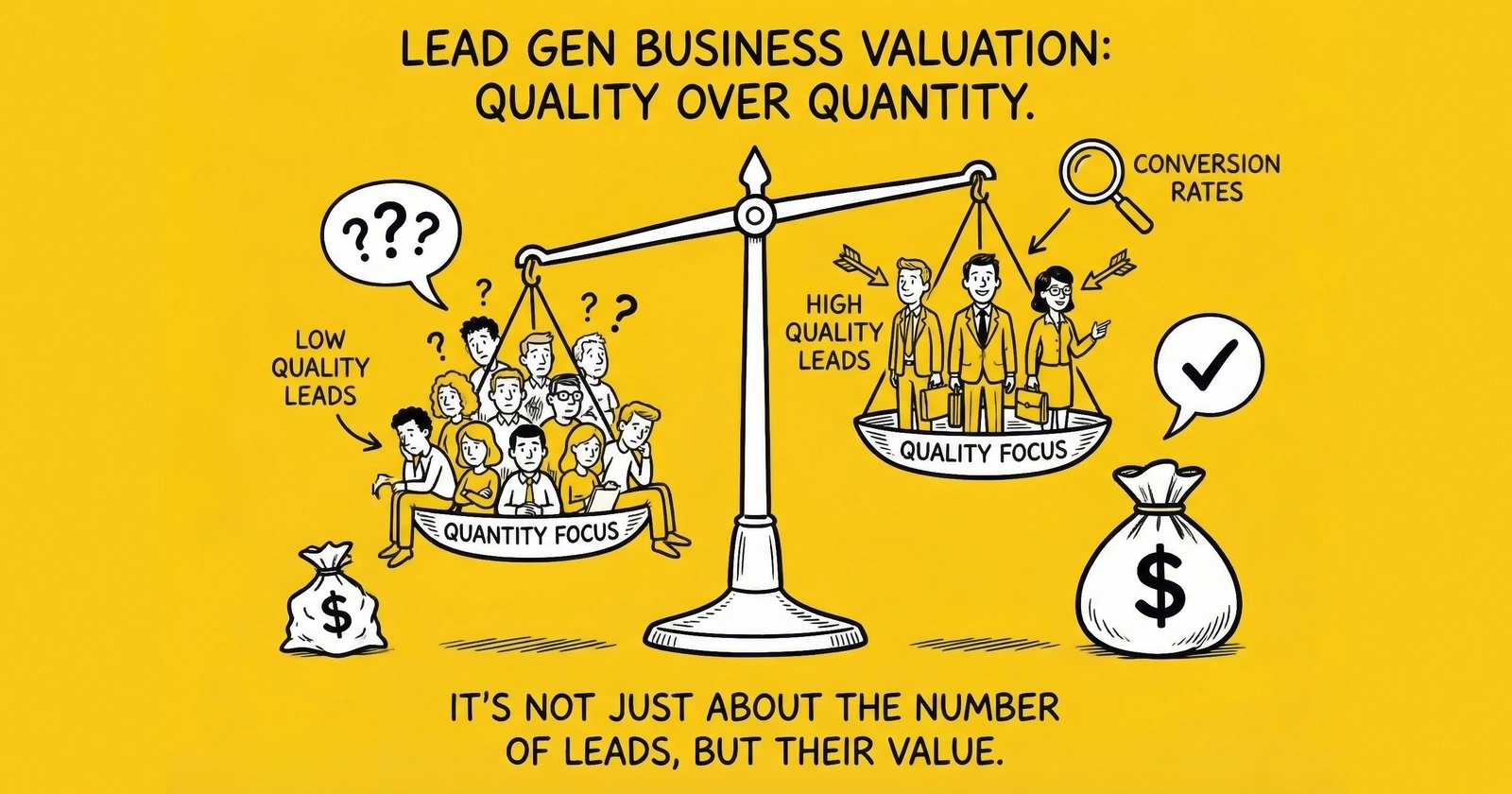
A comprehensive guide to understanding how lead generation companies are valued, what private equity and strategic buyers evaluate during due diligence, and how to position your business for maximum exit value.
Introduction: The Valuation Reality for Lead Generation Businesses
You have built a lead generation business. Maybe you are processing 50,000 leads monthly through your brokerage operation. Perhaps you run a direct generation shop doing $200,000 in monthly revenue with strong margins. Or you have assembled a technology platform that powers dozens of other operators. At some point, the question becomes unavoidable: What is this thing actually worth?
The lead generation industry has seen over 100 M&A transactions since 2016, with private equity showing sustained interest in the space. MediaAlpha reported $864.7 million in revenue for 2024, with transaction value exceeding $1.5 billion. EverQuote crossed $500.2 million in revenue the same year. These are not anomalies – they reflect an industry that generates real value and attracts serious capital.
But valuation in lead generation differs from other digital businesses. Your website traffic is not the primary value driver. Your technology, while important, does not command the premium multiples that pure SaaS businesses enjoy. Instead, acquirers focus on characteristics specific to the lead economy: the quality and predictability of your buyer relationships, the sustainability of your traffic sources, your compliance posture, and the cash flow characteristics that define your model.
This guide provides a detailed examination of how lead generation businesses are valued, what acquirers evaluate during due diligence, and the specific levers you can pull to maximize exit value. Whether you are planning an exit in two years or simply want to understand how your business compares to others in the market, these frameworks will ground your thinking in how deals actually get done.
Understanding Lead Generation Valuation Multiples
EBITDA Multiples: The Primary Framework
Lead generation businesses typically trade on EBITDA multiples – earnings before interest, taxes, depreciation, and amortization. This metric captures the cash-generating capacity of the business independent of capital structure, tax situation, and accounting treatment of assets.
The multiple ranges vary significantly based on business size, quality, and strategic positioning. smaller companies with EBITDA between $500,000 and $2 million typically command multiples of 3x to 6x, averaging around 4x to 5x. These businesses attract individual buyers, small private equity firms, or strategic acquirers looking for tuck-in acquisitions. At this size, you are selling a job as much as a business – the acquirer is often an operator who will step into your role.
Mid-market operators generating $2 million to $10 million in EBITDA enter different territory entirely. Typical multiples range from 5x to 9x, averaging 6x to 7x. Private equity platform investments become common at this tier, and strategic acquirers willingly pay premiums for specific competitive advantages. The difference between 5x and 9x at $5 million EBITDA represents $20 million in value – understanding what drives that spread matters enormously.
Larger platforms generating $10 million or more in EBITDA attract institutional private equity and public company comparables become relevant. These businesses trade at 7x to 12x EBITDA, with premium transactions reaching 10x to 15x. At this scale, you are no longer selling a business – you are selling a platform that becomes part of a larger investment thesis.
Premium multiples of 8x to 12x or higher are reserved for businesses demonstrating exceptional characteristics:
- Growth rates exceeding 40% year-over-year
- Proprietary technology creating defensible competitive advantage
- Strategic value to specific acquirers through geographic expansion, vertical entry, or buyer access
- Recurring or highly predictable revenue characteristics
Revenue Multiples: When They Apply
Revenue multiples are less common in lead generation valuations because profitability varies dramatically between business models. A broker operating at 15% net margin and a direct publisher at 35% net margin might have similar revenues but vastly different values.
However, revenue multiples become relevant in specific circumstances. High-growth businesses expanding 50% or more annually that are not yet profitable – or have suppressed earnings due to reinvestment – may trade at 1x to 2x trailing revenue. The expectation is that profitability will normalize as growth moderates. Strategic acquisitions seeking specific capabilities such as technology, team, or market position rather than pure cash flow may also apply revenue multiples, reflecting synergy expectations rather than standalone economics. And when acquirers evaluate multiple targets simultaneously, revenue multiples help compare businesses with different cost structures.
What Drives Multiple Variation
The spread between a 3x and an 8x EBITDA multiple represents the difference between an okay outcome and a transformative one. On $2 million EBITDA, that spread equals $10 million in transaction value. Understanding what drives this variation is essential.
Revenue quality and predictability form the foundation. Recurring revenue commands premium valuation because acquirers can forecast it with confidence. Concentrated buyer relationships, by contrast, suppress multiples because a single departure could devastate cash flow. Diverse, stable revenue from multiple sources elevates value because it reduces dependency risk.
Growth profile matters nearly as much. Acquirers examine your trailing three-year historical growth rate, projected growth rate with supporting evidence, and growth trajectory – whether you are accelerating or decelerating. A business growing 30% but slowing down each quarter looks different from one growing 20% but picking up speed.
Margin profile reveals operational quality. Absolute margin levels indicate pricing power and cost management. Margin trajectory – whether expanding or compressing – signals future profitability. And margin sustainability as volume scales determines whether growth will create or destroy value.
Operational independence separates lifestyle businesses from investable companies. Founder dependency suppresses multiples because the business cannot survive without you. Documented processes and capable management elevate value because the business can operate – and grow – independently. Technology that enables scale without proportional labor demonstrates operating leverage that acquirers prize.
Risk profile rounds out the picture. Compliance posture and history, traffic source concentration, buyer concentration, and regulatory exposure all factor into an acquirer’s assessment of what could go wrong. Lower risk enables higher multiples; elevated risk demands discounts or structural protections.
The Six Pillars of Lead Business Value
Acquirers evaluate lead generation businesses across six core dimensions. Strength in all six commands premium valuation. Weakness in any single pillar can derail transactions or compress multiples significantly.
Pillar 1: Buyer Relationship Quality
Your buyers are your customers. The quality, diversity, and stickiness of these relationships determines revenue predictability and growth potential. An acquirer inheriting strong buyer relationships inherits ongoing cash flow. An acquirer inheriting problematic relationships inherits headaches.
The cardinal sin of lead generation valuation is revenue concentration. If your largest buyer represents more than 25% of revenue, expect multiple compression. If your top three buyers represent more than 50%, expect significant haircut or earnout structure. Acquirers know that concentrated relationships create existential risk – one departure can crater the business they just purchased.
Relationship tenure demonstrates stability. Long-standing buyer relationships of three years or more suggest the relationship will survive ownership transition. New relationships under twelve months carry transition risk – the buyer may have been purchasing from you, not your company.
Contract terms matter more than handshakes. Written agreements with volume commitments command premium over informal arrangements. Termination provisions that require reasonable notice protect acquirers from surprise departures. Payment terms reveal relationship dynamics too – buyers paying net-15 are more valuable than those paying net-60, and clean payment history trumps chronic delays or disputes.
Return rates at the buyer level reveal relationship health that aggregate metrics obscure. Stable, low return rates indicate alignment between what you sell and what buyers need. Rising return rates signal deterioration that may not yet appear in revenue but will eventually manifest.
To strengthen this pillar, diversify deliberately so no buyer exceeds 20% of revenue. Formalize agreements by moving from handshakes to written contracts. Document everything – buyer communications, volume history, pricing negotiations. Develop a buyer tier structure where premium buyers get preferred service while marginal buyers get standard treatment.
Pillar 2: Traffic Source Sustainability
Lead generation requires traffic. If your traffic sources are unsustainable, your leads dry up, and your business fails. Acquirers scrutinize traffic sustainability because it determines whether they are buying an ongoing business or a declining asset.
Source concentration creates existential risk just as buyer concentration does. If 70% of your leads come from Facebook, a policy change can destroy your business overnight. Acquirers discount heavily for traffic concentration because they understand platform risk intimately.
Source stability indicates staying power. A traffic source generating leads for three years or more at stable cost is more valuable than a source performing well for six months. Time demonstrates resilience through algorithm changes, policy updates, and competitive dynamics.
Cost trends reveal margin trajectory. Rising traffic acquisition costs compress margins over time. Stable or declining costs preserve or expand them. Acquirers model forward economics based on historical cost trends, so unfavorable trajectories directly impact valuation.
Platform risk looms over every paid traffic operation. Advertising platforms can and do ban accounts without warning. A ban on your primary platform is catastrophic. Acquirers evaluate ban history, account age, and backup platform capabilities to assess how exposed you are to arbitrary platform decisions.
The organic versus paid mix affects both margins and stability. Organic traffic from SEO or content assets provides stability and margin advantage because you are not paying for every click. Heavy reliance on paid traffic creates ongoing acquisition cost and platform dependency that suppresses valuation.
To strengthen this pillar, diversify traffic so no single platform exceeds 40% of lead volume. Build owned assets by investing in SEO, content, and organic traffic sources. Document traffic history with cost-per-lead trends by source over 24 months or more. Maintain backup accounts on alternative platforms even if not actively used. Reduce platform dependency by developing traffic sources that do not rely on algorithm or policy decisions.
Pillar 3: Compliance and Legal Posture
TCPA class action settlements average $6.6 million. A single compliance failure can exceed your entire business value. Acquirers know this, and compliance due diligence has intensified dramatically as litigation has increased.
Consent documentation forms the foundation of compliance defense. Do you capture and retain consent certificates? Are you using TrustedForm, Jornaya, or equivalent technology? Can you produce consent documentation for any lead delivered in the past four years? Affirmative answers demonstrate a defensible compliance posture. Negative answers create liability exposure that acquirers must price into their offers.
TCPA compliance requires more than consent capture. Are your consent flows compliant with current FCC regulations? Though the one-to-one consent rule was vacated by the Eleventh Circuit in January 2025, many sophisticated buyers still require one-to-one consent as a practical matter. Do your disclosures meet legal requirements? Are you scrubbing against the DNC registry and litigator lists? Each gap represents potential exposure.
State compliance adds complexity because different states have different telemarketing, privacy, and licensing requirements. Documented compliance programs for each state where you operate demonstrate thoroughness. Ad hoc responses to problems suggest gaps that have not yet surfaced.
Litigation history creates concern even when resolved favorably. Have you been sued? Have your buyers been sued and blamed you? Have your publishers caused compliance issues? Prior litigation raises questions about what might still be lurking.
Compliance infrastructure distinguishes systematic programs from reactive firefighting. Documented policies, regular training, and scheduled audits indicate mature compliance operations. Ad hoc responses to problems suggest you may not discover issues until they become crises.
Vendor compliance matters if you purchase leads from other publishers. How do you verify their compliance? Can you demonstrate due diligence on vendor selection and ongoing monitoring? Your vendors’ compliance failures become your liability.
To strengthen this pillar, implement certified consent capture like TrustedForm or Jornaya if not already in place. Document all compliance policies and procedures. Conduct regular internal compliance audits at minimum quarterly. Maintain relationships with TCPA-specialized legal counsel. Scrub all leads against litigator databases before delivery. Create and document vendor compliance requirements.
Pillar 4: Technology and Operational Leverage
Technology creates operating leverage – the ability to scale volume without proportional increases in labor. Acquirers value technology that enables growth, reduces costs, and creates competitive differentiation.
Core infrastructure determines operational capability. What platforms power your lead routing, buyer integration, and tracking? Commercial platforms like boberdoo, LeadsPedia, and Phonexa are proven but commoditized. Custom-built systems may provide advantage or may represent technical debt. Acquirers assess the age and condition of your technology stack to understand what they are inheriting.
Automation level indicates scalability. What percentage of operations runs without human intervention? Manual processes limit scale and create error risk. Automation enables growth without proportional hiring. The higher your automation level, the more attractive your business becomes as a growth platform.
Custom technology can create competitive advantage when it provides capabilities competitors cannot easily replicate. Routing algorithms that optimize lead placement better than generic solutions, optimization tools that improve campaign performance, or integration capabilities that reduce buyer onboarding time – these differentiate your business from others using standard platforms.
Technical debt determines future investment requirements. What is the state of your codebase? How much investment would be required to maintain, upgrade, or modernize the technology stack? A platform requiring immediate significant investment is worth less than one that can scale without major capital expenditure.
Data assets extend beyond current operations. What data do you collect, retain, and leverage? Historical lead performance data, buyer behavior patterns, and traffic optimization data have value because they inform future decisions. Rich data assets enable smarter operations under new ownership.
Integration capabilities determine market access. How easily can your systems integrate with buyer systems? API-first architecture enables faster buyer onboarding and broader market access. Clunky integrations requiring custom development limit growth potential.
To strengthen this pillar, document all technology systems and integrations. Reduce manual processes through automation. Invest in custom tools that create differentiation. Maintain clean, documented code with version control. Build robust reporting and analytics capabilities. Create data assets from operational activities.
Pillar 5: Financial Performance and Trends
Financial performance is the bottom line of valuation. Acquirers are buying future cash flows, and historical financials provide the most credible evidence of what those cash flows will be.
Revenue trend over three years tells the growth story. Growing, stable, or declining? Accelerating or decelerating? Consistent or volatile? Each pattern implies different future trajectories and commands different multiples.
Margin profile reveals operational quality at multiple levels. Gross margins by revenue stream show where value is created. Net margins after all operating costs show what drops to the bottom line. EBITDA margin trends over time indicate whether operations are improving or degrading.
Unit economics provide the granular view that aggregate metrics obscure. Cost per lead by source reveals traffic efficiency. Revenue per lead by buyer shows pricing power. Margin per lead net of all costs including returns, float, and bad debt demonstrates true profitability.
Cash flow timing determines working capital requirements. Payment terms with buyers and suppliers, float requirements, and working capital needs at current and projected scale all affect how much capital the business consumes or generates. Cash-generative businesses are worth more than cash-consumptive ones.
Revenue quality distinguishes predictable from volatile cash flows. What percentage of revenue is recurring or highly predictable? What percentage is transactional or variable? Understanding lead generation profit margins and revenue quality helps contextualize your business. Predictable revenue commands premium because it can be forecasted with confidence.
Seasonality patterns affect cash flow planning. How does revenue vary by quarter? Predictable patterns that can be planned for are better than unpredictable fluctuations that create surprises.
Growth investment reveals the tradeoff between current profit and future scale. How much is reinvested versus distributed? What return has that investment generated? Intelligent reinvestment with demonstrable returns suggests good stewardship.
| Metric | Good | Excellent | Concerning |
|---|---|---|---|
| Revenue Growth (YoY) | 15-25% | 25%+ | Negative or flat |
| Gross Margin | 25-35% | 35%+ | Below 20% |
| Net Margin | 15-20% | 20%+ | Below 10% |
| Buyer Concentration (Top 3) | 40-50% | Below 35% | Above 60% |
| Return Rate | 8-12% | Below 8% | Above 15% |
| Payment Days (Average) | 30-45 | Below 30 | Above 60 |
To strengthen this pillar, maintain clean, auditable financial records – ideally reviewed or audited. Track unit economics at granular level by source, buyer, and campaign. Improve margins before sale through cost reduction and pricing optimization. Reduce revenue concentration through diversification. Clean up financial anomalies that require explanation. Demonstrate sustainable growth trajectory.
Pillar 6: Team and Leadership Depth
Acquirers buy businesses, not jobs. If the business cannot operate without the founder handling daily execution, the value is limited. Leadership depth enables clean transitions and continued growth post-acquisition.
Founder dependency is the critical question. What happens if the founder leaves? Does the business continue or collapse? Key person risk suppresses multiples significantly because the acquirer is purchasing an asset that depends on someone who may depart.
Management team capability determines operational continuity. Is there a capable team managing day-to-day operations? Media buying, buyer relationships, technology, and compliance should each have dedicated leadership. A founder doing everything creates risk; a team handling everything creates value.
Documentation enables knowledge transfer. Are processes documented such that new team members can execute? Or does operational knowledge exist only in people’s heads? Documented processes survive personnel changes; undocumented tribal knowledge disappears with departures.
Team stability signals cultural and compensation health. How long have key team members been with the company? High turnover suggests problems that will continue post-acquisition. Stable tenure indicates an organization worth joining.
Succession planning provides transition roadmap. If the founder exits post-acquisition, who steps into leadership? Is that person already on the team? Clear succession paths reduce transition risk and enable smoother ownership changes.
To strengthen this pillar, document all processes and procedures. Hire or develop a management layer between founder and execution. Reduce founder involvement in daily operations. Create an organizational chart with clear responsibilities. Implement regular team meetings and communication cadences. Develop succession plans for key roles.
Due Diligence: What Acquirers Actually Examine
Due diligence in lead generation acquisitions is thorough and invasive. Understanding what acquirers will examine helps you prepare and identify issues before they become deal-killers.
Financial Due Diligence
Revenue verification goes beyond the P&L. Acquirers match bank deposits to reported revenue, trace revenue to underlying buyer contracts, verify revenue by buyer, source, and time period, and identify any revenue recognition timing issues. If your reported revenue does not reconcile to cash collected, expect difficult questions.
Expense analysis reveals cost structure and sustainability. Acquirers verify all major expense categories, understand variable versus fixed cost structure, identify one-time or non-recurring costs, and evaluate cost trends and drivers. They want to understand what expenses scale with volume and which are fixed – and whether any are going away.
Working capital analysis determines capital requirements. Acquirers model your cash conversion cycle, evaluate float requirements at current and future scale, assess receivables aging and collection history, and identify any hidden liabilities. Businesses that consume working capital as they grow require more capital than those that generate it.
Earnings quality separates sustainable EBITDA from one-time results. Acquirers adjust for non-recurring items, evaluate owner compensation against market rates, identify related-party transactions, and normalize for accounting quirks. The adjusted EBITDA they calculate – not the number you report – drives valuation.
Compliance Due Diligence
The consent audit examines your entire consent infrastructure. Acquirers review consent capture flows and documentation, test your ability to produce consent certificates on demand, evaluate disclosure language against legal requirements, and assess compliance with current and pending regulations. Failures here can crater deals or result in substantial holdbacks.
Litigation review searches for any past or pending legal exposure. Acquirers search for litigation history as both plaintiff and defendant, review demand letters or threatened claims, evaluate open disputes with buyers or publishers, and assess insurance coverage for potential claims. Even resolved litigation raises questions about what might still emerge.
Vendor compliance evaluation extends liability review to your supply chain. Acquirers review publisher contracts and representations, evaluate vendor selection and monitoring processes, assess liability provisions in vendor agreements, and test publisher compliance on a sample basis. Your vendors’ failures create your liability.
Operational Due Diligence
Technology assessment evaluates both capability and debt. Acquirers review system architecture and documentation, evaluate scalability and technical debt, assess security and data protection measures, and identify third-party dependencies. They want to understand what investment the platform will require post-acquisition.
Customer analysis goes directly to your buyers. Acquirers interview key buyers about relationship quality, evaluate buyer contracts and commitments, assess churn and retention patterns, and identify at-risk relationships. Buyer feedback can confirm your narrative or contradict it.
Traffic source analysis examines your lead supply. Acquirers review traffic source concentration and trends, evaluate advertising account health and history, assess organic traffic assets and rankings, and identify platform dependency risks. Sustainable traffic sources support valuation; fragile ones undermine it.
Commercial Due Diligence
Market position assessment places you in competitive context. Acquirers evaluate competitive positioning, assess market size and growth potential, identify competitive threats and opportunities, and evaluate pricing power and margin sustainability. They want to understand where you fit and whether that position is defensible.
Growth potential modeling projects future value. Acquirers assess realistic growth trajectory, identify growth investment requirements, evaluate expansion opportunities across verticals and geographies, and model integration synergies where applicable. The growth story must be credible and supported by evidence.
Deal Structures in Lead Generation M&A
Understanding common deal structures helps you evaluate offers and negotiate effectively. Headline price is only part of the picture – structure determines what you actually receive and when.
Cash at Close vs. Earnouts
All-cash transactions provide clean exits with certainty of value. They are more common for smaller transactions and typically carry lower headline valuations than deals with earnouts. All-cash makes sense when buyers can verify business quality through due diligence and do not need performance protection.
Earnout structures tie a portion of purchase price – typically 20% to 40% – to post-closing performance. They are common for larger transactions or when future performance is uncertain. Earnouts align seller and buyer interests during transition and typically run 12 to 36 months.
Earnout metrics vary by deal. Revenue targets are most common because they are clear and hard to manipulate. EBITDA targets align with cash flow but give buyers more control through expense decisions. Lead volume or quality metrics work for specific situations. Buyer retention or growth targets focus on relationship continuity.
When negotiating earnouts, ensure metrics are within your control post-closing. Negotiate clear definitions and measurement methodology. Consider what happens if the buyer changes the business in ways that affect your metrics. Understand dispute resolution mechanisms before you sign.
Seller Financing
Seller financing remains common in lead generation transactions, particularly for deals under $10 million. Typical structures involve 15% to 30% of purchase price carried as a seller note at interest rates of 5% to 8% over terms of two to five years. These notes are often subordinated to senior debt if the buyer uses leverage.
Buyers request seller financing because it reduces their upfront capital requirement, aligns seller interest in smooth transition, provides recourse if undisclosed issues emerge, and enables deals that might not otherwise be financeable. From a buyer’s perspective, seller financing makes you a partner in the transition rather than just a counterparty.
Seller considerations include increased transaction risk through potential buyer default, being tied to business performance post-exit, ongoing relationship with the buyer, and the reality that financing may be required to close an otherwise attractive deal. Evaluate buyer creditworthiness carefully if you are carrying a note.
Holdbacks and Escrows
Compliance holdbacks have become standard in the current litigation environment. Typically 10% to 20% of purchase price is retained for 12 to 24 months to cover any compliance claims that emerge post-closing. The amount is released, minus any claims, at the end of the period. Given TCPA exposure, expect compliance holdbacks in virtually any transaction.
Indemnification escrows cover general representation and warranty claims. Typically 10% to 15% of purchase price with 12 to 18 month survival periods, these escrows are more common in larger transactions and protect against undisclosed liabilities.
Working capital adjustments ensure you do not manipulate timing to extract value. Purchase price is adjusted based on closing working capital calculated versus a target or normalized baseline. True-up occurs within 60 to 90 days of closing.
Equity Rollovers
Equity rollovers are offered in platform acquisitions where buyers want seller commitment, PE roll-ups where multiple operators combine, and strategic acquisitions where sellers bring unique capabilities. Typical terms involve 10% to 30% of proceeds taken as equity in the acquiring entity on the same terms as the buyer’s equity.
Rollover considerations include careful evaluation of the acquiring entity’s prospects, understanding the capital structure and your position within it, illiquidity for extended periods of typically three to seven years, and the reality that rollovers may be required for strategic positions like ongoing management roles.
Preparing Your Business for Sale
Preparation dramatically impacts valuation. Starting 18 to 24 months before anticipated exit provides adequate time to address issues and demonstrate improvement trajectories. Rushing to market with a messy business invites multiple compression.
Financial Preparation
Cleaning up the books is the essential first step. Separate personal and business expenses completely. Normalize owner compensation to market rates – if you pay yourself $50,000 when the role requires $150,000, acquirers will adjust. Eliminate related-party transactions or document them clearly. Ensure consistent, defensible revenue recognition.
Demonstrating trajectory matters as much as current performance. Show two to three years of consistent financial improvement. Address any negative trends before going to market. Document the story behind financial performance so acquirers understand what drove results.
Preparing for scrutiny means organizing for efficient due diligence. Organize all financial records before buyers arrive. Prepare monthly P&L, balance sheet, and cash flow statements. Document any adjustments to normalized EBITDA with clear explanations. Consider a quality of earnings study if transaction size warrants the investment.
Operational Preparation
Reducing founder dependency directly increases value. Hire or develop a management layer between yourself and daily execution. Document all processes and procedures so others can follow them. Transition key relationships to team members rather than holding them yourself. Demonstrate the business runs without you by taking extended time away.
Optimizing operations improves the business acquirers will evaluate. Improve margins where possible through cost reduction and pricing optimization. Reduce traffic and buyer concentration by diversifying deliberately. Strengthen compliance infrastructure to reduce perceived risk. Invest in technology that creates operating leverage.
Documenting everything enables efficient due diligence. Create data room materials in advance rather than scrambling when buyers request them. Document technology systems and architecture clearly. Prepare summaries of buyer and publisher relationships. Compile compliance policies and procedures into organized packages.
Strategic Preparation
Understanding your value drivers shapes how you position the business. Identify what makes your business uniquely valuable – every business has something. Prepare a narrative that connects operations to value creation. Anticipate acquirer questions and concerns with thoughtful responses. Develop a compelling growth story supported by evidence.
Knowing your buyer universe enables targeted positioning. Identify potential strategic acquirers who would value your specific capabilities. Research private equity firms active in lead generation. Understand what different buyer types value – strategic synergies, growth platforms, or cash flow. Position your business to appeal to target buyers.
Timing the market affects valuation at the margin. Understand industry cycles that affect valuation multiples. Monitor M&A activity in your vertical for signals of appetite. Consider broader economic conditions that affect buyer financing. Exit from a position of strength, not desperation – buyers sense weakness and price accordingly.
Working with Advisors
Most lead generation business sales benefit from professional advisory support. The right advisors more than pay for themselves through higher valuations and smoother transactions.
Investment Bankers and M&A Advisors
Engagement makes sense for transactions above $5 million enterprise value, complex transactions requiring structured marketing processes, situations where competitive bidding would maximize value, and when you lack relationships with potential acquirers. Investment bankers bring transaction preparation and positioning expertise, buyer identification and outreach capabilities, competitive process management experience, negotiation support and deal structuring knowledge, and coordination of due diligence and closing logistics.
Fee structures typically include retainers of $25,000 to $100,000 and success fees of 3% to 7% of transaction value on a declining scale. Minimum fees of $150,000 to $500,000 apply for smaller transactions. These fees are substantial but often recover themselves through higher valuations achieved in competitive processes.
Business Brokers
Business brokers serve smaller transactions between $1 million and $5 million, straightforward deals without complex structuring, cost-sensitive situations, and local or regional transactions. They provide business listing and marketing, buyer qualification and introduction, basic negotiation support, and transaction coordination.
Fee structures run higher as a percentage – 8% to 12% of transaction value – but with lower retainers than investment bankers. Many work on pure contingency, aligning their interests with closing deals.
Legal Counsel
Legal counsel is essential for every transaction regardless of size. Lawyers handle purchase agreement drafting and negotiation, due diligence response management, disclosure schedule preparation, and closing mechanics and document preparation.
Specialized experience matters significantly. Seek counsel with lead generation industry experience who understand operational realities. TCPA and compliance expertise is critical given the litigation environment. M&A transaction experience is required to negotiate effectively. The right lawyer understands both deal terms and the business context behind them.
Frequently Asked Questions
What valuation multiple should I expect for my lead generation business?
Lead generation businesses typically trade at 3x to 6x EBITDA for smaller companies ($500,000 to $2 million EBITDA) and 5x to 9x EBITDA for larger platforms ($2 million to $10 million EBITDA). Premium multiples of 8x to 12x are reserved for businesses with exceptional growth rates, proprietary technology, or strategic value to specific acquirers. Revenue multiples (1x to 2x) apply primarily to high-growth businesses that are not yet profitable or are reinvesting heavily for growth.
How does buyer concentration affect my business valuation?
Buyer concentration is one of the most significant valuation suppressors in lead generation. If your largest buyer represents more than 25% of revenue, expect multiple compression of 0.5x to 1x EBITDA. If your top three buyers represent more than 50% of revenue, expect significant haircut or earnout structure to protect the acquirer against buyer departure. Diversifying your buyer base to ensure no single buyer exceeds 20% of revenue significantly strengthens valuation.
What compliance issues most concern acquirers?
Acquirers are most concerned about TCPA compliance exposure given average class action settlements of $6.6 million. They evaluate consent documentation practices (TrustedForm, Jornaya certificates), disclosure language compliance, DNC registry scrubbing, litigator list screening, and documented compliance programs. Any litigation history, including threats or demand letters, receives intense scrutiny. Holdbacks of 10-20% of purchase price for 12-24 months to cover compliance claims are now standard in most transactions.
How long does a lead generation business sale typically take?
From decision to sell to closing, most transactions take 6 to 12 months. Preparation and positioning require 2-4 months. Marketing the business and conducting buyer meetings takes 2-3 months. Due diligence runs 6-10 weeks. Negotiation and documentation add 4-6 weeks. Closing logistics require 2-4 weeks. Complex transactions with multiple bidders or complicated structures can extend timelines. Having clean financials, documented operations, and organized data room materials accelerates the process.
What is founder dependency and how does it affect valuation?
Founder dependency means the business cannot operate effectively without the founder’s daily involvement. If the founder manages key buyer relationships, makes critical operational decisions, and handles compliance oversight personally, the business has high founder dependency. This suppresses valuation because the acquirer is buying an asset that depends on someone who may leave post-transaction. Reducing founder dependency by hiring management, documenting processes, and transitioning relationships to team members directly increases valuation.
Should I use an investment banker or sell my business directly?
For transactions above $5 million enterprise value, investment bankers typically justify their fees by achieving higher valuations through competitive processes and professional positioning. They also manage the substantial time commitment of running a sale process. For smaller transactions ($1-5 million), business brokers offer more cost-effective support. Direct sales make sense only when you have existing relationships with likely acquirers and significant M&A experience yourself.
What is an earnout and should I accept one?
An earnout ties a portion of the purchase price (typically 20-40%) to the business achieving specified performance targets after closing. Earnouts are common in lead generation deals, particularly for larger transactions or when buyers have concerns about performance sustainability. Whether to accept depends on your confidence in post-closing performance, how much control you retain over operations, clarity of metric definitions, and your alternatives. Earnouts based on metrics you can control (revenue, volume) are preferable to those you cannot (EBITDA after new management takes over).
How do I value recurring revenue versus transactional revenue in my lead business?
Recurring or highly predictable revenue commands premium valuation in lead generation. If you have buyer contracts with volume commitments, multi-year agreements, or stable relationships that reliably renew, these revenue streams may warrant 6x to 8x valuation. Transactional revenue that could disappear if a single campaign stops performing or a buyer churns typically warrants 3x to 5x valuation. The distinction is predictability – acquirers pay premium for cash flows they can forecast with confidence.
What technology creates valuation premium in lead generation?
Technology that creates operating leverage – enabling scale without proportional labor increases – commands valuation premium. Proprietary routing algorithms that optimize lead placement better than generic solutions, custom buyer integrations that reduce onboarding time, and data-driven optimization tools that improve campaign performance create competitive advantages. Off-the-shelf platforms (boberdoo, LeadsPedia) are necessary infrastructure but do not differentiate. Custom technology that competitors cannot easily replicate creates value beyond current earnings.
How do private equity firms evaluate lead generation investments?
Private equity firms evaluate lead generation businesses based on cash flow quality, growth potential, and operational improvement opportunity. They favor businesses with diversified buyer relationships, multiple traffic sources, strong compliance infrastructure, and management teams capable of operating post-investment. PE firms typically invest at $2-5 million EBITDA for platform acquisitions and $500,000+ EBITDA for add-on acquisitions to existing platforms. They expect to improve operations, accelerate growth, and exit at higher multiples within 3-7 years.
Key Takeaways
-
EBITDA multiples range from 3x to 12x depending on business size, quality, and strategic positioning. smaller companies ($500K-$2M EBITDA) typically trade at 3x-6x; larger platforms ($2M-$10M EBITDA) at 5x-9x; premium businesses with exceptional characteristics at 8x-12x.
-
The six pillars of value determine your multiple: buyer relationship quality, traffic source sustainability, compliance posture, technology leverage, financial performance, and team depth. Weakness in any pillar suppresses valuation.
-
Buyer concentration is the most common valuation killer. No single buyer should exceed 20% of revenue. Top three buyers exceeding 50% of revenue will result in significant multiple compression or earnout structure.
-
Compliance due diligence has intensified. Expect thorough examination of consent documentation, disclosure language, litigation history, and compliance infrastructure. Holdbacks of 10-20% for compliance claims are now standard.
-
Prepare 18-24 months before sale. Clean up financials, reduce founder dependency, strengthen compliance, diversify buyer and traffic sources, and document everything. Preparation directly impacts valuation.
-
Deal structures matter as much as headline price. Understand the interplay of cash at close, earnouts, seller notes, holdbacks, and equity rollovers. A $10 million deal with 40% earnout is not the same as $8 million all-cash.
-
Professional advisors typically justify their fees for transactions above $5 million through competitive processes that increase value and management of time-consuming sale activities. Legal counsel with lead generation experience is essential at any transaction size.
-
Founder dependency suppresses multiples significantly. Build management depth, document processes, and demonstrate the business operates without your daily involvement to maximize exit value.
-
Technology creates leverage but is not the primary value driver. Proprietary tools that differentiate your operations command premium. Standard platforms are necessary infrastructure but do not differentiate.
-
Time your exit for position of strength. Growing businesses with diversified relationships sell at premium. Declining businesses with concentration sell at discount if they sell at all.
This article is adapted from “The Lead Economy” comprehensive guide to lead generation business operations. Market data and valuation benchmarks reflect 2024-2025 transaction activity.